Wednesday of the Eighth Week in Ordinary Time – Lectionary: 349
The Greatness Bought by Blood
There is a kind of greatness that the world applauds, and there is a kind of greatness that only makes sense at the foot of the Cross.
Today’s readings gather around one central theme: Christ has ransomed His people by His precious Blood, and that redemption now forms a new way of life marked by humble, sacrificial service. In 1 Peter 1:18-25, Saint Peter reminds the Church that salvation was not purchased with “perishable things like silver or gold,” but with “the precious blood of Christ.” This language would have carried deep meaning for Jewish Christians, calling to mind the Passover lamb, temple sacrifice, and the ancient longing for deliverance. Yet Peter shows that Jesus is not one sacrifice among many. He is the spotless Lamb known before the foundation of the world, revealed in time to bring faith and hope back to God.
The psalm continues that same movement from redemption to covenant life. Psalm 147 praises the Lord who strengthens His people, feeds them with “finest wheat,” and sends His Word swiftly upon the earth. Israel was blessed not only because God protected her, but because God spoke to her. His statutes and laws were not burdensome chains, but signs of covenant love. From a Catholic perspective, this naturally points the heart toward the Eucharist and the life of the Church, where Christ still strengthens, feeds, and forms His people through Word and Sacrament. As The Catechism of the Catholic Church teaches, the Eucharist is “the source and summit of the Christian life,” because Christ Himself is truly given to His Church.
Then The Gospel of Mark brings the theme into sharp focus. Jesus walks ahead toward Jerusalem, fully aware that betrayal, mockery, scourging, death, and resurrection await Him. Yet James and John are still thinking in terms of rank, honor, and places of privilege. Their request exposes the old human instinct to turn even holy things into a ladder for self-importance. Jesus does not crush their desire for glory. He purifies it. True greatness in His Kingdom is not found in being served, admired, or obeyed, but in becoming servant and slave of all.
This is the Catholic paradox at the center of today’s readings: the redeemed are called to live like the Redeemer. Christ gives His life “as a ransom for many,” and those purchased by His Blood are invited into the same pattern of love. The Word that endures forever does not simply inform the mind. It reshapes ambition, softens pride, and teaches the soul that the road to glory passes through humble service.
First Reading – 1 Peter 1:18-25
The Precious Blood That Makes a New People
Saint Peter writes to Christians scattered across Asia Minor, many of whom were living as outsiders in a pagan world. They had received the Gospel, entered the Church through Baptism, and now had to learn what it meant to live as people who no longer belonged to the old ways of sin, vanity, and empty ambition. This reading fits beautifully with today’s central theme because Peter shows what stands behind true Christian humility and service: believers have been ransomed by the Blood of Christ. They are not their own. They have been bought back, born anew, and formed by the living Word of God.
The language Peter uses is deeply Jewish and sacrificial. When he calls Christ “a spotless unblemished lamb,” the heart is drawn toward the Passover lamb, the sacrifices of the Temple, and the prophecy of the Suffering Servant. Yet Peter is not simply pointing backward. He is showing that all of those signs find their fulfillment in Jesus Christ. The Christian life begins with this truth: redemption is not cheap, and salvation is not sentimental. It cost the Blood of the Son of God.
1 Peter 1:18-25 – New American Bible (Revised Edition)
18 realizing that you were ransomed from your futile conduct, handed on by your ancestors, not with perishable things like silver or gold 19 but with the precious blood of Christ as of a spotless unblemished lamb. 20 He was known before the foundation of the world but revealed in the final time for you, 21 who through him believe in God who raised him from the dead and gave him glory, so that your faith and hope are in God.
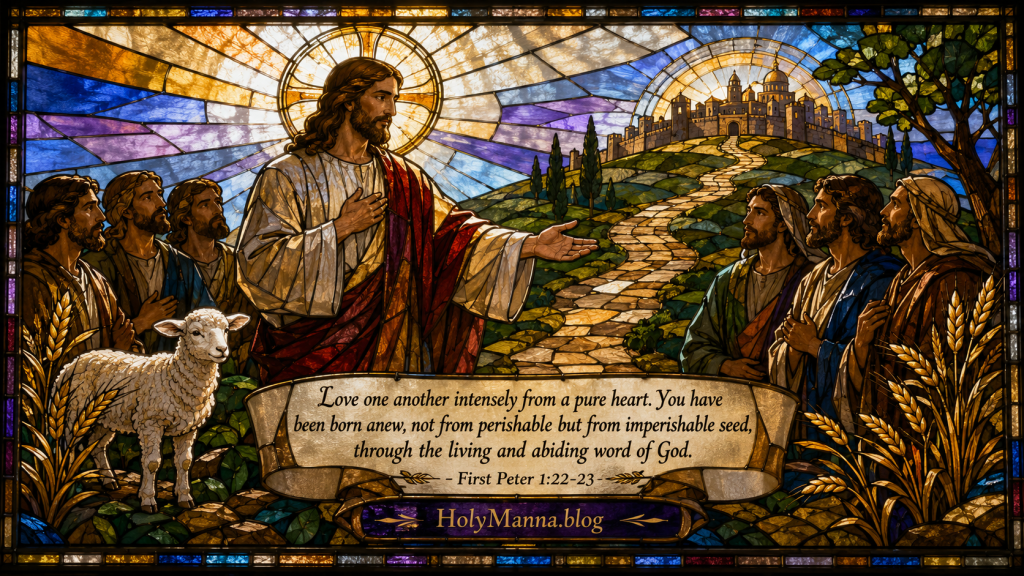
Mutual Love. 22 Since you have purified yourselves by obedience to the truth for sincere mutual love, love one another intensely from a [pure] heart. 23 You have been born anew, not from perishable but from imperishable seed, through the living and abiding word of God, 24 for:
“All flesh is like grass,
and all its glory like the flower of the field;
the grass withers,
and the flower wilts;
25 but the word of the Lord remains forever.”This is the word that has been proclaimed to you.
Detailed Exegesis
Verse 18 – “Realizing that you were ransomed from your futile conduct, handed on by your ancestors, not with perishable things like silver or gold.”
Peter begins by reminding the faithful that they were “ransomed.” In the ancient world, ransom language often referred to the price paid to free a slave, a captive, or someone under bondage. Spiritually, Peter is saying that sin is not merely a mistake or bad habit. Sin enslaves. It traps the soul in futility, meaning a way of life that cannot save, cannot satisfy, and cannot lead to communion with God.
The phrase “handed on by your ancestors” does not mean that family heritage itself is evil. Peter is speaking about the fallen patterns people inherit from the world around them. Every generation passes down habits, assumptions, wounds, false worship, pride, and empty measures of success. Christ does not merely improve that old life. He rescues His people from it.
Peter also says this ransom was not paid with “silver or gold.” Those were precious in human terms, but still perishable in God’s eyes. No earthly treasure can purchase the soul. No achievement, reputation, status, or religious performance can redeem a person from sin. Redemption requires something infinitely greater.
Verse 19 – “But with the precious blood of Christ as of a spotless unblemished lamb.”
Here Peter brings the whole reading to its center. The ransom price is the Blood of Jesus Christ. The word “precious” matters because it tells the believer how valuable salvation is and how valuable the redeemed person is to God.
Calling Christ “a spotless unblemished lamb” recalls the Passover lamb in Exodus, which had to be without blemish, and whose blood marked the homes of Israel during their deliverance from slavery in Egypt. It also points to the sacrificial worship of the Temple, where unblemished offerings were presented to God. In the Catholic faith, all of this is fulfilled in Jesus, the true Lamb of God, whose sacrifice takes away the sins of the world.
This verse also prepares the heart for the Gospel, where Jesus says He came “to give his life as a ransom for many.” Mark 10:45 Peter explains the price. Jesus explains the mission. Together, the readings reveal that Christian greatness begins in gratitude for the Blood that saved us.
Verse 20 – “He was known before the foundation of the world but revealed in the final time for you.”
Peter now opens the mystery wider. The sacrifice of Christ was not an accident, a backup plan, or a tragic interruption in God’s work. The Son was “known before the foundation of the world.” Before creation, before Israel, before the Cross appeared in history, God already held the plan of redemption in His eternal wisdom.
The phrase “revealed in the final time” shows that the coming of Christ is the decisive moment of salvation history. The long preparation of the Old Covenant, the promises to Abraham, the Passover, the Law, the prophets, and the longing of Israel all move toward Him. In Christ, God’s hidden plan becomes visible.
This is why the Catholic Church reads Scripture as one united story. The Old Testament is not discarded. It is fulfilled. The Lamb has come. The ransom has been paid. The final age has begun in Christ.
Verse 21 – “Who through him believe in God who raised him from the dead and gave him glory, so that your faith and hope are in God.”
Peter makes clear that Christian faith is Trinitarian in shape. Through Christ, believers come to faith in God the Father, who raised Jesus from the dead and gave Him glory. The Cross is not the end of the story. The Resurrection reveals that the sacrifice of Christ is accepted, victorious, and life-giving.
This matters because Peter is writing to Christians who may suffer for their faith. Their hope cannot rest in comfort, approval, wealth, or worldly success. Their faith and hope must be in God. The same Father who raised Jesus from death can sustain His people through suffering, purification, rejection, and sacrifice.
This verse also connects directly with today’s Gospel. Jesus tells the Apostles He will be mocked, scourged, killed, and raised after three days. Peter later proclaims that same mystery as the foundation of Christian hope.
Verse 22 – “Since you have purified yourselves by obedience to the truth for sincere mutual love, love one another intensely from a pure heart.”
Peter now moves from redemption to daily life. The Blood of Christ purifies the believer, but this purification must be lived through “obedience to the truth.” In Catholic teaching, truth is not merely an idea to admire. Truth is to be obeyed because Truth has a face, Jesus Christ.
The fruit of this purification is love. Peter calls it “sincere mutual love,” then presses even deeper: “love one another intensely from a pure heart.” This is not shallow politeness. It is not vague niceness. It is the hard, steady, sacrificial love that belongs to people redeemed by Christ.
This verse exposes a common temptation. A person can talk about faith, defend doctrine, and attend religious events, yet still resist the daily demands of charity. Peter will not allow that separation. A purified heart must become a loving heart.
Verse 23 – “You have been born anew, not from perishable but from imperishable seed, through the living and abiding word of God.”
Peter describes Christian life as a new birth. This points naturally to Baptism, where the believer is born again by water and the Holy Spirit. The source of this new life is not “perishable” seed, meaning not merely natural birth, human effort, or earthly inheritance. It is “imperishable seed,” the living Word of God that creates what it speaks.
The Word of God is not dead information. It is living, active, and abiding. It enters the soul, calls it to conversion, plants divine life, and continues to bear fruit. This is why Catholics do not treat Scripture as inspirational decoration. The Word proclaimed in the Church is part of the living encounter with Christ.
This also links to Psalm 147, where God sends His command to the earth and His Word runs swiftly. The God who speaks is the God who creates, redeems, feeds, and forms His people.
Verse 24 – “For: ‘All flesh is like grass, and all its glory like the flower of the field; the grass withers, and the flower wilts.’”
Peter quotes Isaiah 40:6-8, a passage originally spoken to comfort Israel in exile. Human power fades. Empires fade. Beauty fades. Success fades. Public praise fades. Even human life itself is fragile.
This verse humbles every form of worldly ambition. It also prepares the reader for the Gospel, where James and John desire seats of glory. Peter reminds the Church that earthly glory is like a flower in the field. It may look beautiful for a moment, but it cannot last.
That does not mean human life is meaningless. It means human life must be rooted in what endures. A life built on vanity withers. A life rooted in the Word of God remains.
Verse 25 – “‘But the word of the Lord remains forever.’ This is the word that has been proclaimed to you.”
Peter completes the quotation from Isaiah and applies it directly to the Gospel. The Word that remains forever is not distant from the Christian community. It has been proclaimed to them. They have heard it. They have received it. They have been born anew through it.
This is a powerful reminder for the Church today. The same Word proclaimed by the Apostles is still proclaimed in the liturgy. The same Gospel that formed the early Christians still forms the faithful at Mass. Everything else eventually passes away, but the Word of the Lord remains forever.
Teachings
This reading teaches that redemption is not an abstract idea. It is a real deliverance accomplished by the Blood of Jesus Christ. Saint Peter does not say Christians were encouraged, inspired, or merely improved. He says they were ransomed. That means the Christian belongs to Christ because Christ gave Himself to rescue sinners from slavery to sin and death.
The Catechism of the Catholic Church teaches this clearly in CCC 517: “Christ’s whole life is a mystery of redemption. Redemption comes to us above all through the blood of his cross, but this mystery is at work throughout Christ’s entire life: already in his Incarnation through which by becoming poor he enriches us with his poverty; in his hidden life which by his submission atones for our disobedience; in his word which purifies its hearers; in his healings and exorcisms by which ‘he took our infirmities and bore our diseases’; and in his Resurrection by which he justifies us.”
This helps explain why Peter can speak about Christ’s Blood, the living Word, purification, and new birth all in one passage. Redemption is not isolated from the rest of Christian life. The Blood of Christ saves. The Word of Christ purifies. The Resurrection gives hope. The believer is then called to live as a new creation.
The Catechism also teaches in CCC 613: “Christ’s death is both the Paschal sacrifice that accomplishes the definitive redemption of men, through ‘the Lamb of God, who takes away the sin of the world,’ and the sacrifice of the New Covenant, which restores man to communion with God by reconciling him to God through the ‘blood of the covenant, which was poured out for many for the forgiveness of sins.’”
This is exactly the world behind Peter’s phrase “a spotless unblemished lamb.” The Passover, the Temple sacrifices, the Suffering Servant, and the covenant promises all meet in Christ. He is the Lamb. He is the ransom. He is the New Covenant in His Blood.
Saint Leo the Great gives this truth a practical edge when he reminds Christians of their dignity after redemption. In Sermon 21, On the Nativity of the Lord, he says: “Christian, remember your dignity, and now that you share in God’s own nature, do not return by sin to your former base condition. Bear in mind who is your head and of whose body you are a member.”
That is the same message Peter gives. Do not return to futile conduct. Do not live as if the Blood of Christ has not changed your identity. Do not measure life by fading glory when the imperishable Word has made you new.
This reading also teaches that Christian love is not optional. Peter connects purification with charity: “Love one another intensely from a pure heart.” 1 Peter 1:22 The Church has always understood that grace must bear fruit in love. A person redeemed by Christ cannot cling comfortably to bitterness, selfish ambition, contempt, or indifference. The Blood of Christ creates a people capable of loving with the love they first received.
Reflection
This reading asks every Catholic to remember the cost of salvation. Christ did not ransom His people with silver, gold, influence, or power. He ransomed them with His precious Blood. That truth should change the way a person wakes up, speaks, works, forgives, prays, and serves.
It is easy to drift back into futile conduct without even noticing. A person can live for approval, chase status, feed resentment, build an identity around success, and still appear religious on the outside. Peter gently but firmly calls the Church back to reality. The old life was not strong enough to save. The new life must be rooted in Christ.
One practical step is to begin the day by remembering ownership. A baptized Christian does not belong first to personal plans, public opinion, career pressure, family expectations, or old wounds. A baptized Christian belongs to Christ. That simple truth can purify ambition before it becomes pride.
Another step is to let the Word of God become more permanent than emotion. Feelings rise and fall. Motivation comes and goes. Human glory fades like grass. The Word remains forever. Reading Scripture daily, listening attentively at Mass, and returning to one verse in prayer can slowly reshape the soul.
Peter also gives a concrete command: love intensely from a pure heart. That might mean apologizing first, refusing gossip, doing hidden acts of service, being patient with family, praying for someone difficult, or choosing honesty when exaggeration would make someone look better. Christian love is not always dramatic, but it is always costly.
What futile conduct has Christ already ransomed you from, and where are you tempted to return to it?
Where is God asking you to stop living for fading glory and start living from the imperishable Word?
Who needs to receive sincere love from you today, not in theory, but in a concrete act of patience, mercy, or service?
When you hear that you were bought with the precious Blood of Christ, does your daily life reflect that dignity?
The Christian life begins with a gift that could never be earned. Christ gave His Blood. The Word was proclaimed. The soul was born anew. Now the redeemed are called to live like people who have been rescued, purified, and sent into the world to love with the heart of the Lamb.
Responsorial Psalm – Psalm 147:12-15, 19-20
The God Who Strengthens His People and Feeds Them with His Word
Psalm 147 is a hymn of praise rising from the heart of Jerusalem, the city chosen by God as the place of His Temple, His covenant worship, and His visible dwelling among His people. This psalm likely echoes the joy of Israel after exile, when Jerusalem had been restored, the people gathered again, and the Lord’s mercy could be seen not only in spiritual promises but in real protection, peace, children, harvest, and worship.
That matters for today’s readings because 1 Peter 1:18-25 reminds the Church that the faithful have been ransomed by the Blood of Christ and born anew through the living Word of God. Then Mark 10:32-45 shows Jesus walking toward Jerusalem to give His life as a ransom for many. Between those two readings, the psalm teaches the redeemed how to respond: glorify the Lord, trust His protection, receive His peace, be nourished by His gifts, and live by His Word.
In the Old Covenant, Jerusalem praised God because He strengthened her gates and gave Israel His law. In the New Covenant, the Church praises God because Christ strengthens His people through grace, feeds them with the Eucharist, and speaks His saving Word through the life of the Church. This psalm becomes a song for every soul that has been rescued, gathered, fed, and taught by the Lord.
Psalm 147:12-15, 19-20 – New American Bible (Revised Edition)
12 Glorify the Lord, Jerusalem;
Zion, offer praise to your God,
13 For he has strengthened the bars of your gates,
blessed your children within you.
14 He brings peace to your borders,
and satisfies you with finest wheat.
15 He sends his command to earth;
his word runs swiftly!19 He proclaims his word to Jacob,
his statutes and laws to Israel.
20 He has not done this for any other nation;
of such laws they know nothing.
Hallelujah!
Detailed Exegesis
Verse 12 – “Glorify the Lord, Jerusalem; Zion, offer praise to your God.”
The psalm begins with a summons to praise. Jerusalem and Zion are not merely geographic places. They represent the covenant people gathered around the Lord. To glorify God means to recognize His holiness, His faithfulness, and His saving action in history.
For Israel, this praise was tied to the Temple, sacrifice, and covenant worship. For Catholics, the deepest act of praise is fulfilled in the worship of the Church, especially in the Holy Mass. The Church becomes the new Zion gathered around Christ, offering praise to the Father through the Son in the Holy Spirit.
This verse also teaches that praise is the proper response of the redeemed. When a person understands that salvation is gift, worship stops feeling like an obligation and becomes the soul’s honest answer to mercy.
Verse 13 – “For he has strengthened the bars of your gates, blessed your children within you.”
The gates of a city were essential for protection in the ancient world. Strong gates meant safety from enemies, stability for families, and peace within the walls. When the psalm says God has strengthened the bars of Jerusalem’s gates, it is celebrating the Lord as the true defender of His people.
The blessing of children points to covenant life continuing from one generation to the next. God does not only rescue individuals in isolation. He forms a people, protects their life together, and blesses the future.
In today’s theme, this matters because those ransomed by Christ are not left exposed and alone. The Lord gathers His people into the Church, strengthens them through grace, and calls them to pass on the faith. Catholic life is never meant to be a private spiritual hobby. It is life within the household of God.
Verse 14 – “He brings peace to your borders, and satisfies you with finest wheat.”
Peace in Scripture is more than the absence of conflict. It is wholeness, order, blessing, and life rightly arranged under God. For Jerusalem, peace at the borders meant freedom from invasion and the ability to live under the Lord’s covenant.
The phrase “finest wheat” speaks of abundance and nourishment. God does not merely defend His people from danger. He feeds them. He gives what sustains life.
From a Catholic perspective, this verse naturally lifts the heart toward the Eucharist. The Lord who once satisfied Israel with finest wheat now feeds His Church with something infinitely greater: the Body, Blood, Soul, and Divinity of Jesus Christ. The Eucharist is the food of the ransomed, the sacrament of unity, and the strength needed for humble service.
Verse 15 – “He sends his command to earth; his word runs swiftly!”
God’s Word is living, active, and effective. When the Lord speaks, His command does not remain distant or powerless. It runs swiftly. It accomplishes what He wills.
This connects beautifully with 1 Peter 1:23, where Saint Peter says believers have been born anew “through the living and abiding word of God.” The same God who speaks creation into existence speaks redemption into wounded souls. His Word calls, convicts, heals, nourishes, and sends.
For Catholics, the Word of God is not treated as mere religious information. It is proclaimed in the liturgy, guarded by the Church, interpreted within Sacred Tradition, and received as a living encounter with the Lord.
Verse 19 – “He proclaims his word to Jacob, his statutes and laws to Israel.”
This verse celebrates one of Israel’s greatest privileges: God revealed Himself. He gave His people His Word, His statutes, and His laws. The Law was not meant to crush Israel. It was a gift of covenant identity, teaching the people how to live as God’s chosen family.
The name Jacob recalls the patriarch whose descendants became Israel. This verse stretches across salvation history, from the promises made to the fathers to the formation of a people who would bear witness to the one true God.
In the light of Christ, Catholics understand that the law and prophets reach their fulfillment in Jesus. He does not abolish God’s revelation. He brings it to completion. The Word proclaimed to Israel becomes fully revealed in the Word made flesh.
Verse 20 – “He has not done this for any other nation; of such laws they know nothing. Hallelujah!”
The psalm ends by marveling at Israel’s unique gift. Among the nations, Israel had received divine revelation in a privileged way. God had made His covenant known, taught His commandments, and formed a people for Himself.
This was not meant to produce arrogance. It was meant to produce gratitude and mission. Israel was chosen so that blessing might one day reach all nations. In Christ, that promise opens fully to the world. The Gospel is proclaimed beyond Jerusalem, beyond Israel, and to the ends of the earth.
The final “Hallelujah!” means “Praise the Lord.” It is the only fitting response to a God who protects, feeds, speaks, and reveals Himself.
Teachings
This psalm teaches that God’s people are sustained by both nourishment and revelation. The Lord strengthens Jerusalem’s gates, blesses her children, brings peace, satisfies her with finest wheat, and gives her His Word. In Catholic life, these gifts find their deepest fulfillment in the Church, where the faithful are fed at the table of the Word and the table of the Eucharist.
The Catechism of the Catholic Church teaches in CCC 103: “For this reason, the Church has always venerated the Scriptures as she venerates the Lord’s Body. She never ceases to present to the faithful the bread of life, taken from the one table of God’s Word and Christ’s Body.”
That sentence beautifully captures the heart of Psalm 147. God speaks and God feeds. His Word runs swiftly, and His finest wheat satisfies His people. At Mass, Catholics do not choose between Scripture and Sacrament. The Lord gives both. He teaches His people by the Word and nourishes them with Christ Himself in the Eucharist.
The Catechism also teaches in CCC 1324: “The Eucharist is ‘the source and summit of the Christian life.’ ‘The other sacraments, and indeed all ecclesiastical ministries and works of the apostolate, are bound up with the Eucharist and are oriented toward it. For in the blessed Eucharist is contained the whole spiritual good of the Church, namely Christ himself, our Pasch.’”
This helps explain why the phrase “finest wheat” has such a rich Catholic resonance. In its original setting, it praises God for giving Israel peace and harvest. In the fullness of faith, it points toward the greater food of the New Covenant. Christ, the Lamb who ransoms His people, is also the Bread who feeds them.
Saint Augustine often saw the psalms as the prayer of the whole Christ, Head and members. In his preaching on the Psalms, he teaches that the Church sings in union with Christ because the faithful belong to His Body. This gives Catholic prayer a deeply communal meaning. When the Church prays the psalms, she is not merely remembering ancient Israel. She is joining the prayer of Christ and His people across time.
The historical background also matters. Jerusalem had known destruction, exile, vulnerability, and restoration. To sing about strengthened gates and peace at the borders was not sentimental optimism. It was praise born from survival and mercy. The people knew what it meant to be scattered, and they knew what it meant to be gathered again. That makes the psalm a perfect bridge between Peter’s language of ransom and Jesus’ journey toward Jerusalem. God gathers what sin scatters. God feeds what the world starves. God speaks where confusion reigns.
Reflection
This psalm invites Catholics to become people of gratitude. It is easy to notice what feels unstable, unfinished, or uncertain. It is harder, but holier, to recognize where God has already strengthened the gates.
The Lord may not always remove every struggle immediately, but He does give protection through grace. He strengthens the soul through prayer, confession, Scripture, the Eucharist, the teachings of the Church, and the quiet help of faithful people. Sometimes the “bars of the gates” are not dramatic miracles. Sometimes they are the daily habits that keep the soul from drifting back into sin.
The psalm also asks the believer to receive God’s nourishment instead of living spiritually underfed. Many people try to survive on noise, distraction, ambition, caffeine, scrolling, and anxiety. The Lord offers something better. He satisfies with finest wheat. He gives His Word. He gives His Body. He gives peace that the world cannot manufacture.
A practical way to live this psalm is to approach Sunday Mass with more intention. Arrive early enough to quiet the heart. Listen to the readings as God speaking now, not as background religious language. Receive the Eucharist with reverence, remembering that the One who feeds the Church is the same One who gave His life as a ransom for many.
Another way is to build a home where God’s Word can “run swiftly.” Let Scripture be spoken in the family. Let children hear prayer. Let meals begin with gratitude. Let decisions be shaped by the Gospel rather than by fear, pride, or cultural pressure.
Where has God strengthened the gates of your life, even in ways you may have overlooked?
Are you allowing the Word of God to run swiftly through your heart, or are you slowing it down with distraction and resistance?
Do you come to the Eucharist as someone who knows they need to be fed, healed, and strengthened?
What would change in your home, work, or relationships if praise became your first response instead of anxiety?
The redeemed soul has many reasons to praise. The Lord protects His people, feeds them with the finest gift, and speaks a Word that does not fade. The world may offer temporary comfort, but God gives covenant peace. The world may offer noise, but God gives truth. The world may offer status, but God gives Himself.
Holy Gospel – Mark 10:32-45
The King Who Walks Ahead to Become the Servant of All
The Gospel begins on the road to Jerusalem, and that detail matters. In The Gospel of Mark, Jesus is not drifting toward His Passion. He is walking toward it with intention. Jerusalem is the city of the Temple, the place of sacrifice, the heart of Israel’s worship, and the city where prophets were often rejected. The disciples are amazed, and the wider group following Jesus is afraid because something about His determination reveals that the road ahead will not be easy.
This reading brings today’s theme to its fullest expression. In 1 Peter 1:18-25, Saint Peter teaches that Christians were ransomed by the precious Blood of Christ. In Psalm 147, God strengthens, feeds, and speaks to His people. Now, in Mark 10:32-45, Jesus reveals how that ransom will happen. He will be handed over, mocked, scourged, killed, and raised. Yet right after this solemn prediction, James and John ask for places of honor. Their request exposes the old human instinct to seek status, even near holy things. Jesus answers by revealing the heart of Christian greatness: the Son of Man came not to be served, but to serve.
Mark 10:32-45 – New American Bible (Revised Edition)
The Third Prediction of the Passion. 32 They were on the way, going up to Jerusalem, and Jesus went ahead of them. They were amazed, and those who followed were afraid. Taking the Twelve aside again, he began to tell them what was going to happen to him. 33 “Behold, we are going up to Jerusalem, and the Son of Man will be handed over to the chief priests and the scribes, and they will condemn him to death and hand him over to the Gentiles 34 who will mock him, spit upon him, scourge him, and put him to death, but after three days he will rise.”
Ambition of James and John. 35 Then James and John, the sons of Zebedee, came to him and said to him, “Teacher, we want you to do for us whatever we ask of you.” 36 He replied, “What do you wish [me] to do for you?” 37 They answered him, “Grant that in your glory we may sit one at your right and the other at your left.” 38 Jesus said to them, “You do not know what you are asking. Can you drink the cup that I drink or be baptized with the baptism with which I am baptized?” 39 They said to him, “We can.” Jesus said to them, “The cup that I drink, you will drink, and with the baptism with which I am baptized, you will be baptized; 40 but to sit at my right or at my left is not mine to give but is for those for whom it has been prepared.” 41 When the ten heard this, they became indignant at James and John. 42 Jesus summoned them and said to them, “You know that those who are recognized as rulers over the Gentiles lord it over them, and their great ones make their authority over them felt. 43 But it shall not be so among you. Rather, whoever wishes to be great among you will be your servant; 44 whoever wishes to be first among you will be the slave of all. 45 For the Son of Man did not come to be served but to serve and to give his life as a ransom for many.”
Detailed Exegesis
Verse 32 – “They were on the way, going up to Jerusalem, and Jesus went ahead of them. They were amazed, and those who followed were afraid. Taking the Twelve aside again, he began to tell them what was going to happen to him.”
Jesus is “going up to Jerusalem” because Jerusalem sits on a height, but the phrase also has spiritual weight. He is ascending toward the place where His sacrifice will be offered. He walks ahead of them, showing courage, obedience, and divine purpose.
The disciples are amazed, and the followers are afraid. They sense the tension. Jesus has already warned them about suffering, but they still do not fully understand the Cross. The Lord takes the Twelve aside because the mystery of His Passion is not a side note. It is central to His mission and to their future mission as Apostles.
Verse 33 – “Behold, we are going up to Jerusalem, and the Son of Man will be handed over to the chief priests and the scribes, and they will condemn him to death and hand him over to the Gentiles.”
Jesus uses the title “Son of Man,” which recalls Daniel 7, where one like a son of man receives dominion, glory, and kingship. Yet Jesus reveals that His path to glory will pass through betrayal and condemnation.
He will be handed over first to the chief priests and scribes, the religious authorities, and then to the Gentiles, meaning the Roman authorities. This shows that His Passion involves both Jewish leadership and Roman power, but from the Catholic perspective, the deeper truth is that Christ freely offers Himself for all sinners. The blame is not meant to become a weapon against one people. The Cross reveals the tragedy of sin and the mercy of God.
Verse 34 – “Who will mock him, spit upon him, scourge him, and put him to death, but after three days he will rise.”
Jesus describes His Passion with painful clarity. Mockery attacks His dignity. Spitting expresses contempt. Scourging tears His body. Death appears to be defeat. Yet He also says, “after three days he will rise.”
This is the Catholic heart of the Gospel: the Passion and Resurrection cannot be separated. Jesus does not merely suffer as a victim of injustice. He offers Himself in love and rises in victory. His humiliation becomes the road to glory. His death becomes the ransom for many.
Verse 35 – “Then James and John, the sons of Zebedee, came to him and said to him, ‘Teacher, we want you to do for us whatever we ask of you.’”
The timing is startling. Jesus has just spoken about suffering, and James and John approach Him with a request for personal advancement. Their words reveal a familiar human weakness: wanting Jesus to serve personal ambition rather than allowing Jesus to purify the heart.
James and John are not villains. They are Apostles who love Jesus, but their love still needs conversion. They want glory, but they do not yet understand the Cross-shaped path to glory.
Verse 36 – “He replied, ‘What do you wish me to do for you?’”
Jesus does not dismiss them harshly. He asks a question. This is often how the Lord brings hidden desires into the light. He allows them to speak plainly so that He can teach them more deeply.
This question is spiritually important. Prayer often reveals what the heart truly wants. Sometimes a person asks God for good things. Sometimes a person asks from fear, pride, insecurity, or the desire to control. Jesus receives the request, but He will not leave the desire unpurified.
Verse 37 – “They answered him, ‘Grant that in your glory we may sit one at your right and the other at your left.’”
James and John believe Jesus is headed toward glory, and they want the highest places beside Him. In the ancient world, sitting at the right and left of a ruler meant honor, power, and closeness to authority.
Their request is not completely wrong because they desire to be near Jesus. The problem is that they imagine glory in worldly terms. They want the crown without understanding the cup. They want position without grasping sacrifice. They want nearness to Christ without yet seeing that nearness to Christ means nearness to the Cross.
Verse 38 – “Jesus said to them, ‘You do not know what you are asking. Can you drink the cup that I drink or be baptized with the baptism with which I am baptized?’”
Jesus tells them the truth with mercy: “You do not know what you are asking.” They are asking for glory, but they do not understand its cost.
The “cup” in Scripture often symbolizes suffering, judgment, or a destiny accepted before God. The “baptism” here refers to being plunged into the suffering of His Passion. Jesus is asking whether they can share in His suffering, not merely admire His victory.
Catholic discipleship always includes this pattern. Baptism joins the believer to Christ’s death and Resurrection, and daily Christian life requires a willingness to carry the cross in union with Him.
Verse 39 – “They said to him, ‘We can.’ Jesus said to them, ‘The cup that I drink, you will drink, and with the baptism with which I am baptized, you will be baptized.’”
James and John answer confidently, perhaps too confidently. They do not yet understand the full weight of what they are saying. Yet Jesus confirms that they will share in His suffering.
This later becomes true. Saint James is martyred in Acts 12:2, becoming the first Apostle recorded as killed for Christ. Saint John suffers exile and persecution while bearing witness to the Lord. Their ambition will be purified by fidelity.
This verse offers hope. Jesus can take immature zeal and transform it into sanctity. The same men who misunderstand glory can become saints when grace finishes its work.
Verse 40 – “But to sit at my right or at my left is not mine to give but is for those for whom it has been prepared.”
Jesus teaches that glory is not seized by ambition. It is prepared by the Father. The Kingdom is not a political ladder where influence gets rewarded with privilege. It is a divine gift received according to God’s wisdom.
This corrects the disciples’ desire to control the outcome. In Catholic life, holiness is not a negotiation with God for status. The faithful are called to surrender, obedience, and trust. God prepares what belongs to each soul.
Verse 41 – “When the ten heard this, they became indignant at James and John.”
The other Apostles become angry, but their indignation may not be entirely pure. They may be upset because James and John asked first. Rivalry spreads quickly when hearts are still shaped by comparison.
This verse shows how ambition wounds communion. The Apostles are already becoming divided by the question of who deserves the highest place. Jesus must heal not only the ambition of two brothers, but the jealousy of the whole group.
Verse 42 – “Jesus summoned them and said to them, ‘You know that those who are recognized as rulers over the Gentiles lord it over them, and their great ones make their authority over them felt.’”
Jesus summons all of them. This is not just a private correction for James and John. It is a lesson for the entire Church.
He contrasts His Kingdom with the ways of worldly power. Gentile rulers often used authority to dominate, control, and display superiority. Jesus does not deny that authority exists. He rejects authority used for self-exaltation.
This verse has profound meaning for Catholic leadership, family life, work, ministry, and parish service. Authority is never meant to become domination. In Christ, authority must become service.
Verse 43 – “But it shall not be so among you. Rather, whoever wishes to be great among you will be your servant.”
Jesus gives one of the clearest commands in the Gospel: “But it shall not be so among you.” His disciples cannot simply copy the world’s patterns and sprinkle religious language over them.
Greatness in the Church is measured by service. The Greek word behind “servant” is connected to practical service, the kind of humble attention given to the needs of others. Jesus does not abolish the desire for greatness. He converts it.
Verse 44 – “Whoever wishes to be first among you will be the slave of all.”
Jesus goes even further. To be first, one must become “the slave of all.” This is shocking language. A slave in the ancient world had no status, no public honor, and no claim to personal greatness.
Jesus is not glorifying oppression. He is revealing the total self-gift required of love. Christian greatness is not found in being above others, but in being poured out for others. This prepares the disciples to understand the Cross, where the Lord of all takes the lowest place.
Verse 45 – “For the Son of Man did not come to be served but to serve and to give his life as a ransom for many.”
This is the key that unlocks the whole passage. Jesus does not merely command service. He is service in the flesh. The Son of Man, the glorious figure of Daniel 7, reveals His kingship by giving His life.
The word “ransom” connects directly with 1 Peter 1:18-19, where Christians are told they were ransomed not with silver or gold, but with the precious Blood of Christ. Jesus gives the mission. Peter explains the price. The Church receives the gift and is called to live in its pattern.
The phrase “for many” echoes the Suffering Servant in Isaiah 53, who bears the sins of many. Catholic teaching makes clear that Christ’s saving death is offered for all. The word “many” reflects the biblical language of the passage, not a limitation of His love.
Teachings
This Gospel teaches that the Cross is not an accident in the life of Jesus. It is the mission He freely embraces. He walks ahead toward Jerusalem because He came to serve and give His life. His Passion reveals both the seriousness of sin and the depths of divine love.
The Catechism of the Catholic Church teaches in CCC 608: “After agreeing to baptize him along with the sinners, John the Baptist looked at Jesus and pointed him out as the ‘Lamb of God, who takes away the sin of the world’. By doing so, he reveals that Jesus is at the same time the suffering Servant who silently allows himself to be led to the slaughter and who bears the sin of the multitudes, and also the Paschal Lamb, the symbol of Israel’s redemption at the first Passover. Christ’s whole life expresses his mission: ‘to serve, and to give his life as a ransom for many.’”
This teaching gathers together the whole biblical background of today’s readings. Jesus is the Lamb of God, the Suffering Servant, and the Paschal sacrifice. His service is not merely humble behavior. It is redemptive self-offering.
The Catechism also teaches in CCC 609: “By embracing in his human heart the Father’s love for men, Jesus ‘loved them to the end’, for ‘greater love has no man than this, that a man lay down his life for his friends.’ In suffering and death his humanity became the free and perfect instrument of his divine love which desires the salvation of men. Indeed, out of love for his Father and for men, whom the Father wants to save, Jesus freely accepted his Passion and death: ‘No one takes [my life] from me, but I lay it down of my own accord.’ Hence the sovereign freedom of God’s Son as he went out to his death.”
That last line shines directly on verse 32. Jesus goes ahead of them. He is not trapped. He is not defeated. He is free, obedient, and full of love.
The Church also teaches that the faithful share in this pattern. The Catechism says in CCC 786: “Finally, the People of God shares in the royal office of Christ. He exercises his kingship by drawing all men to himself through his death and Resurrection. Christ, King and Lord of the universe, made himself the servant of all, for he came ‘not to be served but to serve, and to give his life as a ransom for many.’ For the Christian, ‘to reign is to serve him,’ particularly when serving ‘the poor and the suffering, in whom the Church recognizes the image of her poor and suffering founder.’ The People of God fulfills its royal dignity by a life in keeping with its vocation to serve with Christ.”
This is why Catholic greatness looks so different from worldly greatness. The baptized share in Christ’s kingship, but Christ reigns from the Cross. The Christian reigns by serving Him, especially in the poor, the suffering, the forgotten, and the inconvenient.
Saint Augustine captures this same truth with beautiful simplicity in Sermon 340: “For you I am a bishop, with you I am a Christian. The first is the name of an office undertaken, the second a name of grace; that one means danger, this one salvation.”
That line reveals the Catholic understanding of authority. Office is for service, not self-importance. Leadership in the Church is a responsibility before God, not a platform for ego.
Historically, this Gospel also speaks against every temptation to turn Christian leadership into worldly domination. The Apostles themselves had to be converted from ambition to service. That is humbling and hopeful. If Jesus patiently formed them, He can also purify ambition in every generation of the Church.
Reflection
This Gospel is painfully relevant because ambition is not always obvious. It can hide inside good things. It can hide inside ministry, career, family leadership, online presence, parish involvement, and even religious devotion. James and John wanted to be near Jesus, but their desire still needed purification.
The first step is honesty. A disciple has to let Jesus ask, “What do you wish me to do for you?” That question can reveal whether prayer is centered on God’s will or on personal control. It can reveal whether the heart wants holiness or recognition. It can reveal whether a person wants to follow Jesus or use Jesus as a ladder toward personal glory.
The second step is accepting the cup. Most Catholics will not face martyrdom, but every Catholic receives daily opportunities to drink from the cup of sacrificial love. Marriage requires it. Parenthood requires it. Forgiveness requires it. Chastity requires it. Caring for aging parents requires it. Serving the poor requires it. Staying faithful when no one applauds requires it.
The third step is choosing service in concrete ways. Let someone else be praised without resentment. Do the hidden task without announcing it. Listen before correcting. Use authority to protect rather than dominate. Let prayer become less about getting a better seat and more about becoming a better servant.
This Gospel also invites a deeper love for the Eucharist. At every Mass, the Church encounters the One who gave His life as a ransom for many. The altar is not a stage for religious inspiration. It is the place where the sacrifice of Christ is made present sacramentally, and the faithful are fed by the Servant King.
Where is Jesus asking you to stop chasing the seat of honor and start choosing the place of service?
What ambition in your heart needs to be purified by the Cross?
Are you willing to drink the cup Christ gives you in ordinary life, especially when sacrifice is hidden and unnoticed?
Who is God asking you to serve today without needing credit, control, or applause?
The road to Jerusalem is not only the road Jesus walked long ago. It is the shape of Christian discipleship. The Lord goes ahead, not to escape suffering, but to transform it by love. He gives His life as a ransom, and then He teaches His people to live as the ransomed: humble, free, courageous, and ready to serve.
The Road of the Ransomed Heart
Today’s readings leave the Church with a clear and beautiful invitation: remember the price of salvation, receive the Word that endures, and follow Jesus into the greatness of humble service.
Saint Peter begins by reminding the faithful that they were not rescued by anything temporary. They were ransomed “not with perishable things like silver or gold” but with “the precious blood of Christ.” 1 Peter 1:18-19 That truth changes the way a Christian sees everything. Life is no longer measured by status, success, applause, or comfort. The redeemed soul belongs to Christ, and that belonging becomes the foundation for purity, love, hope, and mission.
The psalm then teaches the proper response of the redeemed: praise. God strengthens His people, blesses their homes, brings peace, feeds them with “finest wheat,” and sends His Word swiftly through the earth. Psalm 147:14-15 The Lord does not ransom His people and then leave them hungry. He speaks to them. He feeds them. He gathers them into covenant life. In the Church, this reaches its fullness at the Mass, where the faithful are nourished at the table of the Word and the table of the Eucharist. As The Catechism of the Catholic Church teaches, the Eucharist is “the source and summit of the Christian life.” CCC 1324
Then Jesus brings the message to its deepest point in The Gospel of Mark. He walks ahead toward Jerusalem, fully aware of the suffering that awaits Him. The disciples still imagine greatness as honor and position, but Jesus reveals that greatness in His Kingdom looks completely different. “Whoever wishes to be great among you will be your servant.” Mark 10:43 This is not a slogan. It is the shape of the Cross.
The Christian life is not about pretending ambition does not exist. It is about letting Christ purify ambition until it becomes love. James and John wanted seats of glory, but Jesus offered them the cup of sacrifice. The world teaches people to climb higher so they can be served. Jesus teaches His disciples to go lower so they can love.
That is the road of the ransomed heart.
Christ gives His life “as a ransom for many,” and now the people purchased by His Blood are invited to live differently. Mark 10:45 They are called to serve without needing applause, forgive without keeping score, worship without distraction, love without pretending, and carry their daily crosses with courage. This is not weakness. This is the strength of the Kingdom.
Today, the invitation is simple but serious. Let the Blood of Christ remind the soul of its dignity. Let the Word of God become more permanent than fear, pride, or noise. Let the Eucharist strengthen the heart for the kind of service that the world may overlook, but Heaven never forgets.
Where is Christ asking you to trade the desire for recognition for the freedom of humble love?
What would change today if you remembered, deeply and honestly, that you have been ransomed by the precious Blood of Christ?
Walk with Jesus toward Jerusalem. Receive His Word. Be fed by His Body. Serve the person in front of you. That is where true greatness begins.
Engage with Us!
Share your reflections in the comments below. Today’s readings invite every Catholic to remember the price of redemption, receive the Word of God with gratitude, and follow Jesus in the humble greatness of service.
- In the First Reading from 1 Peter 1:18-25, what does it mean to you personally that you were ransomed not by silver or gold, but by the precious Blood of Christ? Where is God asking you to leave behind old patterns of futile living and love others more sincerely from a pure heart?
- In Psalm 147:12-15, 19-20, where have you experienced God strengthening the gates of your life, feeding you with His grace, or guiding you through His Word? How can you grow in gratitude for the gift of Scripture, the Eucharist, and the peace God gives His people?
- In the Holy Gospel from Mark 10:32-45, where do you see the temptation to seek recognition, control, or status instead of humble service? What is one concrete way you can follow Jesus this week by becoming a servant to someone in your family, parish, workplace, or community?
May these readings help every heart walk more faithfully with Christ, the Servant King who gave His life as a ransom for many. Let every word, decision, sacrifice, and act of service be done with the love and mercy Jesus taught us, so that daily life becomes a quiet witness to the Gospel.
Sacred Heart of Jesus, we trust in You!
Immaculate Heart of Mary, pray for us!
Saint Michael the Archangel, defend us in battle!
Follow us on YouTube, Instagram and Facebook for more insights and reflections on living a faith-filled life.

 Holy Manna!
Leave a comment