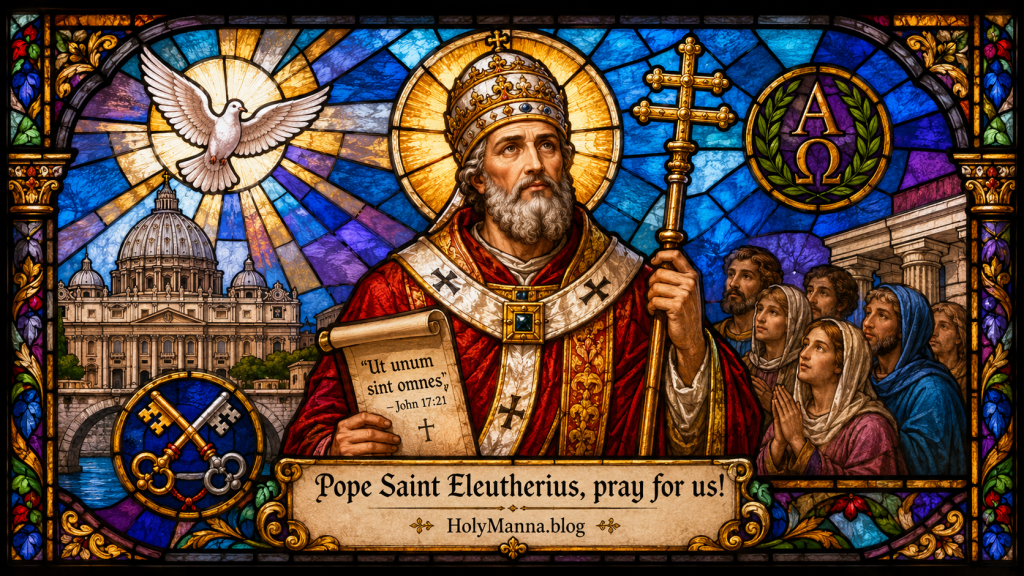
The Quiet Shepherd Who Guarded the Faith When the Church Was Young
Pope Saint Eleutherius was one of the early successors of Saint Peter, remembered in Catholic tradition as a pope, a shepherd, and a martyr. He lived in the second century, when the Church was still young, still vulnerable, and still carrying the living memory of the Apostles through the witness of saints like Saint Irenaeus of Lyons.
Eleutherius did not leave behind a dramatic autobiography, famous sermons, or a collection of personal writings. His holiness is quieter than that. He is remembered as a faithful guardian of the Church during a time of false teaching, spiritual confusion, and persecution. His papacy reminds Catholics that one of the greatest gifts a shepherd can give the Church is stability in the truth.
Saint Irenaeus, in Against Heresies, named Eleutherius in the line of Roman bishops and wrote that “Eleutherius does now, in the twelfth place from the apostles, hold the inheritance of the episcopate.” That one sentence tells us why this early pope matters so much. He stood in the visible chain of apostolic succession, guarding the faith handed down from Christ to the Apostles and from the Apostles to the Church.
The Catechism of the Catholic Church teaches that the Pope, as Bishop of Rome and successor of Saint Peter, is “the perpetual and visible source and foundation of the unity both of the bishops and of the whole company of the faithful” (CCC 882). Pope Saint Eleutherius lived that mission in an age when unity was not theoretical. It had to be defended, protected, and suffered for.
From Nicopolis to the Heart of Rome
Pope Saint Eleutherius was born in Nicopolis in Epirus, in the Greek world. According to The Liber Pontificalis, his father was named Habundius. That detail may seem small, but it reminds us that the early Roman Church was beautifully universal from the beginning. The Bishop of Rome could be a Greek Christian from Epirus, serving in the city where Peter and Paul had poured out their blood.
Before becoming Pope, Eleutherius served as a deacon in the Roman Church under Pope Saint Anicetus. He also appears to have continued serving under Pope Saint Soter, whom he later succeeded. This means Eleutherius was formed not in comfort, but in service. He learned the needs of the faithful before he was entrusted with governing them.
His pontificate is usually placed around A.D. 174 to 189, though early sources give slightly different dates. He became Pope during the age of emperors Marcus Aurelius and Commodus. Christians were not always persecuted with equal intensity across the empire, but the Church was never truly safe. To be Christian still meant belonging to a people misunderstood, accused, and often hated by the world.
Eleutherius became Pope at a moment when the Church needed fathers who could stay calm, faithful, and clear. The greatest danger was not only persecution from outside. It was confusion from within.
A Shepherd in the Age of False Prophets
One of the major controversies connected to Pope Saint Eleutherius was Montanism. Montanus, along with the prophetesses Priscilla and Maximilla, claimed new prophetic revelations from the Holy Spirit. At first glance, the movement could seem intense and holy. It emphasized fasting, severity, prophecy, and spiritual urgency.
But the Church had to discern carefully. The danger was not that Catholics rejected the Holy Spirit. The danger was that Montanism threatened to place alleged new revelations above the apostolic faith already entrusted to the Church.
This matters deeply. The Catholic Church believes God can inspire, guide, and sanctify His people. The Church honors prophecy in its proper place. But public Revelation was fulfilled in Jesus Christ. The Catechism of the Catholic Church teaches, “no new public revelation is to be expected before the glorious manifestation of our Lord Jesus Christ” (CCC 66).
That is why the Montanist crisis mattered so much. It was not just an argument about strict fasting or dramatic prophecy. It was a question of authority. Would the Church remain anchored in the faith of the Apostles, or would she be pulled away by spiritual novelty?
During the persecution of Lyons and Vienne in A.D. 177, suffering Christians wrote letters about the Montanist crisis. Saint Irenaeus carried one of those letters to Pope Eleutherius in Rome. Imagine that scene for a moment. A priest from Gaul, formed by the memory of Saint Polycarp, who had known Saint John the Apostle, comes to Rome to speak with the successor of Peter about the future of the Church’s unity.
That is Catholic history at its most beautiful. The faith is not floating in the air. It is handed down through real people, real bishops, real martyrs, real letters, real suffering, and real obedience.
The Pope Who Helped Guard the Goodness of Creation
A decree about food is traditionally attributed to Pope Saint Eleutherius in The Liber Pontificalis. The decree says, in essence, that Christians should not reject foods created by God and suitable for human use.
Scholars caution that this decree may have been written later and then attributed to Eleutherius. Still, the teaching itself reflects a very Catholic truth. The created world is good because God made it. The Christian life includes fasting, penance, and self-denial, but Catholic discipline is not based on hatred of the body or contempt for creation.
This was especially important in the early Church because several false teachings treated created matter as evil or inferior. Some Gnostic and rigorist movements made holiness look like rejection of the physical world. Catholic faith says something different. Creation is wounded by sin, but creation is not evil. The body is not evil. Food is not evil. Marriage is not evil. The material world comes from the hand of God.
The Catechism of the Catholic Church teaches that creation has its own goodness and perfection because it comes from God. That truth protects Catholics from two opposite errors. One error worships creation as if it were God. The other despises creation as if God had not made it. Catholicism does neither. It receives creation gratefully and orders it toward the Creator.
That is a beautiful part of Eleutherius’s legacy. His name became attached to a defense of ordinary goodness. Bread, wine, meat, oil, water, bodies, families, and daily life can all become places where grace teaches us to love God.
The Famous Legend of King Lucius of Britain
The most famous story associated with Pope Saint Eleutherius is the legend of King Lucius of Britain. According to later tradition, a British king named Lucius wrote to Pope Eleutherius asking to become Christian. The story says Eleutherius sent missionaries, often named Damian and Fugatius, who baptized Lucius, his wife, and many of his people.
It is a wonderful story, and it became very important in medieval Catholic memory, especially in Britain. It gave Britain an ancient connection to Rome and presented Eleutherius almost as a spiritual father to the British people.
However, this story must be told honestly. Catholic scholarship treats the King Lucius story as a legend, not verified history. Britain was under Roman rule during Eleutherius’s time, so the idea of an independent British king writing to the Pope is historically difficult. Some scholars believe the story may have come from a confusion involving another ruler or another place, possibly connected to Edessa rather than Britain.
Still, legends often reveal what later Christians treasured. This legend shows that medieval Catholics wanted to see Britain’s Christian roots as ancient, apostolic, and connected to Rome. Even if the story cannot be verified, it carries a spiritual meaning. The Church has always longed for nations, rulers, families, and ordinary people to come home to Christ.
A Life Remembered More for Fidelity Than Miracles
No reliable major Catholic source preserves specific miracle stories performed by Pope Saint Eleutherius during his lifetime. This is important because several saints share the name Eleutherius, and some miracle stories belong to other saints with that name, not to the Pope.
That does not make his life less holy. Not every saint is remembered for miracles. Some saints are remembered because they governed faithfully, suffered quietly, guarded doctrine, and kept the Church steady when others wanted to drag her into confusion.
Pope Saint Eleutherius is important because he teaches Catholics that holiness is not always loud. Sometimes holiness looks like patience. Sometimes it looks like careful discernment. Sometimes it looks like refusing to let the Church be swept away by whatever spiritual trend sounds impressive in the moment.
The early Church had Gnostics claiming secret knowledge. It had Marcionites rejecting the Old Testament’s God. It had Montanists claiming new prophecy. It had a pagan empire watching Christianity with suspicion. In that world, Eleutherius held the line.
That is worth remembering.
The Burden of Persecution and the Witness of Martyrdom
Pope Saint Eleutherius is traditionally honored as a martyr, though the exact circumstances of his death are not clearly preserved in early sources. Tradition says he died around May 24, near the end of the second century, and was buried on Vatican Hill near Saint Peter. His feast is traditionally commemorated on May 26.
The Church’s memory of him as Pope and Martyr places him among those early shepherds who lived under the shadow of persecution. Even when persecution was not constant in Rome, every Christian leader knew what could happen. To be a bishop in that age was not a career move. It was a cross.
The Catechism of the Catholic Church teaches that martyrdom is “the supreme witness given to the truth of the faith” (CCC 2473). Whether or not the details of Eleutherius’s final suffering can be fully reconstructed, his memory belongs to that heroic age when the successors of the Apostles served Christ with their lives on the line.
That is why his quietness is powerful. He did not need to be remembered for dramatic speeches. His fidelity was his sermon.
The Saint Whose Legacy Lived After Death
After his death, Pope Saint Eleutherius remained part of the Church’s liturgical and historical memory. He is traditionally commemorated on May 26. His memory is preserved in the Roman Martyrology, which honors him as Pope and Martyr and associates him with the conversion of many noble Romans.
His relic tradition is connected first to his burial near Saint Peter on Vatican Hill. Later traditions speak of translations of his remains within Rome, including associations with churches such as San Giovanni della Pigna and Santa Susanna. These later details should be treated carefully, but they show that his memory remained alive in Roman devotion.
His broader cultural impact is especially tied to the King Lucius legend. Even though the story cannot be verified, it shaped the Christian imagination of Britain for centuries. It gave medieval Catholics a way to speak about Britain as a land touched early by the Gospel and connected to the Apostolic See.
But his deepest impact is not legendary. It is ecclesial. He stands in the same line of Roman bishops that Saint Irenaeus used to defend the Catholic faith against heresy. That is his enduring gift to the Church.
He reminds Catholics that the truth is not reinvented in every generation. It is received, guarded, loved, taught, and handed on.
What Pope Saint Eleutherius Is Most Known For
Pope Saint Eleutherius is most known for his role as an early successor of Saint Peter during a time of doctrinal confusion. He is remembered for his connection to Saint Irenaeus, his involvement in the Church’s discernment of Montanism, and his place in the apostolic succession of the bishops of Rome.
He is also known for the famous King Lucius of Britain legend, though that story should be presented as a later tradition rather than verified history.
Most importantly, he is known as a faithful shepherd who protected Catholic unity. His life points to a simple but challenging truth: the Church does not survive because every generation chases what feels new. The Church survives because Christ remains faithful, and His shepherds guard what He has entrusted to them.
A Catholic Reflection on His Life
Pope Saint Eleutherius is a saint for anyone trying to stay faithful in a noisy age.
His world had false teachers, spiritual exaggerations, confusing claims of prophecy, and pressure from the surrounding culture. That sounds very familiar. Catholics today may not be facing Montanus by name, but they still face voices that say the Church must abandon apostolic teaching to stay relevant. They still face spiritual trends that sound intense but are not rooted in obedience. They still face the temptation to confuse novelty with renewal.
Eleutherius teaches a calmer and stronger way. Stay close to Christ. Stay close to the Church. Stay close to the faith handed down from the Apostles. Test every spirit. Love truth more than excitement. Love unity more than personal ego. Love holiness more than religious drama.
Where is God asking you to choose faithful obedience over spiritual noise?
His life also reminds us that the Christian faith is not just about dramatic moments. Most holiness happens quietly. It happens when a parent teaches the faith patiently. It happens when a young adult chooses chastity in a culture that mocks it. It happens when someone goes to confession after years away. It happens when a Catholic refuses to let bitterness, confusion, or fear pull them away from the Church.
Pope Saint Eleutherius did not become great by becoming famous. He became great by being faithful.
Engage with Us!
Share your thoughts and reflections in the comments below. Pope Saint Eleutherius may not be one of the most famous saints, but his life speaks powerfully to anyone trying to remain Catholic in a confusing world.
- Where do you see spiritual confusion or false teaching most clearly in today’s culture?
- How can Pope Saint Eleutherius inspire you to stay rooted in Scripture, Tradition, and the teaching authority of the Church?
- What does apostolic succession mean to you personally as a Catholic?
- Are there areas of your life where God may be asking you to choose quiet faithfulness over attention, novelty, or approval?
- How can you become a steadier witness to Christ in your family, parish, workplace, or friendships?
May the example of Pope Saint Eleutherius encourage us to love the Church, guard the faith, and trust that Christ still leads His people through the successors of the Apostles. Let us live with courage, humility, and mercy, doing everything with the love and mercy Jesus taught us. Saint Pope Eleutherius, pray for us.
Pope Saint Eleutherius, pray for us!
Follow us on YouTube, Instagram and Facebook for more insights and reflections on living a faith-filled life.


Leave a Reply