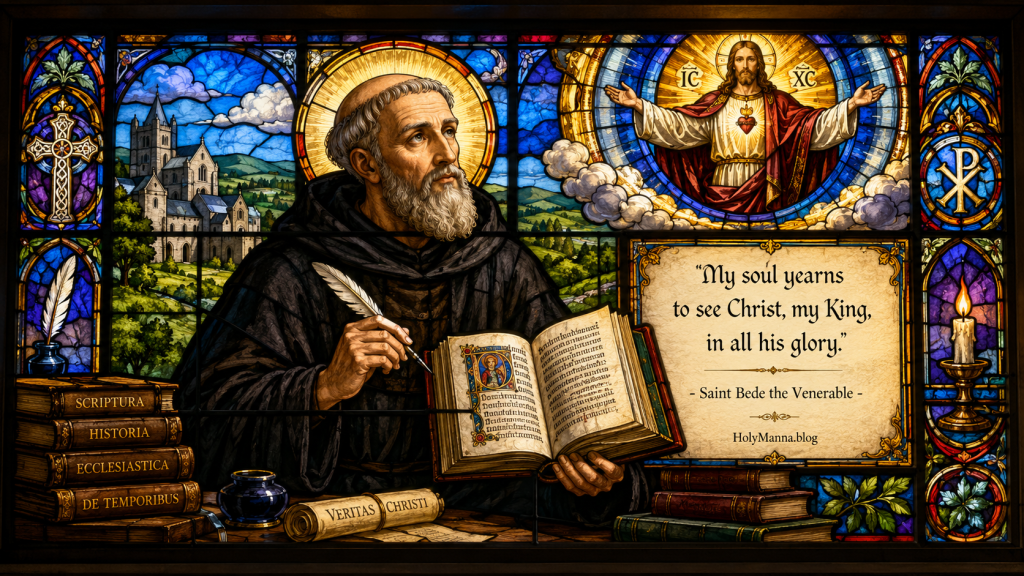
The Monk Who Made History Kneel Before Christ
Saint Bede the Venerable is one of those saints who reminds the Church that holiness does not always look loud. Sometimes it looks like a monk at a desk, a priest with a Bible open, a teacher forming young souls, and an old man still working on Scripture as death approaches.
Born in Northumbria around 672 or 673, Bede became one of the greatest scholars of the early Middle Ages. He was a monk, priest, biblical commentator, historian, teacher, liturgical theologian, and eventually a Doctor of the Church. He is most famous for writing The Ecclesiastical History of the English People, the work that earned him the title “Father of English History.”
Yet from a Catholic perspective, Bede was never simply a historian. He was a man who saw history through the eyes of faith. He believed that Christ was Lord not only of souls, but of time, nations, learning, language, and memory. His scholarship was not about showing off intelligence. It was about serving the Church.
The Catechism of the Catholic Church teaches that Sacred Scripture must be read within the living Tradition of the whole Church, because Scripture was entrusted to the Church by God and is interpreted faithfully within her life and worship. CCC 113 teaches that Scripture should be read “within the living Tradition of the whole Church.” That is exactly how Saint Bede lived. He studied the Bible with the mind of the Church, the Fathers of the Church as his guides, and Jesus Christ as the center of everything.
A Child Given to God
Bede’s own account tells us that, at the age of seven, he was entrusted by his relatives to the care of Abbot Saint Benedict Biscop at the monastery of Wearmouth. Later, he was formed under Abbot Ceolfrid at the twin monastery of Wearmouth-Jarrow, dedicated to Saints Peter and Paul.
That simple childhood offering shaped his entire life. Bede did not grow up chasing worldly influence. He grew up in the rhythm of monastic prayer, psalmody, study, obedience, silence, and sacred learning. In a world where kingdoms rose and fell, Bede’s life became rooted in something far more stable: the worship of God.
A famous story from his youth says that when plague struck the monastery around 686, nearly all who could chant the Divine Office were gone or too ill to continue. According to the story, young Bede and Abbot Ceolfrid were left to keep the prayer of the monastery alive. This story is often repeated in Catholic tradition as a sign of Bede’s early devotion, though the details should be treated carefully as a traditional account rather than a fully verified miracle story.
Still, the heart of the story fits Bede perfectly. Before he became known for books, history, and learning, he was formed by prayer. Before he taught the Church, he learned how to praise God.
Bede was ordained a deacon at nineteen and a priest at thirty by Saint John of Beverley. His priesthood was not exercised in public fame or missionary travel. It was lived in the monastery, where he taught, prayed, wrote, copied, preached, and formed others in the faith.
He later summarized his own life with the famous words: “It has been ever my delight to learn or teach or write.”
That quote sounds simple, but it reveals the soul of the saint. For Bede, learning was not vanity. Teaching was not performance. Writing was not self-expression. All of it was service to Christ and His Church.
A Scholar at the Service of the Church
Saint Bede is most known for The Ecclesiastical History of the English People, completed in 731. This work tells the story of Christianity in Britain and among the English people, including missionaries, kings, bishops, councils, monasteries, conversions, saints, and struggles for unity.
What makes the work so important is not only its historical value. It is also deeply Catholic. Bede wanted to show how the English Church belonged to the one, holy, catholic, and apostolic Church. He cared deeply about communion with Rome, unity in doctrine, and the proper celebration of Easter according to the wider Catholic tradition.
This was a big deal in his time. The Church in Britain had inherited different customs, especially around the dating of Easter. Bede strongly supported the Roman calculation, not because he loved uniformity for its own sake, but because he believed unity in worship mattered. The Resurrection of Christ was not a private local celebration. It was the joy of the whole Church.
Bede also wrote many biblical commentaries, homilies, saints’ lives, works on grammar, poetry, science, chronology, and the calculation of time. He wrote about the Old Testament, the Gospels, Acts of the Apostles, the Catholic Epistles, and Revelation. He also wrote about the holy places of Jerusalem using earlier pilgrimage accounts.
One of his major contributions was helping popularize the dating of history from the Incarnation of Christ, the system often associated with “A.D.” That may sound like a technical detail, but spiritually it is beautiful. Bede helped teach Christian culture to place Christ at the center of time itself.
In Bede’s world, history was not random. Time had meaning because the Son of God entered it.
The Catechism teaches that “the Word of God, expressed in the words of men, is in every way like human language” while still being truly divine revelation, CCC 101. Bede lived with that conviction. He loved language because God had chosen language to reveal Himself. He loved history because God had entered history. He loved learning because all truth leads back to the Truth Himself.
No Flashy Miracles, Just Faithful Holiness
Unlike many saints from the early Church and medieval period, Saint Bede is not mainly remembered for dramatic miracles during his lifetime. Catholic tradition does not preserve a major cycle of verified healing miracles, visions, or supernatural wonders performed by him while he lived.
That should not be seen as a weakness in his story. In fact, it may be one of the most relatable parts of his holiness.
Bede’s miracle, in a sense, was fidelity. He lived the same vocation day after day. He prayed when prayer was ordinary. He studied when study was difficult. He taught when teaching required patience. He wrote when writing demanded discipline. He served the Church without needing the spotlight.
That kind of holiness is deeply Catholic. Not every saint raises the dead, cures the sick, or faces martyrdom in a stadium. Some saints become holy by doing the daily work of love with perseverance.
This is where Bede becomes especially powerful for ordinary Catholics today. He shows that a desk can become a place of sanctification. A classroom can become a mission field. A quiet vocation can shape generations. A hidden life, offered to God, is never wasted.
A Monk Who Faced the Troubles of His Age
Bede did not suffer martyrdom, but his life was not untouched by hardship. He lived in a time when England was still young in the faith, when kingdoms battled, customs differed, learning had to be preserved by hand, and Church unity required patient teaching.
His monastery also experienced the devastating plague that shaped his early life. If the traditional account is reliable, Bede saw death and disruption as a boy, yet continued in prayer and formation.
Later in life, Bede showed concern for problems within the Church. In his Letter to Egbert, he urged pastoral reform, better preaching, stronger clergy formation, and more serious care for ordinary Christians. He wanted priests to teach the faithful the Creed and the Our Father in a language they could understand. He wanted souls to be fed, not neglected.
That matters. Bede was not an ivory tower scholar. He cared about whether regular people knew the faith. He cared whether pastors were actually shepherding. He cared whether Christian learning reached the hearts of the poor and uneducated.
That concern reflects the mission of the Church. The Catechism teaches that the Church exists to proclaim and establish the Kingdom of Christ and of God among all peoples, CCC 763. Bede served that mission with ink, parchment, teaching, prayer, and priestly love.
The Holy Death of a Teacher
The account of Bede’s death is one of the most moving deathbed scenes in Christian history. His disciple Cuthbert recorded that Bede became seriously ill near the end of his life, but he did not stop teaching. Even as his strength faded, he continued dictating and instructing his students.
One of his final projects was a translation of The Gospel of John into the language of his people. This detail is incredibly tender. At the end of his life, Bede was still trying to make the Word of God accessible to ordinary souls.
As his final hours approached, he distributed his few possessions, including small items like incense and cloth, and asked the priests of the monastery to remember him in their Masses and prayers. This was not the death of a man clinging to the world. It was the death of a priest preparing to meet Christ.
According to Cuthbert’s account, a young scribe told Bede that one sentence remained unfinished. Bede dictated the final words. Then the scribe said, “It is finished.” Bede answered, “You have spoken truly. It is finished.”
He then asked to be placed facing the holy place where he used to pray. There, he sang praise to the Holy Trinity and died on May 26, 735.
Another saying associated with his final hours expresses the desire of his soul: “My soul yearns to see Christ, my King, in all his glory.”
That is the death of a Christian scholar. Not a man who worshiped books, but a man whose books led him to Christ.
The Legend of the Name “Venerable”
The most famous legend associated with Saint Bede concerns his title, “Venerable.”
According to the story, after Bede’s death, a monk was trying to compose an epitaph for his tomb. The line began, “Here are the bones of Bede…” but the monk could not find the right word to complete it. When he returned later, the missing word had been supplied, supposedly by angels. The inscription now called him Venerabilis, meaning “Venerable.”
It is a beautiful story, but it cannot be verified. Catholic sources caution that there is no early authority for the angelic version of the legend. Still, the title itself is ancient. Bede was being called “Venerable” within a few generations of his death, and major Christian figures such as Alcuin used the title for him.
So even if angels did not visibly finish the epitaph, the Church recognized something angelic in his wisdom, humility, and holiness.
Relics, Veneration, and a Legacy That Crossed Continents
After his death, Bede was first buried at Jarrow. In the eleventh century, his remains were brought to Durham, where they became associated with the shrine of Saint Cuthbert. A later story says that a monk named Alfred Westou secretly brought Bede’s bones from Jarrow and placed them near the relics of Saint Cuthbert. This story is part of the medieval tradition surrounding his relics, though the exact details are difficult to verify.
Bede’s relics were eventually placed in Durham’s Galilee Chapel. In medieval Catholic devotion, his relics were honored, and Catholic sources note that they were carried in processions on major feast days and Rogation days. This shows that devotion to Bede was not merely academic. He was loved and venerated as a saint of the Church.
During the Reformation, his shrine was destroyed, as happened to many Catholic shrines in England. His remains were later reburied, and his tomb at Durham continued to be remembered as a place connected to one of England’s greatest saints.
Bede’s writings spread widely after his death. Missionaries, monks, bishops, scholars, and teachers copied and used his works throughout Europe. Saint Boniface, the great missionary to Germany, asked for copies of Bede’s writings. That detail alone says a lot. A monk who barely traveled became a teacher to missionaries who carried the Gospel across nations.
In 1899, Pope Leo XIII declared Saint Bede a Doctor of the Church. This title is given to saints whose teaching has special importance for the whole Church. For generations, Bede was often remembered as the great English Doctor of the Church, a saint whose learning served not only England, but the universal Catholic faith.
His feast day is celebrated on May 25 in the Roman Catholic calendar. He is often honored as a patron of scholars, historians, lectors, and English writers. Catholic institutions around the world have carried his name, including the Pontifical Beda College in Rome and San Beda University in the Philippines.
That is one of the surprising joys of his legacy. A monk who lived quietly in Northumbria became a spiritual father to Catholic students, priests, writers, historians, and teachers across the world.
A Saint for Quiet Faithfulness
Saint Bede the Venerable is a saint for anyone who has ever wondered whether ordinary faithfulness really matters.
He did not build an empire. He did not seek fame. He did not live a glamorous life. He stayed faithful to prayer, study, teaching, writing, and priestly service. He loved Scripture. He loved the Church. He loved truth. He loved Christ.
In an age obsessed with noise, Bede teaches the power of depth. In an age addicted to speed, he teaches patience. In an age full of hot takes and shallow opinions, he teaches reverence for truth. In an age where many people want influence without discipline, he shows that real influence is born from humility, prayer, and obedience.
His life also reminds Catholics that learning and holiness belong together. Faith is not anti-intellectual. The Church has always loved true wisdom because all truth comes from God. But Bede also reminds us that knowledge must become love. A person can know many things and still miss Christ. Bede studied so that he could love Christ more deeply and help others do the same.
The Catechism teaches that the saints help build up the Church because “the communion of saints is the Church”, CCC 946. Saint Bede still serves that communion through his example, his writings, his prayers, and his witness to faithful Catholic learning.
What ordinary work has God placed in your hands right now? Could that work become holy if it were offered with more love, patience, and prayer?
Saint Bede shows that the hidden life is not a wasted life. When a soul belongs to Christ, even quiet work can echo for centuries.
Engage with Us!
Share your thoughts and reflections in the comments below. Saint Bede’s life is a powerful reminder that faithfulness in ordinary duties can become extraordinary when it is offered to God.
- How does Saint Bede’s quiet life of prayer, study, and service challenge the way you think about holiness?
- What part of your daily routine could become more Christ-centered if you approached it with more patience and love?
- Saint Bede spent his life learning, teaching, and writing for the good of the Church. What gifts has God given you that could serve others?
- Bede died while helping make Scripture more accessible to ordinary people. How can you make the Word of God more present in your home, friendships, or parish life?
- What does Saint Bede’s love for truth teach you about being Catholic in a noisy and distracted world?
May Saint Bede the Venerable inspire every Christian to seek wisdom with humility, serve faithfully in hidden places, love Scripture deeply, and do every ordinary task with the love and mercy Jesus taught us.
Saint Bede the Venerable, pray for us!
Follow us on YouTube, Instagram and Facebook for more insights and reflections on living a faith-filled life.


Leave a Reply