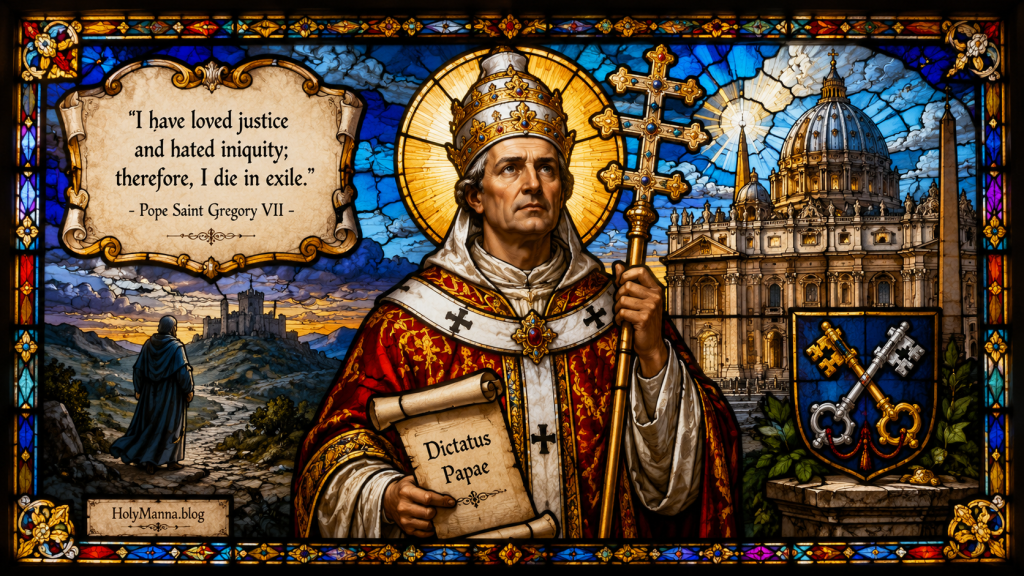
The Pope Who Loved Justice Enough to Die in Exile
Pope Saint Gregory VII was one of the most courageous and controversial reforming popes in Catholic history. Born Hildebrand in the early 11th century, he became pope in 1073 and served until his death in exile on May 25, 1085. His feast day is celebrated on May 25.
He is remembered as a pope who fought to free the Church from corruption, political control, and moral compromise. He opposed simony, defended priestly celibacy, strengthened papal authority, and challenged the power of kings and emperors when they tried to control the appointment of bishops. His life was not peaceful, comfortable, or popular. It was marked by conflict, suffering, exile, and a burning conviction that the Church belongs to Christ.
His most famous words, traditionally spoken near his death, summarize his entire life: “I have loved justice and hated iniquity; therefore, I die in exile.”
That line sounds dramatic because his life was dramatic. Gregory VII was not a pope who tried to make everyone comfortable. He was a shepherd who believed that souls were at stake, and because of that, he was willing to suffer for the holiness and freedom of the Church.
From Hildebrand of Tuscany to Servant of the Church
Pope Saint Gregory VII was born with the name Hildebrand, likely in Tuscany, in or near the town of Sovana, sometime around 1020 to 1025. Catholic tradition remembers him as coming from humble origins. His father, Bonizo, is sometimes described as a carpenter or peasant, though the exact details are uncertain.
As a boy, Hildebrand was sent to Rome, where he was educated near the monastery of Santa Maria on the Aventine Hill. There, he came under the influence of a deeply religious environment shaped by prayer, discipline, and reform. His uncle Laurentius was connected with his formation, and Hildebrand absorbed the spiritual seriousness that would later define his life.
Some traditions associate him strongly with the Benedictine and Cluniac reform spirit. There is some historical debate about whether he was formally a monk of Cluny itself, but there is no serious doubt that he was shaped by monastic reform. He learned to see the Church not as a political machine, but as the Bride of Christ, called to holiness, purity, and freedom.
Before becoming pope, Hildebrand served several popes and became one of the most influential churchmen in Rome. He followed Pope Gregory VI into exile after that pope was removed from office, and later returned to Rome during the reforming pontificate of Pope Leo IX. He served as cardinal-subdeacon, administrator of Church property, papal legate, and eventually Archdeacon of the Roman Church.
He also helped restore the monastery of Saint Paul Outside the Walls, assisted in papal diplomacy, and played a major role in strengthening the process for papal elections. The 1059 decree under Pope Nicholas II, which gave the College of Cardinals a central role in electing future popes, was part of the broader effort to free the papacy from the control of Roman noble families and secular rulers.
By the time Hildebrand became pope, he had already spent decades serving the Church from behind the scenes. He knew the corruption in the Church. He knew the politics. He knew the dangers. And he knew reform would come at a price.
A Reluctant Pope Chosen for a Dangerous Mission
When Pope Alexander II died in 1073, the Roman clergy and people quickly called for Hildebrand to become pope. According to tradition, the people cried out that blessed Peter had chosen Hildebrand. He was elected on April 22, 1073, and later consecrated on June 29, the feast of Saints Peter and Paul.
He took the name Gregory VII in honor of Pope Gregory VI, the pope he had served faithfully in his youth. This choice reveals something beautiful about him. Gregory VII did not forget the man who had helped shape his vocation, even though Gregory VI’s pontificate had been troubled and ended in exile.
Gregory VII did not seem to desire the papacy in a worldly way. His writings show fear before the burden of the office. He understood that he was not stepping into comfort. He was stepping into a battle for the soul of the Church.
The Church he inherited was in serious trouble. Simony was widespread, meaning sacred offices and spiritual things were bought and sold. Clerical immorality was common. Many priests ignored the discipline of celibacy. Bishops were often chosen by kings and nobles for political usefulness rather than spiritual holiness.
To modern ears, some of this may sound like Church politics. To Gregory, it was much deeper. It was about whether the Church would be faithful to Christ or controlled by money, lust, and worldly power.
The Catechism of the Catholic Church teaches that simony is “the buying or selling of spiritual things” and explains that spiritual goods cannot be treated as human property because they come from God. CCC 2121 This is exactly the kind of abuse Gregory VII fought with all his strength.
The Fire of Reform and the Freedom of the Church
Gregory VII’s reform movement became known as the Gregorian Reform, though it had begun before him and continued after him. He did not invent the Church’s desire for reform, but he enforced it with extraordinary courage.
He fought especially against three great evils. The first was simony. The second was clerical sexual immorality. The third was lay investiture, the practice by which kings, emperors, and nobles appointed bishops and abbots as if Church offices were political rewards.
For Gregory, lay investiture was a grave danger because bishops were successors of the Apostles, not servants of royal ambition. A bishop was not supposed to be a political employee. He was supposed to teach the faith, sanctify the people, govern the Church, protect the poor, and lead souls to Christ.
This connects directly with Catholic teaching on Holy Orders. The Catechism of the Catholic Church teaches that ordained ministry exists to serve the faithful in the name and person of Christ. CCC 1547 It also teaches that the pope, as successor of Peter, is the visible source and foundation of unity for the bishops and the faithful, and that he has full, supreme, and universal authority in the Church. CCC 882
Gregory understood that if kings controlled bishops, the Church’s spiritual mission would be compromised. If sacred offices could be bought, grace would appear to be for sale. If clergy lived without discipline, the faithful would be scandalized. His reforms were not about control for its own sake. They were about restoring the Church’s freedom to be holy.
At his Lenten Synods, Gregory ordered simoniacal clergy to stop exercising ministry. He insisted that clergy living in sexual immorality cease their ministry. He sent legates throughout Europe to enforce reform. The resistance was fierce. In some places, clergy rebelled. In France, reformers faced threats and violence. In Germany, married clergy fiercely opposed the enforcement of celibacy.
Gregory did not back down. He believed the Church could not preach conversion to the world while refusing conversion herself.
The Eucharistic Faith He Defended
Pope Saint Gregory VII is often remembered for his conflict with Emperor Henry IV, but another important part of his legacy is his role in defending Catholic Eucharistic faith.
Before becoming pope, Hildebrand was involved in addressing the controversy surrounding Berengarius of Tours, whose teaching on the Eucharist caused serious concern. Later, as pope, Gregory required Berengarius to make a profession of faith affirming the true change of bread and wine into the Body and Blood of Christ.
This matters because Gregory was not only a reformer of Church structures. He was a defender of Catholic doctrine. His reform was not merely administrative. It was sacramental. He wanted the Church to be pure because the Church carries the mystery of Christ into the world.
The Catechism of the Catholic Church teaches that in the Eucharist, Christ is truly, really, and substantially present, and that the change of the bread and wine into the Body and Blood of Christ is called transubstantiation. CCC 1374, CCC 1376
Gregory’s defense of the Eucharist reminds us that Church reform is never just about rules. It is about reverence. It is about worship. It is about recognizing that Christ is truly present among His people.
Canossa and the Emperor in the Snow
The most famous story from Gregory VII’s life is his conflict with Henry IV, King of Germany and later Holy Roman Emperor.
Henry continued appointing bishops despite Gregory’s opposition to lay investiture. In 1076, Henry gathered bishops at Worms and attempted to declare Gregory deposed. Gregory responded by excommunicating Henry and releasing his subjects from allegiance, according to the political and ecclesial understanding of the time.
This was an earthquake in medieval Europe. A pope had excommunicated a king. A king had tried to depose a pope. The question was not only political. It was spiritual. Could a ruler treat the Church as his possession, or did the Church have freedom under Christ?
Under pressure from German nobles, Henry crossed the Alps in winter and came to Canossa in January 1077, where Gregory was staying under the protection of Countess Matilda of Tuscany. Henry came dressed as a penitent, seeking absolution. The famous story says he stood barefoot in the snow for three days before Gregory admitted him and lifted the excommunication.
That image became one of the most famous scenes in medieval history. Some details, especially the picture of Henry standing continuously in the snow for three full days, may have become dramatized over time. Still, the heart of the event is true and powerful. A king who had defied the pope came as a penitent, and the pope, as shepherd of souls, granted absolution.
This is important. Gregory did not refuse mercy when repentance was presented. He was stern, but he was not cruel. He defended justice, but he understood that the Church’s justice always serves repentance and salvation.
How often does pride keep the soul from kneeling before God and asking for mercy?
A Pope Hated for Refusing to Compromise
The peace with Henry IV did not last. The conflict resumed. Gregory excommunicated Henry again in 1080 after Henry continued resisting him. Henry’s supporters chose Guibert of Ravenna as an antipope, who took the name Clement III. Henry marched into Rome in 1084 and was crowned emperor by this antipope.
Gregory refused to surrender. He took refuge in Castel Sant’Angelo. Eventually, the Norman leader Robert Guiscard came to rescue him, but the Normans’ violent sack of Rome turned many Romans against Gregory. The pope who had fought for the freedom of the Church was forced to leave the city of Peter.
He went first to Monte Cassino and then to Salerno, where he died in exile on May 25, 1085.
He was not a martyr in the strict sense, because he was not directly killed for the faith. Yet Catholic tradition often sees in his sufferings something martyr-like. He lost his city. He lost political security. He lost comfort. He was abandoned by many. But he did not abandon the mission entrusted to him.
His final words are remembered as “I have loved justice and hated iniquity; therefore, I die in exile.”
That sentence still cuts deeply. He did not say, “I won every battle.” He did not say, “Everyone finally understood me.” He said he loved justice. That was enough.
A Saint of Courage More Than Wonder-Working
Unlike many saints, Pope Saint Gregory VII is not remembered mainly for spectacular miracle stories during his life. The major Catholic sources do not preserve a strong tradition of specific healings, visions, or wonders performed by him. His sanctity is seen most clearly in heroic virtue, courageous reform, spiritual discipline, suffering, and fidelity to the Church.
That does not make his holiness smaller. It simply gives it a different shape. Some saints reveal God’s power through visible miracles. Gregory VII revealed it through endurance. He showed what it means to hold the line when compromise would be easier, when enemies are louder, and when even apparent failure seems near.
His life teaches that holiness is not always gentle in appearance. Sometimes holiness looks like a father correcting a family he loves. Sometimes it looks like a shepherd standing between wolves and the flock. Sometimes it looks like exile.
The Legacy That Outlived His Exile
At the time of Gregory’s death, it may have looked as if he had failed. Henry IV had been crowned by an antipope. Rome had turned against Gregory. The pope died far from the city he had served.
But history did not end there.
The reforms Gregory defended continued to shape the Church. The long struggle over investiture was eventually addressed through the Concordat of Worms in 1122, which helped distinguish more clearly between the spiritual authority of the Church and the temporal authority of rulers. Gregory did not live to see that settlement, but his witness made it possible.
He was buried in Salerno, where his memory remained especially treasured. He was later beatified by Pope Gregory XIII and canonized by Pope Benedict XIII. His feast is celebrated on May 25.
His cultural impact is enormous. The word “Canossa” became a symbol of worldly power humbled before spiritual authority. The term “Gregorian Reform” became associated with one of the great purification movements in Catholic history. His life influenced how the Church understood the freedom of the papacy, the holiness of the clergy, and the danger of letting political power dominate sacred things.
Pope Saint John Paul II later praised Gregory as a man whose love for justice meant love for God’s order. That is the key to understanding him. Gregory was not chasing power. He was defending the divine order of the Church.
A Flame That Still Burns
Pope Saint Gregory VII can feel like a distant medieval figure, but his life speaks powerfully to Catholics today.
He reminds us that reform begins with truth. A person cannot heal what he refuses to name. Gregory named simony, corruption, lust, compromise, and political manipulation for what they were. He did not pretend that serious problems were harmless.
He also reminds us that the Church must never become a tool of worldly power. The Church serves Christ. Her mission is salvation. Her sacraments are holy. Her shepherds must be free to shepherd. Her priests must be called to holiness. Her people must not be scandalized by leaders who treat sacred things casually.
His life also challenges every Catholic personally. It is easy to admire reform in history and avoid reform in the heart. Gregory fought simony in the Church, but each person must also ask whether anything has been placed above God. Gregory fought impurity among clergy, but each person must examine where purity of heart is needed. Gregory fought political domination of the Church, but each person must ask whether Christ is truly King over daily decisions.
Where does the heart need reform? Where has compromise become comfortable? Where is God asking for courage instead of convenience?
The Saint Who Teaches Us to Love Justice
Pope Saint Gregory VII is most known for fighting simony, defending clerical reform, opposing lay investiture, confronting Emperor Henry IV, receiving Henry’s penance at Canossa, and dying in exile rather than surrendering the freedom of the Church.
But beneath all of that is something even deeper. He loved justice because he loved God. He hated iniquity because sin wounds souls. He defended the Church because the Church belongs to Jesus Christ.
His story is not the story of a man who had an easy personality or a quiet life. It is the story of a saint who had the courage to be misunderstood for the sake of truth. It is the story of a pope who lost Rome but kept faith. It is the story of a shepherd who teaches the Church that sometimes love must be strong, reform must be painful, and justice must be defended even at great personal cost.
Reflection
Pope Saint Gregory VII invites Catholics to recover a serious love for holiness. Not a harsh love. Not a self-righteous love. A real love. The kind of love that wants the Church to be pure because Christ is pure. The kind of love that wants priests to be holy because the sacraments are holy. The kind of love that wants leaders to serve truth, not power.
His life also teaches perseverance. Gregory did not get to see every fruit of his labor. He died in exile, and many of his reforms continued after him. That is a hard but beautiful lesson. Faithfulness is not measured only by visible success. Sometimes the seed is planted in suffering, and the harvest belongs to another generation.
In daily life, his example can be lived by refusing to treat faith casually, by going to confession with honesty, by defending the dignity of the Church without bitterness, by praying for priests and bishops, by rejecting corruption in small choices, and by choosing truth even when it costs something.
The Christian life is not about winning applause. It is about loving what God loves and rejecting what harms the soul.
Is there an area of life where comfort has become more important than holiness? Is there a truth that needs to be defended with charity and courage? Is there a place where God is asking for reform, not someday, but now?
Engage With Us!
Share your thoughts and reflections in the comments below. Pope Saint Gregory VII’s life raises serious questions about courage, reform, holiness, and the freedom of the Church.
- What part of Pope Saint Gregory VII’s life challenges you the most?
- Where do you see the need for reform in your own spiritual life?
- How can Catholics defend truth today without losing charity?
- What does Gregory’s famous line, “I have loved justice and hated iniquity; therefore, I die in exile,” stir in your heart?
- How can we better pray for the holiness, courage, and fidelity of our priests, bishops, and pope?
May Pope Saint Gregory VII inspire us to love justice, reject sin, defend the Church with humility, and live with the courage of saints. Let us live a life of faith and do everything with the love and mercy Jesus taught us.
Pope Saint Gregory VII, pray for us!
Follow us on YouTube, Instagram and Facebook for more insights and reflections on living a faith-filled life.


Leave a Reply