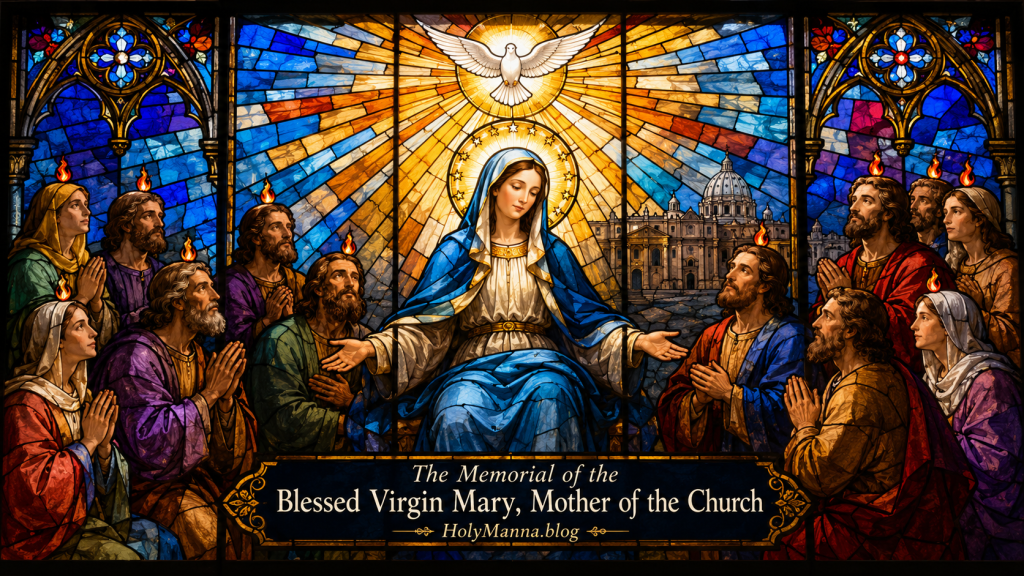
Mary at the Heart of Pentecost
The Memorial of the Blessed Virgin Mary, Mother of the Church is one of the most beautiful reminders that Catholic faith is not only about doctrine, structure, and mission. It is also about family. The Church has a Mother, and that Mother is Mary.
This memorial is celebrated every year on the Monday after Pentecost, which is already a powerful catechesis. On Pentecost, the Holy Spirit descends upon the Apostles, the Church is publicly revealed, and the mission of evangelization begins with fire and courage. Then, immediately after Pentecost, the Church turns her eyes to Mary, the woman who was there at the beginning of Christ’s earthly life, at the foot of His Cross, and in the Upper Room as the Apostles waited in prayer.
This feast celebrates Mary under the title Mother of the Church, a title formally proclaimed by Pope Saint Paul VI during the Second Vatican Council on November 21, 1964. In that proclamation, he declared Mary to be “Mother of the Church, that is, of the whole Christian people, faithful and Pastors alike.”
That title does not take anything away from Jesus. It does the opposite. It shows how deeply Mary belongs to the mystery of Christ. She is Mother of Christ, and the Church is the Body of Christ. As The Catechism of the Catholic Church teaches, Mary is “Mother of Christ, Mother of the Church” CCC 963. She is Mother of the Head, Jesus, and Mother of His members, the faithful.
This memorial is central to Marian devotion because it helps Catholics see Mary not as a distant figure trapped in stained glass, but as a living mother in the life of the Church. She prays with the Church. She intercedes for the Church. She teaches the Church how to receive Christ, how to suffer with faith, and how to wait for the Holy Spirit with hope.
The Day After Pentecost
The story behind this memorial begins in Scripture, but it unfolds across the centuries of Catholic tradition.
In Genesis 3:9-15, 20, Eve is called the mother of all the living. Catholic tradition sees Mary as the New Eve, the woman whose obedience helps undo the knot of Eve’s disobedience. Where Eve listened to the serpent, Mary listened to the angel. Where Eve reached for what was not hers to take, Mary received what God freely gave. Where sin entered through distrust, salvation entered through faith.
That is why Mary’s fiat at the Annunciation matters so much. In The Gospel of Luke, Mary responds to the angel with the words, “Behold, I am the handmaid of the Lord.” With that act of obedient faith, the Son of God takes flesh in her womb. Mary becomes the Mother of God, not because she is the source of Christ’s divinity, but because the child born of her is truly God and truly man.
The memorial also looks to Acts 1:12-14, where Mary is gathered with the Apostles in the Upper Room after the Ascension. The Church is waiting. The Apostles are praying. The Holy Spirit has not yet descended in the rushing wind and tongues of fire. And Mary is there, quietly present, like a mother in the middle of a family that is about to be sent into the world.
Then the memorial reaches its deepest moment in John 19:25-34. At the Cross, Jesus sees His Mother and the beloved disciple. He says to Mary, “Woman, behold, your son.” Then He says to the disciple, “Behold, your mother.”
This is not just a tender family arrangement before Jesus dies. The Church has always seen something deeper here. The beloved disciple stands for every disciple. At Calvary, Jesus gives Mary to the Church, and He gives the Church to Mary.
This is why the memorial belongs after Pentecost. At Pentecost, the Church receives the fire of the Holy Spirit. The next day, the Church remembers that the fire was not given to orphans. The Church has a Mother.
Mary’s Motherhood Is Everywhere
Unlike feasts such as Our Lady of Lourdes or Our Lady of Fatima, the Memorial of Mary, Mother of the Church, was not founded on a specific approved apparition. There is no single visionary, no mountain village, no miraculous spring, and no one moment when Mary appeared under this title and asked for a feast.
Instead, this memorial comes from something even older and broader. It comes from Scripture, the Fathers of the Church, the living Tradition of the Church, Vatican II, papal teaching, and the Church’s liturgy.
That matters because Mary’s motherhood over the Church is not a devotional extra. It belongs to the Catholic understanding of who Mary is in relation to Christ and His Body.
The 2018 decree that placed this memorial on the General Roman Calendar pointed back to Saint Augustine and Saint Leo the Great. Saint Augustine taught that Mary cooperated in charity in the birth of believers in the Church. Saint Leo the Great taught that the birth of Christ the Head is also connected to the birth of His Body, the Church.
There are also sacred images tied to this title. In Saint Peter’s Basilica, the image known as Our Lady of the Column was venerated as miraculous during the Holy Year of 1575. Pope Saint Paul VI later associated this image with the title Mother of the Church. In Saint Peter’s Square, the Mater Ecclesiae mosaic also bears witness to Mary’s maternal protection. Pope Saint John Paul II wanted an image of Mary placed there after the assassination attempt on his life in 1981, convinced that the Blessed Mother had protected him.
So while this feast is not rooted in one apparition, it is surrounded by centuries of Marian intercession, Catholic memory, sacred art, and papal devotion. It reminds the faithful that Mary’s motherhood is not limited to one place or one generation. She is Mother wherever the Church prays, suffers, teaches, and evangelizes.
Mother of Christ, Mother of His Body
The theological heart of this feast is simple enough for a child to love and deep enough for a theologian to spend a lifetime contemplating.
Mary is Mother of the Church because she is Mother of Christ, and the Church is the Mystical Body of Christ.
The Catechism of the Catholic Church teaches that Mary’s role in the Church is inseparable from her union with Christ CCC 964. She does not stand apart from Jesus. She belongs entirely to Him. Her whole mission is to receive Him, bear Him, follow Him, suffer with Him, and lead others to Him.
At the Cross, Mary’s motherhood expands. She remains the Mother of Jesus, but now she is given a new maternal mission toward all who belong to Jesus. The Catechism says Mary is our mother “in the order of grace” CCC 968. That means her motherhood is spiritual, maternal, intercessory, and rooted completely in Christ’s saving work.
Catholic teaching is very careful here. Mary is not the Redeemer. Jesus Christ alone is the Savior. Mary’s intercession does not compete with Christ’s mediation. It depends on it. Vatican II’s Lumen Gentium teaches that Mary’s maternal role “in no wise obscures or diminishes” the unique mediation of Christ.
This is why authentic Marian devotion is always Christ-centered. Mary never says, “Stay with me instead of Him.” Her entire life says what she told the servants at Cana: “Do whatever he tells you.” John 2:5
This memorial also connects beautifully with the Marian doctrines of the Church. Her Immaculate Conception shows that she was prepared by grace for her mission as Mother of the Redeemer CCC 490-493. Her perpetual virginity reveals her total consecration to God’s plan CCC 499-507. Her Assumption shows that the Mother who walked with the pilgrim Church on earth now intercedes for the Church from heaven CCC 966. Her title Mother of the Church gathers these truths and places them close to the daily life of every Catholic.
Mary is not only the Mother who once held Jesus in Bethlehem. She is the Mother who stands beside the Cross, prays in the Upper Room, and continues to care for the Body of Christ today.
From Vatican II to the Universal Church Calendar
Although Catholics had long understood Mary’s maternal relationship to the Church, the title Mother of the Church received a major modern moment during the Second Vatican Council.
On November 21, 1964, Pope Saint Paul VI solemnly proclaimed Mary Mother of the Church. This was not a new doctrine invented in the twentieth century. It was a formal recognition of what the Church had already believed, prayed, and taught in different ways for centuries.
The title continued to grow in the Church’s liturgical life. A votive Mass of Mary, Mother of the Church, was prepared in the 1970s. The title was added to the Litany of Loreto during the pontificate of Pope Saint John Paul II. Some countries and dioceses celebrated Mary under this title before it was placed on the universal calendar.
Then, in 2018, Pope Francis established the memorial for the whole Roman Rite on the Monday after Pentecost. The Church wanted the faithful to remember that the life of the Church is not only institutional, sacramental, and missionary. It is also maternal.
Pope Francis, preaching on the first universal celebration of this memorial, emphasized that the Church is woman, bride, and mother. When the Church forgets her maternal heart, she risks becoming cold, sterile, and merely organizational. Mary teaches the Church tenderness.
That is such a needed word today. Many people encounter the Church through rules, scandals, arguments, wounds, or confusion. This memorial does not erase those difficulties, but it reminds Catholics what the Church is meant to be. She is meant to be a mother who teaches the truth, feeds her children with the sacraments, corrects with love, protects the vulnerable, and leads souls to Jesus.
Shrines, Devotions, and the Tenderness of a Mother
Devotion to Mary, Mother of the Church, is lived most simply through prayer, the liturgy, the Rosary, and filial trust in Mary’s intercession.
One of the most direct devotions is the invocation Mater Ecclesiae, Mother of the Church, in the Litany of Loreto. This title allows Catholics to pray with the Church in a beautifully simple way. Mary is not only the Mother of Jesus in history. She is the Mother of the Church right now.
The Rosary is also deeply connected to this memorial. In the Sorrowful Mysteries, the faithful stand with Mary at the Cross. In the Glorious Mysteries, the faithful pray with Mary in the Upper Room at Pentecost. The Rosary teaches Catholics to see the life of Jesus through the heart of His Mother, and this feast reminds the faithful that Mary continues to form the Church in that same gaze of faith.
There are also shrines dedicated to Mary under this title. In the United States, the National Shrine of Mary, Mother of the Church, in Laurie, Missouri, is dedicated to honoring Mary’s motherhood and the dignity of mothers, families, and human life. Pilgrims who visit places like this are reminded that Marian devotion is not an escape from real life. It strengthens real life. It teaches patience in suffering, courage in family struggles, reverence for motherhood, and hope when the future feels uncertain.
Pilgrimage itself is a deeply Catholic act. The body travels because the soul is searching. A pilgrim goes to a holy place not because Mary is absent elsewhere, but because the heart sometimes needs a place to become quiet enough to receive what God is saying. At Marian shrines, the Church often experiences Mary the way children experience a good mother: close, attentive, gentle, and always pointing back to the Father’s house.
A Feast That Shapes Catholic Culture
The cultural impact of this memorial is still growing because the universal celebration is relatively recent. Yet the title itself has already shaped Catholic prayer, art, architecture, papal devotion, and local celebrations across the world.
In Rome, the title Mater Ecclesiae is visible near the heart of the universal Church. The mosaic in Saint Peter’s Square is not just decoration. It is a reminder to pilgrims that the Church does not walk through history alone. The Mother of Jesus watches over the Church, not as a symbol of sentiment, but as a real mother in the communion of saints.
In countries and communities that celebrated this title before 2018, the memorial often carried a strong sense of ecclesial identity. To honor Mary as Mother of the Church is to remember that Catholics are not isolated spiritual consumers. They are sons and daughters in a household of faith. They belong to Christ, and because they belong to Christ, they belong to one another.
This feast also speaks powerfully to a culture confused about motherhood, authority, tenderness, and truth. Mary shows that motherhood is not weakness. It is strength poured out in love. She shows that obedience is not passivity. It is faith alive and active. She shows that silence is not emptiness. It can be the deepest form of trust.
The memorial also invites parishes to rediscover their own maternal mission. A parish should not feel like a religious office building. It should feel like a spiritual home. It should be a place where the lost are welcomed, sinners are called to conversion, families are strengthened, children are formed, the elderly are honored, and the suffering are not forgotten.
Mary, Mother of the Church, teaches the Church how to be a mother again.
Beneath the Cross, Inside the Upper Room
The Memorial of Mary, Mother of the Church, gives Catholics a beautiful way to understand the spiritual life.
There are moments when life feels like Calvary. Something painful stands in front of the soul, and there is no easy way around it. Mary teaches the faithful how to remain there with love. She does not run from the Cross. She does not pretend it is not happening. She stands. Her faith does not remove the suffering, but it keeps her close to Jesus inside the suffering.
There are also moments when life feels like the Upper Room. The promise has been given, but the next step is unclear. The old life is over, but the new mission has not fully begun. Mary teaches the faithful how to wait in prayer. She shows that waiting does not have to become anxiety. Waiting can become preparation.
This feast also reminds Catholics that Mary’s motherhood is personal. When Jesus says, “Behold, your mother,” He is not giving the Church an abstract doctrine. He is giving His disciples a relationship. Every Catholic is invited to receive Mary with the trust of the beloved disciple.
That does not mean Catholic life becomes sentimental or shallow. True Marian devotion leads to deeper discipleship. A person who receives Mary as Mother should become more faithful to Jesus, more obedient to the Church, more open to the Holy Spirit, more patient in suffering, and more generous in love.
How might life change if Mary were received not as an optional devotion, but as a mother given personally by Jesus?
This memorial answers that question gently. It invites every Catholic to stand closer to the Cross, pray more faithfully in the Upper Room, and walk through the world with the confidence of a child who knows his Mother is near.
Learning to Be Children of Mary and Witnesses of Christ
Mary, Mother of the Church, is not a feast about looking backward with nostalgia. It is a feast about becoming the Church that Christ wants His people to be today.
Mary teaches the faithful to receive Jesus before trying to announce Him. She teaches the Church to pray before rushing into mission. She teaches Catholics to stay close to the Cross instead of fleeing suffering. She teaches believers to trust the Holy Spirit when the future is uncertain.
In daily life, this can be very practical. It means beginning the day with prayer instead of panic. It means asking Mary to help bring peace into a tense family situation. It means staying faithful to Mass even when emotions are dry. It means choosing tenderness without abandoning truth. It means letting the Church be a mother, not merely an institution to critique from a distance.
Mary’s motherhood also challenges Catholics to become more maternal in the spiritual sense. That means protecting life, welcoming the lonely, correcting with charity, feeding others with truth, and helping people find their way back to Jesus.
The Church needs strong teaching, but she also needs warm hearts. She needs courage, but she also needs tenderness. She needs clear doctrine, but she also needs saints who know how to love wounded people back to life.
Mary shows the Church how to hold all of that together.
Engage with Us!
Share your thoughts and reflections in the comments below. This memorial is a beautiful chance to reflect on Mary not only as the Mother of Jesus, but as the Mother given to every disciple by Jesus Himself.
- When you hear Jesus say, “Behold, your mother,” what does that stir in your heart?
- Where in your life do you need Mary’s motherly help right now: at the Cross, in the waiting, or in the mission?
- How can your parish, family, or community become more maternal in the way it welcomes, teaches, protects, and loves?
- What would it look like to pray with Mary more intentionally during the week after Pentecost?
- How can Mary’s tenderness help you follow Jesus with greater courage and peace?
May this memorial help every heart grow in love for Jesus, deeper trust in the Holy Spirit, and greater confidence in the maternal care of the Blessed Virgin Mary. Under the guidance of Our Lady, Mother of the Church, may the faithful keep growing together in faith, hope, and charity.
Blessed Virgin Mary, Mother of the Church, pray for us!
Follow us on YouTube, Instagram and Facebook for more insights and reflections on living a faith-filled life.


Leave a Reply