Memorial of the Blessed Virgin Mary, Mother of the Church – Lectionary: 572A
When the Church Receives Her Mother
There are days in the liturgical year when the Church seems to gather her children close and whisper, “You were not made to walk alone.”
The Memorial of the Blessed Virgin Mary, Mother of the Church, comes right after Pentecost, and that placement is not accidental. Pentecost reveals the Church filled with the Holy Spirit and sent into the world. This memorial reminds the faithful that the same Church is also gathered, formed, and mothered. The Christian life is not merely a mission to accomplish. It is a family to enter, a home to receive, and a grace to live.
Today’s readings move like one great story of salvation. In Genesis 3:9-15, 20, humanity hides after sin, and God speaks the first promise of redemption: “I will put enmity between you and the woman, and between your offspring and hers.” In Catholic tradition, this verse is called the Protoevangelium, the first Gospel, because it points forward to Christ’s victory over the serpent and to Mary, the New Eve, whose obedient faith stands in contrast to Eve’s disobedience. Where sin wounded the human family, God promised a Woman, a Son, and a victory.
In Acts 1:12-14, the Church is seen waiting in the Upper Room after the Ascension. The apostles are not scattered in fear anymore, but they are not yet preaching in power. They are praying together, and Mary is there among them. Scripture says, “All these devoted themselves with one accord to prayer, together with some women, and Mary the mother of Jesus.” This is the Church before Pentecost: apostolic, prayerful, expectant, and gathered around the Mother of the Lord. The Catechism teaches that Mary “aided the beginnings of the Church by her prayers” CCC 965, showing that her motherhood continues in the life of Christ’s Body.
The responsorial psalm, Psalm 87, sings of Zion as the city where God’s people are born. “Glorious things are said of you, O city of God!” Psalm 87:3 becomes more than a hymn about Jerusalem. It becomes an image of the Church, the new Zion, where sons and daughters are born through grace. In this light, Mary’s motherhood and the Church’s motherhood belong together. Mary is Mother of Christ, and because the Church is the Body of Christ, she is also Mother of the Church.
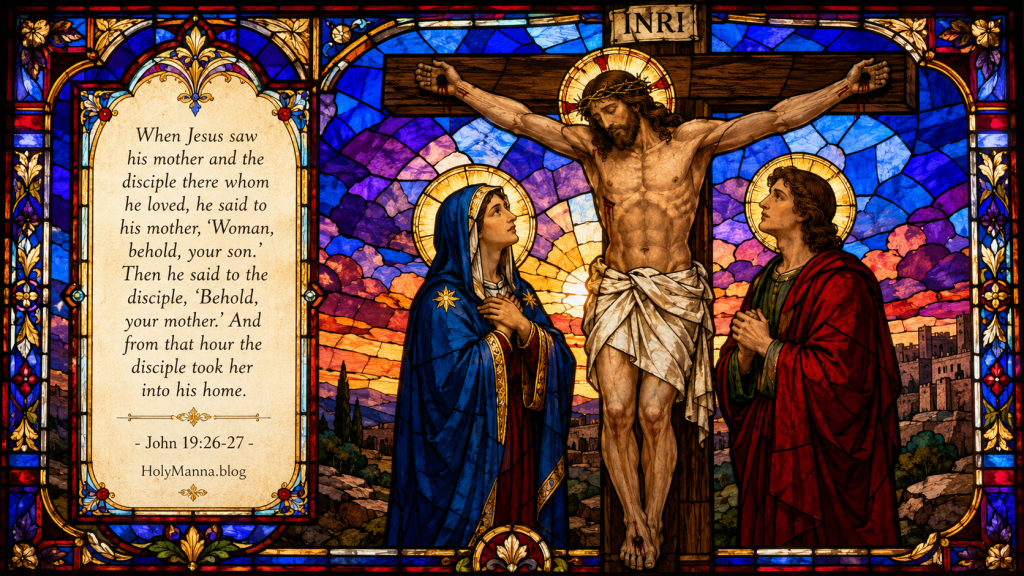
Then the Gospel brings everything to Calvary. In John 19:25-34, Mary stands beside the Cross as Jesus gives her to the beloved disciple: “Woman, behold, your son.” Then He says, “Behold, your mother.” These are not sentimental final words. They are the words of a dying King establishing a new household of grace. From His pierced side flow blood and water, signs of the sacramental life of the Church, especially Baptism and the Eucharist. At the very moment Christ gives His life for the world, He gives His Mother to His disciples.
The central theme of today’s readings is this: Christ heals the orphaned heart by giving His Church a Mother. Sin makes humanity hide. Grace brings humanity home. Eden shows the wound. The Upper Room shows the Church waiting in prayer. Zion shows the joy of belonging. Calvary shows the gift that completes the family of redemption.
What changes when the disciple stops seeing faith as a lonely effort and begins receiving it as life inside the family Christ forms from His Cross?
First Reading (Option 1) – Genesis 3:9-15, 20
The Promise Hidden Inside the Wound
The first reading brings the Church back to Eden, not to admire paradise, but to understand why the world needs redemption. Genesis 3 takes place immediately after the fall of Adam and Eve. They have eaten from the forbidden tree, and for the first time, fear, shame, blame, and spiritual hiding enter human history. The garden that was meant to be a place of communion becomes the place where humanity tries to avoid the gaze of God.
This reading fits beautifully with the Memorial of the Blessed Virgin Mary, Mother of the Church, because it reveals the wound that Mary’s Son came to heal. In Catholic tradition, Genesis 3:15 is called the Protoevangelium, the first Gospel, because God announces that the serpent will not have the final word. A Woman and her offspring will be placed in total opposition to evil. The Church sees this fulfilled in Christ, the victorious Son, and in Mary, the New Eve, whose obedience stands in contrast to Eve’s disobedience.
Today’s theme is motherhood in the family of redemption. Eve is called “the mother of all the living” Genesis 3:20, but after sin, human life becomes marked by death. Mary, Mother of Christ and Mother of the Church, stands at the beginning of the new creation, where grace is stronger than sin and where Christ gathers His disciples into a redeemed family.
Genesis 3:9-15, 20 – New American Bible (Revised Edition)
9 The Lord God then called to the man and asked him: Where are you? 10 He answered, “I heard you in the garden; but I was afraid, because I was naked, so I hid.” 11 Then God asked: Who told you that you were naked? Have you eaten from the tree of which I had forbidden you to eat? 12 The man replied, “The woman whom you put here with me—she gave me fruit from the tree, so I ate it.” 13 The Lord God then asked the woman: What is this you have done? The woman answered, “The snake tricked me, so I ate it.”
14 Then the Lord God said to the snake:
Because you have done this,
cursed are you
among all the animals, tame or wild;
On your belly you shall crawl,
and dust you shall eat
all the days of your life.
15 I will put enmity between you and the woman,
and between your offspring and hers;
They will strike at your head,
while you strike at their heel.20 The man gave his wife the name “Eve,” because she was the mother of all the living.
Detailed Exegesis
Verse 9 – “The Lord God then called to the man and asked him: Where are you?”
God’s question is not a request for information. God knows where Adam is. The question is an invitation to repentance. Adam has hidden himself because sin has damaged his trust in the Father. This is the first mercy after the first sin: God comes looking for man. The Lord does not abandon Adam in his hiding place. He calls him.
This verse speaks to every soul that has ever tried to avoid prayer, confession, silence, or honesty because shame felt too heavy. God’s first word after sin is not rejection. It is a call to return. The Catechism explains, “Man, tempted by the devil, let his trust in his Creator die in his heart and, abusing his freedom, disobeyed God’s command. This is what man’s first sin consisted of. All subsequent sin would be disobedience toward God and lack of trust in his goodness.” CCC 397
Verse 10 – “He answered, ‘I heard you in the garden; but I was afraid, because I was naked, so I hid.’”
Adam’s answer reveals the spiritual damage of sin. Before the fall, Adam and Eve were naked without shame. After sin, nakedness becomes a sign of vulnerability, fear, and broken innocence. Adam is not only afraid of punishment. He is afraid of being seen.
This is what sin does. It does not merely break a rule. It distorts the soul’s image of God. The Father begins to look like a threat instead of the source of life. The Catechism teaches, “Scripture portrays the tragic consequences of this first disobedience. Adam and Eve immediately lose the grace of original holiness. They become afraid of the God of whom they have conceived a distorted image, that of a God jealous of his prerogatives.” CCC 399
Verse 11 – “Then God asked: Who told you that you were naked? Have you eaten from the tree of which I had forbidden you to eat?”
God’s question exposes the lie behind Adam’s fear. Someone has taught Adam to see himself differently. Someone has taught him shame. Someone has whispered that disobedience would bring freedom, but it has brought fear.
The forbidden tree was not about God withholding happiness. It was about trust. Humanity was created to receive life from God, not seize moral independence apart from Him. When Adam eats, he chooses self-rule over filial obedience. This is why Catholic tradition understands sin as more than mistake or weakness. Sin is a rupture of communion.
Verse 12 – “The man replied, ‘The woman whom you put here with me, she gave me fruit from the tree, so I ate it.’”
Adam’s response shows how sin fractures relationships. He blames Eve, but he also subtly blames God: “The woman whom you put here with me.” The gift of woman, once received with joy, is now used as an excuse.
This verse reveals one of the clearest consequences of original sin. Love becomes defensive. Responsibility becomes accusation. Communion becomes self-protection. The man and woman who were made to image God together now stand divided by blame. The Catechism says, “The harmony in which they had found themselves, thanks to original justice, is now destroyed: the control of the soul’s spiritual faculties over the body is shattered; the union of man and woman becomes subject to tensions, their relations henceforth marked by lust and domination.” CCC 400
Verse 13 – “The Lord God then asked the woman: What is this you have done? The woman answered, ‘The snake tricked me, so I ate it.’”
Eve also shifts responsibility, but she tells the truth about the serpent’s deception. The enemy does not usually begin by inviting souls into obvious evil. He begins by twisting trust. He makes God seem restrictive, holiness seem boring, and disobedience seem enlightened.
Her answer reminds the reader that temptation often comes disguised as wisdom. The serpent promises opened eyes, but the result is fear, shame, and hiding. Catholic teaching sees here the beginning of humanity’s long battle with the devil, a battle that Christ wins and Mary shares in by grace.
Verse 14 – “Then the Lord God said to the snake: Because you have done this, cursed are you among all the animals, tame or wild; On your belly you shall crawl, and dust you shall eat all the days of your life.”
God does not question the serpent as He questions Adam and Eve. He pronounces judgment. The serpent is cursed, humiliated, and cast down. The imagery of crawling and eating dust signifies defeat and degradation.
This matters because God’s justice is already moving against evil. Sin has entered the world, but the serpent does not become equal to God. Evil may wound creation, but it cannot overthrow the Creator. The Catholic worldview is never dualistic, as if God and Satan are equal powers. Satan is a creature. God is Lord.
Verse 15 – “I will put enmity between you and the woman, and between your offspring and hers; They will strike at your head, while you strike at their heel.”
This is the first announcement of the Gospel. God promises a future conflict between the serpent and the Woman, between the serpent’s offspring and her offspring. The serpent will strike, but he will not triumph. The offspring of the Woman will crush the power of evil.
The Church sees Christ as the promised offspring who defeats sin, death, and the devil through His Passion, Death, and Resurrection. The Church also sees Mary as the New Eve, the Woman whose obedience belongs to God’s plan of redemption. The Catechism teaches, “The Christian tradition sees in this passage an announcement of the ‘New Adam’ who, because he ‘became obedient unto death, even death on a cross,’ makes amends superabundantly for the disobedience of Adam.” CCC 411
This is why the verse belongs so naturally to today’s memorial. Mary is not introduced as an afterthought in salvation history. The promise of the Woman is already present at the beginning, hidden like a seed in the soil of humanity’s first wound.
Verse 20 – “The man gave his wife the name ‘Eve,’ because she was the mother of all the living.”
Eve’s name means life, and this verse carries a mysterious hope. Even after sin, life continues. Even after judgment, motherhood remains. Even after Eden is wounded, God’s promise moves forward.
Yet for Christians, this verse also points beyond Eve. Mary becomes the Mother of the Living in a new and deeper sense because she is Mother of Christ, who is Life itself. At the Cross, Jesus gives Mary to the beloved disciple, and through him, to the Church. Eve is mother in the order of natural life. Mary is mother in the order of grace.
Teachings: The New Eve and the First Gospel
The Church has always read this passage as more than ancient history. It reveals the deepest drama of the human soul and the first promise of salvation. Adam and Eve’s sin is not just their story. It is the beginning of the condition every person inherits: a wounded nature, a divided heart, and a tendency to hide from God.
The Catechism teaches, “The account of the fall in Genesis 3 uses figurative language, but affirms a primeval event, a deed that took place at the beginning of the history of man. Revelation gives us the certainty of faith that the whole of human history is marked by the original fault freely committed by our first parents.” CCC 390
This is important because the Church does not treat the fall as a myth with no real consequence. It uses figurative language, but it teaches a real spiritual event. Sin has entered the world, and humanity cannot save itself by effort, optimism, or technology. Humanity needs a Redeemer.
That Redeemer is Christ. The first Adam disobeys at the tree. Christ, the New Adam, obeys upon the wood of the Cross. Eve listens to the serpent. Mary listens to the angel. Eve’s disobedience is tied to the fall. Mary’s obedience is tied to the coming of the Savior.
Saint Irenaeus, one of the great early Fathers of the Church, expressed this beautifully: “The knot of Eve’s disobedience was loosed by the obedience of Mary. For what the virgin Eve had bound fast through unbelief, this did the virgin Mary set free through faith.”
That is the Catholic heart of this reading. Mary does not save apart from Christ. She is saved by Christ and participates in His saving plan by grace. Her obedience does not replace His redemption. It receives it, serves it, and points to it.
The Catechism teaches, “Throughout the Old Covenant the mission of many holy women prepared for that of Mary. At the very beginning there was Eve; despite her disobedience, she receives the promise of a posterity that will be victorious over the evil one, as well as the promise that she will be the mother of all the living.” CCC 489
Mary stands in the line of this promise. She is the faithful Woman whose Son defeats the serpent. She is Mother of Christ, and because the Church is the Body of Christ, she is Mother of the Church. This is why today’s memorial places Genesis before the faithful: to show that Mary’s motherhood is not a sentimental add-on to Christianity. It belongs to the great story of redemption.
Reflection: Letting God Find the Hidden Heart
This reading begins with a question that still reaches into every human heart: “Where are you?” Genesis 3:9
That question is not only for Adam. It is for every person who has learned to hide behind busyness, sarcasm, distraction, resentment, image management, or spiritual numbness. Sin teaches the soul to run from the very God who wants to heal it. Shame says, “Stay hidden.” Grace says, “Come home.”
The first practical step from this reading is honesty before God. A Catholic does not need to bring a polished version of the soul into prayer. God already sees the fear, the wound, the habit, the excuse, and the blame. Prayer can begin simply: “Lord, this is where the heart is hiding.” That kind of honesty is not weakness. It is the beginning of repentance.
The second step is to stop blaming and start confessing. Adam blames Eve. Eve blames the serpent. The pattern is painfully familiar. Relationships become strained when responsibility is avoided. Spiritual growth begins when the soul stops saying, “It was because of them,” and begins saying, “Lord, have mercy on me.”
The third step is to live with hope. Genesis 3 is honest about sin, but it is not hopeless. God announces victory before Adam and Eve ever leave the garden. That means the Catholic life is never built on despair. The serpent may strike at the heel, but Christ crushes the head. The wound is real, but the promise is greater.
The fourth step is to receive Mary as the New Eve and Mother. She teaches the Church how to trust where Eve doubted, how to obey where humanity grasped, and how to stand with Christ where fear would rather run away. Her motherhood is not an escape from the Cross. It is a gift given through the Cross.
Where is the soul hiding from God right now?
What blame needs to be surrendered so confession, healing, and peace can begin?
How would daily life change if Mary were welcomed not as a distant figure, but as the Mother Christ gives to help His disciples come home?
First Reading (Option 2) – Acts 1:12-14
Mary in the Upper Room, Where the Church Learns to Pray
The second option for the first reading takes place in the quiet space between the Ascension and Pentecost. Jesus has risen from the dead, appeared to His disciples, taught them about the Kingdom, and ascended into heaven from the Mount of Olives. The apostles are no longer at the empty tomb, but they are not yet preaching boldly in the streets of Jerusalem. They are waiting.
That waiting is not passive. It is prayerful. The Church is gathered in the Upper Room, the same kind of hidden place where fear had once locked the disciples away, but now something different is happening. They are united. They are expectant. They are praying with Mary, the Mother of Jesus.
This reading fits perfectly with the Memorial of the Blessed Virgin Mary, Mother of the Church. On the day after Pentecost, the Church looks back to the Upper Room and sees Mary at the heart of the praying apostolic community. She is not replacing the apostles. She is not standing above the Church as a separate power. She is present as Mother, praying with the Church and for the Church as it prepares to receive the Holy Spirit.
Acts 1:12-14 – New American Bible (Revised Edition)
12 Then they returned to Jerusalem from the mount called Olivet, which is near Jerusalem, a sabbath day’s journey away.
The First Community in Jerusalem. 13 When they entered the city they went to the upper room where they were staying, Peter and John and James and Andrew, Philip and Thomas, Bartholomew and Matthew, James son of Alphaeus, Simon the Zealot, and Judas son of James. 14 All these devoted themselves with one accord to prayer, together with some women, and Mary the mother of Jesus, and his brothers.
Detailed Exegesis
Verse 12 – “Then they returned to Jerusalem from the mount called Olivet, which is near Jerusalem, a sabbath day’s journey away.”
This verse begins after the Ascension of Jesus. The Mount of Olives, or Olivet, was deeply significant in Jewish and Christian memory. It stood east of Jerusalem and was associated with prayer, expectation, and the final movements of Christ’s earthly ministry. Jesus had often gone there with His disciples, and from there He ascended into heaven.
The phrase “a sabbath day’s journey away” reflects Jewish custom. On the Sabbath, travel was limited so that the day would remain holy and restful. Saint Luke includes this detail to show that the apostles returned from a nearby, sacred place into Jerusalem, the city where Christ had died, risen, and commanded them to wait for the promised Spirit.
Spiritually, this return matters. The apostles do not scatter after the Ascension. They obey. They go back to the city that had witnessed the Cross, and they wait for God to act. The Church begins her mission not by rushing ahead, but by returning in obedience.
Verse 13 – “When they entered the city they went to the upper room where they were staying, Peter and John and James and Andrew, Philip and Thomas, Bartholomew and Matthew, James son of Alphaeus, Simon the Zealot, and Judas son of James.”
Saint Luke names the apostles, showing that this is the apostolic foundation of the Church. Peter is listed first, as he often is in the New Testament, reflecting his role of leadership among the Twelve. The list also quietly reminds the reader of the wound left by Judas Iscariot. The apostolic circle has been damaged by betrayal, but it has not been destroyed.
The Upper Room becomes a place of restoration and preparation. The apostles are gathered, but they are not yet fully ready for public mission. They need the Holy Spirit. They need unity. They need prayer. They need to be remade from frightened witnesses into courageous shepherds.
This detail matters for Catholics because the Church is not a vague spiritual idea. She is apostolic. She is built on the foundation of those chosen and sent by Christ. Yet even the apostles must wait, pray, and receive. Authority in the Church is not self-powered. It depends completely on grace.
Verse 14 – “All these devoted themselves with one accord to prayer, together with some women, and Mary the mother of Jesus, and his brothers.”
This is the heart of the reading. The apostles are united “with one accord”, which means their hearts are gathered in a common faith, common obedience, and common hope. The Church before Pentecost is already visible: apostles, women disciples, relatives of Jesus, and Mary, the Mother of the Lord.
Mary is named simply and beautifully: “Mary the mother of Jesus.” That title says everything. She is present because she belongs wherever Christ is being formed in His people. At the Annunciation, the Holy Spirit overshadowed Mary and Christ was conceived in her womb. In the Upper Room, Mary prays as the Holy Spirit prepares to descend upon the Church, the Mystical Body of Christ.
This is why Mary’s presence is so important. The Church is being prepared for mission, and Mary is there as the motherly model of prayer, obedience, and receptivity. She teaches the Church how to wait for the Spirit without anxiety, how to remain united without rivalry, and how to belong to Christ without holding anything back.
Teachings: Mary, Pentecost, and the Birth of the Church
The Church reads Acts 1:12-14 as one of the most important biblical images of Mary’s relationship to the Church. She is present at the beginning of Christ’s earthly life, and she is present at the beginning of the Church’s public mission. This is not accidental. It reveals her maternal role in the mystery of salvation.
The Catechism teaches, “After her Son’s Ascension, Mary ‘aided the beginnings of the Church by her prayers.’ In her association with the apostles and several women, ‘we also see Mary by her prayers imploring the gift of the Spirit, who had already overshadowed her in the Annunciation.’” CCC 965
This teaching shows Mary as a praying Mother. She does not create the Church by her own power. Christ creates the Church. The Holy Spirit animates the Church. The apostles are sent to preach and govern the Church. Yet Mary is there, praying as Mother, because her motherhood continues in the life of Christ’s Body.
The Catechism also says, “At the end of this mission of the Spirit, Mary became the Woman, the new Eve, ‘mother of the living,’ the mother of the ‘whole Christ.’ As such, she was present with the Twelve, who ‘with one accord devoted themselves to prayer,’ at the dawn of the ‘end time’ which the Spirit was to inaugurate on the morning of Pentecost with the manifestation of the Church.” CCC 726
This quote ties today’s readings together beautifully. Mary is the New Eve, the Mother of the Living, and the Mother of the whole Christ, meaning Christ the Head and His Mystical Body, the Church. In Genesis, Eve is called mother in the wounded order of creation. In Acts, Mary is seen as Mother in the redeemed order of grace.
The Second Vatican Council teaches the same truth in Lumen Gentium: “But since it had pleased God not to manifest solemnly the mystery of the salvation of the human race before He would pour forth the Spirit promised by Christ, we see the apostles before the day of Pentecost ‘persevering with one mind in prayer with the women and Mary the Mother of Jesus, and with His brethren,’ and Mary by her prayers imploring the gift of the Spirit, who had already overshadowed her in the Annunciation.” Lumen Gentium 59
This is why the Memorial of the Blessed Virgin Mary, Mother of the Church, is celebrated on the Monday after Pentecost. The liturgical placement teaches a profound Catholic truth. The Church is filled with the Holy Spirit at Pentecost, and immediately the faithful are invited to recognize the Mother who was praying in the Upper Room. The Spirit does not form a scattered crowd of spiritual individuals. He forms one Body, one family, one Church, gathered in prayer with Mary.
Saint Augustine also helps the faithful understand Mary’s greatness. He taught that Mary is blessed not only because she physically bore Jesus, but because she believed and obeyed the Word of God. His teaching is often summarized in this beautiful line: “Mary is more blessed in receiving the faith of Christ than in conceiving the flesh of Christ.”
That insight matters here. Mary’s presence in the Upper Room is not ornamental. She is the perfect disciple. She has already lived what the apostles must now learn. She has received the Word. She has trusted God in uncertainty. She has stood beneath the Cross. She has waited through Holy Saturday. Now she waits again, with the Church, for the fire of the Holy Spirit.
Reflection: Learning to Wait With Mary
This reading speaks directly to a culture that does not like waiting. People want clarity now, answers now, healing now, success now, and proof now. The apostles probably wanted those things too. They had seen the risen Christ, but they still had to wait for the promised Spirit.
Mary teaches the Church that waiting is not wasted when it is filled with prayer.
The first lesson is obedience. The apostles return to Jerusalem because Jesus told them to wait there. They do not invent their own plan. They do not run ahead of grace. In daily life, there are times when the holiest thing a disciple can do is return to the place of obedience and stay faithful there.
The second lesson is unity. The apostles are gathered “with one accord” Acts 1:14. This is not a small detail. Before the Church speaks to the world, the Church prays together. Before mission, there is communion. Before boldness, there is unity. A Catholic family, parish, ministry, or friendship becomes stronger when prayer comes before reaction, criticism, and control.
The third lesson is Marian trust. Mary is in the Upper Room as the Mother who knows how the Holy Spirit works. She remembers the Annunciation. She remembers Bethlehem. She remembers Calvary. She knows that God’s greatest works often begin in hidden places, with humble hearts, through quiet surrender.
The fourth lesson is patience with God’s timing. The apostles had to live in the space between promise and fulfillment. That space can feel uncomfortable, but it is often where faith matures. The soul learns to say, “Lord, the promise is trusted even before the outcome is seen.”
A simple way to live this reading is to create an Upper Room in daily life. That might mean turning off the phone for ten minutes of prayer, praying a decade of the Rosary before making a difficult decision, asking Mary to intercede for a divided family, or inviting the Holy Spirit into the ordinary work of the day before trying to force everything through human effort.
Where is God asking the soul to wait instead of rush?
What would change if prayer came before every reaction, decision, and difficult conversation?
How might Mary be teaching the Church today to become less anxious, more united, and more open to the Holy Spirit?
Responsorial Psalm – Psalm 87:1-3, 5-7
The City Where God’s Children Are Born
The responsorial psalm gives today’s readings a beautiful image of belonging. Psalm 87 is a song of Zion, the holy city of Jerusalem, the place where God chose to make His name dwell among His people. In ancient Israel, Zion was more than a location on a map. It represented covenant, worship, temple, identity, and home. To belong to Zion was to belong to the people gathered around the living God.
On the Memorial of the Blessed Virgin Mary, Mother of the Church, this psalm takes on a deeper Catholic meaning. Zion points beyond ancient Jerusalem to the Church, the new household of God where people from every nation are born into divine life through grace. It also harmonizes beautifully with Mary’s motherhood. If the Church is the spiritual mother who gives birth to children through Baptism, Mary is the Mother of Christ and therefore Mother of His Mystical Body, the Church.
Today’s theme is that Christ does not leave His disciples orphaned. In Genesis, humanity hides after sin. In Acts, the Church gathers in prayer with Mary. In John, Jesus gives Mary to the beloved disciple from the Cross. Here in Psalm 87, the Church sings of a holy city where God’s children can say, “All my springs are in you.” Psalm 87:7 The soul is not homeless anymore. In Christ, through the Church, with Mary as Mother, the disciple is brought home.
Psalm 87:1-3, 5-7 – New American Bible (Revised Edition)
Zion the True Birthplace
1 A psalm of the Korahites. A song.
His foundation is on holy mountains,
2 The Lord loves the gates of Zion
more than any dwelling in Jacob.
3 Glorious things are said of you,
O city of God!
Selah5 And of Zion it will be said:
“Each one was born in it.”
The Most High will establish it;
6 the Lord notes in the register of the peoples:
“This one was born there.”
Selah
7 So singers and dancers:
“All my springs are in you.”
Detailed Exegesis
Verse 1 – “His foundation is on holy mountains,”
The psalm begins with a foundation. Zion is not built on passing trends, human opinion, or political power. It stands on holy mountains because it belongs to God’s saving plan. Jerusalem was set apart as the place of the temple, sacrifice, pilgrimage, and covenant worship.
For Christians, this image points to something greater than stone walls and sacred hills. The Church is founded by Christ, built on the apostles, and made holy by the presence of the Holy Spirit. The Memorial of Mary, Mother of the Church, reminds the faithful that the Church is not merely an organization. She is a holy dwelling place, founded by God, where His children receive life.
Verse 2 – “The Lord loves the gates of Zion more than any dwelling in Jacob.”
The gates of a city represented entrance, protection, public life, and identity. To love the gates of Zion is to love the place where God gathers His people. Zion is beloved because God has chosen it as a dwelling place and a sign of His covenant.
This verse prepares the heart to understand the Church as a visible home of grace. God does not save people as isolated spiritual wanderers. He gathers them. He brings them through the gates. He makes them members of a people. In a deeply Catholic sense, the gates of Zion point toward the sacramental life of the Church, where the faithful enter through Baptism and are nourished by the Eucharist.
Verse 3 – “Glorious things are said of you, O city of God!”
This line is full of wonder. Zion is glorious not because of worldly beauty alone, but because God has chosen her. She is the city of God, the place where His name, His worship, and His promises are treasured.
In today’s memorial, this verse can be heard as praise for the Church and, by analogy, for Mary. The Church is glorious because she is the Bride and Body of Christ. Mary is glorious because she is the Mother of Christ and the perfect image of the Church’s faith. Both glories are received, not self-made. Everything beautiful in Mary and in the Church comes from God’s grace.
Verse 5 – “And of Zion it will be said: ‘Each one was born in it.’ The Most High will establish it;”
This verse introduces the motherly image of Zion. People from many places can be counted as born there. Zion becomes a spiritual birthplace, not only for one tribe or nation, but for all whom God gathers.
This is why the psalm fits the Memorial of Mary, Mother of the Church so well. The Church is the place where the faithful are born again through water and the Spirit. Mary, standing at the heart of the Church, is Mother in the order of grace because she is Mother of Christ, the Head of the Mystical Body. The Most High establishes Zion, just as Christ establishes His Church. Her fruitfulness comes from Him.
Verse 6 – “The Lord notes in the register of the peoples: ‘This one was born there.’”
The image is tender and powerful. God Himself keeps the register. He knows who belongs. He records the children of Zion among the peoples. This is not a cold bureaucratic image. It is a family image. God knows His children by name.
In Catholic life, this points toward the dignity of Baptism and belonging to the Church. The Christian is not anonymous before God. The baptized person has been claimed, named, sealed, and welcomed into the household of faith. The Church is not a club for the already impressive. She is the motherly home where God gathers those reborn in Christ.
Verse 7 – “So singers and dancers: ‘All my springs are in you.’”
The psalm ends in joy. Singers and dancers celebrate because Zion is the place of life-giving water, worship, and belonging. Springs suggest refreshment, nourishment, and origin. To say, “All my springs are in you,” is to say that life flows from the place God has chosen.
For Christians, the deepest spring is Christ Himself. From His pierced side flow blood and water, signs of the sacramental life of the Church. The Church’s springs are Baptism, Eucharist, grace, truth, mercy, and communion. Mary, Mother of the Church, stands near this mystery because she stood beside the Cross when those waters began to flow.
Teachings: Zion, the Church, and Mary’s Maternal Place
The Catholic tradition reads Zion as a figure of the Church, the holy city and household where God gathers His people. The Church is not only an institution with structure, although she truly has visible structure. She is also a mystery, a mother, a temple, a bride, and a city made holy by Christ.
The Catechism teaches, “Often, too, the Church is called the building of God. The Lord compared himself to the stone which the builders rejected, but which was made into the corner-stone. On this foundation the Church is built by the apostles and from it the Church receives solidity and unity. This edifice has many names to describe it: the house of God in which his family dwells; the household of God in the Spirit; the dwelling-place of God among men; and, especially, the holy temple. This temple, symbolized in places of worship built out of stones, is praised by the Fathers and, not without reason, is compared in the liturgy to the Holy City, the New Jerusalem. As living stones we here on earth are built into it.” CCC 756
That teaching helps explain why Psalm 87 matters today. Zion is not just remembered as an ancient city. In the Church’s prayer, Zion becomes an image of the New Jerusalem, the holy people built on Christ. The faithful are living stones in this temple. They are children born into a family, not customers visiting a religious service.
Mary’s role belongs within this mystery of the Church. She is not outside the Church as a rival to it. She is the Church’s most perfect member, image, and motherly presence. The Catechism teaches, “At once virgin and mother, Mary is the symbol and the most perfect realization of the Church: ‘the Church indeed by receiving the word of God in faith becomes herself a mother. By preaching and Baptism she brings forth sons, who are conceived by the Holy Spirit and born of God, to a new and immortal life.’” CCC 507
This quote is especially important for today. Mary and the Church mirror each other. Mary receives the Word of God in faith and bears Christ. The Church receives the Word of God in faith and brings forth children through preaching and Baptism. Mary is virgin and mother. The Church is also virgin in fidelity to Christ and mother in bringing forth new life by grace.
The Second Vatican Council also teaches, “The Catholic Church, taught by the Holy Spirit, honors her with filial affection and piety as a most beloved mother.” Lumen Gentium 53
That phrase, “most beloved mother,” helps the faithful hear Psalm 87 with Catholic ears. The Church is the holy city where God’s children are born, and Mary is honored within that city as Mother because Christ entrusted her to His disciples. She does not replace the Church’s sacramental motherhood. She shines within it.
Reflection: Finding Home in the City of God
This psalm speaks to a generation that often feels spiritually displaced. People can have full calendars, constant notifications, and endless connections while still feeling like they do not really belong anywhere. Psalm 87 answers that ache with a holy image: Zion, the city of God, the place where the Lord says, “This one was born there.” Psalm 87:6
The Christian life begins with the grace of belonging. Before the disciple achieves anything, proves anything, or fixes everything, God gives a home. Through Baptism, the soul is brought into the Church. Through the Eucharist, the soul is fed. Through Confession, the soul is restored. Through Mary’s motherly care, the soul is helped to stay close to Jesus.
The first way to live this psalm is to love the Church as home. That does not mean pretending every Catholic has acted faithfully or every wound has been easy. It means remembering that Christ loves His Church, gives grace through her, and has not abandoned her. A mature Catholic love for the Church can be honest about human weakness while still grateful for divine holiness.
The second way is to return to the springs. The psalm says, “All my springs are in you.” Psalm 87:7 The soul needs living water, not spiritual junk food. That means returning to the sacraments, Scripture, Sunday Mass, daily prayer, and the Rosary. These are not empty routines. They are springs of grace.
The third way is to let Mary teach belonging. Many people approach God like spiritual outsiders, always wondering if they are tolerated more than loved. Mary, Mother of the Church, helps the disciple receive the family Christ gives. She teaches the heart to stop standing at the edge of faith and to come home.
Where does the soul look for belonging when it forgets the Church is home?
What springs have been neglected, and what grace might flow again through Confession, the Eucharist, prayer, or the Rosary?
How can Mary, Mother of the Church, help the disciple love the Church not as a distant institution, but as the family Christ founded and still sustains?
Holy Gospel – John 19:25-34
The Mother Given at the Foot of the Cross
The Holy Gospel brings today’s memorial to its deepest and most tender place: Calvary. Jesus is dying on the Cross, the hour of His sacrifice has come, and Saint John invites the Church to stand close enough to hear the words spoken from the wood of salvation. This is not only a scene of suffering. It is a scene of birth.
In the ancient world, crucifixion was meant to humiliate, silence, and erase a person. Rome used the cross as a public warning. Yet in the mystery of God, the Cross becomes the throne of Christ the King, the altar of the New Covenant, and the place where the Church receives her Mother. Mary stands beneath the Cross not as a passive observer, but as the faithful Mother united to her Son’s sacrifice.
This Gospel fits today’s theme with breathtaking clarity. In Genesis, humanity hides after sin. In Acts, the Church prays with Mary in the Upper Room. In Psalm 87, Zion is the city where God’s children are born. In John 19, Jesus gives Mary to the beloved disciple and blood and water flow from His pierced side. Christ does not leave His disciples orphaned. From the Cross, He gives them a Mother and opens the sacramental life of the Church.
John 19:25-34 – New American Bible (Revised Edition)
25 Standing by the cross of Jesus were his mother and his mother’s sister, Mary the wife of Clopas, and Mary of Magdala. 26 When Jesus saw his mother and the disciple there whom he loved, he said to his mother, “Woman, behold, your son.” 27 Then he said to the disciple, “Behold, your mother.” And from that hour the disciple took her into his home.
28 After this, aware that everything was now finished, in order that the scripture might be fulfilled, Jesus said, “I thirst.” 29 There was a vessel filled with common wine. So they put a sponge soaked in wine on a sprig of hyssop and put it up to his mouth. 30 When Jesus had taken the wine, he said, “It is finished.” And bowing his head, he handed over the spirit.
The Blood and Water. 31 Now since it was preparation day, in order that the bodies might not remain on the cross on the sabbath, for the sabbath day of that week was a solemn one, the Jews asked Pilate that their legs be broken and they be taken down. 32 So the soldiers came and broke the legs of the first and then of the other one who was crucified with Jesus. 33 But when they came to Jesus and saw that he was already dead, they did not break his legs, 34 but one soldier thrust his lance into his side, and immediately blood and water flowed out.
Detailed Exegesis
Verse 25 – “Standing by the cross of Jesus were his mother and his mother’s sister, Mary the wife of Clopas, and Mary of Magdala.”
Mary is standing. That word matters. She is not collapsed in despair, not fleeing in fear, and not cursing the darkness. She stands by the Cross in faith, suffering with her Son in a mother’s heart. Catholic tradition sees here Mary’s profound union with Christ’s saving work. She cannot redeem the world by her own power, because Christ alone is Redeemer, but she is uniquely joined to Him as the Mother who gave Him the human nature He now offers for the life of the world.
The presence of the faithful women also matters. When many others have fled, these women remain. The Church learns something here about discipleship. Love does not always understand, but love stays. Mary’s presence at Calvary teaches the Church how to remain near Jesus when faith becomes costly.
Verse 26 – “When Jesus saw his mother and the disciple there whom he loved, he said to his mother, ‘Woman, behold, your son.’”
Jesus addresses Mary as “Woman,” the same title He used at Cana in John 2. This is not cold or disrespectful. In John’s Gospel, it carries theological weight. Mary is the Woman of the new creation, the New Eve, standing beside the new Adam as He undoes the disobedience of Eden.
The beloved disciple is unnamed, which allows every disciple to stand in his place. Jesus gives Mary a son, but He also reveals Mary’s new spiritual motherhood. She is not only Mother of Jesus according to the flesh. She is being entrusted with the disciple Jesus loves, and through him, with the Church.
Verse 27 – “Then he said to the disciple, ‘Behold, your mother.’ And from that hour the disciple took her into his home.”
This verse is the heart of the Gospel for today’s memorial. Jesus does not merely ask John to take care of Mary. He gives Mary to the disciple as Mother. The words are personal, but they are also ecclesial. The beloved disciple represents the faithful disciple, the one loved by Christ and called to receive what Christ gives.
The phrase “took her into his home” means more than offering shelter. Spiritually, it means welcoming Mary into the life of discipleship. A Catholic does not adore Mary, because adoration belongs to God alone. But a Catholic does receive Mary with filial love because Jesus gives her. True Marian devotion begins here, not in sentimentality, but in obedience to Christ’s word from the Cross.
Verse 28 – “After this, aware that everything was now finished, in order that the scripture might be fulfilled, Jesus said, ‘I thirst.’”
Jesus knows that His mission is reaching completion. His words “I thirst” reveal real physical suffering, but they also echo the thirst of His Sacred Heart for souls. The Son of God thirsts in His humanity while fulfilling the Scriptures and completing the work of redemption.
This thirst also reminds the Church that salvation is not abstract. Jesus suffers in a real human body. He loves with a real human heart. He enters human agony completely. The Mother who once held Him in Bethlehem now hears Him thirst on Calvary. The mystery of the Incarnation reaches its most painful and glorious hour.
Verse 29 – “There was a vessel filled with common wine. So they put a sponge soaked in wine on a sprig of hyssop and put it up to his mouth.”
The detail of hyssop is important. In the Old Testament, hyssop was connected with purification and the Passover. At the first Passover, blood was applied with hyssop to the doorposts of Israelite homes. Here, at the Cross, the true Lamb of God completes the new and eternal Passover.
The common wine given to Jesus is not an act of tenderness in the full sense. It belongs to the harsh reality of crucifixion. Yet even this bitter detail is gathered into the fulfillment of Scripture. Nothing in the Passion is outside the Father’s saving plan.
Verse 30 – “When Jesus had taken the wine, he said, ‘It is finished.’ And bowing his head, he handed over the spirit.”
Jesus’ words “It is finished” do not mean defeat. They mean completion. The mission entrusted to Him by the Father has been fulfilled. The sacrifice has been offered. The obedience of the Son has answered the disobedience of Adam.
The phrase “handed over the spirit” carries deep meaning. On the historical level, Jesus truly dies. On the theological level, John’s wording also points toward the gift of the Spirit that will be poured out upon the Church. The Cross, Resurrection, and Pentecost belong together. The Church receives life because Christ hands Himself over completely.
Verse 31 – “Now since it was preparation day, in order that the bodies might not remain on the cross on the sabbath, for the sabbath day of that week was a solemn one, the Jews asked Pilate that their legs be broken and they be taken down.”
The preparation day was the day before the Sabbath, and John notes that this Sabbath was especially solemn. The religious authorities want the bodies removed before the holy day begins. Breaking the legs of crucified victims would hasten death by making it impossible for them to push up and breathe.
This verse reveals the historical realism of the Passion. Jesus dies within the concrete world of Jewish feast days, Roman authority, and public execution. The salvation of the world happens inside real history, not in a myth or vague spiritual metaphor.
Verse 32 – “So the soldiers came and broke the legs of the first and then of the other one who was crucified with Jesus.”
The soldiers carry out the brutal practice on the two men crucified with Jesus. This detail shows the horror of Roman crucifixion, but it also prepares the reader for the unique treatment of Jesus’ body.
The two others are victims of the same method of execution, but Jesus is the innocent Lamb. He is not merely one condemned man among many. He is the Son who freely lays down His life. His Passion is not controlled by Rome, even though Rome carries out the violence. Jesus has already said in John 10:18, “No one takes it from me, but I lay it down on my own.”
Verse 33 – “But when they came to Jesus and saw that he was already dead, they did not break his legs,”
Jesus is already dead, so His legs are not broken. John sees theological meaning in this detail. Jesus is the true Passover Lamb, and in the Passover instructions, the lamb’s bones were not to be broken. The untouched bones of Christ reveal that His sacrifice fulfills the Old Covenant.
This also confirms the reality of His death. The Church insists that Jesus truly died. His sacrifice was not symbolic theater. He entered death completely so that He could conquer it from within.
Verse 34 – “but one soldier thrust his lance into his side, and immediately blood and water flowed out.”
This final verse opens one of the richest sacramental images in the Gospel. From the pierced side of Christ flow blood and water. The Church has long seen here the signs of the Eucharist and Baptism, the sacramental life by which the Church is born and nourished.
The image also recalls the creation of Eve from the side of Adam. As Adam slept, Eve was formed from his side. As Christ sleeps in death, the Church is brought forth from His pierced side. Mary stands there as Mother while the Church is born from the Heart of her Son.
Teachings: Mary at Calvary and the Birth of the Church
The Church’s teaching on this Gospel is rich, beautiful, and deeply Catholic. Mary’s motherhood reaches a new depth at the Cross. She is already Mother of Jesus, but now Jesus gives her to the beloved disciple. This is why Catholics honor her as Mother of the Church.
The Catechism teaches, “This union of the mother with the Son in the work of salvation is made manifest from the time of Christ’s virginal conception up to his death; it is made manifest above all at the hour of his Passion: Thus the Blessed Virgin advanced in her pilgrimage of faith, and faithfully persevered in her union with her Son unto the cross. There she stood, in keeping with the divine plan, enduring with her only begotten Son the intensity of his suffering, joining herself with his sacrifice in her mother’s heart, and lovingly consenting to the immolation of this victim, born of her: to be given, by the same Christ Jesus dying on the cross, as a mother to his disciple, with these words: ‘Woman, behold your son.’” CCC 964
This teaching shows that Mary’s role at Calvary is not decorative. She is spiritually united to her Son’s sacrifice in the deepest maternal way. She does not add to the sufficiency of Christ’s sacrifice, but she participates in it by faith, love, and obedience.
The Church also teaches that Mary’s motherhood continues in the life of the faithful. The Catechism says, “This motherhood of Mary in the order of grace continues uninterruptedly from the consent which she loyally gave at the Annunciation and which she sustained without wavering beneath the cross, until the eternal fulfillment of all the elect. Taken up to heaven she did not lay aside this saving office but by her manifold intercession continues to bring us the gifts of eternal salvation.” CCC 969
This is why Catholics can confidently ask for Mary’s intercession. Her motherhood is not past tense. It continues in the order of grace, always dependent on Christ and always ordered toward Christ.
The blood and water from the side of Christ are also central to Catholic sacramental theology. The Catechism teaches, “The blood and water that flowed from the pierced side of the crucified Jesus are types of Baptism and the Eucharist, the sacraments of new life. From then on, it is possible ‘to be born of water and the Spirit’ in order to enter the Kingdom of God.” CCC 1225
This makes John 19 one of the great passages for understanding the Church. The Church is not simply an association of believers who admire Jesus. She is born from His pierced side and lives from His sacraments. Baptism gives new birth. The Eucharist gives divine nourishment. Mary stands near this mystery as Mother.
The Catechism also teaches, “The Church is born primarily of Christ’s total self-giving for our salvation, anticipated in the institution of the Eucharist and fulfilled on the cross. ‘The origin and growth of the Church are symbolized by the blood and water which flowed from the open side of the crucified Jesus.’ ‘For it was from the side of Christ as he slept the sleep of death upon the cross that there came forth the wondrous sacrament of the whole Church.’” CCC 766
That quote ties the whole Gospel together. The beloved disciple receives Mary, and the Church receives sacramental life from Christ’s side. Motherhood, sacrifice, and new birth meet at Calvary.
Saint Ambrose beautifully taught, “Let the soul of Mary be in each of you to magnify the Lord; let the spirit of Mary be in each of you to rejoice in God.”
This is not a call to replace Christ with Mary. It is a call to receive Christ the way Mary received Him: with faith, humility, courage, and love.
Reflection: Taking Mary Into the Home of Daily Life
The Gospel asks the disciple to stand at Calvary long enough to receive what Jesus gives. That is not easy. Most people would rather meet Jesus in moments of comfort than stand with Him in moments of suffering. Yet this is where the gift is given: “Behold, your mother.” John 19:27
The first way to live this Gospel is to receive Mary as Mother, not as an idea, but as a gift from Christ. This can begin in a simple way. A Catholic can pray the Hail Mary slowly, keep a Rosary nearby, ask Mary to help in temptation, or entrust a family wound to her intercession. To take Mary into the home means inviting her maternal care into ordinary life: the decisions, the anxieties, the relationships, the grief, and the hidden battles.
The second way is to stand near the Cross instead of running from it. Mary teaches faithful presence. Some suffering cannot be solved immediately. Some prayers are answered slowly. Some wounds require endurance. Mary does not explain away the Cross. She stands beside it with trust. The disciple who receives her learns how to suffer without losing faith.
The third way is to return to the sacraments. Blood and water flow from Christ’s side because the Christian life is not powered by willpower alone. Baptism gives new life. Confession restores that life when sin wounds it. The Eucharist nourishes the soul with Christ Himself. A disciple who feels spiritually dry should return to the springs flowing from the pierced Heart of Jesus.
The fourth way is to love the Church as the family born from Christ’s sacrifice. The Church has sinners in her members, but her source is holy. She comes from the wounded side of Christ. She is nourished by His Blood. She is guided by His Spirit. She is mothered by Mary. To love the Church is not to ignore her human weakness. It is to remember her divine origin.
Has Mary truly been welcomed into the home of daily life, or only admired from a distance?
Where is Christ asking the soul to stand faithfully instead of running from the Cross?
What sacramental spring is Jesus inviting the disciple to return to: Confession, the Eucharist, deeper prayer, or a renewed love for the Church?
Coming Home With Mary, Mother of the Church
Today’s readings tell the story of a wounded family being gathered back into the heart of God.
In Genesis 3:9-15, 20, humanity hides after sin, and God comes searching. Adam and Eve stand exposed, afraid, and divided by blame, but the Lord does not let the serpent have the final word. He gives the first promise of victory: “I will put enmity between you and the woman, and between your offspring and hers.” Genesis 3:15 From the beginning, God is already pointing toward Christ, the Son who will crush the power of evil, and toward Mary, the New Eve, whose faithful obedience will stand in contrast to the disobedience of Eden.
In Acts 1:12-14, the Church is gathered in the Upper Room, waiting for the promised Holy Spirit. The apostles are not alone. Mary is there, praying with them, quietly mothering the Church before its public mission begins. She teaches the faithful that the Church is not born from noise, ambition, or panic, but from prayer, unity, patience, and openness to the Spirit.
In Psalm 87, Zion becomes the image of holy belonging. “Glorious things are said of you, O city of God!” Psalm 87:3 The Christian life is not a private spiritual project. It is life in the household of God, where souls are born into grace, nourished by the sacraments, and counted as children of the Father. The Church is the new Zion, and Mary shines within her as the Mother who helps every disciple remember where home really is.
Then, in John 19:25-34, everything comes together at the Cross. Jesus looks upon Mary and the beloved disciple and says, “Woman, behold, your son.” Then He says, “Behold, your mother.” John 19:26-27 These are not sentimental final words. They are the words of the Savior forming a new family in the very hour of His sacrifice. From His pierced side flow blood and water, the signs of Baptism and the Eucharist, the sacramental life of the Church.
The message of this memorial is simple, but it reaches deeply into the heart: Christ does not leave His disciples orphaned. He comes looking for the hidden soul. He gathers His Church in prayer. He gives His people a spiritual home. He pours out grace from His wounded Heart. And from the Cross, He gives His Mother.
The call today is to come home. Come out of hiding. Return to prayer. Receive the sacraments with renewed gratitude. Love the Church, even while praying for her purification and holiness. Take Mary into the home of daily life, not as a decoration, but as the Mother Jesus Himself gives.
A disciple who receives Mary does not move away from Christ. A disciple who receives Mary learns how to stay closer to Christ, especially at the Cross.
Where is Jesus asking the heart to stop hiding and come home today?
What would change if Mary were welcomed more fully into prayer, family life, temptation, suffering, and mission?
May Mary, Mother of the Church, teach every disciple to trust like she trusted, pray like she prayed, stand like she stood, and love Jesus with an undivided heart.
Engage with Us!
Share your reflections in the comments below. Today’s readings invite the Church to come out of hiding, gather in prayer, find home in the city of God, and receive Mary as the Mother Christ gives from the Cross.
- First Reading (Option 1), Genesis 3:9-15, 20: Where is God asking the heart to stop hiding and answer His question with honesty, trust, and repentance?
- First Reading (Option 2), Acts 1:12-14: Where is the Holy Spirit asking the soul to wait in prayer with Mary instead of rushing ahead in anxiety or control?
- Responsorial Psalm, Psalm 87:1-3, 5-7: What does it mean to see the Church not merely as an institution, but as the spiritual home where God’s children are born into grace?
- Holy Gospel, John 19:25-34: How can the disciple more fully receive Mary into the home of daily life, especially in suffering, temptation, prayer, and love for the Church?
May this memorial help every heart live as a beloved child in the family Christ formed from His Cross. Let faith be strengthened, prayer be renewed, and love become more visible in everyday life. With Mary, Mother of the Church, may every disciple follow Jesus with courage, serve with humility, and do everything with the love and mercy He taught us.
Sacred Heart of Jesus, we trust in You!
Immaculate Heart of Mary, pray for us!
Saint Michael the Archangel, defend us in battle!
Follow us on YouTube, Instagram and Facebook for more insights and reflections on living a faith-filled life.


Leave a Reply