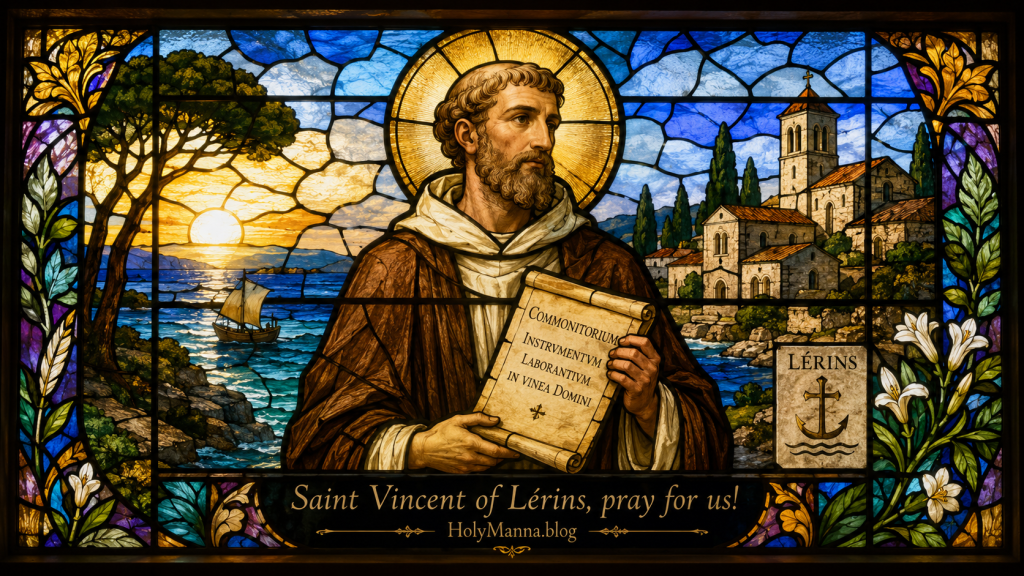
The Monk Who Taught Catholics to Recognize the Faith
Saint Vincent of Lérins is not remembered because he ruled a kingdom, founded a global religious order, or died in a bloody martyrdom. He is remembered because he gave Catholics one of the clearest ways to recognize true doctrine in a confusing world.
He was a fifth-century monk, priest, and theological writer who lived at the famous monastery of Lérins, on the island now known as Saint-Honorat, near Cannes, France. His life was mostly hidden, but his words became famous. His great work, the Commonitorium, helped the Church explain how Catholic teaching remains faithful to the Apostles while still growing in clarity over time.
Saint Vincent is most known for what is often called the Vincentian Canon: “that which has been believed everywhere, always, and by all.” In other words, the Catholic faith is not invented by each generation. It is received, guarded, clarified, and handed on.
That makes Saint Vincent especially important today. In an age of spiritual confusion, religious novelty, online arguments, and personal interpretations of Scripture, he reminds Catholics that truth is not something to be reinvented. It is something to be received from Christ through His Church.
From the Noise of the World to the Silence of Lérins
Very little is known with certainty about Saint Vincent’s early life. He was likely born in Gaul, in what is now France, probably into a well-educated or noble family. Some Catholic traditions say he may have been the brother of Saint Lupus of Troyes, though this cannot be stated with complete certainty.
Before entering monastic life, Vincent seems to have lived in the world with some status. Catholic tradition often remembers him as a man who may have served in the military or held some public position. This comes partly from his own language in the Commonitorium, where he describes himself as having once been tossed by the “tempests of secular warfare” before finding refuge in the harbor of religious life.
Whether that means literal military service or a broader life of worldly struggle, the spiritual meaning is clear. Vincent knew what it meant to live amid ambition, conflict, pride, and distraction. Then he chose something different.
He withdrew to the monastery of Lérins, a remarkable center of Catholic prayer, study, discipline, and holiness. Founded by Saint Honoratus, Lérins became known for forming monks, bishops, saints, and theologians. It was not a noisy place of worldly power. It was an island of prayer, and that is where Vincent found his mission.
He wrote under the name Peregrinus, meaning “pilgrim” or “stranger.” That name says a lot about him. Vincent saw himself as someone passing through this world, not belonging to its vanities, but journeying toward God.
The Commonitorium and the Gold of Catholic Tradition
Saint Vincent’s great contribution to the Church was the Commonitorium, written around A.D. 434. The word means something like a reminder or memorandum. He wrote it to help Catholics remember how to distinguish true doctrine from heresy.
His concern was not theoretical. The early Church had endured major doctrinal battles. Arianism had denied the full divinity of Christ. Nestorianism had divided Christ in a way that endangered the truth that Mary is truly the Mother of God, because the child born of her is one divine Person, Jesus Christ. Other errors also threatened the faithful.
Vincent understood something every Catholic still needs to understand: false teachers often quote Scripture. They may sound biblical. They may use holy words. They may even appear learned and persuasive. But Scripture must be read within the living faith of the Catholic Church.
That is deeply rooted in Catholic teaching. The Catechism of the Catholic Church teaches that Sacred Scripture and Sacred Tradition flow from the same divine source and together make present the one deposit of faith entrusted to the Church. The Church does not invent revelation. She receives it, guards it, and faithfully interprets it through the Magisterium. This is especially clear in CCC 75–79, CCC 84–87, and CCC 112–114.
Saint Vincent’s famous rule was simple but profound. Catholics should hold to the faith believed “everywhere, always, and by all.” He explained that true Catholic teaching is recognized through universality, antiquity, and consent. It must be rooted in the faith of the whole Church, connected to the teaching handed down from the beginning, and supported by the faithful witness of the Church’s approved teachers.
He also gave one of the most beautiful images for Tradition. Reflecting on Saint Paul’s command to guard the deposit of faith in 2 Timothy 1:14, Vincent taught that what the Church has received must be handed on faithfully. He wrote, “You have received gold; give gold in turn.”
That line captures his whole soul. The Church may explain the gold more clearly. She may polish it. She may defend it. She may present it in language that helps a later generation understand. But she may never replace the gold with brass, lead, or counterfeit metal.
A Saint of Clarity, Not a Saint of Spectacle
Saint Vincent is not mainly remembered for miracles during his lifetime. Catholic sources do not preserve major well-attested stories of healings, exorcisms, apparitions, or dramatic wonders connected to him personally.
That may feel surprising because many saints are remembered through miracle stories. But Vincent’s holiness appears in another form. His life was marked by humility, prayer, study, monastic discipline, priestly service, and a fierce love for the truth Christ entrusted to His Church.
His great “work,” if it can be called that, was helping Catholics remain faithful when heresy sounded convincing. That is no small thing. It takes courage to defend truth when error wears religious clothing. It takes humility to submit personal opinions to the faith of the Church. It takes love to guard doctrine, not as an abstract idea, but as the saving truth given by Christ.
Vincent also taught that Catholic doctrine can genuinely develop. He was not saying the Church should freeze in the past. He was saying that authentic development must remain faithful to what was already given.
He wrote that there can be real progress in Christ’s Church, but only if it is truly progress, not alteration. His famous phrase says doctrine must grow “in the same doctrine, in the same sense, and in the same meaning.”
That matters. A child grows into an adult, but remains the same person. A seed grows into a tree, but does not become a different species. In the same way, Catholic doctrine can become clearer, more precise, and more deeply understood, but it cannot become the opposite of what the Church received from the Apostles.
The Catechism of the Catholic Church teaches this same reality in CCC 94, explaining that the Church grows in understanding the deposit of faith through contemplation, study, spiritual experience, and the preaching of bishops who have received the sure charism of truth.
The Burden of Controversy
Saint Vincent was not a martyr. There is no reliable tradition that he died violently for the faith. His hardships were the quieter but still serious struggles of monastic life, doctrinal controversy, and fidelity during a time when the Church was battling dangerous errors.
He lived in a period when theological confusion could divide communities, mislead souls, and damage the faithful’s understanding of Christ. Vincent’s battle was fought with prayer, Scripture, Tradition, and careful reasoning.
One of the more surprising parts of his story is that he has sometimes been associated with the grace controversies of southern Gaul. Some later scholars connected him with positions that resembled what came to be called Semi-Pelagianism. That point must be handled carefully from a Catholic perspective.
The Church honors Saint Vincent as a saint and values his witness to Catholic Tradition. At the same time, saints can live before certain theological questions are fully clarified by the Church. The later Council of Orange in 529 clarified Catholic teaching on grace, especially that even the beginning of faith is made possible by God’s grace. The Catechism of the Catholic Church teaches that faith is a gift of God and that the grace of God moves and assists the human heart, while the human person truly cooperates with that grace. This is especially reflected in CCC 153–155.
So Saint Vincent should not be read as a flawless private theologian on every disputed question. He should be loved as a holy monk, priest, and defender of Catholic continuity, whose greatest contribution remains his teaching on how the Church recognizes and preserves the apostolic faith.
The Voice That Would Not Die
One of the most memorable stories associated with Saint Vincent is not a miracle story, but a strange literary one. According to early testimony, the greater part of the second book of his work was stolen during his lifetime. Because of that, Vincent reportedly wrote a shorter summary of its substance, and the surviving Commonitorium came down to us in a more limited form.
This story is historically reported in early Catholic tradition, though the full lost portion has not survived. It gives the Commonitorium a certain mystery. A major part of the work disappeared, yet what remained was enough to shape Catholic theology for centuries.
Saint Vincent likely died around A.D. 445, or at least before A.D. 450. His relics were honored at Lérins, and his name entered the memory of the Church. His feast day is celebrated on May 24.
There are no major verified posthumous miracle stories commonly associated with Saint Vincent. No famous healing shrine or dramatic apparition tradition stands at the center of his legacy. His impact after death is found above all in theology, catechesis, apologetics, and Catholic intellectual life.
The monastery of Lérins itself remains an important part of his memory. The island became known as a place of saints, monks, bishops, and missionaries. Over the centuries, Lérins influenced Christian life far beyond southern France. Its spiritual culture helped form men who shaped Catholic life in Gaul and beyond.
Saint Vincent’s cultural impact is strongest wherever Catholics discuss Tradition, doctrinal development, and fidelity to the deposit of faith. The phrase “everywhere, always, and by all” remains one of the most famous summaries of Catholic continuity. His image of handing on gold instead of counterfeit metal still speaks powerfully to catechists, priests, theologians, parents, and anyone responsible for passing on the faith.
Holding the Gold in an Age of Counterfeits
Saint Vincent of Lérins is a saint for Catholics who want to be faithful without being shallow, rooted without being rigid, and thoughtful without becoming proud.
His life asks a very direct question: When the world offers a thousand versions of truth, where does the Catholic heart go for certainty?
Vincent’s answer is the Church. Not because Catholics worship the Church, but because Christ entrusted His teaching to His Church. The same Lord who gave us Scripture also gave us Sacred Tradition and the apostolic authority of the Church to guard and interpret the deposit of faith.
That is why Vincent still matters. He reminds Catholics that novelty is not always wisdom. Popularity is not always truth. A Bible verse pulled away from the Church’s living Tradition can be twisted into something dangerous. But the faith handed down through the Catholic Church is not a personal opinion. It is a treasure.
His teaching can be lived in very practical ways. Catholics can read Scripture with the mind of the Church. They can study The Catechism of the Catholic Church instead of relying only on social media arguments. They can ask whether a teaching is rooted in the Church’s Tradition before accepting it as truth. They can speak about doctrine with humility, remembering that the faith is received before it is explained.
Saint Vincent does not invite Catholics into suspicion or fear. He invites them into confidence. Christ has not abandoned His Church. The Holy Spirit still guides her. The gold is still gold.
Engage with Us!
Share your thoughts and reflections in the comments below. Saint Vincent of Lérins gives Catholics a powerful reminder that the faith is not something to reinvent, but something to receive, cherish, and hand on with love.
- Where do you usually turn when you are confused about a Catholic teaching?
- How can Saint Vincent’s rule of “everywhere, always, and by all” help you recognize the difference between true doctrine and spiritual novelty?
- What does the image “You have received gold; give gold in turn” teach you about passing the faith to your family, friends, parish, or children?
- How can you grow in understanding the Catholic faith without drifting away from what the Church has always taught?
- What is one practical way you can read Scripture more faithfully with the mind of the Church this week?
May Saint Vincent of Lérins help us love the truth, guard the faith, and hand on the Gospel with courage and humility. Let us live each day rooted in Christ, faithful to His Church, and ready to do everything with the love and mercy Jesus taught us.
Saint Vincent of Lérins, pray for us!
Follow us on YouTube, Instagram and Facebook for more insights and reflections on living a faith-filled life.


Leave a Reply