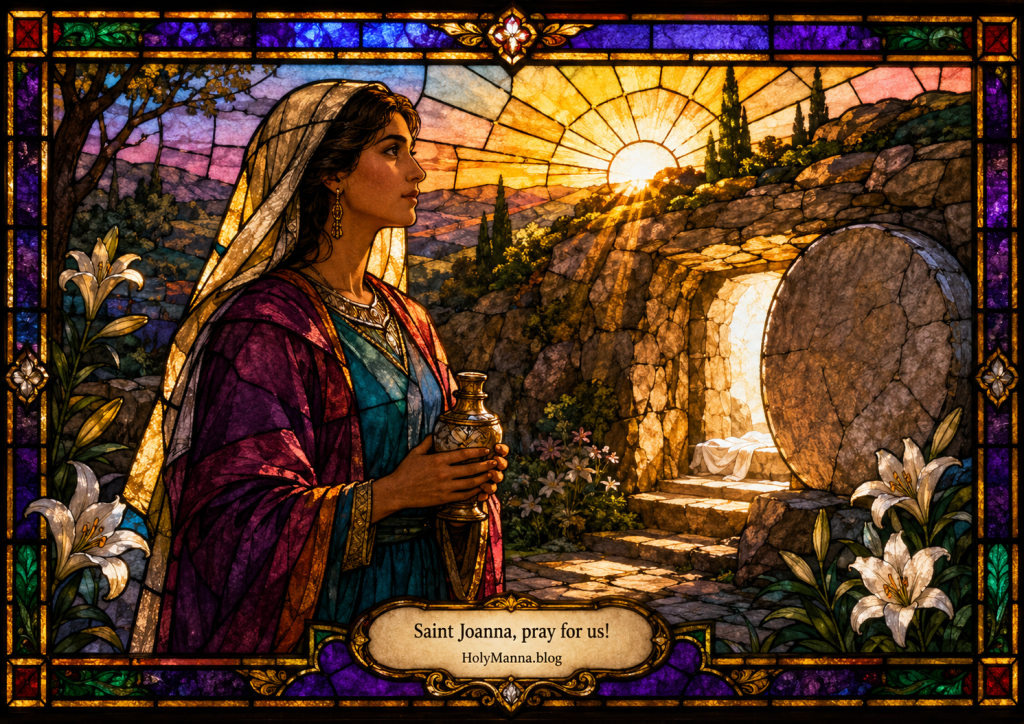
The Woman from Herod’s House Who Ran Toward the Empty Tomb
Saint Joanna, wife of Chuza, is one of those quiet Gospel saints whose name appears only briefly, but whose witness reaches all the way to Easter morning. She was a disciple of Jesus, a woman healed by Him, a generous supporter of His public ministry, and one of the holy women who went to the tomb and became among the first messengers of the Resurrection.
Saint Luke introduces her in Luke 8:1-3, where Jesus is traveling from town to town proclaiming the Kingdom of God. Alongside the Twelve were several women who had been healed by Christ. Among them were Mary Magdalene, Joanna, Susanna, and many others. Luke tells us these women helped provide for Jesus and the Apostles “out of their resources.”
That one detail tells a whole story. Joanna was not merely inspired by Jesus from a distance. She placed her life, her resources, and her influence at His service. She followed Him when it was costly. She remained close when it was dangerous. She showed up at the tomb when hope seemed buried.
In Catholic tradition, Joanna is remembered as Saint Joanna or Blessed Joanna. The Roman Martyrology commemorates her on May 24 as the wife of Chuza, Herod’s steward, and as the woman mentioned by Saint Luke. She is also honored among the holy women of the Gospel, often associated with the Myrrhbearers, those faithful women who came to anoint the body of Jesus and instead heard the first proclamation of Easter joy.
A Woman of Means, a Heart Claimed by Christ
Scripture does not give us Joanna’s birthplace, childhood, parents, or early family background. Like many holy women of the New Testament, she enters the Gospel suddenly, not through a long biography, but through the fruit of grace already at work in her life.
What we do know is striking. Joanna was married to Chuza, the steward of Herod Antipas. Chuza likely held a significant position in Herod’s household, managing property, resources, or affairs connected to the tetrarch’s court. This means Joanna probably lived in a world of status, wealth, political access, and danger.
That is what makes her discipleship so powerful. Herod Antipas was no harmless ruler. He was the man who had Saint John the Baptist imprisoned and executed. He was also the ruler before whom Jesus was mocked during His Passion. Joanna lived close to a palace where ambition, fear, compromise, and spiritual blindness were very real.
And yet, Joanna followed Jesus.
Her conversion or deepening of faith seems to have come through healing. In Luke 8:2, Saint Luke says that the women following Jesus had been cured of evil spirits and infirmities. He does not say what afflicted Joanna specifically. It may have been physical illness. It may have been spiritual suffering. It may have been a burden known only to her and to Christ. But the Gospel makes the important point clear: Jesus healed her, and she responded with discipleship.
That pattern is deeply Catholic. Grace comes first. Christ acts first. He heals, restores, forgives, and calls. Then the soul responds. Joanna’s life reflects what The Catechism of the Catholic Church teaches about the lay faithful, who are called to bring Christ into the ordinary places of life, especially where only they can reach. Her palace connection, her household position, and her resources all became places where grace could bear fruit.
Saint Joanna shows that holiness is not limited to those who leave the world entirely behind. Sometimes holiness means belonging to Christ while standing in the middle of a complicated household, a political environment, or a world that does not understand the Gospel.
The Disciple Who Served with Her Resources
Saint Joanna is most known during Jesus’ public ministry as one of the women who helped sustain the Lord and His Apostles. That might sound simple, but it is spiritually profound.
Jesus and the Twelve traveled, preached, healed, and proclaimed the Kingdom. Their mission required food, lodging, practical support, and material assistance. Joanna helped provide that. She took what she had and placed it under the Lordship of Christ.
This is not a small detail. In a world that often separates faith from money, Joanna teaches that resources are never spiritually neutral. Wealth can become an idol, or it can become an offering. Influence can feed pride, or it can serve the Kingdom. Comfort can make a soul sleepy, or it can become a tool of mercy.
Joanna chose the better path.
She reminds Catholics that generosity is not an accessory to discipleship. It is part of discipleship. She did not need a pulpit to preach. Her offering preached. Her support helped the Gospel move from town to town. Her gratitude became practical love.
This fits beautifully with the Church’s teaching on the dignity and mission of the laity. The Catechism teaches that lay Christians share in Christ’s prophetic office and are called to bear witness to Him in everyday life. Joanna did exactly that. She used the ordinary things of her life, including her means and position, for an extraordinary purpose.
No miracles are recorded as being performed by Joanna during her lifetime. The miracle associated with her life is the one she received from Jesus. She was healed by Him. That healing became the seed of her mission.
Faithful Near the Cross and Brave at the Tomb
Saint Luke does not name Joanna directly at the Crucifixion, but he gives an important clue. In Luke 23:49, he says that the women who had followed Jesus from Galilee stood at a distance and saw the events of His Passion. In Luke 23:55-56, he says these same women saw the tomb and how His body was laid, then prepared spices and perfumed oils.
Since Joanna is named in Luke 8 among the women who followed Jesus from Galilee and then named again in Luke 24 among the women who announced the empty tomb, Catholic tradition reasonably remembers her as one of those faithful women who stayed close through the Passion, burial, and Resurrection.
This matters. Joanna did not follow Jesus only when crowds were excited and miracles were happening. She stayed close when the Lord was rejected. She remained near when the Apostles scattered in fear. She went to the tomb when love seemed to have ended in death.
Then came the moment that changed everything.
In Luke 24:1-10, Joanna and the other women came to the tomb with spices. They found the stone rolled away. They entered and did not find the body of the Lord Jesus. Two men in dazzling garments appeared and said, “Why do you seek the living one among the dead?”
Saint Luke then names the women who told the Apostles: Mary Magdalene, Joanna, Mary the mother of James, and the others with them. Their message was not believed at first. The Apostles thought their words sounded like nonsense. But Peter ran to the tomb and found it just as they had said.
The Catechism of the Catholic Church highlights the importance of this moment. In CCC 641, the Church teaches that Mary Magdalene and the holy women were “the first messengers of Christ’s Resurrection.” Joanna belongs to that sacred company.
That is her great legacy. She was among the first to carry the announcement that death had been defeated.
A Saint Between the Palace and the Kingdom
Joanna’s hardships are not described in detail, and she is not known as a martyr in Roman Catholic tradition. There is no verified account of her death, burial place, later ministry, or final years. Scripture becomes silent after naming her among the women at the empty tomb.
But her known circumstances suggest a real spiritual tension. She was connected to Herod’s household. Her husband served a ruler who had killed John the Baptist and mocked Jesus. To follow Christ from that environment would not have been socially easy or spiritually comfortable.
Her courage was quieter than martyrdom, but not insignificant. She lived near power and chose humility. She had access to privilege and chose service. She belonged to a household tied to Herod, yet her name is remembered with the friends of Jesus.
There is a lesson here for anyone trying to live faithfully in a difficult workplace, divided family, secular culture, or compromised environment. Joanna did not wait for perfect surroundings before serving Christ. She followed Him from where she was.
That is a very Catholic kind of courage.
The Legend of Saint John the Baptist’s Head
One of the most famous traditions associated with Joanna comes especially from Eastern Christian memory and is sometimes repeated in Catholic saint references. According to this tradition, after Herod had Saint John the Baptist beheaded, the Baptist’s head was cast into an unclean place. Joanna, because of her connection to Herod’s household, learned of this and recovered the head. She then buried it honorably on the Mount of Olives, on land associated with Herod.
This story cannot be verified from Scripture, so it should be treated as a pious tradition rather than confirmed history. Still, it is spiritually fitting. Joanna is remembered in the Gospel as a woman close to Herod’s court but faithful to Jesus. The legend presents her as honoring the prophet whom Herod had murdered, quietly resisting the cruelty of the palace by an act of reverence.
It also deepens the contrast in her life. Herod’s court rejected holiness, but Joanna honored it. Herod silenced John the Baptist, but Joanna is remembered as protecting his dignity. Herod mocked Jesus, but Joanna helped announce His Resurrection.
Whether or not the legend can be verified, it expresses something true about her Gospel witness: Joanna belonged to Christ more deeply than she belonged to the world of Herod.
A Quiet Legacy After Death
There are no widely documented Roman Catholic miracle traditions attributed to Joanna after her death. There are no famous shrines universally associated with her relics, no verified posthumous healings commonly tied to her intercession, and no preserved quotations from her.
Her legacy is different. It is scriptural, liturgical, and spiritual.
She is remembered in the Roman Martyrology on May 24. She is honored as one of the holy women who supported Jesus and witnessed the empty tomb. In Eastern Christian tradition, she is often remembered among the Myrrhbearers. In Catholic reflection, she stands as a model of generous discipleship, hidden courage, and Easter witness.
Her cultural impact has grown in modern Christian imagination because her life touches so many themes that still matter today. She was a woman of means who used her resources for the Gospel. She lived near political power without letting power own her soul. She followed Jesus after being healed. She remained faithful in the sorrow of the Passion. She carried the news of the Resurrection when others struggled to believe.
That is why Joanna should not be treated as a minor footnote. The Gospel may give her only a few verses, but those verses place her remarkably close to the heart of salvation history.
The Lesson of Saint Joanna for Today
Saint Joanna teaches that discipleship does not always look dramatic from the outside. Sometimes it looks like quiet generosity. Sometimes it looks like staying faithful in a difficult household. Sometimes it looks like using money wisely, supporting the mission of the Church, and refusing to let comfort become the center of life.
She also teaches that Christ’s healing is never meant to end with the person healed. Jesus restored Joanna, and Joanna responded by following Him. She became a benefactor, a servant, and finally a witness to the Resurrection.
There is also something deeply encouraging about her presence at the tomb. Joanna went there carrying spices for a dead body, but God gave her a message for the living Church. She came to perform one final act of love, and she left carrying the first light of Easter.
Where is Christ asking for quiet faithfulness today?
What resources, relationships, talents, or influence could be placed more fully at the service of the Gospel?
Is there a place in life that feels spiritually difficult, but where Christ is still calling for courage?
Saint Joanna reminds the Church that hidden saints are never hidden from God. The world may remember kings and rulers, but heaven remembers the women who loved Jesus, served Him, and ran from the empty tomb with the news that changed the world.
Engage with Us!
Share your thoughts and reflections in the comments below. Saint Joanna’s life is short in Scripture, but her witness is full of meaning for anyone trying to follow Jesus faithfully in ordinary life.
- What part of Saint Joanna’s story speaks most strongly to your own faith journey?
- How can her example help Catholics use their resources, time, and influence more generously for Christ?
- Have you ever had to follow Jesus in an environment where faith felt difficult, unpopular, or misunderstood?
- What does it mean to you that Joanna and the holy women were among the first messengers of the Resurrection?
May Saint Joanna inspire a deeper courage, a quieter generosity, and a stronger love for the Risen Christ. May her witness remind every heart that no act of faithful service is wasted, no hidden sacrifice is forgotten, and no place is too complicated for grace. Live with faith, serve with humility, and do everything with the love and mercy Jesus taught us.
Saint Joanna, pray for us!
Follow us on YouTube, Instagram and Facebook for more insights and reflections on living a faith-filled life.

 Holy Manna!
Leave a comment