Pentecost Sunday – Lectionary: 63
When Heaven Breathes Through Locked Doors
There are moments when the soul knows it was made for more, but fear still keeps the door locked.
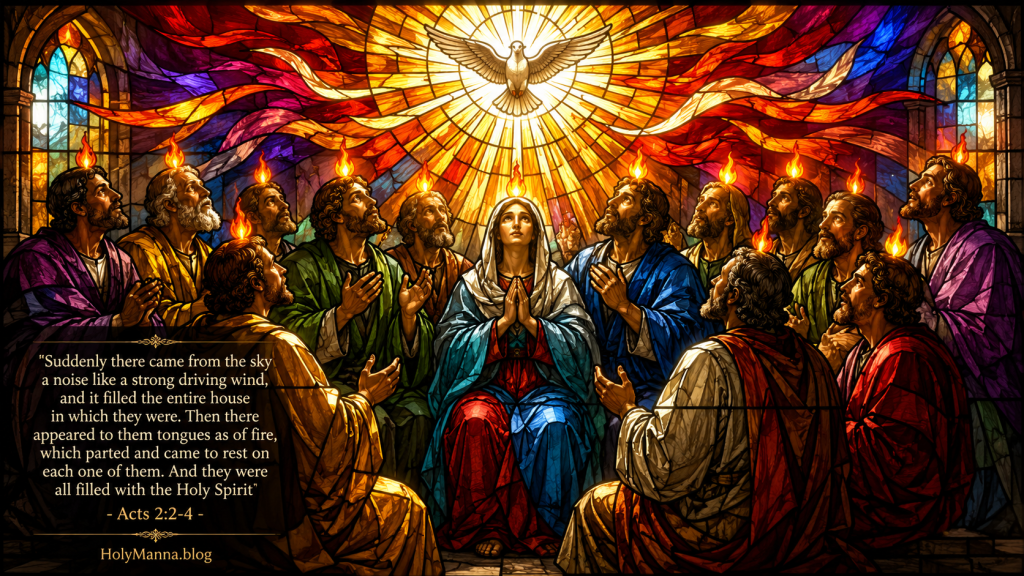
Pentecost Sunday brings the Church into one of the most powerful scenes in salvation history. The disciples are gathered in Jerusalem during the Jewish feast of Pentecost, a pilgrimage feast celebrated fifty days after Passover. Devout Jews from many nations have come to the holy city, carrying different languages, cultures, memories, and hopes. Into that crowded and divided world, the Holy Spirit descends with wind and fire, and suddenly the mighty works of God are proclaimed in words every heart can understand.
The central theme of today’s readings is the transforming power of the Holy Spirit. In Acts 2:1-11, the Spirit turns fearful disciples into bold witnesses. In Psalm 104, the Spirit is the breath of life who renews creation itself. In 1 Corinthians 12:3-7, the Spirit gives different gifts for the good of the one Body of Christ. In John 20:19-23, the risen Jesus enters the locked room, speaks peace, breathes the Holy Spirit upon the apostles, and entrusts them with the forgiveness of sins.
This is not just a story about spiritual excitement. This is the birthday fire of the Church’s mission. Pentecost reveals that the Church is not built by human talent, clever strategy, or emotional momentum. She is born from the risen Christ, filled by the Holy Spirit, and sent to gather the nations into one family of faith. What sin scatters, the Spirit gathers. What fear locks away, the Spirit sends out. What guilt buries in shame, Christ raises through mercy.
The readings also show how deeply Catholic Pentecost truly is. The Holy Spirit does not create isolated believers who follow Jesus privately. He forms a Church, gives apostolic authority, pours out gifts for service, and renews the world through grace. As The Catechism of the Catholic Church teaches, the Holy Spirit is the one who awakens faith, gives new life, and continues Christ’s mission in the Church.
So today’s readings invite every Catholic to stand in that upper room with the apostles. The doors may be locked by fear, exhaustion, sin, confusion, or discouragement, but the risen Jesus still comes into the middle of it all and says, “Peace be with you.” Then He breathes His Spirit again.
Where does the heart need Pentecost today?
First Reading – Acts 2:1-11
When Fire Falls and the Church Finds Her Voice
The first reading for Pentecost Sunday places the Church in Jerusalem, fifty days after Passover, during the Jewish feast of Pentecost. This feast was also known as the Feast of Weeks, a pilgrimage celebration that brought devout Jews from many nations into the holy city. In that setting, God chooses the perfect moment to reveal that the Gospel is not meant to stay locked in one room, one culture, or one language.
The apostles are gathered together, waiting in obedience for the promise of Christ. They are not yet bold public preachers. They are not yet fearless missionaries. They are disciples who have seen the risen Lord, but still need the power of the Holy Spirit to become the Church in full public mission.
This reading fits perfectly into today’s central theme: the Holy Spirit transforms fear into mission, division into unity, and ordinary disciples into witnesses of the mighty works of God. Pentecost is not just a dramatic spiritual moment. It is the visible beginning of the Church’s universal mission.
Acts 2:1-11 – New American Bible (Revised Edition)
The Coming of the Spirit. 1 When the time for Pentecost was fulfilled, they were all in one place together. 2 And suddenly there came from the sky a noise like a strong driving wind, and it filled the entire house in which they were. 3 Then there appeared to them tongues as of fire, which parted and came to rest on each one of them. 4 And they were all filled with the holy Spirit and began to speak in different tongues, as the Spirit enabled them to proclaim.
5 Now there were devout Jews from every nation under heaven staying in Jerusalem. 6 At this sound, they gathered in a large crowd, but they were confused because each one heard them speaking in his own language. 7 They were astounded, and in amazement they asked, “Are not all these people who are speaking Galileans? 8 Then how does each of us hear them in his own native language? 9 We are Parthians, Medes, and Elamites, inhabitants of Mesopotamia, Judea and Cappadocia, Pontus and Asia, 10 Phrygia and Pamphylia, Egypt and the districts of Libya near Cyrene, as well as travelers from Rome, 11 both Jews and converts to Judaism, Cretans and Arabs, yet we hear them speaking in our own tongues of the mighty acts of God.”
Detailed Exegesis
Verse 1 – “When the time for Pentecost was fulfilled, they were all in one place together.”
Pentecost means fiftieth, because it was celebrated fifty days after Passover. For Israel, it was a harvest feast and later associated with the giving of the Law at Mount Sinai. For the Church, it becomes the day when the new law of the Spirit is written not on stone tablets, but in human hearts. The disciples are gathered in unity, and that detail matters. The Holy Spirit descends upon a praying community, not upon scattered individuals chasing private spiritual experiences.
Verse 2 – “And suddenly there came from the sky a noise like a strong driving wind, and it filled the entire house in which they were.”
The sound comes from heaven, which tells the reader that Pentecost is God’s action before it is the Church’s action. The wind recalls the breath of God in creation and the life-giving Spirit who brings dead things back to life. The house is filled before the apostles go out, showing that mission begins with being filled by God. The Church cannot give what she has not first received.
Verse 3 – “Then there appeared to them tongues as of fire, which parted and came to rest on each one of them.”
Fire in Scripture often signals God’s presence, purification, judgment, and consecration. Moses encountered God in the burning bush. Israel followed the pillar of fire through the wilderness. Now fire rests on the apostles, not to consume them, but to transform them. The fire appears as tongues because the Holy Spirit is preparing them to speak. Their mission will be proclamation, and their words will be set aflame by grace.
Verse 4 – “And they were all filled with the holy Spirit and began to speak in different tongues, as the Spirit enabled them to proclaim.”
This verse reveals that the apostles do not create their own mission. They are filled, enabled, and sent. The Holy Spirit gives them the power to proclaim what they could not proclaim by courage alone. The miracle is not simply emotional enthusiasm. It is intelligible witness. The Spirit gives the Church a voice so that Christ can be announced to the nations.
Verse 5 – “Now there were devout Jews from every nation under heaven staying in Jerusalem.”
Pentecost takes place in a city filled with pilgrims. These are devout Jews, along with converts to Judaism, who have come from many lands to worship the God of Israel. This detail shows that God is already preparing the nations to hear the Gospel. Jerusalem becomes the launching point of a mission that will reach the ends of the earth.
Verse 6 – “At this sound, they gathered in a large crowd, but they were confused because each one heard them speaking in his own language.”
The crowd is confused because something impossible is happening. The apostles are Galileans, yet people from many regions hear the message in their own languages. This reverses the confusion of Babel. At Babel, pride scattered humanity and confused speech. At Pentecost, grace gathers humanity and makes divine truth understandable.
Verse 7 – “They were astounded, and in amazement they asked, ‘Are not all these people who are speaking Galileans?’”
Galileans were not expected to be polished international speakers. Their ordinariness makes the miracle even clearer. God chooses humble witnesses so that the power belongs to Him, not to human prestige. This is one of the great consolations of Pentecost. The Holy Spirit does not need impressive people. He needs surrendered people.
Verse 8 – “Then how does each of us hear them in his own native language?”
The miracle touches something deeply personal. Each person hears in his own native language, the language of home, memory, family, and identity. The Gospel is universal, but it is never vague. God speaks to real people in ways they can understand. Catholic evangelization must do the same. It must proclaim the unchanging truth of Christ in a language that reaches actual hearts.
Verse 9 – “We are Parthians, Medes, and Elamites, inhabitants of Mesopotamia, Judea and Cappadocia, Pontus and Asia,”
The list begins to show the wide reach of the Jewish diaspora. These names represent people from east and west, near and far, old empires and distant regions. The Church is being born with the nations already in view. Pentecost reveals that the Gospel is not a local message with limited relevance. It is the announcement of salvation for all peoples.
Verse 10 – “Phrygia and Pamphylia, Egypt and the districts of Libya near Cyrene, as well as travelers from Rome,”
The list expands across the Mediterranean world, even including Rome, the heart of imperial power. This is not accidental. The Gospel will eventually reach Rome itself, and from there the witness of Peter and Paul will become central to the Church’s apostolic mission. Pentecost quietly points forward to the Catholic Church’s universal reach.
Verse 11 – “both Jews and converts to Judaism, Cretans and Arabs, yet we hear them speaking in our own tongues of the mighty acts of God.”
This is the heart of Pentecost. The apostles are not preaching themselves. They are not selling a movement or drawing attention to their own gifts. They are proclaiming what God has done. That is the true voice of the Church. The Holy Spirit gives speech so that Jesus Christ may be known, loved, worshiped, and followed.
Teachings: Pentecost, the Birth of Mission, and the Unity of the Church
Pentecost reveals the Church as one, holy, catholic, and apostolic. She is one because the same Spirit gathers believers into communion. She is holy because the Spirit sanctifies her. She is catholic because the Gospel is proclaimed to every nation. She is apostolic because the Church is sent through the apostles, who receive power from Christ and the Holy Spirit.
The Catechism of the Catholic Church teaches, CCC 731: “On the day of Pentecost when the seven weeks of Easter had come to an end, Christ’s Passover is fulfilled in the outpouring of the Holy Spirit, manifested, given, and communicated as a divine person: of his fullness, Christ, the Lord, pours out the Spirit in abundance.”
This means Pentecost is not separate from Easter. It is the fruit of Easter. The crucified and risen Christ pours out the Holy Spirit so that His saving work may continue in the Church. The fire of Pentecost comes from the victory of the Cross and Resurrection.
The Catechism of the Catholic Church also teaches, CCC 732: “On that day, the Holy Trinity is fully revealed. Since that day, the Kingdom announced by Christ has been open to those who believe in him: in the humility of the flesh and in faith, they already share in the communion of the Holy Trinity. By his coming, which never ceases, the Holy Spirit causes the world to enter into the ‘last days,’ the time of the Church, the Kingdom already inherited though not yet consummated.”
This is a beautiful key to understanding the reading. Pentecost reveals the Trinity in action. The Father sends the Son. The risen Son pours out the Spirit. The Spirit forms the Church and opens the Kingdom to believers. The Church now lives in the time between Christ’s victory and His return in glory.
The miracle of languages also teaches something deeply Catholic about unity. God does not gather the nations by erasing them. The people do not all suddenly become culturally identical. They remain Parthians, Medes, Elamites, Romans, Cretans, Arabs, and others. Yet they hear the one Gospel. Catholic unity does not destroy legitimate diversity. It heals division by gathering every people into the truth of Christ.
This is why Pentecost is often understood as the reversal of Babel. At Babel, humanity tried to build upward in pride, and language became a sign of division. At Pentecost, God comes down in grace, and language becomes a bridge for proclamation. Pride scatters. The Spirit gathers.
Saint Augustine reflected on this mystery when he preached about Pentecost and the unity of the Church. He taught that the Church, spread throughout the nations, speaks in every tongue because she is the Body of Christ. In other words, the miracle of Pentecost continues wherever the Catholic Church proclaims the Gospel across the world in the languages of her children.
Saint John Chrysostom also saw Pentecost as a sign of mission and harvest. The apostles receive fire because the world is ready to be gathered into Christ. Their speech becomes the instrument of divine mercy. Their weakness becomes the stage for God’s power.
This reading also reminds Catholics that evangelization is not optional. The Church receives the Spirit in order to proclaim. A silent Church is not faithful to Pentecost. A hidden disciple is being invited into courage. A baptized Catholic who has received the Holy Spirit is not meant to live as if faith were a private hobby. Faith is personal, but it is never merely private.
The Catechism of the Catholic Church teaches, CCC 767: “When the work which the Father gave the Son to do on earth was accomplished, the Holy Spirit was sent on the day of Pentecost in order that he might continually sanctify the Church.”
Pentecost is not only the beginning of public mission. It is the beginning of the Spirit’s ongoing sanctifying work in the Church. The Holy Spirit continues to purify, strengthen, teach, guide, and send the people of God.
That is why the Church still prays, “Come, Holy Spirit.” It is not a sentimental phrase. It is a cry for the same divine fire that changed frightened disciples into apostles.
Reflection: Let the Spirit Give the Church Her Voice Again
This first reading is not just about what happened to the apostles. It is about what God still wants to do in the Church and in every Catholic soul.
Many people live behind locked interior doors. There are doors locked by fear of judgment, fear of failure, fear of being seen as too religious, fear of speaking the truth, fear of forgiving, fear of confession, and fear of surrender. Pentecost shows that the Holy Spirit does not wait for perfect courage before He comes. He comes to create courage.
The apostles were not chosen because they were naturally fearless. They were filled because they were willing to receive. Their transformation did not come from better planning or stronger personalities. It came from the Holy Spirit.
That matters for daily life. A Catholic parent trying to pass on the faith needs the Holy Spirit. A young adult trying to stay faithful in a cynical culture needs the Holy Spirit. A parish volunteer serving quietly needs the Holy Spirit. A person battling old sins needs the Holy Spirit. Someone trying to forgive a deep wound needs the Holy Spirit. The Church does not run on human stamina. The Church lives by divine breath.
Pentecost also challenges Catholics to speak in a language others can understand. This does not mean watering down the Gospel. It means speaking truth with charity, clarity, patience, and love. The apostles proclaimed “the mighty acts of God” in real human languages. Catholics today are called to do the same in homes, workplaces, friendships, classrooms, parishes, and online spaces.
There is someone nearby who may not understand Catholic vocabulary, but can understand mercy. There is someone who may not know theology, but can recognize peace. There is someone who may not be ready for a long explanation, but can be moved by a holy life. Pentecost invites the Church to become intelligible again, not by becoming worldly, but by becoming more Spirit-filled.
The reading also asks Catholics to examine their gifts. The tongues of fire rested on each one of them. No disciple was skipped. No one was treated as useless. The Holy Spirit gives every baptized person a place in the mission of the Church.
Some are called to teach. Some are called to pray. Some are called to serve the poor. Some are called to strengthen family life. Some are called to create beauty. Some are called to defend truth. Some are called to suffer faithfully. Some are called to encourage quietly. The gift may not look impressive, but when offered to God, it becomes part of Pentecost.
Where is fear keeping the door locked?
What gift has the Holy Spirit already given, and how can it be used for the good of the Church?
Who needs to hear the mighty acts of God in a language they can understand?
Is the heart asking for comfort without mission, or is it ready to be filled and sent?
The first reading ends with the nations hearing God praised in their own tongues. That is the sound of Pentecost. It is the sound of the Church becoming fully alive. It is the sound of fear losing its grip. It is the sound of the Gospel breaking out of the upper room and moving toward the ends of the earth.
The Holy Spirit still wants to make that sound through the Church today.
Responsorial Psalm – Psalm 104:1, 24, 29-31, 34
The Breath of God That Makes the World New
The responsorial psalm for Pentecost Sunday gives the Church one of the most beautiful prayers for understanding the Holy Spirit: “Lord, send out your Spirit, and renew the face of the earth.”
Psalm 104 is a hymn of praise to God the Creator. It looks at the world with wonder and sees everything as dependent on the Lord’s wisdom, power, and life-giving breath. The psalmist does not look at creation as something random, cold, or self-sufficient. He sees a world held in existence by God, clothed in His majesty, filled with His creatures, and renewed by His Spirit.
On Pentecost Sunday, this psalm becomes more than a song about creation. It becomes a prayer for re-creation. In Acts 2:1-11, the Holy Spirit comes with wind and fire, filling the apostles and sending them into mission. In Psalm 104, the same Spirit is the breath that gives life and renews the earth. The connection is clear: the Spirit who gives life to creation also gives supernatural life to the Church.
This fits today’s central theme beautifully. Pentecost is the moment when God renews the face of the earth by first renewing the human heart. The apostles are not simply inspired. They are re-created by grace. The Church is not merely organized. She is filled with divine life.
Psalm 104:1, 24, 29-31, 34 – New American Bible (Revised Edition)
Praise of God the Creator
1 Bless the Lord, my soul!
Lord, my God, you are great indeed!
You are clothed with majesty and splendor,24 How varied are your works, Lord!
In wisdom you have made them all;
the earth is full of your creatures.29 When you hide your face, they panic.
Take away their breath, they perish
and return to the dust.
30 Send forth your spirit, they are created
and you renew the face of the earth.31 May the glory of the Lord endure forever;
may the Lord be glad in his works!34 May my meditation be pleasing to him;
I will rejoice in the Lord.
Detailed Exegesis
Verse 1 – “Bless the Lord, my soul! Lord, my God, you are great indeed! You are clothed with majesty and splendor.”
The psalm begins with worship. Before the psalmist asks for anything, he blesses the Lord. This is important because Pentecost also begins in prayerful waiting. The soul that recognizes God’s greatness becomes ready to receive God’s gift. The Lord is described as clothed with majesty and splendor, meaning creation itself reflects His glory, but never contains Him. God is not part of creation. He is the Creator, Lord, and giver of life.
Verse 24 – “How varied are your works, Lord! In wisdom you have made them all; the earth is full of your creatures.”
The psalmist looks at the diversity of creation and sees wisdom. The variety of God’s works is not chaos. It is ordered beauty. On Pentecost, this verse speaks directly to the many nations gathered in Jerusalem. Parthians, Medes, Elamites, Romans, Cretans, Arabs, and many others are different, yet all are called to hear the same mighty works of God. The Holy Spirit does not destroy variety. He orders it toward communion.
Verse 29 – “When you hide your face, they panic. Take away their breath, they perish and return to the dust.”
This verse humbles the human heart. Every creature depends completely on God. Without His sustaining presence, life collapses. The phrase about returning to the dust recalls Genesis 3:19, where fallen humanity hears, “For you are dust, and to dust you shall return.” The psalm reminds the Church that human strength, intelligence, status, and planning cannot save. Without God’s breath, everything returns to dust.
Verse 30 – “Send forth your spirit, they are created and you renew the face of the earth.”
This is the heart of the psalm for Pentecost Sunday. The Spirit is not only a symbol of comfort. He is the giver of life. When God sends forth His Spirit, creation happens. Renewal happens. Dead places receive breath again. On Pentecost, the apostles become living signs of this verse. Fearful disciples are made new. The Church receives her missionary voice. The face of the earth begins to be renewed through the proclamation of Christ.
Verse 31 – “May the glory of the Lord endure forever; may the Lord be glad in his works!”
The renewal of creation is ordered toward God’s glory. The world exists not for human self-worship, but for divine praise. This verse also reminds Catholics that holiness is not meant to make life smaller or duller. When creation becomes what God made it to be, the Lord is glorified and His works become a cause for joy. Pentecost renews the Church so that the world may once again become a place of praise.
Verse 34 – “May my meditation be pleasing to him; I will rejoice in the Lord.”
The psalm ends personally. After looking at the whole created world, the psalmist turns to his own heart. His meditation, his inner life, his thoughts, and his prayer must be pleasing to God. Pentecost is not only about dramatic public mission. It is also about interior renewal. A Spirit-filled Church begins with Spirit-filled souls, and a renewed world begins with hearts that rejoice in the Lord.
Teachings: The Holy Spirit as Creator, Sanctifier, and Renewer
The responsorial psalm teaches that everything depends on God’s Spirit. Creation is not independent from God, and the Christian life is not independent from grace. The same Spirit who gives life to the world gives supernatural life to the soul.
The Catechism of the Catholic Church teaches in CCC 703: “The Word of God and his Breath are at the origin of the being and life of every creature: ‘It belongs to the Holy Spirit to rule, sanctify, and animate creation, for he is God, consubstantial with the Father and the Son. Power over life pertains to the Spirit, for being God he preserves creation in the Father through the Son.’”
This teaching helps Catholics read Psalm 104 with the eyes of faith. The Spirit is not a created force. He is God. He is consubstantial with the Father and the Son. He rules, sanctifies, and animates creation. The breath that gives life is not impersonal energy. He is the Holy Spirit, the Lord and giver of life.
The Catechism of the Catholic Church also teaches in CCC 291: “In the beginning was the Word… and the Word was God… all things were made through him, and without him was not anything made that was made.” It continues by teaching that the New Testament reveals God created everything by the eternal Word, His beloved Son, and that the Church’s faith likewise confesses the creative action of the Holy Spirit, “the giver of life.”
This matters because Pentecost is Trinitarian. The Father sends the Son. The risen Son pours out the Spirit. The Spirit renews creation and sanctifies the Church. The psalm may come from Israel’s prayer, but in the light of Christ, the Church hears in it the mystery of the Holy Trinity.
The Catechism of the Catholic Church teaches in CCC 1989: “The first work of the grace of the Holy Spirit is conversion, effecting justification in accordance with Jesus’ proclamation at the beginning of the Gospel: ‘Repent, for the kingdom of heaven is at hand.’ Moved by grace, man turns toward God and away from sin, thus accepting forgiveness and righteousness from on high.”
This connects beautifully with Pentecost. The Spirit renews the face of the earth by renewing sinners through conversion. Renewal is not just external improvement. It is the grace of turning away from sin and toward God. The Spirit who created life now restores life wounded by sin.
Saint Basil the Great, one of the great Doctors of the Church, wrote powerfully about the Holy Spirit’s work in the soul: “Through the Holy Spirit comes our restoration to paradise, our ascension into the kingdom of heaven, our return to the adoption of sons, our liberty to call God our Father, our being made partakers of the grace of Christ, our being called children of light, our sharing in eternal glory.”
That quote captures the deep meaning of Psalm 104 on Pentecost. The Spirit does not merely refresh emotions. He restores humanity to communion with God. He brings the soul back to paradise, back to sonship, back to light, back to eternal glory.
Saint Augustine also saw creation as a sign that should lift the soul to the Creator. In his preaching and writings, he repeatedly warned that creatures must be loved in God, not in place of God. This is the Catholic way to read Psalm 104. Creation is good, varied, and beautiful, but it is not ultimate. Its beauty points beyond itself to the Lord who made it and sustains it.
Pentecost also has a strong historical place in the Church’s prayer. The ancient hymn Veni Creator Spiritus, often prayed at Pentecost, ordinations, confirmations, councils, and solemn moments of Church life, calls upon the Creator Spirit to come. Its opening words are traditionally rendered: “Come, Creator Spirit, visit the souls of your faithful; fill with heavenly grace the hearts that you created.” This prayer echoes the heart of Psalm 104. The Spirit who creates the heart must also fill the heart.
Reflection: Let the Spirit Renew the Small Places First
The responsorial psalm gives Catholics a prayer that is both cosmic and personal: “Lord, send out your Spirit, and renew the face of the earth.”
That prayer sounds huge because it is huge. The world needs renewal. Families need renewal. Parishes need renewal. Culture needs renewal. Young people need renewal. The lonely, the addicted, the angry, the distracted, the discouraged, and the spiritually numb all need renewal.
But Psalm 104 quietly reminds the reader that renewal begins with dependence. Creation lives because God gives breath. The soul lives because God gives grace. The Church lives because the Holy Spirit fills her.
This is a needed word in a world obsessed with self-sufficiency. People are constantly told to build themselves, brand themselves, optimize themselves, and save themselves. The psalm says something more honest and more freeing. Without God, everything returns to dust. With His Spirit, even dust can live.
So the Pentecost prayer must become personal. Lord, renew this mind. Renew this heart. Renew this marriage. Renew this friendship. Renew this vocation. Renew this parish. Renew this desire for holiness. Renew the courage to confess sin. Renew the joy of prayer. Renew the ability to rejoice in the Lord.
Daily life gives plenty of places to begin. A Catholic can invite the Holy Spirit into the first minutes of the morning instead of reaching immediately for noise. A family can pray, “Come, Holy Spirit,” before difficult conversations. A person carrying resentment can ask for the grace to forgive. Someone spiritually dry can return to confession and Mass with a humble heart. Someone overwhelmed by the world’s brokenness can choose one concrete act of love instead of giving in to despair.
The Spirit renews the face of the earth, but He often begins in hidden rooms of the heart.
Where has life started to feel dry, tired, or spiritually breathless?
What part of the heart needs the Creator Spirit to make it new again?
Is there a place where self-reliance has replaced prayer?
How can ordinary life become more pleasing to God, like the psalmist’s meditation?
The psalm ends with joy: “I will rejoice in the Lord.” That is the fruit of renewal. Not a shallow happiness that ignores suffering, but a deep Christian joy rooted in the God who creates, sustains, forgives, and sends His Spirit again.
Pentecost teaches that the world is not renewed by outrage, fear, or human control. The world is renewed by the Holy Spirit. And the Catholic soul that learns to pray, “Lord, send out your Spirit,” is already standing at the beginning of something new.
Second Reading – 1 Corinthians 12:3-7
One Spirit, Many Gifts, One Church
Saint Paul writes this passage to the Christians in Corinth, a community full of energy, spiritual gifts, social tension, and plenty of confusion. Corinth was a wealthy Greek city known for trade, status, competition, and religious diversity. The Christians there had received real graces from God, but they were also struggling with pride, division, comparison, and disorder in worship.
That background matters because Saint Paul is not trying to kill their spiritual zeal. He is trying to purify it. He wants the Corinthians to understand that authentic gifts of the Holy Spirit always lead to Jesus, build up the Church, and serve the common good. The Spirit does not create chaos, rivalry, or spiritual showmanship. He creates faith, unity, service, and love.
This fits perfectly with the theme of Pentecost Sunday. In Acts 2:1-11, the Holy Spirit gives the apostles the courage to proclaim the mighty acts of God. In Psalm 104, the Spirit renews creation. Here in 1 Corinthians 12:3-7, the Spirit renews the Church from within by giving different gifts to different people, not for personal glory, but for the good of the Body of Christ.
1 Corinthians 12:3-7, 12-13 – New American Bible (Revised Edition)
3 Therefore, I tell you that nobody speaking by the spirit of God says, “Jesus be accursed.” And no one can say, “Jesus is Lord,” except by the holy Spirit.
4 There are different kinds of spiritual gifts but the same Spirit; 5 there are different forms of service but the same Lord; 6 there are different workings but the same God who produces all of them in everyone. 7 To each individual the manifestation of the Spirit is given for some benefit.
12 As a body is one though it has many parts, and all the parts of the body, though many, are one body, so also Christ. 13 For in one Spirit we were all baptized into one body, whether Jews or Greeks, slaves or free persons, and we were all given to drink of one Spirit.
Detailed Exegesis
Verse 3 – “Therefore, I tell you that nobody speaking by the spirit of God says, ‘Jesus be accursed.’ And no one can say, ‘Jesus is Lord,’ except by the holy Spirit.”
Saint Paul begins with discernment. Not every spiritual claim is truly from God. The sure sign of the Holy Spirit is fidelity to Jesus Christ. The Spirit never leads anyone to reject, diminish, or curse the Lord. Instead, He enables the deepest Christian confession: “Jesus is Lord.”
This confession is not just a slogan. In the ancient world, calling Jesus Lord was a bold act of faith. It meant recognizing Him as risen, divine, sovereign, and worthy of total allegiance. Saint Paul teaches that this kind of faith is itself a gift of grace. No one truly confesses Christ as Lord by human effort alone. The Holy Spirit awakens faith, strengthens the soul, and brings the believer into communion with Jesus.
Verse 4 – “There are different kinds of spiritual gifts but the same Spirit.”
Now Saint Paul turns to the variety of gifts in the Church. The Corinthians were tempted to rank spiritual gifts in a prideful way, as if some people were more important because their gifts were more visible. Paul corrects that mindset. There are different gifts, but they all come from the same Holy Spirit.
This is deeply Catholic. The Holy Spirit does not make every disciple identical. He gives different graces to different people for the building up of the one Church. Some gifts are public. Others are hidden. Some are dramatic. Others are quiet and steady. The source is the same Spirit, so no one has a reason to boast.
Verse 5 – “There are different forms of service but the same Lord.”
The word service is important. A spiritual gift is not meant to become a personal brand. It is ordered toward service. The same Lord who washed the feet of His disciples teaches the Church how to use every gift humbly.
Saint Paul connects gifts with service because the Christian life is not about self-display. It is about love. A gift used without humility becomes dangerous. A gift used in service becomes fruitful. The Holy Spirit gives gifts so Christ may be served in His Body, especially in the Church, the poor, the wounded, the confused, and those who need to hear the Gospel.
Verse 6 – “There are different workings but the same God who produces all of them in everyone.”
Saint Paul now points to God the Father as the one who produces these workings in everyone. The passage has a Trinitarian rhythm: the same Spirit, the same Lord, the same God. The Father, Son, and Holy Spirit are at work in the Church.
This means the Church’s life is not merely human organization. Her ministries, vocations, acts of service, and spiritual fruitfulness come from God. The parish volunteer, the priest, the parent teaching a child to pray, the catechist, the person visiting the sick, the quiet intercessor, and the one offering suffering with love can all become instruments of God’s work.
Verse 7 – “To each individual the manifestation of the Spirit is given for some benefit.”
This verse gives the key to the whole reading. The Spirit is given to each person, but never for selfishness. Every authentic manifestation of the Spirit is given for some benefit. That benefit is the building up of the Church and the good of others.
This verse also reminds Catholics that no baptized person is useless in the Body of Christ. The Holy Spirit gives every member a place. Some may have visible gifts, while others serve quietly and faithfully. In God’s eyes, hidden love is not wasted. The Church is renewed when every person stops comparing gifts and starts offering them.
Teachings: Charisms, Communion, and the Common Good
The second reading teaches that the Holy Spirit gives real gifts to the Church, but those gifts must be rooted in faith, humility, and charity. The Corinthians needed this lesson because they were tempted to turn spiritual gifts into spiritual status. Catholics need the same lesson today. The Holy Spirit does not give gifts to feed pride. He gives gifts to build up the Body of Christ.
The Catechism of the Catholic Church, CCC 683, teaches: “No one can say ‘Jesus is Lord’ except by the Holy Spirit. ‘God has sent the Spirit of his Son into our hearts, crying, “Abba! Father!”’ This knowledge of faith is possible only in the Holy Spirit: to be in touch with Christ, we must first have been touched by the Holy Spirit. He comes to meet us and kindles faith in us.”
This teaching explains the first verse of the reading beautifully. Faith is not self-generated. The ability to confess Jesus as Lord is already the work of grace. The Holy Spirit comes first, touches the soul, kindles faith, and brings the believer to Christ.
The Catechism of the Catholic Church, CCC 799, teaches: “Whether extraordinary or simple and humble, charisms are graces of the Holy Spirit which directly or indirectly benefit the Church, ordered as they are to her building up, to the good of men, and to the needs of the world.”
This is exactly what Saint Paul means when he says the manifestation of the Spirit is given “for some benefit.” Charisms are not only extraordinary gifts. They may also be simple and humble. A person does not need to be famous, impressive, or publicly recognized to be used by the Holy Spirit.
The Catechism of the Catholic Church, CCC 800, teaches: “Charisms are to be accepted with gratitude by the person who receives them and by all members of the Church as well. They are a wonderfully rich grace for the apostolic vitality and for the holiness of the entire Body of Christ, provided they really are genuine gifts of the Holy Spirit and are used in full conformity with authentic promptings of this same Spirit, that is, in keeping with charity, the true measure of all charisms.”
This is an important safeguard. A gift must be received with gratitude, but it must also be used in charity. Charity is the true measure of every charism. A person may have talent, eloquence, knowledge, or influence, but without charity, the gift becomes empty. The Holy Spirit always leads the Church toward love.
The Catechism of the Catholic Church, CCC 801, teaches: “It is in this sense that discernment of charisms is always necessary. No charism is exempt from being referred and submitted to the Church’s shepherds. ‘Their office is not indeed to extinguish the Spirit, but to test all things and hold fast to what is good,’ so that all the diverse and complementary charisms work together ‘for the common good.’”
This teaching protects the Church from confusion. The Holy Spirit is not opposed to the Church’s authority. The same Spirit who gives gifts also guides the Church through her shepherds. Authentic Catholic spirituality is never detached from the Body of Christ, the sacraments, doctrine, and legitimate pastoral discernment.
The Nicene Creed, prayed by the Church at Mass, also gives Catholics the proper foundation for understanding this reading: “I believe in the Holy Spirit, the Lord, the giver of life, who proceeds from the Father and the Son, who with the Father and the Son is adored and glorified, who has spoken through the prophets.”
The Holy Spirit is not a feeling, mood, or force. He is the Lord, the giver of life. He is adored and glorified with the Father and the Son. This is why Saint Paul can speak of the Spirit giving gifts, revealing Christ, and building up the Church. The Spirit is God at work in the soul and in the Body of Christ.
Saint Augustine gave the Church a beautiful image for this mystery when he taught: “What the soul is to the body of man, the Holy Spirit is to the Body of Christ, which is the Church.”
That is a powerful way to understand 1 Corinthians 12. Just as the soul gives life and unity to the human body, the Holy Spirit gives life and unity to the Church. The hand, eye, heart, and foot do different things, but they belong to one body. In the same way, Catholics have different gifts, different vocations, and different forms of service, but one Spirit gives life to all.
Historically, this teaching has mattered whenever the Church has faced division, confusion, or spiritual pride. From the early Church in Corinth to the great councils, from monastic communities to modern parishes, the Church has had to remember that spiritual gifts must remain united to Christ, ordered by charity, and placed at the service of the common good.
The lesson is simple, but serious: if a gift leads away from Jesus, it is not from the Holy Spirit. If a gift produces pride, rivalry, or division, it needs purification. If a gift builds up the Church in truth and love, then it bears the mark of the Spirit.
Reflection: Stop Comparing Gifts and Start Offering Them
This reading speaks directly to ordinary Catholic life because comparison is one of the quietest ways the enemy steals joy.
It is easy to look around and think someone else has the better gift. Someone else speaks better. Someone else prays better. Someone else serves better. Someone else seems more confident, more holy, more useful, or more noticed. That kind of comparison can make a person either proud or discouraged, and neither one comes from the Holy Spirit.
Saint Paul gives a better way. There are different gifts, but the same Spirit. Different forms of service, but the same Lord. Different workings, but the same God. The question is not whether one person’s gift looks like another person’s gift. The question is whether the gift has been surrendered to God for the good of others.
A Catholic home needs this reading. Not every family member serves the same way. A parish needs this reading. Not every volunteer has the same role. A workplace needs this reading. Not every act of Christian witness will look dramatic. A friendship needs this reading. Sometimes the most Spirit-filled gift is patient listening, quiet encouragement, or the courage to speak truth with love.
This passage also invites Catholics to ask whether their gifts are serving Christ or serving ego. A gift can start as grace and become twisted by pride if it is used for attention. The Holy Spirit purifies gifts by rooting them in charity. The more a gift becomes about love of God and neighbor, the more fruitful it becomes.
One practical step is to name the gifts God has actually given, not the gifts a person wishes they had. Another step is to offer those gifts daily in prayer. A third step is to ask where the Church, family, parish, or neighbor needs service right now. The Holy Spirit often reveals a gift through the needs placed directly in front of someone.
A person does not need a platform to be useful to God. A baptized Catholic who loves faithfully, serves humbly, prays sincerely, speaks truthfully, and remains close to the sacraments is already part of the Spirit’s work in the Church.
What gift has the Holy Spirit given that has been ignored, buried, or compared to someone else’s?
Is this gift being used for service, or has it quietly become tied to pride, attention, or approval?
Where is the Church, the family, or the parish asking for humble service right now?
Can the heart honestly say, “Jesus is Lord,” not only with words, but with time, choices, relationships, and priorities?
Pentecost reminds Catholics that the Spirit gives fire, but He also gives order. He gives courage, but also humility. He gives gifts, but always for love.
The Church does not need every Catholic to have the same role. She needs every Catholic to surrender their gifts to the same Lord.
Holy Gospel – John 20:19-23
When the Risen Christ Breathes Peace Into Fear
The Holy Gospel brings the Church back to the evening of Easter Sunday. The tomb is empty, Mary Magdalene has announced that she has seen the Lord, and yet the disciples are still gathered behind locked doors. They have heard the news of the Resurrection, but fear still has a grip on the room.
This detail is painfully human. Faith has begun to dawn, but courage has not yet fully risen. The disciples are not out preaching. They are hiding. They know Jesus was crucified, and they understand that association with Him could bring danger. Into that fear, the risen Christ comes, not with condemnation, but with peace.
This Gospel is chosen for Pentecost because it reveals the Easter gift of the Holy Spirit. In Acts 2:1-11, the Spirit descends publicly with wind and fire. In John 20:19-23, Jesus breathes the Spirit personally upon the apostles and gives them a mission of mercy. Together, these readings show that Pentecost is not only about bold proclamation. It is also about forgiveness, apostolic authority, and the peace of Christ entering the locked rooms of the human heart.
John 20:19-23 – New American Bible (Revised Edition)
19 On the evening of that first day of the week, when the doors were locked, where the disciples were, for fear of the Jews, Jesus came and stood in their midst and said to them, “Peace be with you.” 20 When he had said this, he showed them his hands and his side. The disciples rejoiced when they saw the Lord. 21 [Jesus] said to them again, “Peace be with you. As the Father has sent me, so I send you.” 22 And when he had said this, he breathed on them and said to them, “Receive the holy Spirit. 23 Whose sins you forgive are forgiven them, and whose sins you retain are retained.”
Detailed Exegesis
Verse 19 – “On the evening of that first day of the week, when the doors were locked, where the disciples were, for fear of the Jews, Jesus came and stood in their midst and said to them, ‘Peace be with you.’”
The Gospel begins on “the first day of the week,” the day of the Resurrection. This is why Sunday becomes the Lord’s Day for Christians. A new creation has begun. Yet the disciples are behind locked doors, still afraid.
The phrase “for fear of the Jews” must be read carefully through Catholic teaching. Jesus, Mary, the apostles, and the first disciples were Jewish. The Gospel is describing the disciples’ fear of hostile religious authorities in that moment, not giving permission for hatred toward the Jewish people. The Catholic Church firmly rejects that. Nostra Aetate 4 teaches: “True, the Jewish authorities and those who followed their lead pressed for the death of Christ; still, what happened in His passion cannot be charged against all the Jews, without distinction, then alive, nor against the Jews of today.”
Then Jesus comes and stands in their midst. The locked doors cannot keep Him out. He does not wait for them to become brave enough to open up. He enters their fear and speaks the first gift of the Resurrection: “Peace be with you.” This is not ordinary calm. This is the peace of the risen Lord, the peace won through the Cross.
Verse 20 – “When he had said this, he showed them his hands and his side. The disciples rejoiced when they saw the Lord.”
Jesus shows them His wounds. The risen Lord is not a ghost, not an idea, and not a memory. He is truly risen in His glorified body, and the wounds of His Passion remain as signs of His victorious love.
This is one of the most Catholic images in all of Scripture. The wounds are not erased. They are glorified. Jesus does not hide what love cost Him. He shows His hands and His side so the disciples can recognize that the Crucified One and the Risen One are the same Lord.
The disciples rejoice when they see Him. Their fear begins to give way to Easter joy. Christian joy is not the denial of suffering. It is the discovery that suffering, sin, violence, betrayal, and death do not have the final word. The wounded Christ is alive.
Verse 21 – “[Jesus] said to them again, ‘Peace be with you. As the Father has sent me, so I send you.’”
Jesus repeats His peace because the mission He gives them can only be received from peace. The apostles are not sent out as panicked activists or self-appointed teachers. They are sent by Christ Himself.
The words “As the Father has sent me, so I send you” reveal the apostolic nature of the Church. Jesus was sent by the Father, and now He sends the apostles. Their mission flows from His mission. They are not creating a new message. They are carrying His message, His mercy, His authority, and His saving work into the world.
Verse 22 – “And when he had said this, he breathed on them and said to them, ‘Receive the holy Spirit.’”
This verse is full of creation language. In Genesis, God breathes life into Adam. Here, the risen Jesus breathes the Holy Spirit upon the apostles. This is the beginning of a new creation. Humanity wounded by sin is being renewed by the breath of Christ.
The action is intimate and deliberate. Jesus does not merely speak about the Spirit. He breathes the Spirit upon them. The same Lord who conquered death now gives divine life to His Church. Pentecost will manifest this gift publicly, but here the Gospel shows the risen Christ personally communicating the Spirit to the apostles.
Verse 23 – “Whose sins you forgive are forgiven them, and whose sins you retain are retained.”
This verse reveals the sacramental mission of mercy entrusted to the apostles. Jesus gives them the Holy Spirit and immediately speaks about the forgiveness of sins. This is not a vague command to be nice or emotionally supportive. It is real authority given by the risen Christ.
The Catholic Church sees here the foundation of the Sacrament of Penance and Reconciliation. The apostles, and their successors through the ordained priesthood, are entrusted with the ministry of forgiving and retaining sins in Christ’s name. This does not compete with God’s authority, because only God forgives sins. Rather, Christ chooses to work through His Church as the visible instrument of His mercy.
Teachings: The Spirit, the Church, and the Forgiveness of Sins
This Gospel shows the mission of Christ becoming the mission of the Church. Jesus enters the locked room, speaks peace, reveals His wounds, sends the apostles, breathes the Holy Spirit, and gives the authority to forgive sins. Every part of the scene matters.
The Catechism of the Catholic Church, CCC 730, teaches: “At last Jesus’ hour arrives: he commends his spirit into the Father’s hands at the very moment when by his death he conquers death, so that, ‘raised from the dead by the glory of the Father,’ he might immediately give the Holy Spirit by ‘breathing’ on his disciples. From this hour onward, the mission of Christ and the Spirit becomes the mission of the Church: ‘As the Father has sent me, even so I send you.’”
This teaching captures the heart of the Gospel. The Cross, Resurrection, gift of the Spirit, and mission of the Church belong together. Jesus does not rise from the dead and leave the disciples as spectators. He sends them. The Church continues His mission because the Holy Spirit makes that mission possible.
The Catechism of the Catholic Church, CCC 976, teaches: “The Apostle’s Creed associates faith in the forgiveness of sins not only with faith in the Holy Spirit, but also with faith in the Church and in the communion of saints. It was when he gave the Holy Spirit to his apostles that the risen Christ conferred on them his own divine power to forgive sins: ‘Receive the Holy Spirit. If you forgive the sins of any, they are forgiven; if you retain the sins of any, they are retained.’”
This is the Catholic meaning of John 20:22-23. Forgiveness of sins is not separated from the Holy Spirit or from the Church. Christ gives His own divine power to the apostles, not because they possess it by nature, but because He chooses to act through them.
The Catechism of the Catholic Church, CCC 1441, teaches: “Only God forgives sins. Since he is the Son of God, Jesus says of himself, ‘The Son of man has authority on earth to forgive sins’ and exercises this divine power: ‘Your sins are forgiven.’ Further, by virtue of his divine authority he gives this power to men to exercise in his name.”
This teaching protects the sacrament from misunderstanding. Priests do not forgive sins by their own holiness, personality, or power. Christ forgives through the ministry He entrusted to His Church. Confession is not a human invention. It is the mercy of the risen Christ applied personally to the sinner.
The Catechism of the Catholic Church, CCC 1446, teaches: “Christ instituted the sacrament of Penance for all sinful members of his Church: above all for those who, since Baptism, have fallen into grave sin, and have thus lost their baptismal grace and wounded ecclesial communion. It is to them that the sacrament of Penance offers a new possibility to convert and to recover the grace of justification.”
This is why the Gospel is such good news. Jesus does not merely tell the apostles to remember Him. He gives the Church a sacrament for sinners who need to come home. The locked room becomes the place where mercy is entrusted to the Church.
The Fathers of the Church also saw deep meaning in this passage. Saint Augustine reflected often on Christ’s wounds, teaching that the risen Lord kept them not because He needed them, but because they strengthened the faith of the disciples. The wounds became the proof of love and the medicine for doubt. Saint Gregory the Great also preached that the Lord’s wounds healed the wounds of unbelief, especially in the encounter with Thomas that follows this Gospel.
This reading also carries an important historical significance. The Church’s sacramental practice of confession developed in discipline over time, but its roots are here in the words of Christ. From the apostolic age onward, the Church understood that reconciliation with God and with the Church was not merely private. Sin wounds communion, and Christ gives His Church the ministry of reconciliation.
Pentecost, then, is not only about speaking in tongues or missionary courage. It is also about sacramental mercy. The same Spirit who gives fire to the apostles gives forgiveness to sinners through the Church.
Reflection: Let Christ Enter the Locked Room
This Gospel speaks to anyone who has ever believed in Jesus and still felt afraid.
The disciples had seen so much. They had followed Jesus, heard His teaching, watched His miracles, and received the news that He had risen. Yet they were still behind locked doors. That should bring a strange comfort. Jesus does not abandon disciples who are still afraid. He comes into the room.
There are many locked rooms in ordinary Catholic life. Some are locked by shame. Some are locked by anxiety. Some are locked by old sins that have never been brought honestly to confession. Some are locked by grief, resentment, disappointment, or fear of what surrender might cost. Some are locked by the pressure to keep faith private and avoid standing out.
The risen Jesus still stands in the middle of those places and says, “Peace be with you.”
But His peace is not passive. After speaking peace, He sends. The Christian life cannot remain locked inside comfort. Peace becomes mission. Forgiveness becomes witness. The Spirit becomes courage.
A practical response to this Gospel begins with letting Christ show His wounds. That means looking honestly at the Cross and remembering what mercy cost Him. It also means allowing personal wounds to be brought into His presence instead of hidden in fear. The wounds of Jesus are not symbols of defeat. They are the doorway into trust.
Another practical response is returning to confession with faith. The Sacrament of Penance is one of the clearest ways this Gospel touches daily life. When a Catholic confesses sincerely, the words of absolution are not mere encouragement. They are the mercy of the risen Christ, given through the ministry He established when He said, “Whose sins you forgive are forgiven them.”
This Gospel also asks Catholics to become people of peace in a restless world. That does not mean avoiding truth or pretending everything is fine. The peace of Christ is honest, wounded, and victorious. It can enter a tense home, a struggling marriage, a fractured friendship, a divided parish, or an anxious heart.
What door has fear locked from the inside?
Where does the heart need to hear Jesus say, “Peace be with you,” with real trust?
Is there a sin, wound, or burden that needs to be brought to confession instead of carried alone?
How is Christ sending this life outward in peace, mercy, and courage?
The Gospel ends with mercy entrusted to the Church. That is the beauty of Pentecost. The Holy Spirit does not simply make the apostles brave. He makes them ministers of reconciliation.
The risen Christ still enters locked rooms. He still shows His wounds. He still breathes His Spirit. He still forgives sins. He still sends His Church into the world with peace.
When the Spirit Opens the Door
Pentecost Sunday brings every reading into one bright and burning truth: the Holy Spirit comes to renew what fear, sin, division, and weakness have tried to bury.
In Acts 2:1-11, the Spirit descends like wind and fire, and the Church finds her voice. The apostles are no longer silent, hidden, or uncertain. They are filled with divine courage and begin proclaiming “the mighty acts of God” to people from every nation. What began in one room suddenly becomes a mission for the whole world.
In Psalm 104, the Church prays, “Send forth your spirit, they are created and you renew the face of the earth.” This shows that Pentecost is not only about the apostles. It is about re-creation. The same Spirit who gives life to creation gives new life to the soul, the Church, and the world. God does not patch up what is broken. He renews it from the inside.
In 1 Corinthians 12:3-7, Saint Paul reminds the Church that the Holy Spirit gives different gifts, but always for one purpose: the good of the Body of Christ. No gift is meant for pride. No vocation is useless. No act of humble service is wasted. The Spirit does not make everyone the same. He makes everyone fruitful when their gifts are surrendered to Jesus.
Then in John 20:19-23, the risen Christ enters the locked room, speaks peace, shows His wounds, breathes the Holy Spirit, and gives the apostles the authority to forgive sins. This is the mercy at the heart of Pentecost. The Spirit does not simply make the Church bold. He makes her a minister of reconciliation. Through Christ, the Church becomes a place where sinners can come home.
Together, these readings reveal the full beauty of Pentecost. The Holy Spirit gives courage for mission, breath for renewal, gifts for service, and mercy for sinners. He gathers what sin has scattered. He gives life where the soul has grown tired. He opens the doors that fear has locked. He makes the Church alive.
This feast is an invitation to stop treating faith like something small, private, or safe. The Holy Spirit was not poured out so disciples could remain hidden. He was given so the Church could proclaim Christ with courage, serve with humility, forgive through mercy, and renew the world with holiness.
So the call today is simple and serious. Pray for the Holy Spirit again. Return to confession if the heart needs mercy. Offer personal gifts for the good of the Church. Speak about Christ with charity and courage. Let peace enter the places where fear has been sitting too long.
Where does the heart need Pentecost today?
What door has been locked that Christ is ready to open?
What gift has the Holy Spirit given that now needs to be offered with love?
The risen Jesus still stands in the middle of the Church and says, “Peace be with you.” Then He breathes His Spirit again and sends His people out, not as spectators, but as witnesses.
Come, Holy Spirit. Renew the face of the earth, beginning with every heart willing to be set on fire.
Engage with Us!
Share your reflections in the comments below. Pentecost Sunday invites every heart to ask where the Holy Spirit is calling it out of fear, into renewal, and deeper into the mission of Christ.
- First Reading, Acts 2:1-11: Where is the Holy Spirit asking you to move from silence into faithful witness, so that others can hear “the mighty acts of God” through your words and life?
- Responsorial Psalm, Psalm 104:1, 24, 29-31, 34: What part of your heart, family, parish, or daily routine needs the prayer, “Send forth your spirit, they are created and you renew the face of the earth”?
- Second Reading, 1 Corinthians 12:3-7: What gift has the Holy Spirit given you for the good of the Church, and how can you use it with humility instead of comparison or fear?
- Holy Gospel, John 20:19-23: What locked room in your life needs the risen Jesus to enter with His words, “Peace be with you”, and is there a place where confession, forgiveness, or mercy needs to begin again?
May this Pentecost renew every heart with courage, peace, and holy fire. Let the Holy Spirit lead the Church into deeper faith, stronger witness, and a more generous love. Live this week as someone sent by Christ, and do everything with the love and mercy Jesus taught us.
Sacred Heart of Jesus, we trust in You!
Immaculate Heart of Mary, pray for us!
Saint Michael the Archangel, defend us in battle!
Follow us on YouTube, Instagram and Facebook for more insights and reflections on living a faith-filled life.


Leave a Reply