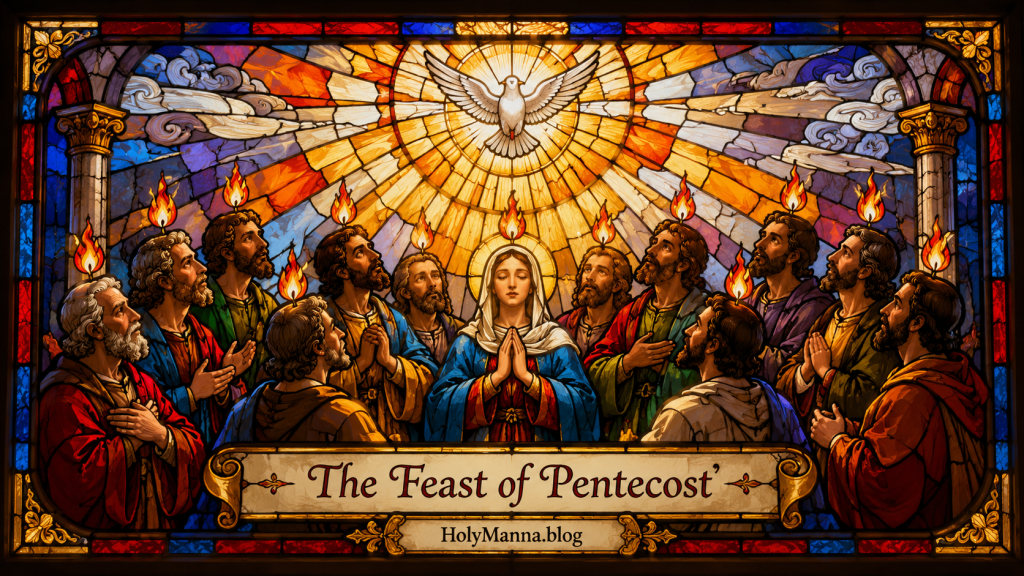
When Heaven Filled the Upper Room
Pentecost is one of the great solemnities of the Catholic Church, celebrated fifty days after Easter. Its name comes from the Greek word for “fiftieth,” and it marks the day when the Holy Spirit descended upon Mary and the Apostles in the Upper Room. It is the great feast of the Church made visible, alive, and missionary.
Before Pentecost, the disciples had seen the risen Christ, but they were still waiting. They had received the promise, but not yet the power. They had faith, but they had not yet gone out to the nations. Then the Holy Spirit came with wind, fire, and speech, and the Church stepped into the streets of Jerusalem with a courage that could only come from God.
The Catechism of the Catholic Church teaches that “On the day of Pentecost when the seven weeks of Easter had come to an end, Christ’s Passover is fulfilled in the outpouring of the Holy Spirit” Catechism of the Catholic Church, 731. That sentence says so much. Pentecost is not separate from Easter. It is Easter brought to its full fruit. The risen Christ pours out the Spirit, and the Church begins her mission of proclaiming salvation to every nation.
From Sinai to Jerusalem: The Story Behind the Feast
Pentecost has roots deep in the Jewish faith. In ancient Israel, the Feast of Weeks was celebrated fifty days after Passover. It was a harvest feast, a day of thanksgiving for the first fruits, and in Jewish tradition it also became associated with the giving of the Law at Mount Sinai. That background matters because the Catholic Church sees Pentecost as fulfillment, not replacement. God prepared His people through the Law, the prophets, the covenant, and the worship of Israel. Then, in Christ, He fulfilled what He had promised.
At Sinai, God gave the Law written on tablets of stone. At Pentecost, God gave the Holy Spirit, who writes the law of love into the hearts of believers. At Sinai, Israel was formed as God’s covenant people. At Pentecost, the Church was manifested publicly as the people of the New Covenant. At Babel, human pride scattered the nations through confused language. At Pentecost, the Holy Spirit gathered many nations into one proclamation of Christ.
The story is told in the Acts of the Apostles. The disciples were gathered together when “there came from the sky a noise like a strong driving wind” and tongues as of fire appeared and rested on each of them. They were filled with the Holy Spirit and began to speak in different tongues as the Spirit enabled them. Devout Jews from many nations heard them proclaiming the mighty works of God in their own languages. What looked like confusion from the outside was actually divine order from within.
Then Peter stood up.
That detail should not be missed. Peter, who had once denied Jesus out of fear, now preached Christ boldly in public. He proclaimed that Jesus, crucified and risen, is Lord and Messiah. The people were cut to the heart and asked what they should do. Peter answered with the apostolic call that still echoes through the Church: “Repent and be baptized, every one of you, in the name of Jesus Christ for the forgiveness of your sins.” About three thousand were added that day.
Pentecost is not only a miracle of speech. It is a miracle of conversion. The Spirit does not come merely to make the Apostles impressive. He comes to make Christ known, to bring sinners to repentance, and to gather people into the Church through Baptism.
The Day the Church Stepped Into the World
Pentecost is often called the birthday of the Church, and that phrase can be beautiful when understood correctly. The Church was founded by Christ. She was prepared through Israel, formed by Jesus’ preaching and miracles, built upon Peter and the Apostles, born from the pierced side of Christ on the Cross, and nourished by the Eucharist. But at Pentecost, the Church is publicly manifested and sent.
The Catechism says, “The Church was made manifest to the world on the day of Pentecost by the outpouring of the Holy Spirit” Catechism of the Catholic Church, 1076. That is the key. Pentecost is the moment when the Church, already gathered by Christ, becomes visible in mission. She no longer waits behind closed doors. She speaks, baptizes, teaches, forgives, suffers, and evangelizes.
This is why Pentecost is deeply Apostolic. The Holy Spirit does not bypass the Apostles. He empowers them. He does not create a private spirituality detached from the Church. He sends the Church into the world with the authority of Christ. Jesus had already told the Apostles after the Resurrection, “As the Father has sent me, so I send you.” Then He breathed on them and said, “Receive the Holy Spirit. Whose sins you forgive are forgiven them, and whose sins you retain are retained.” The Spirit is therefore connected to mission, apostolic authority, and the forgiveness of sins.
That matters today because many people think of the Holy Spirit only in emotional terms. Of course, the Spirit can console, stir the heart, and bring deep peace. But in the Catholic faith, the Holy Spirit also sanctifies through the sacraments, preserves the Church in truth, strengthens the faithful for witness, and unites believers to Christ in His Body, the Church.
The Holy Spirit Is God, Not a Feeling
Pentecost reveals the Holy Spirit as the Third Person of the Most Holy Trinity. He is not an energy, symbol, mood, or vague religious inspiration. He is true God, adored and glorified with the Father and the Son.
The Catechism teaches that the Holy Spirit is “consubstantial with the Father and the Son” Catechism of the Catholic Church, 685. At Pentecost, the Trinity is revealed in the life of the Church. The Father sends the Son. The Son accomplishes the work of redemption. The Father and the Son pour out the Holy Spirit. The Church receives the Spirit and is sent to proclaim Christ to the nations.
This is why Pentecost belongs at the center of Catholic life. Without the Holy Spirit, the Church would be an institution without divine life. Scripture would be words without illumination. Sacraments would be rituals without grace. Evangelization would be marketing without conversion. Holiness would be self-improvement instead of sanctification.
The Holy Spirit is the soul of the Church’s mission. He makes Christ present. He gives life to prayer. He strengthens the weak. He purifies the sinful. He gives courage to the fearful. He makes saints.
The Sacramental Fire of Pentecost
Pentecost is especially connected to Baptism and Confirmation. In the early Church, Pentecost was one of the great times for Baptism, along with Easter. In some traditions, the newly baptized wore white garments, which is connected to the old English name “Whitsunday.” That memory still makes sense because Pentecost is a feast of new life.
Confirmation is even more directly linked to Pentecost. The Catechism teaches that Confirmation brings “the full outpouring of the Holy Spirit as once granted to the apostles on the day of Pentecost” Catechism of the Catholic Church, 1302. Through Confirmation, the baptized are strengthened to spread and defend the faith by word and action. They are marked with the seal of the Holy Spirit and given grace to live as mature witnesses of Christ.
Pentecost also shines light on the Sacrament of Reconciliation. In the Gospel read for Pentecost, Jesus breathes on the Apostles and gives them the authority to forgive sins. This is not a small detail. The Spirit who descended at Pentecost is the same Spirit who brings mercy through the ministry of the Church. He does not merely inspire people to feel forgiven. He works through the sacrament Christ gave for the forgiveness of sins.
The Eucharist, too, is inseparable from the Spirit. Every Mass is a work of the Holy Trinity. The priest invokes the Holy Spirit over the gifts, and by divine power the bread and wine become the Body and Blood of Christ. The same Spirit who filled the Upper Room continues to sanctify the Church at every altar.
Mary in the Upper Room: The Mother Who Prayed With the Church
Pentecost is also a Marian feast in a quiet but powerful way. Acts of the Apostles tells us that the disciples devoted themselves to prayer with Mary, the Mother of Jesus. She is there in the Upper Room, not as a preacher replacing the Apostles, but as the Mother praying with the newborn Church.
This is deeply fitting. At the Annunciation, the Holy Spirit overshadowed Mary, and the Son of God took flesh in her womb. At Pentecost, the Holy Spirit descends again, and the Mystical Body of Christ is manifested to the world. Mary is present at both mysteries. She is Mother of Christ, and she is Mother of the Church.
This is why the Church celebrates the Memorial of the Blessed Virgin Mary, Mother of the Church, on the Monday after Pentecost. After the Spirit descends and the Church is sent, the faithful look to Mary as the mother who teaches the Church how to receive God, ponder His word, and obey with trust.
Mary shows what Pentecost looks like in a soul that is fully open to God. She is not frantic. She is faithful. She does not grasp for attention. She receives grace and magnifies the Lord. In a world addicted to noise, Mary teaches the Church how to wait, pray, and welcome the Spirit.
Prayer, Devotion, and Pilgrimage in the Fire of the Spirit
One of the most beloved devotions connected to Pentecost is the Holy Spirit Novena. It recalls the nine days of prayer between the Ascension and Pentecost, when Mary and the Apostles waited for the promised Spirit. In that sense, it is often called the original novena. Before there were programs, campaigns, and strategies, there was the Church praying in the Upper Room.
The simplest Pentecost prayer is still one of the most powerful: “Come, Holy Spirit, fill the hearts of your faithful and enkindle in them the fire of your love.” That prayer belongs in daily Catholic life. It can be prayed before Mass, before Confession, before teaching, before work, before a hard conversation, before making a decision, or before opening Scripture.
The Church also treasures the great Pentecost sequence, Veni, Sancte Spiritus, often called the Golden Sequence. Its words are tender and beautiful: “Come, Holy Spirit, come!” It asks the Spirit to be light, comfort, healing, rest, refreshment, cleansing, warmth, and strength. It is the prayer of a Church that knows she cannot sanctify herself.
Another major hymn is Veni, Creator Spiritus, traditionally prayed at Pentecost, ordinations, Confirmations, dedications of churches, and other solemn moments when the Church asks the Holy Spirit to descend. It is a prayer for renewal, courage, wisdom, and divine protection.
The most important pilgrimage place connected to Pentecost is the Cenacle, or Upper Room, on Mount Zion in Jerusalem. Catholic tradition associates this sacred place with the Last Supper and the descent of the Holy Spirit. Pilgrims who visit Jerusalem often pray there with a sense of awe because Pentecost is not an abstract idea. It happened in a place, among real people, in the life of the Church.
Pentecost also has a strong Marian pilgrimage dimension. Great Marian shrines around the world, such as Lourdes, Guadalupe, Loreto, and others, remind the faithful that Mary teaches the Church how to pray for the Spirit. True Marian devotion always leads deeper into the life of Christ and the power of the Holy Spirit.
Red Vestments, Golden Hymns, and the Catholic Imagination
The liturgical color for Pentecost is red. It recalls the tongues of fire, the burning charity of the Holy Spirit, and the courage of apostolic witness. Red also reminds Catholics that the same Spirit who gives consolation also gives martyr-like courage. The Spirit does not come only to make life comfortable. He comes to make Christians holy and brave.
The Pentecost liturgy is especially rich. The Vigil readings draw from the great biblical promises of restoration and renewal. The Tower of Babel shows humanity divided by pride. Mount Sinai shows God forming His covenant people. Ezekiel’s dry bones show God breathing life into what seemed dead. Joel’s prophecy announces that God will pour out His Spirit. Then, in the Mass during the Day, Acts of the Apostles shows the promise fulfilled.
Older Catholic customs made this mystery vivid. In some churches, rose petals were dropped from above to symbolize tongues of fire. In some places, trumpets or other sounds recalled the rushing wind. These customs may feel unusual to modern Catholics, but they came from a deeply sacramental imagination. The Catholic instinct knows that invisible grace can be honored through visible beauty.
Different cultures celebrate Pentecost in different ways. Some communities hold processions, special Holy Spirit devotions, Confirmation celebrations, extended vigils, or parish festivals. In many places, Pentecost is a day for invoking the Spirit over families, parishes, catechists, missionaries, and young people preparing to live their faith in public.
The cultural beauty of Pentecost is that it belongs to every language and nation. The miracle of tongues means the Gospel is not trapped in one culture. Christ is for all peoples. The Church is Catholic because she is universal, apostolic, sacramental, and united in the truth of Christ.
The Saints and Popes on the Mystery of Pentecost
The Church Fathers loved Pentecost because they saw its deep unity with the whole story of salvation. Saint Leo the Great connected Pentecost with Sinai. The Law was given fifty days after the Passover, and the Spirit was given fifty days after the Resurrection of Christ, the true Paschal Lamb. For Saint Leo, Pentecost showed both continuity and fulfillment. What God began with Israel, He brought to completion in Christ and poured into the Church through the Spirit.
Saint Augustine saw Pentecost as the feast of Catholic unity. For him, the miracle of languages showed that the Church would speak to every nation. The Holy Spirit was given not for spiritual isolation, but for communion in the Body of Christ. Augustine’s teaching is especially important today because many people want the Spirit without the Church, inspiration without obedience, and faith without visible unity. Pentecost says otherwise. The Spirit gathers.
Saint John Chrysostom emphasized the power of Pentecost to transform fearful disciples into bold witnesses. The Apostles did not become brave because they attended a motivational talk. They became brave because God filled them. Their preaching became fruitful because the Spirit was at work.
Pope Saint John Paul II often spoke of the Holy Spirit as the principal agent of evangelization. Pentecost reminds the Church that mission is not optional. Every baptized and confirmed Catholic is called to witness to Christ in daily life. Some do this in pulpits, classrooms, monasteries, and mission fields. Most do it in homes, workplaces, friendships, and quiet acts of fidelity.
Pope Benedict XVI emphasized that Pentecost begins in prayer. The Church does not receive the Spirit by rushing into activity, but by gathering with Mary, waiting on the promise of Christ, and opening herself to God. That is a needed lesson for a busy Catholic world. Strategy matters, but prayer comes first.
Pope Francis has often described the Holy Spirit as the one who overcomes fear, division, rigidity, and spiritual paralysis. The Spirit does not flatten personalities or erase differences. He creates communion. He does not create chaos. He brings divine life, mercy, and mission.
When the Upper Room Becomes the Heart
Pentecost is not just something that happened long ago in Jerusalem. It is the pattern of Christian life.
Every Catholic has an Upper Room somewhere in the heart. It may be a place of fear, waiting, grief, confusion, shame, or uncertainty. The disciples knew that room well. They had followed Jesus, failed Jesus, seen Jesus risen, and still had to wait for the promise of the Father. That waiting was not wasted. It became the place where the Spirit descended.
That is good news for ordinary Catholics. God can descend into the places that feel locked. He can bring courage where there has been fear. He can bring repentance where there has been sin. He can bring mission where there has been hesitation. He can bring unity where there has been division.
Pentecost also teaches that faith is not meant to stay private in a locked room. The Holy Spirit sends. He sends parents to raise children in the faith. He sends catechists to teach clearly and lovingly. He sends priests to preach and sanctify. He sends religious to witness to the Kingdom. He sends young adults to live chastely and courageously. He sends workers to act with honesty. He sends every Catholic to love, forgive, serve, and speak the truth with charity.
The fruits of the Holy Spirit are not abstract religious words. Love, joy, peace, patience, kindness, goodness, generosity, gentleness, faithfulness, modesty, self-control, and chastity are meant to become visible in real life. Pentecost can be measured in how someone treats family, handles conflict, resists temptation, speaks about others, uses time, and returns to prayer.
Where does the Holy Spirit want to bring fire into daily life today?
What fear needs to become courage?
What locked door needs to open?
What gift has been hidden too long?
The prayer of Pentecost is short enough for a busy day and deep enough for a lifetime: “Come, Holy Spirit.”
Engage with Us!
Share your thoughts and reflections in the comments below. Pentecost is one of those feasts that can meet every Catholic in a different place, especially because the Holy Spirit knows exactly where the heart needs courage, healing, repentance, and renewal.
- Where in your life do you need to pray, “Come, Holy Spirit,” with more trust this week?
- Is there a locked door of fear, shame, or hesitation that God may be asking you to open to His grace?
- How can the gifts of the Holy Spirit help you live your Baptism and Confirmation more faithfully?
- Which fruit of the Holy Spirit do you most need in your family, workplace, parish, or friendships right now?
- How can Mary’s prayerful presence in the Upper Room teach you to wait on God with patience and faith?
Pentecost reminds the Church that God has not abandoned His people. The Holy Spirit still renews hearts, strengthens the weak, forgives sinners, raises up saints, and sends ordinary Catholics into the world with extraordinary grace. May this feast inspire a deeper life of prayer, a stronger love for the sacraments, and a renewed desire to live everything with the love and mercy Jesus taught us.
Holy Spirit, come to us!
Follow us on YouTube, Instagram and Facebook for more insights and reflections on living a faith-filled life.


Leave a Reply