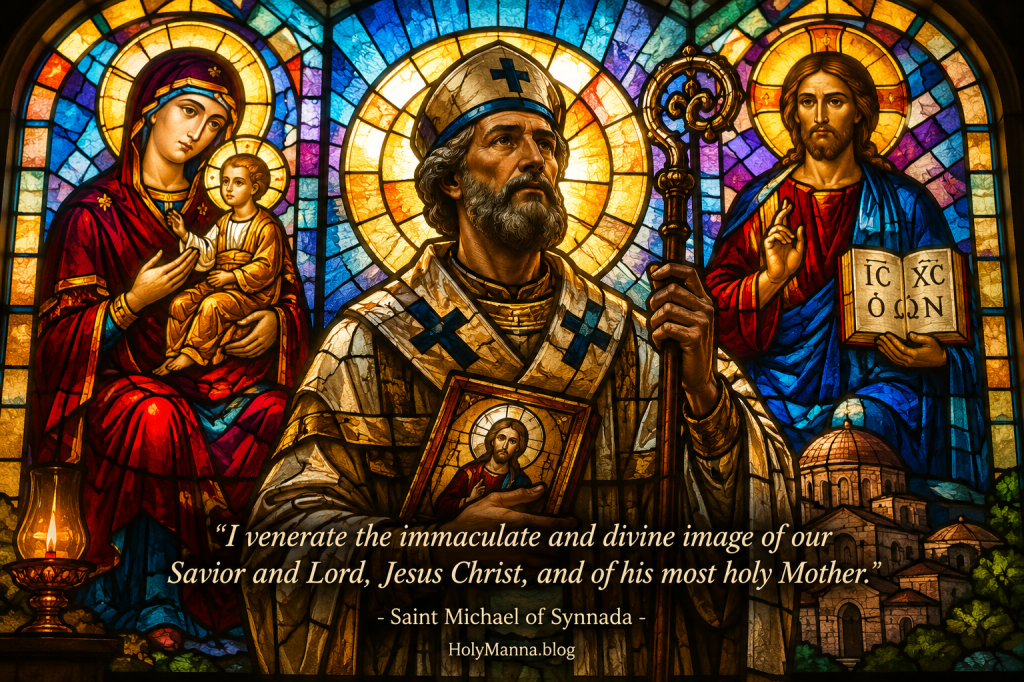
The Bishop Who Defended the Holy Face of Christ
Saint Michael of Synnada, also known as Saint Michael the Confessor, was a bishop from Synnada in Phrygia, in what is now modern-day Turkey. He lived during one of the most intense theological battles in Christian history, the Iconoclast controversy, when emperors and churchmen argued over whether Christians could venerate sacred images of Christ, the Blessed Virgin Mary, the angels, and the saints.
Saint Michael is remembered as a defender of sacred icons, a bishop who suffered exile for the faith, and a man of peace who helped foster unity between Greeks and Latins. He was not only a monk and bishop. He was also trusted as a diplomat, sent between Constantinople, Rome, Charlemagne’s court, and even the Abbasid Muslim world.
What makes Saint Michael so compelling is that his courage was rooted in something deeply Catholic: the mystery of the Incarnation. Christians do not venerate icons because they worship wood, paint, mosaic, or glass. They venerate sacred images because Jesus Christ truly became man. The invisible God became visible in the flesh.
The Catechism of the Catholic Church teaches that “the honor rendered to an image passes to its prototype” and that “whoever venerates an image venerates the person portrayed in it” CCC 2132. Saint Michael suffered because he believed this truth was worth defending.
A Child Entrusted to Saint Michael the Archangel
The details of Saint Michael’s early life are limited, but Catholic tradition places his birth around the middle of the eighth century in Synnada. A later hagiographical tradition says his parents were wealthy but childless, and after praying through the intercession of Saint Michael the Archangel, they received a son and named him Michael in thanksgiving. This story is beautiful and fitting, though it should be understood as a pious tradition rather than a firmly verified historical detail.
As a young man, Michael went to Constantinople for his education. There, he came under the guidance of Saint Tarasius, the Patriarch of Constantinople, a major figure in the Church’s defense of sacred images. Michael also became closely associated with Saint Theophylact of Nicomedia. The two men entered monastic life and were formed in prayer, discipline, study, and service.
This early formation matters because Michael’s later courage did not appear out of nowhere. Before he stood before emperors, he learned to kneel before God. Before he defended icons in public, he allowed Christ to form his heart in silence.
From Monk to Bishop of Synnada
Michael’s holiness and intelligence eventually brought him back into wider service. He was ordained and became bishop of Synnada around the year 787, the same year as the Second Council of Nicaea. That council, recognized by the Catholic Church as the Seventh Ecumenical Council, defended the rightful veneration of sacred images.
This was not a side issue. The fight over icons touched the heart of Christian belief. If Jesus Christ is truly God made man, then His human face can be depicted. If Mary truly bore the Son of God in her womb, then she can be honored in sacred art. If the saints are alive in Christ, then their images can remind the faithful of what grace can do in human lives.
Saint Michael participated in this great Catholic defense of sacred images, and his later sufferings would show that he had not simply signed a theological statement. He had staked his life on the truth behind it.
The Church teaches that sacred images are part of the Christian life because they help direct the heart toward Christ and His saving work. The Catechism explains that Christian iconography expresses in images the same Gospel message that Scripture communicates in words. In other words, sacred art is not decoration for the spiritually sentimental. It is visual theology.
A Diplomat Between East, West, and the Muslim World
One of the most surprising parts of Saint Michael’s life is that he was not only a local bishop. He was also a trusted diplomat during a complicated and tense period of history.
He was sent as an imperial representative to Caliph Harun al-Rashid, one of the most powerful Muslim rulers of the Abbasid world. He also served in diplomatic missions connected to Pope Saint Leo III and Blessed Charlemagne. This means Saint Michael stood at the crossroads of empires, cultures, and Christian communities.
The Roman Martyrology remembers him not only as a defender of icons, but also as a man who fostered peace and concord between Greeks and Latins. That detail is easy to miss, but it is deeply important. Saint Michael did not confuse courage with needless division. He defended the truth, but he also worked for communion.
That makes him a powerful saint for today. In an age when people often think they must choose between conviction and charity, Saint Michael shows another way. He was firm without being faithless to love. He was peaceful without being weak. He was diplomatic without surrendering the faith.
The Miracle of Water and the Harvest Workers
Eastern Christian tradition preserves a story from Michael’s monastic life with Saint Theophylact. During a harvest, workers became exhausted by thirst. Through the prayers of the two holy monks, an empty metal vessel was filled with water for them.
This story cannot be verified in the same way as the major historical events of his life, but it has remained part of the devotional memory surrounding Saint Michael. It reveals how the faithful remembered him: as a man whose prayer brought relief, whose holiness was practical, and whose closeness to God overflowed into care for ordinary people.
Another tradition says Michael and Theophylact prayed during a drought and obtained rain. Like the water vessel story, this should be understood as a devotional tradition rather than a verified historical record. Still, it fits beautifully with the saint’s later connection to crops, harvests, and protection from agricultural disasters.
Saint Michael’s holiness was not abstract. It touched thirsty workers, anxious farmers, and suffering communities. That is a good reminder that Catholic sanctity is never just about private devotion. True holiness becomes mercy in action.
The Emperor Who Wanted Icons Removed
Saint Michael’s greatest trial came under Emperor Leo V the Armenian, who revived Iconoclasm in the Byzantine Empire. Iconoclasm opposed the veneration of sacred images and often treated icons as if they were idols. This brought persecution against bishops, monks, and faithful Christians who defended the Church’s teaching.
When the emperor pressured Church leaders to reject icons, Saint Michael refused. He would not let political power rewrite the faith handed down through the Church. He would not pretend that sacred images were idols. He would not betray the council that had defended the truth of the Incarnation.
A saying attributed to him captures his courage beautifully: “I venerate the immaculate and divine image of our Savior and Lord, Jesus Christ, and of his most holy Mother.”
That sentence is simple, but it is loaded with Catholic theology. Michael was not worshiping an object. He was honoring the One represented. He was confessing that Christ truly became visible, touchable, and human. He was defending the Mother of God, the saints, and the sacred art that helps the faithful lift their minds and hearts to heaven.
A Confessor Sent Into Exile
For his defense of icons, Saint Michael was exiled and imprisoned. He was separated from his people, his diocese, and his homeland. He was not killed in a bloody martyrdom, but the Church honors him as a Confessor because he suffered publicly for Christ and refused to abandon the truth.
This kind of suffering can be easy to overlook. Martyrdom is dramatic and final. Exile is slow. Imprisonment is lonely. Being pushed away from one’s flock, forgotten by the powerful, and forced to endure in silence requires deep perseverance.
Saint Michael died far from his homeland, most likely around the year 826, though some Eastern traditions preserve different dates. Catholic sources most commonly use 826. His death was not the end of his witness. In many ways, it was the beginning of his legacy.
He reminds the Church that faithfulness does not always look victorious in the moment. Sometimes the saint looks defeated. Sometimes the faithful bishop is the one removed from power. Sometimes truth is preserved not by the loudest person in the palace, but by the exiled shepherd who refuses to bend.
Relics, Locusts, and the Memory of a Holy Bishop
After Saint Michael’s death, devotion to him continued, especially in the Christian East. Tradition holds that his relics were preserved in monastic settings, including on Mount Athos. His head has been associated with the Great Lavra of Saint Athanasius, while other relics have been connected to Iviron Monastery. These relic traditions are part of Eastern Christian memory and should be treated as traditional claims rather than modern verified records.
One of the most striking posthumous miracle stories connected to Saint Michael involves a plague of locusts in Cyprus. According to later Eastern tradition, in 1628, after years of locust destruction and famine, the head of Saint Michael was brought from Mount Athos to Cyprus. The relic was carried in procession, prayers were offered, holy water was sprinkled, and the locusts were said to have been driven into the sea.
The story also says that Christians and Muslims gave thanks afterward because the island had been delivered from disaster. This is a powerful legend of intercession and mercy, but it cannot be fully verified historically and should be presented as a later devotional tradition.
Because of stories like this, Saint Michael became associated in some places with the protection of crops, harvests, and communities suffering from pests or drought. That cultural impact may not be widely known in the Latin West, but it shows how deeply local devotion can grow around a saint whose prayers were believed to help people in concrete needs.
Why Saint Michael Still Matters
Saint Michael of Synnada matters because he defended beauty when beauty was under attack. He defended sacred images because he understood that Christian art is not a distraction from doctrine. It is one way doctrine becomes visible.
In a Catholic church, the crucifix tells the truth of Calvary. A statue of Mary reminds the faithful that the Word became flesh in her womb. Stained glass turns sunlight into catechesis. Icons invite prayer. Images of the saints remind ordinary people that holiness is possible.
Saint Michael also matters because he shows how to combine truth and peace. He was a defender of doctrine, but also a bridge between Greeks and Latins. He was strong enough to resist an emperor, but humble enough to serve as a messenger of peace.
That is a rare combination. It is also deeply needed.
What sacred image has helped lift your heart toward God when words were not enough? Where is Christ asking for courage, not aggression, but steady faithfulness? How can beauty become part of your own prayer life again?
Saint Michael’s life invites Catholics to recover confidence in sacred beauty. Not shallow beauty. Not vanity. Not decoration for its own sake. The beauty that points to Christ. The beauty that reminds the soul that God entered history, took on flesh, and sanctified the visible world.
Engage With Us!
Share your thoughts and reflections in the comments below. Saint Michael of Synnada’s life is a powerful reminder that sacred images are not idols, but windows that help the heart contemplate Christ, His Mother, and His saints.
- Has a crucifix, icon, statue, stained glass window, or holy image ever helped you pray more deeply?
- Why do you think beauty matters so much in Catholic worship and devotion?
- Where in your life do you need Saint Michael’s courage to stay faithful under pressure?
- How can Catholics today defend the truth without losing charity and peace?
- What is one way you can bring more sacred beauty into your daily prayer life?
Saint Michael of Synnada teaches that truth is worth suffering for, beauty is worth protecting, and peace is worth building. May his example help every Catholic live with courage, reverence, and love. And may everything be done with the love and mercy Jesus taught us.
Saint Michael of Synnada, pray for us!
Follow us on YouTube, Instagram and Facebook for more insights and reflections on living a faith-filled life.


Leave a Reply