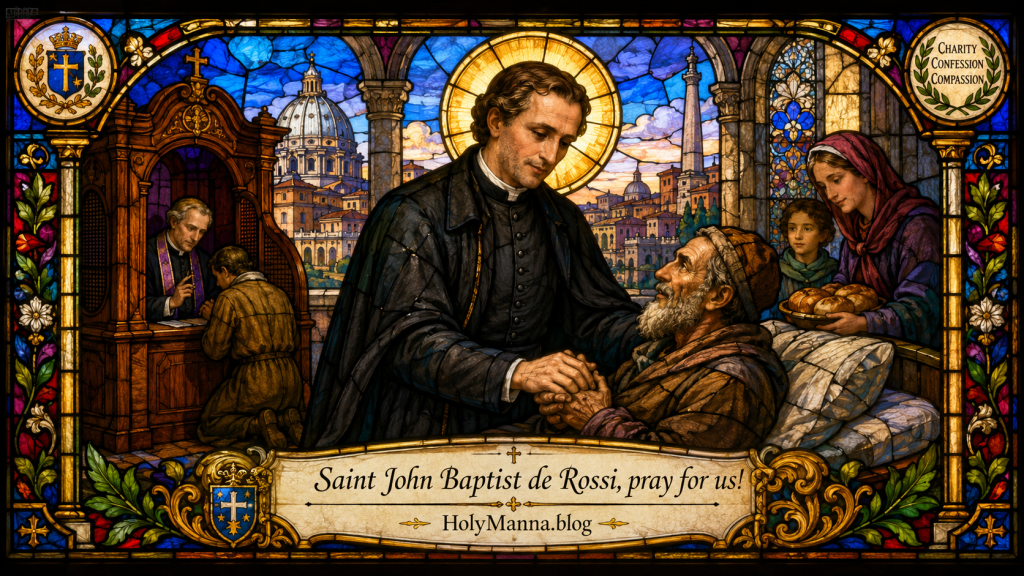
The Confessor Who Went Looking for the Forgotten
Saint John Baptist de Rossi was the kind of priest who reminds the Church that mercy is not a slogan. Mercy has feet. Mercy walks into hospitals, prisons, dark streets, crowded markets, and rooms where sinners are too ashamed to lift their eyes toward God.
Born in 1698 in Voltaggio, near Genoa, Saint John Baptist de Rossi became one of Rome’s most beloved confessors. He was a diocesan priest, not a founder of a religious order, not a bishop, and not a famous theologian in the usual sense. His pulpit was often a hospital room. His mission field was the confessional. His favorite people were the poor, the sick, the homeless, prisoners, laborers, prostitutes, abandoned women, and those who believed they were too far gone for grace.
The Church remembers him as the “Apostle of the Abandoned” and sometimes as a “second Saint Philip Neri.” That comparison says a lot. Like Saint Philip, John Baptist de Rossi understood Rome not only as a city of churches, saints, and pilgrims, but as a city full of wounded souls waiting for someone to come near with the love of Christ.
His life beautifully reflects the teaching of The Catechism of the Catholic Church, which says that the works of mercy are charitable actions by which Christians come to the aid of their neighbor in spiritual and bodily necessities. In him, the corporal and spiritual works of mercy were not separate ministries. They were one life poured out for Jesus.
A Gentle Child Formed for Mercy
Saint John Baptist de Rossi was born on February 22, 1698, to Charles de Rossi and Frances Anfossi. His family was not wealthy, but Catholic tradition remembers them as devout and respected. From childhood, John stood out for his gentle nature, intelligence, modesty, and love for holy things.
Several Catholic sources say that priests noticed his gifts early and encouraged his education. When he was still young, a noble couple from Genoa encountered him after Mass and were struck by his piety. With his father’s permission, they brought him to Genoa so he could continue his studies. His father died while John was still young, and although his mother wanted him home, he believed he needed to continue the path God had opened before him.
In 1711, his cousin Lorenzo de Rossi, a canon of Santa Maria in Cosmedin, called him to Rome. There John studied at the Roman College under the Jesuits. He joined the Sodality of the Blessed Virgin and a group known as the Ristretto of the Twelve Apostles, where he was formed in prayer, devotion, hospital visitation, and works of mercy.
Even before he became a priest, his faith was already practical. He did not see Catholicism as something locked inside a chapel. Prayer had to become service. Devotion had to become charity. Love for Christ had to become love for the poor.
A Weak Body with a Strong Soul
John desired holiness deeply, but in his youth he practiced severe penances that were not always prudent. Catholic sources say his harsh mortifications damaged his health and contributed to epileptic seizures, which afflicted him for the rest of his life.
This is one of the most human parts of his story. John was not a flawless spiritual machine. He was a holy man who had to learn that the body is not an enemy to be destroyed. The Catholic faith does not teach hatred of the body. It teaches discipline, self-mastery, and reverence for the whole person, body and soul.
Because of his epilepsy, his path to ordination was not simple. Under ordinary circumstances, that condition could have prevented him from becoming a priest. Yet he received a dispensation and was ordained on March 8, 1721. Catholic tradition connects his first Mass with Saint Aloysius Gonzaga, one of John’s great spiritual heroes. Some sources say he celebrated it at the tomb of Saint Aloysius, while others say it was at the altar of Saint Aloysius in the Church of Saint Ignatius. Either way, the meaning is clear. John’s priesthood was born under the inspiration of youthful purity, sacrificial love, and heroic devotion.
After ordination, he made a striking promise. He vowed not to accept ecclesiastical benefices unless obedience required it. That may sound like a small historical detail, but it reveals his heart. He did not want rank, comfort, or income. He wanted souls.
The Priest of Hospitals, Prisons, and Dark Streets
Saint John Baptist de Rossi became a priest for people who were easy to ignore.
He visited the sick in hospitals. He served the poor at the Hospice of Saint Galla. He helped provide refuge for vulnerable women, especially those exposed to danger on the streets. He ministered to homeless people, prisoners, prostitutes, laborers, herdsmen, drovers, and teamsters who came into Rome for work.
He did not wait for rough working men to show up neatly dressed at a parish mission. He went to them. He preached to laborers early in the morning or late in the evening, when their schedules allowed them to listen. Near the old Roman Forum, then called Campo Vaccino, he brought the Gospel to people whose lives were hard, exhausting, and often overlooked.
There is something very Catholic and very challenging about that. Saint John Baptist de Rossi did not ask whether the poor were convenient. He asked where they were, when they could listen, and what they needed in order to come closer to Christ.
His method was simple, but powerful. Feed the hungry. Visit the sick. Teach the ignorant. Console the ashamed. Call sinners to repentance. Bring souls to confession. Then do it again the next day.
The Famous Story of the Dying Young Man
One of the most moving stories associated with Saint John Baptist de Rossi involves a young man dying of syphilis. The young man was ashamed, bitter, and resistant to John’s care. He did not want spiritual help. He did not want to be seen in his humiliation.
John did not respond with disgust. He served him.
The story says John even emptied the young man’s bedpan. That small act of humility broke through the man’s shame. Here was a priest who did not merely preach mercy from a safe distance. He touched misery with love. The dying man softened, listened, repented, and made a good confession before death.
That story captures the heart of Saint John Baptist de Rossi’s mission. Some people cannot hear the truth until they first experience love. John did not water down the Gospel. He made the mercy of Christ visible enough that wounded souls could trust it.
This is exactly the kind of mercy the Church teaches. Confession is not humiliation for humiliation’s sake. It is restoration. The Catechism of the Catholic Church teaches that the sacrament of Penance reconciles us with God and restores us to grace. Saint John Baptist de Rossi lived as if he believed that with every fiber of his being.
The Young Man and the Clothes
Another well-known story tells of a young man trapped in a sinful relationship with a woman who came to his house under the pretense of washing and mending his clothes. Saint John Baptist de Rossi spoke with him briefly, but the conversation pierced his conscience.
The next day, the young man returned with a pile of clothes he had taken back from the woman. It was his visible sign that he had broken with the sinful relationship.
This story is often repeated in Catholic accounts of the saint’s pastoral work. It shows that John’s mercy was not sentimental. He loved sinners enough to call them out of sin. He understood that mercy does not mean pretending sin is harmless. Mercy means helping a soul become free.
The Canon Who Refused Comfort
In 1735, John became titular canon of Santa Maria in Cosmedin. After his cousin Lorenzo died, obedience required John to accept the canonry more fully. Yet he did not use the position as a ladder into comfort.
Catholic sources say he refused to live in the house attached to the office and used its value or rent for charitable purposes. Older hagiographical accounts say he quickly disposed of much of the property for the poor.
He also guarded the purity of the confessional. Older Catholic sources say he would not give alms from the confessional to poor penitents and would not accept gifts there from the wealthy. He wanted every soul, rich or poor, to know that his counsel could not be bought, softened, or manipulated by money.
That detail matters. A priest who serves souls must be free. John wanted the poor to receive dignity, and the rich to receive truth.
The Confessor Who Was Once Afraid to Hear Confessions
One of the most surprising facts about Saint John Baptist de Rossi is that he avoided hearing confessions for years.
Because of his epilepsy, he feared having a seizure in the confessional. So, for a time, he preached, instructed sinners, and guided them toward repentance, then sent them to other priests for confession.
In 1738, while recovering at Cività Castellana, the local bishop encouraged him to hear confessions. John reviewed moral theology and eventually received faculties to hear confessions in any church in Rome.
That changed everything.
From then on, the confessional became the center of his priesthood. He spent long hours receiving penitents, especially the poor, the illiterate, the sick, and those who were afraid to approach God. He heard confessions in churches, hospitals, homes, prisons, and wherever mercy was needed.
Catholic tradition remembers him as a “hunter of souls.” That phrase can sound strange to modern ears, but it means something beautiful. He went searching for people who had wandered far from grace, not to shame them, but to bring them home.
Teaching the Faith One Clear Truth at a Time
Saint John Baptist de Rossi was also deeply committed to catechesis. He believed ignorance of the faith was spiritually dangerous, especially for the poor who had never been properly taught.
His most famous saying is:
“Ignorance is the leprosy of the soul.”
That line may sound intense, but it came from pastoral urgency. He knew that people cannot love what they do not know. They cannot follow Christ clearly if no one teaches them the truth with patience and charity.
He also gave practical advice that every Catholic teacher, preacher, parent, podcaster, and blogger should remember:
“Give them one idea that they can take home.”
That is brilliant. He was not trying to impress the poor with complicated speeches. He wanted them to leave with one truth they could remember, pray over, and live.
Another saying attributed to him captures his priestly courage:
“Courage! We are not in the world to follow our own will and pleasure, but to imitate the Lord.”
This was not theory for him. He lived it in sickrooms, prisons, confessionals, shelters, and streets.
Catholic sources also say Pope Benedict XIV entrusted him with the work of teaching catechism to prisoners and government officials, including the public hangman. That is an astonishing detail. John was sent to teach the faith in places touched by crime, punishment, guilt, and death. He carried doctrine into the places where men most needed to remember judgment, mercy, repentance, and hope.
Miracles During Life and the Greater Miracle of Conversion
Saint John Baptist de Rossi is not mainly remembered as a wonder-working saint during his lifetime. The records of his life focus more on charity, preaching, confession, and conversion than on spectacular public miracles.
Yet his ministry was filled with the kind of miracle the Gospel treasures deeply: hardened sinners returning to God.
A dying young man made a good confession because a priest loved him in his humiliation. A young man broke free from sexual sin because John spoke truth with mercy. Poor workers learned the faith in simple words. Prisoners heard doctrine in the shadow of judgment. Sick people met a priest who treated them not as burdens, but as beloved souls.
Older hagiographical traditions also attribute to him extraordinary insight in the confessional. One story says he reminded a penitent of a hidden sin from many years earlier, including details known only to God and the penitent. This story belongs to devotional tradition and cannot be verified with the same certainty as official canonization records, but it reflects the Catholic memory of him as a confessor with unusual spiritual wisdom.
Another story says that when illness confined him to bed, he arranged for a confessional near his couch so penitents who had traveled to him would not be turned away. This story is part of Catholic hagiographical tradition. Whether every detail can be verified or not, it beautifully expresses what the Church remembers about him: he did not want a soul seeking mercy to go home unheard.
Sickness, Perseverance, and a Holy Death
Saint John Baptist de Rossi’s body was fragile for most of his life. Epilepsy, exhaustion, and repeated illness followed him. By the early 1760s, his health had declined seriously.
Catholic accounts say he suffered violent seizures and periods of paralysis. In 1763, he celebrated Mass at Santa Maria in Cosmedin and seemed to indicate that death was near. Later that year, he was found unconscious after a severe seizure. He received Viaticum and the Anointing of the Sick, but then recovered enough to celebrate more Masses before declining again.
He died on May 23, 1764, at Trinità dei Pellegrini in Rome. He was originally buried there near the altar of the Blessed Virgin. Several Catholic sources say his relics were later translated in 1965 to the Roman parish church dedicated to him, San Giovanni Battista de Rossi.
He was beatified by Pope Pius IX on May 13, 1860, and canonized by Pope Leo XIII on December 8, 1881, the Solemnity of the Immaculate Conception.
Miracles and Grace After Death
After his death, devotion to Saint John Baptist de Rossi grew quickly. His cause for canonization began only seventeen years after his death, though political upheaval in Europe delayed the process. Catholic sources say miracles were attributed to his intercession, and Pope Pius IX recognized two miracles before his beatification.
One traditional miracle story concerns Sister Mary Theresa Leonori of the Convent of Saint Cecilia in Rome. She reportedly suffered from an incurable throat disease, had lost her speech, could not take nourishment, and seemed close to death. After invoking Saint John Baptist de Rossi, she was said to have been instantly cured and rose from bed well. This story comes from older Catholic devotional tradition, and the full official details are not easily available, so the specific account cannot be fully verified here.
Other traditions surrounding him include healings and graces received by those who asked his intercession, especially those who were sick, poor, imprisoned, abandoned, or in need of conversion. He remains especially beloved in Voltaggio, his birthplace, and in Rome, the city where he spent his priesthood. The Roman church of San Giovanni Battista de Rossi honors his name, and his memory continues among those devoted to priests who serve the forgotten.
His cultural impact is not the kind that fills museums or crowns kings. It is quieter and more Catholic. He became a model for diocesan priests, confessors, catechists, hospital chaplains, prison ministers, and anyone who believes the Church must go searching for the lost.
Why Saint John Baptist de Rossi Still Matters
Saint John Baptist de Rossi matters because he shows what mercy looks like when it becomes practical.
He did not simply say that God loves sinners. He sat with them. He served them. He heard them. He taught them. He called them to repentance. He brought them to confession.
He did not simply say the poor matter. He gave them his time, his strength, his property, and his priesthood.
He did not simply say doctrine matters. He taught it clearly, especially to those who had been neglected.
He did not simply say suffering can be offered to God. He lived with epilepsy and weakness while still giving himself generously to others.
In a culture that often confuses compassion with approval and truth with harshness, Saint John Baptist de Rossi gives a better way. He shows that Catholic mercy is tender and truthful. It kneels beside the sickbed, but it also leads the soul to confession. It feeds the poor, but it also teaches the faith. It welcomes the sinner, but it does not abandon the sinner to sin.
A Saint for the Ashamed, the Exhausted, and the Overlooked
There is something deeply comforting about a saint like John Baptist de Rossi. He was not famous for worldly brilliance. He did not build a massive institution. He did not have perfect health. He did not begin his priesthood as a fearless confessor.
He became holy by doing the next loving thing in front of him.
He went where people were hurting. He made room for those who felt unwanted. He preached in a way tired people could understand. He entered the confessional even though fear once held him back. He trusted that grace could work through weakness.
That is why his life feels so relevant today. Many people are not rejecting God because they have studied the faith and dismissed it. Many are wounded, ashamed, exhausted, poorly taught, or convinced that no one in the Church would understand them. Saint John Baptist de Rossi reminds Catholics to go find them.
Who are the forgotten people nearby who need not only a kind word, but the mercy of Christ made visible through patient love?
Reflection: Mercy That Moves Toward People
Saint John Baptist de Rossi teaches that holiness is not always dramatic. Sometimes holiness looks like visiting someone no one else wants to visit. Sometimes it looks like teaching the faith patiently to someone who should have been taught years ago. Sometimes it looks like listening in confession until the soul finally believes mercy is possible.
His life is also a reminder that weakness does not disqualify someone from holiness. His epilepsy and poor health were real burdens. Yet those limitations did not stop God from making him a saint. In fact, his weakness may have made him more compassionate toward the fragile and ashamed.
For everyday Catholics, his example is practical. Learn the faith well enough to explain one clear truth to someone else. Make time for the lonely. Do not avoid people simply because their suffering is uncomfortable. Go to confession regularly. Encourage others to return to the sacrament without shaming them. Serve the poor in ways that cost something.
Most of all, remember that mercy must move. Saint John Baptist de Rossi did not wait for the abandoned to find him. He went looking.
What would change if Catholics stopped waiting for wounded people to walk into church, and started meeting them with truth, patience, and mercy?
Engage With Us!
Share your thoughts and reflections in the comments below. Saint John Baptist de Rossi’s life gives so much to think about, especially for anyone who has ever felt too ashamed, too weak, or too ordinary to be used by God.
- What part of Saint John Baptist de Rossi’s story challenges you the most?
- Who are the forgotten or overlooked people in your life, parish, workplace, or neighborhood?
- How can you practice mercy this week in a way that is concrete, humble, and real?
- When was the last time you experienced God’s mercy through confession, prayer, or someone’s kindness?
- What is one truth of the Catholic faith that you could help someone “take home” this week?
Saint John Baptist de Rossi reminds the Church that mercy is not passive. It goes out, bends low, tells the truth, and brings souls back to Jesus. May his example inspire us to live with courage, serve with compassion, and do everything with the love and mercy Jesus taught us.
Saint John Baptist de Rossi, pray for us!
Follow us on YouTube, Instagram and Facebook for more insights and reflections on living a faith-filled life.

 Holy Manna!
Leave a comment