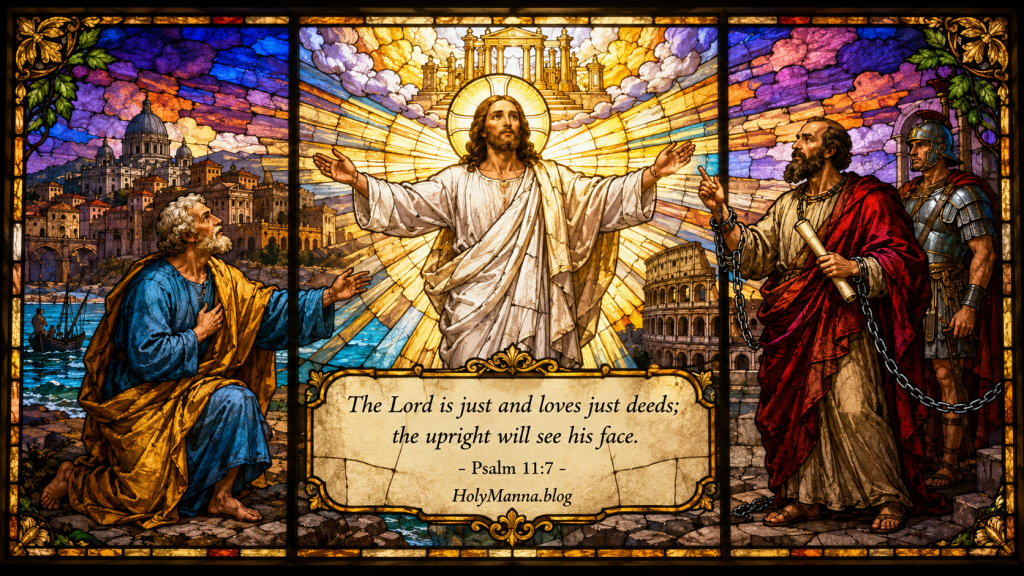
Saturday of the Seventh Week of Easter – Lectionary: 302
When the Story Is Not Over Yet
Some endings in Scripture feel less like a conclusion and more like an open door, inviting every disciple to step through it.
Today’s readings for the Saturday of the Seventh Week of Easter bring the Church to the edge of Pentecost with a powerful reminder: the mission of Christ continues through faithful witnesses who follow Him without comparison, proclaim Him without fear, and trust Him even when the path looks unfinished. In Acts 28:16-20, 30-31, Saint Paul reaches Rome in chains, yet the Gospel itself remains free. In Psalm 11:4-5, 7, the Lord watches from His holy temple, testing hearts and loving justice. In John 21:20-25, Jesus turns Peter away from curiosity about another disciple’s destiny and gives him the command that defines every Christian life: “You follow me.”
The historical setting matters. Paul has finally arrived in Rome, the heart of the empire, not as a powerful man but as a prisoner. Yet this is exactly where the Lord wanted the Gospel to go. What looked like defeat became mission. What looked like limitation became witness. The same pattern appears in the Gospel. Peter, newly restored after his denial, is tempted to look sideways at the beloved disciple and ask, “Lord, what about him?” Jesus does not satisfy Peter’s curiosity. He redirects his heart. Discipleship is not lived by comparing callings. It is lived by fidelity to Christ.
Together, these readings reveal a central theme: the Lord gives each disciple a particular path, but every path must be walked in obedience, trust, and witness. Saint Paul’s chains, the psalmist’s confidence in God’s justice, and Peter’s personal call all point toward the same truth. God sees the whole story, even when His servants only see the next step. As The Catechism teaches, the Christian life is centered on the Person of Jesus Christ, and every act of witness flows from belonging to Him.
On this final day before Pentecost, the Church is invited to stop asking why another person’s road looks different and to listen again to the voice of the risen Lord. Where is Christ asking for faithful witness right now? Where has comparison weakened trust? Where might an apparent limitation become the very place where the Gospel is proclaimed without hindrance?
First Reading – Acts 28:16-20, 30-31
The Gospel in Chains, Yet Completely Unhindered
The final scene of Acts of the Apostles brings Saint Paul to Rome, the center of imperial power. This is the city that represented authority, law, military strength, and worldly influence. Yet Paul does not arrive in Rome as a conquering hero. He arrives as a prisoner, guarded by a soldier, bound because of his witness to Jesus Christ.
That contrast is the heart of this reading. Paul is chained, but the Gospel is free. His body is watched, but his preaching is unhindered. His legal future is uncertain, but his mission is clear. The man who once persecuted Christians now receives all who come to him and proclaims the Kingdom of God with confidence.
This reading fits beautifully into today’s central theme: Jesus gives every disciple a particular path, but every path must be walked in faithful witness. Paul’s path leads through accusation, imprisonment, appeal to Caesar, and house arrest in Rome. Yet none of it cancels his vocation. The Lord uses even Paul’s chains to bring the Gospel into the heart of the empire.
In the religious background of this passage, Paul is speaking as a faithful Jew who believes that the promises made to Israel have been fulfilled in Jesus Christ. When Paul says he wears chains “on account of the hope of Israel,” he is speaking of the hope of resurrection, the coming of the Messiah, and the fulfillment of God’s covenant promises. Paul does not see Christianity as a rejection of Israel. He sees Christ as the fulfillment of Israel’s deepest longing.
Acts 28:16-20, 30-31 – New American Bible (Revised Edition)
16 When he entered Rome, Paul was allowed to live by himself, with the soldier who was guarding him.
Testimony to Jews in Rome. 17 Three days later he called together the leaders of the Jews. When they had gathered he said to them, “My brothers, although I had done nothing against our people or our ancestral customs, I was handed over to the Romans as a prisoner from Jerusalem. 18 After trying my case the Romans wanted to release me, because they found nothing against me deserving the death penalty. 19 But when the Jews objected, I was obliged to appeal to Caesar, even though I had no accusation to make against my own nation. 20 This is the reason, then, I have requested to see you and to speak with you, for it is on account of the hope of Israel that I wear these chains.”
30 He remained for two full years in his lodgings. He received all who came to him, 31 and with complete assurance and without hindrance he proclaimed the kingdom of God and taught about the Lord Jesus Christ.
Detailed Exegesis
Verse 16 – “When he entered Rome, Paul was allowed to live by himself, with the soldier who was guarding him.”
Paul’s arrival in Rome fulfills the missionary movement that began in Jerusalem and spread outward through the power of the Holy Spirit. Rome was not just another city. It was the heart of the empire. For the Gospel to reach Rome meant that the message of Christ had reached one of the most influential centers of the ancient world.
Yet Paul’s freedom is limited. He is allowed to live by himself, but a soldier guards him. This likely refers to a form of house arrest. Paul is not in a dark dungeon at this point, but he is still not free to go wherever he wants. This small detail reveals a deep Christian truth. Circumstances may restrict a disciple, but they cannot restrict God’s grace. Paul’s lodging becomes a mission field. His guard becomes a witness to his patience. His chains become part of his preaching.
Verse 17 – “Three days later he called together the leaders of the Jews. When they had gathered he said to them, ‘My brothers, although I had done nothing against our people or our ancestral customs, I was handed over to the Romans as a prisoner from Jerusalem.’”
Paul does not waste time. After only three days, he calls together the Jewish leaders in Rome. This shows his missionary pattern. Paul often goes first to his own people, to those who know the Scriptures, the promises, the covenant, and the expectation of the Messiah.
His tone is important. He calls them “My brothers.” He does not speak with contempt. He does not present himself as a man who has abandoned his people. He explains that he has done nothing against Israel or the ancestral customs. Paul is defending the truth, but he is not seeking revenge.
This is a beautiful model of Catholic witness. The Christian must speak clearly, but not cruelly. Truth should not become an excuse for bitterness. Paul has suffered because of false accusations, yet his first words in Rome are fraternal. He is a prisoner, but his heart is not imprisoned by resentment.
Verse 18 – “After trying my case the Romans wanted to release me, because they found nothing against me deserving the death penalty.”
Paul explains that even the Roman authorities recognized that he had not committed a capital crime. This echoes the repeated pattern in Acts, where civil authorities often find no real guilt in Paul. The accusation against him is not criminal in the ordinary sense. His true “offense” is his proclamation that Jesus is the risen Messiah.
There is also a quiet connection here to Christ Himself. Jesus was declared innocent and yet handed over. Paul, as an Apostle, now shares in the pattern of his Lord. He is not equal to Christ, but he participates in the mystery of suffering witness. The servant follows the Master.
The Church has always seen suffering for the Gospel as a participation in Christ’s own mission. This does not mean suffering is good in itself. It means that when suffering is united to Christ, God can make it fruitful.
Verse 19 – “But when the Jews objected, I was obliged to appeal to Caesar, even though I had no accusation to make against my own nation.”
Paul’s appeal to Caesar is the legal path that brings him to Rome. Under Roman law, as a Roman citizen, Paul had the right to appeal his case to the emperor. Human politics, legal procedure, and conflict all become part of God’s providence.
His final phrase is especially moving: “Even though I had no accusation to make against my own nation.” Paul refuses to turn his defense into an attack. He could have blamed others. He could have publicly condemned his opponents. Instead, he explains his situation without making hatred the center of his speech.
This is a very practical lesson for the Christian life. There is a way to tell the truth without poisoning the soul. There is a way to defend oneself without becoming consumed by accusation. Paul shows a heart formed by Christ.
Verse 20 – “This is the reason, then, I have requested to see you and to speak with you, for it is on account of the hope of Israel that I wear these chains.”
This is the theological center of the passage. Paul is chained because of “the hope of Israel.” That hope is not vague optimism. It is the hope rooted in God’s promises, fulfilled in Jesus Christ, especially through His resurrection from the dead.
Paul believes that the story of Israel reaches its fulfillment in Christ. The patriarchs, the prophets, the covenant, the Temple, the sacrifices, the longing for redemption, and the expectation of resurrection all find their center in the crucified and risen Lord.
This verse also reveals the paradox of Christian hope. Paul does not say, “I wear these chains because everything has gone wrong.” He says he wears them because of hope. His chains are not a contradiction of hope. They are evidence that he has given his life to it.
Verse 30 – “He remained for two full years in his lodgings. He received all who came to him.”
The scene jumps forward. Paul remains in his lodging for two full years. The pace slows down, almost as if the reader is invited to imagine the steady, daily rhythm of his witness. Visitors come. Paul receives them. Conversations happen. Questions are asked. The Scriptures are explained. The name of Jesus is proclaimed.
This is not dramatic in the worldly sense, but it is deeply apostolic. Paul’s mission is no longer carried out through long journeys across the Mediterranean. It now happens in one place, with whoever walks through the door.
That is powerful for ordinary Catholic life. Not every season is expansive. Some seasons are hidden, repetitive, or confined. Yet those seasons can still be fruitful. A home, a hospital room, a workplace, a parish classroom, a kitchen table, or a quiet conversation can become a place where Christ is proclaimed.
Verse 31 – “And with complete assurance and without hindrance he proclaimed the kingdom of God and taught about the Lord Jesus Christ.”
The final words of Acts of the Apostles are stunning: “without hindrance.” Paul is guarded. Paul is awaiting trial. Paul is not physically free. Yet the Word of God is not bound.
This is how Acts ends, not with Paul’s death, not with a neat conclusion, but with the Gospel still moving forward. The ending feels open because the mission of the Church continues. The story that began with the Holy Spirit descending at Pentecost now reaches Rome, and from Rome it will continue to the nations.
Paul proclaims two realities: the Kingdom of God and the Lord Jesus Christ. These belong together. The Kingdom is not merely a moral program or a social ideal. The Kingdom comes through Christ the King. To proclaim the Kingdom is to proclaim Jesus, crucified and risen, Lord of history, Lord of the Church, and Lord of every human heart.
Teachings: The Hope of Israel and the Mission of the Church
This reading teaches that Christian hope is not passive optimism. It is a theological virtue rooted in God’s promises and fulfilled in Jesus Christ. The Catechism of the Catholic Church teaches in CCC 1817, “Hope is the theological virtue by which we desire the kingdom of heaven and eternal life as our happiness, placing our trust in Christ’s promises and relying not on our own strength, but on the help of the grace of the Holy Spirit.”
That is exactly what Paul embodies. He is not relying on his legal strategy, his personal strength, or his circumstances. He is relying on Christ. He desires the Kingdom. He trusts the promises. He continues preaching because hope has made him spiritually free, even while physically chained.
Paul’s witness also reveals the missionary nature of the Church. The Gospel is never meant to remain hidden among a small circle of believers. It must be proclaimed. The Catechism teaches in CCC 543, “Everyone is called to enter the kingdom. First announced to the children of Israel, this messianic kingdom is intended to accept men of all nations.”
That is why Rome matters. The message first announced to Israel is now being proclaimed at the heart of the Gentile world. Paul is not preaching a private spirituality. He is announcing the Kingdom that God intends for all peoples.
The Church also teaches that witness is not optional for Christians. The Catechism says in CCC 2472, “The duty of Christians to take part in the life of the Church impels them to act as witnesses of the Gospel and of the obligations that flow from it. This witness is a transmission of the faith in words and deeds. Witness is an act of justice that establishes the truth or makes it known.”
Paul’s witness is both word and deed. He speaks the truth about Christ, but his life also preaches. His patience preaches. His forgiveness preaches. His courage preaches. His refusal to hate his own people preaches.
Saint John Chrysostom, reflecting on Paul’s words in Rome, noticed the Apostle’s generous and forgiving spirit. Paul explains his innocence without turning his defense into a bitter accusation. This matters because Christian witness is not merely about being right. It is about revealing Christ. The disciple must be careful that even a true defense does not become an excuse for an unchristian heart.
Historically, Paul’s arrival in Rome is one of the great turning points in the spread of Christianity. The faith that began in the land of Israel now stands in the capital of the empire. Ancient Christian tradition holds that Paul would later be martyred in Rome, offering his life completely for Christ. In this reading, however, the Church sees Paul still preaching, still receiving visitors, still announcing the Kingdom. The final image is not defeat. It is mission.
Reflection: When Limitation Becomes Witness
This reading is a gift for anyone who has ever felt stuck, delayed, misunderstood, falsely judged, or limited by circumstances. Paul is not where he would naturally choose to be. He is not traveling freely from city to city. He is not speaking in the synagogue of his choice or standing in a public square on his own terms. He is guarded in a lodging in Rome.
And yet the Gospel is moving.
That is one of the most hopeful truths in the Christian life. God does not need perfect circumstances to make a life fruitful. He needs a surrendered heart. Paul’s chains did not stop the Kingdom because Paul did not let his chains become the center of his identity. Christ remained the center.
This challenges the modern disciple. It is easy to think mission begins only when life becomes easier, calmer, more organized, more impressive, or more visible. Paul shows something different. Mission begins wherever Christ is obeyed. A difficult workplace can become a place of witness. A family burden can become a school of charity. A season of waiting can become a hidden offering. A painful limitation can become the very place where someone sees the strength of Christian hope.
Paul also teaches the importance of speaking truth without bitterness. He has every human reason to be angry, but he speaks with restraint and charity. His heart is not controlled by those who accused him. It is controlled by Christ.
Where has a limitation been mistaken for the end of the mission?
What chain, frustration, delay, or disappointment might Christ be asking to transform into a witness?
Is there a situation where truth needs to be spoken with more courage, but also with more charity?
If someone watched the way this suffering is being carried, would they see resentment, or would they see hope?
The final words of this reading should stay with the heart: “With complete assurance and without hindrance he proclaimed the kingdom of God and taught about the Lord Jesus Christ.” That is the invitation. Live with the kind of faith that can be watched, restricted, delayed, and tested, yet still remain spiritually free. Because when Christ is truly Lord, even chains can become a pulpit.
Responsorial Psalm – Psalm 11:4-5, 7
The God Who Sees, Tests, and Loves What Is Just
The responsorial psalm places today’s readings under the gaze of God. After seeing Saint Paul arrive in Rome as a prisoner in Acts 28:16-20, 30-31, the Church prays Psalm 11 and remembers that human judgment is never the final judgment. Rome may guard Paul. Enemies may accuse him. The powerful may seem to control the story. Yet the Lord sits enthroned in heaven, seeing every heart with perfect justice.
In its original setting, Psalm 11 is traditionally associated with David, a man who knew what it meant to be hunted, falsely judged, and surrounded by violence. The psalm speaks from a world where the righteous often looked vulnerable and the wicked often looked strong. Yet the prayer refuses panic. It does not say that evil is unreal. It says evil is not ultimate. God sees. God tests. God judges. God loves justice. God promises that the upright will see His face.
That fits today’s theme beautifully. Paul is chained, but he is not forgotten. Peter is corrected by Jesus, but he is not rejected. The beloved disciple testifies, but he does not control the whole mystery. In all of it, God remains enthroned, watching over His Church and testing His servants so their witness becomes purified, courageous, and true.
Psalm 11:4-5, 7 – New American Bible (Revised Edition)
4 The Lord is in his holy temple;
the Lord’s throne is in heaven.
God’s eyes keep careful watch;
they test the children of Adam.
5 The Lord tests the righteous and the wicked,
hates those who love violence,7 The Lord is just and loves just deeds;
the upright will see his face.
Detailed Exegesis
Verse 4 – “The Lord is in his holy temple; the Lord’s throne is in heaven. God’s eyes keep careful watch; they test the children of Adam.”
This verse begins with stability. The Lord is not absent, confused, or overpowered by human disorder. He is in His holy temple, and His throne is in heaven. In ancient Israel, the Temple was the visible place of God’s covenant presence among His people. Heaven, meanwhile, revealed His supreme authority over all creation. Together, these images show both nearness and majesty. God is close to His people, but He is never trapped inside human history.
The phrase “God’s eyes keep careful watch” is deeply comforting and deeply challenging. Nothing escapes Him. He sees the prisoner and the judge, the accused and the accuser, the faithful heart and the violent heart. This matters for Paul in today’s first reading. Even if the Roman legal system is imperfect, God’s judgment is not. Even if Paul’s situation looks unjust, the Lord knows the truth.
The verse also says God’s eyes “test the children of Adam.” In Scripture, testing is not the same as tempting. God does not lure His children into evil. He permits trials that reveal, purify, and strengthen the heart. The test shows what love is made of. Paul’s chains reveal his hope. Peter’s correction reveals his need for humble obedience. Every disciple’s trial reveals whether faith rests on comfort or on Christ.
Verse 5 – “The Lord tests the righteous and the wicked, hates those who love violence.”
This verse makes clear that no one stands outside the searching gaze of God. The righteous are tested, and the wicked are tested. The difference is not whether a person experiences trial. The difference is what the trial reveals.
For the righteous, testing can become purification. It exposes attachments, fears, pride, and hidden weakness so that grace can heal them. For the wicked, testing reveals rebellion, violence, and hardness of heart. The psalm does not say God merely dislikes violence. It says He hates those who love violence. This is not a denial of God’s mercy. It is a declaration that violence is completely opposed to His holy nature.
This also speaks to the Christian life today. Violence is not only physical harm. The heart can love violence through cruelty, revenge, humiliation, slander, contempt, and the desire to crush another person rather than seek their conversion. Paul shows the opposite spirit in Acts 28. He defends himself, but he does not speak with hatred against his people. His witness is courageous without becoming violent.
Verse 7 – “The Lord is just and loves just deeds; the upright will see his face.”
This verse brings the psalm to its great promise. God is not merely a judge who enforces justice from a distance. He is just in Himself, and He loves just deeds. Justice belongs to His very character. To live justly is to live in harmony with who God is.
The final line is one of the most beautiful promises in the psalms: “The upright will see his face.” In the Old Testament, to see God’s face is the language of intimacy, blessing, and communion. For Christians, this promise reaches its fullness in eternal life, when the saints behold God face to face.
This line also ties today’s readings together. Paul can endure chains because his hope is not limited to earthly freedom. Peter can stop comparing himself to the beloved disciple because his true fulfillment is not found in having someone else’s vocation. The upright will see God’s face. That is the destiny that gives meaning to every hidden sacrifice, every faithful act, and every unjust suffering endured with Christ.
Teachings: Justice, Testing, and the Face of God
The psalm teaches that God’s justice is not an abstract idea. It is personal, holy, and living. The Catechism of the Catholic Church teaches in CCC 1807, “Justice is the moral virtue that consists in the constant and firm will to give their due to God and neighbor.” This helps explain why the Lord “loves just deeds.” Justice begins with giving God His due through worship, obedience, and trust. It continues by giving our neighbor what is owed in truth, dignity, mercy, and fairness.
Saint Thomas Aquinas gives a classic definition of justice in the Summa Theologiae, writing, “Justice is a habit whereby a man renders to each one his due by a constant and perpetual will.” This fits the psalm because the righteous person is not just someone who occasionally does good when life is convenient. The righteous person is being formed into steady fidelity, even under pressure.
The promise that “the upright will see his face” points toward the Catholic teaching on heaven and the beatific vision. The Catechism of the Catholic Church teaches in CCC 1023, “Those who die in God’s grace and friendship and are perfectly purified live for ever with Christ. They are like God for ever, for they ‘see him as he is,’ face to face.” This is the fulfillment of the psalm’s hope. The upright do not merely receive a reward from God. They receive communion with God Himself.
The testing described in this psalm also belongs to the larger biblical story. Abraham was tested. Israel was tested in the wilderness. Job was tested in suffering. Peter was tested after his denial. Paul was tested through persecution and imprisonment. In Catholic tradition, trials are not romanticized, but they are understood as places where grace can purify the soul. God does not waste suffering offered to Him.
The psalm also corrects a modern temptation. Many people assume that if God is watching, then He should immediately remove every injustice. Scripture shows something deeper. God sees perfectly, judges rightly, and acts according to His wisdom. Sometimes He delivers quickly. Sometimes He strengthens His servants to endure. Sometimes He turns the very place of suffering into a pulpit, as He does with Paul in Rome.
Reflection: Living Under the Gaze of a Just God
This psalm invites the heart to breathe again. The Lord is in His holy temple. His throne is in heaven. That means the chaos of the world is not in charge. The loudest voices are not in charge. The cruelest people are not in charge. Even personal fear is not in charge. God sees, God tests, and God loves what is just.
For daily life, this changes how a disciple handles pressure. When falsely judged, the Christian does not need to become consumed by self-defense. Truth matters, and there are times when it must be spoken clearly. Yet the soul can remain peaceful because God sees the whole story. Paul gives a beautiful example of this. He explains his innocence, but he does not let resentment take control of his mission.
This psalm also challenges every disciple to examine the heart honestly. God tests the righteous and the wicked. That means trials reveal what is really being loved. A traffic jam, a family conflict, an unanswered prayer, a workplace frustration, or a season of uncertainty can reveal whether the heart is rooted in trust or ruled by impatience. These little tests matter because holiness is usually formed in ordinary moments.
A practical way to live this psalm is to begin each day under God’s gaze, not the world’s gaze. Before checking messages, opinions, comments, or expectations, the soul can turn to the Lord and remember: He sees. He knows. He loves justice. Then, throughout the day, the disciple can choose one just deed at a time. Speak truthfully. Refuse gossip. Forgive before bitterness grows. Treat people fairly when no one is watching. Give God the worship He is due. Carry hidden suffering without letting it become hidden anger.
Where is God testing the heart right now?
What does this trial reveal about trust, patience, justice, or mercy?
Is there any place where the heart has started to love resentment, harshness, or revenge more than peace?
What just deed can be chosen today simply because the Lord is just and loves just deeds?
The promise of Psalm 11 is not that the righteous will never suffer. The promise is greater. The Lord sees them. The Lord purifies them. The Lord loves their faithful deeds. And one day, the upright will see His face.
Holy Gospel – John 21:20-25
The Final Word Is Not Comparison, but Follow Me
The final verses of The Gospel of John feel like the closing scene of a story that is still alive. Jesus has risen from the dead. Peter has just been restored after denying the Lord three times. Three times Jesus asked him about love, and three times He entrusted him with the care of His sheep. Then Jesus told Peter that his love would one day lead him to martyrdom. Peter’s vocation is clear, beautiful, and costly.
Then Peter turns around.
He sees the beloved disciple, the one who leaned close to Jesus at the Last Supper, the one associated with faithful witness, deep love, and true testimony. Peter asks a very human question: “Lord, what about him?”
That question brings today’s theme into sharp focus. Saint Paul’s path in Acts 28:16-20, 30-31 leads through chains, yet the Gospel remains unhindered. Psalm 11:4-5, 7 reminds the Church that God sees, tests, and loves justice. Now, in John 21:20-25, Jesus teaches Peter that discipleship cannot be lived by comparison. Every disciple has a particular path, but every disciple receives the same essential command: “You follow me.”
This Gospel is also deeply apostolic. It speaks about testimony, truth, and the mystery of Christ that no book could ever exhaust. The beloved disciple bears witness, the Church receives that witness, and the reader is reminded that Jesus is not simply a figure from the past. He is the living Lord whose works overflow every page ever written about Him.
John 21:20-25 – New American Bible (Revised Edition)
The Beloved Disciple. 20 Peter turned and saw the disciple following whom Jesus loved, the one who had also reclined upon his chest during the supper and had said, “Master, who is the one who will betray you?” 21 When Peter saw him, he said to Jesus, “Lord, what about him?” 22 Jesus said to him, “What if I want him to remain until I come? What concern is it of yours? You follow me.” 23 So the word spread among the brothers that that disciple would not die. But Jesus had not told him that he would not die, just “What if I want him to remain until I come? [What concern is it of yours?]”
Conclusion. 24 It is this disciple who testifies to these things and has written them, and we know that his testimony is true. 25 There are also many other things that Jesus did, but if these were to be described individually, I do not think the whole world would contain the books that would be written.
Detailed Exegesis
Verse 20 – “Peter turned and saw the disciple following whom Jesus loved, the one who had also reclined upon his chest during the supper and had said, ‘Master, who is the one who will betray you?’”
This verse places Peter beside the beloved disciple. The beloved disciple is presented as one who followed, one who rested close to Jesus at the Last Supper, and one who had intimate access to the Lord’s heart. His closeness to Jesus is not casual sentimentality. It is the closeness of faithful love and true witness.
Peter has just received his own mission. Jesus has told him to feed His sheep and follow Him even to death. Yet Peter turns and sees another disciple. That turn is spiritually important. Peter’s eyes shift from Jesus to someone else’s path. This is the beginning of comparison.
The Catholic life often begins to lose peace in exactly this way. The disciple hears Christ’s call, but then turns and starts measuring another person’s gifts, suffering, holiness, influence, family, or future. The heart that was invited to follow begins to calculate.
Verse 21 – “When Peter saw him, he said to Jesus, ‘Lord, what about him?’”
Peter’s question is short, but it carries a lot of humanity. He has just been told that his own path will include suffering. So he asks about the beloved disciple. Will John suffer too? Will his road be easier? Will his vocation be different? Will his end be more peaceful?
Jesus does not condemn Peter for asking, but He does correct the direction of Peter’s attention. Peter is not called to manage another man’s destiny. He is called to follow Christ.
This verse touches one of the most common spiritual struggles. Comparison often disguises itself as concern or curiosity, but it can quietly become envy, anxiety, resentment, or distraction. The Lord does not want Peter’s soul trapped in someone else’s story.
Verse 22 – “Jesus said to him, ‘What if I want him to remain until I come? What concern is it of yours? You follow me.’”
This is the heart of the Gospel passage. Jesus’ words are direct, merciful, and freeing. “What concern is it of yours?” is not a rejection of Peter. It is a rescue. Jesus is pulling Peter out of comparison and back into vocation.
The command “You follow me” is personal. Jesus does not say, “Follow your preferences.” He does not say, “Follow the path that looks safest.” He does not say, “Follow only if everyone else’s calling makes sense to you.” He says, “You follow me.”
This command also protects the mystery of vocation. God does not give every disciple the same road. Peter will glorify God through martyrdom. The beloved disciple will bear a unique testimony. Paul will preach in chains. Mary will stand beneath the Cross. Each calling differs, but each calling belongs to Christ.
Verse 23 – “So the word spread among the brothers that that disciple would not die. But Jesus had not told him that he would not die, just ‘What if I want him to remain until I come? What concern is it of yours?’”
This verse shows how quickly misunderstanding can spread, even among believers. Jesus speaks mysteriously, and the community turns His words into a rumor. Some begin saying that the beloved disciple would not die. The Gospel carefully corrects this. Jesus did not say he would not die.
This correction matters. The apostolic Church is not built on rumors, exaggerations, or spiritual gossip. It is built on true witness. The Gospel writer wants the reader to know exactly what Jesus said and what He did not say.
There is a lesson here for Catholic life. Not every popular religious claim is true simply because it spreads. Not every exciting interpretation is faithful simply because it sounds spiritual. The Church receives and guards apostolic truth with care, because the words of Christ must not be twisted into something He did not teach.
Verse 24 – “It is this disciple who testifies to these things and has written them, and we know that his testimony is true.”
Now the Gospel turns from Peter’s question to the beloved disciple’s witness. The beloved disciple is identified as the one who testifies and has written these things. The community affirms, “We know that his testimony is true.”
This verse is deeply important for understanding the Catholic faith. Christianity is not based on vague inspiration, private opinion, or detached philosophy. It is based on apostolic testimony. Real witnesses encountered the risen Christ, and their testimony was handed on in the life of the Church.
The beloved disciple does not merely share religious ideas. He testifies to what he has seen and known. His witness is written so that others may believe that Jesus is the Christ, the Son of God, and have life in His name.
Verse 25 – “There are also many other things that Jesus did, but if these were to be described individually, I do not think the whole world would contain the books that would be written.”
The Gospel ends with wonder. John does not claim to have written everything Jesus did. Instead, he says the works of Jesus are so abundant, so rich, and so inexhaustible that the whole world could not contain the books that would be written.
This does not weaken Scripture. It magnifies Christ. The written Gospel is true, inspired, and sufficient for God’s purpose, but Jesus Himself is greater than every human word about Him. He is the eternal Word made flesh. No library can exhaust Him. No homily can finish Him. No lifetime of prayer can fully reach the end of His beauty.
This final verse also leaves the reader with a sense of mission. The Gospel account ends, but the works of Christ continue in His Church. Every saint, every sacrament, every conversion, every act of mercy, every hidden sacrifice, and every faithful witness becomes part of the living story of what the risen Lord continues to do.
Teachings: Apostolic Witness, Personal Vocation, and the Living Word
This Gospel teaches that discipleship is personal before it is comparative. Peter is not told to understand the beloved disciple’s path. He is told to follow Jesus. This is a necessary lesson in every generation because comparison can quietly corrupt vocation. The Lord does not ask a disciple to live someone else’s holiness. He asks each soul to receive grace and follow faithfully.
The Catechism of the Catholic Church teaches in CCC 426, “At the heart of catechesis we find, in essence, a Person, the Person of Jesus of Nazareth, the only Son from the Father… who suffered and died for us and who now, after rising, is living with us forever.” This explains why Jesus’ command is so direct. Christianity is not first about mastering religious information or comparing spiritual paths. It is about following the living Person of Jesus Christ.
This passage also teaches the importance of apostolic testimony. The beloved disciple writes and testifies, and the Church receives his testimony as true. The Catechism teaches in CCC 126, “We can distinguish three stages in the formation of the Gospels: The life and teaching of Jesus. The Church holds firmly that the four Gospels, ‘whose historicity she unhesitatingly affirms,’ faithfully hand on what Jesus, the Son of God, while he lived among men, really did and taught for their eternal salvation, until the day when he was taken up.”
That teaching matters here because John 21:24 explicitly presents the Gospel as testimony. The Church does not approach the Gospels as myths or spiritual fiction. She receives them as faithful apostolic witness to what Jesus truly did and taught for salvation.
The ending of John also points toward the inexhaustible mystery of Christ. The Catechism teaches in CCC 108, “Still, the Christian faith is not a ‘religion of the book.’ Christianity is the religion of the ‘Word’ of God, a word which is ‘not a written and mute word, but incarnate and living.’” This helps explain why John can say the world itself could not contain the books that would be written. The written Gospel leads the reader to the living Word, Jesus Christ Himself.
Saint Augustine, reflecting on this passage, saw Peter and John as representing two beautiful dimensions of Christian life. Peter signifies the active life of following Christ through labor, suffering, shepherding, and martyrdom. John signifies the contemplative life, resting close to the heart of Christ and bearing witness to divine mystery. Catholic tradition does not pit these against each other. The Church needs both faithful action and loving contemplation. Yet both must remain obedient to Jesus.
This Gospel also guards the Church from careless rumor. The misunderstanding about the beloved disciple’s death shows why the apostolic faith must be handed on carefully. The Church’s task is not to invent attractive interpretations, but to preserve and proclaim what Christ actually revealed. As The Catechism teaches in CCC 84, “The apostles entrusted the ‘Sacred deposit’ of the faith contained in Sacred Scripture and Tradition, to the whole of the Church.”
The beloved disciple’s testimony belongs to that sacred deposit. It is not a private possession. It is a gift to the Church, preserved so that every generation may hear the voice of Christ and answer His call.
Reflection: Stop Looking Sideways and Follow Christ
This Gospel lands with surprising force because Peter’s question is so relatable. “Lord, what about him?” is the kind of question that still lives in the heart. What about that person’s easier path? What about her gifts? What about his success? What about their marriage, their family, their platform, their holiness, their suffering, their opportunities?
Jesus’ answer remains the same: “What concern is it of yours? You follow me.”
That is not cold. It is mercy. Jesus knows that comparison steals peace. It makes a person resent blessings that were never meant to be threats. It makes another person’s vocation feel like a judgment against one’s own. It turns discipleship into a competition when it is supposed to be communion.
The practical response is simple, but not easy. The disciple must return daily to the call that Christ has actually given. Not the imagined life. Not the curated life seen online. Not the vocation of someone else in the parish, workplace, family, or friend group. The real path is the one where Jesus is saying, “You follow me.”
This may mean embracing hidden faithfulness. It may mean raising children with patience. It may mean caring for aging parents. It may mean staying faithful in a difficult marriage. It may mean serving quietly in a parish. It may mean telling the truth when it costs something. It may mean carrying a cross that other people do not understand.
The beloved disciple also teaches the importance of remaining close to Christ. He is remembered as the one who reclined near Jesus’ heart. Before any disciple can witness well, that disciple must learn to rest near the Lord. Prayer is not wasted time. Adoration is not escape. Silence before Christ forms the kind of heart that can testify truthfully.
A good way to live this Gospel is to notice moments of comparison as soon as they appear. When the heart asks, “What about him?” or “What about her?” the disciple can turn it into prayer. Lord, bless that person. Lord, purify this heart. Lord, show the next faithful step. Lord, teach this soul to follow You.
Where has comparison been stealing peace?
Whose vocation, success, or suffering has become a distraction from Christ’s personal call?
What would change if the words “You follow me” became the guiding command of this season?
How can the heart stay close enough to Jesus to become a truthful witness like the beloved disciple?
The Gospel ends by saying that the world could not contain all the books that could be written about Jesus. That means the story is still bigger than any one life can see. Peter does not need to control John’s story. John does not need to live Peter’s martyrdom. Paul does not need freedom from chains for the Gospel to be free. Every disciple simply needs to follow the Lord with fidelity.
The final word is not comparison. The final word is not curiosity. The final word is Christ saying, “You follow me.”
The Gospel Is Still Moving, and Christ Is Still Calling
Today’s readings end with a holy kind of unfinished business. Saint Paul is in Rome, chained and guarded, yet still preaching “the kingdom of God” and teaching about Jesus Christ “without hindrance.” Psalm 11 lifts the eyes of the faithful to the Lord enthroned in heaven, the God who sees every hidden struggle, tests every heart, loves justice, and promises that “the upright will see his face.” Then John 21:20-25 brings the disciple back to the simple, piercing command of Jesus: “You follow me.”
Together, these readings remind the Church that discipleship is not about controlling the whole story. Paul does not control his trial. Peter does not control John’s vocation. The beloved disciple does not claim to contain the entire mystery of Christ in one written account. Each one receives a mission, and each one is asked to be faithful with the part entrusted to him.
That is the invitation for every Catholic heart on this final day before Pentecost. Stop waiting for perfect circumstances before living the Gospel. Stop measuring another person’s road as if God’s love were a competition. Stop letting fear, frustration, or comparison steal the joy of following Christ. The Lord can preach through a chained Paul, purify a tested heart, and redirect a distracted Peter. He can also work through ordinary lives, hidden sacrifices, quiet prayers, daily duties, and faithful love.
The Christian life becomes lighter when the soul accepts this truth: Christ does not ask every disciple to carry the same cross, but He does ask every disciple to follow Him. Some paths are public, and others are hidden. Some are filled with visible fruit, and others look like waiting. Some feel like freedom, and others feel like chains. Yet no faithful offering is wasted when it is united to Jesus.
Where is Christ asking for trust instead of comparison? Where is He asking for witness instead of fear? Where is He asking for one faithful step instead of total control?
Today, let the heart return to the voice of the risen Lord. Let prayer become steadier. Let justice become more intentional. Let witness become more courageous. Let comparison fall away. The world still cannot contain all that Jesus has done, and the story of His grace is still being written in the lives of those who hear Him say, “You follow me.”
Engage with Us!
Share your reflections in the comments below. Today’s readings invite a real examination of the heart, especially in the places where faith feels tested, life feels limited, or comparison starts to steal peace.
- In the First Reading from Acts 28:16-20, 30-31, Saint Paul proclaims Christ while under guard in Rome. Where might God be asking you to witness to the Gospel, even in a season that feels restricted, delayed, or frustrating?
- In Psalm 11:4-5, 7, the Lord watches, tests, and loves just deeds. What is one area of your life where God may be inviting you to choose justice, patience, mercy, or integrity more intentionally?
- In the Holy Gospel from John 21:20-25, Jesus tells Peter, “You follow me.” Where has comparison distracted you from the particular path Christ is asking you to walk?
- As Pentecost approaches, what chain, fear, resentment, or distraction needs to be surrendered so the Holy Spirit can make your witness more courageous and free?
May these readings help every heart trust that the Gospel is never hindered when Christ is at the center. Live today with faith, speak with charity, choose what is just, and do everything with the love and mercy Jesus taught us.
Sacred Heart of Jesus, we trust in You!
Immaculate Heart of Mary, pray for us!
Saint Michael the Archangel, defend us in battle!
Follow us on YouTube, Instagram and Facebook for more insights and reflections on living a faith-filled life.


Leave a Reply