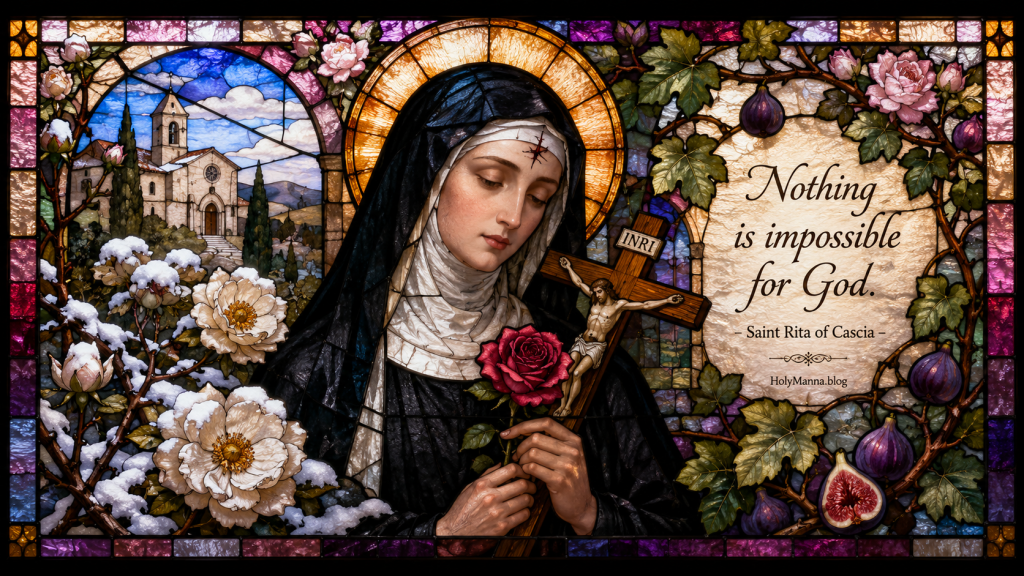
The Rose That Bloomed in Winter
Saint Rita of Cascia is one of the Church’s most beloved saints for people who feel like they have reached the end of human solutions. She is known as the Patroness of Impossible Causes, but that title was not given to her because her life was easy. It was given to her because her life was filled with grief, conflict, family pain, and suffering that only God could redeem.
She was a wife, mother, widow, Augustinian nun, mystic, peacemaker, and spiritual mother to countless Catholics who have turned to her intercession. Pope Saint John Paul II called her “small in stature but great in holiness” and praised her “heroic Christian life as a wife, mother, widow and nun.” That is the heart of Saint Rita’s witness. She became holy not by escaping suffering, but by allowing Christ to transform it.
Saint Rita reminds the Church that sanctity is not only found in peaceful chapels and quiet monasteries. Sometimes holiness is forged in a difficult marriage, beside a sickbed, after betrayal, in the middle of family drama, or through the daily decision to forgive when revenge would feel easier.
A Child of Peace in a Violent Age
Saint Rita was born Margherita Lotti in Roccaporena, a small village near Cascia in Umbria, Italy. Her birth is most commonly dated to 1381, though some Catholic sources give slightly different dates. Her parents, Antonio and Amata Lotti, were known as peacemakers, and older Catholic tradition remembers them as “Peacemakers of Jesus Christ.” That detail matters because Rita would spend her life becoming exactly that.
From childhood, Rita was drawn to prayer and religious life. She was connected to the Augustinian spiritual world around Cascia, and her heart longed for the convent. Yet her parents arranged a marriage for her, as was common in that time. Out of obedience, Rita married Paolo Mancini, also identified in some sources as Paolo di Ferdinando di Mancino.
Catholic tradition often describes Paolo as a difficult, violent, or harsh man, caught up in the feuds and political rivalries of late medieval Italy. Rita did not respond with bitterness. She prayed, endured, loved patiently, and worked for his conversion. Over time, tradition says her witness softened him and helped bring him closer to a Christian way of life.
This is one reason Saint Rita is so loved by those in painful family situations. She did not have a perfect home. She had a real home, marked by tension, fear, love, sacrifice, and hope. She shows that God can work even in the places people are tempted to call beyond repair.
A famous story from her infancy says that bees entered and left her mouth without harming her. This was later understood as a sign of her future holiness, sweetness, and tireless work for God. It is a beautiful devotional legend, but it cannot be verified historically.
The Wife, the Mother, and the Peacemaker
Rita and Paolo had two sons, usually named Giangiacomo and Paolo Maria. Their family lived in a world where family honor, revenge, and political factions could consume entire communities. Eventually, Paolo was murdered, likely because of the violent feuds surrounding his family.
Rita forgave his killers. That alone would make her remarkable.
But her sons wanted revenge. In that culture, they were expected to avenge their father’s blood. One striking story says Rita hid Paolo’s bloody shirt so her sons would not be stirred toward retaliation. That image captures so much of her holiness. She stood between blood and more blood, trying to stop hatred from passing from one generation to the next.
Tradition says Rita prayed that her sons would die rather than commit murder and lose their souls to revenge. Both sons died of illness before they could carry out vengeance. This is one of the most difficult parts of her story, but it must be understood through a Catholic lens. Rita was not careless with their lives. She was terrified for their souls. She loved them so deeply that she begged God to save them from mortal sin.
The Church teaches in The Catechism, CCC 2844, that Christian prayer extends even to the forgiveness of enemies. Rita lived that teaching in the most personal and painful way. Forgiveness for her was not a pretty phrase. It was a Cross.
After the deaths of her husband and sons, Rita again sought entrance into the Augustinian convent of Saint Mary Magdalene in Cascia. At first, the nuns refused her. The issue was not simply that she was a widow. The feud connected to her husband’s murder had not yet been healed, and her entrance could have brought that conflict into the monastery.
So Rita did the impossible before she became known as the Saint of Impossible Causes. She worked to reconcile her husband’s family with the family of his killers. Tradition says the families finally exchanged a peaceful embrace and signed an agreement ending the vendetta. That act of reconciliation opened the way for Rita to enter the convent.
Another beloved story says that Saint Augustine, Saint John the Baptist, and Saint Nicholas of Tolentino miraculously brought Rita into the convent after she prayed for help. This is a cherished devotional tradition, but it cannot be verified historically.
A Hidden Life That Bore Miraculous Fruit
Once Rita entered the Augustinian convent, she lived a life of prayer, penance, humility, charity, and obedience. She was not famous in the worldly sense. She did not build an empire or lead armies or write famous theological books. Her greatness was quieter and deeper. She became conformed to Christ.
One famous convent story says the abbess tested Rita’s obedience by ordering her to water a dry piece of wood. Rita obeyed without complaint, and the dead wood eventually came to life as a vine. This story is beloved in the tradition of Saint Rita and expresses the spiritual fruitfulness of obedience, but it cannot be verified historically.
Rita was also known for her charity toward the sick, the elderly, and the poor. Though she lived within the convent, people came to her for counsel. Her suffering had not made her cold. It made her compassionate.
The most famous mystical event of her life happened while she was praying before Christ crucified. Rita asked to share in the suffering of Jesus. A wound appeared on her forehead, traditionally understood as a thorn from the crown of Christ. This wound remained with her for the rest of her life and became one of her most recognizable signs.
This was not suffering for suffering’s sake. Catholic faith never treats pain as good in itself. Rather, The Catechism teaches in CCC 1505, “By his passion and death on the cross Christ has given a new meaning to suffering: it can henceforth configure us to him and unite us with his redemptive Passion.” Saint Rita’s wound became a visible sign that her pain had been united to the love of Jesus.
Near the end of her life, Rita was sick and confined to bed. A relative visited and asked if she wanted anything from her old home in Roccaporena. Rita asked for a rose from the garden. It was winter. No one expected a rose. Yet when the relative went, she found a fresh rose blooming in the snow. Some traditions also say Rita asked for figs, and that ripe figs were found out of season.
This is the story that gave Saint Rita one of her most beloved symbols: the rose. It is also connected to the traditional saying associated with her story, “Nothing is impossible for God.” There are no verified writings, letters, or diaries from Saint Rita, so this phrase is best understood as a traditional saying connected to her life rather than a quotation from her own surviving writings.
The Cross Without Martyrdom
Saint Rita was not a martyr in the formal sense. She was not executed for the faith. Yet her life was marked by a long martyrdom of the heart.
She suffered in marriage. She suffered the murder of her husband. She suffered the deaths of her sons. She suffered rejection from the convent. She suffered the burden of reconciling enemies. She suffered illness and the wound of the thorn. But she did not let suffering make her bitter.
That is what makes her so powerful. She did not merely survive hardship. She allowed God to make her holy through it.
Her life also speaks deeply to the Catholic understanding of vocation. Rita became holy as a daughter, wife, mother, widow, and religious sister. She shows that holiness is not limited to one state of life. God can sanctify every season when a soul remains open to grace.
Pope Saint John Paul II said that Rita’s lesson centers on forgiveness and the acceptance of suffering, but always through love. That is essential. Rita’s suffering was not passive defeat. It was active surrender to Christ.
The Saint Whose Body Became a Place of Hope
Saint Rita died on May 22, most commonly dated to 1457, though some sources give slightly different years. Devotion to her began almost immediately.
One tradition says that when she died, the convent bells rang by themselves, calling the people of Cascia to the monastery. This story is part of the devotional memory surrounding her death, but it cannot be verified historically.
Another tradition says that a carpenter who had been partially paralyzed wanted to make a proper coffin for Rita. When he expressed this desire, he was healed and was able to prepare a fitting resting place for her body. This story is preserved in Catholic devotion, but it cannot be verified historically.
Because so many people came to venerate her, her burial was delayed. Her body was found to be preserved from ordinary corruption, and today her remains are venerated in the Basilica of Saint Rita in Cascia. This devotion is rooted in the Catholic belief in the communion of saints. As The Catechism teaches in CCC 946-962, the faithful on earth remain united with the saints in heaven through Christ.
Saint Rita was beatified by Pope Urban VIII, and Pope Leo XIII canonized her in 1900. She became widely known as the Saint of the Impossible, especially because of the many miracles attributed to her intercession.
Several miracles were connected with her canonization, including reports of a pleasing fragrance associated with her remains, the healing of Elizabeth Bergamini from a condition that threatened blindness after smallpox, and the healing of Cosimo Pellegrini from severe illness after he reportedly saw Saint Rita in a vision.
Pilgrims continue to travel to Cascia and Roccaporena to honor her. Her feast day is May 22, and roses are traditionally blessed in her honor. She is especially invoked by those facing impossible causes, difficult marriages, family conflict, abuse, infertility, sickness, loneliness, grief, and wounds of the heart.
One surprising cultural detail is that Saint Rita has even been informally associated with baseball because of the story of the Santa Rita No. 1 oil well in Texas. Catholic women reportedly prayed to Saint Rita for the success of the well, and workers had played baseball nearby before oil was finally struck. This is a devotional and cultural story, not formal Church patronage.
The Rose Still Speaks
Saint Rita’s life tells the truth about Christian hope. Hope is not pretending life is easy. Hope is believing that God can bring grace into places that look spiritually frozen.
She teaches that forgiveness is possible, but not cheap. Peace is possible, but not passive. Suffering can be redeemed, but only when united to Christ. Family wounds can be offered to God. The sins of the past do not need to control the next generation.
For anyone carrying a painful marriage, a broken family, grief, resentment, fear, sickness, or a situation that feels impossible, Saint Rita is a gentle but strong companion. She does not offer shallow comfort. She points to the Crucified Christ and says, in the language of her life, that the Cross is not the end of the story.
Where does life feel frozen right now? Where does forgiveness feel impossible? Where might God be asking for trust before the rose begins to bloom?
Saint Rita reminds the faithful that God is still able to bring roses out of winter.
Engage With Us!
Share your thoughts and reflections in the comments below. Saint Rita’s life touches so many real struggles: family pain, grief, forgiveness, marriage, motherhood, loneliness, and hope when things feel impossible.
- What part of Saint Rita’s story speaks most directly to your life right now?
- Is there someone you are struggling to forgive, and how might Saint Rita help you bring that wound to Jesus?
- Where do you need God to bring a “rose in winter” in your own life?
- How can Saint Rita’s example help you choose peace instead of resentment in your family, workplace, or parish?
- What impossible cause would you like to entrust to God through Saint Rita’s intercession?
May Saint Rita of Cascia pray for every heart carrying a heavy cross. May her life remind the faithful that no wound is wasted when it is united to Jesus, and no situation is beyond the mercy of God. Live with faith, forgive with courage, and do everything with the love and mercy Jesus taught us.
Saint Rita of Cascia, pray for us!
Follow us on YouTube, Instagram and Facebook for more insights and reflections on living a faith-filled life.


Leave a Reply