The Slave Who Was Freer Than Her Captors
Saint Julia of Corsica, also known as Saint Julia of Carthage or Saint Julia of Nonza, is remembered by the Catholic Church as a virgin and martyr whose life tells one of the most powerful truths of the Christian faith: real freedom is not found in comfort, status, or doing whatever one wants. Real freedom is found in belonging completely to Jesus Christ.
Her feast is commonly celebrated on May 22, and she is honored especially in Corsica, Livorno, Nonza, Gorgona, and Brescia. She is venerated as a patroness of Corsica and Livorno, and she is invoked by those who suffer from torture, persecution, and ailments of the hands and feet.
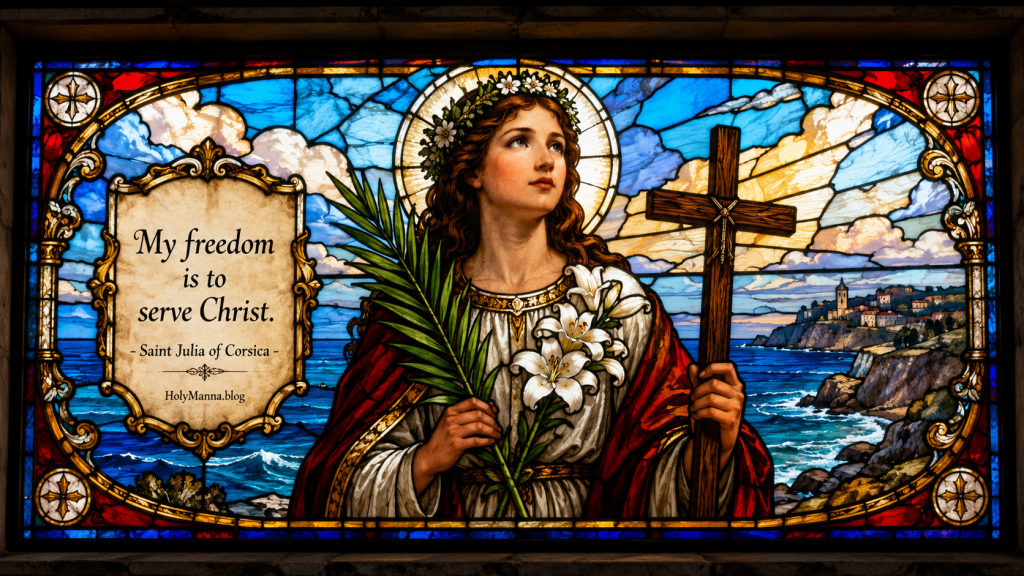
The heart of her story is simple, but it is not small. Julia was outwardly enslaved, but inwardly free. She had no worldly power, no army, no political influence, and no escape plan. Yet when she was pressured to deny Christ, she stood firm. Her most famous traditional saying captures the whole witness of her life: “My freedom is to serve Christ.”
That quote comes from the martyr tradition surrounding her life, not from a surviving writing by Saint Julia herself. Still, it beautifully expresses the Catholic meaning of her witness. In a world that often confuses freedom with self-rule, Saint Julia reminds us that the soul becomes truly free when it belongs to God.
A Daughter of Carthage and a Servant of Christ
The traditional story says that Julia was a Christian girl from Carthage in North Africa. Some accounts describe her as coming from a noble or aristocratic family, though those details are difficult to verify with certainty. What matters most in the Catholic memory of her life is that she belonged to Christ from a young age and remained faithful to Him even after her life was turned upside down.
According to the most common tradition, Carthage was attacked, and Julia was taken captive and sold into slavery. She became the servant of a pagan merchant named Eusebius. In worldly terms, this was a crushing fall. A young Christian woman, possibly from a respected family, was now considered someone else’s property.
But this is where her holiness begins to shine.
Julia did not allow slavery to make her bitter, careless, or faithless. Catholic tradition remembers her as diligent, humble, prayerful, and disciplined. She served faithfully, but she never surrendered her soul. Her master reportedly admired her virtue because she worked honestly and lived with unusual peace. When her daily tasks were finished, she spent her time in prayer, spiritual reading, fasting, and devotion to Christ.
That detail matters. Saint Julia’s sanctity did not begin at the moment of martyrdom. Her martyrdom revealed what had already been growing quietly in her heart. Long before she faced torture, she had already chosen Jesus in the ordinary hidden places of life.
That is a lesson worth sitting with. What kind of soul is being formed in the quiet, unseen moments of daily life?
Holiness in the Ordinary Places
There are no fully verified accounts of Saint Julia performing public miracles during her lifetime in the way we hear about some later saints. She did not leave behind writings, found a religious order, preach to crowds, or become known for dramatic healings while she lived. Her miracle, in many ways, was the miracle of fidelity.
She remained faithful when life became unfair. She remained pure in a pagan world. She remained prayerful when she had every human reason to despair. She remained obedient in service without letting obedience to an earthly master become idolatry. She knew the difference between serving another person with humility and betraying God through compromise.
That is why Saint Julia is so important. She shows that holiness is not only for those with platforms, titles, or public influence. Holiness is for the captive, the overlooked, the exhausted, the mistreated, and the hidden soul who still chooses Christ.
The Catechism of the Catholic Church teaches that the dignity of the human person is rooted in being made in the image of God. Saint Julia’s life reveals that dignity with striking clarity. Even when the world treated her as a slave, heaven saw a daughter. Even when men tried to command her conscience, she knew that her soul belonged to Christ alone.
The Pagan Festival and the Choice That Changed Everything
The great turning point in Saint Julia’s story came during a sea voyage. Her master Eusebius was traveling by ship, and Julia was with him. The vessel stopped near Cap Corse in Corsica, traditionally near Nonza.
While they were there, Eusebius joined a pagan celebration. Julia refused to participate. She would serve her master in earthly duties, but she would not worship false gods. This was the line she would not cross.
According to the traditional account, local pagans noticed her refusal. They seized her while Eusebius was unable to protect her, and they tried to break her resolve. They pressured her to sacrifice to their gods. They offered her freedom if she would deny Christ.
That offer must have been brutally tempting from a human point of view. Freedom from slavery. Freedom from humiliation. Freedom from suffering. All she had to do was make one compromise.
But Julia understood something many people today forget. A body can be free while the soul is enslaved. A person can gain the whole world and lose the one thing that matters most.
So she refused.
Her traditional response, “My freedom is to serve Christ,” is one of those lines that feels almost too strong for the modern heart. It challenges every shallow idea of freedom. Julia was saying that she would rather remain enslaved with Christ than become outwardly free by betraying Him.
That is not weakness. That is spiritual steel.
A Martyr Beneath the Cross
After Julia refused to sacrifice to pagan gods, the traditional story says she was tortured. Some accounts say she was scourged. Corsican oral tradition adds more graphic details, including mutilation, though these details cannot be historically verified with certainty. These traditions should be treated reverently as part of the devotional memory of the saint, but not all of them can be proven as historical fact.
The most beloved tradition says that Julia was crucified near Nonza. This is why she is often shown in art with a cross, along with the palm of martyrdom and sometimes a lily, symbolizing her virginity.
Her death by crucifixion creates a powerful connection with the Passion of Jesus. Julia did not merely speak about belonging to Christ. She followed Him to the Cross. Her suffering became a witness to the Lord who had first suffered for her.
The Catechism of the Catholic Church teaches in CCC 2473 that “Martyrdom is the supreme witness given to the truth of the faith.” Saint Julia lived that teaching with her whole body and soul. She did not die because she hated her enemies. She died because she loved Christ more than life.
That is the meaning of martyrdom. It is not a love of suffering. It is love so deep that even suffering cannot destroy it.
There is also a more historically cautious Catholic theory about her martyrdom. Some Catholic historians suggest that Julia may have been a Christian martyr of Carthage who died during persecution in North Africa, possibly around the time of the Decian persecution in the third century. In this view, her relics may later have been brought to Corsica, which helped form the Corsican tradition around her. This theory is important because it reminds us to distinguish between what the Church venerates with certainty and what later tradition fills in with sacred storytelling.
Still, whether Saint Julia died in Corsica as the beloved tradition says, or whether her relics came there after martyrdom in Africa, the Catholic meaning remains the same. She is honored as a virgin martyr who chose Christ over idolatry, fear, and compromise.
Angels, Monks, and the Body of the Martyr
After Saint Julia’s death, several beautiful legends grew around her relics and her memory. These stories cannot all be historically verified, but they show how deeply the Christian imagination treasured her witness.
One of the most famous legends says that angels appeared to monks on the island of Gorgona and revealed that Julia had been martyred in Corsica. The monks sailed to recover her body. According to the story, they found her still attached to the cross, and a written account of her martyrdom was attached there as well. Some versions say this account was written or provided by angelic hands. This cannot be verified historically, but it reflects the ancient Christian belief that the deaths of the martyrs were precious before God.
Another legend says that the monks sailed with miraculous speed, even against the wind, as they carried her body away for burial. Again, this cannot be verified, but the image is powerful. Creation itself seems to honor the one who honored Christ.
The monks then brought her body to Gorgona, where it was reverently placed in a tomb. From there, devotion to Saint Julia continued to grow across the Mediterranean.
The Spring at Nonza and the Memory of Corsica
Corsican tradition preserves another famous story connected with Saint Julia’s martyrdom. According to this local tradition, after she was tortured near Nonza, a spring appeared at the place associated with her suffering. This spring became part of the devotional landscape of the region and helped keep her memory alive among the people of Corsica.
This miracle story cannot be historically verified with certainty, but it is deeply meaningful. In Catholic symbolism, water often speaks of purification, life, baptism, and grace. A spring flowing from a place of suffering is a beautiful image of what God does through the saints. The world sees death. God brings forth life.
Nonza remains closely connected to Saint Julia’s memory. Churches, local devotion, and cultural traditions in Corsica continue to honor her as one of the island’s beloved patrons. Her story became part of Corsican Catholic identity, not only as a tale from the past, but as a reminder that fidelity to Christ can sanctify a whole people.
Relics, Brescia, Livorno, and a Mediterranean Legacy
Saint Julia’s legacy after death is especially tied to her relics. Catholic sources are most historically confident when speaking about the movement and veneration of her relics.
Her relics were eventually brought to Brescia in northern Italy in the eighth century, around the year 763. They were placed in the Benedictine Monastery of San Salvatore, which later became known as Santa Giulia. This monastery became one of the great religious centers of Brescia for many centuries. It was connected with Queen Ansa, wife of the Lombard king Desiderius, and became an important center of prayer, culture, and Catholic life.
After the monastery was suppressed in the late eighteenth century, Saint Julia’s relics were moved through different locations. In modern times, they have been venerated in the Church of Saint Julia at Villaggio Prealpino in Brescia.
Her devotion is also deeply rooted in Livorno, where she is honored as patroness of the city and diocese. Livorno’s devotion to Saint Julia is connected with one of the city’s oldest lay Catholic associations, the Archconfraternity of the Blessed Sacrament and Saint Julia. This is a beautiful detail because it links her martyrdom directly with Eucharistic devotion. The saint who gave her life for Christ is honored by a community centered on Christ truly present in the Eucharist.
In Livorno, celebrations in her honor have included processions, veneration of relics, blessings connected with the sea and port, and the distribution of blessed bread. Her feast is not merely a private devotion. It has shaped local Catholic culture, civic identity, and public worship.
Saint Julia’s story traveled by ship, monastery, relic, prayer, and pilgrimage. From Carthage to Corsica, from Gorgona to Brescia, from Livorno to Nonza, her memory became part of the Catholic story of the Mediterranean.
What Saint Julia Is Most Known For
Saint Julia is most known for her courageous refusal to renounce Christ when offered earthly freedom. She is remembered as the slave who was spiritually free, the virgin who remained faithful, and the martyr who chose Jesus over survival.
Her life is especially powerful today because modern culture often treats freedom as the ability to follow every desire. Saint Julia gives a better definition. Freedom is not being ruled by fear, sin, comfort, or public pressure. Freedom is the ability to choose the good, to cling to truth, and to belong completely to God.
Her traditional words, “My freedom is to serve Christ,” sound strange to a world addicted to self-expression. But to the Christian heart, they make perfect sense. Service to Christ is not slavery. Sin is slavery. Idolatry is slavery. Fear is slavery. Christ is freedom.
As Jesus says in The Gospel of John, “If the Son makes you free, you will be free indeed.” That is the Gospel truth Saint Julia lived.
A Reflection for the Modern Catholic Heart
Saint Julia’s life asks a hard but necessary question. What would it take to make the soul compromise?
For some people, it is fear of being disliked. For others, it is the desire to fit in. For others, it is comfort, career, romance, money, reputation, or convenience. Most Christians today are not being dragged before pagan altars, but every generation has its own idols. Every age offers its own bargain. Deny Christ here. Stay quiet there. Blend in a little more. Keep faith private. Do not make things awkward.
Saint Julia reminds the Church that faith is not meant to be hidden when truth is on the line.
Her witness does not call every Christian to dramatic martyrdom, but it does call every Christian to daily fidelity. Stay faithful in small duties. Pray when no one sees. Refuse the idols of the age. Keep the body and soul pure. Work honestly. Suffer without hatred. Forgive enemies. Serve others without losing sight of God.
There is also a special lesson here for anyone who feels trapped by circumstances. Saint Julia’s outward life was painfully limited, but her soul was not chained. She teaches that holiness can grow even in hard places. A difficult job, a painful family situation, a season of loneliness, sickness, grief, or uncertainty does not prevent sanctity. With Christ, even suffering can become a place of witness.
The Catechism of the Catholic Church teaches in CCC 956 that the saints continue to intercede for the Church. Saint Julia is not just a figure from the ancient past. She is a living member of the Body of Christ, praying for the faithful who still struggle toward heaven.
So ask for her prayers. Ask her for courage. Ask her for purity of heart. Ask her for the grace to choose Christ when compromise looks easier.
Where is Christ asking for greater courage today? Where is the soul being invited to trade fear for faith?
Engage With Us!
Share your thoughts and reflections in the comments below. Saint Julia’s story is ancient, but her witness feels incredibly relevant in a world that constantly tries to redefine freedom without God.
- What part of Saint Julia’s story challenges you the most?
- Where in your life are you being asked to choose faithfulness over comfort?
- How does the traditional saying, “My freedom is to serve Christ,” change the way you think about freedom?
- What modern idols make it hardest for Catholics to remain faithful today?
- How can Saint Julia’s courage help you live your faith more openly this week?
May Saint Julia of Corsica pray for all who feel pressured, trapped, afraid, or tempted to compromise. May her witness remind every Christian that the world can take many things, but it cannot take a soul that belongs to Jesus. Live with faith, stand with courage, and do everything with the love and mercy Jesus taught us.
Saint Julia of Corsica, pray for us!
Follow us on YouTube, Instagram and Facebook for more insights and reflections on living a faith-filled life.


Leave a Reply