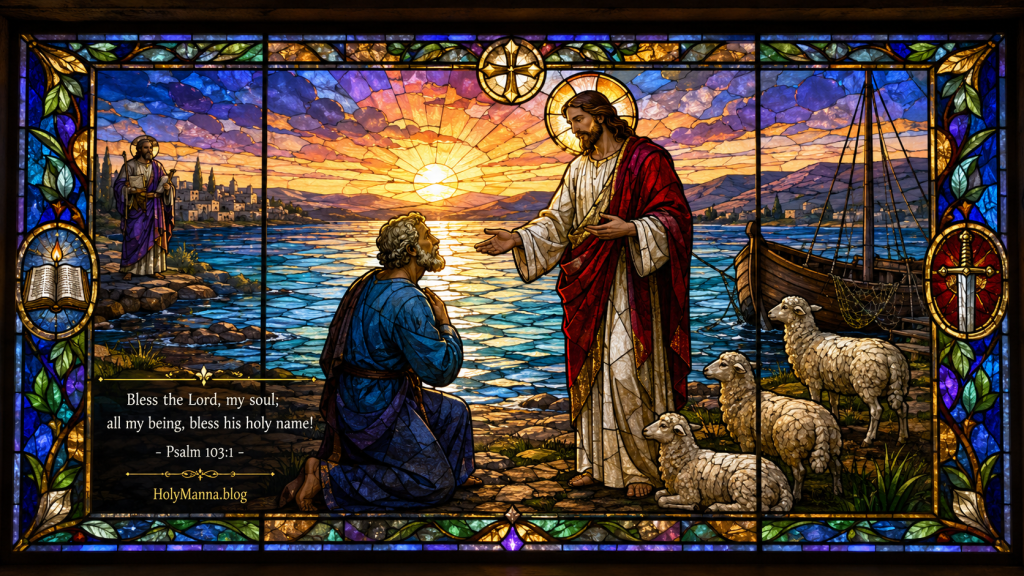
Friday of the Seventh Week of Easter – Lectionary: 301
Mercy That Restores, Love That Sends
There is a moment in the life of faith when Jesus does more than forgive the past. He places a mission in the hands of the forgiven.
Today’s readings bring the Church into that holy tension between mercy and mission. In Acts 25:13-21, Saint Paul stands as a prisoner before Roman authority, yet the real issue is not political rebellion or ordinary crime. Festus admits that the controversy centers on “a certain Jesus who had died but who Paul claimed was alive” Acts 25:19. That single line carries the heartbeat of the apostolic Church. Paul’s chains become a witness stand, and the risen Christ remains the center of everything.
The responsorial psalm, Psalm 103, reveals the mercy behind that witness. God’s love is not small, hesitant, or fragile. The psalm proclaims, “As far as the east is from the west, so far has he removed our sins from us” Psalm 103:12. This prepares the heart for the Gospel, where Peter, the apostle who denied Jesus three times, is not discarded. He is restored. Jesus asks him three times, “Do you love me?” John 21:15-17, not to shame him, but to heal him and entrust him with the care of His flock.
From a Catholic and apostolic perspective, these readings show how the risen Christ builds His Church through forgiven witnesses. Peter receives mercy and is sent to shepherd. Paul suffers misunderstanding and is sent to proclaim that Jesus is alive. This is why The Catechism teaches that the Resurrection is “the crowning truth of our faith in Christ” CCC 638, and why Peter’s restoration matters so deeply for every Catholic who has ever failed and wondered whether God could still use them.
Today’s central theme is this: Christ’s mercy does not leave us where it finds us. It forgives, restores, strengthens, and sends. Where is Jesus asking for your love today, and how might He be turning even your weakness into a place of mission?
First Reading – Acts 25:13-21
Paul’s Chains Become a Witness Stand for the Risen Christ
The first reading places Saint Paul in Caesarea, caught in the machinery of Roman politics and Jewish religious controversy. Felix had left Paul in custody, Festus had inherited the case, and now King Agrippa and Bernice arrive for a formal visit. Agrippa, being familiar with Jewish customs and disputes, becomes a useful listener for Festus, who is trying to understand why Paul is so hated by the religious leaders in Jerusalem.
This scene matters because Paul is not being accused of ordinary wrongdoing. The Roman governor cannot find a clear civil crime. Instead, the heart of the dispute is the Resurrection. Festus reduces the whole controversy to a line that almost sounds casual, but it carries the entire Christian faith: Paul is preaching “a certain Jesus who had died but who Paul claimed was alive” Acts 25:19.
That is the bridge to today’s theme. The risen Christ restores sinners, strengthens witnesses, and sends them into the world. Peter will be restored in the Gospel and told to feed Christ’s sheep. Paul, in this reading, is being moved by Providence toward Rome, where his witness will reach the center of the empire. The world sees a prisoner. The Church sees an apostle being led by God.
Acts 25:13-21 – New American Bible (Revised Edition)
Paul Before King Agrippa. 13 When a few days had passed, King Agrippa and Bernice arrived in Caesarea on a visit to Festus. 14 Since they spent several days there, Festus referred Paul’s case to the king, saying, “There is a man here left in custody by Felix. 15 When I was in Jerusalem the chief priests and the elders of the Jews brought charges against him and demanded his condemnation. 16 I answered them that it was not Roman practice to hand over an accused person before he has faced his accusers and had the opportunity to defend himself against their charge. 17 So when [they] came together here, I made no delay; the next day I took my seat on the tribunal and ordered the man to be brought in. 18 His accusers stood around him, but did not charge him with any of the crimes I suspected. 19 Instead they had some issues with him about their own religion and about a certain Jesus who had died but who Paul claimed was alive. 20 Since I was at a loss how to investigate this controversy, I asked if he were willing to go to Jerusalem and there stand trial on these charges. 21 And when Paul appealed that he be held in custody for the Emperor’s decision, I ordered him held until I could send him to Caesar.”
Detailed Exegesis
Verse 13 – “When a few days had passed, King Agrippa and Bernice arrived in Caesarea on a visit to Festus.”
King Agrippa here is Herod Agrippa II, the last ruler of the Herodian line. His family history is tangled with the story of the New Testament. His great-grandfather, Herod the Great, ruled at the time of Christ’s birth. His father, Herod Agrippa I, persecuted the early Church and had Saint James killed, as recorded earlier in Acts of the Apostles. Bernice, his sister, appears with him in this political setting.
Their arrival in Caesarea shows the world Paul is now entering. He is no longer only dealing with local religious leaders. His case is moving through governors, kings, and eventually the emperor himself. The Gospel is quietly making its way into the halls of power.
Verse 14 – “Since they spent several days there, Festus referred Paul’s case to the king, saying, ‘There is a man here left in custody by Felix.’”
Festus brings up Paul because he has inherited a complicated prisoner from Felix. Paul is not a simple criminal case. He is a theological problem in a political court. Festus does not understand the deep religious meaning of the accusation, so he turns to Agrippa, who knows Jewish customs better than he does.
There is something powerful here. Paul appears passive, almost trapped by the decisions of others. Yet God is still directing the mission. Human authorities are discussing Paul, but Divine Providence is guiding Paul. The Lord had already told Paul that he would bear witness in Rome. Now, even bureaucracy and confusion become part of that journey.
Verse 15 – “When I was in Jerusalem the chief priests and the elders of the Jews brought charges against him and demanded his condemnation.”
The religious leaders do not merely ask for an investigation. They demand condemnation. This shows the intensity of their opposition. Paul’s preaching of the risen Jesus threatens their authority because it proclaims that the crucified One has been vindicated by God.
From a Catholic perspective, this reminds readers that the Gospel has always faced resistance when it confronts pride, power, and unbelief. Paul is not hated because he is violent. He is hated because he proclaims Christ crucified and risen. The same mystery remains challenging today because the Resurrection demands more than polite interest. It demands faith, conversion, and obedience.
Verse 16 – “I answered them that it was not Roman practice to hand over an accused person before he has faced his accusers and had the opportunity to defend himself against their charge.”
Festus explains a principle of Roman justice. The accused must face the accusers and be given the opportunity to defend himself. Even though Festus is not presented as a Christian believer, this legal instinct reflects something naturally good: justice requires truth, fairness, and due process.
The Church teaches that justice is not optional. The Catechism of the Catholic Church says, “Justice is the moral virtue that consists in the constant and firm will to give their due to God and neighbor” CCC 1807. In this moment, even a pagan legal system becomes an instrument that prevents Paul from being handed over unjustly.
This does not mean Rome is righteous in every way. It means God can work through imperfect human structures. He can use a governor, an appeal, a court, and even imprisonment to protect His servant and advance the Gospel.
Verse 17 – “So when [they] came together here, I made no delay; the next day I took my seat on the tribunal and ordered the man to be brought in.”
Festus wants Agrippa to know that he acted quickly and properly. He took his place on the tribunal, the official judgment seat, and ordered Paul to appear. The image is formal and intimidating. Paul stands below political authority, watched and judged by men who have power over his immediate future.
Yet the deeper Christian irony is that Paul, though physically judged, is also spiritually testifying. The tribunal becomes a stage for witness. This echoes the life of Christ Himself, who stood before Pilate and bore witness to the truth. The disciple follows the Master, not only in preaching, but also in suffering before earthly powers.
Verse 18 – “His accusers stood around him, but did not charge him with any of the crimes I suspected.”
Festus expected charges that would make sense in Roman law, perhaps sedition, violence, or public disorder. Instead, the accusations do not match his expectations. Paul is not being charged with the kind of crimes Rome normally punished.
This verse reveals the strange innocence of Christian witness. The world often misunderstands the Church because it looks for political motives where the real issue is spiritual truth. Paul’s enemies are angry, but Festus cannot find a normal crime. The controversy is not about theft, rebellion, or murder. It is about Jesus.
Verse 19 – “Instead they had some issues with him about their own religion and about a certain Jesus who had died but who Paul claimed was alive.”
This is the heart of the passage. Festus, likely without realizing it, summarizes the central proclamation of Christianity. Jesus died, and Paul claims He is alive. That is the apostolic witness. That is the reason Paul suffers. That is the truth that built the Church.
The Catechism of the Catholic Church teaches, “The Resurrection of Jesus is the crowning truth of our faith in Christ, a faith believed and lived as the central truth by the first Christian community; handed on as fundamental by Tradition; established by the documents of the New Testament; and preached as an essential part of the Paschal mystery along with the cross: Christ is risen from the dead! Dying, he conquered death; To the dead, he has given life” CCC 638.
Festus says “a certain Jesus”, but Paul knows Him as Lord. Festus says Jesus died, but Paul proclaims that He lives. The world may reduce Christ to a religious dispute, a historical figure, or an uncomfortable claim. The Church proclaims Him as the risen Son of God.
Verse 20 – “Since I was at a loss how to investigate this controversy, I asked if he were willing to go to Jerusalem and there stand trial on these charges.”
Festus admits confusion. He does not know how to investigate a claim about the Resurrection. Roman law can examine witnesses, crimes, and public order, but it cannot easily judge the mystery of the living Christ.
This is an important spiritual point. The Resurrection is not irrational, but it cannot be reduced to ordinary politics or legal procedure. It must be encountered through testimony, grace, faith, and the witness of the Church. Paul is not simply defending an idea. He is bearing witness to a Person who is alive.
Verse 21 – “And when Paul appealed that he be held in custody for the Emperor’s decision, I ordered him held until I could send him to Caesar.”
Paul appeals to Caesar, exercising his right as a Roman citizen. What appears to be a legal maneuver becomes part of God’s plan. Paul will be sent toward Rome, the heart of the empire. The chains meant to restrict him become the road by which the Gospel travels farther.
This verse reminds readers that God’s mission often moves through circumstances that look frustrating, delayed, or unfair. Paul is not free in the ordinary sense, but he is free in Christ. His body is held, but his witness is not. His enemies try to contain him, but the Gospel keeps moving.
Teachings
The first major teaching of this reading is that the Resurrection is the center of the Christian faith. Festus does not understand the controversy, but he identifies the essential question. Did Jesus remain dead, or is He alive? Saint Paul stakes everything on the answer.
This is why The Catechism of the Catholic Church teaches, “The Resurrection of Jesus is the crowning truth of our faith in Christ, a faith believed and lived as the central truth by the first Christian community; handed on as fundamental by Tradition; established by the documents of the New Testament; and preached as an essential part of the Paschal mystery along with the cross: Christ is risen from the dead! Dying, he conquered death; To the dead, he has given life” CCC 638.
Paul is also a model of Christian witness. He does not control the room. He does not control the outcome. He does not even control where he will be sent. Yet he remains faithful to the truth. His life shows what The Catechism means when it teaches, “Before Pilate, Christ proclaims that he ‘has come into the world, to bear witness to the truth.’ The Christian is not to ‘be ashamed then of testifying to our Lord.’ In situations that require witness to the faith, the Christian must profess it without equivocation” CCC 2471.
That word matters in every age. Paul’s witness is not vague spirituality. He testifies to the risen Jesus. The Church does not exist to offer generic encouragement. She exists to proclaim Christ crucified and risen, to administer His sacraments, to teach His truth, and to shepherd souls toward eternal life.
This reading also teaches that suffering can become mission. Paul’s imprisonment looks like a setback, but God uses it to carry the Gospel toward Rome. The same Lord who turned the Cross into salvation can turn chains into witness. This is deeply apostolic. The Church has always grown through men and women who remained faithful when misunderstood, judged, mocked, imprisoned, or killed.
Saint Paul would later write, “The word of God is not chained” 2 Timothy 2:9. That line captures the spirit of this reading. The apostle may be held, but Christ’s truth is not held. The messenger may suffer, but the message lives.
Reflection
This first reading asks a direct question of every Catholic heart: When people look at your life, would they know that you believe Jesus is alive?
Paul’s whole case turns on the Resurrection. Not politics. Not personality. Not personal ambition. The controversy is Jesus. That should make modern Catholics pause. It is easy to let faith become private inspiration, parish routine, moral opinion, or cultural identity. But apostolic Christianity begins with a proclamation: Jesus Christ died, and Jesus Christ is alive.
That truth should change the way a Catholic speaks, works, suffers, forgives, and hopes. If Jesus is alive, then prayer is not talking to the ceiling. If Jesus is alive, then Confession is not emotional self-improvement. If Jesus is alive, then the Eucharist is not a symbol of community togetherness. If Jesus is alive, then suffering can become an offering, and even frustrating delays can become part of Providence.
This reading also teaches patience in seasons of being misunderstood. Paul is surrounded by people talking about him, judging him, and trying to decide his future. Many believers know that feeling. A faithful Catholic may be misunderstood at work, in family life, online, or even among friends. The temptation is to become bitter, defensive, or silent. Paul shows another way. Stand in truth. Use the opportunity given. Trust that God can work through rooms where no one seems to understand.
A practical step today is to name one place where witness has become uncomfortable. It may be speaking honestly about Catholic teaching, defending the dignity of life, forgiving someone who has hurt you, returning to the sacraments, or simply letting people know that faith is not a hobby but the center of your life. Then ask for the grace to be faithful without becoming harsh, fearful, or ashamed.
The Christian witness does not need to win every argument. It needs to remain faithful to the risen Christ.
Where is God asking you to bear witness that Jesus is alive, even if the people around you do not fully understand?
Responsorial Psalm – Psalm 103:1-2, 11-12, 19-20
The Mercy That Towers Higher Than Our Sin
The responsorial psalm gives today’s readings their heartbeat. In the first reading, Saint Paul is misunderstood and held in custody because he proclaims that Jesus is alive. In the Gospel, Saint Peter is restored after denying the Lord three times. Between those two apostolic stories, Psalm 103 sings of the mercy of God, a mercy so vast that human failure cannot outrun it.
Traditionally attributed to David, this psalm is a hymn of praise to the Lord’s compassion, forgiveness, and sovereign rule. It begins in the soul, with one person calling his whole being to bless God, and then rises all the way to heaven, where angels obey the Lord’s command. That movement matters. The mercy of God is intimate enough to heal a wounded conscience and majestic enough to rule over the whole universe.
This psalm fits today’s central theme beautifully. Christ’s mercy does not merely pardon. It restores, strengthens, and sends. Peter can be restored because God removes sin. Paul can stand firm because God reigns from heaven. The Church can keep proclaiming the risen Jesus because the Lord’s dominion extends over all.
Psalm 103:1-2, 11-12, 19-20 – New American Bible (Revised Edition)
Praise of Divine Goodness
1 Of David.
Bless the Lord, my soul;
all my being, bless his holy name!
2 Bless the Lord, my soul;
and do not forget all his gifts,11 For as the heavens tower over the earth,
so his mercy towers over those who fear him.
12 As far as the east is from the west,
so far has he removed our sins from us.19 The Lord has set his throne in heaven;
his dominion extends over all.
20 Bless the Lord, all you his angels,
mighty in strength, acting at his behest,
obedient to his command.
Detailed Exegesis
Verse 1 – “Bless the Lord, my soul; all my being, bless his holy name!”
The psalm begins with an inner command. The psalmist does not wait for his emotions to catch up. He calls his own soul to praise. This is deeply Catholic because worship is not merely a feeling. It is an act of love, reverence, memory, and obedience.
The phrase “all my being” shows that true worship involves the whole person. The mind, heart, body, memory, imagination, and will are all invited into praise. This connects beautifully to today’s readings. Paul’s entire life becomes testimony to the risen Christ, even in chains. Peter’s whole wounded heart is invited back into love when Jesus asks, “Do you love me?” John 21:15-17.
To bless the Lord’s holy name is to recognize who God truly is. His name reveals His character. He is holy, merciful, faithful, and sovereign. Catholic prayer begins here, not with self-focus, but with adoration.
Verse 2 – “Bless the Lord, my soul; and do not forget all his gifts.”
The psalmist repeats the call to bless the Lord, then adds a warning: do not forget. Forgetfulness is one of the great spiritual dangers. Israel often forgot the mighty deeds of God. Christians can also forget grace, mercy, answered prayers, forgiven sins, and the quiet ways God has carried them.
This verse is especially important beside Peter’s restoration. Peter could have remembered only his failure. Jesus invites him to remember mercy. Paul could have remembered only his imprisonment. God is leading him toward mission. The psalm teaches that the faithful heart must remember the gifts of God more deeply than the wounds of the past.
In Catholic life, this kind of remembering is Eucharistic. The Mass is the great memorial of Christ’s sacrifice, not as a mere recollection, but as a living participation in the saving mystery of Jesus. To remember God’s gifts is to live with gratitude, reverence, and hope.
Verse 11 – “For as the heavens tower over the earth, so his mercy towers over those who fear him.”
This is one of the most beautiful descriptions of divine mercy in the Old Testament. The psalmist reaches for the greatest visible distance imaginable: the heavens towering above the earth. That is how high God’s mercy rises over those who fear Him.
The fear of the Lord does not mean panic before God. It means reverence, humility, awe, and loving obedience. It is the posture of a soul that knows God is not casual, but also knows He is good. Peter stands in that holy fear after the Resurrection. He knows he failed. He knows Jesus knows everything. Yet he also knows the Lord’s mercy is greater than his denial.
This verse prepares readers to understand that mercy is not weakness in God. Mercy is the radiance of His love toward sinners. His mercy towers, not because sin is unimportant, but because His goodness is infinitely greater.
Verse 12 – “As far as the east is from the west, so far has he removed our sins from us.”
This verse gives the psalm its tender power. God does not keep forgiven sin close at hand so He can throw it back in the sinner’s face. When He forgives, He removes sin. The distance between east and west is poetic, immeasurable, and unreachable.
This matters for today’s Gospel. Peter’s denial was real, but it was not stronger than Christ’s mercy. Jesus does not restore Peter by pretending the denial never happened. He restores him by healing the wound through love. Three times Peter denied. Three times Peter confesses love. The mercy described in Psalm 103 becomes visible in the risen Christ.
Catholic teaching never treats sin lightly, but it also never treats sin as greater than grace. Confession is not a place of humiliation. It is the place where Christ removes sin and restores communion with God and the Church.
Verse 19 – “The Lord has set his throne in heaven; his dominion extends over all.”
The psalm now lifts the eyes from personal mercy to universal sovereignty. The same Lord who forgives sins reigns over all creation. His throne is not unstable. His dominion does not depend on human approval, political power, or cultural trends.
This verse speaks directly into the first reading. Festus, Agrippa, Bernice, the chief priests, and the elders all appear powerful. They discuss Paul’s future as if everything rests in their hands. Yet Psalm 103 reveals the deeper truth. The Lord reigns over all. Even earthly tribunals remain beneath His providence.
For Catholics, this is a steadying truth. Christ is not merely Lord in church buildings or private prayer. He is Lord over history, nations, families, suffering, courts, prisons, hospitals, and hidden rooms where people feel forgotten. His dominion extends over all.
Verse 20 – “Bless the Lord, all you his angels, mighty in strength, acting at his behest, obedient to his command.”
The psalm ends this selection by summoning the angels to praise. The worship that began inside one soul now expands to the heavenly court. The angels are mighty, but their greatness is shown in obedience. They act at God’s command.
This verse reminds readers that the Christian life is not isolated. Worship on earth joins the worship of heaven. Every Mass participates in this heavenly praise. When Catholics sing “Holy, Holy, Holy”, they are joining the angels and saints in adoration of the Lord.
The angels also reveal what true strength looks like. They are mighty because they obey. In today’s readings, Paul’s strength is obedience in witness. Peter’s strength will become obedience in shepherding. Christian strength is not self-assertion. It is faithful response to God.
Teachings
The great teaching of Psalm 103 is that God’s mercy is personal, powerful, and sovereign. The Lord forgives sin, remembers His covenant love, rules from heaven, and receives the worship of angels. This is not a small view of mercy. It is mercy flowing from the throne of the living God.
The Catechism of the Catholic Church teaches, “The Gospel is the revelation in Jesus Christ of God’s mercy to sinners. The angel announced to Joseph: ‘You shall call his name Jesus, for he will save his people from their sins.’” CCC 1846. This teaching helps Catholics read Psalm 103 through Christ. The mercy praised by David is fully revealed in Jesus, especially through His Passion, Death, and Resurrection.
The psalm’s line about God removing sin also fits the Church’s teaching on the Sacrament of Penance. The Catechism teaches, “Those who approach the sacrament of Penance obtain pardon from God’s mercy for the offense committed against him, and are, at the same time, reconciled with the Church which they have wounded by their sins and which by charity, by example, and by prayer labors for their conversion.” CCC 1422. This is exactly the kind of mercy Peter receives from the risen Lord. He is not only personally consoled. He is restored for communion and mission.
The verse about the angels also opens a window into Catholic teaching on heavenly worship. The Catechism says, “With their whole beings the angels are servants and messengers of God. Because they ‘always behold the face of my Father who is in heaven’ they are the ‘mighty ones who do his word, hearkening to the voice of his word.’” CCC 329. That final phrase echoes Psalm 103:20 and shows how deeply the Church understands the angels as obedient servants of God’s saving will.
Saint Augustine, reflecting on praise, often taught that the whole life of the Christian should become a song to God. In his spirit, Psalm 103 is not simply something to recite. It is something to become. A forgiven soul becomes a praising soul. A praising soul becomes an obedient soul. An obedient soul becomes a witness.
This is why the psalm belongs with Paul and Peter. Paul witnesses before rulers because the risen Jesus is worth suffering for. Peter is restored because the mercy of Jesus is greater than denial. The angels obey because heaven already knows what earth is still learning: the Lord is worthy of complete praise.
Reflection
Psalm 103 invites the reader to remember mercy before remembering failure. That does not mean ignoring sin. It means letting God define the story more deeply than shame does.
Many people carry old sins like permanent names. They remember what they did, what they said, what they looked at, what they failed to do, or the person they used to be. But this psalm announces something stronger than self-accusation: “As far as the east is from the west, so far has he removed our sins from us” Psalm 103:12. If God has forgiven something, the soul does not need to keep dragging it back from the grave.
A practical way to live this psalm is to begin the day with gratitude before anxiety takes over. Name three gifts from God. Remember one mercy. Thank Him for one sin forgiven. Then ask for the grace to praise Him with the whole day, not only with words, but with patience, honesty, chastity, humility, and service.
This psalm also calls Catholics back to Confession with confidence. If there is sin on the conscience, the answer is not hiding. The answer is returning. God’s mercy towers over those who fear Him, and the sacrament is one of the clearest places where that mercy meets the soul.
Finally, Psalm 103 asks believers to trust that God reigns even when life feels politically, socially, or personally chaotic. Paul’s courtroom was not outside God’s dominion. Peter’s failure was not outside God’s mercy. The angels in heaven obey His command, and the Church on earth is invited to do the same.
What gift of God have you forgotten, and what forgiven sin are you still carrying as if His mercy were not enough?
Holy Gospel – John 21:15-19
The Risen Christ Restores Peter and Turns Wounded Love Into Mission
The Holy Gospel brings the Church to the shore of the Sea of Tiberias after the Resurrection. The disciples have just eaten breakfast with the risen Jesus, and now the Lord turns toward Simon Peter. This is not a casual conversation. This is mercy entering the exact place where Peter had failed.
Earlier, Peter denied Jesus three times near a charcoal fire. Now, after another meal near the sea, Jesus asks Peter three times whether he loves Him. The repetition is not meant to crush Peter. It is meant to heal him. Jesus is not reopening the wound to shame him. He is touching the wound so grace can enter.
This Gospel fits today’s theme with incredible beauty. In the first reading, Saint Paul is being led toward witness because he proclaims that Jesus is alive. In the psalm, God removes sin “as far as the east is from the west” Psalm 103:12. Now in the Gospel, Peter becomes the living proof of that mercy. The risen Christ restores the apostle who denied Him, entrusts him with the care of His flock, and then calls him again with the simple, costly words: “Follow me” John 21:19.
John 21:15-19 – New American Bible (Revised Edition)
15 When they had finished breakfast, Jesus said to Simon Peter, “Simon, son of John, do you love me more than these?” He said to him, “Yes, Lord, you know that I love you.” He said to him, “Feed my lambs.” 16 He then said to him a second time, “Simon, son of John, do you love me?” He said to him, “Yes, Lord, you know that I love you.” He said to him, “Tend my sheep.” 17 He said to him the third time, “Simon, son of John, do you love me?” Peter was distressed that he had said to him a third time, “Do you love me?” and he said to him, “Lord, you know everything; you know that I love you.” [Jesus] said to him, “Feed my sheep. 18 [c]Amen, amen, I say to you, when you were younger, you used to dress yourself and go where you wanted; but when you grow old, you will stretch out your hands, and someone else will dress you and lead you where you do not want to go.” 19 He said this signifying by what kind of death he would glorify God. And when he had said this, he said to him, “Follow me.”
Detailed Exegesis
Verse 15 – “When they had finished breakfast, Jesus said to Simon Peter, ‘Simon, son of John, do you love me more than these?’ He said to him, ‘Yes, Lord, you know that I love you.’ He said to him, ‘Feed my lambs.’”
The scene begins after breakfast, which gives the moment a tender and almost family-like setting. Jesus does not restore Peter in a courtroom or before a shouting crowd. He restores him after feeding him. Before Peter is commanded to feed others, he is first fed by Christ.
Jesus calls him “Simon, son of John”, not simply Peter. This reaches back to Peter’s original identity before his great confession, before his bold promises, before his denial, and before his restoration. Jesus is speaking to the whole man, not the public image of the apostle.
The question “Do you love me more than these?” touches Peter’s old confidence. Before the Passion, Peter had spoken with great certainty, saying that even if others fell away, he would not. Now Jesus gently invites him to confess love without boasting. Peter no longer compares himself to the others. He simply says, “Yes, Lord, you know that I love you.”
Jesus answers with mission: “Feed my lambs.” Forgiveness is not the end of Peter’s story. It is the beginning of a deeper mission. The lambs belong to Jesus, not Peter. Peter is being entrusted with Christ’s flock, which is why this passage has always mattered deeply in the Catholic understanding of Peter’s pastoral role in the Church.
Verse 16 – “He then said to him a second time, ‘Simon, son of John, do you love me?’ He said to him, ‘Yes, Lord, you know that I love you.’ He said to him, ‘Tend my sheep.’”
Jesus asks a second time, and Peter answers again with humility. The repetition is important because love must be confirmed, not just assumed. Peter’s first answer is sincere, but Jesus continues to draw him deeper.
This time, Jesus says, “Tend my sheep.” The image is pastoral. To tend sheep is to guide, guard, nourish, correct, and protect. In biblical tradition, shepherding is a sacred image of leadership. The Lord Himself is the Shepherd of Israel, and bad shepherds are condemned when they use the flock for themselves.
Peter is not being given a position of domination. He is being given a ministry of service. In the Catholic Church, true authority is never separated from charity. The shepherd must love Christ first, because only love for Christ can keep ministry from becoming pride, control, or self-promotion.
Verse 17 – “He said to him the third time, ‘Simon, son of John, do you love me?’ Peter was distressed that he had said to him a third time, ‘Do you love me?’ and he said to him, ‘Lord, you know everything; you know that I love you.’ Jesus said to him, ‘Feed my sheep.’”
The third question pierces Peter’s heart. The Gospel says Peter was distressed, and that detail matters. The mercy of Jesus is gentle, but it is not shallow. Peter must face the truth of his denial, not to be condemned, but to be healed.
Peter’s answer is beautiful because it is no longer built on self-confidence. He says, “Lord, you know everything; you know that I love you.” Peter appeals to Christ’s knowledge, not his own strength. He knows Jesus sees the whole truth: the denial, the tears, the shame, the love, and the weakness. Peter hides nothing.
Jesus again says, “Feed my sheep.” Three denials are met by three professions of love. Three wounds are met by three commands of mission. Peter is not replaced. Peter is restored. This is the mercy praised in Psalm 103. God does not keep forgiven sin close so He can use it against the sinner. He removes it, heals it, and transforms the forgiven person into a witness.
Verse 18 – “Amen, amen, I say to you, when you were younger, you used to dress yourself and go where you wanted; but when you grow old, you will stretch out your hands, and someone else will dress you and lead you where you do not want to go.”
The words “Amen, amen” signal a solemn teaching. Jesus now reveals that Peter’s love will mature into sacrifice. When Peter was younger, he chose his own way. He dressed himself and went where he wanted. But discipleship will lead him beyond self-direction.
The phrase “you will stretch out your hands” points toward Peter’s martyrdom. Tradition holds that Peter was crucified in Rome during the persecution under Nero. The man who once denied Jesus out of fear will one day glorify God by giving his life.
This is one of the great transformations of grace. Jesus does not merely forgive Peter so he can feel better. He strengthens Peter so he can love to the end. Catholic discipleship is not comfort without conversion. It is mercy that makes the soul brave.
Verse 19 – “He said this signifying by what kind of death he would glorify God. And when he had said this, he said to him, ‘Follow me.’”
Saint John explains that Jesus is speaking about the death by which Peter would glorify God. This gives Christian suffering a profound meaning. For the disciple, even death can become an act of worship when united to Christ.
Then Jesus says, “Follow me.” These are the words that began Peter’s journey, and now they begin it again. The call has not been canceled by failure. The vocation remains, but now Peter understands it more deeply. To follow Jesus means more than admiration. It means love, obedience, shepherding, sacrifice, and eventually the cross.
This final command connects Peter with Paul in today’s first reading. Paul is being led where he did not expect to go. Peter will also be led where he does not want to go. Both apostles show that Christian mission belongs to Christ. The disciple follows wherever the Lord leads.
Teachings
This Gospel teaches the mercy of Christ toward sinners and the mission that flows from restored love. Peter had fallen publicly and painfully, but Jesus does not define him by his worst moment. Instead, the risen Lord invites him into repentance, love, and renewed service.
The Catechism of the Catholic Church teaches, “Jesus’ look of infinite mercy drew tears of repentance from Peter and, after the Lord’s resurrection, a threefold affirmation of love for him” CCC 1429. This is the Catholic heart of the passage. Peter’s conversion is not only regret. It is a return to love. His sorrow becomes healing because it meets the mercy of Jesus.
This Gospel also reveals the pastoral office entrusted to Peter. Jesus does not merely forgive Peter privately. He gives him responsibility for the flock. The Catechism of the Catholic Church teaches, “Jesus entrusted a specific authority to Peter: ‘I will give you the keys of the kingdom of heaven, and whatever you bind on earth shall be bound in heaven, and whatever you loose on earth shall be loosed in heaven.’ The ‘power of the keys’ designates authority to govern the house of God, which is the Church. Jesus, the Good Shepherd, confirmed this mandate after his Resurrection: ‘Feed my sheep.’” CCC 553.
This is why Catholics see John 21 as deeply connected to the Petrine ministry. Peter’s authority is not rooted in personal perfection. It is rooted in Christ’s choice, Christ’s mercy, and Christ’s command. The Pope, as successor of Peter, serves the unity and pastoral care of the Church, not as an owner of the flock, but as a servant of the Good Shepherd.
The Catechism of the Catholic Church also teaches, “The Lord made Simon alone, whom he named Peter, the ‘rock’ of his Church. He gave him the keys of his Church and instituted him shepherd of the whole flock. ‘The office of binding and loosing which was given to Peter was also assigned to the college of apostles united to its head.’ This pastoral office of Peter and the other apostles belongs to the Church’s very foundation and is continued by the bishops under the primacy of the Pope.” CCC 881.
The passage also teaches that love for Christ must become service. Saint Augustine captured the heart of this Gospel when he taught, “Let feeding the Lord’s flock be the proof of love.” That line fits the entire scene. Jesus asks for love, and then immediately gives Peter sheep to feed. In Catholic life, love for Jesus can never remain only emotional. It must become care for souls.
Finally, this Gospel teaches the cost of discipleship. Peter’s future martyrdom shows that love matures into surrender. The Catechism of the Catholic Church teaches, “The way of perfection passes by way of the Cross. There is no holiness without renunciation and spiritual battle.” CCC 2015. Peter will become holy not by avoiding weakness, but by letting Christ transform his weakness into faithful love.
Reflection
This Gospel is one of the most consoling passages in Scripture because it speaks to everyone who has failed and wondered whether Jesus still wants them.
Peter did not make a small mistake. He denied the Lord three times during the Passion. He failed in courage, loyalty, and love. Yet the risen Jesus does not discard him. He comes to him, feeds him, questions him, heals him, and sends him.
That matters for daily Catholic life because many people quietly live under the weight of old failures. They believe Jesus forgives in theory, but they struggle to believe He wants them personally. They go to Mass, hear about mercy, and still wonder whether they are too inconsistent, too wounded, too weak, or too late.
Peter’s restoration says otherwise. Jesus does not ask, “Why did you fail me?” He asks, “Do you love me?” That question goes straight to the heart. It does not ignore sin, but it refuses to let sin have the final word.
A good way to live this Gospel is to bring one honest answer to prayer: “Lord, you know everything; you know that I love you” John 21:17. That prayer is powerful because it hides nothing. It admits that Jesus knows the whole story. He knows the sins, excuses, fears, habits, wounds, and contradictions. He also knows the real love that still exists beneath the weakness.
This Gospel also asks every Catholic to look at the people Christ has placed nearby. Jesus tells Peter, “Feed my lambs”, “Tend my sheep”, and “Feed my sheep” John 21:15-17. Not everyone is called to ordained ministry, but every Christian is called to love in a way that nourishes others. Parents feed the lambs when they teach their children to pray. Friends tend the sheep when they encourage one another toward virtue. Catechists feed the flock when they teach the faith clearly. Married couples shepherd one another when they choose forgiveness over resentment.
The question is not only whether a person loves Jesus in private devotion. The question is whether that love becomes service.
This passage also gives courage when following Christ leads somewhere difficult. Jesus tells Peter that one day he will be led where he does not want to go. That is not an easy promise, but it is a holy one. Some acts of obedience feel like being led beyond personal comfort: forgiving someone, going to Confession, speaking the truth, carrying illness, remaining faithful in marriage, serving aging parents, choosing chastity, or staying loyal to Christ when the culture mocks the faith.
Peter’s story shows that grace can make fearful people brave. The man who denied Jesus becomes the shepherd who dies for Him. That is what the risen Christ can do with a humbled heart.
When Jesus asks, “Do you love me?” what answer is your life giving Him right now?
Mercy Restores, Love Sends, and the Risen Christ Leads
Today’s readings gather around one powerful truth: the risen Jesus does not leave His people trapped in fear, failure, confusion, or shame. He restores them with mercy, strengthens them with love, and sends them into the world as witnesses that He is alive.
Saint Paul stands before the powers of his age, misunderstood and held in custody, yet the heart of his whole case is beautifully simple. The dispute is about “a certain Jesus who had died but who Paul claimed was alive” Acts 25:19. That is the center of the Christian life. Jesus is not merely remembered. He is risen. He is living. He is still acting through His Church.
Psalm 103 gives the soul the courage to believe that this risen Lord is merciful beyond measure. God’s mercy is not narrow or reluctant. The psalm proclaims, “As far as the east is from the west, so far has he removed our sins from us” Psalm 103:12. That mercy becomes visible in the Gospel, where Peter, the apostle who denied Jesus three times, is not rejected. He is healed. He is questioned with love. He is entrusted again with mission.
Jesus asks Peter, “Do you love me?” John 21:15-17. That question still reaches into every Catholic heart. It cuts through excuses, shame, pride, fear, and half-hearted discipleship. It does not ask whether a person has never failed. It asks whether love is still alive, and whether that love is willing to follow.
The call to action today is simple but serious. Return to the mercy of Christ. Let Him forgive what still weighs on the heart. Let Him restore what sin has wounded. Then let that mercy become mission. Feed the lambs placed in your life. Tend the sheep entrusted to your care. Witness to the risen Jesus in ordinary conversations, quiet sacrifices, faithful service, and courageous truth.
The Christian life is not about pretending to be strong. It is about bringing a humbled heart to Jesus and saying with Peter, “Lord, you know everything; you know that I love you” John 21:17. From there, Christ does what only Christ can do. He forgives. He restores. He sends.
Where is the risen Jesus asking you to follow Him today, and who is He asking you to love in His name?
Engage with Us!
Share your reflections in the comments below. Today’s readings invite every Catholic heart to return to the mercy of Jesus, trust that He is truly alive, and let His love become mission in everyday life.
- First Reading, Acts 25:13-21: Where is God asking you to witness that Jesus is alive, even if the people around you misunderstand your faith?
- Responsorial Psalm, Psalm 103:1-2, 11-12, 19-20: What forgiven sin, past wound, or old failure do you still need to surrender to the mercy of God?
- Holy Gospel, John 21:15-19: When Jesus asks, “Do you love me?”, what part of your life is He asking you to place back into His hands?
May these readings help every soul walk with deeper trust, stronger courage, and a more generous heart. Live the faith boldly, love the people God has placed before you, and do everything with the mercy, patience, and sacrificial love that Jesus taught us.
Sacred Heart of Jesus, we trust in You!
Immaculate Heart of Mary, pray for us!
Saint Michael the Archangel, defend us in battle!
Follow us on YouTube, Instagram and Facebook for more insights and reflections on living a faith-filled life.


Leave a Reply