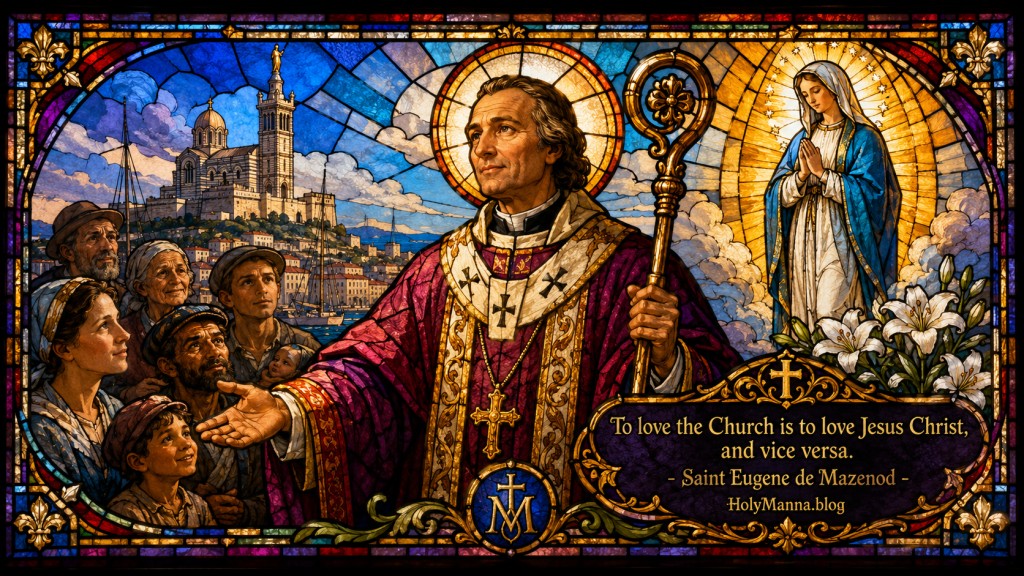
The Noble Refugee Who Became a Missionary Father
Saint Eugene de Mazenod was a French nobleman, a refugee of the French Revolution, a priest of the poor, the founder of the Missionary Oblates of Mary Immaculate, and later the Bishop of Marseille. His feast day is celebrated on May 21, the day he died in 1861.
He is most known for founding a missionary congregation dedicated to evangelizing the poor and spiritually abandoned. His life was shaped by one burning conviction: people who had been forgotten by society must never be forgotten by the Church. Prisoners, workers, youth, servants, rural villagers, immigrants, and the poor all had a place in his priestly heart.
His missionary vision was rooted in the words of Christ in Luke 4:18: “He has sent me to evangelize the poor.” That became the heart of the Oblate mission and the spiritual key to understanding Saint Eugene’s entire life.
The Catechism of the Catholic Church teaches that the Church is missionary by her very nature because she is sent by Christ to all nations. It also teaches that love for the poor belongs to the Church’s constant tradition. Saint Eugene lived both truths with remarkable intensity. He did not see the poor as a project. He saw them as beloved children of God, redeemed by Jesus Christ, and called to become saints.
A Childhood Shattered by Revolution
Charles-Joseph-Eugène de Mazenod was born on August 1, 1782, in Aix-en-Provence, France. His father, Charles Antoine de Mazenod, belonged to the French nobility and served in the legal and political world of Provence. His mother, Rose Eugénie Joannis, came from a prosperous bourgeois family. Eugene was born into privilege, stability, and Catholic culture.
Then the French Revolution came.
When Eugene was still a child, his family fled France to escape the violence and anti-aristocratic persecution of the Revolution. He spent years in exile in Italy, moving through places such as Turin, Venice, Naples, and Palermo. His family lost wealth, status, and stability. His education was interrupted. His parents eventually separated, and his mother returned to France, where she obtained a civil divorce in order to recover family property.
This wounded family history would mark Eugene deeply. It is one reason many Catholics and Oblates see him as a powerful intercessor for wounded families, refugees, children of divorce, and people whose lives have been disrupted by forces beyond their control.
In Venice, one of the most important figures in his life appeared. A holy priest named Don Bartolo Zinelli helped educate Eugene and introduced him more deeply to prayer, discipline, and devotion to the Blessed Virgin Mary. Eugene later looked back on that time as the place where his priestly vocation first began to take root.
That is one of the beautiful surprises of his story. His vocation did not begin in comfort. It began in exile.
The Good Friday That Changed Everything
Eugene returned to France in 1802 as a young man. At first, he was drawn to the world he had lost. He wanted position, security, a good marriage, social success, and the restoration of his family’s status. He was intelligent, passionate, and ambitious. He also had a strong temperament and struggled with pride.
But worldly hopes did not satisfy him. The life he expected kept slipping away. A promising marriage arrangement failed. His family remained wounded. His own heart felt restless.
Then came the great turning point of his life.
On Good Friday in 1807, while praying before the Cross, Eugene experienced a profound conversion. He saw his sins in the light of Christ’s love. He realized that Jesus had shed His Blood for him personally. Instead of being crushed by shame, he was overwhelmed by mercy.
This moment became the foundation of his whole life. Eugene did not become holy because he had an easy personality or a perfect past. He became holy because he allowed the Crucified Christ to claim everything, including his wounds, his pride, his passion, and his future.
His life became a living answer to the mercy of Jesus.
The Priest Who Chose the Forgotten
Eugene entered the Seminary of Saint-Sulpice in Paris in 1808, despite opposition from his mother. He was ordained a priest on December 21, 1811.
After ordination, he did something unexpected. He refused to pursue a comfortable parish assignment or an impressive Church career. Instead, he returned to Aix and gave himself to the people who were least served by ordinary ministry.
He became, in his own famous phrase, “the servant and priest of the poor.”
He preached to the poor in Provençal, the language of ordinary people, rather than polished French. That choice mattered. He did not want the Gospel to sound distant, elite, or unreachable. He wanted people to hear Jesus speaking directly to their hearts.
In his 1813 Lenten sermons to the poor of Aix, Eugene told them something radical for that time. He told them to stop seeing themselves through the contempt of the world and begin seeing themselves through the eyes of faith. He preached: “Come now and learn from us what you are in the eyes of faith.” Then he reminded them that they were children of God, brothers and sisters of Jesus Christ, and heirs of His eternal kingdom.
That was not flattery. That was Catholic truth.
The poor are not leftovers. The poor are not invisible. The poor are not less worthy of reverence. Every human person is created in the image of God, redeemed by Christ, and called to eternal life.
A Saint Before Youth Ministry Had a Name
One of the most striking parts of Saint Eugene’s early priesthood was his love for young people. In 1813, he founded the Association of Christian Youth of Aix. This was not easy or safe. France was still politically tense, and religious youth associations were treated with suspicion under Napoleon’s regime.
Eugene understood that young people needed more than rules. They needed friendship, formation, prayer, belonging, and a serious call to holiness. He gathered young men, taught them the faith, encouraged virtue, and helped them live as Catholics in a world that was spiritually confused.
In this way, Saint Eugene feels surprisingly modern. He understood the loneliness of young people. He understood the pull of the world. He also understood that the Church must not wait for young souls to drift away before reaching out to them.
Where are the young people today who need someone to remind them that they belong to Christ?
The Typhus Barracks and the Courage of Charity
In 1814, around two thousand Austrian prisoners of war were brought to Aix. A typhus outbreak spread through the barracks, and the prisoners were suffering terribly. Their chaplain died, and many of them were in danger of dying without the sacraments.
Eugene volunteered to serve them.
He entered the barracks, heard confessions, brought spiritual comfort, and ministered to the sick and dying. Eventually, he contracted typhus himself and became gravely ill. He received Extreme Unction, the sacrament now usually called the Anointing of the Sick, because death seemed near.
The young men of his Association prayed fervently for him, especially before an image of Our Lady. Eugene eventually recovered and returned to ministry.
This healing was cherished in Oblate memory, although it was not one of the formally approved miracles used for his canonization. Still, the story reveals the character of his priesthood. Eugene was willing to risk his life so that abandoned prisoners could receive Christ’s mercy at the hour of death.
That is the kind of charity the saints teach. Not comfortable charity. Not sentimental charity. Crucified charity.
The Birth of the Oblates
Eugene soon realized that one priest could not do everything. Post-Revolutionary France was spiritually wounded. Many rural areas lacked solid catechesis. The poor were neglected. Faith had grown cold in many hearts.
In 1816, Eugene gathered a small group of priests to live in community and preach missions to the poor. They were first known as the Missionaries of Provence. Their purpose was to renew Catholic faith among those who had been neglected, especially in the countryside.
In 1818, the group embraced religious vows and a rule of life. In 1826, Pope Leo XII officially approved the congregation under the name Missionary Oblates of Mary Immaculate.
The word “Oblate” means one who is offered. These men were to offer themselves entirely to Christ, through Mary, for the salvation of the poor and abandoned.
Their motto came from Luke 4:18: “He has sent me to evangelize the poor.”
For Saint Eugene, this was not merely a slogan. It was a way of seeing the world. The poor were to be approached with reverence. The sinner was to be approached with mercy. The forgotten were to be approached with urgency. The Church had to go where people were most spiritually abandoned.
Mary Immaculate and the Oblate Madonna
Saint Eugene had a deep devotion to the Blessed Virgin Mary, especially under the title of the Immaculate Conception. This devotion became part of the identity of the Oblates of Mary Immaculate.
A beloved story in Oblate tradition took place on August 15, 1822. While Eugene was praying before a statue of Mary Immaculate, he received a spiritual grace of reassurance. He understood, in a profound interior way, that his missionary congregation was truly God’s work and would bear fruit.
This statue became known in Oblate memory as the Oblate Madonna.
This was not a public apparition defined for the whole Church, and it should be understood as a private mystical grace within Oblate tradition. Still, the story reveals something important about Eugene’s spirituality. He trusted Mary as a mother. He saw her not as a distraction from Christ, but as the one who always leads souls more deeply to her Son.
The Catechism of the Catholic Church teaches that Mary’s maternal role in the Church never diminishes the unique mediation of Christ, but shows its power. Saint Eugene lived that truth with confidence and love.
The Bishop Who Rebuilt Marseille
Eugene became a bishop in 1832 and later became Bishop of Marseille in 1837. As bishop, he poured himself into rebuilding Catholic life in a city still wounded by the Revolution and rapidly changing through growth, migration, poverty, and political unrest.
He strengthened seminary formation, supported priests, established new parishes, welcomed religious congregations, promoted Catholic education, cared for workers and immigrants, and encouraged devotion to Our Lady. He also played a major role in the restoration and development of the great Marian shrine of Notre-Dame de la Garde, which remains one of the most beloved Catholic sites in Marseille.
He also helped plan the new cathedral of Marseille, known as La Major, where his body would later be buried.
Eugene was not a passive bishop. He had energy, conviction, and a strong personality. He defended the rights of the Pope at a time when parts of the French Church were influenced by Gallican ideas that weakened full communion with Rome. He supported the moral theology of Saint Alphonsus Liguori and helped strengthen Roman Catholic identity in France.
He loved the Church because he loved Christ. One of his most famous sayings, highlighted by Pope Saint John Paul II, was: “To love the Church is to love Jesus Christ, and vice versa.”
That sentence captures Eugene’s heart. For him, love for Jesus could never be separated from love for His Church.
A Missionary Heart Sent Across the World
Although Eugene himself did not travel widely as a missionary, the congregation he founded spread far beyond France during his lifetime.
The Oblates went to Canada, England, Ireland, the United States, Ceylon, now Sri Lanka, South Africa, and other mission territories. They preached, served Indigenous communities, built parishes, ministered in difficult conditions, and brought the sacraments to places where Catholic life was fragile or just beginning.
One bishop who met Eugene reportedly said, “I have met the apostle Paul.” This story is part of Oblate tradition and reflects how powerfully Eugene’s missionary zeal impressed those who encountered him.
By the time of his death, the Oblates were no longer simply a small French missionary group. They had become a global missionary family.
Hardships Without Martyrdom
Saint Eugene was not a martyr, but his life was full of hardship.
He suffered exile as a child. He endured family division. He battled disappointment, depression, and the collapse of worldly plans. He faced political suspicion, Church conflicts, defections from his missionary community, illness, opposition, and humiliations. He even temporarily lost his French citizenship during a period of political tension.
He also had to fight his own temperament. Eugene could be fiery, emotional, and demanding. But grace worked on him over time. Pope Saint John Paul II noted that Eugene patiently worked to discipline a difficult character and became a man of wisdom, goodness, and apostolic charity.
This is one of the most encouraging parts of his life. Holiness did not erase his personality. Holiness purified it.
The saints are not canonized because they never struggled. They are canonized because they surrendered their struggles to Christ.
Miracles During Life and Stories of Grace
Saint Eugene was not primarily known as a wonder-working saint during his lifetime in the way some saints were. There are no major, universally famous, formally verified public miracles performed by him during life like healings at a touch or dramatic supernatural signs.
However, his life contains powerful stories of grace.
His recovery from typhus after ministering to Austrian prisoners was remembered with gratitude by the young people who prayed for him, though it was not formally approved as a canonization miracle. His Good Friday conversion before the Cross was not a visible miracle, but it was the spiritual turning point that transformed an ambitious nobleman into a priest of the poor. The grace before the Oblate Madonna in 1822 also became a cherished story in Oblate tradition, although it remains a private spiritual experience rather than a public miracle verified by the Church for universal devotion.
These stories matter because they show how God worked in Eugene’s life. Sometimes the greatest miracles are not spectacular signs in the sky. Sometimes the miracle is a proud heart becoming merciful, a wounded man becoming a father, and a restless soul becoming a missionary.
Death Beneath the Song of Mary
In his final months, Eugene suffered from serious illness. He received the Last Rites and prepared for death with faith.
On May 21, 1861, he died in Marseille. Those around him were praying the Salve Regina, the ancient Marian hymn that begins, “Hail, Holy Queen, Mother of Mercy.”
His final message to the Oblates became one of the most famous lines of his life: “Among yourselves, charity, charity, charity; in the world, zeal for souls.”
That was Saint Eugene in one sentence. Love inside the community. Mission outside the community. Charity and zeal, held together in Christ.
Miracles and Impact After Death
After his death, devotion to Saint Eugene grew especially among the Oblates and the people served by them around the world. His cause for canonization was eventually opened, and the Church examined miracles attributed to his intercession.
Two miracles were approved for his beatification.
The first took place in 1929 in Fort Vermilion, Alberta, Canada. A nine-year-old First Nations child was suffering from a serious form of tuberculosis affecting the lymph nodes, commonly known as scrofula. A priest prayed through Eugene’s intercession and placed an image of him near the child’s bed. The next morning, the child was found completely healed. Medical follow-ups confirmed that the healing lasted. This miracle helped lead to Eugene’s beatification.
The second approved beatification miracle took place in 1947 in Hull, Ontario. A young boy had suffered a skull fracture after a fall and had lost his sight. Doctors considered the blindness permanent. His mother brought him to the Marian shrine of Notre-Dame-du-Cap, where prayers were offered through Eugene’s intercession, and a relic and holy image were touched to the child’s eyes. The boy regained his sight. This healing was later judged scientifically inexplicable and was accepted by the Church.
The miracle approved for his canonization involved a married man in Mexico City who was diagnosed in 1987 with cholangiocarcinoma, a malignant cancer of the bile ducts. He was too weak for chemotherapy or surgery, and his condition appeared terminal. His family and parish prayed a novena through Blessed Eugene’s intercession. He suddenly recovered, and later medical tests showed that the cancer had disappeared. Doctors could not explain the cure naturally, and the Church accepted it as the miracle leading to Eugene’s canonization.
Saint Eugene was beatified by Pope Saint Paul VI in 1975 and canonized by Pope Saint John Paul II on December 3, 1995.
At his canonization, Pope Saint John Paul II called him a man of Advent. That is a beautiful title because Eugene spent his life preparing hearts for the coming of Christ.
His relics remain connected to Marseille and the Oblate family. His heart has also held special meaning in Oblate devotion, symbolizing his deep love for Christ, the Church, the poor, and his missionary sons.
A Global Legacy and an Honest Catholic Memory
Saint Eugene’s legacy continues through the Missionary Oblates of Mary Immaculate, who serve in many countries through parish ministry, missions, shrines, retreat work, youth ministry, formation, prison ministry, and outreach to the poor and abandoned.
His feast day on May 21 is celebrated by Oblates and Catholic communities around the world. His name is connected with parishes, schools, retreat houses, formation houses, and missionary works. His influence has reached France, Canada, the United States, Sri Lanka, South Africa, Ireland, the Philippines, Latin America, Africa, and beyond.
A Catholic account of his legacy should also be honest about later wounds in the history of the congregation he founded. Long after Saint Eugene’s death, some Oblates were involved in operating residential schools in Canada, a history connected with deep suffering for Indigenous peoples. This should not be attributed personally to Saint Eugene, who died in 1861, but it remains part of the later institutional history of the Oblates. Catholic memory must be truthful. It can honor the saint’s missionary zeal while also recognizing where members of the Church later failed in justice, charity, and respect for human dignity.
That honesty does not weaken the witness of Saint Eugene. It actually sharpens the lesson. Mission must always be rooted in the love and mercy of Jesus Christ, never in domination, pride, or cultural contempt.
Seeing the Forgotten Through the Eyes of Christ
Saint Eugene de Mazenod teaches a powerful lesson for today. He looked at the poor, prisoners, workers, youth, immigrants, and spiritually abandoned, and he saw what the world often refused to see. He saw souls loved by Christ.
He reminds Catholics that evangelization is not just about programs, platforms, or polished words. It is about seeing people through the eyes of the Crucified Lord.
He also gives hope to anyone with a complicated past. Eugene knew family brokenness, exile, ambition, frustration, anger, illness, and disappointment. Yet none of those things prevented him from becoming a saint. In the hands of Christ, even wounds can become mission.
The practical lesson is clear. Serve the forgotten person nearby. Speak to people in a language they can understand. Defend the dignity of the poor. Pray for wounded families. Love the Church, even when her members are imperfect. Stay close to Mary. Keep returning to the Cross.
Who is the spiritually abandoned person God may be placing nearby today?
Where does Christ want a wounded part of life to become a place of mission?
What would change if every person were seen through the eyes of faith?
Engage with Us!
Share your thoughts and reflections in the comments below. Saint Eugene de Mazenod’s life is full of themes that still speak powerfully today: wounded families, young people searching for meaning, love for the poor, missionary courage, devotion to Mary, and the healing mercy of Christ crucified.
- What part of Saint Eugene’s life speaks most strongly to your own faith journey?
- Have you ever experienced a moment when Christ used suffering or disappointment to redirect your life toward something better?
- Who are the “spiritually abandoned” people in your community who may need encouragement, prayer, or friendship?
- How can Saint Eugene’s final message, “charity, charity, charity”, shape the way Catholics treat family, parish communities, coworkers, and strangers?
- What is one practical way to live with greater zeal for souls this week?
May Saint Eugene pray for all who feel forgotten, all who come from wounded families, all young people searching for truth, and all Catholics called to bring the mercy of Jesus to the world. May his life inspire a deeper love for Christ, a more faithful love for the Church, and a generous heart for the poor and abandoned. Live today with faith, courage, and charity, and do everything with the love and mercy Jesus taught us.
Saint Eugene de Mazenod, pray for us!
Follow us on YouTube, Instagram and Facebook for more insights and reflections on living a faith-filled life.


Leave a Reply