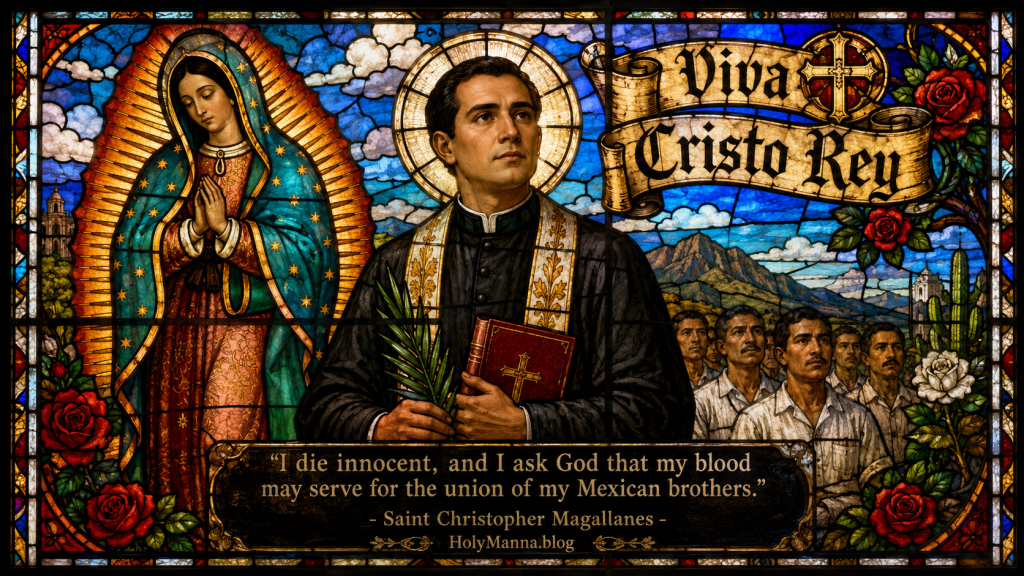
The Priest Who Chose Heaven Over Fear
Saint Christopher Magallanes and his companions stand among the great Catholic witnesses of Mexico, not because they sought conflict, but because they refused to abandon Christ when faith became dangerous. They were priests and laymen who lived during a fierce anti-Catholic persecution in Mexico, especially during the years surrounding the Cristero War. Their crime, in the eyes of their persecutors, was simple: they loved the Church, served the sacraments, formed the faithful, and would not stop preaching Christ.
Saint Christopher Magallanes was a humble diocesan priest from Jalisco, Mexico. He is remembered as a pastor of the poor, a missionary to Indigenous communities, a promoter of the Rosary, a defender of priestly vocations, and a martyr who rejected violence while refusing to abandon his people. He was canonized with 24 companions by Pope Saint John Paul II on May 21, 2000, and their feast is celebrated on May 21.
Their witness reflects what The Catechism of the Catholic Church teaches about martyrdom: “Martyrdom is the supreme witness given to the truth of the faith: it means bearing witness even unto death.” CCC 2473. Saint Christopher did not die as a revolutionary. He died as a priest, forgiving his enemies and praying for the unity of Mexico.
From the Fields of Jalisco to the Altar of God
Cristóbal Magallanes Jara was born on July 30, 1869, in Totatiche, Jalisco, Mexico. He came from a poor rural family and knew the hard life of the countryside. Before entering seminary, he worked in the fields and helped with ordinary labor. That matters because his priesthood never became distant or polished in a worldly way. He understood farmers, families, poverty, hunger, and the quiet burdens of village life.
At the age of 19, he entered the seminary in Guadalajara. He was ordained a priest in September 1899. After ordination, he served as chaplain and assistant director at a school of arts and trades in Guadalajara. Later, he became pastor in his native region of Totatiche, where his priesthood blossomed into a life of remarkable pastoral creativity.
Father Magallanes was not content to simply keep the church doors open. He helped organize schools, catechism centers, practical works for the poor, and projects that improved daily life. Catholic sources remember him as having helped build a dam to support irrigation, found an orphanage, and assist poor families with land and livelihood. He served souls, but he also cared about whether those souls had food, education, water, and hope.
That is deeply Catholic. Grace does not despise ordinary life. The Church teaches that every human person has dignity because every person is made in the image of God. Saint Christopher lived that truth in the soil of rural Mexico.
A Pastor Who Built More Than Buildings
One of Saint Christopher’s most important works was his care for priestly vocations. When anti-Catholic laws and persecution threatened Catholic education and seminary formation, he helped establish a clandestine seminary in Totatiche. It was placed under the patronage of Our Lady of Guadalupe, which is beautifully fitting for a Mexican priest trying to preserve the future of the priesthood under persecution.
This secret seminary was not just a clever response to government pressure. It was an act of faith. Father Magallanes knew that if the Church was deprived of priests, the people would be deprived of the Eucharist, Confession, Anointing of the Sick, and pastoral care. He understood that a starving Church needed shepherds.
He also evangelized among the Indigenous Huichol people and promoted devotion to the Rosary. He loved Our Lady, loved the priesthood, and loved the people placed in his care. In that sense, his life was a living answer to Christ’s command in The Gospel of John: “Feed my sheep.” John 21:17.
He was most known for being a faithful priest who stayed close to his people, protected priestly formation, served the poor, rejected violence, and ultimately gave his life for Christ and the Church.
The Quiet Miracles of a Faithful Priest
There are no widely verified accounts of dramatic supernatural miracles performed by Saint Christopher Magallanes during his lifetime. That should not disappoint anyone. Not every saint is remembered for raising the dead, healing the blind, or multiplying food. Some saints perform a quieter kind of miracle, the miracle of fidelity.
Saint Christopher’s life bore the fruits of grace. Poor families were helped. Children were taught the faith. Indigenous communities heard the Gospel. Seminarians were protected and formed. The Rosary was promoted. The sacraments continued, even when public Catholic life was being squeezed by government hostility.
In a time when fear could have made him silent, he kept preaching. When violence tempted many hearts, he rejected it. When the Church was being pushed underground, he kept forming priests. These are not canonization miracles in the technical sense, but they are signs of holiness. They show what happens when a priest truly belongs to Christ.
A Country Divided and a Church Under Fire
Saint Christopher lived during a painful chapter in Mexican history. The Mexican Constitution of 1917 placed severe restrictions on the Catholic Church. Religious orders, Catholic schools, public worship, Church property, and the rights of priests came under attack. Under President Plutarco Elías Calles, these restrictions became even harsher, leading to deep suffering among Catholics.
This persecution helped spark the Cristero War, whose rallying cry became “¡Viva Cristo Rey!”, meaning “Long live Christ the King!” Many Catholics resisted the government by force, but Saint Christopher Magallanes did not join the armed movement. Catholic sources emphasize that he rejected violence and taught that the Church’s weapon was the Word of God.
That is one of the most important details of his life. He was accused of rebellion, but he was not a violent rebel. He was a priest. He believed in Christ the King, but he did not confuse Christ’s Kingdom with political vengeance. He stayed with his people, continued his priestly ministry, and accepted the risk of death.
Only a Moment, and Then Heaven
On May 21, 1927, Father Magallanes was traveling to celebrate a religious feast in honor of Saint Rita when he was arrested. He was imprisoned with Father Agustín Caloca Cortés, a young priest connected to his seminary work. They were accused of conspiracy, though Catholic accounts emphasize that there was no real evidence against them.
On May 25, 1927, they were taken out to be executed by firing squad in Colotlán, Jalisco. Father Caloca, still young and understandably afraid, was comforted by Father Magallanes. The older priest told him: “Be calm, my son; only a moment, and then heaven.”
That sentence is one of the most powerful Catholic martyrdom quotes of the modern age. It does not deny fear. It does not pretend death is painless. It simply places death inside eternity. For a Catholic, death is not the end. For the faithful soul in Christ, death becomes a doorway.
Before he died, Saint Christopher gave another famous witness: “I die innocent, and I ask God that my blood may serve for the union of my Mexican brothers.”
Another version of his final words is remembered this way: “I am and die innocent; I forgive from my heart those responsible for my death, and I ask God that my blood may serve for the peace of divided Mexicans.”
That is the heart of the saint. He did not die cursing his country. He died praying for it. He did not die asking God to crush his enemies. He died forgiving them.
The Companions Who Shared the Crown
Saint Christopher was canonized with 24 companions, a group of Mexican martyrs made up mostly of diocesan priests, along with three laymen. They did not all die at the same time or in the same place. They were martyred across different regions and years, between 1915 and 1937, during the long suffering of the Church in Mexico.
Among them was Father Agustín Caloca Cortés, who died beside Saint Christopher. His final words are remembered as: “For God we live and for Him we die.”
Another companion, Saint Mateo Correa Magallanes, is famous for defending the seal of Confession. While imprisoned, he was ordered to hear the confessions of condemned men. Afterward, a general demanded that he reveal what they had confessed. Father Mateo refused. When threatened with death, he answered: “You may do so, but you ignore the fact, General, that a priest must keep the secret of confession. I am ready to die.” He was executed the next day.
This is not just a dramatic story. It is a powerful reminder of how sacred Confession is in the Catholic Church. The seal of Confession cannot be broken. A priest may suffer, be imprisoned, or die, but he cannot reveal the sins confessed to him in the sacrament.
Other companions include Saint Toribio Romo González, Saint Miguel de la Mora, Saint Rodrigo Aguilar Alemán, Saint Pedro de Jesús Maldonado, Saint David Galván, Saint José María Robles Hurtado, and the lay martyrs Salvador Lara Puente, Manuel Morales, and David Roldán Lara. Together, they represent priests and lay Catholics who chose fidelity over comfort and Christ over fear.
Miracles, Relics, and a Living Legacy
The major verified miracle associated with the canonization of Saint Christopher Magallanes and his companions involved a woman named María del Carmen Pulido Cortés of Guadalajara. Catholic accounts report that she suffered from an incurable breast condition involving cysts. After receiving and placing on her chest a crucifix containing relics of the Mexican martyrs, she experienced an immediate healing. Doctors reportedly confirmed the cure and could not explain it medically. This miracle was accepted in the canonization process.
Their relics are venerated in Mexico, especially in places connected to their lives and martyrdom. Saint Christopher’s memory is especially strong in Totatiche, Jalisco, where his priestly work and martyrdom remain part of the Catholic identity of the region. The Sanctuary of the Martyrs of Christ the King in Guadalajara has also become an important place of devotion, honoring the martyrs who gave their lives during the persecution.
Their cultural impact is especially strong in Mexico and among Mexican Catholic communities in the United States. The cry “¡Viva Cristo Rey!” remains tied to the memory of the Cristero martyrs. Their feast on May 21 is celebrated with special devotion in communities that remember the cost of keeping the Catholic faith alive.
There is also a major popular devotion connected to one of Saint Christopher’s companions, Saint Toribio Romo González. Many Mexican migrants have told stories of Saint Toribio appearing to help them during dangerous journeys, especially during border crossings. Some say he guided them, gave them directions, or helped them survive. These stories are part of popular devotion and cannot all be historically verified, but they show how deeply the Mexican martyrs remain present in the hearts of ordinary Catholics facing fear, danger, and uncertainty.
A Saint for Catholics Living Under Pressure
Saint Christopher Magallanes teaches something urgently needed today. He shows that courage does not have to become hatred. He rejected violence, but he was not weak. He forgave his persecutors, but he was not passive. He stayed with his people, formed future priests, preached the Gospel, protected the sacraments, and faced death with his eyes fixed on heaven.
His life also reminds Catholics that holiness is not abstract. It is lived in villages, homes, schools, farms, parishes, confessionals, and hidden acts of fidelity. Saint Christopher did not need fame to become holy. He needed grace, courage, obedience, and love.
For anyone who feels pressure to hide the faith, water it down, or keep it private, Saint Christopher offers a better way. Be peaceful, but do not be ashamed. Be charitable, but do not be silent about Christ. Forgive enemies, but do not abandon truth. Serve the poor, teach the faith, pray the Rosary, and stay close to the sacraments.
What would change if Catholics today had the courage to be peaceful without being timid, faithful without being bitter, and bold without losing charity?
Saint Christopher’s final prayer still feels painfully relevant: “I ask God that my blood may serve for the union of my Mexican brothers.” In a divided world, his witness points back to Christ, who prayed that His disciples may be one.
Engage with Us!
Share your thoughts and reflections in the comments below.
- What part of Saint Christopher Magallanes’ story challenges you the most: his courage, his forgiveness, his rejection of violence, or his love for the priesthood?
- How can his final words help Catholics respond to division in families, parishes, communities, and nations?
- Where is God asking you to be more faithful, even if it costs comfort, popularity, or security?
- How can devotion to the Mexican martyrs inspire a deeper love for the Eucharist, Confession, the Rosary, and the priesthood?
May Saint Christopher Magallanes and his companions pray for all Catholics who are trying to live faithfully in difficult times. May their witness help every soul choose courage over fear, forgiveness over bitterness, and Christ over everything. Let us live the faith with conviction, serve others with compassion, and do everything with the love and mercy Jesus taught us.
Saint Christopher Magallanes, pray for us!
Follow us on YouTube, Instagram and Facebook for more insights and reflections on living a faith-filled life.


Leave a Reply