Thursday of the Seventh Week of Easter – Lectionary: 300
A Hope That Holds the Church Together
Some days, faith feels less like a quiet comfort and more like a holy courage that has to be chosen in the middle of pressure.
Today’s readings gather around one central theme: Christ preserves His people in resurrection hope so they can bear witness in unity and love. In Acts 22:30; 23:6-11, Saint Paul stands before the Sanhedrin, surrounded by tension, accusation, and division. Yet the issue beneath everything is not politics or personality. Paul names it clearly: “I am on trial for hope in the resurrection of the dead.” That hope is the fire at the center of the Christian life. It is the reason the Apostles preached, the martyrs endured, and the Church continues to stand when the world becomes hostile.
The religious background matters here. The Pharisees and Sadducees disagreed sharply about the resurrection, angels, and spirits. Paul, once a Pharisee and now an Apostle of Christ, uses that division to reveal the deeper truth. Christianity fulfills Israel’s hope because Jesus Christ has truly risen. What was once debated in the halls of Jewish leadership has now been revealed in the empty tomb.
The psalm gives that hope a voice. In Psalm 16, the faithful soul prays, “Keep me safe, O God; in you I take refuge.” This is not the prayer of someone escaping reality. It is the prayer of someone anchored in God. The psalm points beyond David to Christ Himself, the Holy One not abandoned to the grave, and it invites every believer to trust that God’s path leads to life, joy, and communion with Him.
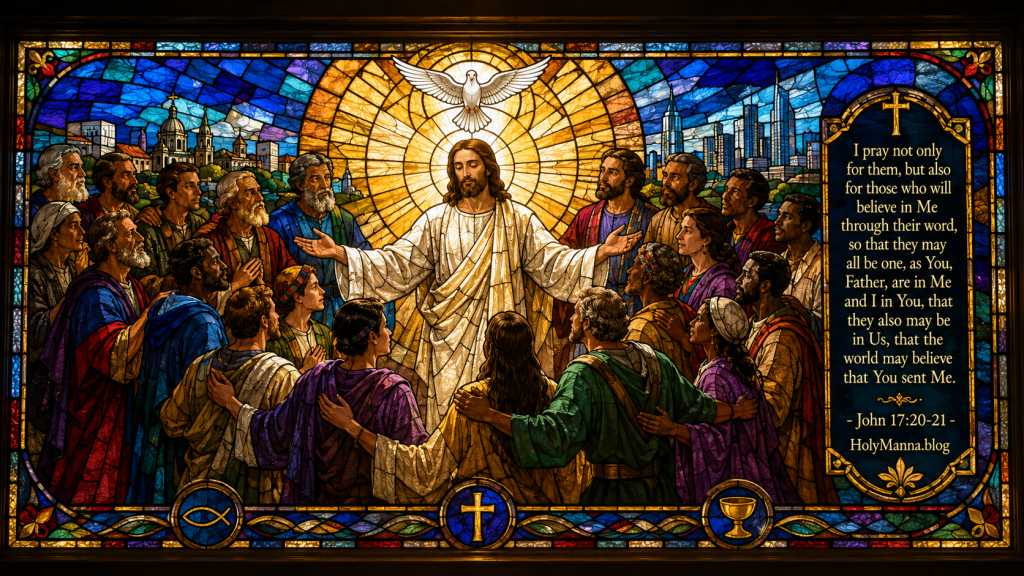
Then, in John 17:20-26, the readings rise into the heart of Jesus’ Priestly Prayer. On the night before His Passion, Christ prays not only for the Apostles, but for all who will believe through their word. That includes the Church across every generation. His desire is clear: “That they may all be one.” This unity is not shallow agreement or religious politeness. It is communion rooted in the love of the Father and the Son, the same divine love poured into the Church through the Holy Spirit.
Together, these readings prepare the heart to see the Christian life as witness, refuge, and communion. Paul shows what courage looks like when faith is tested. The psalm shows where that courage comes from. Jesus reveals what that courage is for: a Church made one in His love, so the world may believe.
Where is Christ asking for courage today? Where is He inviting deeper trust? Where is He calling His people back into unity, not by ignoring the truth, but by living more deeply in His love?
First Reading – Acts 22:30; 23:6-11
When Hope Stands Trial
Saint Paul stands in the middle of a storm. He has been accused, seized, questioned, and now placed before the Sanhedrin, the highest Jewish council in Jerusalem. This was not a casual courtroom scene. The Sanhedrin included chief priests, elders, scribes, Pharisees, and Sadducees. It was the religious authority that handled serious matters concerning Jewish law, doctrine, and public order.
By this point in The Acts of the Apostles, Paul has already become one of the boldest witnesses to the risen Christ. Once a persecutor of Christians, he now preaches the very Gospel he once tried to destroy. That makes this moment powerful. Paul is not simply defending himself. He is standing before the leaders of Israel as a living sign of conversion, mercy, and resurrection hope.
The key issue is the resurrection. The Sadducees denied the resurrection, angels, and spirits. The Pharisees accepted them. Paul, knowing this division, brings the real question into the open: the Christian proclamation that Jesus Christ has risen from the dead and that the dead will rise in Him. This connects directly to today’s central theme. Christ preserves His people in resurrection hope so they can bear witness with courage, even when the world is divided, hostile, or confused.
Acts 22:30; 23:6-11 – New American Bible (Revised Edition)
Paul Before the Sanhedrin. 30 The next day, wishing to determine the truth about why he was being accused by the Jews, he freed him and ordered the chief priests and the whole Sanhedrin to convene. Then he brought Paul down and made him stand before them.
23:6 Paul was aware that some were Sadducees and some Pharisees, so he called out before the Sanhedrin, “My brothers, I am a Pharisee, the son of Pharisees; [I] am on trial for hope in the resurrection of the dead.” 7 When he said this, a dispute broke out between the Pharisees and Sadducees, and the group became divided. 8 For the Sadducees say that there is no resurrection or angels or spirits, while the Pharisees acknowledge all three. 9 A great uproar occurred, and some scribes belonging to the Pharisee party stood up and sharply argued, “We find nothing wrong with this man. Suppose a spirit or an angel has spoken to him?” 10 The dispute was so serious that the commander, afraid that Paul would be torn to pieces by them, ordered his troops to go down and rescue him from their midst and take him into the compound. 11 [a]The following night the Lord stood by him and said, “Take courage. For just as you have borne witness to my cause in Jerusalem, so you must also bear witness in Rome.”
Detailed Exegesis
Verse 30 – “The next day, wishing to determine the truth about why he was being accused by the Jews, he freed him and ordered the chief priests and the whole Sanhedrin to convene. Then he brought Paul down and made him stand before them.”
The Roman commander wants clarity. Paul has caused an uproar, but Rome does not yet understand the theological reasons behind the conflict. So Paul is brought before the Sanhedrin. This places him in the heart of Jewish religious authority, where the deepest questions of law, prophecy, and covenant are debated.
Spiritually, this verse sets the stage for witness. Paul is not standing there by accident. Divine providence is quietly working through political confusion, religious tension, and legal procedure. What looks like a dangerous hearing becomes another place where Christ will be proclaimed. The Church has always understood that God can work even through hostile systems, flawed institutions, and chaotic circumstances.
Verse 6 – “Paul was aware that some were Sadducees and some Pharisees, so he called out before the Sanhedrin, ‘My brothers, I am a Pharisee, the son of Pharisees; I am on trial for hope in the resurrection of the dead.’”
Paul identifies himself as a Pharisee, not because he is retreating from Christianity, but because he is showing continuity between Israel’s hope and the Gospel of Christ. The resurrection was not a random Christian invention. It was the fulfillment of God’s promises.
His statement is the center of the reading: “I am on trial for hope in the resurrection of the dead.” That is the Christian life in one sentence. Paul is not ultimately on trial for disturbing the peace. He is on trial because he believes that death has been conquered in Jesus Christ.
This matters because Christianity rises or falls on the resurrection. Without the resurrection, the Cross would look like defeat. With the resurrection, the Cross becomes victory. Paul’s courage comes from knowing that the risen Lord is alive, reigning, and faithful to His promises.
Verse 7 – “When he said this, a dispute broke out between the Pharisees and Sadducees, and the group became divided.”
Paul’s words expose an existing fracture. The Sanhedrin is not united in belief. The question of resurrection divides the room immediately.
This is more than a clever legal move. It reveals that the Gospel enters real history, real debates, and real human divisions. The resurrection forces a decision. It cannot be reduced to a vague spiritual metaphor. Either God raises the dead, or He does not. Either Christ is risen, or He is not. Paul places that question in the center of the assembly.
Verse 8 – “For the Sadducees say that there is no resurrection or angels or spirits, while the Pharisees acknowledge all three.”
Luke pauses to explain the religious background. The Sadducees were often associated with the priestly aristocracy and tended to accept only the written Torah as authoritative in a strict way. Because of this, they rejected doctrines they did not believe were clearly found there, including the resurrection. The Pharisees, by contrast, accepted the resurrection, angels, spirits, and a broader tradition of interpretation.
This verse helps modern readers understand the conflict. Paul is preaching Christ crucified and risen, but the question underneath is older and deeper. What has God promised His people? What happens to the righteous after death? Is the human person destined only for the grave, or for life with God?
The Catholic answer is clear. The resurrection is not optional. It is at the heart of the Creed, the sacraments, the funeral rites, the martyrs, and Christian hope.
Verse 9 – “A great uproar occurred, and some scribes belonging to the Pharisee party stood up and sharply argued, ‘We find nothing wrong with this man. Suppose a spirit or an angel has spoken to him?’”
The Pharisaic scribes begin defending Paul, at least partly because his claim does not contradict their belief in spirits and angels. Their question is striking: “Suppose a spirit or an angel has spoken to him?”
They are not yet confessing Jesus as Lord, but they are forced to admit that Paul’s experience cannot simply be dismissed according to their own beliefs. This is one of those moments in Scripture where God uses even partial understanding to protect His servant.
There is also a deeper irony here. Paul has indeed encountered the risen Christ. The question is not merely whether a spirit or angel spoke to him. The Lord Jesus Himself appeared to Paul and changed the entire direction of his life.
Verse 10 – “The dispute was so serious that the commander, afraid that Paul would be torn to pieces by them, ordered his troops to go down and rescue him from their midst and take him into the compound.”
The scene becomes violent. Paul’s witness creates such turmoil that the Roman commander fears he will be physically torn apart. Once again, Rome intervenes, not because Rome understands the Gospel, but because God’s providence is protecting Paul’s mission.
This verse reminds believers that obedience to God does not always produce peaceful surroundings. Sometimes fidelity intensifies conflict. Yet even here, Paul is not abandoned. Human power, even pagan political power, becomes an instrument by which God preserves His apostle for the next stage of the mission.
Verse 11 – “The following night the Lord stood by him and said, ‘Take courage. For just as you have borne witness to my cause in Jerusalem, so you must also bear witness in Rome.’”
This is the heart of the passage. After the noise, danger, and confusion, the Lord comes near. Jesus does not send Paul an abstract idea. He stands by him.
The words are tender and commanding: “Take courage.” Paul is not told that suffering is finished. He is told that his mission continues. Jerusalem is not the end. Rome awaits. The Gospel must reach the heart of the empire.
This verse also shows the personal care of Christ for His witnesses. Paul belongs to the Lord. His life is not controlled by the Sanhedrin, the mob, or Rome. His life is held by Christ. The same Jesus who prayed for His disciples in today’s Gospel now stands beside Paul in the night.
Teachings: Resurrection Hope and Apostolic Courage
This reading teaches that Christian courage is rooted in the resurrection. Paul can stand before the Sanhedrin because he knows that Christ is risen and that the faithful are destined for life with Him. The resurrection is not merely one doctrine among many. It is the foundation of Christian hope.
The Catechism of the Catholic Church teaches in CCC 988: “The Christian Creed, the profession of our faith in God the Father, the Son, and the Holy Spirit, and in God’s creative, saving, and sanctifying action, culminates in the proclamation of the resurrection of the dead on the last day and in life everlasting.”
That is exactly what Paul is defending. The Creed reaches its climax in the hope that the dead will rise. Christianity does not end with moral advice. It ends with resurrection, judgment, eternal life, and communion with God.
The Catechism also says in CCC 991: “Belief in the resurrection of the dead has been an essential element of the Christian faith from its beginnings. ‘The confidence of Christians is the resurrection of the dead; believing this we live.’”
That last sentence, drawn from Tertullian, could almost be placed on Paul’s lips. “Believing this we live.” Paul lives differently because he believes differently. He does not cling to safety as his highest good. He clings to Christ.
Saint Paul’s trial also teaches that Christian witness is apostolic. The Lord tells him, “Just as you have borne witness to my cause in Jerusalem, so you must also bear witness in Rome.” The Gospel is meant to move outward. It begins in Jerusalem, spreads through Judea and Samaria, and reaches the ends of the earth. Rome becomes a symbol of the nations, the empire, and the wider world that must hear the name of Jesus Christ.
The Catechism teaches in CCC 857: “The Church is apostolic because she is founded on the apostles, in three ways: she was and remains built on ‘the foundation of the Apostles,’ the witnesses chosen and sent on mission by Christ himself; with the help of the Spirit dwelling in her, the Church keeps and hands on the teaching, the ‘good deposit,’ the salutary words she has heard from the apostles; she continues to be taught, sanctified, and guided by the apostles until Christ’s return, through their successors in pastoral office: the college of bishops, ‘assisted by priests, in union with the successor of Peter, the Church’s supreme pastor.’”
Paul’s witness before the Sanhedrin belongs to this apostolic mission. He has received the Gospel, and now he must hand it on, even under pressure.
There is also a beautiful connection to the saints and martyrs. Throughout Church history, Christians have stood before councils, kings, judges, mobs, and executioners because they believed what Paul believed. The resurrection made them free. The martyrs could lose their bodies because they knew their bodies would rise. They could lose earthly status because they had already received Christ as their inheritance.
That is why today’s first reading is not only about Paul’s legal defense. It is about the courage of the whole Church. Every generation has to decide whether resurrection hope is real enough to shape daily life.
Reflection: Standing Firm When Faith Costs Something
Paul’s courage is not loud arrogance. It is not stubbornness for its own sake. It is the courage of a man who knows what is worth suffering for. He stands before the Sanhedrin and does not make himself the center of the story. He makes the resurrection the center.
That is a needed lesson in daily Catholic life. Many people want faith to remain private, soft, and harmless. The world does not mind a Christianity that stays decorative. It gets uncomfortable when Christians speak clearly about truth, sin, mercy, judgment, resurrection, and eternal life.
Paul reminds believers that the Gospel will sometimes create tension. Faithfulness may cost comfort. It may bring misunderstanding. It may divide a room. Yet the Lord does not abandon His witnesses. He stands near and says, “Take courage.”
This reading invites Catholics to recover resurrection confidence. That means living as if Christ really rose from the dead. It means not letting fear make every decision. It means choosing confession over hidden sin, forgiveness over resentment, truth over approval, and mission over comfort.
A simple way to live this reading is to name the place where courage is needed. Maybe it is a conversation that has been avoided. Maybe it is a sin that needs to be brought to confession. Maybe it is a family tension where truth and charity both need to be present. Maybe it is the quiet courage to keep praying when God feels silent.
The Lord does not always remove the trial. Sometimes He enters the night and strengthens the witness.
Where is fear trying to silence resurrection hope?
What truth is Christ asking His people to speak with both courage and charity?
Where is the Lord saying, “Take courage,” not because the mission is over, but because the next step still matters?
Saint Paul stands before the Sanhedrin, but the deeper reality is this: he stands with Christ. That is enough for him. That is enough for the Church. And by grace, that can be enough for every disciple today.
Responsorial Psalm – Psalm 16:1-2, 5, 7-11
The Soul That Knows God Will Not Abandon It
There is a quiet confidence in Psalm 16 that feels almost shocking when placed beside the danger surrounding Saint Paul in the first reading. Paul is nearly torn apart by a divided council, yet the psalm gives the Church a calm and steady prayer: “Keep me safe, O God; in you I take refuge.”
This is not naïve optimism. This is covenant faith. In ancient Israel, to call the Lord one’s “portion” and “cup” was to say that God Himself was the inheritance, security, and future of the faithful soul. The psalmist is not simply asking God for better circumstances. He is resting in God as the deepest good.
That makes this psalm fit beautifully into today’s theme. Saint Paul stands trial because of resurrection hope. Jesus prays that His disciples may be brought into divine communion. Between those two readings, Psalm 16 sings the heart of the believer who knows that God does not abandon His faithful one to death. In Catholic tradition, this psalm is also profoundly Christological. It points beyond David to Jesus Christ, the Holy One whose body did not see corruption and whose Resurrection opens the path of life for all who belong to Him.
Psalm 16:1-2, 5, 7-11 – New American Bible (Revised Edition)
God the Supreme Good
1 A miktam of David.
Keep me safe, O God;
in you I take refuge.
2 I say to the Lord,
you are my Lord,
you are my only good.5 Lord, my allotted portion and my cup,
you have made my destiny secure.I bless the Lord who counsels me;
even at night my heart exhorts me.
8 I keep the Lord always before me;
with him at my right hand, I shall never be shaken.
9 Therefore my heart is glad, my soul rejoices;
my body also dwells secure,
10 For you will not abandon my soul to Sheol,
nor let your devout one see the pit.
11 You will show me the path to life,
abounding joy in your presence,
the delights at your right hand forever.
Detailed Exegesis
Verse 1 – “Keep me safe, O God; in you I take refuge.”
The psalm begins with trust, not panic. The faithful soul asks for protection, but the deeper movement is surrender. To take refuge in God means to admit that human strength is not enough.
This verse speaks directly to the Christian life. Catholic faith does not teach self-reliance dressed up in religious language. It teaches dependence on grace. The believer is safest not when life is predictable, but when the heart belongs to God.
Verse 2 – “I say to the Lord, you are my Lord, you are my only good.”
This is a declaration of worship. God is not one good among many. He is the supreme good. Everything else is good only insofar as it comes from Him, leads back to Him, or is received according to His will.
This verse challenges the modern temptation to treat God as an accessory to an already full life. The psalmist says something much deeper: without the Lord, even good things lose their proper order. With the Lord, everything can become part of the path to holiness.
Verse 5 – “Lord, my allotted portion and my cup, you have made my destiny secure.”
In the Old Testament, “portion” often referred to inheritance. The tribes of Israel received land as their portion, but the Levites had a special inheritance in the Lord. Here, the psalmist speaks with that same spiritual confidence. God Himself is the inheritance.
The “cup” can represent one’s life, destiny, or share in what God gives. To say that the Lord is one’s cup is to receive life from His hand, even when that life includes suffering. This verse prepares the heart for Saint Paul’s courage and for Jesus’ prayer in the Gospel. The faithful soul can endure trials because its destiny is secure in God.
Verse 7 – “I bless the Lord who counsels me; even at night my heart exhorts me.”
The psalmist does not only receive outward instruction. God’s counsel reaches the inner life. Even at night, when distractions fade and fears often grow louder, the heart is being taught.
This is a beautiful image of conscience formed by God. In Catholic life, the conscience is not meant to be a private opinion factory. It must be formed by Scripture, Tradition, the teachings of the Church, prayer, and the grace of the Holy Spirit. The heart that listens to God in the quiet becomes steadier when life becomes loud.
Verse 8 – “I keep the Lord always before me; with him at my right hand, I shall never be shaken.”
This verse gives the secret to spiritual stability. The psalmist keeps the Lord before him. He does not place fear before him, resentment before him, ambition before him, or comfort before him. He places the Lord before him.
The right hand is a place of strength and defense. To say that God is at the right hand is to say that the faithful soul is not alone. This does not mean life will never be painful. It means that life cannot finally overthrow the one who remains rooted in God.
Verse 9 – “Therefore my heart is glad, my soul rejoices; my body also dwells secure.”
The psalm moves from trust to joy. Because God is near, the whole person is affected: heart, soul, and body. Biblical faith is not anti-body. The human person is a unity of body and soul, created by God and destined for resurrection.
This matters especially in the Easter season. Christian hope is not escape from the body. It is redemption of the whole person. The body matters. What is done with the body matters. The body will rise.
Verse 10 – “For you will not abandon my soul to Sheol, nor let your devout one see the pit.”
This is the great resurrection line of the psalm. In its original setting, it expresses confidence that God will not abandon His faithful servant to death. In the light of Christ, the Church sees its fullest meaning. Jesus is the Holy One who truly enters death and is not abandoned to it.
Saint Peter applies this psalm to Christ in Acts 2, showing that David spoke prophetically of the Resurrection. David died and his tomb remained, but Christ rose. His body did not see corruption. This verse therefore becomes a bridge between Israel’s hope and the Church’s Easter proclamation.
Verse 11 – “You will show me the path to life, abounding joy in your presence, the delights at your right hand forever.”
The psalm ends not merely with survival, but with communion. God shows the path to life. That path is not simply a better mood or a safer road. For Christians, the path to life is Christ Himself.
The final promise is joy in God’s presence forever. This points the heart toward heaven, where the deepest human longing is fulfilled in the vision of God. The psalm begins with refuge and ends with glory.
Teachings: The Resurrection Hope Hidden in the Psalm
Psalm 16 teaches that the Lord is the believer’s refuge, inheritance, counselor, protector, and final joy. It also teaches something even greater when read through the light of Christ: God does not abandon His Holy One to corruption. The Church sees this fulfilled in the Resurrection of Jesus.
The Catechism of the Catholic Church teaches in CCC 627: “Christ’s death was a real death in that it put an end to his earthly human existence. But because of the union which the person of the Son retained with his body, his was not a mortal corpse like others, for ‘divine power preserved Christ’s body from corruption.’ Both of these statements can be said of Christ: ‘He was cut off out of the land of the living,’ and ‘My flesh will dwell in hope. For you will not abandon my soul to Hades, nor let your Holy One see corruption.’ Jesus’ Resurrection ‘on the third day’ was the sign of this, also because bodily decay was held to begin on the fourth day after death.”
This teaching explains why Psalm 16 is not merely comforting poetry. It is a prophetic song fulfilled in Jesus. Christ truly died, but death could not hold Him. His body did not decay because He is the eternal Son united to a real human body. The Resurrection is not a metaphor. It is the victory of God in history.
The psalm also points toward heaven. The final verse says, “You will show me the path to life, abounding joy in your presence, the delights at your right hand forever.” Catholic teaching gives that hope its full shape.
The Catechism of the Catholic Church teaches in CCC 1024: “This perfect life with the Most Holy Trinity, this communion of life and love with the Trinity, with the Virgin Mary, the angels and all the blessed, is called ‘heaven.’ Heaven is the ultimate end and fulfillment of the deepest human longings, the state of supreme, definitive happiness.”
This is the destiny toward which the psalm points. The believer does not merely want relief from pain. The believer longs for God. Heaven is not simply a place where bad things stop happening. Heaven is communion with the Most Holy Trinity.
The Catechism continues in CCC 1025: “To live in heaven is ‘to be with Christ.’ The elect live ‘in Christ,’ but they retain, or rather find, their true identity, their own name.”
That line beautifully connects the psalm to today’s Gospel. Jesus prays, “Father, they are your gift to me. I wish that where I am they also may be with me.” The joy promised in Psalm 16 is fulfilled in being with Christ.
Saint Augustine also saw the psalms as the voice of Christ and His Body, the Church. That matters here because Psalm 16 can be prayed in several layers at once. It is David’s prayer of trust. It is Christ’s prayer fulfilled in the Resurrection. It is the Church’s prayer in every generation. It is also the personal prayer of every disciple who takes refuge in God and waits for eternal life.
Reflection: Learning to Live Like God Is the Inheritance
This psalm speaks to a restless age. Many people are anxious, distracted, and spiritually tired because they are trying to make created things carry the weight only God can hold. Careers, relationships, money, reputation, comfort, and even ministry can become fragile “portions” when they are treated as ultimate.
The psalm gently puts everything back in order: “You are my Lord, you are my only good.”
That is not a rejection of ordinary blessings. It is the only way to receive them rightly. When God is first, good things remain gifts. When God is not first, even good things can become idols.
A practical way to live this psalm is to begin the day by placing the Lord “always before” the heart. Before checking the phone, before entering the noise, before letting anxiety define the day, the soul can pray simply: “Keep me safe, O God; in you I take refuge.” That small act of trust can change the direction of a whole day.
This psalm also invites Catholics to think seriously about death without despair. The Christian does not pretend death is harmless. Death is an enemy. But in Christ, it is a defeated enemy. Because Jesus rose, the faithful can say with hope that God will not abandon them.
What is being treated as the “portion” of the heart right now?
Is God truly the supreme good, or has something created quietly taken His place?
Where is the Lord inviting deeper trust during the night seasons of life?
What would change today if resurrection hope became more real than fear?
The psalm begins with a cry for refuge and ends with eternal joy. That is the shape of the Christian life. The soul runs to God for safety, learns to trust Him as its inheritance, walks the path of life, and discovers that the final destination is not emptiness, but joy in His presence forever.
Holy Gospel – John 17:20-26
The Night Jesus Prayed for Every Believer
The Gospel brings the Church into one of the most sacred rooms in all of Scripture. Jesus is praying on the night before His Passion. Judas has gone into the darkness. The Cross is near. The Apostles are fragile, confused, and about to be scattered. Yet Jesus does not turn inward in fear. He turns to the Father in love.
This passage comes from what Catholic tradition calls the Priestly Prayer of Jesus. In The Gospel of John, Jesus prays as the eternal Son, the true High Priest, the one who offers Himself for the salvation of the world. He prays for the Apostles, but then His prayer reaches beyond the Upper Room. He prays for all who will believe through their word. That means His prayer reaches the whole apostolic Church, across every century, every parish, every monastery, every family, and every soul trying to follow Him.
This Gospel completes today’s theme. Saint Paul bears witness to resurrection hope before a divided council. Psalm 16 sings that God will not abandon His faithful one to death. Now Jesus reveals the deepest purpose of that hope: that His people may be one in the love of the Father and the Son, and finally be with Him in glory.
John 17:20-26 – New American Bible (Revised Edition)
20 “I pray not only for them, but also for those who will believe in me through their word, 21 so that they may all be one, as you, Father, are in me and I in you, that they also may be in us, that the world may believe that you sent me. 22 And I have given them the glory you gave me, so that they may be one, as we are one, 23 I in them and you in me, that they may be brought to perfection as one, that the world may know that you sent me, and that you loved them even as you loved me. 24 Father, they are your gift to me. I wish that where I am they also may be with me, that they may see my glory that you gave me, because you loved me before the foundation of the world. 25 Righteous Father, the world also does not know you, but I know you, and they know that you sent me. 26 I made known to them your name and I will make it known, that the love with which you loved me may be in them and I in them.”
Detailed Exegesis
Verse 20 – “I pray not only for them, but also for those who will believe in me through their word.”
Jesus first prayed for the Apostles, but now His prayer widens. He prays for those who will believe through apostolic preaching. This includes the first Christians, the saints, the martyrs, the Church Fathers, and every Catholic who has received the faith through the Church’s living Tradition.
The phrase “through their word” matters. Faith is handed on. Christianity is not invented privately by each generation. It is received through apostolic witness. This is why the Church is apostolic. She is built on the Apostles, guards their teaching, and continues their mission through the bishops in union with the successor of Peter.
Verse 21 – “So that they may all be one, as you, Father, are in me and I in you, that they also may be in us, that the world may believe that you sent me.”
Jesus prays for unity, but not a shallow unity based on mood, personality, or convenience. He prays that His disciples may be one as the Father and the Son are one. This means Christian unity must be rooted in divine communion.
The purpose of this unity is missionary. Jesus says that the world may believe the Father sent Him. A divided Church wounds her witness. A holy, charitable, truthful, sacramental unity reveals something supernatural. The world is meant to look at Christians and see a communion that cannot be explained by politics, preference, or social comfort.
Verse 22 – “And I have given them the glory you gave me, so that they may be one, as we are one.”
Jesus speaks of glory as something shared with His disciples. In The Gospel of John, glory is deeply connected to the Cross, Resurrection, and revelation of divine love. The glory Jesus receives from the Father is not worldly fame. It is the radiance of divine love revealed through sacrifice.
By giving His disciples this glory, Jesus draws them into His own life. Unity is not merely commanded from the outside. It is given from within. The Church becomes one because Christ shares His life with her, especially through the Holy Spirit and the sacraments.
Verse 23 – “I in them and you in me, that they may be brought to perfection as one, that the world may know that you sent me, and that you loved them even as you loved me.”
Here Jesus reveals the inner architecture of Christian unity: “I in them and you in me.” The life of grace is not just moral improvement. It is Christ dwelling in His people. The Son lives in the disciple, and the Father lives in the Son.
Jesus also says the Father loves His disciples even as He loves the Son. This is almost too beautiful to rush past. The Christian is not merely tolerated by God. In Christ, the believer is brought into the Son’s own relationship with the Father. This is the heart of salvation.
Verse 24 – “Father, they are your gift to me. I wish that where I am they also may be with me, that they may see my glory that you gave me, because you loved me before the foundation of the world.”
Jesus calls His disciples the Father’s gift to Him. This reveals the dignity of every soul in Christ. The disciple is not random, disposable, or forgotten. The disciple is loved by the Father and given to the Son.
Then Jesus reveals His desire: that His people may be with Him and see His glory. This points to heaven, the final destiny of the Christian life. Salvation is not simply being forgiven and left at a distance. Salvation is communion with Christ, seeing His glory, and sharing eternal life with Him.
The phrase “before the foundation of the world” reveals the eternal love between the Father and the Son. Before creation, before time, before human history, the Son is loved by the Father. The Christian is being drawn into that loved by the Father. The Christian is being drawn into that eternal love.
Verse 25 – “Righteous Father, the world also does not know you, but I know you, and they know that you sent me.”
Jesus addresses the Father as righteous. The world does not know the Father because it does not receive the Son. In The Gospel of John, to reject Jesus is to remain blind to the Father.
Yet the disciples have come to know that Jesus was sent by the Father. Their faith is still imperfect, but real. This matters because Christian faith begins with recognizing Jesus not merely as a teacher, prophet, or moral example, but as the Son sent by the Father for the salvation of the world.
Verse 26 – “I made known to them your name and I will make it known, that the love with which you loved me may be in them and I in them.”
To make known the Father’s name means to reveal who God truly is. Jesus does not simply give information about God. He reveals the Father by His words, works, obedience, mercy, Passion, death, and Resurrection.
The goal is love: “That the love with which you loved me may be in them and I in them.” This is the summit of the Gospel. Jesus wants the Father’s own love for the Son to dwell in His disciples. Christianity is not only about knowing commandments, defending doctrine, or doing good works, though all of those matter. It is about being transformed by divine love through union with Christ.
Teachings: Christ’s Priestly Prayer and the Unity of the Church
This Gospel is one of the clearest windows into the heart of Jesus. He is the Son praying to the Father. He is the High Priest offering Himself. He is the Bridegroom praying for His Bride, the Church. He is the Shepherd praying for the flock that will be gathered through the apostolic word.
The Catechism of the Catholic Church teaches in CCC 2747: “Christian Tradition rightly calls this prayer the ‘priestly’ prayer of Jesus. It is the prayer of our High Priest, inseparable from his sacrifice, from his passing over, Passover, to the Father to whom he is wholly ‘consecrated.’”
This means the prayer of Jesus in John 17 cannot be separated from the Cross. He prays as the One who is about to offer Himself. His prayer for unity is written in the language of sacrifice. The Church is not made one by good manners alone. She is made one by the Blood of Christ, the truth of the Gospel, the gift of the Holy Spirit, and the Eucharist.
The Catechism of the Catholic Church teaches in CCC 820: “Christ bestowed unity on his Church from the beginning. This unity, we believe, subsists in the Catholic Church as something she can never lose, and we hope that it will continue to increase until the end of time. Christ always gives his Church the gift of unity, but the Church must always pray and work to maintain, reinforce, and perfect the unity that Christ wills for her. This is why Jesus himself prayed at the hour of his Passion, and does not cease praying to his Father, for the unity of his disciples: ‘That they may all be one. As you, Father, are in me and I am in you, may they also be one in us, so that the world may believe that you have sent me.’”
This teaching is essential for understanding today’s Gospel. Unity is both gift and responsibility. Christ gives unity to the Church, but Christians must pray and work to preserve it. That means unity cannot be built on indifference to truth. It must be built on Christ, who is Truth itself.
The Catechism of the Catholic Church also teaches in CCC 813: “The Church is one because of her source: ‘the highest exemplar and source of this mystery is the unity, in the Trinity of Persons, of one God, the Father and the Son in the Holy Spirit.’ The Church is one because of her founder: for ‘the Word made flesh, the prince of peace, reconciled all men to God by the cross, restoring the unity of all in one people and one body.’ The Church is one because of her ‘soul’: ‘It is the Holy Spirit, dwelling in those who believe and pervading and ruling over the entire Church, who brings about that wonderful communion of the faithful and joins them together so intimately in Christ that he is the principle of the Church’s unity.’ Unity is of the essence of the Church.”
This explains why Jesus prays, “That they may all be one.” The Church’s unity flows from the Trinity. The Father, Son, and Holy Spirit are the source of communion. The Cross restores communion. The Holy Spirit animates communion.
Saint Augustine, reflecting on this prayer, saw that Jesus was praying not only for the Apostles standing before Him, but for all who would come to faith through them. That includes Christians who would be born centuries later. The apostolic word is still bearing fruit, and the prayer of Jesus still surrounds the Church.
The Gospel also points to heaven. Jesus says, “I wish that where I am they also may be with me.” The Catechism of the Catholic Church teaches in CCC 1025: “To live in heaven is ‘to be with Christ.’ The elect live ‘in Christ,’ but they retain, or rather find, their true identity, their own name.”
This is the final answer to the longing of the human heart. Jesus does not merely want servants. He wants His people with Him. He wants them to see His glory. He wants the love of the Father and the Son to live in them forever.
Reflection: Living Like Jesus Has Prayed for His Church
This Gospel should change the way Catholics think about prayer, unity, and identity. Before the disciple prays well, Jesus has already prayed first. Before the Church struggles for unity, Jesus has already asked the Father for it. Before the believer tries to love God, the love of the Father and the Son has already been offered as a gift.
That is deeply comforting. The Christian life is not built on human willpower alone. It is held by the prayer of Christ.
At the same time, this Gospel is challenging. Jesus prays that His disciples may be one so the world may believe. That means division is never harmless. Gossip, bitterness, pride, factionalism, and contempt all work against the prayer of Jesus. Unity does not mean pretending that truth does not matter. Real Catholic unity is unity in truth, charity, sacramental life, and communion with the Church.
A practical way to live this Gospel is to examine where communion has been wounded. Maybe there is someone who needs forgiveness. Maybe there is a family relationship where pride has taken over. Maybe there is a parish tension where charity has grown cold. Maybe online arguments have made the heart more sarcastic than holy. The prayer of Jesus invites every disciple to become the kind of Christian through whom others can more easily believe.
This Gospel also invites deeper Eucharistic living. At Mass, the Church is gathered into the sacrifice of Christ, fed by His Body and Blood, and made one in Him. The unity Jesus prays for is not just an idea. It is sacramental. It is received, nourished, and strengthened at the altar.
Where is Jesus asking for greater unity without compromising truth?
Where has pride made communion harder than it needs to be?
What would change if every Catholic remembered that Jesus prayed personally for those who would believe through the apostolic word?
How would daily life look different if heaven were understood as being with Christ and seeing His glory forever?
On the night before He died, Jesus prayed for His Church. He prayed for the Apostles. He prayed for future believers. He prayed for unity, love, mission, and glory. That means no faithful soul is an afterthought in the heart of Christ.
The Lord who stood beside Paul in the night is the same Lord who prayed in the Upper Room. He still strengthens His witnesses. He still gathers His Church. He still desires that His people be one. And He still wants every disciple to be with Him where He is, to see His glory, and to live forever in the love of the Father.
Held by Hope, Made One in Love
Today’s readings leave the Church with a steady and beautiful message: the risen Christ gives courage to His witnesses, refuge to His faithful ones, and unity to His people.
Saint Paul stands before the Sanhedrin with the whole room turning against itself, yet he knows what is really at stake. He is not simply defending his reputation. He is bearing witness to the resurrection. His words echo through every age of the Church: “I am on trial for hope in the resurrection of the dead.” That hope is still the heart of Catholic life. It is the reason Christians confess their sins, return to prayer, endure suffering, forgive enemies, bury their dead with faith, and keep walking toward heaven.
Then Psalm 16 teaches the soul how to pray when life feels uncertain: “Keep me safe, O God; in you I take refuge.” The psalm does not promise a life without trials. It promises something better. God Himself becomes the portion, the cup, the counselor, the protector, and the path to life. The faithful soul can stand firm because it belongs to the Lord who does not abandon His Holy One to the grave.
Finally, in John 17:20-26, Jesus lifts His eyes to the Father and prays for His Church. He prays for the Apostles, for those who would believe through their word, and for every disciple drawn into the life of grace. His desire is clear: “That they may all be one.” This unity is not shallow agreement or religious politeness. It is communion rooted in the love of the Father and the Son. It is the kind of unity that makes the world pause and wonder if Christ really has been sent by God.
Together, the readings show the shape of Christian discipleship. The Church stands on resurrection hope. The soul takes refuge in the Lord. The faithful are called into unity so the world may believe. This is not an abstract spiritual idea. It is meant to be lived in homes, parishes, friendships, workplaces, marriages, ministries, and ordinary conversations.
The call today is simple, but not easy. Take courage where fear has been winning. Choose God as the true inheritance where lesser things have taken His place. Protect unity where pride, gossip, resentment, or division have crept in. Return to the sacraments with confidence, especially Confession and the Eucharist, because Christ still strengthens His people through the Church He founded.
Where is the Lord asking for courage today? Where is He inviting deeper trust? Where is He asking for a more generous love that protects unity without compromising truth?
The same Lord who stood beside Paul in the night still stands beside His Church. The same Christ who rose from the dead still gives hope stronger than the grave. The same Jesus who prayed in the Upper Room still desires His people to be with Him, to see His glory, and to live forever in the love of the Father.
So the heart can move forward with confidence. Christ has prayed for His Church. Christ has conquered death. Christ has not abandoned His people.
Engage with Us!
Share your reflections in the comments below. Today’s readings invite a real conversation about courage, hope, unity, and the deep love of Christ for His Church.
- First Reading, Acts 22:30; 23:6-11: Where is God asking for courage right now, especially in a place where faith feels uncomfortable, misunderstood, or costly? Saint Paul stood firm because his hope was rooted in the resurrection. What would change if resurrection hope became stronger than the fear of being judged, rejected, or misunderstood?
- Responsorial Psalm, Psalm 16:1-2, 5, 7-11: What does it mean today to say to the Lord, “You are my Lord, you are my only good”? This psalm reminds the soul that God is not just one blessing among many, but the true inheritance of the faithful. Where has the heart been looking for security outside of Him?
- Holy Gospel, John 17:20-26: Jesus prayed, “That they may all be one.” Where is Christ inviting greater unity, forgiveness, patience, or charity? Unity does not mean ignoring truth. It means living the truth with love. How can the Church’s witness become more credible through the way Christians love one another?
May these readings strengthen every heart to live with resurrection hope, take refuge in the Lord, and protect the unity Jesus prayed for on the night before His Passion. Let faith become visible in ordinary choices, daily conversations, hidden sacrifices, and acts of mercy. Live boldly, forgive generously, love faithfully, and do everything with the love and mercy Jesus taught us.
Sacred Heart of Jesus, we trust in You!
Immaculate Heart of Mary, pray for us!
Saint Michael the Archangel, defend us in battle!
Follow us on YouTube, Instagram and Facebook for more insights and reflections on living a faith-filled life.

 Holy Manna!
Leave a comment