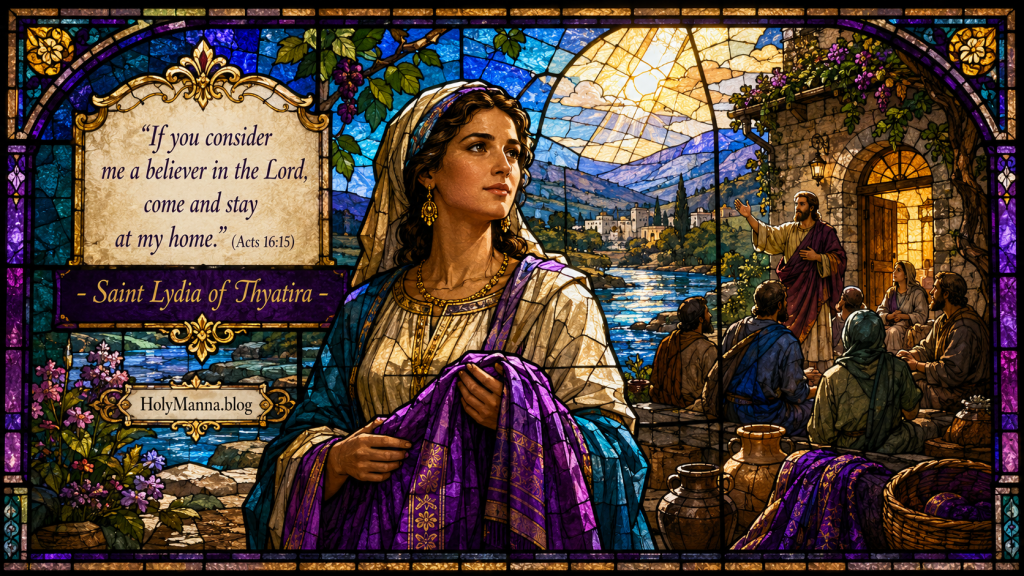
The Woman Who Opened Her Heart and Her Home to the Church
Saint Lydia of Thyatira enters the story of salvation quietly, but her place in Christian history is enormous. She appears in The Acts of the Apostles during Saint Paul’s missionary journey into Macedonia, when the Gospel begins to take root in Europe. She is remembered as the first recorded Christian convert in Europe, a woman of prayer, a businesswoman, a generous host, and a lay disciple who placed her home and resources at the service of the Church.
She was not one of the Twelve Apostles. She did not write a Gospel. She did not leave behind a famous theological treatise. She did something both simple and deeply holy. She listened when the Word of God was preached, allowed the Lord to open her heart, received Baptism, and then opened her home to the servants of Christ.
That may sound ordinary, but it changed history. Before Europe had cathedrals, basilicas, monasteries, Catholic universities, or great shrines, the Church in Philippi had Lydia’s house.
Her story reminds every Catholic that holiness is not only found in pulpits, cloisters, or martyrdom. Holiness can begin in a workplace, a family home, a conversation by a river, and a heart willing to say yes to grace.
A Woman of Purple, Prayer, and Providence
Saint Lydia was originally from Thyatira, a city in Asia Minor, in what is now modern-day Turkey. Thyatira was known in the ancient world for its trade guilds and dye works, especially its production of purple cloth. Scripture describes Lydia as a seller of purple goods, which means she was likely involved in a luxury trade. Purple dye was expensive, difficult to produce, and associated with wealth, honor, and authority.
By the time Saint Paul met her, Lydia was living or working in Philippi, a Roman colony in Macedonia. This detail is important because it shows that she was a woman of movement, trade, and responsibility. She appears to have been a woman of means, and she also seems to have been the head of her household, since Acts 16:15 says that she and her household were baptized.
Scripture also tells us that Lydia was a “worshiper of God” in Acts 16:14. In the world of the New Testament, this likely means she was a Gentile who worshiped the God of Israel before becoming Christian. She was not indifferent to faith. Her heart was already turned toward the Lord, even before she heard the fullness of the Gospel from Saint Paul.
This is one of the most beautiful parts of her story. Lydia was already seeking God, but God was seeking her even more. Catholic teaching reminds us that grace always comes first. The Catechism of the Catholic Church teaches that “the preparation of man for the reception of grace is already a work of grace” in CCC 2001. Lydia’s conversion shows this in a living way. Her journey was not simply the result of curiosity or good timing. It was the movement of God’s grace in her life.
The River Where Grace Opened a Heart
In Philippi, Saint Paul and his companions went outside the city gate on the Sabbath to a river, where they believed there was a place of prayer. There they found women gathered, and Paul began to speak to them. Among those women was Lydia.
Then comes the line that defines her entire life: “The Lord opened her heart to pay attention to what Paul was saying” in Acts 16:14.
That sentence is short, but it is spiritually powerful. Lydia did not merely hear words. She received grace. The Lord opened her heart, and she responded with faith. Her conversion was not forced. It was not emotional manipulation. It was the mysterious cooperation between divine grace and human freedom.
This is deeply Catholic. Faith is a gift, but it is also a response. God opens the door of the heart, but the soul must welcome Him. Lydia did exactly that. After listening to Paul, she and her household were baptized.
Her baptism made her part of Christ and His Church. In The Catechism of the Catholic Church, Baptism is described as the sacrament that frees us from sin, makes us children of God, incorporates us into the Church, and makes us sharers in Christ’s mission. Lydia’s life after Baptism immediately shows this truth. She did not treat faith as a private possession. She turned faith into hospitality.
The Only Words We Have from Saint Lydia
Saint Lydia left behind no writings, no sermons, and no verified famous sayings outside of Scripture. Her only recorded words come after her baptism, when she says to Paul and his companions, “If you consider me a believer in the Lord, come and stay at my home” in Acts 16:15.
That sentence tells us so much about her soul.
She does not simply say, “I believe.” She says, in effect, “If this faith is real, then my home must belong to the Lord too.” She receives the Gospel and immediately becomes generous. She receives Baptism and immediately becomes hospitable. She receives the Church and immediately supports the Church.
There is something refreshingly practical about Lydia’s holiness. She does not complicate discipleship. She does not wait until she feels perfectly prepared. She does not demand a special title or public recognition. She simply opens the door.
That is why she is such a powerful saint for modern Catholics. Many people wonder how to serve God in ordinary life. Lydia gives a clear answer. Start with what you already have. Use your home, your work, your resources, your table, your influence, and your relationships for Christ.
A Home That Became a Church
After Paul and Silas were beaten and imprisoned in Philippi, they were miraculously freed after an earthquake. When they left the prison, they returned to Lydia’s house. Acts 16:40 says they went there, saw the brothers, encouraged them, and then departed.
This strongly suggests that Lydia’s home had become a gathering place for the young Christian community in Philippi. In other words, her house may have been one of the first domestic churches in Europe.
That matters. The early Church often grew through households. Families, servants, workers, friends, and neighbors encountered the Gospel through homes opened in faith. The Catechism of the Catholic Church calls Christian families “islands of Christian life in an unbelieving world” in CCC 1655. Lydia’s household fits that description beautifully.
Her home became more than a private residence. It became a place of refuge, encouragement, worship, and mission. This is one reason Catholics remember her as a patroness of Christian hospitality, converts, businesswomen, merchants, dyers, and textile workers.
Saint Lydia teaches that a Catholic home does not need to be perfect to be holy. It needs to be open to Christ. A dinner table can become a place of evangelization. A living room can become a place of prayer. A business can become a means of generosity. A family can become a witness.
The Quiet Miracle of Conversion
There are no well-attested Catholic miracle stories attributed to Saint Lydia during her lifetime. No ancient source tells us that she healed the sick, raised the dead, or performed visible wonders. The miracle most clearly associated with her is the hidden miracle of grace.
The Lord opened her heart.
That is not less miraculous because it happened quietly. In fact, from a Catholic perspective, the conversion of a heart is one of the greatest works of God. A proud heart becoming humble, a searching heart receiving truth, a comfortable life becoming generous, and a private household becoming a place of mission are all signs of grace.
The earthquake that freed Paul and Silas from prison occurs in the same chapter of The Acts of the Apostles, but Scripture does not attribute that miracle to Lydia. It belongs to the larger story of Paul, Silas, the jailer, and the growth of the Church in Philippi. Lydia’s role remains different but deeply important. She is not the wonder-worker of the chapter. She is the first open door.
That should comfort many ordinary Catholics. Not every saint is remembered for spectacular miracles. Some saints are remembered because they were faithful at the exact moment grace asked something of them.
Hardships Without a Martyr’s Crown
Saint Lydia should not be presented as a martyr. There is no reliable Catholic tradition that she died for the faith, and Scripture gives no account of her death. After Acts 16, she disappears from the biblical record. We do not know when she died, where she died, whether she remained in Philippi, or whether she ever returned to Thyatira.
Yet her life was not without risk. By welcoming Paul and his companions, Lydia associated herself with a mission that had already brought public controversy, beatings, imprisonment, and opposition. Philippi was a Roman colony, and the preaching of Christ could be seen as socially disruptive. Paul and Silas had already suffered there. Lydia’s hospitality was not merely polite. It was courageous.
She opened her home to men who had been imprisoned for the Gospel. She identified herself with the Christian community at its fragile beginning. That required faith, conviction, and holy boldness.
Her hardship is not recorded as bloodshed, but as risk. Her martyrdom was not literal, but her witness still cost her something. True hospitality always does. It asks a person to give space, time, reputation, comfort, and resources for the sake of love.
Traditions, Legends, and Sacred Memory
There are no major miracle legends about Saint Lydia in the Roman Catholic tradition that can be confidently verified. The strongest tradition associated with her is the place of her baptism near Philippi, often connected with a river site in modern Greece. Pilgrims still honor the memory of her baptism near ancient Philippi, and churches and devotional sites in that region preserve her story.
Since Acts 16 only says Paul met the women at a river outside the city, the exact modern location of Lydia’s baptism is a matter of tradition rather than something that can be proven directly from Scripture. Still, it remains a meaningful pilgrimage memory because it connects believers to the place where the Gospel first took root in Europe through her conversion.
Later devotional reflection sometimes imagines that Lydia continued to support Saint Paul and the Philippian Church financially. This is possible, especially because the Church in Philippi later became known for its generosity toward Paul. However, Scripture does not directly say Lydia was the source of that support. This should be treated as a pious possibility, not a verified fact.
What is certain is enough. Lydia heard the Gospel, received Baptism, opened her home, and helped shelter the first Christian community in Philippi.
Her Legacy After Death
Saint Lydia’s legacy grew from a few verses of Scripture into a lasting Catholic memory of lay holiness. She is honored in the Roman Martyrology on May 20, and many Catholic devotional calendars also commemorate her on August 3. She is traditionally associated with dyers and textile workers because of her work with purple cloth, and she is also loved as a model for businesswomen, converts, merchants, generous hosts, and lay supporters of evangelization.
Her cultural impact is especially visible in the way modern Catholics rediscover her as a saint for ordinary working people. She is a saint for professionals who wonder how their careers can serve God. She is a saint for women in business. She is a saint for converts. She is a saint for people who want their homes to become places of welcome, prayer, and Christian witness.
In a world that often separates faith from work, Lydia refuses that split. Her trade, her household, her faith, and her generosity all belong together.
She also speaks powerfully to Catholics who feel like their contribution is small. Lydia only appears briefly in Scripture, but her yes to God helped shape Christian history. That is often how grace works. The world notices platforms, titles, and power. God notices the open heart.
The Lesson of Lydia’s Open Door
Saint Lydia’s life is a reminder that the Christian mission does not only advance through preaching. It also advances through listening, Baptism, generosity, courage, and hospitality.
Her story asks a very practical question: What has God already placed in your hands that can be offered back to Him?
For Lydia, it was a home, a business, a household, and a willing heart. For modern Catholics, it may be a family dinner, a spare room, a parish ministry, a conversation with a friend, a generous donation, a prayer group, or simply the courage to say, “This house belongs to Christ.”
Her life also shows the beauty of cooperation with grace. The Lord opened her heart, but Lydia opened her door. God gave the grace, and Lydia responded with action.
That is the Catholic life in miniature. Grace comes first. Faith responds. Love becomes visible.
A Saint for Homes, Workplaces, and Open Hearts
Saint Lydia is not remembered because she lived a loud life. She is remembered because she lived a receptive one. She listened. She believed. She was baptized. She welcomed. She served.
In her, we see that laypeople are not spectators in the Church. They are living stones in the household of God. A Catholic businesswoman in Philippi became part of the foundation of the Church’s mission in Europe, not because she tried to be famous, but because she let the Gospel rearrange her life.
Her witness is especially needed today. Many Catholics want to serve God but feel overwhelmed by the size of the mission. Lydia reminds us to begin close to home. Let the Lord open the heart. Let Baptism shape the household. Let faith become hospitality. Let generosity become evangelization.
That is how the Church grows. One open heart at a time. One open door at a time.
Engage with Us!
Share your thoughts and reflections in the comments below. Saint Lydia’s story is short, but it gives us so much to think about, especially when it comes to faith, work, hospitality, and the way God uses ordinary lives for extraordinary purposes.
- Where is God asking you to open your heart more fully to His Word, the way Lydia did by the river?
- How can your home become more of a place of Christian welcome, prayer, encouragement, and peace?
- What gifts, resources, work, or influence has God placed in your life that could be used more intentionally for the Gospel?
- Do you ever underestimate the power of small acts of faithfulness, even though Lydia’s brief appearance in Scripture helped mark the beginning of Christianity in Europe?
- How can Saint Lydia’s example help you live your baptism more boldly in your everyday life?
May Saint Lydia of Thyatira inspire us to let God open our hearts, and may we have the courage to open our homes, our work, and our lives to Christ. Let us live with faith, serve with generosity, welcome others with love, and do everything with the mercy Jesus taught us.

 Holy Manna!
Leave a comment