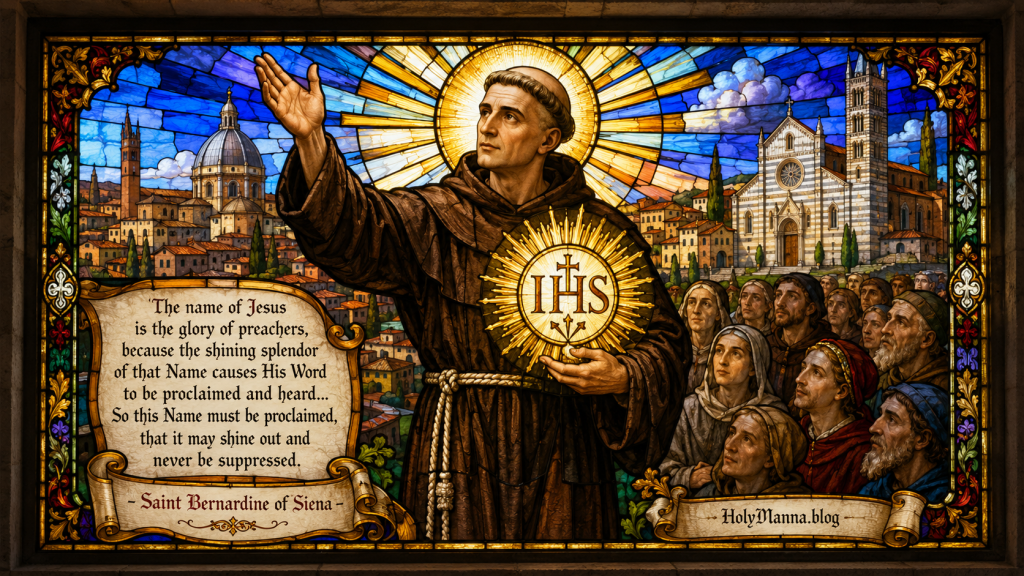
The Fire of the Holy Name
Saint Bernardine of Siena was one of those saints who seemed to walk into a divided world carrying a single burning word: Jesus.
Born in 1380 and raised in the hills and cities of Italy, Bernardine became a Franciscan priest, missionary preacher, reformer, peacemaker, and one of the most powerful Catholic voices of the 15th century. He is best known as the Apostle of the Holy Name of Jesus, the saint who helped spread devotion to the sacred monogram IHS, a shortened form of the Holy Name of Jesus.
In a time when Italian cities were torn apart by political factions, family rivalries, corruption, gambling, greed, and violence, Bernardine lifted up the Name of Jesus as the one banner that could heal a wounded society. His mission was not merely to make people feel religious. His mission was to call entire cities to repentance, peace, justice, and conversion.
This is deeply Catholic. The Catechism of the Catholic Church teaches, “The name ‘Jesus’ contains all: God and man and the whole economy of creation and salvation” (CCC 2666). Bernardine understood that the Holy Name was not a slogan, decoration, or spiritual accessory. It was the saving Name before which every human heart must bow.
A Noble Child Formed by Suffering and Charity
Saint Bernardine was born on September 8, 1380, in Massa Marittima, a town then connected to Siena. His father belonged to the noble Albizzeschi family and served as governor of the town. Bernardine was born on the feast of the Nativity of the Blessed Virgin Mary, a beautiful detail for a man whose preaching would later be filled with devotion to Our Lady.
His childhood, however, was marked by loss. By the age of six, Bernardine had lost both of his parents. He was raised by devout relatives, especially his aunts, who helped form him in faith, discipline, and virtue. He received a good education and studied civil and canon law, which gave him a sharp mind and a strong sense of justice.
But his heart was not shaped only in classrooms. It was shaped in a hospital.
As a young man, Bernardine joined the Confraternity of Our Lady, which served at the hospital of Santa Maria della Scala in Siena. Around the year 1400, a terrible plague struck the city. Many people fled. Many others died. Bernardine and a small group of companions stayed behind and served the sick for months. They cared for the dying, comforted the abandoned, and placed themselves in grave danger for love of Christ.
He survived the plague, but the exhausting labor damaged his health for the rest of his life. This is one of the most important details about him. Before Bernardine preached to crowds, he served the suffering. Before he spoke of Christ in public squares, he met Christ in the sickbed. His later fire in the pulpit came from charity, not ambition.
After the plague, Bernardine distributed his inheritance to the poor and entered the Friars Minor, the Franciscan order founded by Saint Francis of Assisi. He was professed in 1403 and ordained a priest in 1404. He joined the Franciscan Observant movement, which sought a stricter return to poverty, simplicity, prayer, and evangelical discipline.
For years, Bernardine lived more quietly in prayer, study, and formation. Like many saints, his public mission was prepared in hidden places. God was forming the preacher before the world knew his name.
The Preacher Who Made Italy Listen
Around 1417, Bernardine began the great preaching mission that would define his life. He traveled through Italy on foot, going from city to city, village to village, and public square to public square. Churches were often too small to hold the crowds, so he preached outdoors. Some accounts say that tens of thousands came to hear him.
His sermons could last for hours, but people listened. He spoke in the language of ordinary people. He was direct, vivid, humorous, practical, and fearless. He preached about repentance, confession, chastity, marriage, business ethics, greed, gambling, blasphemy, family life, social justice, peace, mercy, and the love of Jesus Christ.
He was not a soft preacher, but he was a serious one. Bernardine believed that sin destroyed souls and tore communities apart. He also believed grace could rebuild what sin had ruined.
He preached against public vice, but he also preached reconciliation. He entered cities divided by political hatred and called people to forgive. He urged factions to stop tearing one another apart. He helped bring peace to communities wounded by revenge, pride, and suspicion.
This is why he is sometimes called the Apostle of Italy. He did not only preach to individuals. He preached to cities, markets, families, rulers, workers, merchants, and ordinary Catholics trying to survive in a noisy and divided age.
The Name Above Every Banner
Saint Bernardine’s greatest devotion was the Holy Name of Jesus. He carried or displayed a tablet marked with the letters IHS, often painted in gold and surrounded by rays like the sun. The letters are traditionally understood as the first three letters of the name of Jesus in Greek.
This became his great sign.
At that time, many Italian cities were divided by rival factions, including the Guelphs and Ghibellines. Families and political groups displayed their own symbols as signs of loyalty and identity. Bernardine urged people to remove these factional symbols and replace them with the Holy Name of Jesus.
That was bold. He was telling people that their deepest identity could not be politics, family pride, revenge, money, or social status. Their deepest identity had to be Christ.
One of his famous teachings says, “The name of Jesus is the glory of preachers, because the shining splendor of that name causes his word to be proclaimed and heard.”
He also preached, “So this name must be proclaimed, that it may shine out and never be suppressed.”
Bernardine believed the Holy Name was light for the mind, medicine for the heart, strength for the weak, and fire for the preacher. He wanted the Name of Jesus not only in churches, but in homes, streets, businesses, and public life.
This devotion fits beautifully with The Catechism, which teaches that prayer to Jesus is simple, powerful, and direct because His Name contains His presence. To say the Holy Name with faith is not empty repetition. It is calling on the Savior.
Stories, Legends, and the Fire of Conversion
Several famous stories are associated with Saint Bernardine.
One well-known tradition says that Saint Vincent Ferrer, the great Dominican preacher, once preached in Alessandria and foretold that his mantle would fall upon someone listening to him. According to the story, Vincent said he would return to France and Spain, while the evangelization of Italy would be left to Bernardine. This story cannot be verified in every detail, but it has long been part of the Catholic memory surrounding Bernardine’s mission.
Another famous story involves a card-painter in Bologna. Bernardine preached so strongly against gambling that a man who made playing cards complained that his trade had been ruined. Bernardine reportedly advised him to make tablets bearing the Holy Name of Jesus instead. According to the story, the man prospered because so many people wanted the holy symbol for their homes. This story is part of the traditional accounts of Bernardine’s life, though the exact details cannot be fully verified.
There is also the powerful story of Bernardine’s trial over the Holy Name. Some critics accused him of promoting a dangerous new devotion and even encouraging idolatry by displaying the IHS tablet. In 1427, he was called to answer these accusations before Church authorities. Saint John of Capistrano defended him, and Bernardine submitted humbly to examination. The charges were rejected, and his preaching was vindicated.
This episode is important because Bernardine’s obedience was as impressive as his zeal. He did not place himself above the Church. He trusted the Church. The Catechism teaches that sacred signs and images are not adored as God, but are honored because they point to the holy realities they represent (CCC 2132). Bernardine’s tablet was not an idol. It was a sign pointing hearts to Jesus.
Miracles, Mercy, and a Voice Restored
Several miracles are associated with Saint Bernardine during his lifetime.
One of the most famous concerns his voice. Bernardine was known to have had a weak and hoarse voice, which would seem like a serious obstacle for a man called to preach to enormous crowds. Catholic tradition says that through the intercession of the Blessed Virgin Mary, his voice was strengthened so that he could preach powerfully. This is one reason he has been invoked by those suffering from chest, lung, respiratory, and voice problems.
Other accounts speak of healings connected with his preaching and with devotion to the Holy Name of Jesus. People who encountered Bernardine or looked upon the Holy Name monogram were said to have received graces and cures. Some of these stories belong to the devotional and hagiographical tradition around him, and not every detail can be historically verified.
Still, the deeper miracle of his life is impossible to miss. Through his preaching, enemies reconciled. Cities repented. People went to confession. Public sins were renounced. Gambling objects and vain luxuries were burned. Families and communities were called back to God.
Sometimes the greatest miracle is not the body suddenly healed, but the heart suddenly converted.
The Saint Who Refused Power
Bernardine was offered several bishoprics, including Siena, Ferrara, and Urbino. He refused them.
This is why he is often shown in sacred art with three mitres at his feet. Those mitres represent the episcopal offices he turned down. A famous saying associated with him explains his refusal: “All Italy was already his diocese.”
That line reveals his heart. Bernardine was not rejecting the office of bishop because he despised it. He was refusing honor because he knew his vocation was to preach as a poor Franciscan. He wanted to remain free to move from place to place, calling sinners back to Christ.
He also became one of the great builders of the Franciscan Observant reform. When he entered the movement, it was still relatively small in Italy. By the time of his death, it had grown tremendously. He helped reform and establish many friaries, strengthened Franciscan discipline, and inspired other great saints and preachers, including Saint John of Capistrano and Saint James of the Marches.
His influence also reached women’s religious life, including reforms among Poor Clare communities. His mission was not only about preaching in public squares. It was also about renewing the Church from within.
Hardships Without Martyrdom
Saint Bernardine was not a martyr in the strict sense. He did not die by execution for the faith. But he endured real hardship.
His health had been damaged since his service during the plague. His missionary life was physically demanding. He traveled constantly, preached for hours, faced criticism, and carried the burden of reforming communities that often resisted repentance. He was accused, misunderstood, and temporarily silenced because of controversy over the Holy Name devotion.
He also lived in an era marked by social unrest, political hatred, moral confusion, and religious tension. His preaching sometimes reflected the harsh rhetoric and limitations of his time, and a faithful Catholic telling of his story should be honest about that. Saints are canonized for heroic holiness, not because every phrase, assumption, or cultural attitude of their century should be repeated without discernment.
The Church teaches the dignity of every human person. The Catechism says, “The equality of men rests essentially on their dignity as persons and the rights that flow from it” (CCC 1935). So, when reading Bernardine today, Catholics can receive his zeal for conversion, peace, the Holy Name, and moral reform, while also remembering that truth must always be proclaimed with charity and reverence for the human person.
Near the end of his life, Bernardine was weak and ill, but he set out again to preach in the Kingdom of Naples. Too frail to walk, he rode on a donkey. He reached L’Aquila in a dying condition and died there on May 20, 1444. Tradition says the friars were chanting words from Christ’s prayer in The Gospel of John: “Father, I have manifested your name… I come to you” (John 17).
That detail is deeply fitting. The preacher of the Holy Name died surrounded by the prayer of Jesus Himself.
Miracles and Impact After Death
After Bernardine’s death, miracles were reported through his intercession, and devotion to him spread quickly. He was canonized in 1450 by Pope Nicholas V, only six years after his death. That rapid canonization shows how deeply the Church recognized his holiness and impact.
His body was venerated in L’Aquila, where a great basilica was built in his honor. His relics remain an important sign of Catholic devotion. Pilgrims have long visited his shrine to honor the saint who gave his life to proclaiming the Name of Jesus.
Several posthumous miracle stories are associated with him. Sacred art and devotional tradition preserve accounts of healings and interventions through his intercession. These include stories of a girl healed of an ulcer, a blind man receiving sight, a wounded man being restored, a prisoner being freed, a child born dead being revived, and a young man injured by a bull being healed. These stories belong to the devotional tradition around Saint Bernardine, and not all of them can be verified in detail.
There are also traditions of people being healed at his tomb or through his intercession after death. These miracle stories helped strengthen devotion to him and supported the recognition of his sanctity in the life of the Church.
His cultural impact was enormous. The IHS monogram spread widely across Italy and beyond. It appeared on churches, homes, public buildings, altars, artwork, and later in the emblems of religious communities. The symbol became especially associated with devotion to Jesus and was later famously used by the Jesuits.
Saint Bernardine also influenced Catholic preaching, Franciscan reform, social ethics, and religious art. He became a major figure in Renaissance sacred art, often portrayed holding the IHS tablet, with rays around the Holy Name and mitres at his feet.
Even places bear his memory. The city and Diocese of San Bernardino in California are named after him. In parts of Europe, especially where Franciscan Observants spread, communities influenced by his reform were sometimes known as Bernardines.
His feast day is celebrated on May 20. The Church’s prayer for his memorial asks God, who gave Saint Bernardine a great love for the Holy Name of Jesus, to set the faithful aflame with divine love through his merits and prayers.
That is exactly the grace his life still asks for today.
A Name That Still Burns
Saint Bernardine’s life speaks powerfully to the modern world.
People today still live under banners. Some live under the banner of politics. Some live under the banner of money. Some live under the banner of lust, resentment, personal branding, career ambition, addiction, anxiety, or social media approval. Bernardine would understand that world very well. He preached to cities full of noise, division, pride, and restless desire.
His answer was not complicated. Put the Name of Jesus above everything.
Put the Name of Jesus over the home. Put the Name of Jesus over the tongue. Put the Name of Jesus over work, money, relationships, entertainment, conflict, and temptation. Let His Name shape the way people speak, forgive, buy, sell, pray, suffer, and love.
This does not mean using the Holy Name casually. It means reverencing it. It means calling on Jesus with faith. It means letting His Name become a refuge in temptation, a prayer in anxiety, a shield against pride, and a light in confusion.
What banner is really ruling the heart right now? Is it Christ, or is it something smaller?
Saint Bernardine reminds the Church that evangelization does not always begin with complicated programs. Sometimes it begins with the simple, faithful, reverent proclamation of one Name.
Jesus.
The Name above every name.
Engage with Us!
Share your thoughts and reflections in the comments below. Saint Bernardine’s life gives so much to ponder, especially in a world that still feels divided, distracted, and hungry for peace.
- What part of Saint Bernardine’s life challenges you the most: his service to plague victims, his bold preaching, his devotion to the Holy Name, or his refusal of worldly honors?
- Where do you need to place the Name of Jesus more intentionally in your daily life: your home, your work, your speech, your relationships, or your struggles?
- Are there any “banners” in your life that compete with Christ, such as pride, politics, comfort, resentment, ambition, or fear?
- How can Saint Bernardine’s devotion to the Holy Name help you pray more simply and faithfully this week?
- What is one practical act of peace, repentance, or mercy you can offer today in honor of Jesus?
May Saint Bernardine of Siena help every Catholic speak the Name of Jesus with reverence, live under that holy banner with courage, and bring peace wherever division has taken root. Let us live a life of faith and do everything with the love and mercy Jesus taught us.
Saint Bernardine of Siena, pray for us!
Follow us on YouTube, Instagram and Facebook for more insights and reflections on living a faith-filled life.

 Holy Manna!
Leave a comment