Wednesday of the Seventh Week of Easter – Lectionary: 299
Kept by Christ, Sent into the World
There are moments when faith feels like standing on the shoreline, watching someone beloved sail away, while still hearing his voice say, “Do not be afraid.”
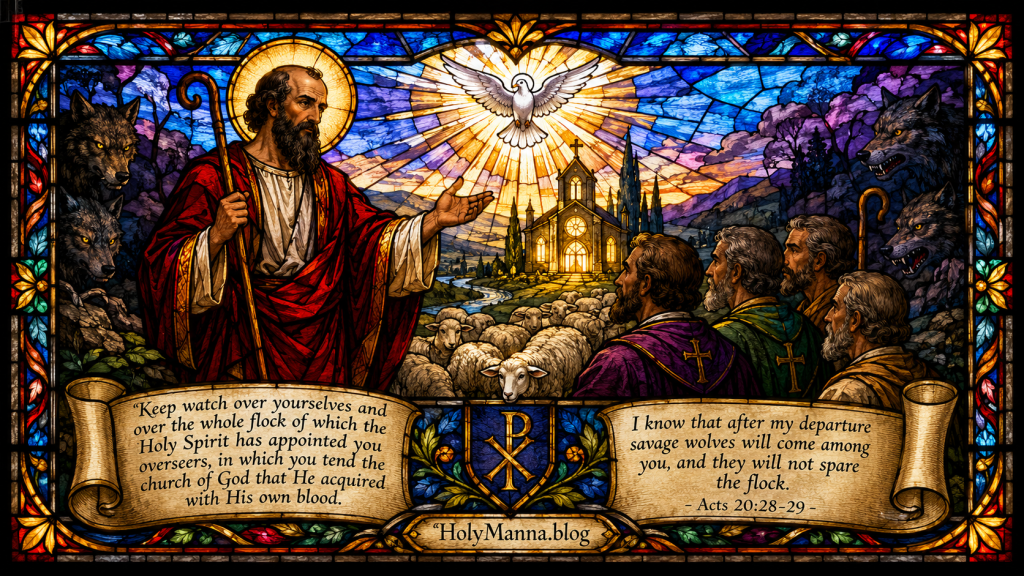
Today’s readings carry that sacred ache. In Acts 20:28-38, Saint Paul is saying goodbye to the elders of Ephesus. He knows danger is coming. He warns them about “savage wolves” who will threaten the flock, even from within. Yet he does not leave them with fear. He leaves them with vigilance, prayer, hard work, generosity, and trust in God’s word. In Psalm 68:29-30, 33-36, the Church sings of the God who gives strength to His people. Then, in John 17:11-19, Jesus prays to the Father for His disciples, asking not that they be taken out of the world, but that they be protected from the Evil One and consecrated in truth.
The central theme is clear: Christ does not remove His people from the battle, but He guards them, strengthens them, and sends them into the world as witnesses of truth.
This is deeply apostolic. The early Church knew that following Christ meant living in a world that often misunderstood, resisted, and hated the Gospel. The apostles did not build the Church through comfort or popularity. They built it through preaching, sacrifice, pastoral care, sacramental life, and fidelity to the truth handed down from Christ. Saint Paul’s farewell reminds the Church that shepherds must guard the flock because the Church belongs to God, purchased by the Blood of Christ. Jesus’ priestly prayer reminds every disciple that holiness does not mean escaping the world. Holiness means belonging to the Father while being sent into the world with the heart of the Son.
The Catechism of the Catholic Church teaches that the Church is apostolic because she is built on the foundation of the apostles, preserves their teaching, and continues to be taught, sanctified, and guided by their successors through the Holy Spirit. This matters today because the readings are not simply about ancient farewells. They are about how the Church survives every age: through truth, unity, prayer, sacrifice, and shepherds who love the flock enough to protect it.
The Christian life is not passive. Jesus prays, “Consecrate them in the truth. Your word is truth” John 17:17. Paul commands, “Keep watch over yourselves and over the whole flock” Acts 20:28. The psalm declares, “Awesome is God in his holy place” Psalm 68:36. Together, these readings invite the faithful to become Catholics who are awake, rooted, generous, and unafraid.
Where is Christ asking this soul to stand firm in truth while still loving the world He came to save?
First Reading – Acts 20:28-38
A shepherd’s goodbye becomes a lesson in vigilance, sacrifice, and love.
The first reading brings the Church into one of the most emotional scenes in the Acts of the Apostles. Saint Paul is speaking to the elders of Ephesus, not in a classroom, not in a synagogue debate, but in a farewell. He is on his way toward Jerusalem, where suffering awaits him. He knows these leaders may never see him again. So his words are not casual advice. They are the final instructions of an apostle who has poured out his life for the Church.
Ephesus was one of the great cities of the ancient world, famous for commerce, pagan worship, and the temple of Artemis. It was a place of spiritual conflict and missionary fruitfulness. Paul had labored there for years, preaching Christ, forming disciples, and strengthening the Church. Now he calls the presbyters, the elders who served as shepherds, and tells them what faithful leadership must look like when the apostle is gone.
This reading fits beautifully with today’s central theme. In the Gospel, Jesus prays that His disciples be kept in the Father’s name and consecrated in truth. In this reading, Paul shows what that prayer looks like in the lived life of the Church. Christ guards His people through faithful shepherds, sound doctrine, prayer, sacrifice, humility, and generous love.
Acts 20:28-38 – New American Bible (Revised Edition)
28 Keep watch over yourselves and over the whole flock of which the holy Spirit has appointed you overseers, in which you tend the church of God that he acquired with his own blood. 29 I know that after my departure savage wolves will come among you, and they will not spare the flock. 30 And from your own group, men will come forward perverting the truth to draw the disciples away after them. 31 So be vigilant and remember that for three years, night and day, I unceasingly admonished each of you with tears. 32 And now I commend you to God and to that gracious word of his that can build you up and give you the inheritance among all who are consecrated. 33 I have never wanted anyone’s silver or gold or clothing. 34 You know well that these very hands have served my needs and my companions. 35 In every way I have shown you that by hard work of that sort we must help the weak, and keep in mind the words of the Lord Jesus who himself said, ‘It is more blessed to give than to receive.’”
36 When he had finished speaking he knelt down and prayed with them all. 37 They were all weeping loudly as they threw their arms around Paul and kissed him, 38 for they were deeply distressed that he had said that they would never see his face again. Then they escorted him to the ship.
Detailed Exegesis
Verse 28 – “Keep watch over yourselves and over the whole flock of which the holy Spirit has appointed you overseers, in which you tend the church of God that he acquired with his own blood.”
Paul begins with a command that every Christian leader needs to hear: before watching over others, keep watch over yourself. A shepherd who neglects his own soul becomes dangerous, even if he sounds religious. The elders are told to guard both their interior life and the flock entrusted to them. Paul reminds them that their authority is not self-appointed. The Holy Spirit has placed them as overseers. This points toward the apostolic structure of the Church, where pastoral authority is received, not invented.
The phrase “the church of God that he acquired with his own blood” is breathtaking. The Church is not a human club, a spiritual lifestyle brand, or a community built on shared preferences. She belongs to God because Christ purchased her with His Blood. This is why doctrine, worship, and pastoral care matter so much. The flock is precious because the price was Calvary.
Verse 29 – “I know that after my departure savage wolves will come among you, and they will not spare the flock.”
Paul does not romanticize the future. He knows that danger will come. The image of “savage wolves” echoes the biblical contrast between shepherds and predators. In the Old Testament, unfaithful leaders were often condemned because they failed to protect God’s people. Paul warns that the Church will be attacked by forces that do not love the flock and do not care about souls.
This warning is still relevant. False teaching does not usually arrive wearing a name tag that says it is false. It often comes dressed as sophistication, compassion without truth, freedom without obedience, or spirituality without the Cross. Paul teaches the Church to be loving, but not naive.
Verse 30 – “And from your own group, men will come forward perverting the truth to draw the disciples away after them.”
This is even more painful. Paul says the danger will not only come from outside, but from within. Some will twist the truth and attract disciples to themselves. That is the opposite of apostolic ministry. A true shepherd draws souls to Christ. A false shepherd draws souls to himself.
This verse helps explain why the Catholic Church has always taken doctrine seriously. Heresy is not merely an intellectual mistake. It wounds communion, confuses the faithful, and endangers souls. Truth is not harsh when it protects people from spiritual poison. Truth is an act of mercy.
Verse 31 – “So be vigilant and remember that for three years, night and day, I unceasingly admonished each of you with tears.”
Paul’s vigilance was not cold suspicion. It was love with tears. He spent three years teaching, correcting, warning, encouraging, and suffering for the Christians in Ephesus. The phrase “with tears” reveals the heart of a true apostle. He did not correct people because he enjoyed being right. He corrected them because he loved them enough to care about their salvation.
This is a needed lesson in Catholic life. Correction without love becomes pride. Love without correction becomes weakness. Paul gives the Church both. He speaks the truth, but his truth is soaked in prayer, sacrifice, and tears.
Verse 32 – “And now I commend you to God and to that gracious word of his that can build you up and give you the inheritance among all who are consecrated.”
Paul cannot physically remain with them, so he entrusts them to God. This is a deeply Catholic moment. The Church does not ultimately survive because of the personality of one apostle, one priest, one bishop, one catechist, or one parent. She survives because God is faithful.
Paul also commends them to God’s word, which builds up the Church and leads believers toward their inheritance among the consecrated. This connects directly to the Gospel, where Jesus prays, “Consecrate them in the truth. Your word is truth” John 17:17. The word of God is not decoration for the Christian life. It forms, purifies, strengthens, and sanctifies the people of God.
Verse 33 – “I have never wanted anyone’s silver or gold or clothing.”
Paul now defends the purity of his ministry. He did not use the Gospel as a way to become wealthy or important. In the ancient world, traveling teachers could sometimes seek patronage, honor, and material gain. Paul makes clear that his mission was not driven by greed.
This matters because spiritual leadership is corrupted when it becomes self-serving. Paul’s poverty of spirit gives credibility to his preaching. He can tell the elders to protect the flock because he has already shown them that he is not trying to possess the flock.
Verse 34 – “You know well that these very hands have served my needs and my companions.”
Paul’s hands preached in a different way. He worked to support himself and his companions. He was known as a tentmaker, and his labor showed humility, discipline, and freedom from manipulation. He did not want anyone to think the Gospel was a business scheme.
There is something very human and beautiful here. The same apostle who preached Christ crucified also worked with his hands. Catholic holiness is not detached from ordinary labor. Work can become part of discipleship when it is done with integrity, generosity, and love.
Verse 35 – “In every way I have shown you that by hard work of that sort we must help the weak, and keep in mind the words of the Lord Jesus who himself said, ‘It is more blessed to give than to receive.’”
Paul’s labor was not only for himself. It was for the weak. Christian work is meant to become charity. He then quotes a saying of Jesus not recorded in the four Gospels: “It is more blessed to give than to receive.” This line captures the whole shape of Christian life. The disciple finds joy not by grasping, but by giving. Not by hoarding, but by serving. Not by using others, but by becoming a gift.
This verse also gives a powerful bridge to the works of mercy. Faith is not just belief in the mind. It becomes hands that feed, teach, comfort, forgive, and carry others.
Verse 36 – “When he had finished speaking he knelt down and prayed with them all.”
Paul ends with prayer. He does not merely give instructions and walk away. He kneels. Apostolic authority bows before God. This gesture teaches that the Church is protected not only by vigilance, but by worship. Paul has warned them, taught them, and exhorted them, but now he places everything before the Lord.
Kneeling also reveals humility. The apostle does not stand above the Church as a distant commander. He kneels among brothers. The Church is strongest when her leaders are not afraid to pray in dependence before God.
Verse 37 – “They were all weeping loudly as they threw their arms around Paul and kissed him.”
This is not a sterile institutional moment. It is family. The elders love Paul because he has loved them. The tears reveal that apostolic ministry creates real bonds. Catholic life is not merely doctrine on paper. It is communion, spiritual fatherhood, friendship in Christ, and shared suffering.
Their embrace also shows the human cost of mission. Following Christ often involves goodbyes, sacrifices, and grief. Yet this grief is not empty. It is the grief of love offered to God.
Verse 38 – “For they were deeply distressed that he had said that they would never see his face again. Then they escorted him to the ship.”
The final wound is personal. They are distressed because Paul said they would not see his face again. In biblical language, the face matters. To see someone’s face is to share presence, affection, recognition, and communion. Paul is leaving, but his teaching, example, and prayer remain.
They escort him to the ship, which gives the scene a quiet dignity. The Church walks with her apostles as far as she can, then entrusts them to God. This is the rhythm of Christian life. Love, mission, farewell, prayer, and trust.
Teachings: The Church Is Guarded by Apostolic Shepherds and Sacrificial Love
This reading is one of the clearest biblical foundations for apostolic pastoral care. Paul speaks to the elders as shepherds appointed by the Holy Spirit to guard the flock of God. The Church is not self-made. She is apostolic, and her shepherds are called to continue the mission entrusted by Christ to the apostles.
The Catechism of the Catholic Church teaches this directly in CCC 861: “In order that the mission entrusted to them might be continued after their death, the apostles consigned, by will and testament, as it were, to their immediate collaborators the duty of completing and consolidating the work they had begun, urging them to tend to the whole flock, in which the Holy Spirit had appointed them to shepherd the Church of God. They accordingly designated such men and then made the ruling that likewise on their death other proven men should take over their ministry.”
That teaching sounds almost like a commentary on Acts 20. Paul knows he is leaving. He knows danger is coming. So he entrusts the flock to men appointed by the Holy Spirit. This is not merely practical organization. It is part of Christ’s care for His Church.
The Catechism continues in CCC 862: “Just as the office which the Lord confided to Peter alone, as first of the apostles, destined to be transmitted to his successors, is a permanent one, so also endures the office, which the apostles received, of shepherding the Church, a charge destined to be exercised without interruption by the sacred order of bishops. Hence the Church teaches that ‘the bishops have by divine institution taken the place of the apostles as pastors of the Church, in such wise that whoever listens to them is listening to Christ and whoever despises them despises Christ and him who sent Christ.’”
This does not mean every shepherd is automatically holy in his personal conduct. Paul’s warning proves the opposite. Shepherds must keep watch over themselves. The office is sacred, and because it is sacred, it carries judgment, responsibility, and the need for conversion.
Saint Gregory the Great, one of the great Doctors of the Church, describes the heart of pastoral leadership in The Pastoral Rule: “The ruler should be always pure in thought, exemplary in conduct, discreet in silence, profitable in speech, a near neighbor to every one in sympathy, exalted above all in contemplation, a humble companion to those who do well, but rigid, for the zeal of righteousness, against the vices of evil-doers.”
That is exactly the balance Paul shows. He is compassionate, but not soft on error. He is humble, but not passive. He works with his hands, but also guards doctrine. He weeps, but he warns. He loves the flock, but he does not flatter it.
Paul’s final teaching, “It is more blessed to give than to receive”, also opens the door to Catholic teaching on charity. The Catechism teaches in CCC 2447: “The works of mercy are charitable actions by which we come to the aid of our neighbor in his spiritual and bodily necessities. Instructing, advising, consoling, comforting are spiritual works of mercy, as are forgiving and bearing wrongs patiently. The corporal works of mercy consist especially in feeding the hungry, sheltering the homeless, clothing the naked, visiting the sick and imprisoned, and burying the dead.”
Paul lived this. He instructed. He admonished. He consoled. He worked. He helped the weak. He gave himself away. This is why the reading is not only about bishops and priests. It is about every Catholic vocation. Parents guard the domestic church. Catechists guard the truth entrusted to students. Friends help friends remain faithful. Every baptized Christian is called to become generous, vigilant, and rooted in the word of God.
Reflection: Keeping Watch Without Losing the Heart
This reading feels especially important in an age that is full of noise. Everyone has a platform. Everyone has an opinion. Everyone can sound like a teacher. Paul’s warning is not outdated. The wolves still come. Sometimes they come through confusion, pride, resentment, lust, greed, ideology, or a version of Christianity that wants resurrection without the Cross.
But Paul does not teach fear. He teaches watchfulness. There is a difference. Fear panics and withdraws. Watchfulness stays awake in faith. Fear assumes the enemy is stronger than God. Watchfulness trusts God while refusing to be careless.
The first step is to keep watch over the soul. Before criticizing the Church, the culture, the parish, the family, or the world, a disciple has to ask what is happening inside his own heart. Is this soul being formed by the word of God, or by anger, distraction, and pride? Is this heart protecting the flock, or feeding division?
The second step is to stay close to the Church’s teaching. Paul does not tell the elders to invent something new after he leaves. He commends them to God and to His gracious word. For Catholics, that means Scripture read within the living Tradition of the Church, guided by the Magisterium. A Catholic who wants to remain faithful cannot live on headlines, social media arguments, and shallow takes. The soul needs Scripture, the sacraments, prayer, sound teaching, and the humility to be corrected.
The third step is to serve the weak. Paul does not separate doctrine from charity. He says hard work must help the weak. That can mean feeding someone, encouraging someone, visiting someone, forgiving someone, teaching someone, or simply noticing the person everyone else overlooks. The Christian life becomes credible when truth takes flesh in mercy.
Finally, this reading invites Catholics to pray for shepherds. Bishops, priests, deacons, religious, parents, teachers, and catechists carry real spiritual responsibility. They need prayer more than applause and correction more than flattery. Paul knelt and prayed with the elders because the Church cannot be protected by strategy alone.
Where is God asking for greater vigilance in this life? What truth needs to be guarded more carefully? Who is weak nearby and needs practical love? What would change today if the words of Jesus were taken seriously: “It is more blessed to give than to receive”?
Responsorial Psalm – Psalm 68:29-30, 33-36
When the Church feels surrounded, she sings to the God who gives strength to His people.
The responsorial psalm answers the tears of Saint Paul’s farewell with a song of confidence. In the first reading, Paul warns the elders of Ephesus that wolves will come against the flock. In the Gospel, Jesus prays that His disciples will be kept from the Evil One and consecrated in truth. Between those two readings, Psalm 68 rises like a hymn from the heart of Israel, reminding the faithful that God is not weak, distant, or distracted. He is the Lord who acts, protects, strengthens, and reigns.
Historically, Psalm 68 is a victory hymn. It celebrates the God of Israel as the divine warrior who leads His people, defeats His enemies, and dwells among them in His holy place. It remembers the great works of God in Israel’s history, especially His power shown in the Exodus, His care for Jerusalem, and His reign over all nations. In the liturgy, the psalm becomes the Church’s prayer. The same God who strengthened Israel now strengthens the Church purchased by the Blood of Christ.
This psalm fits today’s theme beautifully. The Church is not kept safe because her members are strong on their own. The Church is kept safe because God gives power and strength to His people. When shepherds must be vigilant, when disciples face hatred from the world, and when truth must be guarded, the Church does not begin with anxiety. She begins with worship.
Psalm 68:29-30, 33-36 – New American Bible (Revised Edition)
29 Summon again, O God, your power,
the divine power you once showed for us,
30 From your temple on behalf of Jerusalem,
that kings may bring you tribute.33 You kingdoms of the earth, sing to God;
chant the praises of the Lord,
Selah
34 Who rides the heights of the ancient heavens,
Who sends forth his voice as a mighty voice?
35 Confess the power of God,
whose majesty protects Israel,
whose power is in the sky.
36 Awesome is God in his holy place,
the God of Israel,
who gives power and strength to his people.
Blessed be God!
Detailed Exegesis
Verse 29 – “Summon again, O God, your power, the divine power you once showed for us.”
This verse is a prayer of remembrance and trust. Israel calls upon God to show again the strength He has already revealed. The people are not asking an unknown god to prove himself. They are crying out to the Lord who has acted before. He delivered His people from slavery, guided them through the wilderness, established them in the land, and made His presence known among them.
For Catholics, this kind of prayer is deeply familiar. The Church constantly remembers what God has done so that she can trust what God will do. At every Mass, the Church remembers the saving sacrifice of Christ, not as a mere mental exercise, but as a living participation in the mystery of redemption. The God who once showed His power in the Exodus has shown it most fully in the Cross and Resurrection of Jesus Christ.
In the context of today’s readings, this verse becomes the prayer of the Church under pressure. When Paul warns of wolves and Jesus speaks of the Evil One, the faithful can pray, “Summon again, O God, your power.” The Church does not need to invent her own strength. She asks God to renew His strength in her.
Verse 30 – “From your temple on behalf of Jerusalem, that kings may bring you tribute.”
The temple was the visible sign of God’s dwelling among His people. Jerusalem was not important because it was politically impressive, but because God had chosen to make His name dwell there. This verse looks toward the nations acknowledging the Lord and bringing tribute to Him. It is a vision of divine kingship, where earthly power bows before the true King.
For the Church, this verse points beyond the earthly temple toward Christ Himself. Jesus is the true Temple, the place where God and man meet. Through Him, the worship of Israel is fulfilled and opened to all nations. The Church now worships not in a single earthly sanctuary only, but in Christ, through the sacraments, especially the Eucharist.
This connects with today’s Gospel because Jesus prays to the Father as the true High Priest. He is about to offer Himself, and through His sacrifice, people from every nation will be gathered into one. The tribute God desires is not merely gold or political honor. He desires hearts consecrated in truth.
Verse 33 – “You kingdoms of the earth, sing to God; chant the praises of the Lord.”
The psalm expands from Israel to all kingdoms of the earth. God is not a local deity, restricted to one tribe or region. He is Lord of all creation. The nations are invited to sing, not because Israel’s God is one option among many, but because He is the true God.
This verse carries a missionary heartbeat. The praise of God is meant to spread. In Acts 20, Paul has given his life to preach Christ among the nations. In John 17, Jesus says, “As you sent me into the world, so I sent them into the world” John 17:18. The psalm shows the goal of that mission: all peoples praising the Lord.
Catholic worship is never meant to become a private spiritual hobby. The Church sings so that the world may hear. The Mass sends the faithful outward, so that homes, workplaces, cities, and cultures may be touched by the praise of God.
Verse 34 – “Who rides the heights of the ancient heavens, Who sends forth his voice as a mighty voice?”
This verse describes God with majestic, cosmic imagery. He rides above the heavens. His voice is mighty. In the ancient world, false gods were often associated with sky, storm, power, and fertility. This psalm boldly declares that the Lord, the God of Israel, reigns over the heavens themselves. Creation is not ruled by chaos or competing divine forces. It is ruled by the one true God.
The “mighty voice” of God also reminds the faithful that His word is powerful. God speaks, and creation obeys. God speaks, and prophets are sent. God speaks, and the Church is built up. This fits directly with the Gospel, where Jesus prays, “Your word is truth” John 17:17. The God whose voice shakes the heavens is the same God whose word consecrates the Church in truth.
For daily Catholic life, this matters because many voices compete for attention. The world has a loud voice. Fear has a loud voice. Sin has a loud voice. The Evil One lies with a persuasive voice. Yet God’s voice is mightier than all of them.
Verse 35 – “Confess the power of God, whose majesty protects Israel, whose power is in the sky.”
To confess God’s power is to acknowledge publicly who He is. Faith is not merely private admiration. It becomes worship, proclamation, and allegiance. The psalm calls the people to recognize that Israel’s protection comes from the majesty of God.
This verse connects beautifully with Paul’s warning to the elders. They must protect the flock, but they do so under the majesty of God. They are shepherds, but they are not the Savior. Their vigilance matters because God works through them, but their confidence must remain in the Lord.
The line “whose power is in the sky” lifts the eyes upward. The faithful are not meant to live trapped at ground level, obsessed only with problems, threats, and anxieties. God’s power is above every earthly crisis. His majesty protects His people, even when they feel small.
Verse 36 – “Awesome is God in his holy place, the God of Israel, who gives power and strength to his people. Blessed be God!”
The psalm ends in worship. God is “awesome”, not in the casual modern sense, but in the holy sense. He inspires reverence, awe, fear of the Lord, and confidence. He is not merely powerful in a distant way. He gives power and strength to His people.
This final verse is the heart of the responsorial psalm. God’s strength is not kept locked away in heaven. He gives it. He strengthens the weary, guards the faithful, sustains the Church, and empowers disciples to live the mission. Paul can leave the elders because God remains. The disciples can stay in the world because the Father keeps them. The Church can face the wolves because the Lord gives strength to His people.
The final words, “Blessed be God!”, are the proper ending to every Christian battle. Praise comes before, during, and after the struggle. Worship is how the Church remembers who is truly in control.
Teachings: The Psalms Teach the Church How to Pray With Memory and Hope
The responsorial psalm is not just a musical pause between readings. It is the Church praying Scripture back to God. The psalms teach the faithful how to bring fear, hope, grief, victory, repentance, praise, and longing into the presence of the Lord. They form the language of prayer for Israel, for Christ, and for the Church.
The Catechism of the Catholic Church teaches in CCC 2585: “From the time of David to the coming of the Messiah texts appearing in these sacred books show a deepening in prayer for oneself and in prayer for others. The psalms were gradually collected into the five books of the Psalter or ‘Praises,’ the masterwork of prayer in the Old Testament.”
That is exactly what happens in today’s psalm. The Church prays for God to show His power again, not only for personal comfort, but for the strengthening of all His people. It is a prayer for the whole flock.
The Catechism continues in CCC 2586: “The Psalms both nourished and expressed the prayer of the People of God gathered during the great feasts at Jerusalem and each Sabbath in the synagogues. Their prayer is inseparably personal and communal; it concerns both those who are praying and all men. The Psalms arose from the communities of the Holy Land and the Diaspora, but embrace all creation. Their prayer recalls the saving events of the past, yet extends into the future, even to the end of history; it commemorates the promises God has already kept, and awaits the Messiah who will fulfill them definitively. Prayed by Christ and fulfilled in him, the Psalms remain essential to the prayer of his Church.”
This teaching helps explain why Psalm 68 belongs so naturally in today’s Mass. It remembers God’s saving power in Israel, but it also points forward to Christ. It begins in the story of the chosen people, but it opens outward to the nations. It is historical, personal, communal, and prophetic all at once.
The Catechism also teaches in CCC 2587: “The Psalter is the book in which the Word of God becomes man’s prayer. In other books of the Old Testament, ‘the words proclaim God’s works and bring to light the mystery they contain.’ The words of the Psalmist, sung for God, both express and proclaim his saving works.”
This is why the Church sings the psalms in the Mass and in the Liturgy of the Hours. God gives His word to His people, and then His people return that word to Him in prayer. The psalm is not merely about God’s strength. It becomes a way for the faithful to receive that strength.
Saint Augustine famously loved the psalms because he saw Christ praying in them and the Church praying with Christ. In his teaching on the psalms, Augustine often reminded Christians that the voice of the psalm can be the voice of Christ the Head, the voice of the Church His Body, or the voice of both together. This matters for today’s reading because the Church does not sing alone. She sings in Christ, through Christ, and with Christ.
The historical background of Psalm 68 also matters. Israel lived among nations that worshiped many gods and often measured divine power by military victory, fertility, storms, or royal domination. Psalm 68 proclaims something different and greater. The God of Israel is Lord of the heavens, protector of His people, and worthy of praise from every kingdom. In the fullness of time, this universal call to worship is fulfilled in the Catholic mission to bring all nations to Christ.
Reflection: Singing Strength Into a Tired Soul
There are days when the soul feels surrounded. The news is loud, temptation is loud, family stress is loud, work pressure is loud, and the culture often feels like it is pulling in the opposite direction of the Gospel. Today’s psalm does not pretend those pressures are imaginary. It simply teaches the faithful where to look first.
Look to the God who has already acted. That is the first movement of the psalm. “Summon again, O God, your power” is a prayer rooted in memory. When faith feels weak, remember. Remember sins forgiven in confession. Remember grace received in the Eucharist. Remember prayers answered. Remember strength that arrived when human strength ran out. Catholic hope is not wishful thinking. It is memory turned toward the future.
Look to the God who reigns above the noise. The psalm speaks of the Lord who rides the ancient heavens and sends forth His mighty voice. That is not poetic decoration. It is spiritual sanity. The voices of the world are not equal to the voice of God. The lie is not equal to the truth. The Evil One is not equal to the Father. The flock may be threatened, but it is not abandoned.
Look to the God who gives strength. The psalm does not say God only admires strong people. It says He gives strength to His people. That means weakness is not disqualification. Weakness can become the very place where grace is received. The tired parent, the weary priest, the anxious student, the struggling spouse, the tempted young adult, the grieving widow, and the Catholic trying to stay faithful in a confused world can all pray this psalm honestly.
A simple way to live this psalm is to begin the day with praise before checking the noise. Pray one line slowly: “Awesome is God in his holy place, the God of Israel, who gives power and strength to his people” Psalm 68:36. Let that line become a shield. Let it interrupt fear. Let it remind the soul that God gives what He asks for.
Another way is to make worship the first response instead of the last resort. When facing a hard conversation, a temptation, a disappointment, or a moment of discouragement, pause and bless God before reacting. Praise does not erase the problem, but it puts the problem back under the authority of God.
Where does this soul need God to summon His power again? What voice has become louder than the voice of the Lord? What would change today if praise came before panic?
The psalm ends with “Blessed be God!” That is not denial. That is defiance against despair. The Church can bless God because He is still in His holy place, still guarding His people, still strengthening His flock, and still sending His Church into the world with truth, unity, and courage.
Holy Gospel – John 17:11-19
Jesus does not pray for an easy life for His disciples. He prays for a holy one.
The Holy Gospel brings the faithful into one of the most sacred moments in all of Scripture. Jesus is not teaching a crowd, answering a Pharisee, healing the sick, or walking along the Sea of Galilee. He is praying to the Father on the night before His Passion. This passage comes from John 17, often called the Priestly Prayer of Jesus, because Christ speaks as the High Priest who is about to offer Himself for the salvation of the world.
The setting matters. Jesus has washed the feet of His apostles. He has spoken to them about love, the Holy Spirit, persecution, peace, and the mystery of remaining in Him. Judas has gone into the night. The Cross is near. Yet Jesus does not turn inward in fear. He turns toward the Father in prayer.
This Gospel fits perfectly with today’s theme. In the first reading, Saint Paul tells the elders of Ephesus to guard the flock. In the psalm, the Church praises the God who gives strength to His people. Now, in the Gospel, Jesus reveals the deepest reason the Church can stand firm. Before the Church guards anything, Christ guards the Church. Before the disciples are sent into the world, Jesus prays for them. Before they suffer hatred, He asks the Father to keep them in His name, consecrate them in truth, and protect them from the Evil One.
John 17:11-19 – New American Bible (Revised Edition)
11 And now I will no longer be in the world, but they are in the world, while I am coming to you. Holy Father, keep them in your name that you have given me, so that they may be one just as we are. 12 When I was with them I protected them in your name that you gave me, and I guarded them, and none of them was lost except the son of destruction, in order that the scripture might be fulfilled. 13 But now I am coming to you. I speak this in the world so that they may share my joy completely. 14 I gave them your word, and the world hated them, because they do not belong to the world any more than I belong to the world. 15 I do not ask that you take them out of the world but that you keep them from the evil one. 16 They do not belong to the world any more than I belong to the world. 17 Consecrate them in the truth. Your word is truth. 18 As you sent me into the world, so I sent them into the world. 19 And I consecrate myself for them, so that they also may be consecrated in truth.
Detailed Exegesis
Verse 11 – “And now I will no longer be in the world, but they are in the world, while I am coming to you. Holy Father, keep them in your name that you have given me, so that they may be one just as we are.”
Jesus speaks as the Son returning to the Father. His earthly mission is approaching its climax, yet His disciples remain in the world. This is the ache at the heart of the passage. Jesus is going to the Father, but His friends will remain in a world that does not understand them.
When Jesus says, “Holy Father, keep them in your name”, He is asking the Father to guard them in the divine life, truth, and authority revealed through the Son. In Scripture, the name of God is not a label. It reveals presence, identity, covenant, and power. To be kept in the Father’s name is to be held inside the relationship of love and truth that Jesus came to reveal.
Then Jesus prays for unity: “so that they may be one just as we are.” This is not shallow agreement or religious politeness. It is a unity rooted in the communion of the Father and the Son. The Church is called to be one because God is one. Catholic unity is not built on personality, politics, taste, or convenience. It is built on the life of the Trinity.
Verse 12 – “When I was with them I protected them in your name that you gave me, and I guarded them, and none of them was lost except the son of destruction, in order that the scripture might be fulfilled.”
Jesus describes His earthly care for the apostles. He protected them. He guarded them. He did not treat them as disposable followers, but as souls entrusted to Him by the Father. Even in their weakness, confusion, ambition, and fear, He remained faithful.
The tragic exception is “the son of destruction”, a reference to Judas. This does not mean Judas was forced to betray Jesus against his will. Rather, Jesus shows that even the betrayal was not outside the mysterious fulfillment of Scripture. Evil is real, betrayal is real, and human freedom is real. Yet God’s plan is not defeated by sin.
This verse also deepens the reading from Acts 20. Paul tells the elders to guard the flock because Jesus first guarded His own. True shepherds imitate the Shepherd who protects souls entrusted to Him.
Verse 13 – “But now I am coming to you. I speak this in the world so that they may share my joy completely.”
Jesus prays aloud for the sake of the disciples. He wants them to hear His prayer so that His joy may be in them. This is striking because the Passion is about to begin. Jesus speaks of joy on the edge of betrayal, arrest, scourging, crucifixion, and death.
Christian joy is not the same as comfort. It is not dependent on life going smoothly. The joy of Christ comes from communion with the Father, obedience to the Father’s will, and love that gives itself completely. Jesus wants His disciples to share that joy, not as a passing emotion, but as the deep gladness of belonging to God.
Verse 14 – “I gave them your word, and the world hated them, because they do not belong to the world any more than I belong to the world.”
The disciples are hated because they have received the Father’s word. This is not because the created world is evil. God created the world good. In this passage, “the world” means humanity organized against God, the fallen system of pride, sin, unbelief, and rebellion.
The word of God separates the disciples from the spirit of the age. They no longer belong to the world’s values, even though they still live in the world. This is one of the hardest parts of Christian discipleship. The Catholic is not called to despise the world, but neither is he called to be absorbed by it. The disciple must love the people of the world while refusing the lies of the world.
Verse 15 – “I do not ask that you take them out of the world but that you keep them from the evil one.”
This is one of the most important lines in the Gospel. Jesus does not ask the Father to remove His disciples from the world. He does not pray for isolation, escape, or a life without conflict. He asks that they be protected from the Evil One.
This is deeply Catholic. Holiness is not withdrawal from reality. Holiness is fidelity inside reality. The family, the workplace, the parish, the neighborhood, the public square, and the ordinary struggles of life are all places where discipleship is lived. Jesus sends His followers into the world, but He does not send them unprotected.
The Evil One is not a symbol for bad vibes or social pressure. Catholic teaching takes seriously the reality of Satan, temptation, spiritual warfare, and the need for divine protection. This line also echoes the prayer Jesus teaches His disciples: “deliver us from evil.”
Verse 16 – “They do not belong to the world any more than I belong to the world.”
Jesus repeats the truth from verse 14 because disciples need to hear it more than once. The Christian does not belong to the world. This is not arrogance. It is identity. Baptism changes where a person belongs. The disciple still pays bills, raises children, works, suffers, celebrates, laughs, and lives in history, but the deepest citizenship is in the Kingdom of God.
This verse challenges the modern habit of letting culture define identity. The world says identity comes from desire, status, politics, money, image, or personal reinvention. Christ says the disciple belongs to the Father. That belonging becomes the foundation for freedom.
Verse 17 – “Consecrate them in the truth. Your word is truth.”
This is the heart of the passage. To be consecrated means to be set apart for God and dedicated to His purpose. Jesus is not asking the Father to make the disciples merely informed. He is asking that they be made holy in truth.
Truth is not presented here as an idea to win arguments. Truth is the atmosphere of holiness. Jesus says, “Your word is truth.” The Father’s word forms the Church, purifies the Church, strengthens the Church, and sends the Church. A disciple cannot be consecrated by trends, feelings, slogans, or personal opinions. A disciple is consecrated by truth.
This also connects to Saint Paul’s warning in Acts 20. False teachers will arise by “perverting the truth” Acts 20:30. Jesus answers that danger before it arrives: the Church must be consecrated in the truth of God’s word.
Verse 18 – “As you sent me into the world, so I sent them into the world.”
The disciples are not kept safe so they can hide. They are kept safe so they can be sent. Jesus compares their mission to His own. The Father sent the Son into the world, and now the Son sends His disciples into the world.
This verse is the missionary heart of the Church. Catholic life is not meant to stay locked inside private devotion. The disciple is sent into family life, work, suffering, friendships, culture, and history as a witness to Christ. The Church exists to worship God and bring souls to Him.
This is why Jesus does not ask the Father to remove the disciples from the world. The world is precisely where the mission happens.
Verse 19 – “And I consecrate myself for them, so that they also may be consecrated in truth.”
Jesus consecrates Himself for His disciples. This points directly to the Cross. He freely offers Himself to the Father as Priest and Victim. His self-consecration is not for His own purification, because He is without sin. It is His total self-offering for the salvation and sanctification of His people.
The disciples can be consecrated in truth because Jesus first consecrates Himself for them. Christian holiness begins in Christ’s sacrifice. The Church is not made holy by human effort alone, but by the offering of Jesus, made present sacramentally in the life of the Church, especially in the Eucharist.
This final verse gathers the entire passage into one mystery. Jesus prays for protection, unity, joy, mission, and truth, then He offers Himself so that all of it can become possible.
Teachings: Christ the High Priest Guards, Consecrates, and Sends His Church
The Church has always treasured John 17 as the prayer of Christ the High Priest. In this prayer, Jesus stands at the threshold of His Passion and speaks to the Father on behalf of His disciples. He does not pray vaguely. He prays for their protection, unity, joy, holiness, and mission.
The Catechism of the Catholic Church teaches in CCC 2746: “When his hour came, Jesus prayed to the Father. His prayer, the longest transmitted by the Gospel, embraces the whole economy of creation and salvation, as well as his death and Resurrection. The prayer of the Hour of Jesus always remains his own, just as his Passover ‘once for all’ remains ever present in the liturgy of his Church.”
This matters because today’s Gospel is not simply a prayer from the past. The prayer of Jesus remains alive in the Church. His Passover remains present in the liturgy. Every Mass brings the faithful into the saving mystery of the Son offering Himself to the Father.
The Catechism continues in CCC 2747: “Christian Tradition rightly calls this prayer the ‘priestly’ prayer of Jesus. It is the prayer of our high priest, inseparable from his sacrifice, from his ‘passing over’ (Passover) to the Father to whom he is wholly ‘consecrated.’”
This explains why Jesus says, “I consecrate myself for them” John 17:19. He is not merely setting a good example. He is offering Himself. His prayer and sacrifice belong together. His words in John 17 flow toward Calvary.
The prayer of Jesus is also a prayer for unity. The Catechism teaches in CCC 820: “Christ bestowed unity on his Church from the beginning. This unity, we believe, subsists in the Catholic Church as something she can never lose, and we hope that it will continue to increase until the end of time. Christ always gives his Church the gift of unity, but the Church must always pray and work to maintain, reinforce, and perfect the unity that Christ wills for her. This is why Jesus himself prayed at the hour of his Passion, and does not cease praying to his Father, for the unity of his disciples: ‘That they may all be one. As you, Father, are in me and I am in you, may they also be one in us, … so that the world may know that you have sent me.’ The desire to recover the unity of all Christians is a gift of Christ and a call of the Holy Spirit.”
This teaching helps correct a common misunderstanding. Unity is not something the Church invents. Christ gives unity to His Church. Yet the faithful must pray and work to maintain, reinforce, and perfect that unity. This means gossip, factionalism, bitterness, and pride are not harmless. They fight against the prayer of Jesus.
The Gospel also speaks directly about evil. Jesus prays, “that you keep them from the evil one” John 17:15. The Catechism teaches in CCC 2851: “In this petition, evil is not an abstraction, but refers to a person, Satan, the Evil One, the angel who opposes God. The devil (dia-bolos) is the one who ‘throws himself across’ God’s plan and his work of salvation accomplished in Christ.”
That is why Catholic prayer asks for protection. The Christian life is not paranoia, but it is also not naive. The Evil One seeks division, confusion, despair, impurity, pride, and separation from God. Jesus knows this, and He prays for His disciples before they even understand the battle ahead.
Finally, Jesus says, “Your word is truth” John 17:17. The Catechism teaches in CCC 107: “The inspired books teach the truth. ‘Since therefore all that the inspired authors or sacred writers affirm should be regarded as affirmed by the Holy Spirit, we must acknowledge that the books of Scripture firmly, faithfully, and without error teach that truth which God, for the sake of our salvation, wished to see confided to the Sacred Scriptures.’”
This is why Scripture cannot be reduced to inspiration in the vague modern sense. It is God’s word given for salvation. The Church reads it in the Holy Spirit, within the living Tradition, and under the guidance of the Magisterium. The disciple is consecrated in truth by receiving God’s word as truth, not as raw material for personal preference.
Saint Augustine, preaching on John 17, saw the unity of believers as a gift that comes from sharing in divine love. He explained that Christ prays for His people so they may be one, not by becoming God by nature, but by being joined together through grace, faith, and charity. Augustine’s insight protects the Catholic meaning of unity. The Church does not become one by pretending differences do not exist. She becomes one by being drawn into the love of the Father and the Son through the Holy Spirit.
The historical life of the Church proves how necessary this prayer is. From the apostolic age onward, the Church faced persecution from outside and false teaching from inside. Yet she endured because Christ prayed for her, the apostles taught her, the sacraments nourished her, and the Holy Spirit guarded her in truth.
Reflection: Living in the World Without Belonging to It
This Gospel speaks directly to modern Catholic life. Jesus does not ask the Father to take His disciples out of the world. That means the goal is not to escape ordinary life, but to live ordinary life as someone who belongs to God.
The disciple still has to answer emails, raise children, sit in traffic, pay bills, deal with difficult relatives, face temptation, and make hard choices. Holiness is not found by floating above all of that. Holiness is found by belonging to Christ inside all of that.
A practical first step is to remember identity before activity. Before checking the phone, walking into work, speaking to a spouse, correcting a child, or entering a difficult conversation, the soul can silently pray, “Holy Father, keep me in your name.” That small prayer reorders the day. It reminds the heart that identity comes from the Father, not from productivity, approval, anxiety, or comparison.
A second step is to choose truth over noise. Jesus says, “Consecrate them in the truth. Your word is truth.” A Catholic who wants to be spiritually strong needs more than religious vibes. The soul needs Scripture, the Eucharist, confession, the teachings of the Church, and honest prayer. Truth has to become daily food, not emergency medicine.
A third step is to resist the Evil One without becoming obsessed with him. Jesus tells the truth about evil, but He keeps His eyes on the Father. That is the right Catholic balance. Do not be naive about temptation, but do not give fear the throne. Confess sin quickly. Avoid near occasions of sin. Pray the Our Father slowly. Use holy water. Ask Saint Michael’s intercession. Stay close to the sacraments. Grace is stronger than the enemy.
A fourth step is to protect unity. Jesus prayed, “so that they may be one just as we are” John 17:11. That makes unity a serious Christian responsibility. Before repeating a rumor, posting an angry comment, mocking another Catholic, or turning frustration into contempt, the disciple can ask: Does this serve the prayer of Jesus, or does it serve division?
A final step is to accept being sent. Jesus says, “As you sent me into the world, so I sent them into the world” John 17:18. The world is not merely a danger zone. It is mission territory. The workplace can become a place of witness. The family can become a domestic church. A friendship can become a path back to God. A difficult season can become an offering.
Where is Christ asking this soul to live more faithfully in the world without belonging to the world? What lie needs to be replaced by the truth of God’s word? Where has division been allowed to grow? Who needs to encounter the love of Christ through this life today?
Jesus prayed this before the Cross. That means He already knew the weakness of His disciples. He knew Peter would deny Him. He knew the apostles would scatter. He knew the Church would face wolves, hatred, temptation, and division. Still, He prayed. Still, He consecrated Himself. Still, He sent them.
That is the hope of this Gospel. The Church is not held together by human strength. She is held together by the prayer of Jesus Christ.
Sent Into the World, Held by the Father
Today’s readings leave the soul with a steady and serious kind of hope. Saint Paul stands before the elders of Ephesus with tears in his eyes, warning them to guard the flock because the Church belongs to God and was purchased by the Blood of Christ. The psalm lifts that warning into worship, reminding the faithful that God is the One “who gives power and strength to his people” Psalm 68:36. Then Jesus, on the night before His Passion, prays to the Father for His disciples: “Holy Father, keep them in your name” John 17:11.
Together, these readings tell one beautiful story. The Christian life is not safe because the world is gentle. It is safe because Christ is faithful. The Church does not survive because every shepherd is perfect, every disciple is strong, or every age is friendly to the Gospel. The Church survives because Jesus prays for her, the Holy Spirit appoints shepherds to guard her, the word of God consecrates her in truth, and the Father gives strength to His people.
Saint Paul teaches vigilance. The psalm teaches praise. Jesus teaches trust, unity, holiness, and mission. The faithful are not called to run from the world, but neither are they called to belong to it. They are called to live in the world as people consecrated in truth, guarded from the Evil One, and sent as witnesses of Christ.
That means today is an invitation to become more awake. Guard the heart. Stay close to Scripture. Pray for priests and bishops. Serve the weak. Refuse gossip and division. Choose truth over comfort. Choose generosity over selfishness. Choose the quiet courage of belonging to God in a world that often forgets Him.
The Catechism of the Catholic Church reminds the faithful that Christ’s priestly prayer remains His own and is inseparable from His sacrifice. That should bring deep peace. Jesus did not merely pray for the disciples long ago. He continues to intercede for His Church. The same Lord who said, “Consecrate them in the truth. Your word is truth” John 17:17, still desires to make His people holy today.
So the call is simple, but not easy. Let Christ keep this heart in the Father’s name. Let His word correct what is false. Let His grace strengthen what is weak. Let His prayer heal what is divided. Let His mission shape every ordinary part of life.
Where is God asking for vigilance today? Where is He asking for praise instead of fear? Where is He asking this soul to be consecrated more deeply in truth?
The Church is not abandoned. The flock is not forgotten. The world is not stronger than the Father’s love. Blessed be God.
Engage with Us!
Share your reflections in the comments below. Today’s readings invite the faithful to think deeply about vigilance, truth, unity, spiritual protection, and the call to live in the world without belonging to the world.
- In the First Reading from Acts 20:28-38, Saint Paul tells the elders to “keep watch” over themselves and the flock. Where is God asking for greater spiritual vigilance in daily life, family life, parish life, or personal prayer?
- Saint Paul reminds the Church that Jesus said, “It is more blessed to give than to receive.” How can generosity become more concrete this week through time, attention, service, forgiveness, or care for someone who is weak or struggling?
- In Psalm 68:29-30, 33-36, the Church praises the God who gives strength to His people. Where is strength needed most right now, and how can praise become the first response instead of fear or discouragement?
- In the Holy Gospel from John 17:11-19, Jesus prays, “Holy Father, keep them in your name.” What does it mean to be kept by the Father while still living in a world full of noise, temptation, and pressure?
- Jesus also prays, “Consecrate them in the truth. Your word is truth.” What falsehood, distraction, or compromise needs to be surrendered so that this life can be more fully rooted in the truth of Christ?
May these readings inspire a deeper love for Scripture, a stronger trust in the Father’s protection, and a renewed commitment to live as faithful witnesses in the world. Go forward with courage, guard the heart, serve the weak, protect unity, and do everything with the love and mercy Jesus taught us.
Sacred Heart of Jesus, we trust in You!
Immaculate Heart of Mary, pray for us!
Saint Michael the Archangel, defend us in battle!
Follow us on YouTube, Instagram and Facebook for more insights and reflections on living a faith-filled life.


Leave a Reply