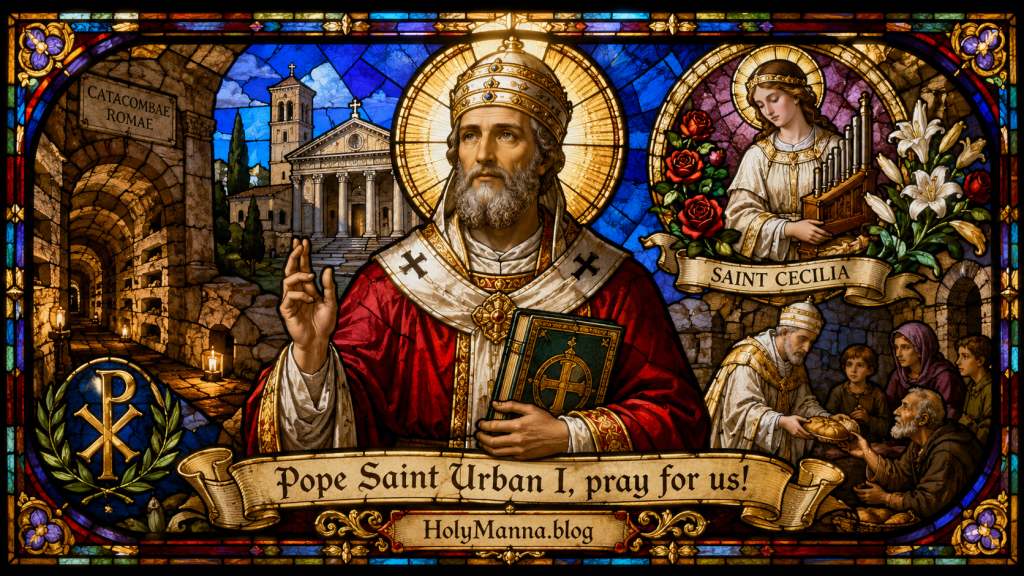
The Hidden Shepherd of Rome
Pope Saint Urban I is one of those early saints whose life feels almost hidden beneath the dust of ancient Rome. He was real. He was pope. He shepherded the Church during a fragile and important moment. Yet so much of his personal life remains quiet, almost tucked away in the catacombs where the first Christians prayed, buried their dead, and waited for the full dawn of freedom.
Urban I served as Bishop of Rome from about 222 to 230, following Pope Saint Callistus I. He lived during the reign of Emperor Alexander Severus, a time when Christians in Rome experienced unusual peace compared with the harsher persecutions that came before and after. That peace mattered. It allowed the Christian community to grow quietly in Rome, especially around the catacombs, where the memory of the martyrs and the hope of the Resurrection shaped the faith of ordinary believers.
He is most remembered as an early pope who preserved the unity of the Church, as a saint connected by tradition to Saint Cecilia, and as a pope long venerated as a martyr, even though modern Catholic historians are cautious about whether he truly died by martyrdom. His story is not flashy. It is not full of verified writings, famous sermons, or dramatic public acts. Instead, Pope Saint Urban I reminds Catholics that some saints serve the Church faithfully in hiddenness, and heaven remembers what history forgets.
A Roman Son Called to Shepherd the Church
According to ancient tradition, Urban was Roman by birth. The Liber Pontificalis says his father was named Pontianus. Beyond that, very little is known about his childhood, family, education, or early conversion. This is common with many of the earliest popes. They lived close enough to the Apostolic age to inherit its fire, but not close enough to later centuries to leave behind the kind of records Catholics might wish they had.
What can be said is that Urban became pope after the death of Pope Saint Callistus I, whose own pontificate had been marked by controversy, mercy toward repentant sinners, and conflict with the schismatic Hippolytus. Urban inherited that difficult situation. Hippolytus and his followers continued in opposition, and Urban had to guide the Roman Church through division without letting the Church’s identity be swallowed by conflict.
That alone is worth remembering. Urban’s sainthood was not built on noise. It was built on fidelity. He was a guardian of unity at a time when the Church was still young, still vulnerable, and still misunderstood by the empire around her.
The Catechism of the Catholic Church teaches that the Church is the communion of saints, and that the good of each member is shared with the whole Body of Christ. CCC 947 says, “Since all the faithful form one body, the good of each is communicated to the others.” Urban’s life fits this beautifully. Even when his personal story is mostly hidden, his faithful service strengthened the Church that later generations inherited.
The Quiet Growth of the Roman Church
Urban’s pontificate unfolded under Emperor Alexander Severus, who was not Christian but was relatively favorable toward Christians. The Church was still not legally secure in the way it would become after Constantine, but this period gave Christians in Rome some room to breathe.
One famous account from the era says that Christians and tavern-keepers disputed over a piece of land in Rome. Alexander Severus reportedly decided in favor of the Christians, saying it was better that God be worshiped there than that the place be used for drinking. Whether every detail of that story can be pressed historically or not, it reflects the unusual atmosphere of Urban’s time. The Church was still marginal, but she was gaining visibility.
During Urban’s pontificate, the Christian population in Rome seems to have grown. The expansion of the catacombs in the first half of the third century points to a community becoming larger, more organized, and more rooted. These were not merely burial tunnels. They were sacred places of memory, prayer, hope, and identity. The catacombs preached without words that Christians believed death did not have the final say.
Urban’s importance is found in that quiet growth. He shepherded the Church in a season when the seed was spreading under the soil. Others would later see the harvest.
The Legend of Saint Cecilia and the Hidden Pope
The most famous story associated with Pope Saint Urban I is his connection to Saint Cecilia. This story comes from the Acts of Saint Cecilia, a beloved ancient account that deeply shaped Christian imagination, art, music, and devotion. However, Catholic historians treat much of the narrative as legendary rather than strictly historical.
According to the story, Cecilia was a noble Roman Christian virgin who had consecrated herself to Christ. She was given in marriage to a pagan man named Valerian. On their wedding night, Cecilia told Valerian that she belonged to Christ and that an angel guarded her purity. Valerian asked to see this angel, and Cecilia told him to go to the third milestone on the Via Appia, where he would find Bishop Urban hiding among the poor and the persecuted.
Valerian went, found Urban, received instruction, and was baptized. When he returned to Cecilia, the story says he saw an angel crown both Cecilia and himself with roses and lilies. Later, Valerian’s brother Tiburtius also converted, and both brothers were eventually martyred.
It is a beautiful story, but it must be told honestly. The connection between Urban and Saint Cecilia is part of Catholic tradition, but it cannot be verified with certainty. The Acts of Saint Cecilia are generally treated as devotional legend rather than strict biography. Still, like many legends loved by the Church, the story communicates something deeply true: Christ transforms marriages, families, and even pagan Rome itself through hidden grace.
Urban appears in the legend as the quiet priestly figure who receives a searching soul, baptizes him, and sends him back into the world changed. That is a powerful image of the Church’s mission. She does not merely argue people into faith. She receives them, washes them in baptism, and gives them back to the world as witnesses.
A Saint Without Verified Miracles During Life
No verified miracles from Pope Saint Urban I’s lifetime are known. That does not mean no miracles occurred. It simply means the surviving historical record does not preserve any that can be responsibly presented as certain.
This is important because Catholic storytelling should never need exaggeration. Urban’s sanctity does not depend on filling the gaps with invented wonders. His life already speaks through his office, his fidelity, his connection to the early Roman Church, and his long veneration among the faithful.
There are, however, later miracle stories and legends associated with him. These should be received as legends unless clearly supported by stronger historical evidence.
One medieval legend says that after the martyrdom of Saint Cecilia, the Roman official Almachius searched for Urban. Urban was accused of converting many people and of hiding Cecilia’s treasure. In the story, Urban explains that Cecilia’s treasure had gone to heaven through the hands of the poor. He is arrested, beaten, imprisoned, and brought before idols. When Urban prays, the idol collapses and kills pagan priests. Urban and his companions are then beaten again, make the sign of the Cross, exchange the kiss of peace, and are beheaded.
This story cannot be verified. Still, it reveals how Catholic memory understood Urban: as a fearless shepherd, a defender of the poor, and a witness against idolatry. The miracle of the falling idol is not historically secure, but the spiritual meaning is unmistakable. False gods collapse before Christ.
The Poor as the Treasure of the Church
There are no verified authentic writings or sayings from Pope Saint Urban I. No letters, homilies, or decrees survive that can be confidently attributed to him.
There is, however, a traditional saying associated with him that became important in Catholic memory. It teaches that offerings given to God must be used for the Church, the Christian brethren, and the poor, because they are “the offerings of the faithful, the return made for sin, and the patrimony of the poor.”
This saying is attributed to Urban, but it is not historically verified as his own. Even so, it beautifully expresses Catholic teaching. The goods of the Church are not meant for vanity, luxury, or selfishness. They exist for worship, for the support of the Church’s mission, and for the care of those in need.
That phrase, “the patrimony of the poor,” may be the most memorable phrase connected with Urban. It captures the heart of the Gospel. The poor are not an optional side concern for Catholics. They belong close to the altar because Christ Himself identifies with them. In Matthew 25:40, Jesus says, “Amen, I say to you, whatever you did for one of these least brothers of mine, you did for me.”
Urban’s memory challenges the Church in every age to ask whether her treasures are serving Christ or simply decorating human pride.
Hardship, Schism, and the Question of Martyrdom
Urban’s pontificate was not marked by empire-wide persecution, but it was not without hardship. The lingering schism of Hippolytus was a real wound in the Roman Church. Division among Christians is never a small thing. It damages witness, confuses the faithful, and tempts people to place personal judgment above ecclesial communion.
Urban had to lead through that. He had to preserve unity without surrendering truth. That is a deeply Catholic kind of suffering, and one many faithful Catholics can understand even today. Not every hardship comes from outside the Church. Sometimes the deepest wounds come from division within the household of faith.
Urban has long been venerated in tradition as a pope and martyr. Older liturgical sources call him a martyr, and the older Roman Martyrology commemorated him as one who suffered for the faith. However, modern Catholic historians are cautious because the Church enjoyed relative peace under Alexander Severus, and the later accounts of Urban’s martyrdom are not considered historically reliable.
So what should Catholics say? The honest answer is that Urban’s martyrdom is traditional but uncertain. He may have died as a martyr, or he may have died naturally in 230. Either way, the Church venerates him as a saint.
The Catechism of the Catholic Church teaches in CCC 2473, “Martyrdom is the supreme witness given to the truth of the faith.” If Urban died as a martyr, then he gave that supreme witness. If he did not, he still gave the daily witness of pastoral fidelity. Both forms of holiness matter. Some saints die in blood. Others die after years of hidden perseverance. Heaven knows the weight of both.
The Puzzle of His Tomb and the Memory of Rome
Urban died around 230. His burial became one of the more surprising puzzles in early papal history.
The Acts of Saint Cecilia and the Liber Pontificalis say that Urban was buried in the Catacomb of Praetextatus on the Via Appia. Later, an inscription referring to an Urban was found in the Catacomb of Saint Callistus. This led to scholarly debate over whether Pope Urban was buried in one catacomb or the other, or whether there were two holy men named Urban remembered in early Roman devotion.
The most careful Catholic conclusion is that Pope Urban was likely buried in the Catacomb of Praetextatus, while the Urban remembered in the Catacomb of Saint Callistus may have been another bishop of the same name. It is not the sort of neat answer modern readers always want, but it is the honest answer.
There is something fitting about that. Urban’s life was hidden, and even his tomb became partially veiled in uncertainty. Yet the Church remembered him. His name endured. His feast was celebrated. His memory remained attached to the sacred geography of Rome.
Relics, Veneration, and the Church of Saint Cecilia
Urban’s memory became closely tied to the cult of Saint Cecilia. In the ninth century, Pope Paschal I translated relics associated with Saint Cecilia, Valerian, Tiburtius, Maximus, Pope Urban, and Pope Lucius to the church of Saint Cecilia in Trastevere. This act linked Urban even more closely with Cecilia’s story and with one of Rome’s beloved churches.
Relics matter in Catholic life because the body matters. The saints are not ghosts or ideas. They were baptized men and women who loved Christ in real bodies, suffered in real bodies, prayed in real bodies, and will rise in glorified bodies. The veneration of relics points to the Resurrection, not away from it.
Urban’s relic tradition kept his memory alive not through books but through prayer, pilgrimage, and sacred place. Generations of Catholics did not need a full biography to honor him. They knew he belonged to the living memory of the Church.
A Patron in Bucchianico and a Living Cultural Memory
One of the most interesting parts of Urban’s legacy after death is his connection to Bucchianico, a town in Abruzzo, Italy, where he is honored as patron.
A local legend says that during a medieval conflict between Chieti and Bucchianico, Saint Urban appeared in a dream to the town’s military leader and inspired a clever defense. The people of Bucchianico were too few to face their attackers directly, so they dressed in armor and moved repeatedly along the walls and hills to make it look as if a much larger army defended the town. The attackers withdrew.
This story is a local legend and cannot be verified as historical fact. Still, it became part of Bucchianico’s Catholic identity. The town continues to celebrate Saint Urban through the Festa dei Banderesi, an ancient festival that remembers the saint’s protection and the community’s deliverance.
This is a beautiful example of how Catholic devotion works across centuries. A pope from third-century Rome becomes the patron of a medieval Italian town. A saint whose life is mostly hidden becomes a figure of protection, gratitude, and local memory. The communion of saints is not abstract. It becomes songs, processions, feasts, family customs, and prayers whispered by people who still believe heaven is close.
The Confusion with the Other Saint Urban
There is one detail worth clarifying. Some people associate “Saint Urban” with vineyards, winegrowers, gardeners, vintners, and protection against storms or frost. That patronage usually belongs to Saint Urban of Langres, a later bishop, not Pope Saint Urban I.
Because both saints share the name Urban, and because both may be shown in bishop-like vesture, they are sometimes confused. Pope Saint Urban I should be remembered primarily as an early pope of Rome, a guardian of Church unity, a saint connected to the Cecilia tradition, and a figure associated with care for the poor.
The Hidden Holiness That Still Speaks
Pope Saint Urban I is not remembered because he left behind famous books. He is not remembered because we can quote his sermons or trace every detail of his ministry. He is remembered because the Church recognized holiness in him and kept his name alive.
That should comfort ordinary Catholics. Not everyone is called to be famous. Not everyone will leave behind writings, titles, or public achievements. Some are called to be steady. Some are called to keep the faith during confusing times. Some are called to serve the Church when nobody is taking notes.
Urban’s life reminds Catholics that hidden fidelity is still fidelity. He governed the Church during a time of quiet growth. He helped preserve unity. He became part of the devotional memory surrounding Saint Cecilia. He was remembered as one who cared for the poor and guarded the treasures of the Church for holy use.
In a world obsessed with visibility, Urban teaches the dignity of hidden service. In a divided age, he teaches the importance of unity. In a culture tempted to measure everything by wealth, he reminds the Church that the poor are her patrimony.
What hidden work is God asking you to do faithfully, even if no one applauds it?
A Shepherd for Catholics Who Feel Small
There is something very relatable about Pope Saint Urban I. His life does not come to us polished and complete. It comes in fragments. A papal list. A catacomb memory. A legend with Saint Cecilia. A traditional saying about the poor. A debated tomb. A feast day. A local Italian celebration. A saintly name carried through the centuries.
Yet that is often how grace works in ordinary lives too. Most people do not see the full picture while they are living it. They see a duty, a family, a parish, a struggle, a small act of mercy, a temptation to quit, and a chance to remain faithful one more day.
Urban’s story encourages Catholics to trust that God sees the whole picture. The world may miss the meaning of a hidden life, but God does not. The Church may not preserve every detail, but heaven loses nothing.
Engage With Us!
Share your thoughts and reflections in the comments below. Pope Saint Urban I may not be as famous as Saint Peter, Saint Cecilia, or Saint Lawrence, but his hidden fidelity has a lot to teach Catholics today.
- Where is God asking you to be faithful in a hidden or ordinary way?
- How can Pope Saint Urban I’s quiet leadership help you think differently about service in your parish, family, or workplace?
- What does the phrase “the patrimony of the poor” challenge you to reconsider about generosity and stewardship?
- When division appears in the Church, your family, or your community, how can you become a person of unity without compromising the truth?
- How does the legend of Saint Cecilia and Valerian remind you that one sincere conversion can change an entire household?
May Pope Saint Urban I pray for the Church today, especially for Catholics who serve quietly, lead patiently, and love the poor sincerely. May his hidden witness encourage every believer to live with faith, perseverance, and humility, doing all things with the love and mercy Jesus taught us.
Pope Saint Urban I, pray for us!
Follow us on YouTube, Instagram and Facebook for more insights and reflections on living a faith-filled life.


Leave a Reply