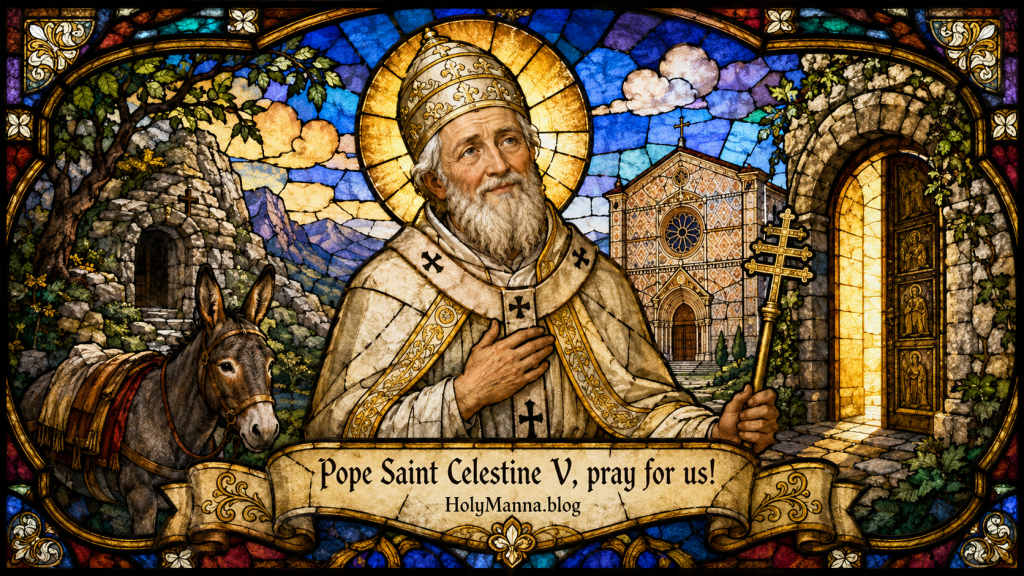
The Hermit Pope Who Laid Down the Tiara
Pope Saint Celestine V is one of the most surprising saints in Catholic history. Before he was pope, he was Pietro del Morrone, a Benedictine hermit who wanted silence, prayer, fasting, and God. He did not spend his life chasing influence. He spent it hiding from the noise of the world in the mountains of Italy.
Then, in one of those strange turns of providence that only makes sense through the eyes of faith, the Church came looking for him.
After more than two years without a pope, the cardinals elected this elderly hermit to the Chair of Saint Peter in 1294. He became Pope Celestine V, served only a few months, and then freely resigned the papacy. That one decision made him famous, but it should not be the only thing remembered about him. He was also a founder of monastic reform, a lover of the poor, a man of penance, and the pope who gave the Church the beautiful gift of the Celestinian Forgiveness.
The Catechism of the Catholic Church teaches that the pope, as successor of Saint Peter, has “full, supreme, and universal power over the whole Church” CCC 882. That makes Celestine’s resignation even more striking. He did not lay down a small responsibility. He laid down one of the heaviest burdens on earth because he believed humility, conscience, and the good of the Church required it.
Celestine V is remembered as the Hermit Pope. He is a saint for anyone who has ever felt overwhelmed by responsibility, trapped by expectations, or called by God into a humility that the world does not understand.
A Poor Child of Molise, Raised for Silence
Pietro Angeleri, later known as Pietro del Morrone, was born in Molise in southern Italy sometime around 1209 to 1215. Catholic tradition describes him as coming from a humble peasant family. Some sources say he was one of twelve children, raised in poverty, simplicity, and faith. His mother, widowed while he was still young, encouraged his religious formation and helped guide him toward the things of God.
As a young man, Pietro entered Benedictine life. Yet even within monastic life, his soul longed for greater solitude. He was not drawn to comfort, reputation, or advancement. He wanted the hidden life. He wanted prayer. He wanted the desert, even if that desert was found in the cold caves and rugged mountains of Abruzzo.
He withdrew first near Monte Morrone and later into the Majella mountains. There, he lived with intense austerity. Catholic tradition says he wore rough penitential clothing, fasted often, kept long periods of prayer, and modeled himself on Saint John the Baptist. His life was not fashionable spirituality. It was hard, hidden, and deeply Catholic. He understood that the soul must sometimes be stripped of noise before it can hear God clearly.
The Catechism reminds the faithful that all Christians are called to holiness, saying, “All Christians in any state or walk of life are called to the fullness of Christian life and to the perfection of charity” CCC 2013. Pietro lived that call with radical seriousness. He did not assume holiness was only for priests, monks, or scholars. He gave his whole life to God and allowed that surrender to shape every hour.
Ironically, the more he tried to hide, the more people came to him. Disciples gathered around him, attracted by his holiness and discipline. In time, his way of life grew into the Celestines, a strict Benedictine congregation. His reform was approved by the Church, and before his death, his movement had spread through many monasteries.
Pietro also cared deeply for the poor and for ordinary laypeople. Tradition says he formed a pious association for lay visitors, encouraging them to pray, avoid sin, love one another, visit the sick, and help the needy. He was so committed to mercy that he was willing to sell precious church objects from his monasteries in order to provide for the poor.
That detail says a lot. Pietro was not a cold ascetic. His fasting did not make him harsh. His silence did not make him indifferent. His prayer opened his heart to mercy.
The Donkey, the Tiara, and the Door of Mercy
When Pope Nicholas IV died in 1292, the Church entered a painful period without a pope. The cardinals were divided by politics, family rivalries, and competing interests. For more than two years, no successor was chosen.
From his mountain solitude, Pietro sent a warning that God’s judgment would come if the cardinals did not act. The message shook them. Eventually, Cardinal Latino Orsini proposed the holy hermit himself. On July 5, 1294, Pietro del Morrone was elected pope.
When messengers found him, he reportedly wept. He did not want the papacy. He did not seek honor. He did not imagine himself suited for the politics of Rome. But after prayer and pressure from those around him, he accepted as an act of obedience.
His entrance into L’Aquila became one of the most memorable scenes in medieval Catholic history. The new pope rode not on a proud warhorse, but on a donkey. The reins were held by King Charles II of Naples and Charles Martel. The image was powerful: an elderly hermit, humble and hesitant, being led into the splendor and danger of papal power.
He was crowned at Santa Maria di Collemaggio in L’Aquila and took the name Celestine V.
One of his most lasting acts as pope was the granting of the Celestinian Forgiveness, known as the Perdonanza Celestiniana. By the bull Inter sanctorum solemnia, he granted a plenary indulgence to the faithful who were truly repentant, confessed, and visited the Basilica of Santa Maria di Collemaggio during the appointed time around the anniversary of his coronation.
The Catechism explains that an indulgence is “a remission before God of the temporal punishment due to sins whose guilt has already been forgiven” CCC 1471. In other words, indulgences are not a loophole around repentance. They are not permission to sin. They are a gift of mercy flowing from Christ through the ministry of the Church.
Celestine’s indulgence was especially beautiful because it was open to ordinary people, including the poor. Long before the first universal Jubilee of 1300, Celestine opened a door of mercy in L’Aquila. The annual celebration of the Celestinian Forgiveness continues to this day, with the opening of the Holy Door at Santa Maria di Collemaggio.
That may be one of the most important things to remember about him. The pope who seemed politically weak gave the Church a powerful witness to mercy.
A Saintly Pope Who Knew His Limits
Celestine V was holy, but holiness does not automatically make someone a skilled administrator. Catholic sources are honest about this. His short pontificate was troubled. He was elderly, inexperienced in papal government, unfamiliar with the machinery of the Roman Curia, and vulnerable to political pressure, especially from King Charles II of Naples.
He made questionable appointments. He granted favors too freely. Some sources say he even gave the same office or benefice to more than one person. He created twelve cardinals, many connected to French or Angevin influence. He moved the papal court to Naples, which placed him even more under the shadow of royal politics.
Inside all of this, Celestine longed for his cell. He reportedly had a simple monastic room built for himself, even while living near the royal court. The poor hermit had become pope, but his soul still belonged to silence.
Eventually, he became convinced that remaining pope would harm both himself and the Church. The question was serious: could a pope resign? Since the pope has no earthly superior, who would receive such a resignation?
After consultation, especially with Cardinal Benedetto Gaetani, the future Pope Boniface VIII, Celestine concluded that a pope could freely resign. He issued a decree affirming this possibility and then, on December 13, 1294, he laid down the papal office.
His resignation included the famous Latin phrase, “sponte, ac libere cedo Papatui”, which means, “I freely and willingly renounce the papacy.”
That was not weakness in the spiritual sense. That was humility. Celestine knew the papacy was sacred. He also knew he was not able to govern it well. In a world that often confuses humility with failure, Celestine’s resignation remains a stunning act of conscience.
Modern canon law still reflects the principle clarified by his act: a pope may resign if the resignation is made freely and properly manifested.
The Prisoner Who Still Belonged to God
After Celestine resigned, Cardinal Benedetto Gaetani was elected Pope Boniface VIII. Boniface feared that political factions might use the former pope to create division or even claim Celestine was still the true pope. Because of that danger, Celestine was placed under custody.
The old hermit tried to return to solitude. He fled for a time and attempted to cross the Adriatic, possibly hoping to find a place where he could live quietly again. A storm drove him back, and he was captured. He was eventually confined in the castle of Fumone near Anagni.
Celestine died there on May 19, 1296.
Some later accusations claimed Boniface VIII had him murdered, but Catholic sources caution against accepting that charge. There is no solid proof that Celestine was killed. What seems more likely is that the elderly saint, weakened by age, hardship, confinement, fasting, and sorrow, died after months of imprisonment.
His final suffering was not martyrdom in the strict sense, since he was not executed for refusing to deny the faith. Still, it was a real participation in the Cross. He had given up the papacy, but he did not escape suffering. He had chosen humility, but humility led him into confinement. He had wanted silence, and in the end, silence came through a prison cell.
The Catechism teaches that the saints show forth the holiness of Christ and strengthen the whole Church by their example CCC 828. Celestine’s final months remind the faithful that holiness does not mean life becomes easy. Sometimes holiness means being misunderstood, limited, and hidden, while still belonging entirely to God.
Miracles, Relics, and the Saint Who Would Not Be Forgotten
Celestine V was canonized by Pope Clement V in 1313, only seventeen years after his death. His feast day is celebrated on May 19. He is venerated as a saint of humility, monastic reform, mercy, and holy detachment.
Catholic tradition remembers him as a miracle worker both during life and after death. His canonization process gathered many testimonies. Some accounts attribute dozens of miracles to him, with a smaller number officially accepted during the process.
During his life, stories were told of healings through his prayers, blessings, and sacramentals. One account tells of a child named Bartolomeo, believed incurable by physicians, who was healed after Pietro made the sign of the cross over him. Another story tells of a blind woman who received her sight after being given a wooden cross sent by Pietro. Other traditions speak of a mentally ill man healed after eating blessed bread from him, a feverish woman healed through a linen cloth he had sent, and a girl’s diseased foot healed after he made the sign of the cross over it.
These miracle stories belong to the Catholic tradition surrounding his canonization, though the exact historical details of each individual case cannot always be verified with modern methods.
One legend connected to his death says that, shortly before he died, a golden cross appeared suspended in the air. This story is part of the devotional tradition surrounding Celestine, but it cannot be verified.
After his death, his relics became a major focus of devotion. His body was eventually brought to the Basilica of Santa Maria di Collemaggio in L’Aquila, the same basilica where he had been crowned pope and where the Celestinian Forgiveness is still celebrated.
A famous story connected to the Perdonanza tells of a skeptical notary from Roccamorice who mocked the indulgence. According to the legend, he said its power was no more likely than a stick lodging itself in stone. Then the stick reportedly embedded in the stone, and the notary repented and traveled to L’Aquila carrying the stone as testimony. This is a legend and cannot be verified, but it shows how deeply the people associated Celestine with mercy and conversion.
His relics have had a dramatic history. In 1988, his body was stolen and later recovered near Amatrice. The thieves were never conclusively identified. In 2009, after the devastating earthquake in L’Aquila, the basilica was badly damaged, and his reliquary was buried in rubble before being recovered.
The annual Perdonanza Celestiniana remains his greatest cultural legacy. It includes prayer, pilgrimage, civic procession, the opening of the Holy Door, and a public remembrance of Celestine’s gift of mercy. It has become both a religious and cultural treasure for L’Aquila and for the wider Church.
The Great Refusal or the Great Yes?
One of the most famous literary controversies surrounding Celestine V comes from Dante’s Divine Comedy. In Inferno, Dante mentions the soul of the one who made “the great refusal.” Many commentators have identified this figure with Celestine V, interpreting his resignation as cowardice.
The Church’s memory of Celestine is much more generous.
Pope Francis, visiting L’Aquila in 2022, pushed back against the idea that Celestine was simply the man of the great refusal. He said Celestine was not a man who said no, but a man who said yes. His yes was not to worldly power, but to humility. His yes was not to political ambition, but to God’s mercy.
That is the better Catholic reading of his life. Celestine did not reject the Church. He loved the Church enough to admit that he could not govern her well. He did not despise the papacy. He revered it enough to step aside when he believed he was harming it.
There is something deeply freeing about that.
The modern world tells people to cling to status, pretend competence, and never admit weakness. Saint Celestine V teaches something different. He teaches that humility is not self-hatred. Humility is truth. It is knowing who God is, knowing who we are, and choosing obedience over ego.
The Lesson of the Hermit Pope
Saint Celestine V’s life is not easy to categorize. He was not a great reforming pope in the usual administrative sense. He did not reign long enough to reshape Europe. He did not win battles, build empires, or master the politics of his age.
But he did something more important. He showed that sanctity can survive humiliation. He showed that a Christian can be holy without being impressive in the eyes of the world. He showed that mercy matters more than control.
His life also teaches the danger of noise. Pietro became holy in silence before he ever became famous. He learned to hear God in solitude before the Church called him to public responsibility. In an age of constant notifications, endless opinions, and spiritual distraction, Celestine’s witness feels strangely modern.
What if the soul is not weak because it needs silence, but wounded because it never receives it?
Celestine also speaks to anyone carrying a burden that feels too heavy. Sometimes God asks perseverance. Sometimes God asks surrender. The key is humility, prayer, counsel, and obedience to truth.
The lesson is not that people should abandon difficult duties whenever they become uncomfortable. The Cross is not optional. But Celestine reminds the faithful that there is a difference between carrying the Cross and clinging to a role out of pride. His resignation was not laziness. It was discernment before God.
A practical way to honor Saint Celestine V is to make room for silence each day, even if only for ten minutes. Put down the phone. Pray slowly. Examine the conscience honestly. Ask God where pride is pretending to be responsibility. Visit the sick. Help the poor. Go to Confession. Receive mercy, then give mercy.
That is the path of Celestine: silence, humility, repentance, and trust.
Engage With Us!
Share your thoughts and reflections in the comments below. Saint Celestine V’s life raises questions that are surprisingly relevant today, especially for anyone trying to follow Christ in a culture obsessed with achievement, image, and control.
- Where in your life might God be inviting you to choose humility over appearance?
- Do you make enough room for silence, prayer, and honest discernment before making important decisions?
- Have you ever mistaken worldly success for faithfulness to God?
- What burden are you carrying right now that needs to be brought honestly before Christ?
- How can Saint Celestine V’s witness help you seek mercy more deeply through Confession, prayer, and trust in the Church?
Saint Celestine V reminds the Church that the greatest saints are not always the most powerful, polished, or successful. Sometimes they are the ones hidden in caves, misunderstood by history, and quietly faithful to God when the world does not know what to do with them.
May his witness help every Catholic seek Christ with humility, receive mercy with gratitude, and live each day with the love and mercy Jesus taught us.
Pope Saint Celestine V, pray for us!
Follow us on YouTube, Instagram and Facebook for more insights and reflections on living a faith-filled life.

 Holy Manna!
Leave a comment