Tuesday of the Seventh Week of Easter – Lectionary: 298
When Love Finishes the Mission
There is a sacred kind of courage that appears when a soul stops asking, “What will this cost me?” and begins asking, “Lord, how can this life glorify You?”
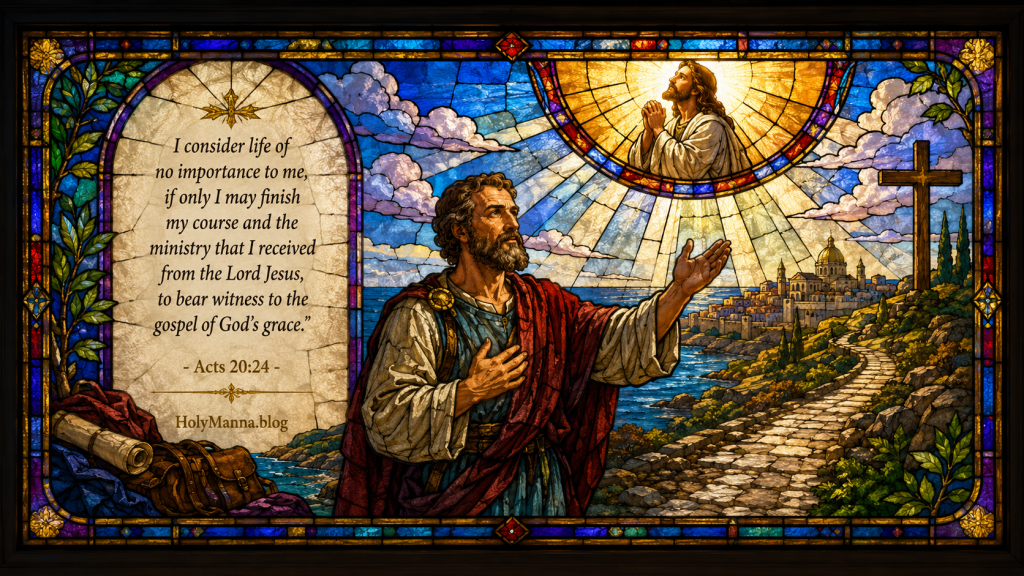
Today’s readings gather around one central theme: the mission of Christ continues through a Church kept by the Father, sent by the Son, and strengthened by the Holy Spirit. In Acts 20:17-27, Saint Paul stands before the presbyters of Ephesus like a spiritual father saying goodbye to his sons. He knows suffering is waiting for him in Jerusalem, yet he does not cling to safety. His only desire is to finish the work entrusted to him, saying, “I consider life of no importance to me, if only I may finish my course.” Acts 20:24
The psalm gives the reason Paul can speak with such freedom. God is not distant from His weary servants. He is the One who restores His weakened inheritance, provides for the poor, and carries His people day by day. “Blessed be the Lord day by day, God, our salvation, who carries us.” Psalm 68:20 The mission may be heavy, but the faithful are never asked to carry it alone.
Then the Gospel lifts the whole scene into the prayer of Jesus. In John 17:1-11, Christ raises His eyes to the Father on the eve of His Passion. Catholic tradition calls this His priestly prayer, and The Catechism of the Catholic Church teaches that this prayer is inseparable from His sacrifice and is truly “the prayer of unity.” CCC 2747-2751 Before the Apostles are sent, before Paul preaches, before the Church suffers, Jesus prays: “Holy Father, keep them in your name… so that they may be one just as we are.” John 17:11
Historically, these readings place the Church in that holy space between Ascension and Pentecost, when the disciples are learning that Christ’s visible departure is not abandonment. The Lord returns to the Father, but His mission remains alive in His Body, the Church. Paul’s farewell at Miletus shows what apostolic leadership looks like after Easter: humble service, tears, trials, truthful preaching, and total surrender to the Holy Spirit. Jesus’ prayer shows where that courage begins: not in human strength, but in communion with the Father.
Today, the Church is invited to see discipleship as a received mission, not a self-made project. Jesus accomplishes the work the Father gave Him. Paul seeks to finish the ministry he received from Jesus. The psalm reminds every tired Christian that God carries His people through the journey. What course has the Lord placed before this soul, and what would it mean to finish it with love?
First Reading – Acts 20:17-27
A Father’s Farewell and the Courage to Finish the Course
Saint Paul’s farewell to the presbyters of Ephesus feels like one of those rare moments when a man knows his words may be remembered long after his face is gone. He is in Miletus, a coastal city, and he summons the leaders of the Church in Ephesus to meet him there. These men are not casual acquaintances. They are shepherds of a Christian community Paul loved, taught, corrected, and served with tears.
This reading takes place near the end of Paul’s missionary journeys, as he is traveling toward Jerusalem. He does not know every detail of what awaits him, but the Holy Spirit has made one thing clear: suffering is coming. Paul’s response is not fear, self-pity, or negotiation. His response is surrender. He wants only to finish the mission entrusted to him by the Lord Jesus.
This fits beautifully into today’s central theme. In the Gospel, Jesus prays to the Father because His hour has come. In this first reading, Paul walks into his own hour of sacrifice because he belongs to Christ. Jesus glorifies the Father by accomplishing the work given to Him. Paul glorifies Christ by finishing the ministry he received from Him.
Acts 20:17-27 – New American Bible (Revised Edition)
Paul’s Farewell Speech at Miletus. 17 From Miletus he had the presbyters of the church at Ephesus summoned. 18 When they came to him, he addressed them, “You know how I lived among you the whole time from the day I first came to the province of Asia. 19 I served the Lord with all humility and with the tears and trials that came to me because of the plots of the Jews, 20 and I did not at all shrink from telling you what was for your benefit, or from teaching you in public or in your homes. 21 I earnestly bore witness for both Jews and Greeks to repentance before God and to faith in our Lord Jesus. 22 But now, compelled by the Spirit, I am going to Jerusalem. What will happen to me there I do not know, 23 except that in one city after another the holy Spirit has been warning me that imprisonment and hardships await me. 24 Yet I consider life of no importance to me, if only I may finish my course and the ministry that I received from the Lord Jesus, to bear witness to the gospel of God’s grace.
25 “But now I know that none of you to whom I preached the kingdom during my travels will ever see my face again. 26 And so I solemnly declare to you this day that I am not responsible for the blood of any of you, 27 for I did not shrink from proclaiming to you the entire plan of God.
Detailed Exegesis
Verse 17 – “From Miletus he had the presbyters of the church at Ephesus summoned.”
Paul does not return directly to Ephesus, likely because he is trying to continue his journey without delay, but he still makes time for the shepherds of that Church. The word “presbyters” refers to ordained elders, those entrusted with leadership and pastoral care. Catholic tradition sees in these men an early form of ordained ministry in the apostolic Church. Paul is not merely gathering friends. He is addressing men responsible for souls.
This matters because the Church is never presented in Scripture as a loose spiritual club. From the beginning, the apostolic communities had structure, teaching authority, and shepherds. Paul’s farewell is personal, but it is also ecclesial. He is speaking to leaders who must continue guarding the flock after his departure.
Verse 18 – “When they came to him, he addressed them, ‘You know how I lived among you the whole time from the day I first came to the province of Asia.’”
Paul begins with his life before he explains his doctrine. He can point to his conduct because his teaching and his witness were united. This is powerful because Christian credibility depends not only on what is said, but on whether the speaker’s life has been shaped by the truth being proclaimed.
The Church has always understood that witness matters. The Gospel is not an idea to admire from a distance. It is a life to be lived. Paul is saying, in effect, “You saw the Gospel in my daily conduct.” His life became a living homily.
Verse 19 – “I served the Lord with all humility and with the tears and trials that came to me because of the plots of the Jews.”
Paul describes ministry with three words that still matter: humility, tears, and trials. He does not present apostolic life as glamorous. He presents it as service. He served the Lord, not his ego, not his reputation, and not a movement built around his personality.
His tears show that true Catholic courage is not emotional coldness. Paul suffers. He grieves. He loves deeply. Yet he does not quit. His trials came partly from opposition, but he does not use persecution as an excuse to stop preaching. The mission of Christ is carried forward through wounded people who remain faithful.
Verse 20 – “And I did not at all shrink from telling you what was for your benefit, or from teaching you in public or in your homes.”
Paul did not shrink from the truth. That line cuts straight into modern Christian life. It is tempting to speak only the parts of the faith that are easy, popular, or emotionally safe. Paul refused to do that.
He taught publicly and in homes, which shows the fullness of apostolic ministry. The Gospel belongs in the assembly, but it also belongs at the dinner table, in family life, in friendship, in ordinary conversation, and in the hidden places where souls are formed. Paul’s preaching was not occasional content. It was a whole way of life.
Verse 21 – “I earnestly bore witness for both Jews and Greeks to repentance before God and to faith in our Lord Jesus.”
Paul summarizes the Gospel with beautiful simplicity: repentance before God and faith in Jesus Christ. He preached to Jews and Greeks, which means his message crossed religious, ethnic, and cultural boundaries. The Gospel is universal, but it is not vague. It calls every person to conversion.
Repentance is not merely feeling bad. It is a turning of the heart back to God. Faith is not merely agreeing that Jesus exists. It is entrusting oneself to Him as Lord. Paul’s preaching had both elements because Catholic discipleship has both elements: turning away from sin and turning toward Christ.
Verse 22 – “But now, compelled by the Spirit, I am going to Jerusalem. What will happen to me there I do not know.”
Paul is “compelled by the Spirit.” This does not mean he is forced against his will. It means his will has been surrendered to God’s will. He is moving toward Jerusalem because obedience has become more important than comfort.
There is also something deeply human here. Paul admits he does not know what will happen. Saints do not always receive a detailed map. Often, they receive only enough light for the next faithful step. Paul’s courage is not based on knowing the future. It is based on trusting the One who leads him.
Verse 23 – “Except that in one city after another the holy Spirit has been warning me that imprisonment and hardships await me.”
The Holy Spirit does not promise Paul an easy road. He warns him that prison and hardship are ahead. This is one of the great corrections to a shallow idea of Christian life. The Spirit’s guidance is not always toward immediate safety. Sometimes the Spirit leads a disciple straight into sacrifice.
This does not mean suffering is good in itself. It means suffering can become holy when endured in union with Christ. Paul’s road to Jerusalem mirrors the pattern of Jesus, who also went toward suffering in obedience to the Father.
Verse 24 – “Yet I consider life of no importance to me, if only I may finish my course and the ministry that I received from the Lord Jesus, to bear witness to the gospel of God’s grace.”
This is the heart of the reading. Paul does not despise life. He understands its purpose. Life is not meant to be hoarded. It is meant to be offered.
His “course” is the race of discipleship. His “ministry” is not self-appointed. It was received from the Lord Jesus. That is crucial. Paul is not chasing personal ambition. He is stewarding a gift. His task is to bear witness to grace, not to build a platform around himself.
This verse asks every Christian a serious question: What course has Christ given this soul to finish?
Verse 25 – “But now I know that none of you to whom I preached the kingdom during my travels will ever see my face again.”
Paul’s words become tender and final. He knows this is goodbye. The emotional weight is real because Christian love is real. The Church is not an abstraction. It is made of faces, names, homes, meals, prayers, tears, and memories.
He reminds them that he preached the kingdom. Paul’s mission was not merely moral advice or religious inspiration. He proclaimed the reign of God in Jesus Christ. The kingdom had entered history through the death and Resurrection of the Lord, and now Paul had spent his life announcing it.
Verse 26 – “And so I solemnly declare to you this day that I am not responsible for the blood of any of you.”
This line sounds intense because it is. Paul is using the language of prophetic responsibility. In the Old Testament, the watchman was accountable if he failed to warn the people. Paul is saying that he has fulfilled his duty. He has not hidden the truth needed for salvation.
This should sober anyone entrusted with teaching the faith. Parents, priests, catechists, godparents, teachers, and sponsors cannot treat truth as optional. Souls matter. Silence can sometimes look polite, but it can also become cowardice when love requires witness.
Verse 27 – “For I did not shrink from proclaiming to you the entire plan of God.”
Paul ends this portion by repeating the point. He did not shrink. He proclaimed the entire plan of God.
The phrase “entire plan of God” is beautiful because Catholic faith is not a collection of disconnected opinions. It is a divine plan of creation, covenant, prophecy, Incarnation, Cross, Resurrection, Church, sacraments, holiness, judgment, and eternal life. Paul did not reduce the Gospel to what was easy to accept. He handed on what he had received.
The Church today is called to the same courage. Not harshness. Not arrogance. Not fear. Courage.
Teachings: Apostolic Witness, Holy Orders, and the Whole Counsel of God
This reading reveals the heart of apostolic ministry. Paul teaches the truth, forms shepherds, suffers for Christ, and entrusts the Church to ordained leaders who must continue the mission after him. The Catholic faith recognizes this pattern as part of the living structure of the Church. Christ sends the Apostles. The Apostles appoint successors and co-workers. The Gospel is handed on faithfully through the Church.
The Catechism of the Catholic Church teaches, “The whole Church is apostolic, in that she remains, through the successors of St. Peter and the other apostles, in communion of faith and life with her origin: and in that she is ‘sent out’ into the whole world. All members of the Church share in this mission, though in various ways.” CCC 863
That quote helps explain why Paul’s farewell matters. He is not only speaking as an individual missionary. He is acting as an apostle within the living mission of the Church. The presbyters of Ephesus are being reminded that the faith must be preserved, preached, and lived.
The Catechism also teaches, “The disciple of Christ must not only keep the faith and live on it, but also profess it, confidently bear witness to it, and spread it: ‘All however must be prepared to confess Christ before men and to follow him along the way of the Cross, amidst the persecutions which the Church never lacks.’ Service of and witness to the faith are necessary for salvation: ‘So every one who acknowledges me before men, I also will acknowledge before my Father who is in heaven; but whoever denies me before men, I also will deny before my Father who is in heaven.’” CCC 1816
That is Paul’s life in one paragraph. He keeps the faith, lives it, professes it, bears witness to it, and follows Christ along the way of the Cross.
Saint John Chrysostom, reflecting on Paul’s farewell, admired the apostle’s humility because Paul did not present ministry as domination, but as service. He wrote, “See how he begins with humility: ‘You know,’ he says, ‘from the first day that I came into Asia, after what manner I have been with you at all seasons.’” Homilies on the Acts of the Apostles, Homily 44
Chrysostom’s point is simple and searching. Paul’s authority was credible because it was humble. He had no need to pretend. His life was visible. His sacrifices were known. His tears were real. His teaching had weight because he had suffered for it.
This reading also connects to the Catholic understanding of conscience and responsibility. Paul says he is not responsible for their blood because he did not withhold the truth. In The Book of Ezekiel, God warns the prophet that if he fails to speak, he will be responsible for the death of the wicked. That prophetic background helps explain Paul’s solemn words. He sees preaching as a matter of eternal consequence.
The Catholic Church does not believe truth should be weaponized, but neither does she believe truth should be hidden. Charity and truth belong together. A Church that speaks truth without charity becomes harsh. A Church that speaks charity without truth becomes sentimental. Paul shows the apostolic way: humility, tears, courage, and the full Gospel.
Reflection: Finishing the Course Without Shrinking Back
This reading is a mirror for every Christian who has ever wanted to soften the faith in order to avoid discomfort. Paul’s words are not only for clergy, although they certainly speak powerfully to priests and bishops. They are also for parents trying to raise children in the faith, young adults trying to stay Catholic in a skeptical culture, catechists explaining unpopular teachings, and ordinary believers trying to live with integrity at work, online, and at home.
Paul does not ask, “How can this be easier?” He asks how he can finish the ministry received from Jesus. That shift changes everything. A disciple is not called to build a comfortable life and fit Jesus into the leftover spaces. A disciple is called to receive life as a mission.
There are simple ways to live this reading. Speak the truth with charity when silence would be easier. Pray before difficult conversations instead of avoiding them. Treat Catholic teaching as a gift to be understood, not an obstacle to be minimized. Ask the Holy Spirit for courage, especially when obedience brings uncertainty. Serve the people God has placed nearby, not only in public ways, but also “in homes,” in the ordinary hidden places where love becomes real.
Paul’s farewell also reminds believers to examine whether their lives make the Gospel visible. His credibility came from consistency. The people of Ephesus knew how he lived. That is both inspiring and uncomfortable.
If the people closest to this soul judged the Gospel by its daily conduct, what would they learn about Christ?
What truth has become tempting to avoid because it might cost popularity, comfort, or approval?
Where is the Holy Spirit asking for obedience before all the details are clear?
What course has the Lord Jesus entrusted to this life, and what would it look like to finish it faithfully?
Saint Paul shows that Christian maturity is not measured by how much suffering a person avoids, but by how faithfully a person loves through it. He walks toward Jerusalem with open hands, a steady heart, and a conscience at peace. He has preached Christ. He has served with tears. He has not shrunk back.
That is the shape of apostolic courage. That is the path of a life poured out for grace.
Responsorial Psalm – Psalm 68:10-11, 20-21, 33
The God Who Carries His Tired People
The responsorial psalm answers the ache beneath Saint Paul’s farewell. Paul is walking toward Jerusalem knowing imprisonment and hardship are waiting for him, but Psalm 68 reminds the Church that God never sends His servants without also sustaining them. The mission may be heavy, but the Lord is heavier with mercy. He carries what His people cannot carry alone.
Historically, Psalm 68 is a great hymn of victory and procession. It celebrates the God of Israel as the One who rises up, scatters His enemies, provides for the poor, leads His people, and reigns over all nations. It echoes the memory of the Exodus, the wilderness journey, the gift of the promised land, and God’s presence among His people. In Catholic prayer, this psalm becomes even richer because the Church hears it in light of Christ, who conquers sin and death, ascends to the Father, and pours out the Holy Spirit upon His people.
That is why this psalm fits today’s theme so beautifully. Jesus prays that His disciples may be kept in the Father’s name. Paul shows what it looks like to continue the mission with courage. The psalm reveals the hidden strength behind both: God is the Savior who repairs the weak, provides for the poor, and carries His people day by day.
Psalm 68:10-11, 20-21, 33 – New American Bible (Revised Edition)
10 You poured abundant rains, God,
your inheritance was weak and you repaired it.
11 Your creatures dwelt in it;
you will establish it in your goodness for the poor, O God.20 Blessed be the Lord day by day,
God, our salvation, who carries us.
Selah
21 Our God is a God who saves;
escape from death is the Lord God’s.33 You kingdoms of the earth, sing to God;
chant the praises of the Lord,
Selah
Detailed Exegesis
Verse 10 – “You poured abundant rains, God, your inheritance was weak and you repaired it.”
This verse begins with the image of rain, which in the world of Scripture is never just weather. Rain means blessing, fertility, renewal, and divine care. Israel knew what it meant to depend on the heavens. A land without rain became fragile. A people without God became even more fragile.
The phrase “your inheritance” points to Israel, the people God chose and formed for Himself. Yet the psalm does not pretend that God’s inheritance is always strong. It says the inheritance was weak. That is an honest spiritual truth. God’s people grow tired. The Church grows weary. Families become strained. Disciples become afraid. Even apostles like Paul shed tears.
But God does not abandon His weakened inheritance. He repairs it. This is a beautiful word for grace. Grace does not merely admire the strong. Grace restores the weak.
Verse 11 – “Your creatures dwelt in it; you will establish it in your goodness for the poor, O God.”
God’s goodness makes room for the vulnerable. The land becomes a dwelling place because God establishes it. The poor are not forgotten at the edges of His kingdom. They are remembered in His goodness.
In the Old Testament, care for the poor was never optional. It was woven into Israel’s covenant life because God Himself had rescued Israel when they were helpless. The poor, the widow, the orphan, and the stranger revealed whether Israel truly understood the heart of God.
In today’s context, this verse deepens Paul’s mission. Paul is not preaching an abstract Gospel. He is announcing the kingdom of the God who makes a home for the weak and provides for the poor. The Church continues that same mission whenever she preaches Christ, feeds the hungry, shelters the vulnerable, comforts the sorrowing, and defends the dignity of every human person.
Verse 20 – “Blessed be the Lord day by day, God, our salvation, who carries us.”
This is the heart of the psalm for today. God does not only rescue once and then step back. He carries His people “day by day.” His saving care is steady, patient, and personal.
That phrase is especially moving beside Paul’s words in Acts 20. Paul can walk toward hardship because he is not walking alone. He can carry the Gospel because God carries him. He can finish his course because divine grace sustains human weakness.
Catholic faith is not built on the fantasy that believers are naturally strong. It is built on the truth that God is faithful. The Christian life is daily. So is God’s mercy.
Verse 21 – “Our God is a God who saves; escape from death is the Lord God’s.”
The psalm now moves from daily help to ultimate deliverance. God saves. God alone holds the escape from death.
For ancient Israel, this expressed trust in the Lord’s power over enemies, danger, exile, and destruction. For Christians, the words reach their full meaning in Jesus Christ. The Father raises the Son from the dead, and through the Son, death no longer has the final word.
This verse prepares the heart for the Gospel. Jesus prays to the Father on the eve of His Passion, but He does not pray as a victim trapped by death. He prays as the Son who will pass through death into glory. The God who saves will reveal His saving power most fully through the Cross and Resurrection.
Verse 33 – “You kingdoms of the earth, sing to God; chant the praises of the Lord.”
The psalm ends by widening the horizon. The praise of God is not meant to remain locked within one nation. All kingdoms of the earth are summoned to sing.
This points toward the universal mission of the Church. In Acts 20, Paul says he bore witness to both Jews and Greeks. The Gospel is not tribal. It is Catholic, meaning universal. All nations are invited into the praise of the one true God.
This also connects to Jesus’ prayer in John 17. The disciples are kept in the Father’s name so they may continue Christ’s mission in the world. Their unity is not for private comfort. It is for witness, so the world may come to know the Father through the Son.
Teachings: Praise, Providence, and the Poor Who Belong to God
Psalm 68 teaches that God is not a distant observer of human struggle. He is the God who pours rain, repairs weakness, provides for the poor, carries His people, saves from death, and summons the nations to praise. This is the God Paul trusts as he walks toward suffering. This is the God Jesus reveals as Father.
The Catechism of the Catholic Church speaks beautifully about God’s sustaining care: “With creation, God does not abandon his creatures to themselves. He not only gives them being and existence, but also, and at every moment, upholds and sustains them in being, enables them to act and brings them to their final end. Recognizing this utter dependence with respect to the Creator is a source of wisdom and freedom, of joy and confidence.” CCC 301
That is exactly the spirit of the psalm. God does not simply create and disappear. He upholds. He sustains. He enables. He brings His people to their final end. The tired Christian can bless the Lord “day by day” because God’s providence is not occasional. It is constant.
The psalm also calls the Church to praise. The Catechism teaches, “Praise is the form of prayer which recognizes most immediately that God is God. It lauds God for his own sake and gives him glory, quite beyond what he does, but simply because HE IS. It shares in the blessed happiness of the pure of heart who love God in faith before seeing him in glory.” CCC 2639
That explains the final summons: “You kingdoms of the earth, sing to God.” Psalm 68:33 Praise is not spiritual decoration. It is the proper response of creation to the Creator. It trains the heart to see reality correctly. God is God, and man is not.
This psalm also reveals God’s special care for the poor. The Church has always seen concern for the poor as inseparable from fidelity to God. The Catechism teaches, “God blesses those who come to the aid of the poor and rebukes those who turn away from them: ‘Give to him who begs from you, do not refuse him who would borrow from you’; ‘you received without pay, give without pay.’ It is by what they have done for the poor that Jesus Christ will recognize his chosen ones. When ‘the poor have the good news preached to them,’ it is the sign of Christ’s presence.” CCC 2443
This gives Psalm 68 a sharp edge. God’s goodness “for the poor” is not just a comforting idea. It becomes a mission for the Church. If God provides for the poor, then His people must not ignore them. If God carries the weak, then His people must not crush them. If God repairs His weakened inheritance, then His people must become instruments of repair.
Saint Augustine often read the psalms as the voice of Christ and His Body, the Church. In that Catholic tradition, the praise of Psalm 68 is not only ancient Israel singing after deliverance. It is also the Church singing in Christ, carried through history by the God who saves.
That is why the psalm belongs in Eastertide. Christ has conquered death. The Church is preparing for Pentecost. The mission is moving outward to the nations. Yet before the Church speaks, she sings. Before she carries the Gospel, she remembers that God carries her.
Reflection: Letting God Carry What Has Become Too Heavy
There are seasons when the soul becomes tired in a way coffee cannot fix. A person can keep showing up, keep answering emails, keep serving family, keep attending Mass, keep smiling in public, and still feel weak inside. Psalm 68 speaks directly into that place.
God does not shame His weakened inheritance. He repairs it.
That truth should settle deeply into the heart. Weakness is not the end of discipleship. Sometimes it is the place where trust becomes real. Paul was not strong because he avoided tears. He was strong because he served through them. The psalm reveals why: the Lord carried him day by day.
A practical way to live this psalm is to begin the day by letting God be God. Before grabbing the phone, before checking messages, before mentally rehearsing anxieties, the Christian can pray simply: “Lord, carry today.” That is not laziness. That is faith. Then the day can be lived with ordinary responsibility, but without the illusion that everything depends on human strength.
This psalm also invites gratitude. The line “Blessed be the Lord day by day” Psalm 68:20 teaches the soul to notice daily mercy. Not every grace feels dramatic. Some graces are quiet: enough patience for one more conversation, enough courage to apologize, enough clarity to make a hard decision, enough strength to resist a familiar sin, enough humility to ask for help.
The psalm also calls for concrete charity. If God establishes His goodness for the poor, then the disciple should ask where the poor are nearby. They may be materially poor, lonely, elderly, grieving, spiritually confused, or quietly ashamed. God’s people are called to become visible signs of His care.
What burden is being carried as if God were not already carrying this soul?
Where has weakness become a reason for shame instead of an invitation to receive grace?
Who nearby needs to experience the goodness of God through a concrete act of patience, generosity, or mercy?
Does daily prayer sound more like praise, or only like panic?
The psalm teaches that praise is not denial. Praise is defiance against despair. It is the tired Church looking at the road ahead and saying, with steady faith, “Blessed be the Lord day by day, God, our salvation, who carries us.” Psalm 68:20
Holy Gospel – John 17:1-11
The Prayer That Holds the Church Together
The Gospel brings today’s readings into the hidden center of the Christian life: the prayer of Jesus. After the Last Supper discourse, before the betrayal, arrest, scourging, and Cross, Jesus raises His eyes to the Father and prays. He does not run from His hour. He enters it. He does not gather the Apostles around a strategy session. He gathers them into His communion with the Father.
Catholic tradition calls John 17 the High Priestly Prayer of Jesus. This is the prayer of the Son who is about to offer Himself to the Father for the salvation of the world. He prays for glory, eternal life, the disciples, and unity. In today’s first reading, Saint Paul shows what this prayer looks like when it becomes apostolic mission. Paul is willing to finish his course because Jesus first finished the work given to Him by the Father. In the responsorial psalm, God carries His people day by day. In the Gospel, the Son reveals why the Church can endure: she is held inside the prayer of Christ.
John 17:1-11 – New American Bible (Revised Edition)
The Prayer of Jesus. 1 When Jesus had said this, he raised his eyes to heaven and said, “Father, the hour has come. Give glory to your son, so that your son may glorify you, 2 just as you gave him authority over all people, so that he may give eternal life to all you gave him. 3 Now this is eternal life, that they should know you, the only true God, and the one whom you sent, Jesus Christ. 4 I glorified you on earth by accomplishing the work that you gave me to do. 5 Now glorify me, Father, with you, with the glory that I had with you before the world began.
6 “I revealed your name to those whom you gave me out of the world. They belonged to you, and you gave them to me, and they have kept your word. 7 Now they know that everything you gave me is from you, 8 because the words you gave to me I have given to them, and they accepted them and truly understood that I came from you, and they have believed that you sent me. 9 I pray for them. I do not pray for the world but for the ones you have given me, because they are yours, 10 and everything of mine is yours and everything of yours is mine, and I have been glorified in them. 11 And now I will no longer be in the world, but they are in the world, while I am coming to you. Holy Father, keep them in your name that you have given me, so that they may be one just as we are.
Detailed Exegesis
Verse 1 – “When Jesus had said this, he raised his eyes to heaven and said, ‘Father, the hour has come. Give glory to your son, so that your son may glorify you.’”
Jesus raises His eyes to heaven in the posture of prayer. The “hour” has finally come. Throughout The Gospel of John, the hour points toward the Passion, death, Resurrection, and return of Jesus to the Father. To human eyes, the Cross will look like humiliation. To the eyes of faith, it is the hour when divine love is revealed most completely.
When Jesus asks the Father to glorify the Son, He is not asking for worldly admiration. He is asking that the Father’s saving love be revealed through His obedience. The Son glorifies the Father by giving Himself completely. The Father glorifies the Son by raising Him and revealing Him as Lord.
Verse 2 – “Just as you gave him authority over all people, so that he may give eternal life to all you gave him.”
The Father has given the Son authority over all people. This authority is not domination. It is saving authority. Jesus reigns in order to give life.
The phrase “all you gave him” reveals the mystery of divine love. The disciples belong to the Father, and the Father entrusts them to the Son. Christian life begins not with self-definition, but with belonging. The baptized are not spiritual freelancers. They are given to Christ, redeemed by Christ, and kept in Christ.
Verse 3 – “Now this is eternal life, that they should know you, the only true God, and the one whom you sent, Jesus Christ.”
Jesus defines eternal life as knowing the Father and the Son. This does not mean knowing facts about God in a distant way. It means communion. It means the living relationship of faith, love, worship, obedience, and grace.
Eternal life begins now because the Christian already begins to know God through Jesus Christ. Heaven is the fullness of that communion. This is why the Catholic life is not simply about rule-following. It is about becoming united to God through Christ in the Holy Spirit.
Verse 4 – “I glorified you on earth by accomplishing the work that you gave me to do.”
Jesus glorifies the Father by accomplishing the work entrusted to Him. His mission is not improvised. It is received from the Father and fulfilled in perfect obedience.
This verse connects directly with Saint Paul in Acts 20:24, where Paul wants only to finish the course and ministry he received from the Lord Jesus. The pattern is clear. The Son receives His work from the Father. The Apostle receives his ministry from the Son. Every Christian receives a vocation from God and is called to complete it with love.
Verse 5 – “Now glorify me, Father, with you, with the glory that I had with you before the world began.”
Jesus reveals His divine identity. Before the world began, the Son shared glory with the Father. This verse points to the eternal preexistence of Christ. He is not merely a holy teacher sent by God. He is the eternal Son, consubstantial with the Father.
Catholic faith confesses this every Sunday in the Creed: “God from God, Light from Light, true God from true God.” The prayer of Jesus is therefore not the prayer of a creature trying to reach upward. It is the eternal Son speaking to the eternal Father in the communion of divine love.
Verse 6 – “I revealed your name to those whom you gave me out of the world. They belonged to you, and you gave them to me, and they have kept your word.”
In biblical thought, the “name” of God means more than a label. It reveals God’s identity, presence, authority, and covenant love. Jesus reveals the Father’s name because He reveals the Father Himself.
The disciples belonged to the Father and were given to the Son. Their faith is described as keeping the word. This does not mean they understood everything perfectly. The Apostles still had weakness, fear, and confusion ahead. Yet they had received the word of Christ and remained with Him.
Verse 7 – “Now they know that everything you gave me is from you.”
The disciples are beginning to understand that Jesus’ teaching, authority, works, and mission all come from the Father. This knowledge is still growing, but it is real.
Faith often matures this way. A disciple may not see the whole picture at once, but grace gives enough light to recognize that Jesus is from the Father. The Christian life grows as the soul learns to trust that everything Christ gives is from God and leads back to God.
Verse 8 – “Because the words you gave to me I have given to them, and they accepted them and truly understood that I came from you, and they have believed that you sent me.”
Jesus gives the disciples the words of the Father. They accept, understand, and believe. This is the movement of faith. God speaks first. The disciple receives. Understanding deepens. Faith becomes personal.
This verse also reveals the apostolic foundation of the Church. The Apostles receive the words of Christ, and through them, the Church receives the apostolic faith. Catholic tradition is not a later invention added onto Jesus. It is the living handing on of what Christ gave to the Apostles.
Verse 9 – “I pray for them. I do not pray for the world but for the ones you have given me, because they are yours.”
Jesus prays specifically for His disciples. This does not mean He lacks love for the world. He came to save the world. Here, however, He is praying in a particular way for those who will carry His mission into the world.
This should deeply comfort every Catholic heart. Before the Apostles preach, suffer, fail, repent, and lead, Jesus prays for them. The Church is not sustained first by human competence. She is sustained by Christ’s intercession.
Verse 10 – “And everything of mine is yours and everything of yours is mine, and I have been glorified in them.”
Jesus speaks with a unity that only the Son can claim. Everything that belongs to the Father belongs to the Son, and everything that belongs to the Son belongs to the Father. This reveals the communion of the Trinity and the divinity of Christ.
Then Jesus says He has been glorified in His disciples. This is astonishing because the disciples are still imperfect. Yet Christ is glorified in them because they have received Him, believed in Him, and will become witnesses to Him. The holiness of the Church comes from Christ, even while her members still need purification.
Verse 11 – “And now I will no longer be in the world, but they are in the world, while I am coming to you. Holy Father, keep them in your name that you have given me, so that they may be one just as we are.”
Jesus is returning to the Father, but the disciples remain in the world. This is the tension of the Church’s life. She belongs to heaven, but she serves on earth. She is consecrated to God, but sent into history.
Jesus asks the Father to keep them in His name. The goal is unity: “so that they may be one just as we are.” This unity is not shallow friendliness or vague spirituality. It is a communion rooted in the life of the Father and the Son. The Church’s unity is divine in origin, apostolic in structure, sacramental in life, and missionary in purpose.
Teachings: The High Priestly Prayer and the Unity of the Church
The Catholic Church reads John 17 as one of the deepest windows into the heart of Jesus. He is the Son praying to the Father, the High Priest preparing to offer Himself, and the Bridegroom praying for His Church. This prayer is not separate from the Cross. It leads directly into it.
The Catechism of the Catholic Church teaches, “Christian Tradition rightly calls this prayer the ‘priestly’ prayer of Jesus. It is the prayer of our high priest, inseparable from his sacrifice, from his passing over, ‘Passover,’ to the Father to whom he is wholly ‘consecrated.’” CCC 2747
This means the Gospel is not simply giving readers a private devotional moment. It is bringing them close to the mystery of Christ’s priesthood. Jesus offers prayer before He offers His Body. His words and His sacrifice belong together.
The Catechism continues, “In this Paschal and sacrificial prayer, everything is recapitulated in Christ: God and the world; the Word and the flesh; eternal life and time; the love that hands itself over and the sin that betrays it; the disciples present and those who will believe in him by their word; humiliation and glory. It is the prayer of unity.” CCC 2748
That quote helps unlock today’s Gospel. Jesus gathers everything into Himself. Heaven and earth, glory and suffering, eternity and time, love and betrayal, the Apostles and future believers, all are held in His prayer. The Church exists inside this prayer of unity.
The Catechism also teaches, “Jesus fulfilled the work of the Father completely; his prayer, like his sacrifice, extends until the end of time. The prayer of this hour fills the end-times and carries them toward their consummation.” CCC 2749
This is why the prayer of Jesus still matters today. It did not expire after the Last Supper. It continues in His intercession. Christ, risen and ascended, remains the eternal High Priest. The Church prays because Christ prays. The Church offers because Christ offered Himself. The Church remains one because Christ asks the Father to keep her.
Saint Augustine, preaching on this passage, saw that Christ prayed not from weakness, but to teach His Body how to pray. He wrote, “Our Lord, the Only-begotten and co-eternal with the Father, could in the form of a servant and out of the form of a servant pray in silence if this were needful; but He wished to show Himself as the Son who asked of the Father, that He might teach us to pray.” Tractates on the Gospel of John, Tractate 104
Augustine helps the reader understand the humility of Jesus. The eternal Son prays aloud so that His disciples can learn the posture of sonship. Prayer is not weakness. Prayer is communion.
Saint Cyril of Alexandria also taught that Christ’s prayer reveals His care for those who belong to Him. He explains that Jesus entrusts the disciples to the Father because they will remain in the world and face hatred, temptation, division, and persecution. The Lord does not remove them from the world at once. He asks that they be kept faithful in it.
That is the Church’s story. From the Apostles to Saint Paul, from the martyrs to ordinary parish families, the disciples of Jesus remain in the world while belonging to the Father. They are not preserved by isolation, but by grace.
This Gospel also teaches the heart of Catholic unity. Jesus prays that His disciples may be one as the Father and Son are one. The Catechism of the Catholic Church teaches, “The sole Church of Christ is that which our Savior entrusted to Peter’s pastoral care after his Resurrection, commissioning him and the other apostles to extend and rule it. This Church, constituted and organized as a society in the present world, subsists in the Catholic Church, governed by the successor of Peter and by the bishops in communion with him.” CCC 816
This unity is not merely emotional. It is visible, sacramental, doctrinal, and apostolic. The Church is one because she receives one Lord, one faith, one Baptism, one Eucharist, and one apostolic mission.
Reflection: Living Inside the Prayer of Jesus
This Gospel is one of the most comforting passages in Scripture because it shows Jesus praying for His own before they even know how badly they will need it. Peter will deny Him. The disciples will scatter. Fear will lock them in an upper room. Thomas will struggle to believe. Yet Jesus already prays.
That should give hope to every Catholic who feels weak, distracted, or spiritually inconsistent. Christ does not wait for His disciples to become impressive before He loves them. He prays for them while they are still fragile.
The daily Christian life changes when a person remembers that faith is not sustained by personal grit alone. The Son is praying. The Father is keeping. The Spirit is strengthening. The Church is not held together by human mood, cultural approval, or perfect leadership. She is held together by the prayer and sacrifice of Jesus Christ.
A simple way to live this Gospel is to begin the day by returning to the name of the Father. Before anxiety takes over, before resentment speaks, before the noise of the world sets the tone, the soul can pray: “Holy Father, keep me in Your name.” That prayer is small enough for a busy morning and deep enough for a lifetime.
This Gospel also asks Catholics to take unity seriously. Unity does not mean pretending differences are meaningless. It means staying rooted in Christ, refusing needless division, forgiving quickly, obeying the truth, praying for the Church, and resisting the temptation to turn every disagreement into a battlefield. Jesus prayed for unity on the night before He died. That means unity is not optional decoration. It is part of His final desire for His disciples.
The Gospel also invites every disciple to ask whether life is being spent on the work given by the Father. Jesus says, “I glorified you on earth by accomplishing the work that you gave me to do.” John 17:4 Paul echoes that desire when he wants to finish his course. The Christian life becomes clearer when the question changes from comfort to mission.
What work has the Father entrusted to this soul in this season of life?
Does prayer feel like a last resort, or like the place where mission begins?
Where is Jesus asking for unity, forgiveness, or humility in a relationship that has become strained?
What would change if this day were lived as a response to the prayer of Christ?
The Gospel does not leave the Church with a theory. It leaves her with a praying Savior. Jesus raises His eyes to heaven, speaks to the Father, and carries His disciples in His heart. Paul will later carry the Gospel through tears and trials because he has been caught up into this same mystery. The Church can keep walking because Christ has prayed, Christ has offered Himself, and Christ still intercedes.
The disciples are in the world, but they are not abandoned in the world. They are kept in the Father’s name.
Carried by the Father, Sent by the Son, Strengthened by the Spirit
Today’s readings leave the soul standing in a holy place between prayer and mission. Jesus raises His eyes to heaven and prays for His disciples. Paul stands before the presbyters of Ephesus and prepares to continue his course through suffering. The psalm sings over both scenes with quiet confidence: “Blessed be the Lord day by day, God, our salvation, who carries us.” Psalm 68:20
That is the story of the Christian life. The disciple is not sent into the world alone. Before Paul could preach with courage, Jesus had already prayed. Before the Church could carry the Gospel to the nations, the Father had already promised to keep His people in His name. Before any believer can finish the course, God first carries the tired, repairs the weak, and pours grace like rain over His inheritance.
Saint Paul shows what faithful mission looks like when love becomes mature. He does not cling to comfort. He does not shrink from the truth. He does not treat his life as something to preserve at all costs. He receives his ministry from Christ and wants only to finish it well. Jesus reveals where that kind of courage begins. It begins in communion with the Father. It begins in prayer. It begins in surrender to the work God has given.
The call today is simple, but not easy. Let Christ pray over the places that feel weak. Let the Father carry what has become too heavy. Let the Holy Spirit lead, even when the road ahead is unclear. Then live the faith without shrinking back.
Speak the truth with charity. Serve with humility. Pray before acting. Forgive before resentment hardens. Return to the sacraments with a grateful heart. Stay close to the Church. Ask God for the grace to finish the course, not dramatically, not perfectly, but faithfully.
What part of life is the Lord asking to be offered back to Him with trust?
Where is God inviting this soul to stop surviving and start living with mission?
The readings end with a quiet but powerful reassurance. The Church is not held together by human strength. The disciple is not carried by willpower alone. Jesus has prayed. The Father keeps. The Spirit sends. God carries His people day by day.
Engage with Us!
Share your reflections in the comments below. Today’s readings are rich with courage, surrender, unity, and the quiet confidence that God carries His people day by day. These questions are meant to help the heart linger with the Word and bring it into daily life.
- First Reading, Acts 20:17-27: Where is Saint Paul’s courage challenging this soul to stop shrinking back from the truth and start living the faith with greater humility, honesty, and love?
- Responsorial Psalm, Psalm 68:10-11, 20-21, 33: What burden needs to be handed back to the Lord today, trusting that He is truly the God who carries His people day by day?
- Holy Gospel, John 17:1-11: How does it change the way this day is lived to remember that Jesus prayed for His disciples, and that His prayer still holds the Church together?
- Today’s Central Theme: What course has the Lord entrusted to this life, and what would it look like to finish it faithfully rather than comfortably?
May these readings strengthen every heart to live with deeper faith, steadier hope, and greater love. Let every conversation, sacrifice, decision, and act of service be done with the love and mercy Jesus taught us, so that even ordinary days may become a faithful offering to the Father.
Sacred Heart of Jesus, we trust in You!
Immaculate Heart of Mary, pray for us!
Saint Michael the Archangel, defend us in battle!
Follow us on YouTube, Instagram and Facebook for more insights and reflections on living a faith-filled life.

 Holy Manna!
Leave a comment