The Saint Who Taught Rome to Say “Thanks Be to God”
Saint Felix of Cantalice does not enter Catholic history like a prince, scholar, bishop, or martyr. He enters like a poor man walking through the streets of Rome with a begging sack over his shoulder, a smile on his face, and the name of God constantly on his lips.
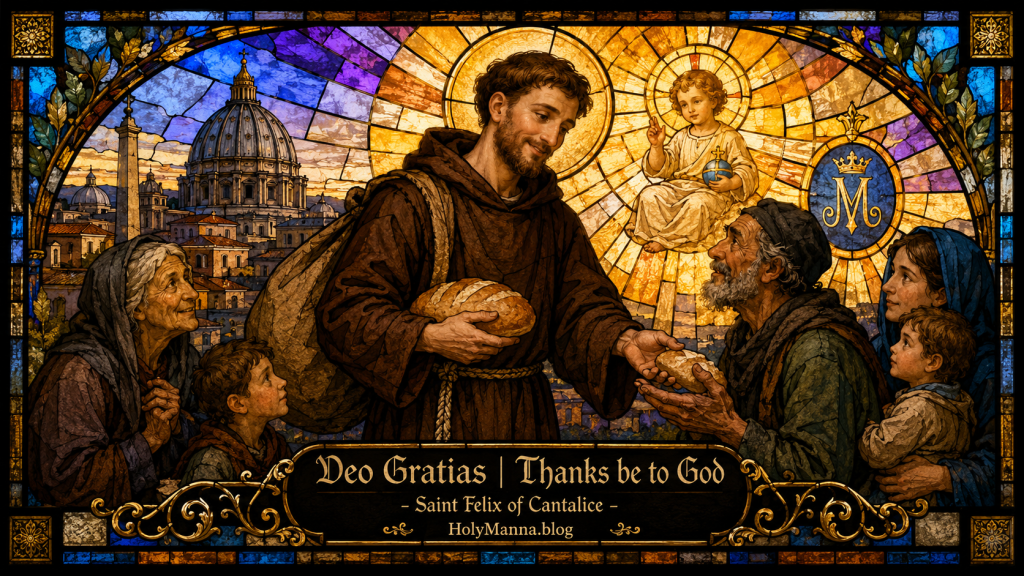
He was a Capuchin lay brother, born into poverty, formed by hard work, and made holy through humility. For about forty years, he begged for food and supplies for his friary and for the poor of Rome. The people loved him so much that they called him “Friar Deo Gratias”, because his constant response to life was “Deo Gratias,” meaning “Thanks be to God.”
That was not just a phrase for Saint Felix. It was his whole soul.
When someone gave him bread, he said “Deo Gratias.” When someone insulted him, he said “Deo Gratias.” When a door opened, he thanked God. When a door slammed shut, he thanked God again.
In a world that often measures people by wealth, status, education, influence, and online approval, Saint Felix stands as a deeply Catholic reminder that holiness does not need a platform. Sometimes sanctity looks like a tired man carrying beans, bread, and hidden sorrow through the city streets, loving Christ in every poor person he meets.
The Catechism of the Catholic Church teaches that love for the poor is part of the Church’s constant tradition, inspired by the poverty of Jesus and His concern for the suffering, CCC 2444. Saint Felix lived that teaching in flesh and blood. He did not write a theological masterpiece. He became one.
From the Fields of Cantalice to the Fields of Grace
Saint Felix was born in 1515 in Cantalice, a small town near Rieti in Italy. His family was poor, and from a young age he worked as a shepherd and farm laborer. He did not grow up with the privileges of formal education, and he never became known as a learned man in the usual sense.
But the Church has always understood that wisdom and holiness are not the same thing as worldly brilliance.
As a young man, Felix worked for the Picchi family near Cittaducale. He spent his days among animals, fields, tools, soil, and long hours of labor. These years formed him in simplicity, patience, and endurance. The rhythm of rural life also gave him space for prayer. He learned to see God not as an idea locked away in books, but as the Lord of the fields, the poor, the hungry, the ordinary, and the hidden.
A famous story from his youth tells of a frightening accident with a team of oxen. According to tradition, the animals panicked, trampled him, and dragged a plow across his body. Felix survived. The story is often told as a providential escape that awakened in him a deeper desire to give his life completely to God. Since the details come through devotional tradition, it is best understood as a treasured story from his life rather than something that can be fully verified in every detail.
Not long after, Felix sought entrance into the Capuchins, a reform branch of the Franciscan family known for poverty, penance, simplicity, and closeness to the poor. He entered the order in the 1540s and professed vows as a lay brother.
He never became a priest. He became something quieter, and in many ways, something just as needed. He became a brother.
Saint Felix once said, according to Capuchin tradition, that he knew only five letters. Those five letters were the five wounds of Christ.
That small saying contains an entire spirituality. Felix may not have mastered Latin theology, but he had learned Christ crucified. He knew the wounds of Jesus. He knew that love becomes real when it suffers, serves, forgives, and gives itself away.
The Holy Beggar of Rome
Saint Felix was sent to Rome, and there he spent nearly four decades as the Capuchin questor. A questor was the brother assigned to go out and beg for the needs of the friars. Felix walked through the city collecting bread, wine, oil, vegetables, and whatever else people could give.
But he was not only collecting food. He was gathering souls.
Rome came to know him as a cheerful, humble, holy man. He visited the sick. He comforted widows. He encouraged the poor. He counseled the troubled. He prayed for families. He taught children simple songs about the faith, helping them learn virtue and avoid sin through music and joy.
This is one of the most beautiful parts of his mission. Felix understood something that every Catholic parent, catechist, teacher, and evangelist should remember. The faith is not only taught through lectures. It is also taught through tenderness, repetition, song, joy, and example.
Children loved him. The poor trusted him. The powerful respected him. Saints recognized him.
Saint Philip Neri, the joyful apostle of Rome, became his close friend. Their friendship makes perfect sense. Both men carried holiness with warmth, humor, and a little holy mischief. They knew that joy could break through hearts that sternness could not reach.
Saint Charles Borromeo, one of the great reforming bishops of the Catholic Reformation, also encountered Felix. According to Catholic tradition, when Saint Charles was working on guidance for his Oblates, Saint Philip Neri brought him to Felix for advice. That is astonishing. An uneducated lay brother was being consulted by some of the greatest Catholic minds and saints of his day.
That is not a small detail. It shows how deeply the Church honors sanctity. Felix did not have academic credentials, but he had wisdom born from prayer, poverty, humility, and union with Christ.
Even Pope Sixtus V knew him. Tradition says that Felix predicted the election of Felice Peretti, who became Pope Sixtus V in 1585. Whether one treats the story as a prophetic gift or a pious tradition, it reflects the reputation Felix had among Catholics of his time. People believed he was a man close to God.
Bread, Mercy, and the Famine of Rome
One of the major public moments in Felix’s life came during the famine of 1580. Rome was suffering, and hunger spread through the city. The authorities knew that Felix was trusted by the people, so they asked the Capuchins to let him help collect food for the starving.
Imagine that for a moment. Rome did not turn first to a celebrity, nobleman, or political operator. Rome turned to the poor friar with the begging sack.
Felix worked tirelessly. He begged from those who had something to give and carried food to those who had nothing. His mission was not glamorous, but it was deeply Eucharistic in spirit. The man who adored Christ in prayer also served Christ in the hungry.
The Catechism says that the works of mercy include feeding the hungry, sheltering the homeless, visiting the sick, and comforting the afflicted, CCC 2447. Saint Felix did not treat those works as optional extras. They were the shape of his daily life.
That is why his holiness feels so practical. He did not ask whether helping the poor would make him important. He just helped. He did not ask whether anyone would remember his sacrifice. He just gave. He did not need attention because gratitude had already made him free.
The Saint Who Saw the Christ Child
Saint Felix was known not only for charity, but also for deep prayer and mystical grace. He lived a penitential life, slept little, and often spent the night in prayer. His body worked hard during the day, and his soul kept vigil through the night.
The most famous mystical story associated with him tells that the Blessed Virgin Mary appeared to him and placed the Infant Jesus in his arms. This is why Saint Felix is often shown in sacred art holding the Christ Child.
This story is central to his legacy. The poor friar who carried bread through the streets was given the image of carrying Jesus Himself. That is profoundly Catholic. Christ comes to the humble. Christ comes through Mary. Christ is found in the poor, the small, and the hidden.
Pope Saint John Paul II later reflected on this image beautifully, teaching that Felix carried the poor Christ Himself in the burdens of the needy. That is the heart of Saint Felix’s life. He held Christ in prayer, and he held Christ in the poor.
The Catechism teaches that Christ identifies Himself with the poor, CCC 2449. Saint Felix lived as if this were visibly true every day. To serve the hungry was to serve Jesus. To comfort a child was to comfort Jesus. To carry the burdens of Rome was to carry the Christ Child.
The Legends, Stories, and Holy Humor of Friar Deo Gratias
Many stories gathered around Saint Felix because the people loved him. Some are well rooted in Catholic tradition. Others are pious legends that reveal how the faithful remembered him, even if every detail cannot be historically verified.
One famous story tells of Saint Felix and Saint Philip Neri interrupting the wildness of Carnival in Rome. According to tradition, they organized a penitential procession with a crucifix. Felix led a Capuchin preacher named Fra Lupo with a rope around his neck, representing Christ being led to judgment. The procession entered the middle of Carnival celebrations, Fra Lupo preached, and the people were moved to repentance.
It sounds dramatic because it was dramatic. Felix and Philip understood that sometimes a city drunk on noise needs a holy interruption. They did not hate the people. They wanted to wake them up.
Another cherished story says that Felix loved his begging sack so much that he once declared, “I would not exchange this sack for the papacy and King Philip put together.” The saying shows his joyful poverty. To the world, a begging sack looked like humiliation. To Felix, it was freedom.
He also referred to himself humbly as the “ass of the Capuchins.” That may sound strange to modern ears, but in his Franciscan world, it was a way of embracing lowliness. He saw himself as a simple beast of burden for God, carrying what needed to be carried, going where obedience sent him, and asking for no applause.
Another saying associated with his Marian devotion is, “If you do not know the way to Paradise, go to Mary. She will teach you the way.” That line fits beautifully within Catholic devotion. Mary never leads souls away from Christ. She always says, as she did at Cana, “Do whatever he tells you,” John 2:5.
There is also a local tradition from Cantalice that Felix once struck the ground with his staff and water sprang forth for thirsty workers. A sanctuary connected to this tradition, San Felice all’Acqua, preserves the memory of the story. Since this comes through local devotion, it should be presented as a beloved tradition that cannot be fully verified in every detail.
Other devotional traditions say Felix was invoked by children and even by silkworm breeders because of stories involving children and the restoration of diseased silkworms. This belongs more to popular devotion than to firmly documented history, so it should be treated as a local or devotional tradition that cannot be fully verified.
Still, these stories tell something true about how Catholics remembered him. He was not remembered as distant or severe. He was remembered as near, useful, kind, playful, prayerful, and powerful with God.
Hardship Without Bitterness
Saint Felix was not martyred, but his life was filled with hardship. Poverty was not a costume for him. It was his path to Christ. Begging every day required humility. Being rejected required patience. Serving the poor required strength. Living penance required discipline. Remaining joyful required grace.
There is a temptation to romanticize saints like Felix. The image of a cheerful friar walking through Rome can sound sweet and easy. It was not easy.
He endured exhaustion. He slept very little. He carried heavy loads. He heard people’s sorrows. He saw hunger, sickness, family pain, and spiritual confusion. He was sometimes mocked or dismissed. Yet his response remained “Deo Gratias.”
That is the miracle of his character.
Anyone can say “Thanks be to God” when life is comfortable. Felix said it when life was humiliating, tiring, and uncertain. His gratitude was not shallow optimism. It was faith trained by sacrifice.
The Catechism teaches that prayer and Christian life are inseparable, CCC 2745. Saint Felix proves it. His charity flowed from prayer, and his prayer was tested in charity. He did not escape suffering by being holy. He became holy by offering suffering with love.
Death, Relics, and the Love of Rome
Saint Felix died in Rome on May 18, 1587, on his seventy-second birthday. By then, the city already regarded him as a saint. After his death, people from every class came to venerate him. Children came. The poor came. Nobles came. Cardinals came. Pope Sixtus V also came.
That scene says so much. The poor beggar had become one of Rome’s treasures.
His body rests in the Capuchin church of the Immaculate Conception in Rome, a place associated with Capuchin memory and devotion. For Catholics, relics are not magic objects. They are sacred reminders that grace truly works through human bodies. The saints loved God with real hands, real feet, real wounds, real exhaustion, and real perseverance.
The Catechism teaches that the saints in heaven do not stop caring for those on earth. Their intercession is their most exalted service to God’s plan, CCC 956. Saint Felix’s mission did not end when he died. Catholics honor him because he remains a friend and intercessor in Christ.
Miracles were reported after his death, and his reputation for holiness spread. Some accounts speak generally of healings and divine favors attributed to his intercession. The exact details of many individual miracle stories are not always easy to verify from accessible historical sources, so they should be treated with reverent caution. What is certain is that the Church formally recognized his sanctity.
He was beatified by Pope Urban VIII in 1625 and canonized by Pope Clement XI in 1712. He became the first Capuchin friar to be canonized, which gives him a special place in the history of the Capuchin order.
The First Canonized Capuchin and a Saint for Ordinary Catholics
Saint Felix’s canonization mattered deeply for the Capuchins. The order was still relatively young in his lifetime, and the early Capuchins faced serious challenges. Felix gave the Church a living image of what Capuchin reform was supposed to look like: prayer, poverty, penance, simplicity, obedience, joy, and service to the poor.
He also influenced later Catholic life through the Congregation of the Sisters of Saint Felix of Cantalice, commonly known as the Felician Sisters. Their spirituality drew inspiration from Saint Felix, Saint Francis, Saint Clare, and Blessed Mary Angela Truszkowska. Through education, service, and works of mercy, his spirit continued to bear fruit beyond Italy.
His feast day is celebrated on May 18. He is especially honored by Franciscans, Capuchins, the people of Cantalice, and communities connected to his name. In his hometown, devotion to him includes liturgical celebrations, processions, and local festivities. His memory still belongs not only to churches and books, but also to streets, songs, families, and communities.
That feels fitting. Felix was a saint of the streets.
He belonged among ordinary people. He belonged near doorways, kitchens, markets, hospital beds, and children’s voices. He belonged wherever gratitude needed to be learned again.
The Lesson of the Begging Sack
Saint Felix of Cantalice teaches that a Catholic life does not have to be impressive to be holy. It has to be faithful.
His begging sack was not a symbol of failure. It was a symbol of surrender. He carried it through Rome as a poor man, but also as a free man. He was not chained to ambition, resentment, vanity, or comfort. He belonged to Christ, and because he belonged to Christ, he could belong to everyone.
His constant “Deo Gratias” is a hard lesson for modern hearts. Gratitude is easy when prayers are answered quickly. It is harder when life feels repetitive, hidden, unfair, or exhausting. Felix teaches that gratitude is not pretending everything is fine. Gratitude is trusting that God is still good.
What would change if every irritation became a chance to say “Thanks be to God” with sincerity?
That does not mean ignoring pain. Felix did not ignore suffering. He walked straight into it. He fed the hungry, comforted the sorrowing, and carried the needs of others into prayer. His gratitude made him more compassionate, not less.
For Catholics today, his life offers simple but demanding practices. Thank God before complaining. Serve someone who cannot repay the favor. Treat the poor as Christ, not as an inconvenience. Pray when tired. Stay humble when praised. Stay gentle when rejected. Let Mary lead the soul closer to Jesus. Carry the little daily burdens with love.
Saint Felix reminds the Church that holiness can be loud like preaching, but it can also be quiet like footsteps on stone streets before sunrise. It can sound like a sermon, but it can also sound like a poor friar whispering “Deo Gratias” again and again until a whole city remembers God.
Engage With Us!
Share your thoughts and reflections in the comments below. Saint Felix of Cantalice lived a simple life, but his witness reaches straight into the heart of daily Catholic living. His joy, humility, and love for the poor challenge every believer to ask whether gratitude has truly taken root in the soul.
- Where is God inviting you to say “Deo Gratias” in a part of life that feels difficult, repetitive, or hidden?
- How can Saint Felix’s love for the poor help you see Christ more clearly in the hungry, lonely, sick, or forgotten people around you?
- What would it look like to carry your own “begging sack” with humility, accepting the duties and sacrifices God has placed in your life?
- How can Mary help you draw closer to Jesus, especially when the way to holiness feels confusing or difficult?
- What small act of mercy can you offer today without needing recognition or repayment?
May Saint Felix of Cantalice teach every Catholic heart to live with humility, serve with joy, and say “Thanks be to God” in every season. Keep walking with faith, keep loving the poor, keep trusting Jesus, and do everything with the love and mercy He taught us.
Saint Felix of Cantalice, pray for us!
Follow us on YouTube, Instagram and Facebook for more insights and reflections on living a faith-filled life.


Leave a Reply