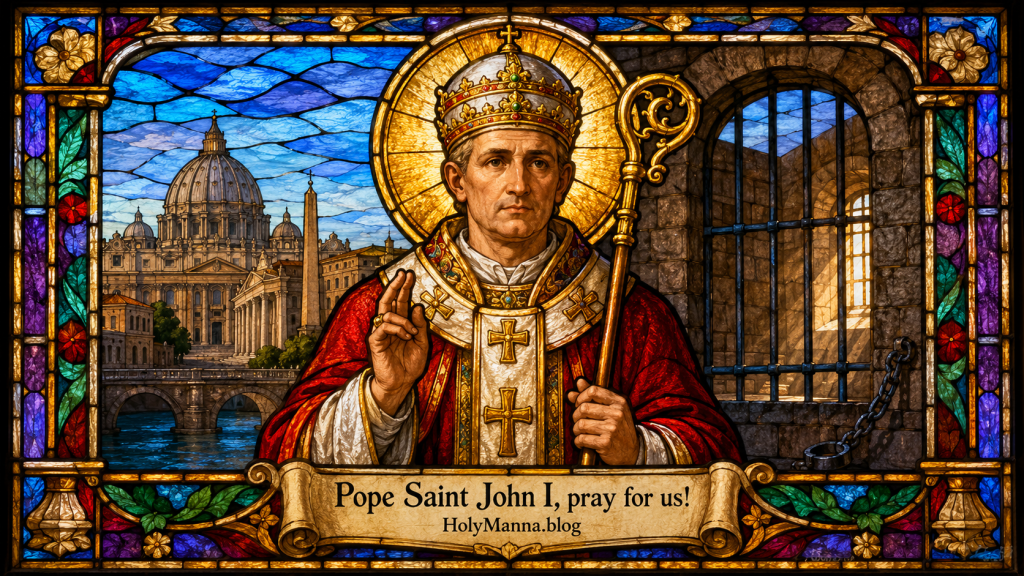
The Pope Who Chose Truth Over Survival
Pope Saint John I is one of those saints whose life does not come to us with many childhood stories, dramatic speeches, or long collections of writings. His legacy is simpler, sharper, and in many ways more challenging. He was a pope caught between a Catholic emperor, an Arian king, and the eternal truth about Jesus Christ.
John I served as Pope from 523 to 526, during a dangerous time for the Church in the West. Rome no longer held the political power it once had. Italy was ruled by Theodoric the Great, an Ostrogothic king who followed Arianism, the heresy that denied the full divinity of Jesus Christ. Against that error, the Catholic Church confessed, as she still does, that the Son is “consubstantial with the Father” (CCC 242).
That truth would cost Pope John his freedom and eventually his life. He is remembered as a pope, a martyr, and a man who showed that mercy toward people in error must never become compromise with error.
A Tuscan Shepherd Raised Up for a Difficult Hour
Pope Saint John I was born in Tuscia, the old Roman region of Tuscany, likely around the year 470. Catholic tradition identifies him as the son of Constantius. Little is known about his family, childhood, or early education, which is not unusual for saints of this period. What is known is that he entered the Roman clergy and became a respected churchman before his election to the papacy.
Some Catholic sources identify him with John the Deacon, a Roman cleric connected with the great Catholic philosopher Boethius. Two of Boethius’s theological works were addressed to a John the Deacon who later became Pope John I. That connection is striking, because both Boethius and John would suffer under the suspicion and cruelty of Theodoric.
There is also a possible, though carefully handled, tradition that John had once been involved in the Laurentian schism and later reconciled with Pope Symmachus. If this was truly the same John, his life becomes even more moving. A man once connected to division in the Church later became a pope remembered for fidelity, communion, and martyrdom.
John became pope on August 13, 523. He was already advanced in age and physically frail. Yet God placed him in the Chair of Peter at a moment when strength would not look like armies, political influence, or worldly success. It would look like an old pope refusing to bend the truth about Christ.
Arianism, Politics, and the Question That Changes Everything
The great conflict around Pope John was not only political. It was theological. Theodoric was an Arian, and Arianism struck at the heart of Christianity by denying that Jesus Christ is truly God.
The Church had already condemned Arianism at the Council of Nicaea. The Catholic faith teaches that Jesus is not a creature, not merely a holy teacher, and not a lesser divine being. He is the eternal Son of God, true God from true God. The Catechism of the Catholic Church teaches that the Son is “one only God with him” (CCC 242).
That doctrine may sound abstract at first, but it is everything. If Jesus is not truly God, then the Cross is not the saving act of God Himself. If Jesus is not truly God, then the Eucharist is not the true Body and Blood of the Lord. If Jesus is not truly God, then Christianity collapses into moral advice and religious poetry.
Pope John understood that peace purchased by denying Christ is not peace. It is surrender.
The Forced Journey to Constantinople
Theodoric became angry when Emperor Justin I of Constantinople issued measures against Arians in the East. The emperor required that churches taken by Arians be restored to Catholics and placed pressure on Arian communities. Theodoric saw this as both a religious and political threat.
So he forced Pope John I to travel to Constantinople as part of an embassy. The king wanted the pope to persuade Emperor Justin to reverse his policies toward the Arians. Some accounts say Theodoric even wanted John to support the return of Catholics who had once been Arians back into Arianism.
This placed John in an almost impossible position. As a pastor, he could plead for gentleness and moderation. As pope, he could ask that people be treated with mercy. But he could not ask a Catholic emperor to favor heresy. He could not bless false teaching in the name of diplomacy.
That is why John’s life is such a powerful Catholic witness. He did not confuse charity with weakness. He did not confuse peace with compromise. He knew that love for souls must always be joined to love for truth.
The Catechism teaches that martyrdom is “the supreme witness given to the truth of the faith” (CCC 2473). Pope John’s martyrdom began before prison. It began when he chose fidelity over self-preservation.
Honored in the East, Hated by the King
When Pope John arrived in Constantinople, he was received with extraordinary honor. The people came out to meet him. Emperor Justin showed deep reverence toward him, and tradition says that the emperor prostrated himself before the pope. John celebrated Easter in Hagia Sophia in the Latin Rite on April 19, 526, a remarkable sign of Catholic unity between Rome and Constantinople.
One famous pious story says that, as John entered Constantinople, he healed a blind man. This story belongs to Catholic devotional tradition, but it cannot be verified with modern historical certainty. Still, it expresses how the faithful remembered him: as a holy shepherd whose presence brought light.
John’s mission, however, did not satisfy Theodoric. The pope had not betrayed Catholic truth. He had not become the king’s religious puppet. He had not turned the Chair of Peter into a tool of Arian politics.
To Theodoric, that was failure. To the Church, that was faithfulness.
Prison, Exhaustion, and a Martyr’s Crown
When Pope John returned to Italy, Theodoric had him arrested and imprisoned in Ravenna. John was elderly, tired from the difficult journey, and weakened by harsh treatment. He died in prison on or around May 18, 526.
His martyrdom was not the dramatic martyrdom of lions, flames, or swords. It was the slow martyrdom of deprivation, imprisonment, and exhaustion. Yet the Church honors him as a martyr because he suffered and died for his fidelity to the Catholic faith.
This is important for modern Catholics. Not every martyr looks heroic in the eyes of the world. Some martyrs die forgotten in cells. Some are mocked, isolated, pressured, or worn down. Some are simply asked to trade truth for comfort and refuse.
Pope Saint John I did not win by escaping prison. He won by remaining faithful inside it.
The Saint Who Still Speaks Without Many Words
There are no securely verified famous quotations from Pope Saint John I. Some letters were later attributed to him, but Catholic scholarship considers them apocryphal, meaning they should not be treated as authentic writings of the saint.
That silence is fitting. John’s greatest sermon was not written with ink. It was written with endurance.
The Church’s liturgy gives a beautiful phrase for his witness, asking God that those who honor him may “imitate his constancy in the faith.” That is the heart of his sainthood. He was constant. He remained steady when politics became threatening, when power became cruel, and when compromise would have made life easier.
Legends, Judgment, and the Death of Theodoric
Catholic tradition also preserves a dramatic story about Theodoric after John’s death. According to a later hagiographical account, the king was served the head of a large fish and suddenly imagined that it looked like the head of Symmachus, one of the men he had unjustly condemned. Terrified and tormented, Theodoric died soon afterward.
This story cannot be verified with historical certainty. It should be read as a moral legend rather than a proven miracle. Its meaning is clear: earthly power does not escape divine judgment. The king who imprisoned the pope appeared victorious for a moment, but the Church remembers John as the saint and Theodoric as the warning.
A Legacy Buried Beneath Saint Peter’s
After his death, Pope John’s body was brought to Rome and buried in St. Peter’s Basilica. His tomb did not become a major shrine in the way some saints’ tombs did, and later rebuilding at St. Peter’s obscured the exact location of his remains. Still, Catholic tradition remembers him as buried beneath the shadow of the Apostle Peter, whose office he held and whose faith he defended.
John’s feast day is May 18 in the Ordinary Form of the Roman Rite. He is honored as a pope and martyr, and the liturgical color is red. In the older calendar, he is commemorated on May 27, connected with the translation of his body to Rome.
His legacy also contains a few surprising details. He was the first pope to take the name John, a name that later became one of the most beloved papal names in Church history. The later Pope John II was born with the name Mercurius, which had pagan associations, and he chose the name John in honor of Pope Saint John I. This helped begin the custom of popes taking a new name upon election.
John is also remembered as the first pope known to have traveled to Constantinople while in office. He stands at a crossroads of East and West, empire and papacy, politics and doctrine, mercy and truth.
A Catholic Lesson for an Age of Compromise
Pope Saint John I is a saint for anyone tempted to soften the faith in order to be accepted. His life teaches that kindness matters, mercy matters, and prudence matters, but none of these can require a Catholic to deny Christ.
He could ask for gentleness toward Arians. He could seek peace. He could try to prevent unnecessary cruelty. But he could not pretend that Arianism was true. He could not act as though the divinity of Christ was negotiable.
That lesson is deeply needed. The modern world often asks Catholics to be agreeable before being faithful. It praises “dialogue” as long as doctrine stays quiet. It welcomes compassion as long as truth is edited out. Pope John shows another way: speak with charity, act with prudence, but remain constant in the faith.
His life invites every Catholic to ask a serious question: Where is Christ asking for constancy rather than comfort?
Faithfulness in Ordinary Daily Life
Most Catholics will never be forced into a royal embassy or imprisoned by an Arian king. Yet the same spiritual battle appears in smaller ways every day. It appears when faith feels awkward in conversation. It appears when Catholic teaching is misunderstood. It appears when silence would be easier than gentle honesty.
Pope Saint John I teaches that holiness is not always loud. Sometimes holiness looks like refusing to cooperate with a lie. Sometimes it looks like staying faithful when no one applauds. Sometimes it looks like accepting suffering rather than betraying Christ.
A practical devotion to Pope Saint John I could begin with a simple prayer before difficult conversations: Lord Jesus Christ, keep this heart gentle, but keep it faithful. Another way to honor him is to study what the Church teaches about Christ’s divinity, especially in The Catechism of the Catholic Church, and to pray the Nicene Creed slowly, remembering that saints suffered and died for those words.
The Creed is not just something recited at Mass. It is the truth that held Pope John steady in prison.
Engage With Us!
Share your thoughts and reflections in the comments below. Pope Saint John I may not be one of the most famous popes, but his witness is powerful for anyone trying to live the Catholic faith with courage, clarity, and charity.
- Where do you feel the most pressure to compromise your Catholic faith in daily life?
- How can Pope Saint John I teach you to be both charitable and firm in the truth?
- What does it mean to you that martyrdom can sometimes look like quiet endurance rather than dramatic public suffering?
- How can praying the Nicene Creed with more attention deepen your love for Jesus Christ as true God and true man?
- Who in your life needs to see a peaceful but courageous witness to the Catholic faith?
May Pope Saint John I pray for all who feel pressured to trade truth for comfort. May his constancy strengthen every Catholic heart. And may every word, decision, conversation, and hidden sacrifice be done with the love and mercy Jesus taught us.
Pope Saint John I, pray for us!
Follow us on YouTube, Instagram and Facebook for more insights and reflections on living a faith-filled life.


Leave a Reply