Monday of the Seventh Week of Easter – Lectionary: 297
When Faith Is Scattered, Christ Gives Peace
There are days when faith feels strong in the morning and fragile by nightfall. Today’s readings speak directly into that tension, where sincere belief meets fear, weakness, confusion, and the need for a deeper outpouring of grace.
The central theme running through today’s Mass readings is this: Christ gathers His scattered people, strengthens them by the Holy Spirit, and gives them peace in a troubled world. In Acts 19:1-8, Paul arrives in Ephesus and finds disciples whose faith is real, but incomplete. They know repentance through the baptism of John, yet they have not received the fullness of Christian Baptism and the Holy Spirit. This moment reminds Catholic readers that Christianity is not simply moral effort or private belief. It is sacramental life, apostolic teaching, and the power of the Holy Spirit given through the Church.
The Responsorial Psalm, Psalm 68:2-7, 33, widens the picture. God rises in power, scatters His enemies, and defends the vulnerable. He is “Father of the fatherless, defender of widows” Psalm 68:6. The Lord who conquers evil is also the Lord who gives a home to the forsaken. This matters because the disciples in both Acts and John are, in different ways, spiritually vulnerable. They need God to gather, strengthen, and shelter them.
Then, in John 16:29-33, the Apostles declare their faith with confidence, but Jesus gently reveals how fragile that confidence will be. They will scatter. They will leave Him alone. Yet He is not abandoned, because the Father is with Him. Then comes the promise at the heart of the day: “In the world you will have trouble, but take courage, I have conquered the world” John 16:33.
Historically, these readings sit in the sacred space between Easter and Pentecost. The Church is contemplating the risen Christ, preparing for the gift of the Holy Spirit, and learning that the mission of the Gospel will not be carried by human courage alone. The early Christians lived in a world of synagogues, pagan cities, imperial pressure, spiritual confusion, and real persecution. Yet the Church did not grow because the world was easy. The Church grew because Christ had conquered, and the Holy Spirit made fearful disciples bold.
That is the invitation today. Faith must move from partial understanding to fullness, from fear to courage, from isolation to communion, and from worldly anxiety to peace in Christ. Where does the heart still scatter when trouble comes? Where is the Holy Spirit asking to strengthen what is sincere, but still incomplete?
First Reading – Acts 19:1-8
When Partial Faith Meets the Fullness of the Holy Spirit
In today’s first reading, Saint Paul arrives in Ephesus, one of the great cities of the ancient world. Ephesus was wealthy, influential, religiously intense, and famous for the temple of Artemis. It was a place where commerce, pagan worship, magic practices, philosophy, and Jewish synagogue life all met in the same streets. Into that crowded spiritual atmosphere comes Paul, carrying not a new opinion, but the fullness of the Gospel of Jesus Christ.
The men Paul meets are called disciples, which means they are not hostile to God. They are sincere. They have received the baptism of John, a baptism of repentance that prepared Israel for the Messiah. But something is missing. They know the call to turn away from sin, but they have not yet entered the fullness of Christian Baptism and the life of the Holy Spirit.
This fits beautifully into today’s theme. Christ gathers scattered and incomplete hearts, strengthens them by the Holy Spirit, and sends them into a troubled world with courage. These disciples in Ephesus are not mocked for what they lack. They are led deeper. That is how grace works. God does not despise small beginnings. He brings them to completion.
Acts 19:1-8 – New American Bible (Revised Edition)
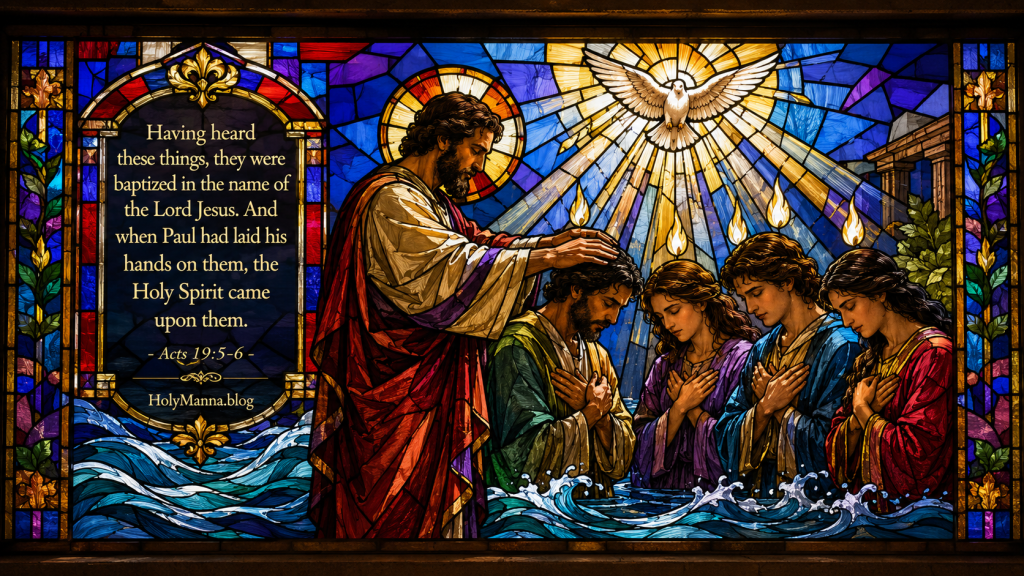
Paul in Ephesus. 1 While Apollos was in Corinth, Paul traveled through the interior of the country and came [down] to Ephesus where he found some disciples. 2 He said to them, “Did you receive the holy Spirit when you became believers?” They answered him, “We have never even heard that there is a holy Spirit.” 3 He said, “How were you baptized?” They replied, “With the baptism of John.” 4 Paul then said, “John baptized with a baptism of repentance, telling the people to believe in the one who was to come after him, that is, in Jesus.” 5 When they heard this, they were baptized in the name of the Lord Jesus. 6 And when Paul laid [his] hands on them, the holy Spirit came upon them, and they spoke in tongues and prophesied. 7 Altogether there were about twelve men.
8 He entered the synagogue, and for three months debated boldly with persuasive arguments about the kingdom of God.
Detailed Exegesis
Verse 1 – “While Apollos was in Corinth, Paul traveled through the interior of the country and came [down] to Ephesus where he found some disciples.”
Paul arrives in Ephesus after traveling through the interior regions, continuing his missionary work with the restless zeal of an Apostle. Ephesus will become one of the major centers of early Christianity, and Paul’s presence there is no accident. The mention of Apollos reminds readers that the early Church was already expanding through different preachers, teachers, and missionaries, but always under the guidance of apostolic truth. These “disciples” have some connection to the message of repentance, but their formation is incomplete. The Church, from the beginning, did not treat incomplete formation as enough. She taught, baptized, confirmed, corrected, and sent.
Verse 2 – “He said to them, ‘Did you receive the holy Spirit when you became believers?’ They answered him, ‘We have never even heard that there is a holy Spirit.’”
Paul’s first concern is not whether they are nice people, sincere people, or religious people. His concern is whether they have received the Holy Spirit. This question reveals the heart of Christian life. Faith is not merely agreement with religious ideas. It is life in the Spirit. Their answer shows that they are still standing at the threshold. They have heard a message of repentance, but they have not yet received the fullness of the New Covenant. From a Catholic perspective, this is deeply important because the Christian life is sacramental, not merely motivational. The Holy Spirit is not an optional extra for especially intense believers. He is the Lord, the Giver of Life, poured into the Church through Christ.
Verse 3 – “He said, ‘How were you baptized?’ They replied, ‘With the baptism of John.’”
Paul immediately asks about baptism because baptism marks the doorway into Christian life. The baptism of John was holy and necessary in its own place, but it was preparatory. John called Israel to repentance and pointed toward the One who was coming after him. His baptism confessed sin and prepared the heart, but it did not confer the sacramental grace of Christian Baptism instituted by Christ. This distinction matters because the Catholic faith never reduces Christianity to good intentions. Repentance is essential, but repentance must lead to Christ, His Church, and the sacraments He gave for salvation.
Verse 4 – “Paul then said, ‘John baptized with a baptism of repentance, telling the people to believe in the one who was to come after him, that is, in Jesus.’”
Paul honors John the Baptist by explaining his mission correctly. John was not the destination. He was the voice crying out in the wilderness. His whole ministry pointed beyond himself to Jesus. This verse shows the proper relationship between repentance and faith. Repentance opens the door, but Jesus is the Lord who enters. Catholic conversion is never just self-improvement. It is not simply trying harder, being more disciplined, or becoming morally respectable. True conversion means turning toward Jesus Christ, receiving His grace, and being incorporated into His Body, the Church.
Verse 5 – “When they heard this, they were baptized in the name of the Lord Jesus.”
Once they hear the fullness of the Gospel, they respond. They are baptized in the name of the Lord Jesus. This does not contradict Christ’s command to baptize in the name of the Father, and of the Son, and of the Holy Spirit. Rather, it distinguishes Christian Baptism from the baptism of John and identifies it as belonging to Jesus Christ. This is the sacramental moment where incomplete preparation becomes incorporation into Christ. They are no longer only waiting for the Messiah. They are brought into His death and Resurrection.
Verse 6 – “And when Paul laid [his] hands on them, the holy Spirit came upon them, and they spoke in tongues and prophesied.”
Here the Catholic tradition sees a powerful apostolic sign connected to Confirmation. Paul lays hands on them, and the Holy Spirit comes upon them. The laying on of hands is not a casual gesture. It is apostolic, sacramental, and ecclesial. The visible signs of tongues and prophecy show that the Holy Spirit is empowering them for witness. The Spirit does not merely make them feel inwardly comforted. He makes them bold, articulate, and ready for mission. The same Spirit who descended at Pentecost now fills these disciples in Ephesus, showing that the mission of the Church is spreading beyond Jerusalem into the nations.
Verse 7 – “Altogether there were about twelve men.”
The number twelve is worth noticing. It echoes the twelve tribes of Israel and the twelve Apostles, suggesting fullness, restoration, and apostolic continuity. These men in Ephesus become a small sign of the Church’s mission to gather all peoples into the New Covenant. God is building His people again, not around bloodline, geography, or temple sacrifice, but around Christ, Baptism, the Holy Spirit, and apostolic faith.
Verse 8 – “He entered the synagogue, and for three months debated boldly with persuasive arguments about the kingdom of God.”
After this encounter, Paul continues his mission in the synagogue. He speaks boldly and persuasively about the Kingdom of God. This is what the Holy Spirit does in the Church. He creates witnesses. He gives courage. He forms minds capable of reasoned defense and hearts willing to endure resistance. Paul does not preach vague spirituality. He proclaims the Kingdom of God, which means the reign of Christ breaking into history through His Church, His sacraments, His teaching, and His saving power.
Teachings: The Sacraments Complete What Sincere Repentance Begins
This reading is one of the clearest reminders that Catholic Christianity is not merely a private relationship with Jesus detached from the Church. The disciples in Ephesus believe something true, but they still need Baptism in Christ and the gift of the Holy Spirit through apostolic ministry. Their sincerity is real, but sincerity alone is not the fullness of Christian initiation.
The Catechism of the Catholic Church teaches this about Baptism: “Holy Baptism is the basis of the whole Christian life, the gateway to life in the Spirit, and the door which gives access to the other sacraments. Through Baptism we are freed from sin and reborn as sons of God; we become members of Christ, are incorporated into the Church and made sharers in her mission: ‘Baptism is the sacrament of regeneration through water in the word.’” CCC 1213
That teaching helps explain why Paul does not leave these men with only John’s baptism. John’s baptism prepared them for Christ, but Christian Baptism gives sacramental rebirth in Christ. It brings the believer into the life of the Church and opens the door to the other sacraments.
The laying on of hands in this passage also connects strongly to Confirmation. The Catechism teaches: “From that time on the apostles, in fulfillment of Christ’s will, imparted to the newly baptized by the laying on of hands the gift of the Spirit that completes the grace of Baptism. For this reason in the Letter to the Hebrews the doctrine concerning Baptism and the laying on of hands is listed among the first elements of Christian instruction. The imposition of hands is rightly recognized by the Catholic tradition as the origin of the sacrament of Confirmation, which in a certain way perpetuates the grace of Pentecost in the Church.” CCC 1288
This is why Confirmation should never be treated like a Catholic graduation ceremony. It is not the end of religious formation. It is a strengthening for mission. The Holy Spirit seals the baptized more deeply, binds them more firmly to Christ and His Church, and gives them courage to confess the faith.
The Catechism also teaches: “It is evident from its celebration that the effect of the sacrament of Confirmation is the special outpouring of the Holy Spirit as once granted to the apostles on the day of Pentecost.” CCC 1302
That sentence belongs right beside Acts 19. What happened in Jerusalem at Pentecost is now being extended to Ephesus. The same Spirit who filled the Apostles fills these men. The same Spirit who made Peter bold makes Paul bold. The same Spirit who gives tongues and prophecy gives the Church courage to preach Christ in every age.
Saint Cyril of Jerusalem, teaching newly baptized Christians about the anointing of the Spirit, wrote: “But beware of supposing this to be plain ointment. For as the Bread of the Eucharist, after the invocation of the Holy Ghost, is mere bread no longer, but the Body of Christ, so also this holy ointment is no more simple ointment, nor common, after invocation, but it is Christ’s gift of grace, and, by the advent of the Holy Ghost, is made fit to impart His Divine Nature.” St. Cyril of Jerusalem, Mystagogical Catecheses
That ancient teaching helps modern Catholics recover wonder. The sacraments are not religious props. They are not symbols invented to make us feel included. They are outward signs instituted by Christ to give grace. The men in Ephesus are changed because Christ acts through His Church.
Reflection: Let the Holy Spirit Complete the Unfinished Places
There is something comforting and challenging about these twelve men in Ephesus. They are not rebels. They are not mockers. They are not spiritually lazy. They have received what they knew, and when Paul teaches them more fully, they respond. That kind of humility is beautiful.
Many Catholics today are in a similar place. There may be real faith, real repentance, real love for God, and yet still an incomplete surrender to the Holy Spirit. Someone may go to Mass but rarely pray. Someone may believe in Jesus but avoid Confession. Someone may have been confirmed years ago but never really asked the Holy Spirit to ignite the gifts received. Someone may know Catholic teaching intellectually but still live timidly, as if the Gospel were private information instead of good news for the world.
This reading gently asks every Catholic to stop settling for partial faith. The Lord wants more for His people. He wants sacramental life, daily conversion, courage, mission, and the fire of the Holy Spirit.
A practical response begins with repentance, but it cannot stop there. Go to Confession with honesty. Renew baptismal promises with attention instead of routine. Ask the Holy Spirit every morning for wisdom, courage, chastity, patience, and zeal. Learn the faith seriously enough to explain it with charity. Speak about Christ naturally when the moment comes. Serve the parish, the family, the lonely, and the poor with a heart that has been strengthened from within.
The question Paul asked in Ephesus still belongs in Catholic hearts today: “Did you receive the holy Spirit when you became believers?” Acts 19:2
Is there an area of faith that is sincere, but still unfinished?
Has Confirmation been treated as a past event, or as a living grace meant to strengthen today’s witness?
Where is the Holy Spirit asking for permission to make fear give way to courage?
What would change this week if faith moved from quiet belief to apostolic boldness?
The men in Ephesus did not stay where they were. They listened, received, and were filled. That is the path of the Church in every generation. Christ gathers incomplete hearts, gives them the Holy Spirit, and sends them into the world with courage.
Responsorial Psalm – Psalm 68:2-7, 33
The God Who Rises for the Forgotten
Psalm 68 sounds like a procession. It is bold, dramatic, and full of movement. God rises. Enemies scatter. The just rejoice. The vulnerable are defended. The forsaken are given a home. The kingdoms of the earth are summoned to praise.
In the background of this Psalm is the memory of Israel’s God marching with His people. The language recalls the Exodus, the wilderness journey, the Ark of the Covenant, and the Lord’s victorious presence among His people. This is not a quiet little prayer whispered in a corner. It is the song of a people who know that God is not passive. He acts. He rescues. He judges evil. He gathers His children.
That fits today’s theme beautifully. In Acts 19:1-8, the disciples in Ephesus are brought from partial understanding into the fullness of life in the Holy Spirit. In John 16:29-33, Jesus tells the Apostles they will be scattered, but He also gives them peace because He has conquered the world. Here in Psalm 68, the Church sings of the God who scatters evil and gathers the vulnerable. He is mighty enough to conquer, and tender enough to become “Father of the fatherless” Psalm 68:6.
This is the Catholic vision of divine power. God’s strength is never cold. His victory is never detached from mercy. The Lord rises against wickedness precisely because He loves His people, especially those who have no one else to defend them.
Psalm 68:2-7, 33 – New American Bible (Revised Edition)
2 May God arise;
may his enemies be scattered;
may those who hate him flee before him.
3 As the smoke is dispersed, disperse them;
as wax is melted by fire,
so may the wicked perish before God.
4 Then the just will be glad;
they will rejoice before God;
they will celebrate with great joy.5 Sing to God, praise his name;
exalt the rider of the clouds.
Rejoice before him
whose name is the Lord.
6 Father of the fatherless, defender of widows—
God in his holy abode,
7 God gives a home to the forsaken,
who leads prisoners out to prosperity,
while rebels live in the desert.33 You kingdoms of the earth, sing to God;
chant the praises of the Lord,
Selah
Detailed Exegesis
Verse 2 – “May God arise; may his enemies be scattered; may those who hate him flee before him.”
This verse begins with the language of holy battle. It echoes the ancient cry of Israel when the Ark of the Covenant set out on the journey through the wilderness: “Arise, Lord, may your enemies be scattered, and may those who hate you flee before you.” Numbers 10:35 The Psalm is not celebrating human vengeance. It is proclaiming that evil cannot stand before the living God. For Christians, this verse points toward Christ, who rises from the dead and scatters the powers of sin, Satan, and death. The enemies of God are not merely political opponents or personal annoyances. They are everything that resists His holiness, truth, mercy, and reign.
Verse 3 – “As the smoke is dispersed, disperse them; as wax is melted by fire, so may the wicked perish before God.”
The images are vivid. Smoke looks large for a moment, but wind drives it away. Wax may seem solid, but fire quickly melts it. So it is with wickedness before God. Evil often looks permanent when people are suffering under it. Sin can look powerful. Injustice can look untouchable. Fear can feel immovable. Yet before the holiness of God, all of it is fragile. This verse teaches hope, not arrogance. The Catholic heart learns that God’s justice is real, and no darkness has the final word before Him.
Verse 4 – “Then the just will be glad; they will rejoice before God; they will celebrate with great joy.”
The scattering of evil leads to the joy of the just. This joy is not shallow excitement. It is the relief of those who have waited for God to act. It is the joy of the poor who are defended, the faithful who are vindicated, and the repentant who discover that God’s mercy is stronger than their past. In the Easter season, this joy belongs especially to the Church. Christ has risen. The world is still troubled, but it has been conquered. The Christian can rejoice not because life is easy, but because Jesus is Lord.
Verse 5 – “Sing to God, praise his name; exalt the rider of the clouds. Rejoice before him whose name is the Lord.”
The Psalm now becomes worship. Israel is commanded to sing, praise, exalt, and rejoice. The title “rider of the clouds” presents God as sovereign over creation, majestic above all earthly powers. In the ancient world, surrounding nations often used storm and cloud imagery for their false gods, but Israel boldly gives this language to the one true Lord. He alone rules heaven and earth. For Catholics, this verse teaches that worship is the proper response to God’s victory. When God reveals His power and mercy, His people do not merely analyze Him. They adore Him.
Verse 6 – “Father of the fatherless, defender of widows, God in his holy abode.”
Here the Psalm reveals the heart of God. The Lord who rides upon the clouds is also Father to the fatherless and defender of widows. In the ancient world, orphans and widows were among the most vulnerable people in society. Without family protection, inheritance security, or social power, they were easily forgotten or exploited. God identifies Himself as their defender. This is a major biblical theme and a foundation for Catholic social teaching. God’s holiness is not distance from the suffering. His holiness is revealed in His faithful love for those who cannot protect themselves.
Verse 7 – “God gives a home to the forsaken, who leads prisoners out to prosperity, while rebels live in the desert.”
This verse gives the Psalm its deeply human tenderness. God does not merely defeat enemies. He gives a home to the forsaken. He leads prisoners out into blessing. He restores dignity to those who have been trapped, abandoned, or forgotten. At the same time, the verse warns that rebellion against God leads to spiritual barrenness. The desert here becomes an image of isolation, sterility, and exile. The contrast is powerful. Those who trust God are gathered into His household, while those who reject Him choose a wilderness of their own making.
Verse 33 – “You kingdoms of the earth, sing to God; chant the praises of the Lord.”
The Psalm ends by calling not only Israel, but all kingdoms of the earth to praise God. This universal note points beyond one nation to the mission of the Church. The God of Israel is not a tribal deity. He is Lord of all peoples. In the light of Christ, this verse prepares the heart for the Gospel mission. Paul will preach in Ephesus. The Apostles will go to the nations. The Church will carry the praise of the Lord across languages, cultures, empires, and centuries. Every kingdom is invited to bow before the true King.
Teachings: God’s Victory Is Revealed in Mercy for the Vulnerable
Psalm 68 teaches that God’s power and God’s mercy are inseparable. He rises against evil, but He also bends toward the forgotten. He scatters His enemies, but He gathers the forsaken. He reigns from His holy abode, but He is not distant from the orphan, the widow, the prisoner, or the lonely.
This is why the Psalm fits so naturally into the prayer of the Church. The Catechism of the Catholic Church teaches: “The Psalms both nourished and expressed the prayer of the People of God gathered during the great feasts at Jerusalem and each Sabbath in the synagogues. Their prayer is inseparably personal and communal; it concerns both those who are praying and all men. The Psalms arose from the communities of the Holy Land and the Diaspora, but embrace all creation. Their prayer recalls the saving events of the past, yet extends into the future, even to the end of history; it commemorates the promises God has already kept, and awaits the Messiah who will fulfill them definitively. Prayed by Christ and fulfilled in him, the Psalms remain essential to the prayer of his Church.” CCC 2586
This helps explain why Catholics do not read Psalm 68 as a museum piece from ancient Israel. The Psalm is fulfilled in Christ and prayed by His Body, the Church. When God rises, Christians see the Resurrection. When enemies scatter, Christians see the defeat of sin and death. When the forsaken are given a home, Christians see the Church, the household of God, where the lonely are meant to be gathered into communion.
The Psalm’s care for orphans, widows, prisoners, and the forsaken also belongs to the heart of Catholic social teaching. The Catechism teaches: “God blesses those who come to the aid of the poor and rebukes those who turn away from them: ‘Give to him who begs from you, do not refuse him who would borrow from you’; ‘you received without pay, give without pay.’ It is by what they have done for the poor that Jesus Christ will recognize his chosen ones. When ‘the poor have the good news preached to them,’ it is the sign of Christ’s presence.” CCC 2443
That teaching gives Psalm 68 a practical edge. If God is “Father of the fatherless” Psalm 68:6, then His people must not be indifferent to the fatherless. If God is “defender of widows” Psalm 68:6, then His Church must defend the vulnerable. If God “gives a home to the forsaken” Psalm 68:7, then Catholic homes, parishes, friendships, ministries, and families should become places where the lonely encounter the mercy of God.
Saint Augustine famously taught that the Psalms become the voice of the whole Christ, Head and members. In that spirit, the Church hears Psalm 68 not only as something sung to God, but also as something that forms the people of God. The Psalm teaches the Church how to praise, how to hope, how to resist evil, and how to care for those most easily overlooked.
This is especially powerful during the Easter season. The risen Christ is the victorious Lord, but His victory does not make Him less tender. After the Resurrection, He gathers frightened disciples, restores Peter, breathes peace, sends the Spirit, and builds a Church that must carry His mercy into the world. The Lord who conquers also consoles.
Reflection: Let God’s Victory Become Mercy Through Us
This Psalm is a needed correction for the modern heart. Many people want a gentle God who never judges evil. Others want a powerful God who crushes enemies but demands nothing from His people. Psalm 68 gives something better and truer. God is mighty, holy, merciful, and close to the suffering.
That matters in daily life. There are moments when evil feels like smoke filling the room. Anxiety spreads. Temptation presses in. Family wounds reopen. Cultural confusion grows louder. The weak are ignored. The lonely disappear into the background. It can feel like darkness has weight.
But the Psalm says smoke can be dispersed. Wax can melt. The enemies of God can flee. The just can rejoice. The forsaken can come home.
The Catholic response is not passive optimism. It is faithful cooperation with grace. Begin by letting God rise in the heart. Let Him scatter sin through Confession. Let Him melt pride through prayer. Let Him drive out resentment through forgiveness. Let Him turn fear into worship. Then let His mercy move outward in concrete ways.
Call the lonely relative. Visit the elderly parishioner. Help the single mother. Pray for the imprisoned. Welcome the person who feels out of place at church. Defend the dignity of the poor without turning them into projects. Make the home a place where people are not merely entertained, but received.
The Psalm says, “God gives a home to the forsaken” Psalm 68:7. That line should stay with the reader. God often gives that home through people who have allowed His Spirit to make room in them.
Where does God need to rise in the heart today?
What enemy of grace needs to be scattered through repentance, Confession, and prayer?
Who is the forsaken person God may be asking this family, this parish, or this friendship to welcome?
Does worship lead to mercy, or does praise stay safely disconnected from the vulnerable?
The Lord who rides upon the clouds is not too high to notice the lonely. The God who scatters enemies is not too busy to defend widows. The Father who conquers evil is still building a home for His children. In a world full of trouble, that is why the just can rejoice.
Holy Gospel – John 16:29-33
Peace for Disciples Who Are About to Scatter
The Gospel brings readers into the Upper Room, where Jesus is speaking to His Apostles on the night before His Passion. The atmosphere is heavy with love, confusion, fear, and revelation. Jesus has been preparing them for His departure, promising the coming of the Holy Spirit, and revealing that sorrow will give way to joy. The disciples think they finally understand. They say He is speaking plainly now. They profess faith that He came from God.
Then Jesus gently exposes the weakness beneath their confidence.
This is not a cold rebuke. It is the mercy of a Savior who knows His friends better than they know themselves. They believe, but their faith is about to be tested. They love Him, but they will scatter. They confess Him, but fear will soon drive them into hiding. Yet Jesus gives them the gift they will need most: peace in Him.
This Gospel ties together today’s readings with striking clarity. In Acts 19:1-8, incomplete disciples receive the fullness of the Holy Spirit. In Psalm 68:2-7, 33, God rises to scatter evil and give a home to the forsaken. Now, in John 16:29-33, Jesus speaks to disciples who will be scattered by fear, but not abandoned by God. The world will bring trouble, but Christ has already conquered the world.
John 16:29-33 – New American Bible (Revised Edition)
29 His disciples said, “Now you are talking plainly, and not in any figure of speech. 30 Now we realize that you know everything and that you do not need to have anyone question you. Because of this we believe that you came from God.” 31 Jesus answered them, “Do you believe now? 32 Behold, the hour is coming and has arrived when each of you will be scattered to his own home and you will leave me alone. But I am not alone, because the Father is with me. 33 I have told you this so that you might have peace in me. In the world you will have trouble, but take courage, I have conquered the world.”
Detailed Exegesis
Verse 29 – “His disciples said, ‘Now you are talking plainly, and not in any figure of speech.’”
The disciples believe they have finally reached clarity. Throughout the Farewell Discourse, Jesus has spoken of going to the Father, sending the Advocate, and preparing His disciples for sorrow and joy. Much of this has sounded mysterious to them. Now they feel as though the fog has lifted. Their words are sincere, but also a little premature. This is often how faith grows. A person receives a moment of understanding and thinks the whole mystery has been mastered. Yet the Cross will reveal that understanding Jesus is not only an intellectual matter. True understanding must pass through suffering, humility, and grace.
Verse 30 – “‘Now we realize that you know everything and that you do not need to have anyone question you. Because of this we believe that you came from God.’”
The disciples confess something true. Jesus knows everything. He sees the heart. He answers questions before they are asked. He comes from God. Their profession of faith is real, and yet it is still fragile. This verse shows that even a true confession can need purification. Catholic faith is not only saying the right thing about Jesus. It is remaining with Jesus when the cost becomes personal. The disciples are moving in the right direction, but they still need the Passion, the Resurrection, and Pentecost to strengthen what they now profess with words.
Verse 31 – “Jesus answered them, ‘Do you believe now?’”
Jesus’ question is loving, but piercing. He is not denying their faith. He is revealing its weakness. His words invite them to humility. They believe now, but what will happen when soldiers arrive? They believe now, but what will happen when the Shepherd is struck? They believe now, but what will happen when following Him no longer feels safe? This question belongs to every disciple. Faith spoken in comfort must become faith persevering under pressure. Jesus is teaching them that confidence in themselves will fail, but confidence in Him will endure.
Verse 32 – “‘Behold, the hour is coming and has arrived when each of you will be scattered to his own home and you will leave me alone. But I am not alone, because the Father is with me.’”
Jesus names the coming failure before it happens. The disciples will scatter, each one retreating into his own fear and self-preservation. This fulfills the prophetic pattern of the Shepherd being struck and the sheep being scattered. Yet Jesus immediately reveals the deeper truth: He is not truly alone. Even when abandoned by His friends, He remains in perfect communion with the Father. This is one of the great mysteries of the Passion. Human companionship collapses, but divine communion remains. The Son walks toward the Cross in obedience, not as a victim of chaos, but as the beloved Son whose Father is with Him.
Verse 33 – “‘I have told you this so that you might have peace in me. In the world you will have trouble, but take courage, I have conquered the world.’”
This is the heart of the Gospel. Jesus does not promise a trouble-free life. He promises peace in Him. That distinction matters. The Christian peace is not built on easy circumstances, social approval, perfect health, financial security, political comfort, or emotional calm. It is built on union with Christ. The world will bring tribulation, but the world is not ultimate. Jesus has conquered it through His obedience, His Cross, His Resurrection, and His victory over sin and death. The disciple is not asked to pretend trouble is small. The disciple is asked to remember that Christ is greater.
Teachings: Christ’s Peace Is Stronger Than the World’s Trouble
This Gospel shows the difference between worldly peace and the peace of Christ. Worldly peace often means that nothing is bothering us. Christ’s peace means that even when trouble comes, the soul can remain anchored in Him. Jesus does not deny suffering. He names it plainly. “In the world you will have trouble” John 16:33. Yet He also commands courage because His victory is already accomplished.
The Catechism of the Catholic Church teaches: “Peace is not merely the absence of war, and it is not limited to maintaining a balance of powers between adversaries. Peace cannot be attained on earth without safeguarding the goods of persons, free communication among men, respect for the dignity of persons and peoples, and the assiduous practice of fraternity. Peace is ‘the tranquillity of order.’ Peace is the work of justice and the effect of charity.” CCC 2304
This teaching helps explain why Jesus says, “peace in me” John 16:33. Christian peace is not just emotional relaxation. It is the right ordering of the soul in Christ. It is the fruit of justice, charity, and communion with God.
The Catechism continues: “Earthly peace is the image and fruit of the peace of Christ, the messianic ‘Prince of Peace.’ By the blood of his Cross, ‘in his own person he killed the hostility,’ he reconciled men with God and made his Church the sacrament of the unity of the human race and of its union with God. ‘He is our peace.’ He has declared: ‘Blessed are the peacemakers.’” CCC 2305
The peace Jesus gives in this Gospel flows from the Cross. He gives peace before the Passion because the Cross is not defeat. It is the place where Christ conquers. This is why His final words in today’s Gospel are so powerful. The world will rage, but the Cross has already judged the world. Sin will wound, but mercy will triumph. Death will appear to win, but Easter will expose death as defeated.
The courage Jesus commands is also deeply connected to the virtue of fortitude. The Catechism teaches: “Fortitude is the moral virtue that ensures firmness in difficulties and constancy in the pursuit of the good. It strengthens the resolve to resist temptations and to overcome obstacles in the moral life. The virtue of fortitude enables one to conquer fear, even fear of death, and to face trials and persecutions. It disposes one even to renounce and sacrifice his life in defense of a just cause.” CCC 1808
This is the courage Jesus gives His Apostles. It is not macho confidence. It is not personality strength. It is grace-filled firmness in the face of fear. Before Pentecost, the Apostles scatter. After receiving the Holy Spirit, they preach, suffer, and die as witnesses. The same men who ran from the Passion later gave their lives for the risen Christ.
The Fathers of the Church saw this clearly. In the Catena Aurea, Saint Augustine teaches that the disciples’ scattering was not only physical, but also spiritual, because fear shook their faith. Yet Christ was not alone, because the Father remained with Him. Saint John Chrysostom explains that Jesus foretold their weakness so that, when it happened, they would not despair. The Lord revealed both their failure and His victory before the trial arrived.
Saint Gregory the Great gives a beautiful summary of this Gospel’s message: “Have Me within you to comfort you, because you will have the world without you.” That is the life of the Christian in one sentence. The world outside may be troubled, unstable, hostile, confusing, or exhausting. But Christ within gives peace that the world cannot manufacture and cannot take away.
This Gospel also prepares the Church for Pentecost. The Apostles cannot live the mission by natural courage alone. They need the Holy Spirit. The same truth appeared in the first reading. The disciples in Ephesus needed the fullness of the Spirit. The Apostles in the Upper Room need the Spirit too. So does every Catholic who wants to remain faithful in a world that often pulls the heart away from Christ.
Reflection: Courage Is Born When the Heart Stops Trusting Itself More Than Christ
There is something painfully honest about this Gospel. The disciples say the right words, and Jesus knows they are still going to run. That should make modern Catholics pause. It is possible to believe sincerely and still be weaker than imagined. It is possible to love Jesus and still panic under pressure. It is possible to know the Creed and still scatter when faith becomes inconvenient.
But Jesus does not speak this truth to humiliate His disciples. He speaks it so they will remember His mercy after their failure. When they scatter, they will eventually understand that He saw it coming and loved them anyway. That is a powerful lesson for anyone who has ever failed after promising God they would do better.
This Gospel invites a more humble kind of confidence. The disciple should not say, “Nothing will shake me.” The disciple should say, “Lord, keep me close when I am shaken.” Christian courage begins when self-reliance gives way to trust in Christ.
There are practical ways to live this reading. Begin the day by asking Jesus for His peace before checking the noise of the world. Go to Confession when fear, sin, or compromise has scattered the heart. Pray for the Holy Spirit to strengthen the grace of Confirmation. Read the Passion narratives slowly and notice that Jesus remains faithful even when everyone else fails. Choose one difficult responsibility and face it with Christ instead of avoiding it. Bring peace into the home by speaking truth without cruelty and practicing patience when stress rises.
This Gospel also asks Catholics to be realistic about the world without becoming cynical. Jesus says there will be trouble. That means Christians should not be shocked when discipleship costs something. There will be cultural pressure, family tension, temptation, grief, sickness, persecution, disappointment, and spiritual battle. Yet none of these things gets the final word. Christ does.
Where does the heart scatter when trouble comes?
Is faith rooted in Christ’s victory, or only in the hope that life will stay manageable?
What fear needs to hear Jesus say, “Take courage”, today?
Has peace been confused with comfort, when Christ is offering something deeper?
What would change this week if the soul truly believed, “I have conquered the world”?
The Apostles will scatter, but Jesus will gather them again. Fear will have its hour, but not the final word. The world will bring trouble, but Christ has conquered the world. That is why the Catholic heart can be honest about suffering and still remain brave. Peace is not found in pretending the world is safe. Peace is found in staying close to the One who has already won.
The Courage to Be Gathered, Strengthened, and Sent
Today’s readings tell the story of a people who are not yet as strong as they think they are, but who are loved more deeply than they realize. In Acts 19:1-8, the disciples in Ephesus have sincere faith, but they still need the fullness of Baptism in Christ and the gift of the Holy Spirit. In Psalm 68:2-7, 33, God rises in power, scatters evil, and gathers the vulnerable into His care. In John 16:29-33, the Apostles profess belief, but Jesus gently reveals that they will soon be scattered by fear. Still, He gives them the promise that carries the whole day: “In the world you will have trouble, but take courage, I have conquered the world” John 16:33.
This is the rhythm of the Christian life. God finds what is unfinished and brings it to fullness. He sees what is scattered and gathers it home. He notices what is afraid and strengthens it with peace. The Church is not built from flawless people who never tremble. The Church is built from sinners, seekers, disciples, and witnesses who allow the Holy Spirit to complete what human strength cannot finish.
That is good news for any Catholic trying to stay faithful in a noisy, anxious, and distracted world. The Lord does not ask His people to pretend trouble is not real. He asks them to remember that trouble is not ultimate. Sin can be confessed. Fear can be surrendered. Weak faith can be strengthened. Lonely hearts can be gathered. Ordinary believers can become courageous witnesses when the Holy Spirit is welcomed again.
The call today is simple and serious. Return to the sacraments with renewed hunger. Ask the Holy Spirit to stir up the grace of Baptism and Confirmation. Let God rise in the hidden places where fear, pride, resentment, or compromise have settled in. Become, in some small but real way, a sign of the Father who gives a home to the forsaken.
Where is Christ asking for deeper trust today? Where has faith remained sincere, but incomplete? Who needs to encounter God’s sheltering love through one patient word, one act of mercy, or one courageous witness?
The world will still bring trouble, but the Catholic heart does not belong to the world. It belongs to Christ. And Christ has conquered.
Engage with Us!
Share your reflections in the comments below. Today’s readings invite a deep and honest conversation about faith, fear, the Holy Spirit, and the peace Christ gives when life feels unsettled.
- For the First Reading, Acts 19:1-8: Where might the Holy Spirit be asking to bring fuller life, courage, and clarity into a faith that is sincere, but still growing?
- For the Responsorial Psalm, Psalm 68:2-7, 33: Who in your life may need to experience God as “Father of the fatherless, defender of widows” through your patience, generosity, or presence?
- For the Holy Gospel, John 16:29-33: When trouble comes, where does your heart tend to scatter, and how is Jesus inviting you to find peace in Him again?
- For today’s central theme: What would change this week if you truly lived from Christ’s promise, “Take courage, I have conquered the world” John 16:33?
May this day become an opportunity to welcome the Holy Spirit more deeply, trust Christ more completely, and love others with the mercy He has shown us. Live the faith with courage, speak with charity, serve with humility, and do everything with the love and mercy Jesus taught us.
Sacred Heart of Jesus, we trust in You!
Immaculate Heart of Mary, pray for us!
Saint Michael the Archangel, defend us in battle!
Follow us on YouTube, Instagram and Facebook for more insights and reflections on living a faith-filled life.


Leave a Reply