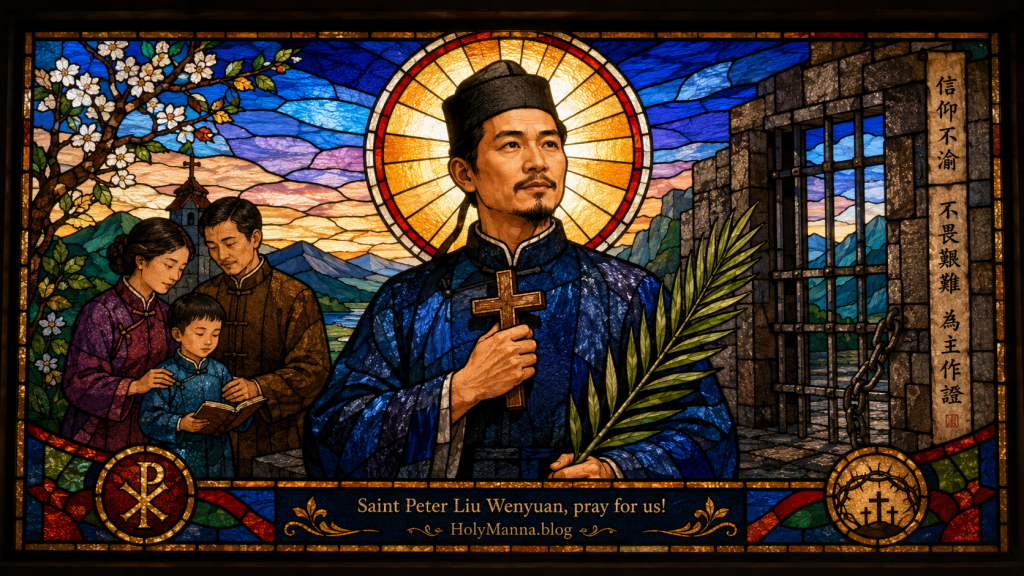
The Man Who Would Not Leave the Faith Behind
Saint Peter Liu Wenyuan was not a bishop, priest, monk, or famous theologian. He was a Chinese Catholic layman, a husband, a father, a catechist, and a martyr. That alone makes his story feel close to home.
He belonged to the Church in China during a time when being Catholic could cost a person everything. For Peter, it did. He lost his freedom, endured exile, suffered separation from his family, and finally gave his life for Christ. Yet his story is not mainly about cruelty. It is about fidelity. It is about a baptized layman who loved Jesus so deeply that no court, prison, exile, or threat could make him turn away.
The Church remembers Saint Peter Liu Wenyuan as one of the 120 Martyrs of China, canonized by Pope Saint John Paul II on October 1, 2000. His individual feast day is May 17, the day of his martyrdom. Along with the other Chinese martyrs, he is also remembered on July 9, the feast of Saint Augustine Zhao Rong and Companions.
Saint Peter’s life reminds Catholics today that holiness is not reserved for the sanctuary. Sometimes it grows in a family home, in a field, in a prison cell, and in the heart of a father who simply refuses to abandon Christ.
A Convert Formed by Grace
The details of Saint Peter Liu Wenyuan’s early life are not as complete as those of some saints. Catholic sources agree that he was born in China, most likely in the Guizhou region, into a non-Christian family. Some traditions place his birth around 1760, while others give a later date, around 1790. Because the official Church biography is brief, the exact date should be treated with caution.
What is clearer is the beauty of his conversion.
Catholic tradition says Peter came to know Christianity through the witness of another believer. Some accounts say a Christian friend introduced him to the faith. Another tradition says a Catholic silk merchant spoke to him about Jesus while Peter was working as a farmer. Either way, the pattern is deeply Catholic and deeply human. One ordinary Christian shared the faith, and another soul began to move toward Christ.
Peter eventually received baptism and took the Christian name Peter. That name was not small. Like Saint Peter the Apostle, this Chinese convert would one day be asked to stand firm when fear pressed against him. Like the first Peter, he would have to answer the question beneath every martyr’s life: Do you belong to Christ, even when it costs you everything?
Peter married and had children. He did not leave ordinary life behind in order to become holy. Instead, grace entered his ordinary life and transformed it. He became a catechist, teaching the Catholic faith to others and strengthening believers during persecution.
This matters. The Catechism of the Catholic Church teaches that lay people share in Christ’s mission by the witness of their lives and by proclaiming the Gospel. CCC 905 says, “Lay people also fulfill their prophetic mission by evangelization, that is, the proclamation of Christ by word and the testimony of life.” Saint Peter Liu Wenyuan lived that teaching before most Catholics today had ever heard those words.
A Catechist in a Time of Fear
Saint Peter Liu Wenyuan is most known for being a faithful lay catechist. He taught the faith when the faith was dangerous. He encouraged Christians when fear could easily have silenced them. He witnessed to Christ in a land where Catholic life was often watched, restricted, and punished.
The Chinese Catholic martyrs came from many walks of life. Some were priests. Some were religious. Many were laypeople. Some were children. Some were parents. Saint Peter stands among them as a reminder that catechists are often the hidden backbone of the Church, especially in times and places where priests are few or persecution is strong.
A catechist does more than repeat religious information. A true catechist hands on a living faith. He teaches souls how to pray, how to trust God, how to receive suffering with hope, and how to remain Catholic when the world says it would be easier to compromise.
That was Peter’s mission.
There are no well-attested miracles performed by Saint Peter during his lifetime in the official accounts. That should not disappoint us. His miracle, in a very real spiritual sense, was perseverance. He kept the faith when his life was pulled apart. He taught Christ when teaching Christ could bring punishment. Catholic tradition also remembers that he converted or strengthened others while imprisoned or exiled, though the exact details are not easy to verify.
That kind of hidden fruit is often how God works. The greatest miracle in a saint’s life is not always a healing or a vision. Sometimes it is a soul that refuses to stop loving Jesus.
Exile, Slavery, and the Long Road of Fidelity
In 1814, Saint Peter Liu Wenyuan was arrested because of his Catholic faith. The official Vatican account says he was condemned to exile in Tartary, where he remained for almost twenty years. Other Catholic sources say he was sent to Mongolia or Manchuria and even sold into slavery. Some accounts differ on the exact place and timeline, but they agree on the heart of the story: Peter suffered long years of exile because he would not abandon Christ.
This was not a quick martyrdom. Peter’s road to heaven passed through years of humiliation, separation, and endurance.
Imagine the weight of that. He was a husband and father. He had a home. He had people who needed him. He had the ordinary hopes any Catholic father might have: to work, pray, raise his children, and live in peace. Then persecution came and stripped those things away.
Yet Peter endured. He did not treat exile as a sign that God had abandoned him. He carried the faith into suffering.
This is where his life becomes painfully relevant. Many Catholics today may never face imprisonment for the faith, but they do face quieter forms of exile. Some are mocked by family. Some are isolated at work. Some feel strange or out of step because they believe what the Church teaches. Some suffer quietly because fidelity to Christ has cost them relationships, comfort, or opportunities.
Saint Peter Liu Wenyuan teaches that exile does not have to destroy faith. It can purify it.
The Catechism says in CCC 1808 that fortitude gives “firmness in difficulties and constancy in the pursuit of the good.” It also says fortitude enables a person to face trials and persecutions, even fear of death. Saint Peter’s life is a picture of that virtue made flesh.
The Father Who Went to the Prison
After many years, Peter was allowed to return home. Some Catholic sources say this happened around 1827, while others say around 1830. What matters most is that his return did not mark the end of his trials.
Persecution came again.
One of the most moving stories associated with Saint Peter concerns his family. Catholic tradition says that one of his sons and his daughter-in-law, along with other Catholics, were imprisoned after refusing to permit pagan funeral rites for a deceased Christian friend. Peter went to the prison to comfort them and strengthen them in the faith.
Another tradition adds a vivid detail. Peter is said to have disguised himself as a vegetable merchant so he could get near the prison and encourage his imprisoned family members. This detail comes from later hagiographical tradition and cannot be verified with certainty, but it fits the remembered character of the saint: a father, catechist, and comforter of suffering Christians.
That image is unforgettable. An elderly Catholic father, already tested by exile, does not hide in safety. He goes toward the prison. He goes toward danger. He goes toward his children and fellow believers.
That is Catholic love.
It is the love Saint Paul describes when he says in 1 Corinthians 13:7, “Love bears all things, believes all things, hopes all things, endures all things.” Peter’s love endured. His faith did not make him less of a father. It made him a braver one.
According to tradition, a soldier recognized him as a Catholic, and Peter was arrested again.
Strangled for the Name of Christ
After his second arrest, Peter was brought before the tribunal. He was accused of being Christian. He confessed the faith. He was condemned to death by strangulation.
On May 17, 1834, Saint Peter Liu Wenyuan was martyred.
The Church does not remember his death as a tragedy without meaning. The Church remembers it as martyrdom. CCC 2473 teaches, “Martyrdom is the supreme witness given to the truth of the faith.” A martyr does not merely die. A martyr bears witness. A martyr says with his body what his lips already confessed: Christ is worth everything.
Catholic tradition preserves one saying attributed to Saint Peter. After hearing of great suffering in his family, including the death of his eldest son in prison according to one account, he is said to have sighed, “May the will of God be done.” Because this comes from later hagiographical tradition rather than the brief official Vatican account, it should be received carefully. Still, it beautifully expresses the soul of the saint.
Those words do not mean suffering is easy. They do not mean Peter felt nothing. They mean that even grief was placed into the hands of God.
That is not weakness. That is heroic faith.
Signs, Stories, and the Light Around His Death
No widely documented posthumous miracles are commonly associated with Saint Peter Liu Wenyuan in the strongest Catholic sources. However, Catholic tradition does preserve several miraculous signs or legends surrounding his martyrdom.
One story says that while Peter was praying in prison, a large white cloth appeared before him and then vanished when the soldiers came to take him away. This was interpreted as a sign of his approaching death. This story belongs to devotional tradition and cannot be verified with certainty.
Another tradition says that as Peter was led out for execution, a globe of fire descended from heaven and rested above his head. The same account says an angel wiped blood from his face and carried his soul to heaven. These are beautiful martyr legends, but they should be presented as legends because they cannot be historically verified from the official Church summary.
After his execution, another touching tradition says that Peter’s wife came to recover his body and buried him in the garden or orchard he had cared for. This detail, too, comes from hagiographical tradition, but it is deeply fitting. The catechist who cultivated souls was laid to rest in the earth he had cultivated.
His legacy did not end in that garden.
Saint Peter Liu Wenyuan was beatified by Pope Leo XIII on May 27, 1900, and canonized by Pope Saint John Paul II on October 1, 2000, with the 120 Martyrs of China. Their witness continues to shape Chinese Catholic memory, especially in parishes and communities named for the Chinese Martyrs. Their feast is celebrated on July 9, and Saint Peter’s individual remembrance remains May 17.
His cultural impact is tied to the broader witness of the Chinese martyrs. These saints remind the whole Church that Catholicism is not foreign to any people or culture. The Gospel can take root in every land. It took root in China through priests, religious, catechists, parents, children, and ordinary believers who loved Jesus more than life.
A Saint for Parents, Catechists, and Quietly Tested Catholics
Saint Peter Liu Wenyuan is a saint for anyone who thinks ordinary life cannot become holy.
He was a husband. He was a father. He was a convert. He was a catechist. He suffered exile. He returned home. He went to comfort imprisoned Christians. He confessed Christ. He died a martyr.
His life teaches that Catholic faith is not just something kept privately in the heart. It must become visible in love, courage, teaching, sacrifice, and fidelity. Jesus says in Matthew 10:32, “So every one who acknowledges me before men, I also will acknowledge before my Father who is in heaven.” Saint Peter Liu Wenyuan acknowledged Christ before men, before prison walls, before courts, and before death.
For modern Catholics, his witness is both challenging and encouraging.
It is challenging because many of us want a faith that costs very little. We want Catholic identity without Catholic sacrifice. We want courage, but only if it does not disturb our comfort. Peter’s life gently but firmly says that real discipleship must be ready to suffer.
It is encouraging because Peter shows that holiness is possible in ordinary vocations. A parent can be a saint. A catechist can be a saint. A worker can be a saint. A convert can become a pillar of faith. A person who has suffered greatly can still become a witness of hope.
The lesson is simple, but not easy: stay faithful where God has placed you. Teach the faith. Comfort the suffering. Do not abandon Christ when obedience becomes costly. And when life becomes heavy, pray with the trust remembered in Saint Peter’s story: “May the will of God be done.”
Where is Christ asking for quiet courage in your life right now?
Who needs you to be a steady Catholic witness, not with loud speeches, but with faithful love?
What would change if your home, work, and parish life became places where you handed on the faith like Saint Peter Liu Wenyuan?
Engage with Us!
Share your thoughts and reflections in the comments below. Saint Peter Liu Wenyuan’s story is simple on the surface, but it reaches deep into family life, courage, suffering, and the lay vocation to holiness.
- What part of Saint Peter Liu Wenyuan’s story challenged you the most?
- How can Catholic parents today imitate his courage in handing on the faith to their children?
- Have you ever felt pressure to hide your Catholic faith in order to avoid conflict or rejection?
- What does his traditional prayer, “May the will of God be done,” teach you about trusting God in suffering?
- How can catechists, teachers, parents, and parish volunteers draw strength from his example?
Saint Peter Liu Wenyuan reminds us that holiness does not need fame. It needs fidelity. It needs courage. It needs love that keeps walking toward Christ, even when the road leads through suffering.
May his witness encourage us to live the faith boldly, teach the truth lovingly, comfort those who suffer, and do everything with the love and mercy Jesus taught us.
Saint Peter Liu Wenyuan, pray for us!
Follow us on YouTube, Instagram and Facebook for more insights and reflections on living a faith-filled life.


Leave a Reply