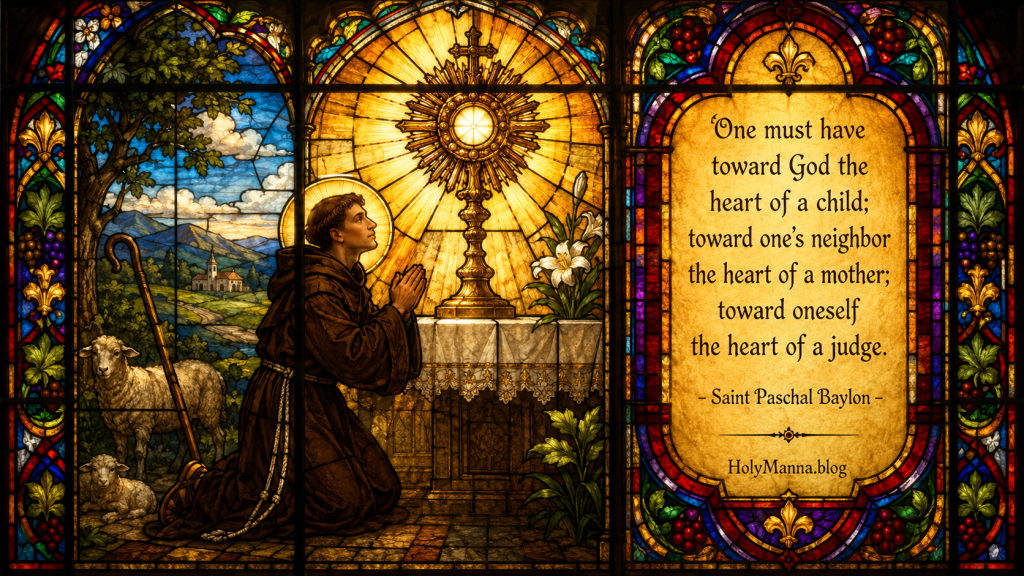
A Poor Brother with a Eucharistic Heart
Saint Paschal Baylon is one of those saints who reminds the Church that holiness is not reserved for the famous, the educated, the wealthy, or the powerful. He was a shepherd, a servant, a cook, a porter, a beggar for the friars, and a humble Franciscan lay brother. Yet the Church remembers him as the “Seraph of the Eucharist,” a man so deeply in love with Jesus in the Blessed Sacrament that his whole life seemed to orbit the tabernacle.
He was born in Spain in the sixteenth century, during a time when the Catholic faith was being defended, renewed, and proclaimed with great intensity. This was the age of saints like Saint Teresa of Ávila, Saint John of the Cross, Saint Ignatius of Loyola, and Saint Francis Xavier. Saint Paschal belonged to that great Catholic century, but his path was quieter. He did not found a religious order. He did not preach to nations. He did not become a priest. He simply loved Jesus in the Eucharist with the purity of a child and the strength of a warrior.
That is why the Church honors him as the patron of Eucharistic congresses and Eucharistic associations. His life beautifully reflects what The Catechism of the Catholic Church teaches when it says that the Eucharist is “the source and summit of the Christian life” CCC 1324. Saint Paschal believed that truth with every breath. For him, the consecrated Host was not a symbol, not a reminder, and not a religious object. It was Jesus Christ Himself, truly present.
A Shepherd Boy Learning to Pray in the Fields
Saint Paschal Baylon was born on May 16, 1540, in Torrehermosa, in the region of Aragon, Spain. His family was poor but devout. His parents, Martín Baylón and Isabel Jubera, raised him in the Catholic faith, but poverty meant that Paschal had to work from childhood. He became a shepherd at a young age, spending long days in the fields watching sheep.
To many people, that might sound like a lonely life. For Paschal, it became a hidden school of prayer. The open fields became his chapel. The silence became his teacher. The sheep became his responsibility before God. He learned to read slowly and humbly, using prayer books when he could. He prayed the Rosary, honored the Blessed Virgin Mary, and developed a deep love for the Holy Mass.
One of the most beautiful traditions from his youth says that when Paschal heard the church bell ring at the moment of the consecration, he would stop wherever he was, kneel in the field, and adore Jesus from afar. He could not always be physically present at Mass, but his heart ran to the altar. That simple image says almost everything about him: a poor shepherd boy kneeling in the dirt, adoring Christ hidden under the appearance of bread.
Catholic tradition also says that Paschal carved a cross and an image of the Blessed Virgin Mary into his shepherd’s staff so that he could pray before them while tending the flock. Another story says that when his fellow shepherds were thirsty, he struck the ground with his staff and a spring of water flowed. This story belongs to devotional tradition and cannot be firmly verified, but it reveals how Catholics remembered him: as a man whose prayer seemed to make even the hard ground fruitful.
As a young man, Paschal longed to become a Franciscan. Around the age of eighteen, he tried to enter the Franciscan community connected with the reform of Saint Peter of Alcantara, but he was not accepted at first. Rather than becoming discouraged, he remained nearby and continued working as a shepherd. A wealthy man reportedly offered to adopt him and make him his heir, but Paschal refused. He wanted poverty, not comfort. He wanted Christ, not status.
In 1564, he finally received the Franciscan habit, and the following year he made his profession as a religious brother. His superiors recognized his intelligence and holiness, and some encouraged him to consider becoming a priest. Paschal declined. He believed he was unworthy to touch the Eucharistic Lord with priestly hands. That was not a rejection of the priesthood. It was the humility of a man overwhelmed by the mystery of the altar.
The Lay Brother Who Became a Theologian of the Eucharist
As a Franciscan lay brother, Paschal embraced the humblest work in the friary. He served as porter, cook, gardener, and beggar. He cared for the poor and the sick who came to the friary door. He gave generously, sometimes so generously that the other friars had to gently restrain him. He did not see the poor as interruptions. He saw them as Christ coming to the door.
That is an important part of his holiness. Saint Paschal’s Eucharistic devotion did not make him cold, distant, or overly private. It made him more charitable. He adored Jesus in the tabernacle, and then he served Jesus in the hungry and the forgotten. This is deeply Catholic. The Eucharist always sends us outward in love. As The Catechism teaches, the Eucharist commits us to the poor, because to receive Christ truly is to recognize Christ in the least of our brothers and sisters CCC 1397.
Paschal spent long hours in prayer before the Blessed Sacrament, often at night. His fellow friars sometimes found him in deep ecstasy before the Eucharist. Some accounts say he was even seen lifted from the ground during adoration. These mystical experiences belong to the Church’s devotional memory of him and are consistent with how he has been remembered by Catholic tradition, though exact details are difficult to verify with modern historical standards.
What is easier to see is the fruit of his prayer. Though he had very little formal education, many people came to him for counsel. Learned men sought wisdom from the humble lay brother. He became known as a man of infused understanding, especially concerning the Eucharist. In that sense, he became a theologian without a classroom. His theology was learned on his knees.
Two sayings are especially associated with him. One beautiful and well-attested saying is: “One must have toward God the heart of a child; toward one’s neighbor the heart of a mother; toward oneself the heart of a judge.”
That one sentence could serve as a complete spiritual program. Toward God, trust. Toward others, tenderness. Toward oneself, honesty.
Another saying preserved from his writings is: “This is what you ask supremely: that God be sought above all else.”
That was Paschal’s life in a single line. Seek God above all else.
A Eucharistic saying is also traditionally attributed to him: “God is as really present in the consecrated Host as He is in the glory of Heaven.” This exact wording is best treated as traditionally attributed rather than firmly verified, but the doctrine is completely Catholic. The Catechism of the Catholic Church teaches that in the Eucharist, Christ is present “truly, really, and substantially” CCC 1374. Saint Paschal lived as if that sentence were written in fire across the door of every tabernacle.
A Defender of the Real Presence
One of the most dramatic moments in Saint Paschal’s life came in 1576. His Franciscan superiors sent him on a dangerous mission to France, carrying important documents to the Franciscan Minister General in Paris. At that time, parts of France were torn apart by religious conflict. Some regions were controlled by Huguenots, French Calvinists who rejected Catholic teaching on the Eucharist.
Paschal traveled in his Franciscan habit, which made him an obvious target. He was mocked, insulted, beaten, and threatened. At Orléans, he entered into a dispute over the Eucharist and defended the Catholic doctrine of the Real Presence. The crowd became violent, and Paschal narrowly escaped death. Some accounts say he was struck by stones and suffered an injury to his shoulder that affected him for the rest of his life.
This was not martyrdom in the strict sense, because he did not die from the persecution. But it was a real participation in the suffering of those who defend Christ before a hostile world. He was willing to bleed for the truth that Jesus is truly present in the Blessed Sacrament.
That courage matters today. Many Catholics live in a world that politely doubts, casually mocks, or simply ignores the Eucharist. Saint Paschal reminds us that the Real Presence is not a decorative Catholic idea. It is the burning center of the faith. If the Eucharist is truly Jesus, then adoration is not optional sentiment. It is the only sane response.
After returning from France, Paschal wrote a small collection of reflections defending the Real Presence of Christ in the Eucharist and the authority of the Roman Pontiff. These writings helped strengthen his reputation, and he came to be called the “Seraph of the Eucharist.” A seraph is associated with burning love. That title fits him perfectly. Paschal was not merely interested in the Eucharist. He burned with Eucharistic love.
The Hidden Crosses of a Humble Saint
Saint Paschal was not a martyr, but his life was still marked by suffering. He knew poverty from childhood. He embraced hard work. He practiced fasting and penance. He accepted lowly assignments in religious life. He endured ridicule and physical danger during his mission in France. He also carried the hidden suffering that comes with humility: being overlooked, misunderstood, and underestimated.
Yet none of this made him bitter. That may be one of the most important lessons from his life. Paschal did not use poverty as an excuse for resentment. He did not use humility as a performance. He did not use suffering to draw attention to himself. He gave everything quietly to Jesus.
Near the end of his life, he lived at the friary in Villa Real near Valencia. He continued serving as porter and beggar, welcoming the poor and gathering alms for the community. One day, while out begging, he collapsed. He understood that death was near. Like a true son of Saint Francis, he received death not as defeat, but as the final doorway to Christ.
Saint Paschal died on May 17, 1592, after receiving Holy Communion. Tradition notes a beautiful providence in the dates of his life. He was born around Pentecost and died around Pentecost. The man whose heart burned with Eucharistic fire died in the season of the Holy Spirit’s fire.
The Saint Who Adored Even After Death
The most famous story connected with Saint Paschal’s death happened at his funeral Mass. According to Catholic tradition, as the priest elevated the consecrated Host, Paschal opened his eyes and looked toward the Eucharist in adoration. Some versions say his eyes opened again at the elevation of the chalice.
This story is widely loved in Catholic devotion, though it should be presented carefully as a traditional account. It cannot be verified in the same way as his profession, mission to France, or canonization. Still, it beautifully expresses the truth of his life. Even in death, Saint Paschal was remembered as adoring the Eucharistic Lord.
Miracles were reported soon after his death. Pilgrims came to his tomb, and accounts of healings and divine favors spread. Some stories say that miraculous cures happened even before he was buried. Other accounts speak of graces received through his intercession at his tomb in Villa Real. The exact details of every miracle story cannot all be verified, but the Church’s recognition of his sanctity eventually led to his beatification and canonization.
He was beatified by Pope Paul V in 1618 and canonized by Pope Alexander VIII in 1690. In 1897, Pope Leo XIII proclaimed him patron of Eucharistic congresses and Eucharistic associations. This official patronage sealed what the faithful had already understood: Saint Paschal belonged especially to the mystery of the Eucharist.
His relics were venerated in Spain, but during the Spanish Civil War, his shrine was attacked and his remains were desecrated and scattered. Some relics were later recovered and returned to Villa Real in 1952. This painful part of his legacy is worth remembering. Even after death, the body of this Eucharistic saint was treated with violence. Yet devotion to him endured. His memory could not be destroyed.
Saint Paschal’s influence spread through Spain, Southern Italy, Latin America, and the Philippines. In sacred art, he is often shown in a Franciscan habit kneeling before a monstrance or adoring a vision of the Host. That image is his whole biography in one scene: poverty kneeling before glory.
In Naples and parts of Southern Italy, popular devotion to him became very strong, especially under Spanish influence. He also became associated in popular Catholic culture with cooks and pastry chefs, likely because of his humble service in friary kitchens. A colorful culinary legend connects him with zabaglione, the Italian dessert made with egg yolks, sugar, and wine. This story belongs to legend and cannot be verified, but it shows how deeply his name entered Catholic popular culture.
In the Philippines, Saint Paschal is honored in the famous Obando Feast of the Three Saints in Bulacan, alongside Saint Clare and Our Lady of Salambáo. The celebration includes Masses, processions, dancing, thanksgiving, and prayers for children, marriage, healing, and other needs. Because some elements of the Obando fertility dance may have older cultural roots, it should be understood through a Catholic lens: not as magic or superstition, but as popular devotion purified by prayer, the Mass, thanksgiving, and trust in God’s providence.
Learning to Kneel Before Love
Saint Paschal Baylon is a saint for anyone who feels ordinary. He is a saint for people who work simple jobs, serve quietly, pray imperfectly, and wonder whether hidden faithfulness matters. His life answers with a joyful yes.
He teaches that the tabernacle is not a side chapel of Catholic life. It is the throne room of the King. He teaches that adoration is not wasted time. It is love sitting in the presence of Love. He teaches that humility is not self-hatred. It is knowing one’s place before God and then serving others with peace.
His life also gives a needed correction to modern Catholic life. Some people want service without worship. Others want devotion without charity. Saint Paschal shows the Catholic both-and. He adored Christ in the Eucharist, and he served Christ in the poor. He defended doctrine, and he practiced mercy. He loved silence, and he opened the friary door to those in need.
The Eucharist formed him into a man of childlike trust, motherly compassion, and honest self-examination. That is why his saying still lands with such force: “One must have toward God the heart of a child; toward one’s neighbor the heart of a mother; toward oneself the heart of a judge.”
That is practical holiness. Trust God simply. Love others tenderly. Examine oneself truthfully.
Where does Saint Paschal’s life gently challenge the way the Eucharist is approached today? For many Catholics, the first step may be simple. Arrive at Mass a little earlier. Make a visit to the tabernacle during the week. Spend ten quiet minutes in adoration. Receive Holy Communion with deeper recollection. Serve the poor with more patience. Defend the faith without arrogance. Let love for Jesus become visible in love for people.
Saint Paschal did not need worldly power to become great. He needed the Eucharist. So do we.
Engage with Us!
Share your thoughts and reflections in the comments below. Saint Paschal Baylon’s life is simple on the surface, but it opens up some deep questions about prayer, humility, service, and belief in the Real Presence of Jesus in the Eucharist.
- How does Saint Paschal’s love for the Eucharist challenge the way you prepare for Mass and receive Holy Communion?
- When was the last time you spent quiet time before the tabernacle or in Eucharistic adoration?
- What humble task in your daily life could become an offering of love to God?
- Do you find it easier to serve others or to sit quietly with Jesus in prayer? What might Saint Paschal teach you about bringing those two together?
- How can you have toward God the heart of a child, toward your neighbor the heart of a mother, and toward yourself the heart of a judge?
May Saint Paschal Baylon help us become Catholics who truly believe what the Church teaches about the Eucharist, adore Jesus with reverence, serve others with tenderness, and live each ordinary day with extraordinary love. May our lives, like his, point quietly and faithfully to Christ, who gives Himself to us with endless love and mercy.
Saint Paschal Baylon, pray for us!
Follow us on YouTube, Instagram and Facebook for more insights and reflections on living a faith-filled life.


Leave a Reply