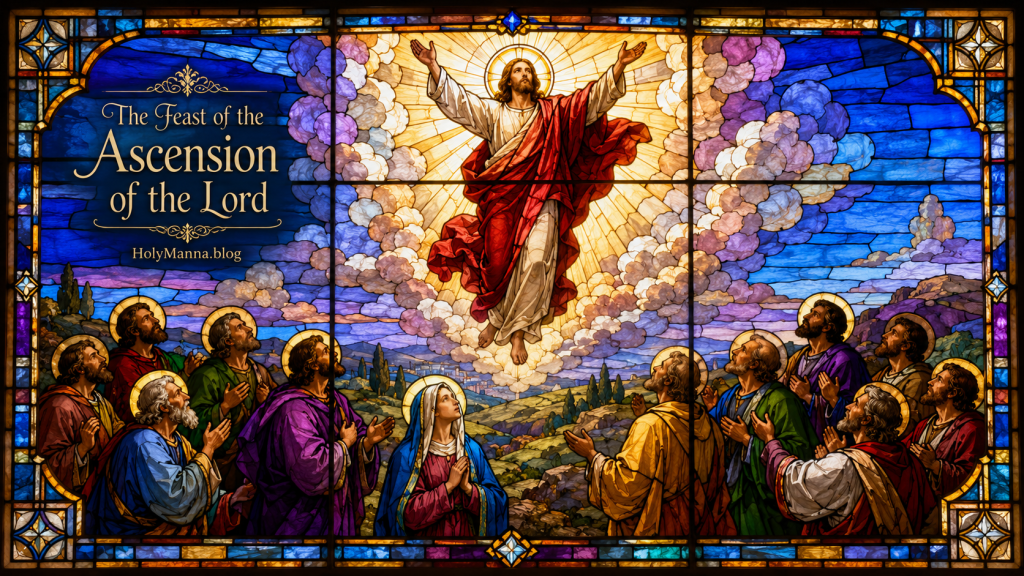
When Heaven Opened and the Mission Began
The Solemnity of the Ascension of the Lord celebrates one of the most glorious and hope-filled mysteries of the Catholic faith: Jesus Christ, risen from the dead, ascended bodily into heaven and is seated at the right hand of the Father.
At first glance, the Ascension can sound like a departure. Jesus rises from the dead, spends forty days with His disciples, and then is taken up into heaven. It can almost feel like the end of the story. But in the Catholic tradition, the Ascension is not Christ leaving His Church behind. It is His enthronement as King, His entrance as High Priest into the heavenly sanctuary, and the beginning of the Church’s mission to the nations.
The Ascension tells the faithful that Jesus did not merely rise from the dead as a spirit or memory. He rose in His glorified body. The same body born of the Virgin Mary, the same body nailed to the Cross, the same body laid in the tomb, and the same body touched by Thomas now enters the glory of the Father. This is why the feast matters so deeply. In Christ, human nature has entered heaven.
The Catechism of the Catholic Church teaches that “Christ’s Ascension marks the definitive entrance of Jesus’ humanity into God’s heavenly domain” CCC 665. That one sentence carries enough hope to strengthen a soul for a lifetime. Jesus has gone before us, not as a stranger to our weakness, but as the Head of His Body, the Church. Where the Head has gone, the Body is called to follow.
Forty Days of Glory and a Cloud of Mystery
The story of the Ascension begins after Easter morning. Jesus has conquered sin and death. The tomb is empty. The disciples have seen Him, touched Him, eaten with Him, listened to Him, and slowly begun to understand that everything He said was true.
St. Luke tells us in Acts of the Apostles that Jesus appeared to the Apostles for forty days after His Resurrection, speaking to them about the Kingdom of God. He did not rush them. He taught them. He strengthened them. He healed their fear and prepared them for mission.
Before ascending, Jesus tells them, “You will receive power when the Holy Spirit comes upon you, and you will be my witnesses in Jerusalem, throughout Judea and Samaria, and to the ends of the earth” Acts 1:8.
Then, while they are watching, He is lifted up, and a cloud takes Him from their sight. Two men in white garments appear and say, “Men of Galilee, why are you standing there looking at the sky?” Acts 1:11.
That question is almost tender, but it is also a wake-up call. The disciples are not supposed to stand there frozen in holy nostalgia. They are supposed to go back to Jerusalem, pray, wait for the Holy Spirit, and then carry the Gospel to the world.
The Ascension took place near Bethany, on or near the Mount of Olives, the place long associated with this mystery in Christian memory. The location matters because Catholicism is not a vague spiritual philosophy. It is historical. It is embodied. It is rooted in real places, real people, real wounds, real roads, and real witnesses.
The disciples had walked with Jesus through Galilee and Judea. They had seen Him mocked, crucified, buried, and risen. Now they see Him ascend. The One who humbled Himself to the point of death is now exalted. The One who wore a crown of thorns now reigns in divine glory.
The Ancient Feast of Christ’s Exaltation
The Ascension has been celebrated by the Church from very ancient times. St. Augustine considered the feast to be of apostolic origin, and by his era it was already observed widely in the Church. Early Christian writers such as St. John Chrysostom, St. Gregory of Nyssa, and St. Leo the Great preached on its meaning with reverence and joy.
In the early centuries, the Ascension was closely connected to the whole Paschal Mystery. Easter, Ascension, and Pentecost were understood as one great movement of salvation. Christ rises from the dead, appears to His disciples, ascends to the Father, and sends the Holy Spirit upon the Church.
The feast is traditionally celebrated forty days after Easter because Acts of the Apostles says that Jesus appeared to the disciples for forty days before ascending. In many places, it is celebrated on Ascension Thursday. In other dioceses, including many parts of the United States and Canada, it is transferred to the following Sunday so that more of the faithful can participate in the solemnity.
This transfer should not make the feast feel less important. The Ascension is one of the great solemnities of the Lord. It belongs to the heart of the Creed itself. Every Sunday at Mass, Catholics profess that Jesus “ascended into heaven and is seated at the right hand of the Father.”
That line is not decorative. It is not filler. It is the truth that the crucified and risen Jesus reigns now.
The Human Body at the Right Hand of the Father
The theological heart of the Ascension is stunning. Jesus brings our humanity into heaven.
The Son of God did not become man temporarily. The Incarnation was not a costume. Jesus remains true God and true man forever. His glorified human nature is now in the presence of the Father. That means human life has been lifted higher than any philosopher or emperor could have imagined.
The Catechism teaches that after the Resurrection, Christ’s glory remained veiled under ordinary appearances during the forty days when He ate and drank with His disciples. Then, through the Ascension, His humanity entered definitively into divine glory CCC 659. This is why the Ascension is not a rejection of the body. It is the glorification of the body in Christ.
This matters in a culture that often treats the body as either a toy, a burden, a brand, or a biological accident. The Ascension says something far greater. The body is destined for resurrection. The body is meant for glory. The body is not disposable. The body is part of God’s plan for salvation.
Jesus ascends with His wounds. He does not erase the marks of love. The wounds of the Cross become signs of victory. Heaven does not mean that suffering never happened. Heaven means that suffering surrendered to the Father through love can be transformed into glory.
The Ascension also reveals Christ as our eternal High Priest. The Catechism teaches that Jesus entered heaven itself and now appears before the face of God on our behalf CCC 662. He intercedes for us. He presents His sacrifice to the Father. He is the living bridge between heaven and earth.
That is why Catholics can pray with confidence. The Christian does not approach the Father alone. Jesus stands before the Father with His sacred humanity, His wounds, His priesthood, His mercy, and His love.
The King Who Is Not Far Away
One of the easiest mistakes to make is to imagine the Ascension as Jesus going far away. But the Church teaches the opposite. Jesus is not less present after the Ascension. He is present in a new, deeper, sacramental, and universal way.
Before the Ascension, Jesus was visibly present in one place at a time. After the Ascension, He reigns at the right hand of the Father and is present to His Church through the Holy Spirit, the sacraments, the Scriptures, the apostolic teaching of the Church, and above all the Eucharist.
St. Leo the Great gave one of the most famous homilies on the Ascension. He taught that what was visible in Christ passed into the sacraments. This does not mean Jesus became a vague idea. It means He now meets His Church through sacred signs He Himself established.
That is profoundly Catholic. The Lord who ascended into heaven still touches sinners through absolution. He still feeds the hungry soul through the Eucharist. He still gives new birth through Baptism. He still strengthens the confirmed through the Holy Spirit. He still blesses marriages, heals the sick, ordains priests, and gathers His people into one Body.
The Ascension is not absence. It is royal presence.
St. Augustine also preached beautifully on this feast. He reminded the faithful that Christ is the Head and the Church is His Body. Therefore, the Ascension of Christ is not merely something that happened to Jesus. It is the beginning of our own hope. Augustine urges believers to lift their hearts with Christ, while still living faithfully on earth.
This is the balance every Catholic needs. Hearts lifted to heaven. Feet planted in duty. Eyes fixed on Christ. Hands ready to serve.
The Mission Begins With Waiting
The Ascension also teaches the Church how mission works.
Jesus commands the Apostles to be His witnesses, but He does not tell them to run immediately into the streets with their own clever plans. He tells them to wait for the Holy Spirit.
That is a hard lesson for modern Christians. It is tempting to confuse activity with faithfulness. It is tempting to believe that if something is loud enough, busy enough, polished enough, or emotionally intense enough, it must be fruitful. But the Church is born from prayer before she is sent into mission.
After the Ascension, the Apostles return to Jerusalem. They gather in prayer with Mary, the Mother of Jesus. This prayerful waiting leads to Pentecost. For this reason, the days between Ascension and Pentecost became the foundation for the Pentecost Novena, one of the most beloved traditions of Catholic prayer.
This is not just a pious custom. It reflects the life of the first Church. The Apostles had seen the risen Lord. They had received the mission. But they still needed the Holy Spirit.
So do we.
A Catholic family needs the Holy Spirit. A parish needs the Holy Spirit. A tired parent needs the Holy Spirit. A young adult trying to stay faithful in a confused world needs the Holy Spirit. A priest preparing a homily, a teacher forming children, a worker trying to act with integrity, and a sinner trying to begin again all need the Holy Spirit.
The Ascension reminds us that Christian mission is never powered by ego. It is powered by grace.
Mount Olivet, Pilgrimage, and the Desire for Heaven
The Mount of Olives has long been associated with the Ascension. Pilgrims to the Holy Land have venerated the place where tradition remembers Christ ascending into heaven. The Chapel of the Ascension stands on the Mount of Olives, and Christian pilgrims continue to visit, pray, and remember the mystery.
There is something deeply Catholic about pilgrimage to a place like that. It reminds the soul that faith is not an abstraction. The Gospel happened in real geography. The Lord walked real paths. The Apostles stood on real ground. The Ascension was witnessed by real men who would soon become missionaries, bishops, martyrs, and saints.
The Ascension is also the Second Glorious Mystery of the Rosary. Traditionally, this mystery is associated with hope and the desire for heaven. When Catholics meditate on the Ascension, they are not merely remembering an event. They are learning to desire the Father’s house.
This is not escapism. A true desire for heaven makes a person more faithful on earth, not less. The Christian who remembers heaven can forgive more freely, suffer more patiently, resist temptation more bravely, and love more generously.
The Ascension also has a history of processions, especially in older Catholic customs. Some communities marked the feast with outdoor processions, banners, hymns, and prayers that recognized Christ’s lordship over creation. In some places, customs connected to the land, crops, and first fruits surrounded the season, especially near the traditional Rogation days. These practices expressed a simple Catholic instinct: if Christ is King, then fields, homes, families, labor, weather, harvest, and human life all belong under His blessing.
The Feast in the Life of the Church and the World
Around the world, the Ascension is celebrated with solemn Mass, joyful hymns, and readings filled with royal and missionary power. The Church sings with Psalm 47, “God mounts his throne to shouts of joy: a blare of trumpets for the Lord” Psalm 47:6.
This is the sound of Catholic hope. The King has returned victorious. The Lamb who was slain now reigns. The Cross was not defeat. The tomb was not the end. The Ascension is the coronation of the crucified Christ.
In some countries and dioceses, Ascension Thursday remains a holy day of obligation. In others, the feast is moved to Sunday. Either way, the celebration invites Catholics to recover a sense of heaven, kingship, mission, and hope.
The hymns of the feast often carry that same upward movement. They speak of Christ rising above the heavens, angels rejoicing, the gates of heaven opening, and the Church being sent forth. The liturgy does not treat the Ascension as a quiet farewell. It treats it as triumph.
Yet the triumph of Christ is not worldly triumph. Jesus does not reign like earthly rulers. He reigns as the Lamb. His throne is marked by sacrifice. His glory is inseparable from His wounds. His authority is revealed through mercy.
That is why this feast speaks so clearly to Catholics today. Many people are anxious, distracted, wounded, or spiritually tired. The Ascension says that Christ is not defeated by the chaos of the world. Christ reigns. Christ intercedes. Christ sends the Spirit. Christ prepares a place for His people.
Living With Hearts Lifted Up
The Ascension asks every Catholic to live with a different horizon.
Without heaven, daily life can shrink into survival, ambition, entertainment, and anxiety. With heaven, everything changes. Work becomes vocation. Suffering can become offering. Family life becomes a school of love. Prayer becomes oxygen. The sacraments become encounters with the living Christ. Death itself becomes a doorway, not a wall.
But the Ascension does not allow lazy spirituality. The angels ask the Apostles why they are standing there looking at the sky. That question is still for us.
It is possible to talk about faith without living mission. It is possible to admire Jesus without obeying Him. It is possible to love beautiful Catholic ideas while avoiding the hard work of forgiveness, chastity, patience, generosity, repentance, and evangelization.
The Ascension gently but firmly calls the Church out of spiritual comfort. Jesus reigns in heaven, and His disciples have work to do on earth.
That work begins close to home. It begins with prayer in the morning, patience with family, honesty at work, reverence at Mass, mercy toward the annoying person, courage in moral choices, and hope when life feels heavy. It begins with asking the Holy Spirit for help instead of trying to white-knuckle holiness alone.
The Ascension also invites the faithful to receive the Eucharist with fresh wonder. The same Jesus who sits at the right hand of the Father gives Himself under the appearance of bread and wine. Heaven touches the altar. The King feeds His people. The ascended Lord remains with His Church.
That is the Catholic heart of this feast. Jesus goes up, but He does not go away.
A Feast for the Tired, the Hopeful, and the Sent
The Ascension is a feast for anyone who feels stuck between heaven and earth.
It is for the person who believes but still struggles. It is for the parent trying to raise faithful children in a loud culture. It is for the young adult trying to stay pure, sane, and prayerful. It is for the grieving soul who needs to know death does not win. It is for the sinner who wonders whether mercy is still possible. It is for the disciple who knows the mission is too big and his strength is too small.
The Ascension answers with Jesus.
Christ is already where we hope to go. Christ carries our humanity into the Father’s glory. Christ intercedes for us. Christ sends the Holy Spirit. Christ remains with His Church. Christ will come again.
The disciples returned to Jerusalem with joy because they finally understood something. Jesus was not gone. Jesus was reigning.
That joy belongs to the Church today.
Do you live like heaven is real?
Do you believe that Jesus is interceding for you right now?
Where is Christ asking you to stop staring at the sky and begin living your mission?
What part of your life needs to be lifted toward heaven today?
Engage with Us!
Share your thoughts and reflections in the comments below. The Ascension is such a powerful feast because it speaks to hope, mission, heaven, the body, the Church, and the Holy Spirit. It is one of those mysteries that can meet each person differently depending on the season of life they are walking through.
- When you think about Jesus ascending bodily into heaven, what does that teach you about the dignity of your own body and your eternal destiny?
- Where in your life do you need more hope and a stronger desire for heaven?
- Are there places where you have been trying to do God’s work without first praying for the power of the Holy Spirit?
- How can the Ascension help you live your daily responsibilities with more courage, patience, and faithfulness?
- Who in your life needs to hear, through your words or your example, that Christ reigns and has not abandoned His people?
May this feast lift every Catholic heart toward heaven while keeping every Catholic life rooted in love. Christ has ascended. Christ reigns. Christ intercedes. Christ sends His Church on mission. So live with hope, walk with courage, and do everything with the love and mercy Jesus taught us.
Jesus Chrits, our God and King, we trust in You!
Follow us on YouTube, Instagram and Facebook for more insights and reflections on living a faith-filled life.

 Holy Manna!
Leave a comment