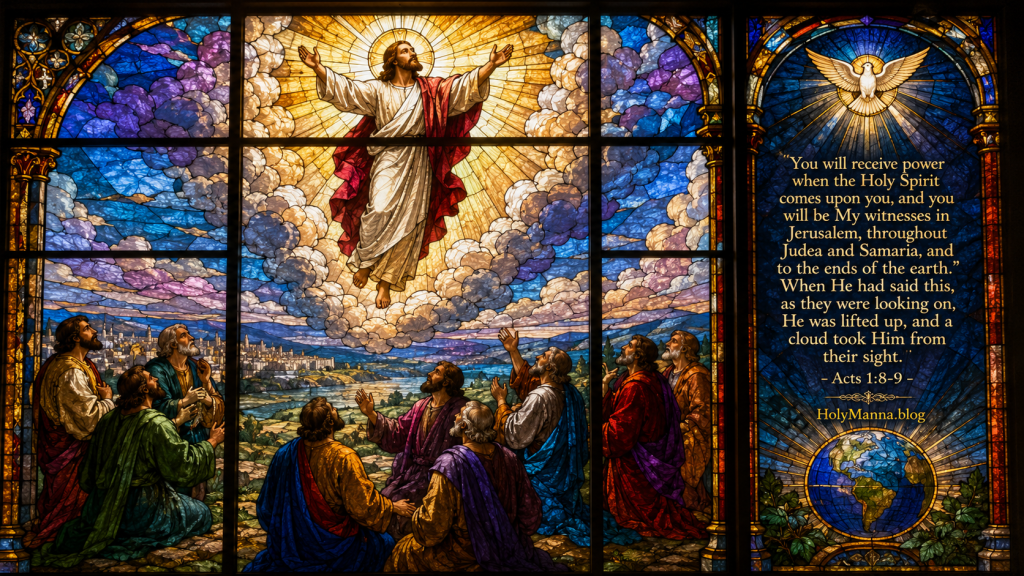
The Ascension of the Lord – Lectionary: 58
When the King Ascends, the Mission Begins
Some feasts feel like an ending, but the Ascension feels more like a door opening into everything the Church was born to become. Today’s readings gather the disciples at the edge of a mystery: Jesus has risen, He has taught them for forty days, and now He is lifted up into glory. Yet the Church does not stand there grieving as if Christ has vanished. She listens, worships, receives her mission, and prepares for the fire of the Holy Spirit.
The central theme of today’s readings is this: Christ ascends to reign, and His Church is sent to witness. In Acts 1:1-11, the apostles are still hoping for a restored earthly kingdom, but Jesus turns their attention from timelines to testimony. “You will receive power when the Holy Spirit comes upon you, and you will be my witnesses” Acts 1:8. In Psalm 47, the Church sings like a royal procession, proclaiming that God has mounted His throne with joy. In Ephesians 1:17-23, Saint Paul pulls back the veil and shows Christ seated above every power, ruler, dominion, and age. Then, in Matthew 28:16-20, the Risen Lord stands before the Eleven and gives the Great Commission: “Go, therefore, and make disciples of all nations” Matthew 28:19.
The Ascension took place within the deep religious memory of Israel. Mountains, clouds, thrones, trumpets, and divine glory were not random images to Jewish believers. The cloud recalled God’s presence in the wilderness and on Sinai. The mountain recalled covenant, revelation, and worship. The throne language echoed the psalms of Israel’s King, who rules not only one nation, but all peoples. Now the apostles begin to see that Jesus is not merely restoring one political kingdom. He is revealing the Kingdom of God, a kingdom that will reach Jerusalem, Judea, Samaria, and the ends of the earth.
From a Catholic perspective, the Ascension does not mean Jesus becomes distant. The Catechism teaches that Christ’s Ascension marks His entrance, in His humanity, into divine glory, where He intercedes for us and reigns at the right hand of the Father. The same Lord who rises beyond their sight remains truly present to His Church through the Holy Spirit, the sacraments, the apostolic mission, and above all, the Eucharist.
That is why today’s feast is not only about looking up. It is about being sent out. The angels ask the disciples, “Why are you standing there looking at the sky?” Acts 1:11. Their question still lands in the heart of every Catholic who loves Jesus but hesitates to live publicly as His witness. The Ascension asks the Church to stop treating faith like a private comfort and start receiving it as a mission.
Where is Christ sending His Church today? Where is He sending each disciple? And what would change if Catholics truly believed that the King who reigns in heaven is still with them always?
First Reading: Acts 1:1-11
The King rises into glory, and His witnesses are sent into the world.
The opening of Acts of the Apostles feels like the turning of a great page in salvation history. Saint Luke begins where his Gospel ended. Jesus has suffered, died, risen from the dead, and appeared to His apostles for forty days. Those forty days are not random. In Scripture, forty often marks a sacred time of preparation: Israel wandered forty years in the wilderness, Moses remained forty days on Sinai, Elijah journeyed forty days to Horeb, and Jesus fasted forty days in the desert. Now, after forty days of Resurrection teaching, the apostles stand at the threshold of the Church’s public mission.
This reading belongs perfectly to the theme of the Ascension: Christ ascends to reign, and His Church is sent to witness. The apostles still imagine the Kingdom in earthly terms, wondering whether Jesus will now restore political sovereignty to Israel. But Jesus widens their vision. The Kingdom will not be confined to one nation, one border, or one political moment. It will move outward through the power of the Holy Spirit, beginning in Jerusalem and reaching “to the ends of the earth” Acts 1:8.
The Ascension is not Jesus stepping away from His Church. It is Jesus taking His place at the right hand of the Father, where He reigns, intercedes, and sends the Holy Spirit. The apostles are not left abandoned. They are entrusted with a mission.
Acts 1:1-11 – New American Bible (Revised Edition)
The Promise of the Spirit. 1 In the first book, Theophilus, I dealt with all that Jesus did and taught 2 until the day he was taken up, after giving instructions through the holy Spirit to the apostles whom he had chosen. 3 He presented himself alive to them by many proofs after he had suffered, appearing to them during forty days and speaking about the kingdom of God. 4 While meeting with them, he enjoined them not to depart from Jerusalem, but to wait for “the promise of the Father about which you have heard me speak; 5 for John baptized with water, but in a few days you will be baptized with the holy Spirit.”
The Ascension of Jesus. 6 When they had gathered together they asked him, “Lord, are you at this time going to restore the kingdom to Israel?” 7 He answered them, “It is not for you to know the times or seasons that the Father has established by his own authority. 8 But you will receive power when the holy Spirit comes upon you, and you will be my witnesses in Jerusalem, throughout Judea and Samaria, and to the ends of the earth.” 9 When he had said this, as they were looking on, he was lifted up, and a cloud took him from their sight. 10 While they were looking intently at the sky as he was going, suddenly two men dressed in white garments stood beside them. 11 They said, “Men of Galilee, why are you standing there looking at the sky? This Jesus who has been taken up from you into heaven will return in the same way as you have seen him going into heaven.”
Detailed Exegesis
Verse 1: “In the first book, Theophilus, I dealt with all that Jesus did and taught.”
Saint Luke addresses Theophilus, the same figure named at the beginning of The Gospel of Luke. The name means “lover of God,” which makes him both a real recipient and a beautiful image of every believer who desires to understand the works of Christ. Luke says his first book concerned what Jesus “did and taught”, reminding readers that the Gospel is never only an idea. Jesus teaches with authority, but He also acts with mercy, healing, forgiveness, and sacrifice. In Catholic life, doctrine and action belong together. The truth we profess must become the life we live.
Verse 2: “Until the day he was taken up, after giving instructions through the holy Spirit to the apostles whom he had chosen.”
The Ascension is already in view. Jesus is “taken up”, but not before instructing the apostles. Their mission is not self-appointed. They are chosen, formed, and sent. Luke also says Jesus gives instructions “through the holy Spirit,” showing that the Spirit is already active in the life of Christ and will soon animate the life of the Church. Apostolic authority is not merely organizational. It is rooted in Christ’s choice and empowered by the Holy Spirit.
Verse 3: “He presented himself alive to them by many proofs after he had suffered, appearing to them during forty days and speaking about the kingdom of God.”
The Resurrection is not presented as a vague spiritual feeling. Jesus offers “many proofs.” He appears, speaks, eats, teaches, and shows that the same One who suffered is now alive. The Church’s faith rests on real events, not religious imagination. For forty days, Jesus speaks about the Kingdom of God. This matters because the apostles are not being trained for private devotion alone. They are being prepared to announce the reign of God in Christ.
Verse 4: “While meeting with them, he enjoined them not to depart from Jerusalem, but to wait for ‘the promise of the Father about which you have heard me speak.’”
Jesus tells them to wait. That can feel surprising. The apostles have seen the Risen Lord. They know the truth. They have a mission. Yet Jesus says they must not rush ahead without the promised Spirit. Jerusalem, the city of the Passion and Resurrection, will also become the birthplace of Pentecost. Catholic mission begins not with activity, but obedience. The Church must receive before she can give. She must be filled before she can be sent.
Verse 5: “For John baptized with water, but in a few days you will be baptized with the holy Spirit.”
Jesus contrasts John’s baptism with the coming baptism in the Holy Spirit. John’s baptism prepared hearts for repentance, but the Holy Spirit will empower the Church for supernatural mission. This verse points toward Pentecost, when the apostles will be transformed from fearful witnesses into bold preachers. In Catholic teaching, this also helps us see how the Christian life is not sustained by human willpower alone. Grace is necessary. The Holy Spirit makes the Church fruitful.
Verse 6: “When they had gathered together they asked him, ‘Lord, are you at this time going to restore the kingdom to Israel?’”
The apostles still struggle to understand the Kingdom. They are thinking in terms of Israel’s national restoration. They are not wrong to expect God’s promises to be fulfilled, but their vision is still too small. Jesus has come not only for Israel, but through Israel for all nations. Their question reveals how patient Jesus is with His disciples. Even after the Resurrection, their understanding is still being purified. That should console every Catholic who believes, worships, and still has questions.
Verse 7: “He answered them, ‘It is not for you to know the times or seasons that the Father has established by his own authority.’”
Jesus gently corrects their desire for a timeline. The future belongs to the Father’s authority. This does not mean Christians ignore the Second Coming. It means Christians do not control it. The Church lives in watchfulness, not speculation. Catholic faith is not built on decoding dates, chasing predictions, or panicking over world events. The disciple’s task is fidelity.
Verse 8: “But you will receive power when the holy Spirit comes upon you, and you will be my witnesses in Jerusalem, throughout Judea and Samaria, and to the ends of the earth.”
This is the heart of the reading. Jesus does not give them the date of the Kingdom’s fulfillment. He gives them the power and mission of witness. The movement begins in Jerusalem, then Judea, then Samaria, then the ends of the earth. This is the map of evangelization. The Church begins at the center of Israel’s worship and moves outward to every nation. The apostles are not sent as influencers, entertainers, or political reformers. They are sent as witnesses to Christ crucified, risen, ascended, and returning.
Verse 9: “When he had said this, as they were looking on, he was lifted up, and a cloud took him from their sight.”
The cloud is a deeply biblical sign. In the Old Testament, the cloud often marks God’s mysterious presence, such as the cloud over Sinai and the cloud that guided Israel in the wilderness. Here, the cloud receives Jesus from their sight, revealing His divine glory. The Ascension is not a disappearance into the sky. It is Christ’s exaltation. His humanity enters the glory of heaven. The One who humbled Himself even unto death is now glorified at the Father’s right hand.
Verse 10: “While they were looking intently at the sky as he was going, suddenly two men dressed in white garments stood beside them.”
The apostles gaze upward, understandably stunned. Then two men in white garments appear, recalling the angelic witnesses at the Resurrection. Heaven itself interprets what the disciples have seen. The white garments signal divine testimony. God does not leave the apostles to confusion. He gives them a message that turns their wonder into mission.
Verse 11: “They said, ‘Men of Galilee, why are you standing there looking at the sky? This Jesus who has been taken up from you into heaven will return in the same way as you have seen him going into heaven.’”
The angels do more than redirect the apostles’ eyes. They interpret the Ascension through the lens of Christian hope. Jesus has truly gone into heaven, but He has not disappeared into absence. He will return in glory. The same Lord who ascends will come again, not as a suffering servant hidden beneath weakness, but as the victorious Judge and King.
This final verse holds together two truths every Catholic needs. First, the Church must not stand frozen in nostalgia, staring at the place where Jesus once appeared. Second, the Church must never forget that history is moving toward His return. The Christian life is lived between Ascension and Second Coming. That is why Catholic discipleship is never passive. The Church waits, but she waits by worshiping, preaching, baptizing, teaching, serving, suffering, and witnessing.
Teachings: The Ascension, the Sacraments, and the Mission of the Church
The Ascension is one of the great mysteries of the Creed. Every Sunday, Catholics profess that Jesus “ascended into heaven and is seated at the right hand of the Father.” This is not symbolic poetry. It is a statement about the risen humanity of Christ entering divine glory. The Son of God did not abandon the human nature He took from the Virgin Mary. He raised it into heaven.
The Catechism of the Catholic Church teaches: “So then the Lord Jesus, after he had spoken to them, was taken up into heaven, and sat down at the right hand of God. Christ’s body was glorified at the moment of his Resurrection, as proved by the new and supernatural properties it subsequently and permanently enjoys. But during the forty days when he eats and drinks familiarly with his disciples and teaches them about the kingdom, his glory remains veiled under the appearance of ordinary humanity. Jesus’ final apparition ends with the irreversible entry of his humanity into divine glory, symbolized by the cloud and by heaven, where he is seated from that time forward at God’s right hand.” CCC 659
That teaching helps make sense of the cloud in Acts 1:9. The cloud is not just weather. It is biblical language for the presence and glory of God. Jesus is not floating away from the world. He is entering the glory proper to the Son, now with His sacred humanity.
The Church also teaches that the Ascension means Christ now intercedes for us. The Catechism says: “There Christ permanently exercises his priesthood, for he ‘always lives to make intercession’ for ‘those who draw near to God through him.’ As ‘high priest of the good things to come’ he is the center and the principal actor of the liturgy that honors the Father in heaven.” CCC 662
This is deeply consoling. The Ascended Lord is not idle. He is not watching from a distance like a king who has lost interest in his people. He is the eternal High Priest. Every Mass on earth is joined to His heavenly priesthood. Every prayer offered through Him reaches the Father through the Son. Every sacrament draws its power from the living Christ.
Saint Leo the Great preached beautifully on this mystery when he said: “Our Redeemer’s visible presence has passed into the sacraments.” St. Leo the Great, Sermon 74
That one line captures the Catholic imagination perfectly. The apostles no longer see Jesus walking beside them in the ordinary visible way, but the Church still encounters Him truly. He is present in His Word. He is present in the priest acting in His name. He is present when the Church prays. He is present in the poor and suffering. Above all, He is truly, really, and substantially present in the Eucharist.
The Ascension also reveals the Church’s mission. Jesus does not allow the apostles to remain as spectators of glory. He tells them they will receive the Holy Spirit and become His witnesses. The Catechism teaches: “The Church on earth is by her nature missionary since, according to the plan of the Father, she has as her origin the mission of the Son and the Holy Spirit.” CCC 850
That means evangelization is not a side project for unusually outgoing Catholics. It belongs to the Church’s identity. The Father sends the Son. The Father and the Son send the Holy Spirit. The Son sends the apostles. The apostles hand on the faith to the Church. Every baptized Catholic is drawn into that movement of divine mission.
The Ascension also keeps the Church focused on Christ’s return. The Catechism teaches: “Since the Ascension God’s plan has entered into its fulfillment. We are already at ‘the last hour.’ Already the final age of the world is with us, and the renewal of the world is irrevocably under way; it is even now anticipated in a certain real way, for the Church on earth is endowed already with a sanctity that is real but imperfect.” CCC 670
This is why Catholics live with both urgency and patience. The Kingdom has already begun in Christ, but it has not yet been fully manifested. The Church is holy, but still filled with sinners being purified. Christ reigns, but evil still thrashes around in history. The final victory is certain, but the mission is still unfolding.
Saint Augustine also gives a powerful lens for this reading. Speaking of Christ’s Ascension, he teaches that Christ is in heaven and yet remains with His Church on earth. In one of his Ascension sermons, he says: “He did not leave heaven when he came down to us; nor did he withdraw from us when he went up again into heaven.” St. Augustine, Sermon on the Ascension
That is the Catholic heart of this feast. Jesus ascends, but He does not abandon. Jesus reigns, but He remains near. Jesus is hidden from ordinary sight, but He is present in a deeper way through grace, the Holy Spirit, the sacraments, and the apostolic Church.
Reflection: Stop Staring, Start Witnessing
This reading speaks directly to the Catholic who believes in Jesus but still hesitates to be sent by Him. The apostles are standing there, looking upward, and honestly, it makes sense. Who would not stare after seeing the Lord ascend into glory? But the angels lovingly interrupt them. There is a time to gaze, and there is a time to go.
Many Catholics can get stuck in a kind of spiritual staring. They love beautiful liturgies, Catholic podcasts, Scripture reflections, saint quotes, and theological discussions. Those are good things. They can strengthen the soul. But if they never lead to witness, something is incomplete. The Ascension turns contemplation into mission.
Jesus does not give the apostles control over the future. He gives them the Holy Spirit. He does not give them every answer about timing. He gives them a task. That is often how God works in daily life. The anxious heart wants certainty. Christ gives grace. The restless mind wants a schedule. Christ gives a mission. The fearful disciple wants to wait until everything feels clear. Christ says the Holy Spirit will provide power.
This reading invites Catholics to begin close to home. Jerusalem came first for the apostles. That means witness often begins in the ordinary places already given to us: the family dinner table, the workplace conversation, the parish ministry, the friendship that needs honesty, the child who needs formation, the spouse who needs patience, the stranger who needs mercy.
A Catholic does not need to have every theological answer before becoming a witness. The apostles themselves still needed formation. They still misunderstood parts of the Kingdom. Yet Jesus still chose them, instructed them, and promised the Holy Spirit. The key is not personal perfection. The key is fidelity to Christ and openness to the Spirit.
A simple way to live this reading is to pray each morning, “Come, Holy Spirit.” Then ask for one concrete opportunity to witness that day. It may be a word of encouragement. It may be an invitation to Mass. It may be refusing gossip. It may be making the Sign of the Cross before lunch without embarrassment. It may be explaining Catholic teaching with charity instead of anger. It may be forgiving someone when pride wants to keep score.
The Ascension also invites deeper trust in the sacraments. Since Christ’s visible presence has passed into the sacramental life of the Church, the Catholic disciple should not live far from Confession, the Eucharist, Adoration, and prayer. The Lord who ascended is still feeding, forgiving, strengthening, and sending His people.
Where has the heart been staring at the sky instead of obeying the mission?
What timeline or outcome needs to be surrendered to the Father’s authority?
Who is the “Jerusalem” closest to home where Christ is asking for faithful witness?
What would change this week if the words of Jesus were taken personally: “You will be my witnesses” Acts 1:8?
The First Reading ends with the apostles looking upward, but the story of the Church moves forward. Soon the Holy Spirit will come like fire. Fearful men will become bold preachers. Jerusalem will hear the Gospel. The nations will receive Baptism. The Church will carry Christ to the ends of the earth.
The Ascended Lord still reigns.
The Holy Spirit is still given.
The Church is still sent.
Responsorial Psalm: Psalm 47:2-3, 6-9
The Church claps, sings, and shouts because the crucified King now reigns over all the earth.
The responsorial psalm for the Ascension does not sound like a farewell song. It sounds like a coronation. Psalm 47 belongs to the royal praise of Israel, the kind of prayer that imagines all nations recognizing the Lord as King. In ancient Israel, worship was never merely private. Trumpets, shouts, processions, and songs filled the sacred imagination of God’s people because the Lord was not one tribal deity among many. He was the Most High, the great King over all the earth.
On the Solemnity of the Ascension, the Church hears this psalm with Christian ears. The words “God has gone up with a shout” Psalm 47:6 become a joyful prophecy fulfilled in Christ. The One who descended into our humanity, suffered on the Cross, and rose from the tomb now ascends to the Father. He does not ascend as a defeated victim escaping the world. He ascends as King, Priest, and Lord.
This fits today’s central theme perfectly. Christ ascends to reign, and His Church is sent to witness. Before the apostles go out to the nations in Acts of the Apostles and before Jesus commands them to make disciples in The Gospel of Matthew, the Church sings the truth that makes mission possible: God reigns over every people, every nation, every heart, and every age.
Psalm 47:2-3, 6-9 – New American Bible (Revised Edition)
2 All you peoples, clap your hands;
shout to God with joyful cries.
3 For the Lord, the Most High, is to be feared,
the great king over all the earth,6 God has gone up with a shout;
the Lord, amid trumpet blasts.
7 Sing praise to God, sing praise;
sing praise to our king, sing praise.8 For God is king over all the earth;
sing hymns of praise.
9 God rules over the nations;
God sits upon his holy throne.
Detailed Exegesis
Verse 2: “All you peoples, clap your hands; shout to God with joyful cries.”
The psalm begins with an invitation that reaches beyond Israel. “All you peoples” means the worship of God is meant to become universal. This already points toward the mission Jesus gives in Matthew 28:19, when He commands the apostles to make disciples of all nations. The clapping and shouting are not shallow excitement. They are the bodily expression of a people who recognize victory. Catholic worship is reverent, but it is not lifeless. The whole person is meant to praise God: heart, voice, body, mind, and soul.
Verse 3: “For the LORD, the Most High, is to be feared, the great king over all the earth.”
The joy of verse 2 is grounded in holy fear. This is not servile terror, but reverent awe before the Lord’s majesty. God is “the Most High”, not a manageable religious idea or a private comfort we can shape according to preference. He is “the great king over all the earth.” In the light of the Ascension, this kingship is revealed in Christ, who says in Matthew 28:18, “All power in heaven and on earth has been given to me.” The risen Jesus reigns not only over the Church, but over all creation.
Verse 6: “God has gone up with a shout; the LORD, amid trumpet blasts.”
This is the verse the Church especially hears on Ascension Day. The image is royal and liturgical. Trumpets announce victory. Shouts accompany the King’s enthronement. In its original setting, this language may have evoked Israel’s worship, perhaps even processions connected to the ark or temple praise. In Christ, the verse reaches its deepest meaning. Jesus ascends in glory, and heaven receives the King. The apostles see Him lifted up, but the psalm teaches the Church how to interpret what they saw: this is not loss. This is enthronement.
Verse 7: “Sing praise to God, sing praise; sing praise to our king, sing praise.”
The command is repeated because praise must be learned, repeated, and deepened. The psalmist does not say praise once and move on. He says it again and again. Catholic life works the same way. The Church repeats the Creed, repeats the Psalms, repeats the prayers of the Mass, and returns again and again to the Eucharist because love deepens through faithful repetition. The Ascension calls the Church to praise Christ not only with Sunday words, but with a whole life ordered toward His reign.
Verse 8: “For God is king over all the earth; sing hymns of praise.”
The psalm returns to the reason for worship: God is King. This is not merely a comforting phrase. It is a claim about reality. Earthly rulers rise and fall. Cultures change. Economies tremble. Nations argue. Families struggle. Hearts get restless. Yet God remains King over all the earth. The Ascension reveals that this kingship is now visible in the glorified humanity of Jesus Christ. The world is not ultimately ruled by chaos, sin, politics, technology, money, or fear. Christ reigns.
Verse 9: “God rules over the nations; God sits upon his holy throne.”
The final verse gives the psalm its throne room. God rules over the nations, and He sits upon His holy throne. For the Christian, this points directly to Christ seated at the right hand of the Father. The Ascension does not remove Jesus from history. It reveals His lordship over history. This is why the Church can go out to the nations without despair. The apostles are sent into a dangerous world, but they are not sent by a powerless teacher. They are sent by the enthroned King.
Teachings: Christ the King Who Reigns From Heaven
The Ascension fulfills the royal hope sung in Psalm 47. Israel praised the Lord as King over the nations, and the Church now proclaims that Jesus Christ, true God and true man, has entered heavenly glory and reigns at the right hand of the Father.
The Catechism of the Catholic Church teaches: “Christ’s Ascension into heaven signifies his participation, in his humanity, in God’s power and authority. Jesus Christ is Lord: he possesses all power in heaven and on earth. He is ‘far above all rule and authority and power and dominion,’ for the Father ‘has put all things under his feet.’ Christ is Lord of the cosmos and of history. In him human history and indeed all creation are ‘set forth’ and transcendently fulfilled.” CCC 668
That teaching gives Psalm 47 its full Christian force. When the Church sings that God rules over the nations, she is not speaking vaguely. She is confessing that Jesus Christ is Lord of the cosmos and history. His kingship is not symbolic in the weak sense. It is real, universal, and everlasting.
The Catechism also teaches: “As Lord, Christ is also head of the Church, which is his Body. Taken up to heaven and glorified after he had thus fully accomplished his mission, Christ dwells on earth in his Church. The redemption is the source of the authority that Christ, by virtue of the Holy Spirit, exercises over the Church. ‘The kingdom of Christ [is] already present in mystery,’ ‘on earth, the seed and the beginning of the kingdom.’” CCC 669
This is important because the Ascension does not make Christ absent from the earth. He reigns from heaven and dwells on earth in His Church. His Kingdom is already present in mystery, especially through the sacraments, the apostolic faith, the saints, the Eucharist, and the work of grace in ordinary believers.
Saint Augustine, reflecting on the Ascension, taught that Christ’s exaltation does not separate Him from His people. His words are deeply consoling: “He did not leave heaven when he came down to us; nor did he withdraw from us when he went up again into heaven.” St. Augustine, Sermon on the Ascension
That is why the psalm can be so joyful. Jesus has gone up, but He has not gone away. The throne of heaven does not make Him distant. It reveals the majesty of the One who remains near through the Holy Spirit and the sacramental life of the Church.
Saint Leo the Great also teaches the Church how to understand this mystery. He says: “Our Redeemer’s visible presence has passed into the sacraments.” St. Leo the Great, Sermon 74
This means the Church does not cling to the Ascension as if it were a memory of something lost. The same King praised in Psalm 47 still comes to His people. He comes in the Eucharist. He forgives in Confession. He strengthens in Confirmation. He joins bride and groom in Matrimony. He anoints the sick. He acts through His Church because He reigns as Head of His Body.
Historically, the Church has always linked the Ascension with mission. Christ is enthroned, therefore the Gospel can be preached to every nation. The apostles are not sent out with a fragile idea. They are sent out under the authority of the King who rules heaven and earth. The trumpet blasts of Psalm 47 become, in the life of the Church, the preaching of the Gospel, the ringing of church bells, the chanting of the Mass, and the quiet witness of faithful Catholics who live as if Christ truly reigns.
Reflection: Let the Heart Sing Like Christ Is Really King
Psalm 47 asks modern Catholics a simple but uncomfortable question: Does the heart actually live like Christ is King?
It is easy to say Jesus reigns when life is peaceful. It is harder when the news is heavy, the family is tense, the bills are real, the culture feels confused, and the soul is tired. Yet the psalm does not say God becomes King when life feels stable. It says God is King over all the earth.
That truth should change the way Catholics move through daily life. If Christ reigns, then fear does not get the final word. If Christ reigns, then politics cannot become an idol. If Christ reigns, then personal suffering is not meaningless. If Christ reigns, then the Church’s mission still matters. If Christ reigns, then every Mass is more than a routine. It is worship offered to the King of heaven and earth.
One practical way to live this psalm is to begin the day with an act of praise before checking the phone. A simple prayer can reorder the heart: “Jesus Christ, You are Lord of heaven and earth. Reign in this home, this work, this suffering, and this day.” That kind of prayer is not dramatic. It is faithful. It teaches the soul to clap and sing even before circumstances improve.
Another way is to bring reverence back into ordinary Catholic life. Make the Sign of the Cross slowly. Genuflect like Christ is truly present in the tabernacle. Sing at Mass instead of standing silently out of habit. Speak of God with warmth in the home. Let children, friends, coworkers, and family see that faith is not a private hobby, but allegiance to the King.
What fear has been acting like it owns the throne of the heart?
Where has praise become too quiet, too embarrassed, or too dependent on circumstances?
How would Sunday Mass feel different if the soul truly heard the trumpets of Psalm 47?
What part of daily life still needs to be placed under the reign of Jesus Christ?
The Ascension teaches that Jesus has gone up in glory. Psalm 47 teaches the Church how to respond. Clap. Sing. Shout with joy. Live with reverence. Go out with courage.
The King is on His throne, and His Church has every reason to praise.
Second Reading: Ephesians 1:17-23
Saint Paul prays that the Church would see what heaven already knows: Christ reigns, and His Body shares in His victory.
The second reading from Ephesians feels like someone pulling back the curtain between earth and heaven. The apostles in Acts 1:1-11 see Jesus lifted up until a cloud takes Him from their sight. Psalm 47 teaches the Church to sing because God has mounted His throne. Now Saint Paul tells the faithful what that heavenly enthronement means for everyday believers: Christ is raised, seated at the Father’s right hand, placed above every power, and given as Head of the Church, which is His Body.
Ephesus was not a quiet little religious town. It was a major city in the Roman world, famous for wealth, magic, trade, and the great temple of Artemis. Christians there lived in a culture crowded with spiritual claims, political powers, social pressure, and pagan worship. Saint Paul’s words would have landed with real force. He tells them that Jesus is not one power among many. He is above every principality, authority, power, dominion, and name.
This fits the central theme of today’s feast beautifully. Christ ascends to reign, and His Church is sent to witness. Before the Church can go out with courage, her heart must be enlightened. She must know who Christ is, where He reigns, what power raised Him, and how deeply she belongs to Him.
Ephesians 1:17-23 – New American Bible (Revised Edition)
17 that the God of our Lord Jesus Christ, the Father of glory, may give you a spirit of wisdom and revelation resulting in knowledge of him. 18 May the eyes of [your] hearts be enlightened, that you may know what is the hope that belongs to his call, what are the riches of glory in his inheritance among the holy ones, 19 and what is the surpassing greatness of his power for us who believe, in accord with the exercise of his great might, 20 which he worked in Christ, raising him from the dead and seating him at his right hand in the heavens, 21 far above every principality, authority, power, and dominion, and every name that is named not only in this age but also in the one to come. 22 And he put all things beneath his feet and gave him as head over all things to the church, 23 which is his body,[a] the fullness of the one who fills all things in every way.
Detailed Exegesis
Verse 17: “That the God of our Lord Jesus Christ, the Father of glory, may give you a spirit of wisdom and revelation resulting in knowledge of him.”
Saint Paul begins with prayer, not strategy. He asks the Father to give believers “a spirit of wisdom and revelation.” This means Christian understanding is not merely intellectual. It is a gift of grace. The faith is reasonable, but it cannot be reduced to information. A person can know many religious facts and still not truly know God. Saint Paul wants the faithful to receive a deeper knowledge of the Father through Christ, a knowledge that changes how they see suffering, mission, hope, and the Church.
Verse 18: “May the eyes of [your] hearts be enlightened, that you may know what is the hope that belongs to his call, what are the riches of glory in his inheritance among the holy ones.”
The phrase “the eyes of your hearts” is one of the most beautiful expressions in Saint Paul’s letters. The heart has a kind of vision. It can become clouded by fear, sin, distraction, resentment, or despair. Saint Paul prays that the faithful would see hope clearly. This hope is not vague optimism. It is the hope of a people called by God, destined for glory, and made heirs with the saints. The Ascension teaches that human nature, in Christ, has entered heavenly glory. That is the horizon of Christian hope.
Verse 19: “And what is the surpassing greatness of his power for us who believe, in accord with the exercise of his great might.”
Saint Paul wants believers to know God’s power, not as an abstract doctrine, but as a living reality “for us who believe.” This power is not worldly domination. It is the divine power that conquers sin, death, fear, and the devil. Catholics can sometimes live as if grace is weak and temptation is inevitable. Saint Paul says otherwise. The same God who acts in Christ also acts in His people. The Christian life depends not on self-help, but on supernatural grace.
Verse 20: “Which he worked in Christ, raising him from the dead and seating him at his right hand in the heavens.”
Here Saint Paul names the heart of the mystery. God’s power is revealed in the Resurrection and Ascension of Christ. The Father raises Jesus from the dead and seats Him at His right hand. In biblical language, the right hand is the place of honor, authority, and royal power. The Ascension is not Jesus fading into the clouds. It is the enthronement of the crucified and risen Lord. The One who was rejected by men is exalted by the Father.
Verse 21: “Far above every principality, authority, power, and dominion, and every name that is named not only in this age but also in the one to come.”
This verse would have spoken powerfully to Christians in Ephesus, a city familiar with spiritual fear, pagan worship, and imperial authority. Saint Paul insists that Christ is above every visible and invisible power. No demon, empire, ruler, ideology, celebrity, movement, fear, or spiritual force can rival Him. This remains incredibly relevant today. The modern world may not always use ancient titles like “principality” and “dominion,” but it still offers plenty of false powers that demand trust, obedience, and worship. Saint Paul says Christ is above them all.
Verse 22: “And he put all things beneath his feet and gave him as head over all things to the church.”
Saint Paul echoes royal and messianic language from the Psalms. To place all things beneath Christ’s feet means that all creation is subject to Him. Yet Paul immediately connects this cosmic authority to the Church. Christ is not only King over the universe. He is Head of the Church. This means the Church does not invent her own truth or mission. She receives both from Christ. Catholic faith is not built on majority opinion, cultural pressure, or personal preference. The Church belongs to her Head.
Verse 23: “Which is his body, the fullness of the one who fills all things in every way.”
The Church is not merely an organization inspired by Jesus. She is His Body. This is one of Saint Paul’s deepest teachings. Christ the Head is in heaven, and His Body lives and works on earth. Through the Church, Christ continues to teach, sanctify, shepherd, forgive, feed, and send. This is why the Ascension does not leave the world empty of Christ’s presence. He fills all things, and He makes His presence known through His Body, especially in the sacramental life of the Church.
Teachings: Christ the Head, the Church His Body, and the Hope of Glory
This reading gives the Church one of the clearest biblical foundations for understanding the Ascension and the mystery of Christ’s lordship. Saint Paul is not offering a vague spiritual encouragement. He is teaching that Jesus Christ, risen from the dead and seated at the Father’s right hand, reigns over all creation and is given as Head to the Church.
The Catechism of the Catholic Church teaches: “Christ’s Ascension into heaven signifies his participation, in his humanity, in God’s power and authority. Jesus Christ is Lord: he possesses all power in heaven and on earth. He is ‘far above all rule and authority and power and dominion,’ for the Father ‘has put all things under his feet.’ Christ is Lord of the cosmos and of history. In him human history and indeed all creation are ‘set forth’ and transcendently fulfilled.” CCC 668
This paragraph is almost a direct meditation on Ephesians 1:20-22. The Ascension means that Christ’s humanity shares in divine glory and authority. The world is not ultimately ruled by chaos. History is not drifting without meaning. Christ is Lord of the cosmos and of history.
The Catechism continues: “As Lord, Christ is also head of the Church, which is his Body. Taken up to heaven and glorified after he had thus fully accomplished his mission, Christ dwells on earth in his Church. The redemption is the source of the authority that Christ, by virtue of the Holy Spirit, exercises over the Church. ‘The kingdom of Christ [is] already present in mystery,’ ‘on earth, the seed and the beginning of the kingdom.’” CCC 669
That is the Catholic heart of this reading. Christ is in heaven, yet He dwells on earth in His Church. His reign is already present in mystery. The Church is not the Kingdom in its final fullness, but she is its seed and beginning on earth.
The Church also teaches the deep unity between Christ and His people. The Catechism says: “Christ ‘is the head of the body, the Church.’ He is the principle of creation and redemption. Raised to the Father’s glory, ‘in everything he [is] preeminent,’ especially in the Church, through whom he extends his reign over all things.” CCC 792
This matters because many people today treat the Church as if she were simply a human institution with religious values. Catholics can admit honestly that the Church is made up of sinners and has suffered wounds from the sins of her members. But Saint Paul’s teaching goes deeper than sociology. The Church is Christ’s Body. Her holiness comes from Him. Her mission comes from Him. Her authority comes from Him. Her life comes from Him.
Saint Augustine expressed this mystery with striking beauty when he preached on Christ and the Church as one whole Christ. He said: “Let us rejoice then and give thanks that we have become not only Christians, but Christ himself. Do you understand and grasp, brethren, God’s grace toward us? Marvel and rejoice: we have become Christ. For if he is the head, we are the members; he and we together are the whole man.” St. Augustine, Tractates on the Gospel of John
This is not sentimental language. It is the theology of the Mystical Body. The Ascended Christ does not leave His people as scattered individuals trying to stay religious. He joins them to Himself as members of His Body.
Saint John Chrysostom also marveled at the dignity given to the Church. Reflecting on Saint Paul’s teaching, he emphasized that the Church is not beneath Christ as something unrelated to Him, but joined to Him as body to head. His teaching helps the faithful understand that Christ’s glory is not meant to make the Church feel abandoned, but elevated. The Head is in heaven, and the Body is being drawn toward where the Head has gone.
This is why the Ascension is full of hope. Christ’s glory is not isolated from His people. Where the Head has gone, the Body hopes to follow.
Reflection: Let the Eyes of the Heart Be Opened
Saint Paul’s prayer is needed badly today. Many Catholics do not primarily need more noise, more panic, more commentary, or more scrolling. They need the eyes of their hearts enlightened.
A darkened heart can still function. It can still work, pay bills, go to Mass, answer emails, and keep up appearances. But it begins to forget hope. It begins to treat the powers of this world as if they are stronger than Christ. It begins to see the Church only through scandal, politics, frustration, or personal disappointment. It begins to think holiness is unrealistic and mission belongs to someone else.
Saint Paul speaks into that fog and prays for light.
The Ascension teaches that Christ is not competing for relevance in a crowded world. He reigns above every power. That means Catholics do not need to live as frightened spectators of history. They can be sober about evil, honest about suffering, and realistic about cultural confusion, while still remaining deeply confident. The King is already seated at the right hand of the Father.
One practical way to live this reading is to pray with Ephesians 1:18 slowly: “May the eyes of my heart be enlightened.” That prayer can be brought into a Holy Hour, prayed before Mass, whispered before a difficult conversation, or repeated when anxiety starts taking over. It is a prayer for spiritual sight.
Another way is to examine which “powers” feel bigger than Christ in daily life. For some, it may be fear of the future. For others, it may be career pressure, political anger, addiction, resentment, money, lust, social approval, or family wounds. Saint Paul does not deny that powers exist. He proclaims that Christ is above them.
Catholics can also live this reading by remembering that they are not isolated believers. The Church is His Body. That means parish life matters. The sacraments matter. Obedience to Church teaching matters. Serving the poor matters. Catholic friendship matters. Teaching children the faith matters. Showing up when the Church needs witnesses matters.
Where does the heart need to be enlightened today?
What false power has been treated as if it were stronger than Jesus Christ?
Does daily life reflect the truth that Christ is Head of the Church, or does personal preference still try to take His place?
How would hope change if the soul remembered that the same power that raised Jesus from the dead is at work in those who believe?
Saint Paul does not want the Church to live with small hope. He wants believers to see the immense glory of Christ and the dignity of belonging to His Body. The Ascension is not Christ’s retreat from the world. It is His enthronement over the world.
The Head is in heaven.
The Body is on earth.
And the same Lord who fills all things is still filling His Church with hope, power, and mission.
Holy Gospel: Matthew 28:16-20
On the mountain of mission, the Risen Lord sends a doubtful Church with divine authority and a promise that will never expire.
The Holy Gospel brings the Church to a mountain in Galilee, the place Jesus had chosen for this final commissioning. In The Gospel of Matthew, mountains are places of revelation. Jesus gives the Sermon on the Mount. He is transfigured on a mountain. Now, after His Resurrection, He gathers the Eleven on a mountain and reveals the mission of the Church.
This scene carries the whole weight of today’s theme: Christ ascends to reign, and His Church is sent to witness. In Acts 1:1-11, Jesus promises the Holy Spirit and sends the apostles to the ends of the earth. In Psalm 47, the Church sings that God reigns over all nations. In Ephesians 1:17-23, Saint Paul proclaims Christ seated above every power and given as Head to the Church. Now, in Matthew 28:16-20, Jesus speaks with that same heavenly authority and commands His apostles to make disciples of all nations.
The setting matters. The disciples are not in Jerusalem, the religious center of Israel, but in Galilee, the region where Jesus first called fishermen, healed the sick, preached the Kingdom, and formed His followers. The mission begins where discipleship began. The Eleven are fewer than before because Judas is gone, and that absence reminds the reader that the Church’s mission begins amid wounds, failure, and mercy. Yet Jesus does not cancel the mission because His followers are imperfect. He draws near and sends them.
Matthew 28:16-20 – New American Bible (Revised Edition)
16 The eleven disciples went to Galilee, to the mountain to which Jesus had ordered them. 17 When they saw him, they worshiped, but they doubted. 18 Then Jesus approached and said to them, “All power in heaven and on earth has been given to me. 19 Go, therefore, and make disciples of all nations, baptizing them in the name of the Father, and of the Son, and of the holy Spirit, 20 teaching them to observe all that I have commanded you. And behold, I am with you always, until the end of the age.”
Detailed Exegesis
Verse 16: “The eleven disciples went to Galilee, to the mountain to which Jesus had ordered them.”
The Gospel begins with obedience. The Eleven go where Jesus told them to go. This is already a lesson in discipleship. The Church does not invent her own meeting place, her own message, or her own mission. She receives all of it from Christ. The mention of “the eleven” quietly reminds us of Judas’ betrayal, but it also shows that Jesus continues His work through a wounded apostolic community. The Church’s mission does not depend on perfect men. It depends on the authority and faithfulness of Jesus Christ.
Verse 17: “When they saw him, they worshiped, but they doubted.”
This verse is painfully honest. The disciples worship the Risen Lord, which shows that they recognize His divine majesty. Yet Matthew also says “they doubted.” Their faith is real, but not yet fully steady. This does not mean they reject Jesus. It means their hearts are still trembling before a mystery too large for them to fully grasp. Catholic disciples can find great comfort here. Jesus does not wait for His followers to feel perfectly confident before sending them. He receives their worship, meets them in their weakness, and gives them a mission anyway.
Verse 18: “Then Jesus approached and said to them, ‘All power in heaven and on earth has been given to me.’”
The phrase “Jesus approached” is tender. He comes close before He commands. His authority is not cold or distant. It is the authority of the crucified and risen Lord who draws near to His fragile disciples. When He says “All power in heaven and on earth has been given to me,” He reveals the foundation of the Church’s mission. The apostles do not go because they are impressive, persuasive, or culturally powerful. They go because Christ has universal authority. His kingship extends over heaven, earth, every nation, every soul, every age, and every hidden power.
Verse 19: “Go, therefore, and make disciples of all nations, baptizing them in the name of the Father, and of the Son, and of the holy Spirit.”
The mission flows from Christ’s authority. Because all power belongs to Him, the Church must go. The command is not merely to win arguments or collect admirers. Jesus says to “make disciples.” A disciple is formed, taught, baptized, corrected, nourished, and sent. The mission is universal, reaching “all nations,” which fulfills God’s plan to bless all peoples through Israel. The Baptismal formula is explicitly Trinitarian: “in the name of the Father, and of the Son, and of the holy Spirit.” The Church’s mission is not generic spirituality. It is entrance into the life of the Most Holy Trinity through Baptism.
Verse 20: “Teaching them to observe all that I have commanded you. And behold, I am with you always, until the end of the age.”
Jesus does not command the apostles only to baptize. He also commands them to teach. More specifically, they must teach the nations “to observe all” that He commanded. This is why Catholic evangelization includes doctrine, morality, worship, prayer, sacramental life, and obedience. The Gospel is not reduced to inspiration. It becomes a whole way of life under the lordship of Jesus Christ. Then comes the promise that holds the Church together through every century: “I am with you always, until the end of the age.” The Ascended Lord remains present to His Church. He is with her in the Holy Spirit, in the sacraments, in the apostolic teaching, in the poor, in the saints, and most intimately in the Eucharist.
Teachings: The Church Sent by Christ to Baptize, Teach, and Make Disciples
This Gospel is often called the Great Commission, but it is more than a missionary slogan. It is the risen Christ giving the apostolic Church her identity. She is sent by His authority, into all nations, with the Trinitarian sacrament of Baptism, and with the duty to teach everything He commanded.
The Catechism of the Catholic Church teaches: “The Lord’s missionary mandate is ultimately grounded in the eternal love of the Most Holy Trinity: ‘The pilgrim Church is missionary by her very nature, since it is from the mission of the Son and the mission of the Holy Spirit that she draws her origin, in accordance with the decree of God the Father.’ The ultimate purpose of mission is none other than to make men share in the communion between the Father and the Son in their Spirit of love.” CCC 850
This teaching shows that evangelization is not a marketing campaign. It is not merely expanding membership. It is the Church drawing souls into communion with the Father, through the Son, in the Holy Spirit. Mission begins in the heart of the Trinity.
The Catechism also teaches: “Christians are baptized ‘in the name of the Father and of the Son and of the Holy Spirit.’ Before receiving the sacrament, they respond to a three-part question when asked to confess the Father, the Son and the Spirit: ‘I do.’ ‘The faith of all Christians rests on the Trinity.’” CCC 232
This explains why Matthew 28:19 is so important. Jesus does not give the Church a vague religious washing. He gives Baptism in the name of the Trinity. The Christian is plunged into the life of God, marked by the Father, redeemed by the Son, and sanctified by the Holy Spirit.
The Catechism continues: “Christians are baptized in the name of the Father and of the Son and of the Holy Spirit: not in their names, for there is only one God, the almighty Father, his only Son and the Holy Spirit: the Most Holy Trinity.” CCC 233
That one word, “name,” matters. Jesus says “in the name,” not names, because the Father, Son, and Holy Spirit are one God. The Great Commission therefore carries the Church into the central mystery of Christian faith.
The Catechism says this plainly: “The mystery of the Most Holy Trinity is the central mystery of Christian faith and life. It is the mystery of God in himself. It is therefore the source of all the other mysteries of faith, the light that enlightens them.” CCC 234
This is why the Gospel cannot be separated from Trinitarian faith. To make disciples is to bring people into the mystery of God Himself.
The command to baptize also reveals the necessity and seriousness of the sacrament. The Catechism teaches: “The Lord himself affirms that Baptism is necessary for salvation. He also commands his disciples to proclaim the Gospel to all nations and to baptize them. Baptism is necessary for salvation for those to whom the Gospel has been proclaimed and who have had the possibility of asking for this sacrament.” CCC 1257
The Church does not baptize because it is a nice ceremony. She baptizes because Christ commanded it, and because Baptism truly matters. Through Baptism, the soul is cleansed from sin, reborn as a child of God, incorporated into Christ, and joined to the Church.
The Fathers of the Church saw the Great Commission as the moment the Gospel broke beyond the borders of one people and was entrusted to the apostles for the whole world. Saint John Chrysostom, reflecting on this passage, emphasizes that Jesus sends the apostles not only to one nation, but to all nations, and that He gives them the power to teach and baptize because His own authority is universal. His preaching reminds Catholics that mission is not based on human strength, but on the command and companionship of Christ.
Saint Augustine also captures the comfort of Christ’s final promise. Speaking of the Lord’s Ascension and His continued presence, he says: “He did not leave heaven when he came down to us; nor did he withdraw from us when he went up again into heaven.” St. Augustine, Sermon on the Ascension
That line belongs close to Matthew 28:20. Jesus ascends, yet says, “I am with you always.” He reigns in heaven, yet remains with His Church on earth. He is hidden from ordinary sight, yet present through grace, the sacraments, the Holy Spirit, and the apostolic Church.
Saint Leo the Great gives another beautiful Catholic key to this mystery: “Our Redeemer’s visible presence has passed into the sacraments.” St. Leo the Great, Sermon 74
This is exactly why the Church can continue the mission with confidence. Christ has not left His people with a memory and a moral code. He has left them with His living presence. The same Lord who sends the apostles remains active in the Church He sends.
Reflection: Sent While Still Learning to Trust
This Gospel is honest about the Church. The disciples worship, but they doubt. They obey, but they are still weak. They gather on the mountain, but they are only eleven. Something has broken. Someone has betrayed. The group is smaller than it should be.
And Jesus still comes near.
That should matter to every Catholic who feels unqualified, inconsistent, or spiritually unfinished. The Great Commission was first entrusted to men who still needed the Holy Spirit, still needed courage, and still needed deeper understanding. Christ did not wait for a perfect Church before giving her a mission. He gave the mission, promised His presence, and sent the Spirit.
This Gospel also challenges the modern habit of treating faith as private. Jesus does not say, “Keep this quietly among yourselves.” He says, “Go.” He does not say, “Make casual admirers.” He says, “Make disciples.” He does not say, “Teach whatever seems acceptable to the culture.” He says, “Teaching them to observe all that I have commanded you.”
That word “all” is uncomfortable, but it is merciful. Christ does not give partial truth because partial truth cannot fully heal. The Church must teach the mercy of God, the call to repentance, the dignity of the human person, the sanctity of life, the reality of sin, the beauty of chastity, the necessity of forgiveness, the truth of the Eucharist, the Cross, the Resurrection, and the hope of eternal life. Catholic faith is not a collection of favorite teachings. It is a life received from Christ.
A practical way to live this Gospel is to begin with the closest mission field. The first place may not be a foreign country. It may be the home. It may be a child who needs to learn how to pray. It may be a friend who has drifted from the sacraments. It may be a coworker who only knows caricatures of Catholicism. It may be a parish ministry that needs someone reliable. It may be the quiet witness of going to Confession regularly and letting grace reshape the soul.
Another practical step is to recover confidence in Baptism. Many Catholics were baptized as infants and rarely think about what happened there. Yet Baptism was not a sentimental family event. It was a death and rebirth. The baptized belong to Christ. They are marked by the Trinity. They are incorporated into the Church. They are sent to live as disciples.
The final promise of Jesus should be carried like a lantern through the ordinary battles of life: “I am with you always, until the end of the age.” Matthew 28:20 When the faith feels heavy, He is with the Church. When the culture mocks Christian truth, He is with the Church. When parents feel overwhelmed, He is with the Church. When young adults feel alone in trying to live chastely and faithfully, He is with the Church. When priests, religious, catechists, and lay faithful grow tired, He is with the Church.
Where is Christ asking for obedience before complete confidence?
Who needs discipleship, not just encouragement, from the Catholics closest to them?
What part of Christ’s teaching has become easy to avoid because it feels uncomfortable?
How would daily life change if the soul truly believed, “I am with you always” Matthew 28:20?
The Holy Gospel ends not with the disciples speaking, but with Jesus promising. That is the final word. The mission is great, but His authority is greater. The Church is weak, but His presence is stronger. The nations are many, but His command is clear.
The King who ascends still draws near.
The Church that worships while trembling is still sent.
And the Lord who says “Go” also says “I am with you always.”
Lift Your Eyes, Then Carry the Gospel
The Ascension gathers every reading into one great movement of grace. Jesus rises in glory, but His Church is not left behind in confusion. In Acts 1:1-11, the apostles look toward heaven as the Lord is lifted up, and the angels gently remind them that faith cannot remain frozen in wonder. In Psalm 47, the Church learns how to respond: “God has gone up with a shout; the LORD, amid trumpet blasts” Psalm 47:6. In Ephesians 1:17-23, Saint Paul shows what that heavenly glory means: Christ is seated above every power and given as Head of the Church. Then, in Matthew 28:16-20, the Risen Lord sends His disciples into the world with the command to baptize, teach, and make disciples of all nations.
The message is clear and beautiful. Christ ascends to reign, and His Church is sent to witness. The Ascension is not Jesus leaving His people. It is Jesus taking His throne, interceding for His Church, and sending the Holy Spirit so ordinary disciples can live with extraordinary courage. The Catechism of the Catholic Church teaches that Christ’s Ascension marks His entrance, in His humanity, into divine glory, where He reigns at the right hand of the Father and continually intercedes for us. That means heaven is not far from the Christian life. Heaven is where Christ reigns, where the Church is headed, and where every Mass is mysteriously joined.
This feast also tells the truth about discipleship. The apostles worshiped, but some doubted. They loved Jesus, but they still needed the Holy Spirit. They had questions, but Christ still sent them. That should encourage every Catholic who feels unfinished. The Lord does not wait for perfect confidence before giving a mission. He draws near, gives grace, and says, “Go, therefore, and make disciples of all nations” Matthew 28:19.
So the call today is simple, but not small. Lift your eyes to Christ the King. Trust that He reigns above every fear, every wound, every temptation, and every false power. Then lower your eyes back to the people God has placed in front of you. The mission begins there. It begins in the home, in the parish, at work, in friendship, in acts of mercy, in fidelity to the sacraments, and in the courage to speak the truth with love.
Where is Christ asking you to stop staring and start witnessing?
What part of your life still needs to come under the reign of Jesus Christ?
Who needs to see, through your life, that the Lord is not absent, but truly present with His Church?
The Ascension is not the end of the story. It is the moment the Church is sent into the world with heaven in her heart. The King reigns. The Spirit is promised. The mission continues. And the final word belongs to Jesus: “And behold, I am with you always, until the end of the age” Matthew 28:20.
Engage with Us!
Share your reflections in the comments below. The Ascension is one of those feasts that invites the heart to look upward toward Christ’s glory, then outward toward the mission He has entrusted to His Church. Every reading today asks the same beautiful question in a different way: If Jesus truly reigns, how should His disciples live?
- First Reading, Acts 1:1-11: Where might Jesus be asking you to stop waiting for perfect clarity and begin witnessing with the help of the Holy Spirit?
- Responsorial Psalm, Psalm 47:2-3, 6-9: What part of your life needs to be placed more fully under the kingship of God with trust, praise, and reverence?
- Second Reading, Ephesians 1:17-23: Where do the eyes of your heart need to be enlightened so you can see Christ’s power, hope, and authority more clearly?
- Holy Gospel, Matthew 28:16-20: Who is God placing in your life right now who may need discipleship, encouragement, truth, or an invitation back to the sacraments?
May this feast of the Ascension strengthen every Catholic heart to live with courage, worship with joy, and witness with humility. Christ reigns in heaven, remains with His Church, and sends His people into the world. Let us live a life of faith, speak the truth with charity, and do everything with the love and mercy Jesus taught us.
Sacred Heart of Jesus, we trust in You!
Immaculate Heart of Mary, pray for us!
Saint Michael the Archangel, defend us in battle!
Follow us on YouTube, Instagram and Facebook for more insights and reflections on living a faith-filled life.


Leave a Reply