The Saint Who Wore Mary’s Mantle
Saint Simon Stock stands in Catholic memory as one of the great Marian figures of the Carmelite tradition. He is best known as the saint associated with the Brown Scapular of Our Lady of Mount Carmel, one of the most beloved sacramentals in the Catholic Church. His life is wrapped in both history and holy legend, which makes him a fascinating saint to approach with reverence and honesty.
The most historically secure details are simple. Simon was an English Carmelite of the thirteenth century. He died in Bordeaux around the year 1265. He was venerated by the Carmelite Order for his holiness, his deep devotion to the Blessed Virgin Mary, and his role in helping the Carmelites survive a difficult transition from their roots as hermits on Mount Carmel to their new life as friars in Europe.
Yet his legacy became much larger than the few historical facts we can safely confirm. Through him, generations of Catholics came to see the Brown Scapular not as a lucky charm, but as a quiet garment of trust, a sign of belonging to Mary, and a reminder to follow Jesus with perseverance.
What does it mean to live under Mary’s mantle, not as an escape from the Gospel, but as a deeper invitation into it?
A Child of England and a Soul Drawn to Carmel
Tradition says Simon was born in Kent, England, around the year 1165. Older Catholic sources call him Simon Anglus, meaning Simon the Englishman. His surname, “Stock,” became connected to one of the most famous legends about his early life.
According to that legend, Simon was drawn to prayer from a very young age and, at about twelve years old, went to live as a hermit inside the hollow trunk of an oak tree. The word “stock” can mean a tree trunk, which is why the story became attached to his name. It is a beautiful image: a young soul hidden in the wood, withdrawing from noise so he could listen for God. Still, this detail cannot be verified historically, so it should be received as a later Carmelite story rather than a proven fact.
Whether or not he truly lived in a hollow tree, the legend says something important about how Catholics remembered him. Simon was remembered as a man of silence, prayer, austerity, and longing for God. He belonged spiritually to the desert, even when Providence later placed him in the middle of a struggling religious order.
The Carmelites themselves had begun as hermits near the spring of Elijah on Mount Carmel in the Holy Land. Their life was shaped by solitude, prayer, Scripture, and devotion to the Blessed Virgin Mary. But as the Christian presence in the Holy Land became unstable, many Carmelites moved into Europe. There, they had to learn how to live their vocation in cities, among universities, parishes, and ordinary people.
This was not a small adjustment. It was a crisis of identity. Were the Carmelites still hermits? Were they now friars? Could they preserve their contemplative soul while serving the Church in a new way?
Saint Simon Stock is remembered as one of the men who helped the Order answer yes.
The Carmelite Father in a Time of Uncertainty
Older Catholic tradition says Simon was elected a leader of the Carmelite Order in the thirteenth century, possibly at Aylesford in England. Modern Carmelite scholarship is more cautious, noting that some details about his leadership are difficult to verify and may have blended together memories of more than one early Carmelite named Simon.
Still, Catholic tradition consistently remembers him as a key figure during the Order’s difficult move into Europe. This is one reason his story still matters. Simon was not simply a private mystic. He was a man remembered for helping a spiritual family endure.
The Carmelites had to adapt without losing themselves. They had to become present in Europe without forgetting Mount Carmel. They had to preach, study, and serve without abandoning contemplation.
That tension is familiar today. Many Catholics feel the same pull. Life is noisy. The world is restless. Work, family, politics, technology, and constant distraction can make the soul feel scattered. Saint Simon reminds us that adaptation does not have to mean surrender. A Catholic can live in the world without letting the world define the soul.
This is where his Marian devotion becomes so important. Carmel belonged to Mary. The Carmelite heart learned to look at Jesus through the eyes of His Mother. Simon’s legacy is rooted in that trust.
As The Catechism of the Catholic Church teaches, devotion to Mary never replaces worship of God. Marian devotion “differs essentially from the adoration which is given to the incarnate Word and equally to the Father and the Holy Spirit” and greatly fosters that adoration. CCC 971
Mary always leads to Jesus. That is the key to understanding Saint Simon Stock.
The Brown Scapular and the Promise of Our Lady
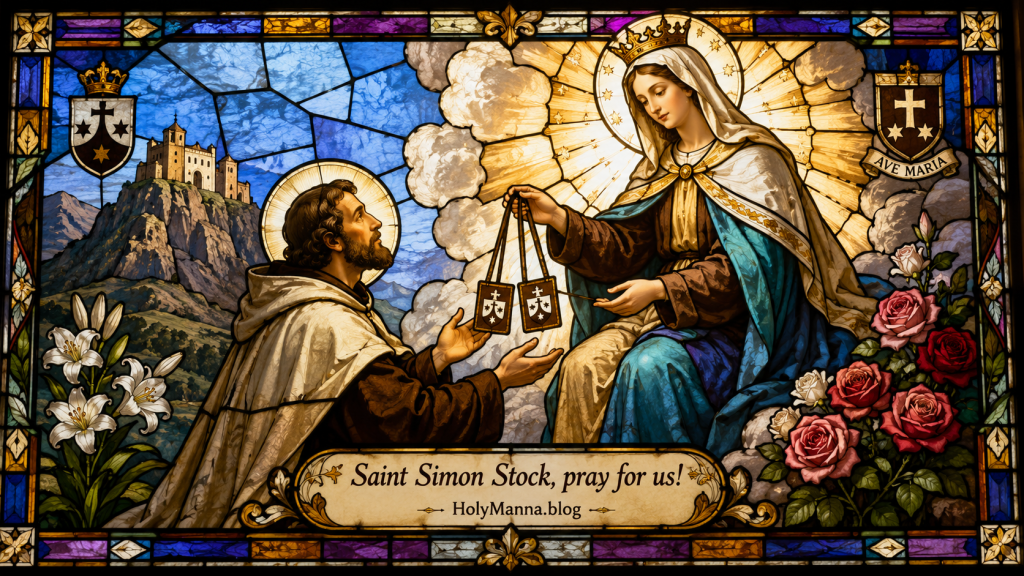
The most famous story associated with Saint Simon Stock is the vision of Our Lady of Mount Carmel. According to Carmelite tradition, on July 16, 1251, the Blessed Virgin Mary appeared to Simon during a time of hardship for the Order. She gave him the Brown Scapular as a sign of her protection.
The traditional promise associated with the vision is often given in these words: “This shall be the privilege for you and for all Carmelites, that anyone dying in this habit shall be saved.”
This is the story that made Simon Stock known throughout the Catholic world. It is also the story that must be explained carefully.
The Brown Scapular is a sacramental. It is not magic. It is not a spiritual insurance policy. It is not permission to live carelessly. It does not replace confession, repentance, prayer, the Eucharist, or obedience to Christ.
The Catechism of the Catholic Church teaches that sacramentals “do not confer the grace of the Holy Spirit in the way that the sacraments do,” but by the prayer of the Church they prepare us to receive grace and cooperate with it. CCC 1670
That is the Catholic way to understand the scapular. It is a garment of discipleship. It is a small sign that says, “Mary, help me belong more fully to your Son.” The person who wears it should be trying to live in friendship with Christ, seeking grace, practicing repentance, praying faithfully, and trusting Mary’s intercession.
The scapular promise, then, should not be treated like a shortcut around the Gospel. It should be understood as a promise of Mary’s motherly care for those who live and die seeking Jesus.
The historical details of the vision are debated by modern Carmelite scholars. The story appears clearly in later medieval Carmelite tradition, and the Order today presents it with reverence but also caution. So the best Catholic way to say it is this: according to Carmelite tradition, Our Lady appeared to Saint Simon Stock and gave him the Brown Scapular. The devotion remains approved and deeply fruitful, even though the historical documentation of the apparition itself is not as strong as the devotion’s later spiritual impact.
A Hymn from Carmel’s Heart
One of the most beautiful prayers associated with Saint Simon Stock is the Carmelite hymn Flos Carmeli. Older tradition attributed it to him, but modern scholarship does not consider his authorship certain. Still, it belongs deeply to the Carmelite spirit and is often remembered alongside him.
Its opening words are:
“Flos Carmeli, vitis florigera, splendor caeli, Virgo puerpera singularis.”
In English, this means:
“Flower of Carmel, vine blossom-laden, splendor of heaven, childbearing yet maiden, none equals thee.”
Even if Simon did not write it, the hymn captures the Marian soul of Carmel. Mary is the flower of Carmel, the beauty of holiness, the Virgin Mother who brings us Christ. For a Carmelite, she is not a decoration on the edge of the faith. She is the mother who teaches the soul how to listen, how to ponder, how to remain, and how to follow Jesus all the way to the Cross.
Miracles, Grace, and the Humility of the Record
Unlike some saints, Saint Simon Stock does not have a long list of historically verified miracles performed during his lifetime. The central miraculous story connected to his life is the traditional apparition of Our Lady and the giving of the Brown Scapular. Because this belongs to Carmelite tradition rather than fully verified historical record, it should be honored as tradition while presented honestly.
The lack of many documented lifetime miracles does not make Simon less important. Some saints leave behind dramatic healings and public wonders. Others leave behind a spiritual inheritance that quietly forms millions of souls. Simon belongs especially to the second kind.
Through the scapular devotion, Catholics learned to see daily perseverance as a Marian path. Wearing the scapular became a reminder to pray, to remain faithful, to avoid sin, to return to confession, and to trust Mary’s maternal intercession at the hour of death.
In that sense, the great miracle surrounding Simon’s legacy is not one event alone. It is the conversion of ordinary lives through a simple sign of faith.
Trials Without Martyrdom
Saint Simon Stock was not a martyr. He did not die by persecution for the faith. His hardships were different, but still serious.
He lived during a period when the Carmelite Order faced uncertainty, suspicion, relocation, and the challenge of proving its place within the Church’s life in Europe. The Carmelites were no longer simply hidden hermits on Mount Carmel. They had entered a religious landscape already shaped by great mendicant orders like the Franciscans and Dominicans. They needed recognition, structure, and protection.
Tradition remembers Simon as a man who turned to Mary in this crisis. That detail is spiritually powerful. He did not respond to uncertainty with panic. He prayed. He trusted. He carried the burden of his Order before the Mother of God.
That is a lesson many Catholics need. When the family is strained, when work is unstable, when the Church feels wounded, when the culture feels hostile, the Catholic response is not despair. It is deeper fidelity.
Mary does not remove every trial. She teaches us how to stand beneath the Cross.
Death in Bordeaux and the Miracles at His Tomb
Saint Simon Stock died in Bordeaux around 1265. His remains were venerated there, and devotion to him grew especially in the Carmelite community and local Catholic life. After his death, miracles were reportedly associated with visits to his tomb. These posthumous miracles helped strengthen his local cult, especially in Bordeaux, though the specific miracle accounts are not all easy to verify in detail today.
His relics became an important part of his legacy. They were preserved by the Carmelites in Bordeaux for centuries. During the French Revolution, when churches, religious houses, and relics were often endangered, his remains were reportedly hidden for protection. Later, they were placed in the Cathedral of Saint André in Bordeaux, in a chapel connected with Our Lady of Mount Carmel.
A major relic also became associated with Aylesford in England, an important Carmelite site. Aylesford holds special meaning because tradition connects it with early Carmelite life in England and with Simon’s memory.
These places matter because Catholicism is not a vague spirituality floating in the air. It is embodied. It has relics, shrines, feasts, chapels, habits, candles, processions, and places where generations have prayed. Saint Simon’s memory lives not only in books, but in the devotional life of the Church.
The Scapular After Simon: A Small Garment with a Huge Legacy
The Brown Scapular became one of the most widespread Catholic devotions in the world. Lay people who wanted to share in Carmelite spirituality began wearing a smaller form of the Carmelite habit. Over time, scapular confraternities spread among rich and poor, nobles and workers, scholars and ordinary families.
The devotion became especially tied to the feast of Our Lady of Mount Carmel on July 16. Catholics across many cultures came to associate that day with Mary’s protection and the gift of the scapular. Churches, processions, images, and popular devotions spread the story of Our Lady giving the scapular to Saint Simon Stock.
In Ireland, the Brown Scapular became especially beloved during hard times, including the long years when Catholics suffered under persecution. Alongside the Rosary, it became a quiet sign of Catholic identity, Marian trust, and perseverance.
Pope Saint John Paul II himself had deep devotion to the scapular. He called the scapular tradition a treasure for the whole Church and connected it to a life of Marian discipleship. That papal love for the scapular helped many modern Catholics rediscover the devotion not as superstition, but as a simple and serious way to live under Mary’s care.
This is Saint Simon’s lasting cultural impact. His name became linked to one of the most recognizable signs of Catholic devotion in history. Even Catholics who know very little about him may know the Brown Scapular. That small piece of cloth carries a whole theology of trust.
The Saint of Mary’s Quiet Protection
Saint Simon Stock is remembered as the “scapular saint,” but that title should not make him seem small. His life points to something large and deeply Catholic.
He reminds us that Mary is not a sentimental extra. She is the Mother of the Church. She forms disciples. She protects souls. She teaches humility, obedience, prayer, and perseverance.
He also reminds us that sacramentals are meant to shape a way of life. A rosary is meant to be prayed. Holy water is meant to stir faith. A crucifix is meant to lift the heart to Christ crucified. A scapular is meant to remind the wearer to live as a child of Mary and a disciple of Jesus.
The scapular hangs close to the heart for a reason. It quietly asks for conversion.
Is faith being worn only on the outside, or is it beginning to clothe the heart?
Reflection: Wearing the Gospel Close to the Heart
Saint Simon Stock’s life invites Catholics to rediscover the beauty of faithful devotion. He does not call us to flashy spirituality. He calls us to hidden perseverance.
The legend of the hollow tree, even if it cannot be verified, speaks to the need for silence. Every Catholic needs some kind of inner cell, a place where the soul can stop performing and simply listen to God.
His Carmelite legacy speaks to trust during uncertainty. The Carmelites had to change without losing their identity. That is a lesson for every Catholic navigating modern life. Adaptation is not the same thing as compromise. The Christian can work, build, parent, study, lead, and serve in the world while still remaining rooted in prayer.
The Brown Scapular speaks to belonging. In a culture obsessed with self-invention, the scapular says something different. It says the soul is not self-made. The soul belongs to Christ. The soul has a Mother. The soul is called to holiness.
A practical way to honor Saint Simon Stock is to renew devotion to Mary in a mature Catholic way. Pray the Rosary. Learn about the Brown Scapular. Go to confession regularly. Receive the Eucharist worthily. Ask Mary to help with daily conversion, especially in the hidden battles no one else sees.
The goal is not simply to wear something Catholic. The goal is to become someone Catholic.
Engage With Us!
Share your thoughts and reflections in the comments below. Saint Simon Stock’s story is a beautiful invitation to think about Marian devotion, trust in difficult seasons, and the small sacramentals that quietly shape Catholic life.
- What does the Brown Scapular mean to you, or what questions do you have about it?
- How can Mary’s motherly care help you follow Jesus more faithfully in your daily life?
- Where in your life do you need the quiet perseverance that Saint Simon Stock modeled?
- Are there Catholic sacramentals, such as the scapular, Rosary, crucifix, or holy water, that have helped deepen your faith?
- How can you make sure devotion to Mary always leads you closer to Christ?
May Saint Simon Stock teach us to trust Mary without superstition, to wear our faith with humility, and to follow Jesus with steady hearts. Let us live each day clothed in grace, strengthened by prayer, and ready to do everything with the love and mercy Jesus taught us.
Saint Simon Stock, pray for us!
Follow us on YouTube, Instagram and Facebook for more insights and reflections on living a faith-filled life.


Leave a Reply