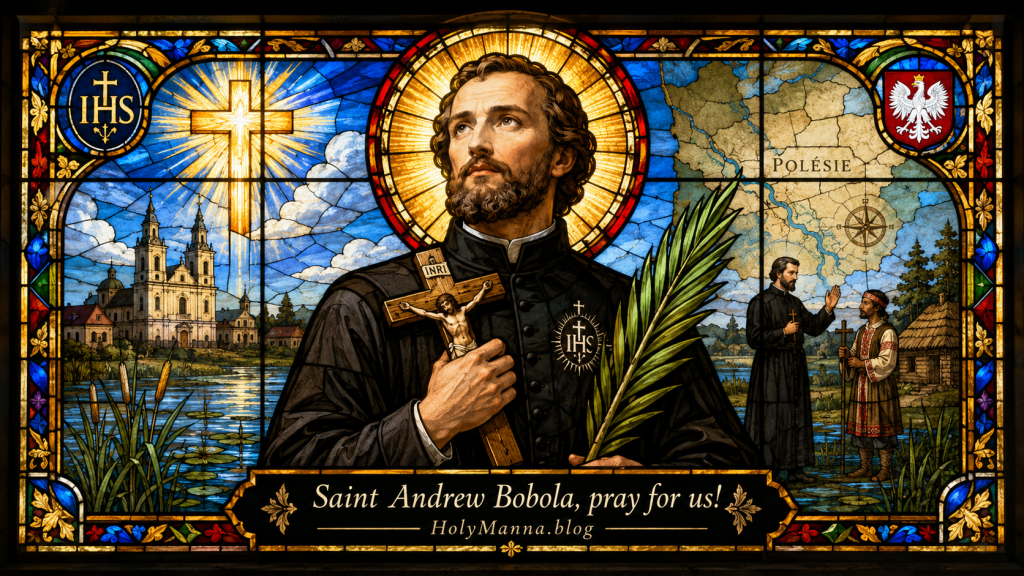
The Hunter of Souls Who Would Not Let Go of Christ
Saint Andrew Bobola was a Polish Jesuit priest, missionary, preacher, confessor, catechist, and martyr. He lived during one of the most violent and religiously divided periods in Eastern Europe, yet his whole life was spent trying to bring souls closer to Christ and His Church.
He is remembered as the “Apostle of Polesia,” the “Apostle of Lithuania,” and most famously as the “hunter of souls.” That title may sound intense to modern ears, but it captures his missionary fire. He searched for the forgotten, the poorly catechized, the spiritually wounded, and the separated, and he tried to bring them home to the sacraments.
Saint Andrew Bobola is most known for his fearless missionary work, his defense of the Catholic faith, his ministry among neglected villages, his love for the Eucharist and the Blessed Virgin Mary, and his brutal martyrdom on May 16, 1657. His life reminds us that holiness is not comfort. Sometimes holiness looks like preaching in muddy villages, hearing confessions for hours, serving the sick during plague, enduring rejection, and finally saying yes to Christ when the cost is everything.
The Catechism of the Catholic Church teaches that martyrdom is “the supreme witness given to the truth of the faith” CCC 2473. Saint Andrew Bobola gave that witness not in a quiet room or from a comfortable pulpit, but with his own blood.
A Noble Son Formed for a Difficult Mission
Andrew Bobola was born around 1591, most likely in Strachocina near Sanok in southeastern Poland. He came from a Polish noble family connected to the Leliwa coat of arms, and his family was known for its strong Catholic identity during the Counter-Reformation.
He studied at the Jesuit college in Braniewo, where he received a serious education in Latin, rhetoric, and Greek. That Greek training later helped him read the Greek Fathers of the Church and engage in theological discussions with Orthodox clergy. This matters because his future mission would unfold in lands where Catholics and Orthodox Christians lived close together, but often with deep wounds and tension between them.
Andrew entered the Society of Jesus in Vilnius on July 31, 1611. He made his first vows in 1613, studied philosophy, taught in Jesuit schools, returned to study theology, and was ordained a priest on March 12, 1622. That date is beautiful in Catholic memory because it was also the day Saint Ignatius of Loyola and Saint Francis Xavier were canonized in Rome. A new Jesuit priest was ordained on the same day the Church raised two great Jesuit saints to the altars.
One surprising detail from his life is that Andrew did not pass the major comprehensive theology exam that could have opened the door to a more prestigious academic career. In worldly terms, that could have looked like a failure. In God’s providence, it redirected him toward the mission field, where he became a saint.
That is worth sitting with for a moment. Sometimes the door that closes is not punishment. Sometimes it is mercy. Sometimes God allows a path to narrow so the soul can walk more directly toward its true vocation.
The Priest Who Went Looking for the Forgotten
Saint Andrew Bobola served in many places, including Nieśwież, Vilnius, Bobruisk, Płock, Warsaw, Łomża, and Pinsk. He preached, heard confessions, taught catechism, directed Marian sodalities, supervised schools, and gave popular missions.
He was not a priest who waited for perfect conditions. He went into villages where people were poorly instructed in the faith. He visited families. He baptized. He heard confessions. He helped reconcile sinners to God. He encouraged people to return to Mass and the sacraments. In Nieśwież, Catholic sources record that he helped regularize 49 couples who had been living together outside sacramental marriage.
That detail is powerful because it shows the heart of his priesthood. He was not only debating theology or preaching dramatic sermons. He was helping ordinary people get their lives right with God.
He also served during plague outbreaks in Vilnius. While fear and death spread through the city, Andrew and other Jesuits ministered to the sick and abandoned. Several Jesuits died in those epidemics. Andrew survived, but his willingness to risk himself for the suffering revealed the kind of shepherd he was becoming.
The Gospel of John gives us Christ’s own image of priestly love: “The good shepherd lays down his life for the sheep” John 10:11. Saint Andrew Bobola lived that long before he died it.
A Saint With Rough Edges
One of the most relatable parts of Saint Andrew Bobola’s story is that he was not naturally gentle or easygoing. Jesuit records describe him as zealous, intelligent, and gifted, but also choleric, impatient, stubborn, and sometimes explosive.
That may surprise people who imagine saints as naturally calm from childhood. Andrew had to fight himself. His superiors saw his gifts, but they also recognized his faults. Pope Pius XII later emphasized that Andrew had to wage a real interior battle against pride, impatience, and stubbornness.
This makes him a deeply encouraging saint for everyday Catholics. He did not become holy because he had no weaknesses. He became holy because he allowed grace to discipline his weaknesses. He did not pretend his temperament was sanctity. He submitted it to Christ.
The Catechism teaches that grace does not destroy human freedom, but heals and elevates it. God works in real human beings, not imaginary ones. Andrew Bobola’s sanctity was not plastic holiness. It was forged holiness.
What rough edge in the soul might God be asking to transform into zeal, patience, courage, or mercy?
Into the Marshes of Polesia
The mission that defined Saint Andrew’s life unfolded especially in the Pinsk region and the marshy lands of Polesia. These were difficult mission territories. Catholic sources describe isolated villages, poor roads, weak catechesis, superstition, religious tension, and many people who had drifted away from sacramental life.
Andrew walked into that world with the heart of a missionary. He went from village to village, sometimes through harsh terrain, teaching the faith, preaching, hearing confessions, and encouraging people to return to the Church.
His zeal made him loved by many and hated by others. Catholic tradition says whole communities were drawn closer to the Catholic faith through his preaching. This is why he became known as the “hunter of souls.”
That phrase should be understood with charity. Saint Andrew lived in a world of fierce religious conflict between Catholics, Orthodox Christians, Protestants, Cossacks, Polish nobles, and political powers fighting for control. Older Catholic sources often use the polemical language of their time. A faithful Catholic today should tell his story with conviction, but not contempt.
The Catholic Church teaches that the Orthodox Churches possess true sacraments, especially apostolic succession and the Eucharist. The Catechism also teaches that those born into separated Christian communities are to be treated with respect and affection as brothers in Christ. Saint Andrew should therefore be remembered as a martyr for Catholic faith and unity, not as a reason for bitterness toward Eastern Christians.
His life should move Catholics to pray with Jesus: “That they may all be one” John 17:21.
The Miracles of a Life Poured Out
There are no widely verified miracle stories from Saint Andrew Bobola’s lifetime in the way there are for some saints who healed the sick or raised the dead. His life was not remembered primarily for wonder-working during life. It was remembered for missionary fruit, sacramental courage, and heroic charity.
Still, there were grace-filled signs in his ministry. He served during plague and survived while many around him died. He helped bring sinners back to confession. He regularized marriages. He catechized the neglected. He drew people back to the Eucharist. He helped strengthen Catholic identity in places where the Church was fragile and threatened.
Sometimes the greatest miracle in a saint’s life is not spectacular. Sometimes it is a soul returning to confession after years away. Sometimes it is a couple choosing sacramental marriage. Sometimes it is a hardened heart becoming soft again before God.
That kind of miracle may not make headlines, but heaven pays attention.
The Martyrdom of a Catholic Priest
In 1657, violence swept through the region. Cossack forces entered the Pinsk area during a time of war and anti-Catholic hostility. Another Jesuit, Father Maffon, was captured and killed on May 15. Andrew Bobola fled to Janów Poleski and then to a nearby village, but he was pursued.
On May 16, 1657, he was captured. His persecutors knew him as the “hunter of souls.” They pressured him to abandon the Catholic faith. He refused.
The accounts of his martyrdom are among the most brutal in Catholic hagiography. He was beaten, dragged, burned, mutilated, and tortured for hours. The details are painful, and they should not be treated as sensational entertainment. They should be received with reverence, because this was a priest sharing in the Passion of Christ.
When asked if he was a Catholic priest, he confessed his faith. The best-known words associated with his martyrdom are:
“I am a Catholic priest; I was born in the Catholic faith; in that faith I wish to die.”
Another confession preserved in Catholic tradition is:
“My faith leads to salvation. Convert.”
He died around 3 p.m., the hour Christians associate with the death of Our Lord. His body was taken first to a local church and then to Pinsk, where the Jesuits buried him in the crypt of their church.
The Second Letter to Timothy says, “I have fought the good fight, I have finished the race, I have kept the faith” 2 Timothy 4:7. Those words fit Saint Andrew Bobola almost perfectly.
The Martyr Who Was Found Again
After his death, Andrew Bobola’s memory faded for a time. Then, according to Catholic tradition, something remarkable happened.
In 1702, Father Marcin Godebski, a Jesuit rector in Pinsk, reportedly saw Saint Andrew Bobola in an apparition. The saint told him to find his coffin and promised protection if his body were honored. After a search, the coffin was discovered. Catholic sources say his body was remarkably preserved despite the damp conditions of the crypt, and the signs of his martyrdom were still visible.
This story belongs to Catholic devotional tradition. It is not part of public revelation, and Catholics are not required to believe it in the way they believe the Creed. The Catechism explains that private revelations do not improve or complete the definitive Revelation of Christ, but may help people live the Gospel more fully in a particular time, CCC 67.
After the rediscovery of his body, devotion to Saint Andrew spread rapidly. Many people came to pray near his relics. Catholic sources report healings, graces, and favors through his intercession. During a plague in the Pinsk region in 1709 and 1710, the faithful invoked him, and tradition says the region experienced special protection.
Healings Through His Intercession
Several miracles were officially associated with his beatification and canonization.
For his beatification, the Church recognized healings involving children. One was Katarzyna Brzozowska, a three-year-old suffering from severe bloody dysentery. Her parents brought her to Saint Andrew’s tomb in Pinsk, and she was reportedly healed. Another was Marianna Florkowska, who was gravely ill during a dysentery epidemic in Vilnius. Her mother prayed, attended Masses in honor of the Holy Trinity, invoked Andrew’s intercession, and the child recovered. A third involved the son of Jan Chmielnicki, who was suffering from scurvy, infected wounds, and a death-like collapse. His mother entrusted him to God through Andrew’s intercession, and he was restored to health.
For his canonization, two miracles were recognized. Ida Kopecka of Krynica suffered severe radiation burns after medical X-ray treatment in 1922. After praying through Blessed Andrew’s intercession and applying his relic near the wound, she was healed in a way judged extraordinary. Sister Alojza Dobrzyńska suffered from a grave pancreatic condition described in Catholic sources as incurable. After prayers, novenas, and Masses through Andrew’s intercession, she recovered. Vatican-appointed examiners judged the healing inexplicable by natural causes.
These stories are not magic. They belong to the Catholic understanding of the communion of saints. The Catechism teaches that the saints in heaven “do not cease to intercede with the Father for us” CCC 956. Saint Andrew Bobola’s miracles remind the faithful that death does not end Christian love. In Christ, love becomes more powerful.
A Prophecy, a Nation, and a Saint for Poland
Another famous story connected to Saint Andrew Bobola comes from 1819. According to Catholic tradition, he appeared to Dominican Father Alojzy Korzeniewski in Vilnius and foretold that Poland would regain independence after a great war and that he would become one of her patrons. This is a private-revelation tradition and cannot be treated as public doctrine. It also cannot be verified in the same way as official canonization miracles.
Still, the story became deeply meaningful to Polish Catholics, especially after Poland regained independence following World War I.
In 1920, when Bolshevik forces approached Warsaw, many Catholics prayed through the intercession of Blessed Andrew Bobola. After Poland’s victory in the Battle of Warsaw, often called the “Miracle on the Vistula,” many faithful associated the deliverance of Poland with the intercession of Our Lady and Blessed Andrew.
This is part of his cultural impact. Saint Andrew Bobola became more than a local martyr. He became a national intercessor, a sign of Catholic endurance, and a reminder that Poland’s spiritual identity had been preserved through suffering.
The Long Journey of His Relics
The story of Saint Andrew Bobola’s relics is astonishing.
After his burial in Pinsk, his body was rediscovered in 1702. Later, his relics were transferred to Połock. In 1853, Pope Pius IX beatified him. In 1922, Bolshevik authorities seized and profaned his relics. They transported the body to Moscow and displayed it in an anti-religious hygiene exhibition, hoping to discredit Catholic devotion.
But according to Catholic sources, visitors began praying near the relics. Eventually, the relics were hidden away. In 1923, through negotiations connected to the Holy See’s famine relief mission in Russia, the Soviet authorities released the relics. They would not allow them to go directly to Poland, so the relics were sent to Rome.
Pope Pius XI canonized Andrew Bobola on Easter Sunday, April 17, 1938. Later that year, his relics returned to Poland by special train. Crowds gathered along the route. The return became a major Catholic and national event. In Warsaw, President Ignacy Mościcki placed his Cross of Independence on the saint’s coffin as a votive offering.
During World War II, the relics were moved for protection. They survived the devastation of Warsaw and were eventually placed in the church of Saint Andrew Bobola in Warsaw. That church later became the National Shrine of Saint Andrew Bobola.
His relics are now honored in many places, especially in Poland. His cult is strong in Warsaw, Strachocina, Janów Poleski, and among Polish Catholics around the world. He was declared a secondary patron of Poland in 2002.
The Saint Who Still Speaks to a Divided World
Saint Andrew Bobola’s life can be difficult for modern people to understand because he lived in a hard, violent, religiously divided age. But that is exactly why he matters.
He reminds Catholics that truth is worth suffering for. He also reminds Catholics that evangelization is not about winning arguments for pride. It is about loving souls enough to labor for their salvation.
He was not a perfect-tempered man. He was not a comfortable saint. He was not polished in the modern sense. He was fiery, intense, disciplined, courageous, and gradually purified by grace. He gave everything he had to Christ and the Church.
His life invites Catholics to recover a missionary heart without losing charity. It is possible to love the Catholic faith fully and still speak with respect toward those who are separated from full communion with the Church. It is possible to defend truth without becoming cruel. It is possible to be zealous without becoming proud.
Saint Andrew Bobola teaches that the soul is worth the effort.
A Faith Worth Living and Dying For
The heart of Saint Andrew Bobola’s witness is simple. He belonged to Christ, and he would not deny Him.
Most Catholics will not be asked to die as martyrs. But every Catholic is asked to live as a witness. That may mean returning to confession. It may mean repairing a marriage. It may mean teaching the faith to children. It may mean defending Catholic truth in a world that misunderstands it. It may mean serving the sick, the lonely, or the forgotten when nobody applauds.
Saint Andrew’s courage did not begin at the moment of martyrdom. It was built through years of prayer, obedience, preaching, confession, sacrifice, and daily fidelity. Martyrdom was the final fruit of a life already given away.
Where is Christ asking for a more courageous yes today?
What forgotten soul nearby may need patience, truth, and mercy?
What weakness of temperament could become holiness if surrendered to grace?
Saint Andrew Bobola, the hunter of souls, shows that Catholic faith is not meant to sit safely on a shelf. It is meant to be preached, lived, suffered for, and shared.
Engage with Us!
Share your thoughts and reflections in the comments below. Saint Andrew Bobola’s life is intense, courageous, and deeply challenging, especially for Catholics trying to live the faith in a divided world.
- What part of Saint Andrew Bobola’s story challenged you the most?
- How can his missionary zeal inspire Catholics to bring others closer to the sacraments today?
- What does his struggle with impatience and stubbornness teach us about becoming holy in real life?
- How can Catholics defend the truth of the faith while still speaking with charity toward those who disagree?
- Where might God be asking you to become a “hunter of souls” through prayer, service, encouragement, or witness?
May Saint Andrew Bobola help us live with courage, speak the truth with love, return often to the sacraments, and do everything with the love and mercy Jesus taught us.
Saint Andrew Bobola, pray for us!
Follow us on YouTube, Instagram and Facebook for more insights and reflections on living a faith-filled life.


Leave a Reply