Saturday of the Sixth Week of Easter – Lectionary: 296
When Holy Fire Learns the Way Home
Sometimes the soul has zeal before it has fullness, and today’s readings show how gently God completes what He has already begun.
In Acts 18:23-28, Apollos arrives with a brilliant mind, a burning heart, and a deep love for the Scriptures. He knows much about Jesus, yet he still needs Priscilla and Aquila to take him aside and explain “the Way of God more accurately” Acts 18:26. His story reminds Catholics that faith is never meant to be a solo project. Even great gifts need the Church. Even strong preaching needs formation. Even sincere zeal must be brought into the fullness of the apostolic faith.
That same movement widens in Psalm 47. The God who forms Apollos through the Church is not merely the God of one teacher, one synagogue, or one nation. He is “king over all the earth” Psalm 47:8. The psalm gathers every people into worship, showing that the mission of the Church is not small, private, or tribal. The Gospel is meant for the nations, because Christ reigns over every human heart, every culture, and every generation.
Then, in John 16:23-28, Jesus brings the whole mystery into the intimacy of prayer. He tells His disciples, “whatever you ask the Father in my name he will give you” John 16:23. This is not a blank check for selfish desires. It is an invitation to pray as beloved children, united to the Son who comes from the Father and returns to the Father. The Catechism teaches, “There is no other way of Christian prayer than Christ” CCC 2664, because Christian prayer is not simply reaching upward. It is being drawn into the Son’s own relationship with the Father.
The central theme of today’s readings is that Christian joy becomes complete when zeal, worship, and prayer are all gathered into communion with Christ and His Church. Apollos receives fuller formation. The nations are called into praise. The disciples are invited to ask the Father in the name of Jesus.
Where does the Lord want to complete what He has already begun in your heart?
First Reading – Acts 18:23-28
When a Burning Heart Learns the Fullness of the Way
The First Reading places us inside the living, breathing growth of the early Church. Saint Paul is traveling again, strengthening disciples across Galatia and Phrygia, while another powerful voice enters the story: Apollos, a Jewish man from Alexandria. Alexandria was one of the intellectual capitals of the ancient world, famous for learning, rhetoric, philosophy, and Jewish scriptural scholarship. Apollos was not a casual believer. He was eloquent, educated, and deeply formed by the Scriptures.
Yet his story is not mainly about talent. It is about formation.
Apollos knows Jesus, but not yet in the fullness of the apostolic faith. He knows the baptism of John, which prepared Israel for repentance and readiness, but he still needs to be brought more deeply into the sacramental and ecclesial life of Christ. That is where Priscilla and Aquila enter the scene. This married couple, faithful collaborators of Saint Paul, quietly takes Apollos aside and explains “the Way of God more accurately” Acts 18:26.
This fits beautifully with today’s central theme: Christian joy becomes complete when zeal, worship, and prayer are gathered into communion with Christ and His Church. Apollos has zeal. Priscilla and Aquila give him fuller formation. The Church does not extinguish his fire. She purifies it, directs it, and makes it fruitful.
Acts 18:23-28 – New American Bible (Revised Edition)
23 After staying there some time, he left and traveled in orderly sequence through the Galatian country and Phrygia, bringing strength to all the disciples.
Apollos. 24 A Jew named Apollos, a native of Alexandria, an eloquent speaker, arrived in Ephesus. He was an authority on the scriptures. 25 He had been instructed in the Way of the Lord and, with ardent spirit, spoke and taught accurately about Jesus, although he knew only the baptism of John. 26 He began to speak boldly in the synagogue; but when Priscilla and Aquila heard him, they took him aside and explained to him the Way [of God] more accurately. 27 And when he wanted to cross to Achaia, the brothers encouraged him and wrote to the disciples there to welcome him. After his arrival he gave great assistance to those who had come to believe through grace. 28 He vigorously refuted the Jews in public, establishing from the scriptures that the Messiah is Jesus.
Detailed Exegesis
Verse 23 – “After staying there some time, he left and traveled in orderly sequence through the Galatian country and Phrygia, bringing strength to all the disciples.”
Saint Paul continues his missionary work by strengthening the disciples. This detail may seem simple, but it reveals something essential about the early Church. Evangelization did not end when people first believed. The apostles returned to communities, encouraged them, corrected them, taught them, and helped them persevere.
Catholic life works the same way. Conversion is not a one-time emotional moment. It is a lifelong strengthening in grace. The Church mothers her children through preaching, the sacraments, catechesis, discipline, and community. Saint Paul’s journey reminds us that disciples need ongoing formation, especially after the initial joy of belief.
Verse 24 – “A Jew named Apollos, a native of Alexandria, an eloquent speaker, arrived in Ephesus. He was an authority on the scriptures.”
Apollos enters the scene with impressive credentials. He is Jewish, Alexandrian, eloquent, and learned in the Scriptures. Alexandria had a large Jewish population and was known for deep engagement with the Old Testament. It was also associated with the Greek translation of the Hebrew Scriptures, the Septuagint, which the early Church often used.
This means Apollos likely knew the promises of God very well. He knew the Law, the Prophets, and the hopes of Israel. His gift was real. His intelligence was real. His love for Scripture was real. The Church does not treat these gifts as threats. Grace builds upon them.
Still, gifted people need formation. Intelligence does not automatically equal fullness of faith. Eloquence does not automatically equal doctrinal completeness. A person can know many true things about God and still need the Church to lead him more deeply into the whole truth.
Verse 25 – “He had been instructed in the Way of the Lord and, with ardent spirit, spoke and taught accurately about Jesus, although he knew only the baptism of John.”
This verse captures the tension in Apollos’ life. He has been instructed in “the Way of the Lord”, he has an “ardent spirit”, and he teaches accurately about Jesus. Yet his knowledge is incomplete because he knows only the baptism of John.
John’s baptism was a baptism of repentance. It prepared hearts for the coming Messiah. Christian Baptism, however, is far greater. It unites the person to Christ’s death and Resurrection, washes away sin, gives new birth in the Holy Spirit, incorporates the person into the Church, and makes the baptized a member of Christ’s Body.
The Catechism teaches, “Holy Baptism is the basis of the whole Christian life, the gateway to life in the Spirit, and the door which gives access to the other sacraments. Through Baptism we are freed from sin and reborn as sons of God; we become members of Christ, are incorporated into the Church and made sharers in her mission: ‘Baptism is the sacrament of regeneration through water in the word.’” CCC 1213
Apollos has repentance. He has zeal. He has Scripture. He has boldness. But he still needs the fullness of sacramental life in Christ.
Verse 26 – “He began to speak boldly in the synagogue; but when Priscilla and Aquila heard him, they took him aside and explained to him the Way of God more accurately.”
This is one of the most beautiful moments of lay formation in the New Testament. Priscilla and Aquila do not publicly shame Apollos. They do not humiliate him in front of the synagogue. They do not dismiss him as useless because his understanding is incomplete. They take him aside and teach him.
There is a whole Catholic spirituality hidden in that gesture. Truth matters, but so does charity. Correction matters, but so does discretion. Formation matters, but so does respect for the person being formed.
Priscilla and Aquila show the power of the domestic Church. Their marriage, their home, their friendship with Saint Paul, and their quiet teaching all become instruments of the Gospel. They remind Catholics that the faith is not passed on only from pulpits and classrooms. It is also passed on at kitchen tables, in parish conversations, after Bible studies, during OCIA, in friendships, and through married couples who live the faith seriously.
Verse 27 – “And when he wanted to cross to Achaia, the brothers encouraged him and wrote to the disciples there to welcome him. After his arrival he gave great assistance to those who had come to believe through grace.”
Once Apollos receives fuller formation, he is not sidelined. He is sent. The brothers encourage him and write letters so the disciples in Achaia will welcome him. This shows the early Church acting as a real communion. Apollos does not appoint himself as a lone preacher. He is received, formed, encouraged, and recommended by the brethren.
The phrase “those who had come to believe through grace” is important. Apollos gives great assistance, but grace is the source of faith. The preacher helps. The catechist helps. The apologist helps. The friend helps. But God gives the growth.
This protects evangelizers from pride and discouragement. If someone responds to the Gospel, grace is at work. If someone takes time to respond, grace is still at work. The Catholic disciple plants, waters, teaches, invites, and accompanies, but conversion belongs to God.
Verse 28 – “He vigorously refuted the Jews in public, establishing from the scriptures that the Messiah is Jesus.”
Now Apollos’ zeal is fully directed. He uses his knowledge of Scripture to show that Jesus is the Messiah. His learning becomes service. His eloquence becomes evangelization. His boldness becomes apostolic witness.
This verse also shows the early Christian way of reading the Old Testament. The apostles and their collaborators did not throw away Israel’s Scriptures. They read them in the light of Christ. Jesus is the fulfillment of the Law, the Prophets, the covenants, the sacrifices, the promises, and the hopes of Israel.
Apollos becomes fruitful because his scriptural knowledge is now united to the apostolic proclamation. The Bible belongs in the heart of the Church, and the Church teaches her children to read the Bible in the light of Christ.
Teachings: Scripture, Baptism, and the Church That Forms Us
This reading teaches that zeal is good, but zeal must be formed. Apollos is not condemned for knowing only part of the truth. He is invited into more. That is how grace often works. The Lord begins with the gifts already present in a person, then draws those gifts into fuller communion with His Church.
The Catholic Church has always insisted that Scripture must be received within the living faith of the Church. This does not weaken Scripture. It protects Scripture from being reduced to personal interpretation or private opinion. Apollos knows Scripture, but Priscilla and Aquila help him read and teach it more fully in the apostolic faith.
The Catechism teaches, “The task of giving an authentic interpretation of the Word of God, whether in its written form or in the form of Tradition, has been entrusted to the living, teaching office of the Church alone. Its authority in this matter is exercised in the name of Jesus Christ.” CCC 85
Then The Catechism immediately clarifies that this authority is not domination over Scripture, but service to the Word of God: “Yet this Magisterium is not superior to the Word of God, but is its servant. It teaches only what has been handed on to it. At the divine command and with the help of the Holy Spirit, it listens to this devotedly, guards it with dedication and expounds it faithfully. All that it proposes for belief as being divinely revealed is drawn from this single deposit of faith.” CCC 86
That is exactly what Priscilla and Aquila are doing in miniature. They are not inventing a new religion for Apollos. They are helping him receive the fullness of what has been handed on.
This passage also highlights the dignity of lay people in the mission of the Church. Priscilla and Aquila are not apostles in the same sense as the Twelve, and they are not shown here as ordained ministers. Yet they play a decisive role in forming a preacher who will greatly assist believers in Achaia.
The Catechism teaches, “Lay people also fulfill their prophetic mission by evangelization, ‘that is, the proclamation of Christ by word and the testimony of life.’ For lay people, ‘this evangelization . . . acquires a specific property and peculiar efficacy because it is accomplished in the ordinary circumstances of the world.’” CCC 905
That line feels written for Priscilla and Aquila. Their evangelization happens in ordinary circumstances. They hear Apollos. They recognize his gifts. They notice what is missing. They act with charity. Their quiet faithfulness strengthens the public mission of the Church.
Saint John Chrysostom, preaching on The Acts of the Apostles, admired the humility and discretion of this moment. He saw in Priscilla and Aquila a model of correction done with wisdom rather than arrogance. They did not crush Apollos’ zeal. They completed his understanding.
This is deeply Catholic. The Church is not afraid of intelligence, eloquence, or passion. She only asks that these gifts be converted, disciplined, and placed at the service of truth.
Reflection: Let the Church Complete the Fire
Apollos is easy to admire because he has the kind of faith that feels alive. He speaks boldly. He knows Scripture. He has passion. He is not lukewarm. Many Catholics today long for that kind of fire, especially in a world where faith is often treated as a private hobby or an embarrassing family tradition.
But Apollos also teaches something harder. Fire is not enough. A sincere heart still needs formation. A Bible-loving Christian still needs the Church. A gifted speaker still needs correction. A bold disciple still needs humility.
This reading invites Catholics to ask whether they are teachable. It is easy to want the mission of Apollos without the correction of Priscilla and Aquila. It is easy to want to explain the faith before allowing the Church to explain the faith more deeply to us. It is easy to confuse confidence with maturity.
A practical response begins with humility. Catholics can make time for real formation, not just quick spiritual inspiration. They can read Scripture with the mind of the Church. They can study The Catechism. They can receive correction without becoming defensive. They can go to Confession when pride has made them hard to teach. They can seek out faithful mentors, priests, catechists, and serious Catholic friends who help them grow.
This reading also calls mature Catholics to correct others with charity. Priscilla and Aquila did not weaponize truth. They served truth. They did not embarrass Apollos. They loved him enough to help him become more fruitful.
Who has been a Priscilla or Aquila in your life, someone who helped you understand the faith more accurately?
Where might the Lord be asking you to become more teachable, especially in areas where you already feel confident?
Is your zeal being formed by the Church, or is it being shaped more by personality, politics, social media, or personal preference?
The story of Apollos is hopeful because it shows that incompleteness is not failure. It is an invitation. God does not waste a burning heart. He brings it home, teaches it through the Church, and sends it back out with greater power.
Responsorial Psalm – Psalm 47:2-3, 8-10
The King Who Gathers Every Nation Into Joy
The Responsorial Psalm rises like a trumpet blast between the First Reading and the Gospel. In Acts 18:23-28, Apollos is formed more fully in the Way of God so that he can help others see from the Scriptures that Jesus is the Messiah. In John 16:23-28, Jesus teaches His disciples to ask the Father in His name, because He has come from the Father and is returning to the Father. Between those two readings, Psalm 47 gives the Church her song: God reigns over all the earth, and every people is invited into His praise.
This psalm likely belonged to Israel’s worship of God as King. It celebrates the Lord not only as the God of Israel, but as the sovereign Lord of all nations. That matters deeply in the Easter season. The risen Christ is not a private consolation for a small group of disciples. He is the King who sends the Church to all peoples. His Ascension, which the Church prepares to celebrate in this season, reveals that Jesus returns to the Father not as a defeated teacher, but as the victorious Son who reigns in glory.
Today’s psalm teaches that Christian joy is never meant to stay locked inside one heart, one parish, one nation, or one culture. The God of Abraham gathers the peoples. The King of Israel becomes known as King over all the earth. The same Lord who forms Apollos through the Church also opens the nations to the praise of His holy name.
Psalm 47:2-3, 8-10 – New American Bible (Revised Edition)
2 All you peoples, clap your hands;
shout to God with joyful cries.
3 For the Lord, the Most High, is to be feared,
the great king over all the earth,8 For God is king over all the earth;
sing hymns of praise.
9 God rules over the nations;
God sits upon his holy throne.
10 The princes of the peoples assemble
with the people of the God of Abraham.
For the shields of the earth belong to God,
highly exalted.
Detailed Exegesis
Verse 2 – “All you peoples, clap your hands; shout to God with joyful cries.”
The psalm begins with a universal invitation. It does not say only Israel should clap, sing, and rejoice. It says “All you peoples” Psalm 47:2. The worship of the true God is meant to draw every nation into joy.
This is important because biblical joy is not shallow emotion. It is the gladness of recognizing that God reigns. In Catholic worship, joy is not merely excitement or noise. It is the soul responding to the truth that God is Lord, that His mercy is real, and that His kingdom cannot be defeated.
This verse also reminds the Church that evangelization should lead to worship. The goal is not merely to win arguments, gain attention, or prove religious points. The goal is that every people may come to know, love, praise, and adore the living God.
Verse 3 – “For the Lord, the Most High, is to be feared, the great king over all the earth.”
The joy of verse 2 is joined to holy fear in verse 3. God is not praised because He is harmless. He is praised because He is “the Most High” and “the great king over all the earth” Psalm 47:3. Biblical fear of the Lord is not panic before a cruel master. It is reverence before the Holy One.
This holy fear is badly needed today. Modern people often want a comforting God without a commanding God. They want mercy without majesty, intimacy without obedience, and spirituality without surrender. Psalm 47 will not allow that split. God is joyful to praise because He is glorious to behold.
The Church teaches that worship is due to God alone. The Catechism says, “Adoration is the first act of the virtue of religion. To adore God is to acknowledge him as God, as the Creator and Savior, the Lord and Master of everything that exists, as infinite and merciful Love.” CCC 2096
That is the spirit of this verse. God is the Creator, Savior, Lord, and Master of all. The right response is reverent praise.
Verse 8 – “For God is king over all the earth; sing hymns of praise.”
The psalm now repeats its central proclamation: God is King. Because He is King, the people are commanded to sing. Worship flows from truth. The soul sings rightly when it sees reality rightly.
This verse also gives Catholics a beautiful reminder about the Mass. Every liturgy is an act of praise before the King. The faithful do not gather first to be entertained, affirmed, or emotionally stirred. They gather to worship the God who reigns over heaven and earth. When the Church sings, she is not filling empty space. She is joining the praise of creation, the angels, the saints, and the whole Body of Christ.
The command to “sing hymns of praise” Psalm 47:8 is also missionary. The Church’s praise should be audible in the world. A Catholic life should carry the sound of gratitude, reverence, and confidence in God’s rule.
Verse 9 – “God rules over the nations; God sits upon his holy throne.”
This verse deepens the image of divine kingship. God does not merely reign in theory. He “rules over the nations” Psalm 47:9. He is enthroned above history, politics, empires, wars, economies, and human ambition.
For ancient Israel, this was a bold confession. Surrounding nations had their gods, kings, armies, and imperial claims. Yet Israel proclaimed that the Lord was above them all. For Christians, this becomes even clearer in Christ. The risen and ascended Jesus sits at the right hand of the Father. His throne is not symbolic wishful thinking. It is the true center of history.
The Catechism teaches, “Christ’s Ascension marks the definitive entrance of Jesus’ humanity into God’s heavenly domain, whence he will come again; this humanity in the meantime hides him from the eyes of men.” CCC 665
The throne of God is not distant from Christian hope. Christ, in His glorified humanity, has entered the heavenly sanctuary. The King who reigns over the nations is also the Savior who took on flesh for our salvation.
Verse 10 – “The princes of the peoples assemble with the people of the God of Abraham. For the shields of the earth belong to God, highly exalted.”
The final verse is breathtaking. The rulers and peoples of the earth gather with the people of Abraham. This points toward the universal mission fulfilled in Christ. The promise made to Abraham was never meant to end with one family alone. Through Abraham, all nations would be blessed.
In Catholic eyes, this verse looks toward the Church. In Christ, Jews and Gentiles are called into one covenant family. The nations are not erased. They are purified, gathered, and brought into communion under the one true God.
The phrase “the shields of the earth belong to God” Psalm 47:10 suggests that earthly power ultimately belongs under divine authority. Kings, princes, governments, armies, and all human protections are not absolute. God alone is “highly exalted” Psalm 47:10.
This is a hard but freeing truth. No earthly power can save like God. No nation can replace God. No political victory can become the kingdom of God. Earthly authority has a place, but it must bow before the Lord.
Teachings: The Universal King and the Mission of the Church
Psalm 47 teaches the Catholic heart how to think about power, worship, and mission. God is King over Israel, but not only over Israel. He is King over all nations. This prepares the way for the Catholicity of the Church, which means that the Church is universal because Christ is universal. He sends His disciples not merely to one people, but to all peoples.
This connects directly to the mission of the Church. The Catechism teaches, “The Church on earth is by her nature missionary since, according to the plan of the Father, she has as her origin the mission of the Son and the Holy Spirit.” CCC 850
That quote gives the deeper reason behind the psalm’s joy. The nations are called to praise because the Father sends the Son, and the Father and the Son send the Holy Spirit. Mission is not a marketing plan. It begins inside the life of the Trinity.
The psalm also points toward the Ascension. In the wider psalm, the line “God mounts his throne amid shouts of joy; the LORD, amid trumpet blasts” Psalm 47:6 has long been heard by Christians as a fitting song for Christ’s return to the Father. The risen Jesus ascends, not because He is leaving His Church helpless, but because He reigns and intercedes as Lord.
The Catechism teaches, “Jesus Christ, the head of the Church, precedes us into the Father’s glorious kingdom so that we, the members of his Body, may live in the hope of one day being with him forever.” CCC 666
This gives Christian worship its confidence. The Church sings because her Head already reigns. The faithful struggle on earth, but Christ is not struggling for His throne. He is seated in glory.
Saint Augustine often preached about the unity of Christ and His Body, the Church. In his teaching on the psalms, he reminds believers that Christ prays and sings in His members. When the Church praises God, she is not a disconnected crowd of religious individuals. She is the Body of Christ lifting her voice to the Father.
That matters for today’s theme. Apollos is brought more deeply into the Way through the Church. The nations are gathered into praise. The disciples are taught to ask the Father in Jesus’ name. All of it points to communion. God does not save isolated individuals so they can remain isolated. He gathers a people, forms a Church, and teaches the nations to sing.
Reflection: Let the King Reorder the Heart
This psalm is joyful, but it is not soft. It asks a direct question without asking it out loud: who really reigns?
For many people, the honest answer is complicated. Work reigns on Monday. Anxiety reigns at night. Politics reigns during election season. Money reigns when bills are tight. Approval reigns when people are watching. Old wounds reign when silence finally settles in. The mouth may say God is King, while the heart lives under many smaller rulers.
Psalm 47 invites Catholics to put everything back in order. God is King over all the earth, which means He must also be King over the ordinary parts of life. He is King over the family calendar, the phone screen, the bank account, the private thoughts, the parish commitments, the grudges, the ambitions, and the places still waiting to be surrendered.
A practical response begins with worship. Catholics can make Sunday Mass the anchor of the week, not a negotiable activity squeezed between other priorities. They can recover reverence in prayer, especially by kneeling, making the Sign of the Cross slowly, and remembering that prayer is an audience with the King. They can sing at Mass with humility, even if their voice is not impressive, because worship is not a performance. They can pray for the nations, especially those wounded by war, poverty, persecution, secularism, and confusion.
This psalm also calls Catholics to a bigger heart. If God is King over all the earth, then no person is outside the concern of His Church. The annoying coworker, the fallen-away sibling, the confused young adult, the politician, the immigrant, the prisoner, the wealthy executive, the poor neighbor, and the stranger across the world all belong under the gaze of the King.
Where has a smaller ruler taken the throne that belongs to God alone?
Does your worship look like confidence that Christ reigns, or does your daily life look like fear is in charge?
Who in your life needs to be invited, patiently and lovingly, into the joy of praising the King?
The psalm gives the Church a song for the road to Ascension. Christ reigns. The nations are being gathered. The Father’s plan is still unfolding. The Church can clap, sing, pray, preach, and hope, because the King over all the earth has not abandoned His people. He is highly exalted, and His joy is meant to become the song of every nation.
Holy Gospel – John 16:23-28
When the Son Opens the Father’s Heart
The Holy Gospel brings us back into the Upper Room, where Jesus is speaking to His disciples on the night before His Passion. The atmosphere is tender, serious, and filled with mystery. The disciples do not yet understand everything that is about to happen. They will soon see Jesus arrested, condemned, crucified, buried, risen, and glorified. They are standing at the edge of the Paschal Mystery, even if they cannot yet name it.
In this passage from The Gospel of John, Jesus teaches them how their relationship with the Father will change after His death, Resurrection, and return to the Father. They will no longer pray as outsiders. They will ask “in my name” John 16:23. They will not be spiritual orphans trying to reach a distant God. They will be beloved children praying through the Son.
This completes the theme running through today’s readings. In Acts 18:23-28, Apollos’ zeal is brought into fuller communion with the Church. In Psalm 47:2-3, 8-10, all nations are called to praise the King over all the earth. Now, in John 16:23-28, Jesus reveals the deepest source of that mission and worship: the Son has come from the Father, returns to the Father, and brings His disciples into the Father’s love.
John 16:23-28 – New American Bible (Revised Edition)
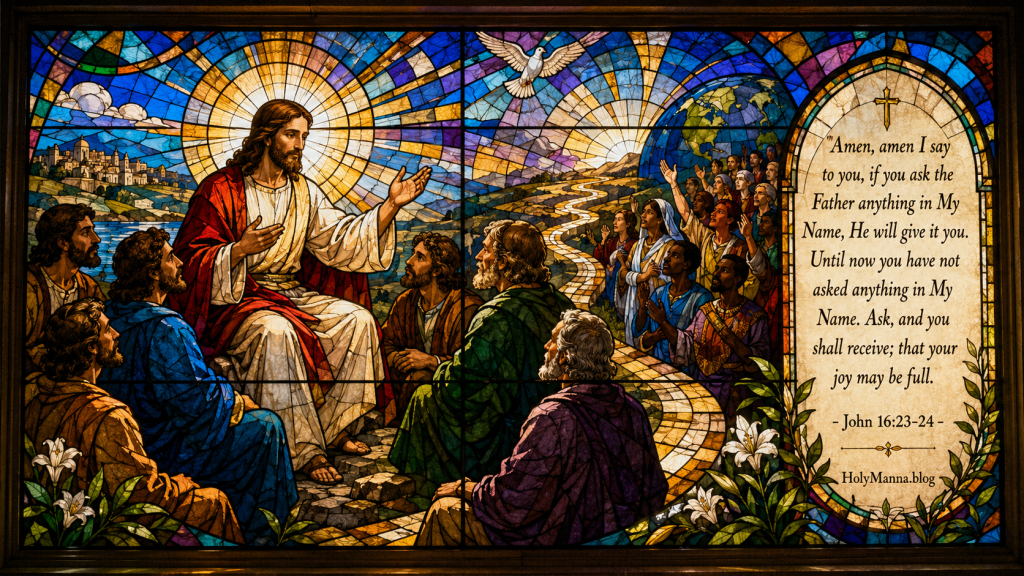
23 On that day you will not question me about anything. Amen, amen, I say to you, whatever you ask the Father in my name he will give you. 24 Until now you have not asked anything in my name; ask and you will receive, so that your joy may be complete.
25 “I have told you this in figures of speech. The hour is coming when I will no longer speak to you in figures but I will tell you clearly about the Father. 26 On that day you will ask in my name, and I do not tell you that I will ask the Father for you. 27 For the Father himself loves you, because you have loved me and have come to believe that I came from God. 28 I came from the Father and have come into the world. Now I am leaving the world and going back to the Father.”
Detailed Exegesis
Verse 23 – “On that day you will not question me about anything. Amen, amen, I say to you, whatever you ask the Father in my name he will give you.”
Jesus speaks of “that day” John 16:23, pointing toward the new reality that will come through His Resurrection, Ascension, and the gift of the Holy Spirit. The disciples are confused now, but after the Paschal Mystery they will receive a clearer understanding. The Holy Spirit will guide them into the truth, and their prayer will take on a new boldness.
The phrase “in my name” John 16:23 is the heart of the verse. To ask in Jesus’ name does not mean simply adding a pious phrase to the end of a prayer. It means praying in union with Jesus Himself: His will, His mission, His obedience, His love, and His desire for our salvation.
This is why Catholic prayer is always Christ-centered. The Church prays to the Father through the Son in the Holy Spirit. The Mass itself reaches its summit in this movement when the priest prays, “Through him, and with him, and in him, O God, almighty Father”. Christian prayer has confidence because the Son has opened the way to the Father.
Verse 24 – “Until now you have not asked anything in my name; ask and you will receive, so that your joy may be complete.”
Jesus now invites the disciples into a new kind of prayer. Before His glorification, they had not yet prayed in the full light of His Passion, Resurrection, and Ascension. After Easter, they will ask as those who know that Christ has conquered sin and death.
The purpose of this asking is “so that your joy may be complete” John 16:24. This does not mean every earthly desire will be granted exactly as requested. Jesus is speaking of a deeper joy, the joy of communion with God. Complete joy comes when the heart learns to desire what the Son desires and to trust the Father’s love even when the answer is not what was expected.
This verse gently corrects shallow ideas of prayer. Prayer is not magic, negotiation, or spiritual self-expression. Prayer is relationship. Prayer forms the heart until it can receive the joy God actually wants to give.
Verse 25 – “I have told you this in figures of speech. The hour is coming when I will no longer speak to you in figures but I will tell you clearly about the Father.”
Jesus acknowledges that He has often spoken in mysterious language. In The Gospel of John, He has used images such as living water, bread from heaven, the vine and branches, birth from above, the shepherd and the sheep, and the woman in labor. These images reveal truth, but they also require faith.
The “hour” John 16:25 is the hour of His Passion and glorification. After that hour, and through the gift of the Holy Spirit, the disciples will understand more clearly who the Father is. Jesus does not merely teach facts about God. He reveals the Father. His whole life is the visible mission of the invisible God.
This matters because many people imagine God according to fear, wound, personality, or culture. Jesus corrects those false images. To know the Father, one must look at the Son.
Verse 26 – “On that day you will ask in my name, and I do not tell you that I will ask the Father for you.”
At first, this verse can sound surprising. Is Jesus saying He will not intercede for us? No. The New Testament clearly teaches that Christ intercedes for His people. Here, Jesus is emphasizing something different: the Father’s love is not reluctant.
Jesus is not saying, “The Father is distant, so I must convince Him to care.” He is revealing that through the Son, the disciples will have real access to the Father. Christ is the one Mediator, and His mediation does not keep the Father away from us. It brings us into the Father’s love.
The Catholic faith does not divide the Trinity, as if the Son were merciful while the Father were severe. The Father sends the Son because He loves the world. The Son reveals the Father because He is one with Him. The Holy Spirit pours divine love into our hearts.
Verse 27 – “For the Father himself loves you, because you have loved me and have come to believe that I came from God.”
This is one of the most tender lines in the Gospel. Jesus says plainly, “the Father himself loves you” John 16:27. The disciples are loved by the Father because they have loved the Son and believed that He came from God.
This does not mean human love comes first, as if God waits to love until people prove themselves worthy. Catholic theology teaches that grace always comes first. The disciples love because they have already been drawn by grace. Their faith and love are real, but they are responses to divine initiative.
This verse is deeply healing. Many people carry a hidden fear that God merely tolerates them. Jesus reveals something greater. The Father loves His children. He desires their salvation. He receives their prayers through the Son.
Verse 28 – “I came from the Father and have come into the world. Now I am leaving the world and going back to the Father.”
This final verse summarizes the whole mission of Jesus. He comes from the Father, enters the world, and returns to the Father. This is not the journey of a religious teacher who appears briefly and disappears. This is the eternal Son entering human history for our salvation.
Here the Gospel points toward the Ascension. Jesus’ return to the Father is not abandonment. It is victory. He returns in His glorified humanity, bringing our human nature into the glory of God. Because He goes to the Father, the disciples can pray in His name, receive the Spirit, and continue His mission in the Church.
This verse also gives the Christian life its direction. The Son comes from the Father and returns to the Father, and He brings His people with Him. Every prayer, sacrament, act of charity, moment of repentance, and step of discipleship is part of that homeward journey.
Teachings: Prayer in the Name of Jesus and the Father’s Love
This Gospel passage teaches one of the deepest truths of Christian prayer: Catholics do not pray as isolated individuals trying to reach God by their own strength. They pray in Christ, through Christ, and with Christ. Prayer is possible because the Son has opened the way.
The Catechism teaches, “There is no other way of Christian prayer than Christ. Whether our prayer is communal or personal, vocal or interior, it has access to the Father only if we pray ‘in the name’ of Jesus. The sacred humanity of Jesus is therefore the way by which the Holy Spirit teaches us to pray to God our Father.” CCC 2664
That quote is a key to today’s Gospel. Jesus does not merely give the disciples better words. He gives them access. His sacred humanity becomes the road by which believers come to the Father. This is why Catholic prayer is never detached from the Incarnation, the Cross, the Resurrection, and the Ascension.
The Catechism also teaches, “When Jesus openly entrusts to his disciples the mystery of prayer to the Father, he reveals to them what their prayer and ours must be, once he has returned to the Father in his glorified humanity. What is new is to ‘ask in his name.’ Faith in the Son introduces the disciples into the knowledge of the Father, because Jesus is ‘the way, and the truth, and the life.’ Faith bears its fruit in love: it means keeping the word and the commandments of Jesus, it means abiding with him in the Father who, in him, so loves us that he abides with us. In this new covenant the certitude that our petitions will be heard is founded on the prayer of Jesus.” CCC 2614
This gives Catholic prayer both confidence and humility. Confidence, because the Son Himself brings the prayer of the Church to the Father. Humility, because asking in Jesus’ name means asking as disciples, not consumers. The goal is not to bend God’s will around personal preference. The goal is to be drawn into the will of the Son.
Saint Augustine explains this beautifully in his preaching on The Gospel of John. Reflecting on this passage, he teaches that to ask in Christ’s name means asking for what truly belongs to salvation and eternal joy. He writes, “Whatever is asked in opposition to the interests of salvation is not asked in the name of the Saviour.” St. Augustine, Tractates on the Gospel of John, Tractate 102
That line is simple and sharp. It helps explain why some prayers seem unanswered. God is not deaf. God is Father. A good father does not give a child everything that child demands. He gives what leads to life.
Saint Augustine also helps protect the truth about the Father’s love. Jesus says, “the Father himself loves you” John 16:27, and Augustine reminds Christians that this love begins with God. He draws from The First Letter of John: “We love, because he first loved us.” 1 John 4:19
This is the Catholic story of grace. The Father loves first. The Son comes to save. The Spirit moves the heart. The disciple responds with faith, love, prayer, obedience, and joy.
The Gospel also connects to the Ascension. The Catechism teaches, “Jesus Christ, the head of the Church, precedes us into the Father’s glorious kingdom so that we, the members of his Body, may live in the hope of one day being with him forever.” CCC 666
So when Jesus says He is going back to the Father, He is not closing a door. He is opening the way home.
Reflection: Learning to Pray Like Beloved Children
This Gospel is tender, but it is also challenging. Jesus tells the disciples to ask, but He also teaches them how to ask. They must ask in His name. That means prayer cannot stay trapped in selfishness, fear, resentment, vanity, or control. Prayer has to become Christ-shaped.
Many Catholics pray sincerely, but anxiously. They bring God urgent needs, family worries, financial stress, health concerns, relationship pain, grief, and private battles. That is good. The Father wants His children to come to Him. But this Gospel invites Catholics to go deeper than simply presenting requests. It invites them to ask, “Lord, teach this heart to want what You want.”
A practical response begins by praying through Jesus intentionally. Before asking for anything, a Catholic can pause and say, “Jesus, let this prayer be united to Your will.” That small act changes the posture of the soul. It moves prayer from demand to trust.
Another step is to pray the Our Father slowly. That prayer already teaches the order of Christian desire: the Father’s name, the Father’s kingdom, the Father’s will, daily bread, forgiveness, deliverance from evil. It forms the heart to ask rightly.
Catholics can also bring unanswered prayers honestly before the Lord. Instead of pretending disappointment does not hurt, they can place it before the Father through the Son. The Cross proves that God can bring life from what looks like silence, defeat, and loss.
This Gospel also invites a healing of false images of God. Jesus says, “the Father himself loves you” John 16:27. Some hearts need to sit with that line for a long time. The Father is not looking for a reason to reject His children. He is drawing them into the Son.
Do your prayers sound more like the requests of a beloved child or the negotiations of someone afraid of being forgotten?
When you ask in Jesus’ name, are you asking for Christ’s will to shape your desire, or are you asking Christ to approve what you already want?
Where do you need to trust that the Father loves you, even if His answer is slower, quieter, or different than expected?
The disciples in the Upper Room are about to walk through confusion, sorrow, failure, and fear. Jesus does not give them a shortcut around the Cross. He gives them something better. He gives them access to the Father. He teaches them to ask in His name. He promises a joy that suffering cannot erase.
That same invitation stands today. The Son has come from the Father. The Son has returned to the Father. Now every Catholic prayer, whispered at a bedside, offered at Mass, spoken in a car, or cried through tears, can rise through Jesus Christ into the heart of the Father who loves His children.
Let the Fire Come Home
Today’s readings leave the Church with a simple but powerful invitation: let every gift, every prayer, and every desire come home to God.
Apollos shows what happens when a gifted soul remains humble. He is eloquent, bold, and deeply rooted in Scripture, but he still allows Priscilla and Aquila to teach him “the Way of God more accurately” Acts 18:26. His story reminds Catholics that zeal is beautiful, but zeal becomes fruitful when it is formed by the Church. The Lord does not shame Apollos for what he lacks. He completes him through faithful disciples who know how to speak truth with charity.
Then Psalm 47 widens the whole scene. The God who forms one preacher also calls every nation into praise. “God is king over all the earth” Psalm 47:8, and no corner of life sits outside His reign. Not the home. Not the workplace. Not the hidden interior battles. Not the countries wounded by confusion, violence, pride, or unbelief. Christ reigns over all, and His Church is sent so that every people may learn the song of the King.
Finally, Jesus brings everything into the heart of the Father. He tells His disciples, “whatever you ask the Father in my name he will give you” John 16:23. Christian prayer is not begging from a distance. It is the prayer of beloved children united to the Son. The Catechism teaches, “There is no other way of Christian prayer than Christ” CCC 2664, because Jesus Himself is the way into the Father’s love.
The message is clear. Let the Church form the mind. Let worship reorder the heart. Let prayer become more than requests and become communion. Let the name of Jesus purify desires until joy becomes complete.
This week, bring one part of life more consciously under Christ’s reign. Open Scripture with the Church instead of alone with opinions. Ask for correction without defensiveness. Pray the Our Father slowly. Go to Mass with renewed reverence. Encourage someone whose faith is still growing. Speak the truth gently, like Priscilla and Aquila. Ask boldly, but ask in the name of Jesus.
Where is the Lord trying to complete what He has already begun in you?
The same God who strengthened Apollos, gathered the nations, and opened the Father’s heart to the disciples is still at work today. He does not waste a burning heart. He forms it, purifies it, and sends it out with joy.
Engage with Us!
Share your reflections in the comments below. Today’s readings invite every Catholic heart to become more humble, more joyful, and more rooted in the Father’s love through Jesus Christ.
- First Reading, Acts 18:23-28: Where is God inviting you to be more teachable, like Apollos, and allow the Church to explain “the Way of God more accurately” in your life?
- Responsorial Psalm, Psalm 47:2-3, 8-10: What part of your daily life still needs to be surrendered more fully to the truth that “God is king over all the earth”?
- Holy Gospel, John 16:23-28: When you pray in Jesus’ name, are you asking the Father with trust as a beloved child, or are you still praying as if you need to convince Him to love you?
- Today’s central theme: How can your zeal, worship, and prayer become more deeply united to Christ and His Church this week?
May these readings help us live with humble courage, joyful worship, and deeper confidence in the Father’s love. Let us go forward in faith, doing everything with the love, mercy, patience, and truth that Jesus taught us.
Sacred Heart of Jesus, we trust in You!
Immaculate Heart of Mary, pray for us!
Saint Michael the Archangel, defend us in battle!
Follow us on YouTube, Instagram and Facebook for more insights and reflections on living a faith-filled life.

 Holy Manna!
Leave a comment