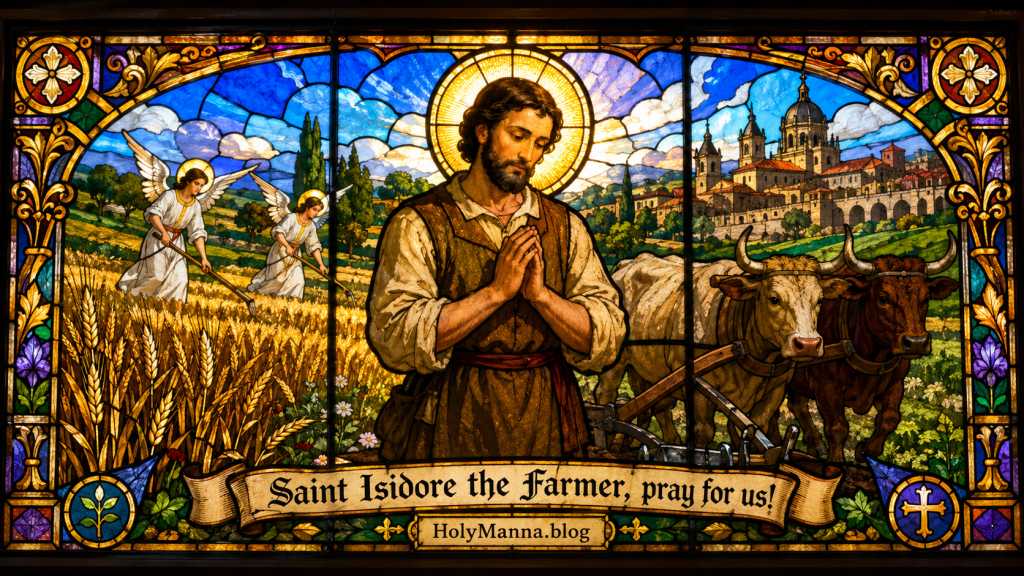
A Saint for the Ordinary Catholic
Saint Isidore the Farmer, known in Spanish as San Isidro Labrador, is one of those saints who quietly ruins every excuse that holiness is only for monks, priests, theologians, missionaries, or martyrs.
He was a husband. He was a father. He was poor. He worked the land. He woke up early, went to Mass, prayed deeply, labored honestly, fed the hungry, loved his wife, cared for animals, and trusted God with the kind of faith that looks simple from the outside but is heroic from the inside.
The Church remembers him as the patron saint of farmers, farm workers, rural communities, day laborers, and the city of Madrid. His life is a beautiful reminder that sainthood does not require a famous platform or a dramatic public mission. Sometimes, sanctity looks like a man walking to Mass before sunrise, then taking up his tools and doing the day’s work with love.
The Catechism of the Catholic Church teaches that “Work honors the Creator’s gifts and the talents received from him” CCC 2427. Saint Isidore lived that truth with dirt under his fingernails and prayer in his heart.
A Poor Child in Medieval Madrid
Saint Isidore was born in or near Madrid, likely in the late eleventh century. Catholic sources differ on the exact dates of his life. Many traditions place him around 1070 to 1130, while Madrid’s own Catholic tradition preserves a later timeline, around 1082 to 1172. What matters most is that he belonged to medieval Madrid, a city shaped by the tensions, struggles, and mingled cultures of Christian and Muslim Spain.
Some Catholic traditions describe him as a Mozarab Christian, meaning a Catholic living in a region influenced by Muslim rule while preserving the Christian faith. His family was poor, and he was named after the great Saint Isidore of Seville, one of Spain’s most revered bishops and scholars.
Unlike his namesake, Isidore the Farmer was not a man of books, schools, or public authority. He was a laborer. He worked with his hands. He knew what it meant to depend on the weather, the soil, the strength of animals, and the mercy of God.
He eventually worked for a landowner named Juan de Vargas, sometimes also rendered as Iván de Vargas. He became known not for ambition or cleverness, but for humility, faithfulness, and charity. In Catholic memory, his greatness begins precisely there. He did not run from ordinary life. He made ordinary life holy.
A Holy Marriage Rooted in Prayer
Saint Isidore married María Toribia, venerated in Spanish devotion as Santa María de la Cabeza. Catholic sources describe her as a holy woman, and she was beatified in 1697. Together, Isidore and María formed one of the most beautiful holy marriages in Catholic tradition.
They were not wealthy. They did not have an easy life. They lived simply, worked hard, and gave generously. Their home was marked by prayer and charity. Tradition says they had a son, and one of the most beloved miracle stories connected to them involves that child falling into a deep well.
Their marriage teaches something deeply needed today. Holiness is not opposed to family life. Marriage is not a lesser path to sanctity. The home can become a little domestic church, and daily responsibilities can become the very place where grace does its quiet work.
The Catechism teaches that the Christian home is called to be a place of faith, hope, and charity, a place where parents and children learn prayer and sacrifice. Saint Isidore and María lived that teaching long before most people had catechisms on their shelves.
Mass Before the Fields
The most defining rhythm of Saint Isidore’s life was this: he went to Mass before work.
That detail may sound small, but it shaped everything. Isidore was known for rising early, attending Mass, praying in churches, and then going to labor in the fields. Some of his fellow workers complained that he was late or not pulling his weight. In their eyes, prayer looked like wasted time.
But in God’s eyes, prayer was the root of his work.
Saint Isidore did not use devotion as an excuse to avoid responsibility. He worked faithfully. But he put God first, and that made his work fruitful. His life feels like a living commentary on the words of Christ in The Gospel of Matthew: “But seek first the kingdom of God and his righteousness, and all these things will be given you besides” Matthew 6:33.
That was Isidore’s secret. He sought God first, then took up the plough.
When Angels Took Up the Plough
The most famous story about Saint Isidore is the miracle of the angels and the oxen.
According to Catholic tradition, some fellow workers accused Isidore of neglecting his duties because he spent too much time at Mass and in prayer. His employer, Juan de Vargas, went to see for himself. What he found was astonishing. Isidore was praying, and the field was being ploughed by oxen guided by angelic figures. In some versions, angels were ploughing beside him, so that the work of several men was being done.
This is a beloved Catholic legend associated with Saint Isidore. It cannot be verified in the way a modern event would be documented, but it has been cherished for centuries because it reveals the spiritual truth of his life. God was not rewarding laziness. God was revealing the hidden power of a soul that placed prayer before productivity.
The story reminds modern Catholics that work is good, but work is not God. Productivity is useful, but productivity is not holiness. A person can be busy all day and still be spiritually empty. Saint Isidore teaches that when the soul is rightly ordered toward God, even ordinary work becomes part of the path to heaven.
The Child in the Well
One of the most tender stories from Saint Isidore’s life concerns his son.
According to tradition, Isidore and María’s child fell into a deep well. Any parent can imagine the terror of that moment. The child was beyond human reach, and there seemed to be nothing they could do.
So they prayed.
The story says that as they prayed, the water in the well began to rise until the child floated safely to the top. This miracle is one of the reasons Saint Isidore has been invoked by some Catholics in situations involving children and danger.
This story, too, belongs to Catholic tradition and cannot be verified by modern historical standards. But it has endured because it shows the heart of Christian trust. Isidore and María did not control the situation. They surrendered it to God. Their prayer did not come from comfort. It came from anguish, love, and faith.
What fear in your life needs to be carried to God instead of carried alone?
Bread for the Poor and the Miracle of the Pot
Saint Isidore and María were known for feeding the poor. That is not a decorative detail in his life. It is central to his sanctity.
One story says that Isidore brought hungry people home to be fed, but María discovered that the pot was empty. Isidore asked her to check again. When she did, the pot was miraculously full, and there was enough food for those in need.
This miracle story cannot be verified by modern standards, but it fits perfectly with the Catholic memory of Isidore’s charity. He trusted that generosity would not make him poor in the only way that matters. He understood that the hungry person at the door was not an inconvenience. The hungry person was Christ arriving in disguise.
In The Gospel of Matthew, Jesus says, “Amen, I say to you, whatever you did for one of these least brothers of mine, you did for me” Matthew 25:40. Saint Isidore lived that Gospel not in theory, but in his kitchen.
The Banquet Where the Poor Were Welcome
Another beautiful story tells of Isidore arriving late to a confraternity meal because he had been praying. On the way, he brought poor people with him. When he arrived, the others said there was only enough food saved for him.
Isidore answered that his portion would be enough for everyone.
The food was shared, everyone ate, and there was still some left over. This story clearly echoes the Gospel miracles of multiplication. It cannot be verified as modern history, but it reveals the Catholic imagination around Saint Isidore. Wherever he went, the poor were not treated as outsiders. They were brought to the table.
That is a hard lesson for a comfortable age. Charity is not only writing a check or feeling compassion. Charity makes room. Charity shares the portion that was supposed to be kept for oneself.
The Birds, the Grain, and the Mercy of Creation
Saint Isidore is also remembered for his kindness toward animals.
One winter day, according to tradition, he saw hungry birds searching for food in the snow. He poured out part of his grain for them. Someone mocked him for wasting what he needed. But when Isidore reached the mill, the sack was still full.
This story cannot be verified in a modern historical sense, but it is consistent with his image as a saint who saw creation as God’s gift. He was not sentimental in a shallow way. He was reverent. He understood that animals, fields, water, grain, and harvest all belonged first to the Creator.
The Catechism teaches that animals are God’s creatures and that “men owe them kindness” CCC 2416. Saint Isidore’s mercy toward the birds shows a heart trained by grace. He did not see the world as something merely to use. He saw it as something entrusted to human care.
The Donkey and the Wolf
Another lesser-known legend tells of Saint Isidore leaving his donkey outside while he went into church to pray. People came to warn him that a wolf was attacking the animal. Isidore calmly entrusted the matter to God and continued his prayer. When they returned, the donkey was unharmed, and the wolf was dead.
This story cannot be historically verified, but it carries the unmistakable tone of medieval hagiography. It shows Isidore’s deep trust in Providence. He did not panic. He did not abandon prayer at the first sign of danger. He trusted that God was Lord inside the church and outside it, in the sanctuary and in the field.
That does not mean Catholics should be careless or irresponsible. It means fear must not become the master of the soul.
Springs in Dry Ground
Water appears again and again in the stories of Saint Isidore. Some traditions say he was also a well-digger, and several miracles involve springs, wells, rain, and relief from drought.
One story says that his master, Juan de Vargas, was thirsty while they were in the fields. Isidore struck or opened the ground, and a spring of fresh water appeared. Other traditions say that springs connected to him continued to be places of devotion after his death.
These stories cannot all be verified, but they explain why Saint Isidore became so closely tied to prayers for rain, crops, wells, farms, and rural survival. For farmers, water is not a luxury. It is life. In Isidore’s story, water becomes a sign of God’s providence flowing through humble faith.
The Raising of María de Vargas
One of the more dramatic miracle stories says that María de Vargas, the daughter of Isidore’s employer, had died. According to the tradition, Isidore prayed and said she was not dead but asleep. She was restored to life.
This story cannot be verified by modern standards, but it belongs to the long devotional memory surrounding Saint Isidore. It presents him as a man whose holiness was recognized not through power or position, but through prayer.
The miracle also shows why his employer’s household became deeply connected to his sanctity. Those who first doubted him eventually saw that this poor laborer was rich in God.
Hardship Without Martyrdom
Saint Isidore was not a martyr. He did not die by violence for the faith. His hardship was quieter, but still real.
He knew poverty. He knew labor. He knew misunderstanding. He was mocked and accused by coworkers. He lived in a time of political and cultural tension in medieval Spain. He and María seem to have known the pain of fear for their child, and some traditions suggest they suffered the grief of losing him young.
His holiness was not forged in a prison cell or before an executioner. It was forged in repetition. Morning prayer. Daily Mass. Work. Hunger at the door. Another field. Another task. Another opportunity to choose God over resentment.
That kind of sanctity may not look dramatic, but it is demanding. Many people can make one heroic gesture. Fewer can live hidden fidelity day after day.
Saint Isidore teaches that ordinary life is not spiritually neutral. It is the place where a soul either becomes generous or selfish, prayerful or distracted, humble or bitter, faithful or lukewarm.
His Death and the Incorrupt Body
After Saint Isidore died, devotion to him grew steadily in Madrid. Catholic tradition says that decades after his burial, his body was discovered incorrupt. His remains became an object of deep veneration, and miracles were attributed to his intercession.
His body was eventually honored in Madrid, and his relics became closely tied to the spiritual identity of the city. Over time, Saint Isidore became not only a beloved rural saint, but the patron of Madrid itself.
The veneration of relics can seem strange to modern people, but it is deeply Catholic. The body is not a disposable shell. The body is destined for resurrection. The Catechism teaches that “We believe in the true resurrection of this flesh that we now possess” CCC 1017. The relics of the saints remind Catholics that grace touches real bodies, real places, real history, and real human lives.
A Saint Who Helped a King
One famous posthumous legend connects Saint Isidore with King Alfonso VIII of Castile and the Battle of Las Navas de Tolosa in 1212. According to the story, a mysterious shepherd showed the Christian army a hidden path before the battle. Later, when the king saw Saint Isidore’s body, he recognized him as the man who had guided them.
This story cannot be historically verified with certainty, but it became an important part of Spanish Catholic memory. It shows how deeply the people of Madrid believed Saint Isidore continued to intercede after death.
In Catholic teaching, the saints are not gone. They are alive in Christ. The Catechism teaches that “Being more closely united to Christ, those who dwell in heaven fix the whole Church more firmly in holiness” CCC 956. That is why Catholics ask the saints to pray for us. They are not rivals to Christ. They are members of His Body, alive in His glory.
The Healing of King Philip III
Another important posthumous miracle concerns King Philip III of Spain. Catholic tradition says that the king was gravely ill and recovered after Saint Isidore’s relics were brought to him or venerated in prayer.
This royal healing helped strengthen devotion to Saint Isidore and contributed to the formal recognition of his sanctity. It also shows something striking. A poor farmer became the heavenly intercessor of kings.
That is the upside-down beauty of the Kingdom of God. The hidden laborer, overlooked in life by many, becomes great in heaven. The man who once served earthly masters becomes an intercessor for rulers.
Canonized Among Giants
Saint Isidore was canonized by Pope Gregory XV on March 12, 1622. That date is remarkable because he was canonized alongside Saint Ignatius of Loyola, Saint Francis Xavier, Saint Teresa of Ávila, and Saint Philip Neri.
Think about that lineup. A founder of the Jesuits. A missionary giant. A mystical Doctor of the Church. A joyful apostle of Rome. And beside them, a farmer.
That is one of the most beautiful facts about Saint Isidore. The Church placed a poor laborer among some of the most famous saints of the Catholic Reformation. It was as if the Church were saying that holiness is not measured by public achievement. It is measured by love.
Saint Isidore did not write a theological masterpiece. He did not cross oceans preaching the Gospel. He did not reform a religious order. He went to Mass, worked the fields, fed the poor, loved his wife, and trusted God.
And that was enough for sainthood.
Patron of Farmers, Madrid, and Hidden Workers
Saint Isidore is most known as the patron saint of farmers, farm workers, peasants, day laborers, rural communities, and Madrid. In many places, he is invoked for rain, crops, harvests, animals, and the needs of agricultural life.
His feast day is celebrated on May 15. In Madrid, his feast is a major religious and cultural celebration. The faithful honor his relics, attend Mass, take part in processions, visit places associated with his life, and keep traditional customs connected to food, water, music, and local dress.
His impact spread beyond Spain through Catholic devotion, especially into Latin America, the Philippines, and rural Catholic communities throughout the world. Catholic Rural Life has also promoted devotion to him among farmers and rural Catholics in the United States.
Saint Isidore’s legacy endures because he belongs to everyone who feels ordinary. He belongs to workers who are tired. Parents who are stretched thin. Men and women who wonder whether hidden sacrifices matter. People who pray before clocking in. People who try to be faithful without applause.
He is a saint for those who do their duty quietly and ask God to make it holy.
The Field as a Place of Grace
Saint Isidore’s life is a quiet rebuke to a distracted age. Modern people often think meaning must be found somewhere else. A better job. A bigger platform. A more exciting calling. A more impressive identity.
Saint Isidore says something different. Begin with God. Be faithful where you are. Love the people God has placed near you. Feed the poor. Do honest work. Receive the sacraments. Trust Providence. Let grace enter the ordinary.
The Catechism teaches that all Christians are called to holiness, each according to his or her state in life. Saint Isidore shows what that looks like when the state in life is humble, hidden, and full of labor.
His field became a chapel. His plough became an offering. His home became a place of charity. His poverty became generosity. His daily Mass became the anchor of his soul.
What would change if your ordinary work became an offering to God?
Holiness in the Dirt of Daily Life
Saint Isidore’s story is comforting, but it is also challenging.
It is comforting because most Catholics are not called to become famous missionaries, theologians, or martyrs. Most are called to ordinary holiness in ordinary places. Jobs. Families. Parishes. Kitchens. Classrooms. Offices. Fields. Construction sites. Car rides. Grocery stores. Sickrooms. Quiet prayers before the day begins.
It is challenging because ordinary holiness leaves no room for excuses. Saint Isidore did not need wealth to be generous. He did not need status to be faithful. He did not need comfort to pray. He did not need recognition to serve.
His life asks modern Catholics to recover the beauty of putting God first. Not after everything else is done. Not only when convenient. Not only when life calms down. First.
That might mean beginning the day with prayer before checking the phone. It might mean attending daily Mass when possible. It might mean doing honest work when nobody is watching. It might mean feeding someone, forgiving someone, or treating creation with reverence. It might mean offering a repetitive job to God instead of resenting it.
Saint Isidore teaches that holiness does not always look impressive. Sometimes it looks like showing up, praying first, working hard, and loving well.
Where is God asking you to become a saint in the middle of your normal life?
Engage with Us!
Share your thoughts and reflections in the comments below. Saint Isidore’s life is simple on the surface, but it reaches deeply into work, family, prayer, poverty, and trust in God.
- What part of Saint Isidore’s life challenges you the most: his prayer, his work ethic, his charity, or his trust in Providence?
- How can you place God first in your daily routine, even before the demands of work, family, and responsibilities begin?
- What ordinary task in your life could become an offering to God this week?
- How does Saint Isidore’s love for the poor invite you to practice charity in a more concrete way?
- Where do you need to trust God more deeply, especially in situations that feel beyond your control?
May Saint Isidore the Farmer pray for all who labor, all who feel hidden, all who provide for families, all who depend on the land, and all who are trying to become holy in ordinary life. Live with faith, work with love, serve with mercy, and do everything with the love and mercy Jesus taught us.
Saint Isidore the Farmer, pray for us!
Follow us on YouTube, Instagram and Facebook for more insights and reflections on living a faith-filled life.


Leave a comment