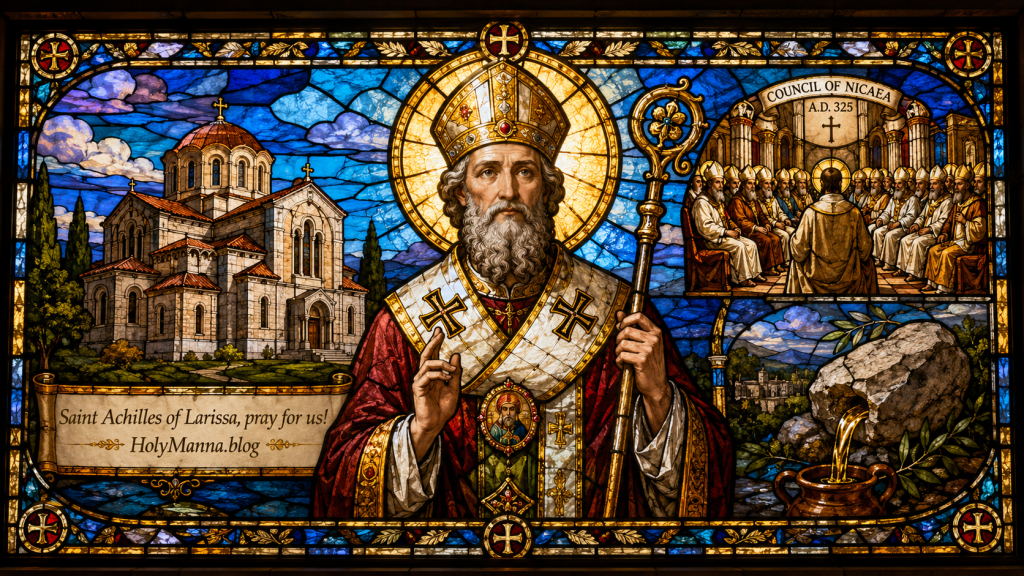
The Bishop Who Made a Stone Speak for Christ
Saint Achilles of Larissa, also known as Saint Achillius, was a fourth-century bishop of Larissa in Thessaly, Greece. He is remembered as a defender of the Catholic faith, a shepherd of the poor, a missionary bishop, and a wonderworker. His feast day is celebrated on May 15, and his name remains especially beloved in Larissa, where he is honored as a patron and protector.
He lived during one of the most important moments in Church history: the age of the First Council of Nicaea in 325. This was the council that confronted the Arian heresy, which denied the full divinity of Jesus Christ. Saint Achilles stood with the bishops who defended the truth that the Son is not a creature, not a lesser being, and not merely the highest of God’s works. Jesus Christ is true God from true God.
The heart of Saint Achilles’ legacy is beautifully connected to the Nicene faith that Catholics still profess at Mass: “God from God, Light from Light, true God from true God, begotten, not made, consubstantial with the Father.”
That one word, “consubstantial,” may sound technical, but it protects the whole Christian faith. If Jesus is not truly God, then He cannot truly save. If the Son is not equal to the Father, then the Cross is not the saving act of God Himself. Saint Achilles reminds the Church that doctrine is not dry theology. Doctrine is love guarded from error.
From Noble Roots to a Life Poured Out for God
Tradition says Saint Achilles was born in Cappadocia, in Asia Minor, sometime in the third century. Some later summaries associate him more generally with Greece or Thessaly, but the most common tradition places his origins in Cappadocia. He was said to have come from a noble or patrician family and to have received a strong education, especially in philosophy and classical learning.
But Achilles was not formed by learning alone. He was formed by faith. After the death of his parents, tradition says he gave away his wealth to the poor and set out on pilgrimage. He traveled to the Holy Land, where he prayed at the places sanctified by the earthly life, Passion, Death, and Resurrection of Jesus Christ. He then went to Rome to venerate the tombs of Saints Peter and Paul.
That detail matters. Achilles did not become holy by chasing status. He became holy by surrendering everything to Christ. Wealth became charity. Education became service. Travel became pilgrimage. His life began to take the shape of the Gospel.
In the spirit of Matthew 19:21, he lived the words of Christ: “If you would be perfect, go, sell what you possess and give to the poor, and you will have treasure in heaven.”
After his pilgrimage, Achilles became known as an evangelizer. He preached among pagan peoples and helped bring many to the Christian faith. Eventually he arrived in Larissa, an important city in Thessaly. The episcopal see was vacant, and the clergy and people recognized in him the qualities of a true shepherd. He became bishop of Larissa, and his name would be forever tied to that city.
A Shepherd Who Defended Truth and Served the Poor
As bishop, Saint Achilles was known not only for doctrine, but also for mercy. He is remembered as a pastor who cared deeply for the poor, the sick, the elderly, and strangers. Some traditions say he founded or supported works of mercy, including a hospital and a home or hospice for the elderly.
This is one of the most important parts of his story. Saint Achilles was not merely a bishop who argued against heresy. He was a bishop who made the love of Christ visible. He knew that the defense of truth and the service of the poor belong together.
The Catechism of the Catholic Church, CCC 2447, teaches that the works of mercy are charitable actions by which Christians come to the aid of their neighbor in spiritual and bodily necessities. Saint Achilles lived that truth as a bishop. He defended the divinity of Christ at the highest level of Church life, but he also cared for suffering people in the ordinary streets of his city.
That is Catholic holiness. It is both creed and charity. It is both worship and service. It is both reverence before the altar and tenderness toward the wounded.
Saint Achilles is also remembered as a builder of Christian life in Larissa. After the Council of Nicaea, tradition says he returned to his diocese strengthened in faith and worked to replace pagan worship with Christian churches. These details belong partly to later hagiographical tradition, but they reflect the way the Christian memory of Larissa understood him: a bishop who helped turn a city toward Christ.
The Wonderworker of Larissa
Saint Achilles was remembered as a wonderworker, sometimes called “the Thaumaturgist,” which means miracle-worker. Catholic sources preserve his reputation as a saint celebrated for miracles. Eastern Christian traditions, which carry many of the fuller stories surrounding him, say he healed the sick, cast out demons, and worked many signs through the grace of God.
These miracle traditions should be received with the right Catholic sense. Miracles are not magic tricks, and saints are not performers. Miracles are signs of God’s mercy. They point beyond the saint to Christ, who is the true healer and Savior.
The Catechism of the Catholic Church, CCC 799, teaches that charisms are gifts of the Holy Spirit ordered toward the building up of the Church. Saint Achilles’ reputation as a wonderworker fits that understanding. His miracles were remembered because they strengthened faith, healed suffering, and confirmed the truth he preached.
The most famous miracle story associated with him takes place during his confrontation with the Arians. According to hagiographical tradition, while debating those who denied the full divinity of Christ, Achilles took a stone and challenged them. The story says he told them, “If Christ is a creature of God, as you say, tell oil to flow from this stone.”
They could not answer.
Then, according to the same tradition, Achilles prayed and declared, “If the Son of God is equal to the Father, as we believe, then let oil flow from this stone.”
Oil then flowed from the stone.
This story cannot be verified as a historical transcript from the Council of Nicaea, and it should be described as a legend or hagiographical tradition. Still, it beautifully expresses the Catholic truth Saint Achilles defended. The stone becomes a kind of silent preacher. Creation itself, in the story, bears witness that the Son is equal to the Father.
Standing Firm When the Faith Was Under Attack
Saint Achilles lived during a time of intense theological conflict. The Church had emerged from centuries of persecution, but now she faced a danger from within: a false teaching about Christ. Arianism was not a small disagreement. It struck at the identity of Jesus Himself.
The First Council of Nicaea in 325 was called to answer this crisis. Saint Achilles is remembered among the bishops who defended the apostolic faith. The Church affirmed that the Son is eternally begotten of the Father, not created. He is of the same divine substance as the Father.
The Catechism of the Catholic Church, CCC 465, explains that the Council of Nicaea confessed the Son as “begotten, not made, consubstantial with the Father.”
That was the battle Saint Achilles entered. His hardship was not martyrdom by blood, but fidelity in a moment when error threatened to confuse the faithful. He had to defend the truth with clarity and courage.
There is no strong tradition that Saint Achilles died as a martyr. He appears to have died peacefully in Larissa around 330 or sometime in the mid-fourth century. But not every saint is called to shed blood. Some are called to protect the Church by teaching clearly, serving faithfully, and refusing to compromise when Christ is diminished.
That was the witness of Saint Achilles. He teaches that a bishop, a parent, a teacher, a catechist, and every Catholic must sometimes say with love and firmness: Christ is Lord, and the truth about Him matters.
Relics, Prespa, and a Memory That Would Not Die
After his death, Saint Achilles was buried in Larissa, where his memory remained strong. His relics became a major part of his posthumous legacy. Tradition says that in the tenth century, after the Bulgarian ruler Samuel conquered Thessaly, the relics of Saint Achilles were taken from Larissa to Prespa, where a great basilica was built in his honor.
This basilica, associated with the island of Saint Achilleios in Small Prespa Lake, became an important sign of his wider cultural impact in Greece and the Balkans. His name remained attached not only to churches, but also to places, local devotion, and the spiritual identity of communities.
Later tradition says his relics were eventually returned to Larissa in the twentieth century, where they continued to be venerated by the faithful. This later history belongs especially to local tradition, but it shows the enduring devotion surrounding him. Saint Achilles was not remembered as a distant figure locked in the fourth century. He remained a living presence in the devotional memory of the people.
Stories also developed of his intercession during times of danger and disease, especially when the people of Larissa invoked him as their heavenly protector. Some of these posthumous miracle stories are part of local tradition and cannot be fully verified, but they show the confidence Christians placed in his prayers.
This confidence is deeply Catholic. The Catechism of the Catholic Church, CCC 956, teaches that the saints in heaven “do not cease to intercede with the Father for us.” Catholics do not ask the saints to replace Christ. Catholics ask the saints to pray with us and for us, because the whole Church is one Body in Christ.
Saint Achilles’ impact after death is especially visible in Larissa, where he is honored as a patron saint. His feast day on May 15 remains a day of celebration, prayer, and gratitude. His legacy also reaches into the wider Orthodox world, where his memory has been preserved with great devotion. From a Catholic perspective, this is a reminder that the saints of the first millennium often belong to the shared memory of Christians before later divisions hardened.
One surprising detail is that the name Achilles already carried great weight in Greek culture because of the ancient hero Achilles from Homeric tradition. Yet in Larissa, the Christian Saint Achilles became a very different kind of hero. The old heroic ideal celebrated strength, battle, and glory. Saint Achilles showed a higher heroism: fidelity to Christ, service to the poor, defense of truth, and pastoral love.
A Saint for Catholics Who Want Courage
Saint Achilles is a powerful saint for Catholics today because he brings together two virtues that modern people often separate: conviction and compassion.
He was not soft on doctrine. He defended the truth that Jesus Christ is fully divine. He understood that a false Christ cannot save anyone. In an age when many people want a comfortable Jesus, a vague Jesus, or a merely inspiring Jesus, Saint Achilles points back to the real Jesus confessed by the Church: the eternal Son of God.
But he was also not cold. He cared for the poor, the sick, the elderly, and the stranger. His faith did not stop at correct words. It became mercy in action.
That is the lesson. Catholics are not called to choose between truth and love. Truth without love becomes harsh. Love without truth becomes sentimental. In Christ, truth and love are one.
Saint Achilles invites the faithful to become steady Catholics. Not loud for attention. Not timid out of fear. Not cynical. Not careless. Steady. Rooted in the Creed. Faithful to the Church. Generous to the poor. Brave enough to speak the truth. Humble enough to serve without applause.
What would it look like to defend Christ in ordinary life without becoming bitter, prideful, or combative?
Maybe it begins with learning the faith more deeply. Maybe it means praying the Nicene Creed slowly instead of rushing through it at Mass. Maybe it means correcting error with patience. Maybe it means helping someone who is sick, lonely, elderly, or forgotten. Maybe it means refusing to treat doctrine like a hobby and charity like an optional extra.
Saint Achilles reminds the Church that holiness is not one-dimensional. The saint who defended the divinity of Christ also cared for wounded human beings. The bishop who spoke against heresy also became known as a wonderworker. The man who gave away his wealth became richer in heaven than he ever could have been on earth.
Engage With Us!
Share your thoughts and reflections in the comments below. Saint Achilles gives us a beautiful example of courage, clarity, and compassion in a time when the Church needed faithful witnesses.
- How does Saint Achilles’ defense of Christ’s divinity help you appreciate the Nicene Creed more deeply?
- Where in your life is God asking you to stand more firmly for the truth, but with charity and humility?
- How can you imitate Saint Achilles by serving the poor, the sick, the elderly, or the stranger this week?
- What part of his story challenges you most: his courage at Nicaea, his care for the vulnerable, or his willingness to give up worldly security for Christ?
May Saint Achilles of Larissa pray for us, that we may love Jesus Christ as true God and true man, defend the faith with courage, serve the suffering with tenderness, and do everything with the love and mercy Jesus taught us.
Saint Achilles of Larissa, pray for us!
Follow us on YouTube, Instagram and Facebook for more insights and reflections on living a faith-filled life.


Leave a comment