Friday of the Sixth Week of Easter – Lectionary: 295
When Fear Becomes Courage and Sorrow Becomes Joy
Sometimes the Lord does not remove the storm right away. Sometimes He enters the storm, stands beside His servant, and says, “Do not be afraid. Go on speaking, and do not be silent.” Acts 18:9
Today’s readings are held together by a beautiful Easter truth: Christian joy is not the absence of suffering, but the fruit of Christ’s presence within it. Saint Paul faces hostility in Corinth, the Psalmist sings of God’s kingship over every nation, and Jesus prepares His disciples for a sorrow that will soon be transformed into joy. The same movement runs through all three readings: fear gives way to mission, earthly chaos gives way to divine sovereignty, and grief gives way to the joy no one can take away.
In Acts 18:9-18, Paul is in Corinth, a wealthy and morally restless city where the Gospel was both desperately needed and fiercely resisted. Corinth was a major Roman commercial hub, filled with competing religions, social ambition, and spiritual confusion. Paul had reason to feel afraid. Yet the Lord tells him to remain, speak, and trust: “For I am with you.” Acts 18:10 That promise becomes the foundation of his courage. Even when he is dragged before Gallio’s tribunal, God’s providence quietly protects the mission.
The responsorial psalm lifts the whole scene from the courtroom to the throne room of heaven. “God is king over all the earth.” Psalm 47:8 This is not just a song of victory for ancient Israel. It is a proclamation that history belongs to God. The world may resist the Gospel, civil authorities may misunderstand it, and believers may suffer for it, but Christ reigns. Near the Ascension, the Church hears this psalm with Easter ears, recognizing the risen Lord who has gone up in glory and now rules as King.
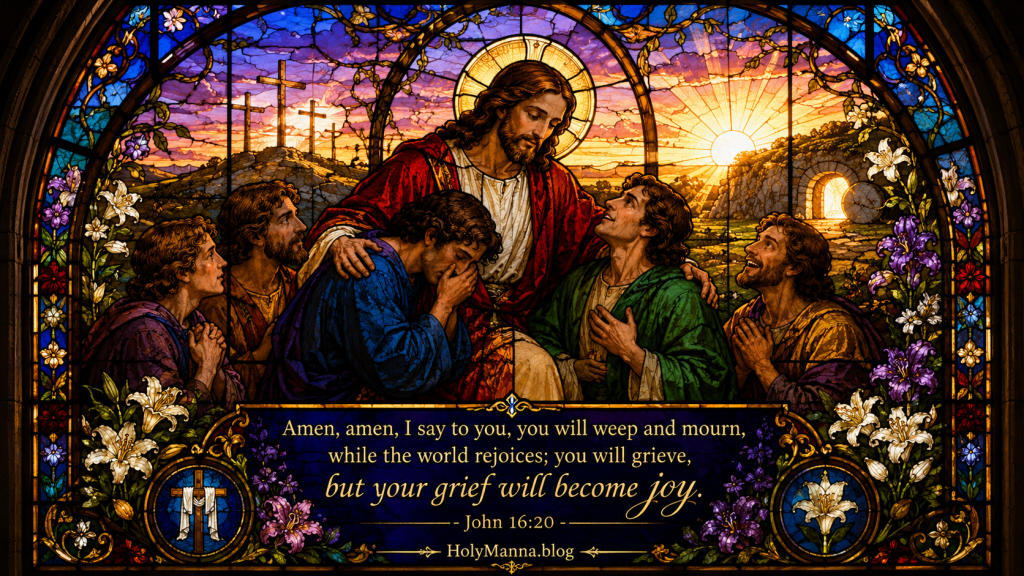
Then, in John 16:20-23, Jesus speaks to the coming grief of His disciples. They will weep while the world rejoices. They will feel the agony of Good Friday. Yet He compares their sorrow to a woman in labor, because Christian suffering, united to Christ, can become the birthplace of new life. “Your grief will become joy.” John 16:20 This is the heart of today’s message. The disciple may pass through fear, opposition, and tears, but the risen Christ turns faithful sorrow into Easter joy.
The Catechism of the Catholic Church teaches that the disciple must bear witness to the faith with confidence, even amid difficulty, and that hope sustains the soul during trial. CCC 1816, CCC 1818-1820 Today’s readings show that truth in motion. Paul keeps speaking. The Church keeps singing. The disciples keep waiting. And Christ keeps His promise.
Where is the Lord asking for courageous witness, deeper trust, and a joy that does not depend on easy circumstances?
First Reading – Acts 18:9-18
Courage in Corinth: When Christ Tells His Servant to Keep Speaking
Saint Paul stands in Corinth, one of the most famous cities of the Roman world. It was wealthy, busy, strategic, and spiritually messy. Merchants, sailors, officials, travelers, philosophers, and worshipers of many gods passed through its streets. Corinth was the kind of place where the Gospel could spread quickly, but also the kind of place where preaching Christ crucified could stir fierce resistance.
Paul had already known rejection, prison, beatings, and public humiliation. He was no stranger to danger. Yet in this reading, the Lord speaks to him with fatherly tenderness: “Do not be afraid. Go on speaking, and do not be silent.” Acts 18:9 This is the heartbeat of the reading. The Christian mission does not move forward because believers never feel fear. It moves forward because Christ is present in the middle of fear.
This reading fits beautifully with today’s theme of sorrow becoming joy. In the Gospel, Jesus tells His disciples that their grief will become joy. In Acts, Paul lives that promise in real time. He faces hostility, legal accusation, and public disorder, yet the Lord’s providence quietly protects the mission. Paul remains, teaches, and eventually leaves with Priscilla and Aquila, showing that the Word of God cannot be chained by fear, tribunals, or opposition.
Acts 18:9-18 – New American Bible (Revised Edition)
9 One night in a vision the Lord said to Paul, “Do not be afraid. Go on speaking, and do not be silent, 10 for I am with you. No one will attack and harm you, for I have many people in this city.” 11 He settled there for a year and a half and taught the word of God among them.
Accusations Before Gallio. 12 But when Gallio was proconsul of Achaia, the Jews rose up together against Paul and brought him to the tribunal, 13 saying, “This man is inducing people to worship God contrary to the law.” 14 When Paul was about to reply, Gallio spoke to the Jews, “If it were a matter of some crime or malicious fraud, I should with reason hear the complaint of you Jews; 15 but since it is a question of arguments over doctrine and titles and your own law, see to it yourselves. I do not wish to be a judge of such matters.” 16 And he drove them away from the tribunal. 17 They all seized Sosthenes, the synagogue official, and beat him in full view of the tribunal. But none of this was of concern to Gallio.
Return to Syrian Antioch. 18 Paul remained for quite some time, and after saying farewell to the brothers he sailed for Syria, together with Priscilla and Aquila. At Cenchreae he had his hair cut because he had taken a vow.
Detailed Exegesis
Verse 9 – “One night in a vision the Lord said to Paul, ‘Do not be afraid. Go on speaking, and do not be silent,’”
The scene begins at night, which often carries a deeper spiritual meaning in Scripture. Night can be the hour of uncertainty, fear, temptation, or hidden grace. Paul receives a vision from the Lord, not because he is weak in faith, but because even strong saints need encouragement. The command “Do not be afraid” reveals that Paul had real human fear. The Lord does not scold him for this. Instead, He strengthens him.
This is deeply Catholic. Grace does not destroy human nature. It heals, elevates, and strengthens it. The Lord commands Paul to keep speaking because faith must be witnessed publicly. Silence can sometimes be prudence, but it can also become cowardice when charity and truth require speech.
Verse 10 – “for I am with you. No one will attack and harm you, for I have many people in this city.”
The reason Paul can continue is not his personality, his education, or his courage. The reason is Christ’s presence: “I am with you.” This echoes God’s promise throughout salvation history. The Lord was with Moses, Joshua, the prophets, Mary, the Apostles, and now Paul.
The phrase “I have many people in this city” is beautiful. Corinth looked worldly, corrupt, and resistant, but Christ already saw souls waiting for grace. Paul could not yet see them all, but the Lord could. This reminds Catholics that evangelization begins with trust. Before the missionary speaks, God is already working.
Verse 11 – “He settled there for a year and a half and taught the word of God among them.”
Paul obeys. He stays in Corinth for eighteen months, which is a long missionary season compared to some of his other stops. His courage becomes steady teaching. The Gospel takes root not only through dramatic moments, but through patient instruction, daily preaching, conversations, friendships, worship, and perseverance.
This verse also highlights the importance of doctrine. Paul does not merely inspire people. He teaches the word of God. The Church continues this apostolic mission through Scripture, Tradition, the Magisterium, catechesis, preaching, and the sacraments.
Verse 12 – “But when Gallio was proconsul of Achaia, the Jews rose up together against Paul and brought him to the tribunal,”
Gallio was a Roman official, the proconsul of Achaia. His appearance gives this passage historical weight. Paul is not preaching in a vague spiritual world. He is preaching in real cities, before real authorities, under real political systems.
The opposition rises together against Paul and brings him before the tribunal. This shows how public the conflict has become. The Gospel is not merely a private idea. It challenges religious assumptions, social habits, and public life. Christianity has always had public consequences because Christ is Lord of the whole person and the whole world.
Verse 13 – “saying, ‘This man is inducing people to worship God contrary to the law.’”
The accusation is religious and legal at the same time. Paul is charged with leading people to worship God in a way his opponents consider unlawful. The heart of the dispute is Jesus. Paul proclaims that Jesus is the Messiah, crucified and risen, the fulfillment of the Law and the Prophets.
This is important for Catholics because Christianity is not a rejection of Israel’s faith, but its fulfillment in Christ. The Church reads the Old Testament in light of Christ, while honoring the sacred history of God’s covenant with Israel. Paul’s preaching is controversial because he announces that the promises have reached their fulfillment in Jesus.
Verse 14 – “When Paul was about to reply, Gallio spoke to the Jews, ‘If it were a matter of some crime or malicious fraud, I should with reason hear the complaint of you Jews;’”
Paul is ready to defend himself, but Gallio speaks first. This is one of those almost quiet moments of providence. The Lord had promised protection, and now Paul does not even need to make his defense.
Gallio distinguishes between a serious civil crime and a religious dispute. From his Roman perspective, Paul has not committed fraud or public crime. God uses this legal judgment to protect Paul’s mission, even though Gallio himself is not acting as a believer.
Verse 15 – “‘but since it is a question of arguments over doctrine and titles and your own law, see to it yourselves. I do not wish to be a judge of such matters.’”
Gallio refuses to judge the case. To him, this is an internal religious matter involving doctrine, names, and Jewish law. He does not understand the theological depth of the issue, but his refusal has major consequences. It prevents Paul’s preaching from being treated as a Roman crime in that moment.
The verse also reminds readers that doctrine matters. Gallio may dismiss the dispute as religious argument, but the question beneath it is the most important question in history: Who is Jesus Christ? For Paul, Jesus is not merely a name or title. He is Lord, Messiah, Son of God, and Savior.
Verse 16 – “And he drove them away from the tribunal.”
Gallio ends the hearing abruptly. Paul is spared from punishment, and the case collapses. This fulfills the Lord’s promise from the vision: “No one will attack and harm you.” Acts 18:10
This does not mean Paul’s life will always be safe. Later, he will suffer greatly. But in this moment, for this mission, in this city, the Lord preserves him. Divine providence does not always remove suffering, but it always governs the mission of salvation.
Verse 17 – “They all seized Sosthenes, the synagogue official, and beat him in full view of the tribunal. But none of this was of concern to Gallio.”
This verse is painful and troubling. Sosthenes, a synagogue official, is beaten publicly while Gallio shows indifference. Some traditions connect this Sosthenes with the Sosthenes mentioned by Paul in 1 Corinthians 1:1, though the identification is not certain.
The violence reveals the disorder that can follow when hearts resist truth and justice. Gallio’s indifference also reminds readers that worldly power can sometimes protect the innocent in one moment and ignore injustice in the next. Human courts are limited. God alone judges perfectly.
Verse 18 – “Paul remained for quite some time, and after saying farewell to the brothers he sailed for Syria, together with Priscilla and Aquila. At Cenchreae he had his hair cut because he had taken a vow.”
Paul does not flee immediately after the trial. He remains for some time, which shows that the Lord’s promise gave him real stability. When he finally leaves, he does so in communion with the brothers and with Priscilla and Aquila, a married couple who become essential collaborators in the mission.
The mention of Cenchreae, the eastern port of Corinth, places the journey in a concrete historical setting. Paul’s haircut because of a vow likely reflects a Jewish religious practice, possibly connected to a Nazirite-style vow. This detail shows that Paul, though apostle to the Gentiles, remains deeply shaped by Jewish faith and devotion. His life is one of mission, discipline, thanksgiving, and worship.
Teachings: The Church Speaks with Courage Because Christ Is Present
The first great teaching of this reading is that Christian witness requires courage. Paul is not commanded to win every argument, control every outcome, or avoid every hardship. He is commanded to speak and not be silent. The Church continues that apostolic duty in every age.
The Catechism of the Catholic Church teaches: “The disciple of Christ must not only keep the faith and live on it, but also profess it, confidently bear witness to it, and spread it: ‘All however must be prepared to confess Christ before men and to follow him along the way of the Cross, amidst the persecutions which the Church never lacks.’” CCC 1816
This is Paul in Corinth. This is the Christian in the workplace. This is the parent teaching the faith at home. This is the young adult trying to live chastely in a culture that mocks purity. This is the Catholic who refuses to treat Sunday Mass, confession, moral truth, or prayer as optional accessories.
The second teaching is that mission belongs to the whole Church, not only to clergy. Paul travels with Priscilla and Aquila, a married couple whose home and work become part of the apostolic mission. This matters deeply. The Gospel spreads through preaching, but also through marriages, friendships, hospitality, businesses, homes, and ordinary fidelity.
The Catechism says: “The whole Church is apostolic, in that she remains, through the successors of St. Peter and the other apostles, in communion of faith and life with her origin: and in that she is ‘sent out’ into the whole world. All members of the Church share in this mission, though in various ways. ‘The Christian vocation is, of its nature, a vocation to the apostolate as well.’ Indeed, we call an apostolate ‘every activity of the Mystical Body’ that aims ‘to spread the Kingdom of Christ over all the earth.’” CCC 863
The third teaching is that suffering and opposition do not mean the mission has failed. In fact, the mission of Christ often advances through resistance. Paul’s night vision comes before public accusation. The Lord prepares him before the trial arrives. This is how grace often works. God strengthens the soul before the soul understands why strength will be needed.
The Catechism teaches: “The way of perfection passes by way of the Cross. There is no holiness without renunciation and spiritual battle.” CCC 2015
That sentence could sit above the whole life of Saint Paul. It also speaks to every Catholic trying to follow Christ seriously. Holiness is not comfort with religious decoration. Holiness is love purified by sacrifice.
There is also a powerful historical lesson in Gallio’s tribunal. The Roman official does not become a Christian, but his decision allows Paul’s preaching to continue. God’s providence can work through saints, strangers, institutions, courtrooms, delays, disappointments, and unexpected protections. Catholics do not believe history is random. Christ is Lord over history, even when His hand is hidden.
Reflection: Keep Speaking When Christ Is with You
This reading lands close to home because fear still tempts good Catholics into silence. It may not always look dramatic. Sometimes silence looks like avoiding a conversation about faith because it might be awkward. Sometimes it looks like laughing along with something that wounds human dignity. Sometimes it looks like hiding Catholic convictions at work, in dating, online, or around family because peace feels easier than witness.
Paul’s courage did not come from being naturally fearless. It came from hearing the Lord say, “I am with you.” Acts 18:10 That is still the foundation. A Catholic does not need to become loud, harsh, or argumentative. The call is not to become obnoxious. The call is to become faithful. Speak when truth requires speech. Stay when love requires perseverance. Leave when the mission moves forward. Trust when providence is not obvious.
A practical way to live this reading is to begin the day by asking for one moment of courageous witness. It may be a kind word about God, an invitation to Mass, a defense of someone being mocked, a refusal to compromise morally, or a quiet decision to pray before a meal even when others do not. Another way is to remember that God may already have “many people” in places that look spiritually hopeless. The cynical coworker, the distant family member, the restless friend, and the confused city are not beyond grace.
This reading also invites Catholics to remain steady. Paul stayed in Corinth for a year and a half. Not every spiritual fruit appears quickly. Evangelization often requires patient presence. Parents may teach for years before seeing fruit. Friends may pray for years before a conversion. A person may fight the same weakness for years before experiencing deeper freedom. The Lord sees the harvest before His servants do.
Where is fear making silence look like prudence?
Who might be one of the Lord’s hidden people in the city, workplace, classroom, parish, or family?
What truth needs to be spoken with charity instead of avoided for comfort?
How can today become a small act of apostolic courage rather than another day of spiritual hesitation?
The Lord did not tell Paul, “You will never suffer.” He told him, “I am with you.” That promise is enough for the Apostle in Corinth, and it is enough for every Catholic disciple still learning how to speak Christ into a noisy and frightened world.
Responsorial Psalm – Psalm 47:2-8
The King Who Reigns Above Every Courtroom, City, and Sorrow
The responsorial psalm rises like a trumpet blast in the middle of today’s readings. In Acts 18:9-18, Saint Paul stands in Corinth, surrounded by opposition and dragged before a Roman tribunal. In John 16:20-23, Jesus tells His disciples that they will weep and mourn before their sorrow becomes joy. Then Psalm 47 lifts the eyes of the Church above every earthly conflict and proclaims the deeper truth: God is King.
This psalm was likely used in Israel’s worship as a hymn of divine kingship. It celebrates the Lord not merely as Israel’s protector, but as the sovereign King over all peoples and all nations. That matters for today’s theme because the Christian does not find courage by pretending the world is easy. The Christian finds courage by remembering who reigns over the world.
The Church hears this psalm with Easter and Ascension joy. “God has gone up with a shout; the Lord, amid trumpet blasts.” Psalm 47:6 For ancient Israel, this language celebrates the Lord’s enthronement and victory. For Catholics praying in the Easter season, it also points toward Christ, risen from the dead and ascending to the Father. The same Lord who tells Paul, “Do not be afraid,” Acts 18:9, is the King who reigns over history. The same Jesus who promises, “Your grief will become joy,” John 16:20, is the Lord whose victory is already secure.
Psalm 47:2-8 – New American Bible (Revised Edition)
2 All you peoples, clap your hands;
shout to God with joyful cries.
3 For the Lord, the Most High, is to be feared,
the great king over all the earth,
4 Who made people subject to us,
nations under our feet,
5 [a]Who chose our heritage for us,
the glory of Jacob, whom he loves.
Selah6 God has gone up with a shout;
the Lord, amid trumpet blasts.
7 Sing praise to God, sing praise;
sing praise to our king, sing praise.8 For God is king over all the earth;
sing hymns of praise.
Detailed Exegesis
Verse 2 – “All you peoples, clap your hands; shout to God with joyful cries.”
The psalm begins with an invitation to all peoples, not only Israel. The command to clap and shout is not shallow excitement. It is liturgical joy. The nations are being summoned to recognize the Lord’s glory.
This verse matters because Catholic worship is not private spirituality. The Mass is public praise offered to God by the whole Church. Every tribe, language, people, and nation is invited into the worship of the true God. The Church’s mission is universal because God’s kingship is universal.
Verse 3 – “For the Lord, the Most High, is to be feared, the great king over all the earth,”
The fear of the Lord is not panic before a cruel master. It is holy reverence before the majesty of God. The Lord is “the Most High,” meaning He is above every earthly ruler, empire, courtroom, and cultural trend.
This verse gives the foundation for Christian courage. Paul can stand before Gallio because Gallio is not the highest authority. The world can rejoice while the disciples weep, but the world does not have the final word. God is “the great king over all the earth.”
Verse 4 – “Who made people subject to us, nations under our feet,”
In its original setting, this verse recalls God’s victories on behalf of Israel. The Lord protected His covenant people and gave them a land, a heritage, and deliverance from enemies.
Read through Christ, this verse must be understood in light of the Gospel, not worldly domination. The victory of Christ is not about crushing peoples in hatred. It is about conquering sin, death, Satan, and every power that enslaves the human heart. The nations are brought under God’s reign so they can be blessed, redeemed, and gathered into His Kingdom.
Verse 5 – “Who chose our heritage for us, the glory of Jacob, whom he loves. Selah”
God is not only powerful. He is loving. He chooses, blesses, and gives an inheritance. The “glory of Jacob” points to the covenant promises given to Israel, the people from whom the Messiah would come.
For Catholics, this verse reminds readers that salvation history is not random. God chose Israel, formed a covenant people, gave the Law and the prophets, and prepared the world for Jesus Christ. The Church does not replace this history as if it never mattered. The Church receives its fulfillment in Christ, the Son of David and Son of God.
The word “Selah” invites a pause. It is as though the psalm asks the worshiper to stop and breathe in the truth that the God who rules the nations also loves His people personally.
Verse 6 – “God has gone up with a shout; the Lord, amid trumpet blasts.”
This verse sounds like a royal procession. The King ascends His throne amid shouting and trumpets. In Israel’s worship, it evokes victory, enthronement, and the majesty of God among His people.
For the Church, this verse shines with Ascension meaning. Christ rises from the dead, appears to His disciples, and ascends to the Father. He does not ascend as a distant memory. He ascends as Lord, King, High Priest, and Head of the Church. His Ascension does not mean abandonment. It means enthronement.
Verse 7 – “Sing praise to God, sing praise; sing praise to our king, sing praise.”
The repetition is deliberate. The psalmist does not simply say, “sing praise” once and move on. He repeats it because the heart needs to be stirred into worship.
Praise is not optional decoration in the spiritual life. Praise trains the soul to remember reality. Anxiety says the problem is ultimate. Praise says God is ultimate. Fear says the world is in control. Praise says Christ is King.
Verse 8 – “For God is king over all the earth; sing hymns of praise.”
The psalm reaches its central proclamation: God reigns over everything. Not just over religious spaces. Not just over Israel. Not just over the Church building on Sunday morning. God is King over families, nations, history, suffering, mission, and the hidden battles of the soul.
This final verse ties directly to today’s readings. Paul can keep preaching because God is King. The disciples can pass through sorrow because God is King. The Church can sing in the Easter season because Christ is King over all the earth.
Teachings: Christ the King of History and the Hope of the Church
The great teaching of Psalm 47 is that God’s reign is universal. The Lord is not one power among many. He is not a tribal deity competing with other gods. He is the Most High, the King over all the earth. This truth reaches its fullness in Jesus Christ, who is crucified, risen, ascended, and seated at the right hand of the Father.
The Catechism of the Catholic Church teaches: “‘Christ died and lived again, that he might be Lord both of the dead and of the living.’ Christ’s Ascension into heaven signifies his participation, in his humanity, in God’s power and authority. Jesus Christ is Lord: he possesses all power in heaven and on earth. He is ‘far above all rule and authority and power and dominion,’ for the Father ‘has put all things under his feet.’ Christ is Lord of the cosmos and of history. In him human history and indeed all creation are ‘set forth’ and transcendently fulfilled.” CCC 668
That is the Catholic key to this psalm. The King over all the earth has a human face. He is Jesus Christ. The One enthroned above all things still bears the wounds of love. His reign is not cold power. It is crucified love glorified.
The Catechism continues: “As Lord, Christ is also head of the Church, which is his Body. Taken up to heaven and glorified after he had thus fully accomplished his mission, Christ dwells on earth in his Church. The redemption is the source of the authority that Christ, by virtue of the Holy Spirit, exercises over the Church. ‘The kingdom of Christ [is] already present in mystery,’ ‘on earth, the seed and the beginning of the kingdom.’” CCC 669
This means that Christ’s kingship is not only future. His Kingdom is already present in mystery through the Church. It is present in the Mass, in the sacraments, in the preaching of the Gospel, in acts of mercy, in faithful marriages, in hidden prayer, in courageous witness, and in every soul that chooses grace over sin.
Saint Augustine, reflecting often on the Psalms as the prayer of Christ and His Church, teaches that the voice of the psalm is not isolated from the Body of Christ. The Church prays with Christ her Head. This helps explain why Psalm 47 belongs so naturally to Easter. The Church is not merely remembering an ancient hymn. She is singing the victory of her risen King.
The historical setting also matters. Israel knew what it meant to live among powerful nations. Egypt, Assyria, Babylon, Persia, Greece, and Rome all seemed massive in their time. Yet the psalm proclaims that the Lord is King over every empire. By the time Paul stands before Gallio in Corinth, Rome looks like the master of the world. But Psalm 47 tells the deeper truth. Rome is not ultimate. Gallio is not ultimate. Public opinion is not ultimate. Christ is Lord.
Reflection: Praise Teaches the Soul Who Is Really in Charge
This psalm is medicine for anxious Catholics. The modern world is loud, restless, and often spiritually confused. News cycles rage. Politics disappoints. Families struggle. Culture shifts quickly. Work becomes exhausting. The heart can start to feel like everything depends on human strength, human approval, and human control.
Then the psalm says, “God is king over all the earth.” Psalm 47:8
That sentence needs to be prayed slowly. It does not mean life will always be easy. Paul still faces opposition. The disciples still grieve. The Cross still stands at the center of salvation. But God’s kingship means suffering is not meaningless, evil is not victorious, and history is not wandering without a Shepherd.
A practical way to live this psalm is to begin the day with praise before petitions. Before asking God to fix the problem, the soul can first remember who God is. He is Lord. He is King. He is Father. He is faithful. Another way is to bring one anxious area of life under Christ’s kingship very intentionally. A Catholic can say, “Jesus, You are King over this family, this fear, this decision, this sorrow, and this day.”
Praise also purifies perspective. It does not make problems disappear, but it puts them in their proper place. The problem may be real, but it is not royal. Christ is royal. The fear may be loud, but it is not Lord. Christ is Lord.
What part of life feels louder than the kingship of God right now?
Does the soul praise God only when life feels settled, or also when the tribunal, the sorrow, and the uncertainty are still present?
Where does Christ need to be acknowledged again as King: the home, the calendar, the phone, the budget, the imagination, the habits, or the hidden places of the heart?
How would today change if praise came before panic?
The Church sings Psalm 47 because she knows the ending of the story. The King has gone up with a shout. Christ has conquered death. The sorrow of Good Friday has given birth to Easter joy. And because God is King over all the earth, His people can clap, sing, witness, endure, and hope.
Holy Gospel – John 16:20-23
The Joy No One Can Take Away
In this Gospel, Jesus is speaking during the Last Supper, in the long and tender farewell discourse of The Gospel of John. The room is heavy with mystery. The disciples do not fully understand what is coming, but Jesus knows. Judas has gone out into the night. The Cross is near. The apostles are about to watch their Lord be arrested, condemned, mocked, scourged, crucified, and buried.
Yet Jesus does not speak like a defeated man. He speaks like the Son who knows the Father’s plan. He tells His disciples the truth: they will weep, they will mourn, and the world will rejoice. But He also tells them the deeper truth: their grief will become joy.
This Gospel completes the movement of today’s readings. In Acts 18:9-18, Paul is told not to be afraid because Christ is with him. In Psalm 47, the Church sings that God is King over all the earth. Now, in John 16:20-23, Jesus reveals how His Kingdom works in the human heart. The sorrow of Good Friday becomes the joy of Easter morning. Christian suffering, when united to Christ, is not wasted. It becomes like labor pains before new life.
John 16:20-23 – New American Bible (Revised Edition)
20 Amen, amen, I say to you, you will weep and mourn, while the world rejoices; you will grieve, but your grief will become joy. 21 When a woman is in labor, she is in anguish because her hour has arrived; but when she has given birth to a child, she no longer remembers the pain because of her joy that a child has been born into the world. 22 So you also are now in anguish. But I will see you again, and your hearts will rejoice, and no one will take your joy away from you. 23 On that day you will not question me about anything. Amen, amen, I say to you, whatever you ask the Father in my name he will give you.
Detailed Exegesis
Verse 20 – “Amen, amen, I say to you, you will weep and mourn, while the world rejoices; you will grieve, but your grief will become joy.”
Jesus begins with “Amen, amen,” a solemn expression that signals a teaching of deep importance. He is not offering vague comfort. He is preparing His disciples for the scandal of the Cross.
The disciples will “weep and mourn” because they will see the One they love handed over to death. The world will rejoice because those opposed to Jesus will think they have finally silenced Him. For a brief moment, evil will appear victorious.
But Jesus gives a promise that only God can make: “Your grief will become joy.” He does not merely say that joy will come after grief. He says the grief itself will become joy. The very sorrow of the Cross will become the cause of Easter gladness, because through the Passion, Christ conquers sin and death.
This is the Christian mystery. God does not always remove suffering immediately. He redeems it. He enters it. He transforms it from within.
Verse 21 – “When a woman is in labor, she is in anguish because her hour has arrived; but when she has given birth to a child, she no longer remembers the pain because of her joy that a child has been born into the world.”
Jesus uses the image of childbirth, one of the most human and powerful images possible. Labor is real pain. It cannot be dismissed or romanticized. Yet it is pain ordered toward life.
The phrase “her hour has arrived” matters in The Gospel of John. Jesus often speaks of His “hour,” meaning the hour of His Passion, death, Resurrection, and glorification. Here, the woman’s hour becomes an image of the disciples’ anguish and, even more deeply, of Christ’s own Passion.
The Cross is the labor by which new creation is born. From the pierced side of Christ flow blood and water, signs that the Church has long associated with the sacraments, especially Baptism and the Eucharist. The suffering is not meaningless. It brings forth life.
This verse also honors the deeply embodied nature of salvation. Jesus does not explain suffering with a cold idea. He gives a picture every family can understand. New life often comes through sacrifice.
Verse 22 – “So you also are now in anguish. But I will see you again, and your hearts will rejoice, and no one will take your joy away from you.”
Jesus names their present anguish. He does not deny it. This is important for Catholics because faith is not emotional pretending. The disciple is allowed to grieve. The Blessed Mother grieved at the foot of the Cross. The apostles grieved. The saints grieved. But Christian grief is held inside a greater promise.
Jesus says, “I will see you again.” The joy of the disciples will not come from an idea, a memory, or a motivational phrase. Their joy will come from seeing the risen Lord. Saint Augustine beautifully taught that the disciples’ joy was Jesus Himself. That is why no one could take it away.
Worldly joy can be taken. Money can disappear. Health can fail. Popularity can turn. Comfort can be interrupted. But the joy rooted in the risen Christ cannot be stolen by suffering, persecution, disappointment, or death.
This is the joy Paul carries into Corinth. This is the joy the psalmist sings before the King. This is the joy the Church receives every Easter and every Mass.
Verse 23 – “On that day you will not question me about anything. Amen, amen, I say to you, whatever you ask the Father in my name he will give you.”
“On that day” points first to the joy of the Resurrection, when the disciples will begin to understand what once confused them. The Cross will no longer look like defeat. It will be revealed as victory.
Jesus then gives a promise about prayer: “Whatever you ask the Father in my name he will give you.” This does not mean prayer becomes a way to control God. To pray in Jesus’ name means to pray in union with Jesus, according to His will, with trust in the Father.
Christian prayer is not magic. It is sonship. The disciple prays as one joined to Christ, the Son, who brings the soul to the Father in the Holy Spirit. This is why Catholic prayer always reaches its highest form in the Mass, where the Church offers worship to the Father through Christ, with Christ, and in Christ.
Teachings: Christian Sorrow, Easter Joy, and Prayer in the Name of Jesus
The first great teaching of this Gospel is that Christian joy is born from the Paschal Mystery. Jesus does not promise His disciples a life without sorrow. He promises a joy stronger than sorrow because it flows from His Resurrection.
The Catechism of the Catholic Church teaches: “The Paschal mystery has two aspects: by his death, Christ liberates us from sin; by his Resurrection, he opens for us the way to a new life.” CCC 654
That is exactly what Jesus is preparing the disciples to receive. Their grief at His death will become joy because His death is not the end. It is the passage into Resurrection.
The second teaching is that hope gives joy even during trial. The Christian does not rejoice because suffering feels good. The Christian rejoices because Christ has already conquered the deepest enemies: sin, death, and the devil.
The Catechism teaches: “Hope is the theological virtue by which we desire the kingdom of heaven and eternal life as our happiness, placing our trust in Christ’s promises and relying not on our own strength, but on the help of the grace of the Holy Spirit.” CCC 1817
The Catechism also teaches: “Hope is expressed and nourished in prayer, especially in the Our Father, the summary of everything that hope leads us to desire.” CCC 1820
This connects directly with Jesus’ promise that the disciples may ask the Father in His name. Prayer is not an escape from reality. Prayer is where hope breathes. Prayer is where sorrow is carried into the heart of the Father.
The third teaching is that Christian prayer happens in union with Jesus. The Catechism says: “In the Holy Spirit, Christian prayer is a communion of love with the Father, not only through Christ but also in him.” CCC 2615
This is one of the great treasures of Catholic life. The baptized do not approach the Father as strangers. They approach Him in Christ. The name of Jesus is not a formula tacked onto the end of a prayer. His name means His person, His mission, His obedience, His sacrifice, His Sonship, and His love.
Saint Augustine’s teaching on this passage helps the reader understand why Jesus says no one can take this joy away. The joy of the disciples is not merely that circumstances improve. Their joy is Christ Himself, risen and present. The world can persecute Christians, misunderstand them, mock them, or take earthly comforts from them, but it cannot take Christ from the faithful soul.
Pope Francis also preached on these readings and made the point with pastoral honesty. The Christian life is not one long party. There is fear, sadness, and trial. Yet Christian sorrow is not sterile sorrow. In Christ, sorrow becomes fruitful, like the pain of a mother giving birth. The Christian waits, trusts, prays, and discovers that God can bring life from what once felt unbearable.
Reflection: Let Christ Transform the Sorrow Instead of Wasting It
This Gospel speaks to anyone carrying a quiet grief. Some sorrow is obvious, like illness, death, betrayal, financial stress, loneliness, family division, or the anxiety of watching someone drift from God. Other sorrow is hidden, like shame, regret, temptation, spiritual dryness, or the ache of wanting a holier life but feeling weak.
Jesus does not shame the sorrow. He says, “You will grieve.” John 16:20 That alone is comforting. The Lord knows the truth about the human heart. He knows that disciples cry. He knows that faith does not make pain imaginary. He knows that waiting can feel long.
But He also says, “Your grief will become joy.” John 16:20 That promise invites a different way of living. Instead of treating suffering as proof that God is absent, the Catholic can begin to ask how Christ may be bringing new life through it. This does not make suffering easy. It makes it holy when united to Him.
A practical way to live this Gospel is to bring one sorrow to prayer each day and name it honestly before the Father. No pretending is needed. A simple prayer is enough: “Father, in the name of Jesus, do not let this sorrow be wasted. Unite it to the Cross and bring from it whatever life You desire.” Another way is to look for the small signs of Resurrection already appearing: a little more patience, a little more humility, a deeper hunger for prayer, a better confession, a reconciled conversation, or a renewed trust in God.
The Gospel also calls Catholics to protect their joy. That does not mean protecting comfort. It means protecting union with Christ. Frequent confession, Sunday Mass, Eucharistic adoration, daily prayer, Scripture, the Rosary, and acts of charity all keep the heart close to the One whose joy cannot be taken away.
What sorrow is Jesus asking to transform rather than simply remove?
Is the heart looking for joy mainly in comfort, approval, success, or control?
What would it mean to pray more deeply in the name of Jesus instead of merely asking God to fix circumstances?
Where has God already brought life from something that once felt like loss?
The disciples did not understand everything in the Upper Room. They would soon run, weep, hide, and wonder what had happened. But Jesus had already spoken the promise before the sorrow arrived. “Your hearts will rejoice, and no one will take your joy away from you.” John 16:22 That promise still belongs to the Church. It belongs to every Catholic who stands before the Cross, waits through the silence, and trusts that Easter joy is already on the way.
The Joy That Survives the Storm
Today’s readings tell one steady story: the disciple of Christ will face fear, sorrow, opposition, and confusion, but none of these things has the final word. Christ does.
Saint Paul stands in Corinth and hears the Lord say, “Do not be afraid. Go on speaking, and do not be silent.” Acts 18:9 That command is not only for an apostle in an ancient city. It is for every Catholic who has ever felt pressure to shrink back from the faith, stay quiet about the truth, or make peace with a world that does not understand the Gospel. The Lord does not promise Paul an easy road. He promises His presence.
Then Psalm 47 lifts the soul above the noise of the tribunal and the anxiety of human judgment. “God is king over all the earth.” Psalm 47:8 That single truth changes everything. The Christian does not need to live as though fear is king, suffering is king, public opinion is king, or the culture is king. Christ reigns. He reigns over history, over the Church, over every hidden sorrow, and over every faithful act of witness.
In the Gospel, Jesus takes the deepest grief of the disciples and places it inside the mystery of birth. “You will grieve, but your grief will become joy.” John 16:20 He does not say grief will be easy. He does not say the Cross will feel light. He says sorrow united to Him can become fruitful. Like a mother in labor, the Church suffers with hope because new life is being born through Christ.
The Catechism of the Catholic Church reminds the faithful that Christian hope is not wishful thinking. It is trust in the promises of Christ and reliance on the grace of the Holy Spirit. CCC 1817 That hope gives courage to speak, strength to endure, humility to pray, and joy that the world cannot steal.
So today, the invitation is simple but serious. Keep speaking with charity. Keep praising when life feels uncertain. Keep praying in the name of Jesus. Keep trusting that sorrow placed in the hands of Christ is never wasted.
Where is the Lord asking for courage today?
What grief needs to be brought honestly to the Father in the name of Jesus?
What would change if Christ’s kingship were trusted more than fear, comfort, or approval?
The road of discipleship still passes through Corinth, through the courtroom, through the Cross, and through the quiet places where the heart waits for God. But the risen Lord walks that road with His people. His promise remains true: “Your hearts will rejoice, and no one will take your joy away from you.” John 16:22
Engage with Us!
Share your reflections in the comments below. Today’s readings speak to the real places where faith gets tested: fear, uncertainty, sorrow, prayer, and the courage to keep following Christ when the world feels loud.
- For the First Reading, Acts 18:9-18: Where is the Lord asking you to hear His words, “Do not be afraid. Go on speaking, and do not be silent”, and respond with courage instead of hesitation?
- For the Responsorial Psalm, Psalm 47:2-8: What area of your life needs to be placed again under the kingship of God, especially as the psalm proclaims, “God is king over all the earth”?
- For the Holy Gospel, John 16:20-23: What sorrow, grief, or hidden struggle do you need to bring to Jesus with trust, believing His promise that “your grief will become joy”?
- For today’s central message: How can you live this Easter joy in a practical way today, especially through prayer, witness, patience, forgiveness, or charity?
May these readings help every heart speak with courage, praise with confidence, pray with trust, and suffer with hope. Let us live the faith boldly, love generously, forgive quickly, and do everything with the mercy and love Jesus taught us.
Sacred Heart of Jesus, we trust in You!
Immaculate Heart of Mary, pray for us!
Saint Michael the Archangel, defend us in battle!
Follow us on YouTube, Instagram and Facebook for more insights and reflections on living a faith-filled life.


Leave a comment