The Man Who Stood Where Judas Fell
Saint Matthias enters the story of the Church at one of its most painful moments. Judas Iscariot had betrayed the Lord. The Twelve, chosen by Jesus Himself, now carried a wound. The Resurrection had happened. The Ascension had just taken place. The disciples were gathered in Jerusalem, waiting for the promise of the Holy Spirit.
Then Saint Peter stood up.
In The Acts of the Apostles, Peter explains that the place of Judas must be filled. This was not merely an administrative decision. The Twelve Apostles represented the restored twelve tribes of Israel, gathered now around Jesus Christ, the Messiah. The apostolic college had to be made whole before Pentecost, before the Church would be sent out publicly in the power of the Holy Spirit.
The replacement had to be someone who had followed Jesus from the beginning of His public ministry, from the baptism of John through the Ascension. He had to be able to testify that Jesus had truly risen from the dead. Peter says this man must become “a witness to his resurrection” Acts 1:22.
Two men were proposed: Joseph called Barsabbas, also known as Justus, and Matthias. The disciples prayed, saying, “You, Lord, who know the hearts of all, show which one of these two you have chosen” Acts 1:24. Then they cast lots, and the lot fell to Matthias. From that moment, he was numbered with the Eleven Apostles.
Saint Matthias is most known for replacing Judas Iscariot and restoring the number of the Twelve. But his story is much more than a historical footnote. He is the Apostle of hidden fidelity, the quiet disciple who followed Christ faithfully long before his name appeared in Scripture. He reminds the Church that God sees the faithful soul long before the world does.
A Hidden Disciple Prepared by Grace
Scripture does not tell us where Matthias was born, who his parents were, or what his early childhood was like. That silence matters. It keeps the focus on what the Holy Spirit chose to reveal: Matthias was faithful.
According to the requirements given by Peter in Acts 1:21-22, Matthias had been with Jesus from the baptism of John until the Ascension. That means he had likely seen the Lord teach, heal, forgive sinners, confront hypocrisy, suffer, die, rise, and ascend into heaven. He was not a late arrival. He was not chosen because he was available at the last minute. He had walked with Christ for a long time.
Catholic tradition often identifies Matthias as one of the seventy or seventy-two disciples whom Jesus sent out during His ministry. This is not directly stated in Scripture, but it is a long-standing tradition supported by several early Christian writers. If true, it means Matthias had already tasted the missionary life before becoming one of the Twelve.
Later medieval tradition, especially stories associated with The Golden Legend, says Matthias was born in Bethlehem, belonged to the tribe of Judah, and was educated in the Law and the Prophets. These details cannot be verified with certainty, so they should be treated as pious tradition rather than firm history. Still, they paint a fitting picture of a man formed in the hope of Israel and ready to recognize the Messiah when He came.
There is no dramatic conversion story recorded for Matthias. No road to Damascus. No weeping at the feet of Jesus. No famous speech. His conversion seems to have been the steady kind, the quiet kind, the daily kind. He followed, listened, remained, and endured.
That kind of holiness is easy to overlook. It is also the kind most Christians are called to live.
The Gift of God Given to the Church
The name Matthias comes from the Hebrew name Mattithiah, often understood to mean “gift of Yahweh” or “gift of God”. That meaning fits his story beautifully. Judas had left a wound in the apostolic body, and Matthias was given as a gift to help restore what betrayal had damaged.
The Catechism of the Catholic Church teaches that the Church is apostolic because she is built on “the foundation of the Apostles” CCC 857. The Apostles had a unique role as eyewitnesses of the Resurrection, but their mission also continues through their successors, the bishops in communion with the successor of Peter.
That is why Matthias matters so much. His election shows that the Church does not belong to the failures of men. The Church belongs to Christ. Judas betrayed Him, but Judas did not destroy His mission. Sin wounds the Church, but Christ heals, restores, and sends.
Pope Benedict XVI once reflected on Matthias as a man who had remained faithful “to the end” and was then chosen to replace the betrayer. That is the heart of Matthias’s witness. He is not famous because he preached a sermon recorded in Scripture. He is not remembered because he wrote an epistle. He is remembered because he stayed.
In a world obsessed with visibility, Matthias is the saint of faithful presence.
Signs, Silence, and the Mission After Pentecost
After Matthias is chosen in Acts 1, Scripture does not mention him again by name. That can feel surprising at first. He becomes one of the Twelve, receives the Holy Spirit at Pentecost, and then disappears into the larger mission of the Apostles.
But silence is not the same as insignificance.
The Church remembers him as an Apostle and martyr. Catholic tradition says he preached the Gospel after Pentecost, though the details vary. Some traditions say he preached in Judea. Others say he carried the Gospel to Cappadocia, the Caspian region, Colchis near the Black Sea, or what some ancient sources called Ethiopia. In these traditions, “Ethiopia” may not mean the modern country by that name, but a distant region known to ancient writers.
Because these traditions are ancient but inconsistent, the most honest Catholic approach is to say this: Matthias certainly belonged to the apostolic mission, but the exact locations of his preaching cannot be known with full certainty.
No miracles performed by Saint Matthias are recorded in the New Testament. However, later legends say he healed the blind, cured the sick, and even raised the dead in the name of Jesus Christ. These stories belong to pious tradition and cannot be historically verified, but they reflect the Church’s long memory of Matthias as an Apostle who preached with power and courage.
There is also an apocryphal story called the Acts of Andrew and Matthias, in which Matthias is sent to a city of cannibals, imprisoned, and miraculously rescued by Saint Andrew. Catholic tradition does not treat this account as historically reliable. It is a legend, and it cannot be verified.
The most important miracle connected to Matthias may not be a physical healing at all. It is the restoration of apostolic order after betrayal. God brought a faithful witness into the very place left empty by sin.
That is a miracle every Catholic needs to remember.
The Apostle Who Carried the Cross of Fidelity
The martyrdom of Saint Matthias is also surrounded by different traditions. The Church venerates him as a martyr, but the exact details of his death are not certain.
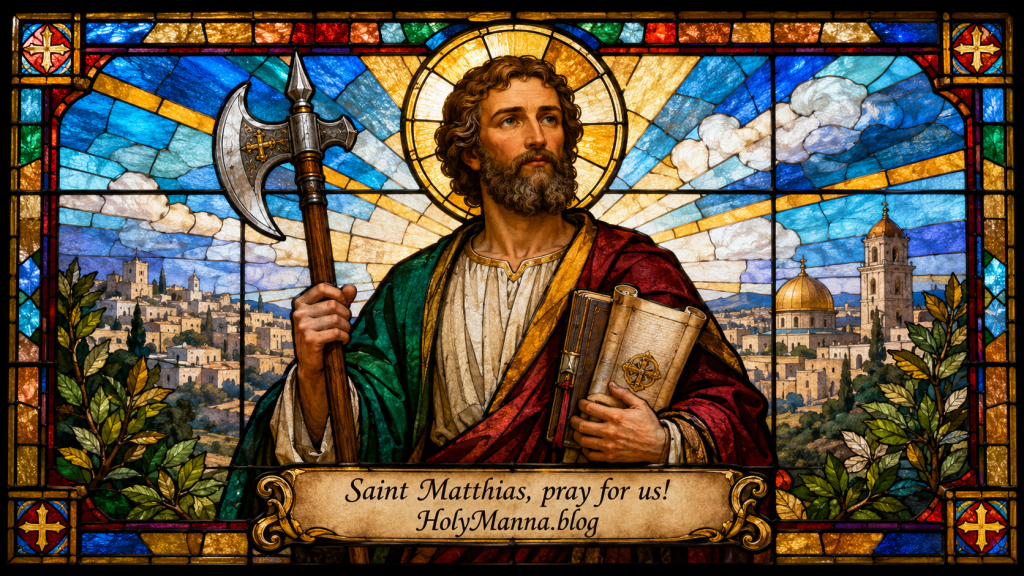
The most common Western tradition says Matthias was stoned in Jerusalem and then beheaded. This is why sacred art often shows him holding an axe or a halberd. The axe became his symbol because of the tradition that he was killed by beheading.
Other traditions say he was crucified in Colchis or died near Sebastopolis. Some accounts place his missionary work among fierce or hostile peoples near the Black Sea. These traditions cannot all be reconciled, so they should be presented carefully.
What is certain is the meaning of his witness. Matthias was chosen to take the place of a man who abandoned Christ. He then lived as a man who would not abandon Him. His life becomes a quiet answer to Judas. Where Judas sold the Lord, Matthias served Him. Where Judas left the apostolic mission, Matthias entered it. Where Judas despaired, Matthias witnessed to hope.
That contrast is powerful.
In every generation, the Church experiences wounds from betrayal, scandal, weakness, cowardice, and sin. Saint Matthias reminds Catholics that holiness is still possible. Fidelity is still possible. Restoration is still possible.
The last word does not belong to Judas. It belongs to Jesus Christ.
The Legends, the Sayings, and the Memory of a Quiet Saint
There are no verified personal quotations from Saint Matthias in Scripture. He never speaks in the biblical text. That silence has its own beauty, because his witness is not built on eloquence but on faithfulness.
There is, however, an ancient ascetical saying attributed to him through early Christian tradition: “We must combat our flesh” and increase the growth of the soul by faith and knowledge. This saying is often connected to discussions surrounding the apocryphal Gospel of Matthias, a text the Church does not receive as authentic Scripture. For that reason, it should be treated as attributed to Matthias, not as a verified quotation.
Still, the spiritual meaning of the saying fits Catholic teaching. The Christian life requires self-mastery, grace, prayer, and the disciplined turning of the heart toward God. The Catechism teaches that holiness involves union with Christ and that the saints show us what grace can do in real human lives. The communion of saints is not sentimental. It is the living fellowship of those who belong to Christ CCC 946-948.
Some legends say that when Matthias was chosen by lot, a ray of heavenly light shone upon him. This is not found in Scripture and cannot be verified. But as a story, it expresses something true about his calling. Matthias did not seize the office. He received it. He did not campaign for honor. He was chosen through prayer.
That is very Catholic. Vocation is not self-invention. It is a response to God.
Relics, Pilgrims, and the Apostle of Fidelity
After his death, devotion to Saint Matthias grew especially through the veneration of his relics. Tradition says Saint Helena, the mother of Emperor Constantine, brought relics of Matthias to Rome. A portion of relics also became associated with Trier, Germany.
The Basilica of Saint Matthias in Trier became one of the most important pilgrimage sites connected with him. Medieval tradition says his relics were discovered there in the twelfth century, and pilgrims began coming to honor the Apostle. Trier is especially significant because it has long claimed to house the only Apostle’s tomb north of the Alps.
This devotion shaped Catholic culture in parts of Europe. Pilgrim confraternities formed, and devotion to Matthias spread through regions such as the Rhineland, Lorraine, Hungary, Bohemia, and Silesia. In Trier, Matthias came to be honored especially as the “Apostle of Fidelity”, a beautiful title that captures his whole mission.
He is also remembered in the Roman Canon, Eucharistic Prayer I, where his name appears among the saints. This means that countless Catholics across the centuries have heard his name at the altar during the Holy Sacrifice of the Mass.
Saint Matthias is honored in the Roman Catholic Church on May 14. His feast was formerly celebrated on February 24, but it was moved in the modern Roman calendar to May 14, placing it closer to the season of the Ascension and outside the usual penitential days of Lent.
He is invoked as a patron of alcoholics, carpenters, tailors, and those seeking perseverance. He has also been invoked historically against smallpox. His connection to those struggling with alcoholism may be linked to the tradition of self-mastery associated with the saying attributed to him. Whether one is battling addiction, discouragement, hiddenness, or the wounds caused by betrayal, Matthias is a powerful companion.
The Catechism teaches that the saints in heaven “do not cease to intercede with the Father for us” CCC 956. That means Matthias is not merely a character from ancient history. He is alive in Christ, praying for the Church whose apostolic mission he helped restore.
The Saint for Anyone Who Feels Hidden
Saint Matthias is a deeply encouraging saint for ordinary Catholics.
He was faithful before he was known. He followed Jesus before anyone was writing his name down. He was present in the background, listening, learning, watching, and believing. Then, when the Church needed someone to stand in a painful gap, God chose him.
That is a lesson worth taking personally.
Many people want a dramatic mission before they have learned hidden fidelity. Matthias teaches the opposite. Be faithful in the hidden years. Be faithful when no one notices. Be faithful in prayer, in Mass, in confession, in family duties, in work, in chastity, in patience, and in the ordinary sacrifices that do not get applause.
God wastes none of it.
Saint Matthias also speaks to Catholics wounded by scandal in the Church. Judas was real. Betrayal was real. Sin among those close to holy things was real even in the apostolic age. But Matthias shows that betrayal does not cancel Christ’s promises. The Church belongs to Jesus, and Jesus keeps restoring His people.
Where has God been asking for quiet fidelity rather than visible success?
Is there a place in life where betrayal, disappointment, or scandal has made it hard to trust Christ’s plan?
Could Saint Matthias be inviting the faithful to stay, pray, and keep witnessing to the Resurrection?
The life of Saint Matthias gives a simple but powerful answer. Stay close to Jesus. Remain faithful. Be ready when God calls.
Engage with Us!
Share your thoughts and reflections in the comments below. Saint Matthias is one of those saints who does not say much in Scripture, but his silence speaks loudly to anyone trying to live faithfully in a noisy world.
- What part of Saint Matthias’s story speaks most to your own faith journey right now?
- Have you ever felt hidden, overlooked, or forgotten while trying to remain faithful to God?
- What does Matthias teach us about trusting Christ after betrayal, scandal, or disappointment?
- Where might God be asking you to practice quiet fidelity this week?
- How can you become a stronger witness to the Resurrection in your family, workplace, parish, or friendships?
May Saint Matthias pray for us, especially when faithfulness feels hidden and the mission feels heavy. Let us live with courage, stay close to Christ, and do everything with the love and mercy Jesus taught us.
Saint Matthias, pray for us!
Follow us on YouTube, Instagram and Facebook for more insights and reflections on living a faith-filled life.


Leave a comment