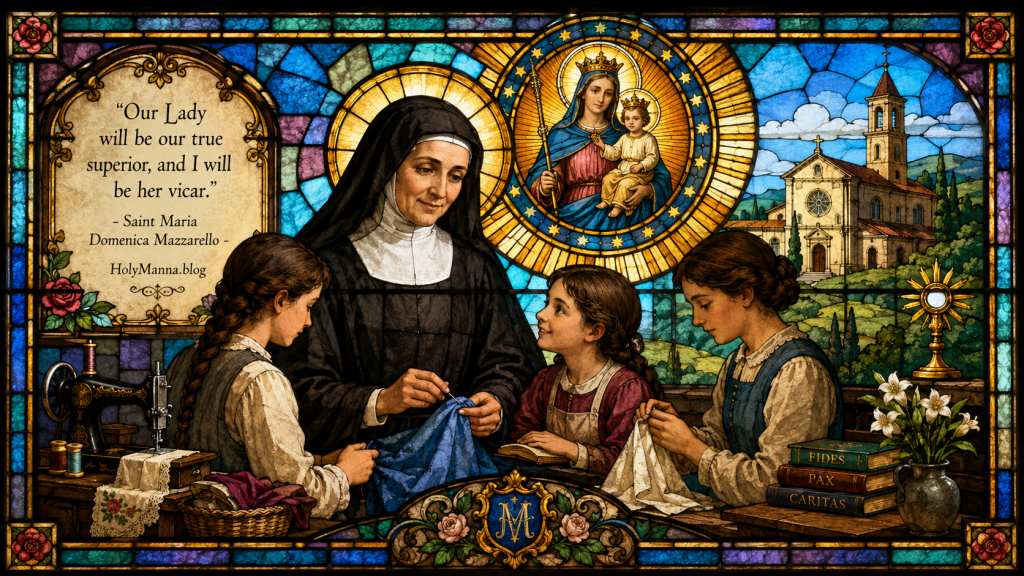
The Window, the Needle, and the Girls God Entrusted to Her
Saint Maria Domenica Mazzarello is one of those saints whose life feels hidden at first glance, almost too ordinary for history books. She was not born into nobility. She did not study in great universities. She did not travel the world as a missionary. She grew up in a farming family, worked hard, prayed deeply, suffered illness, learned to sew, and quietly became one of the great spiritual mothers of Catholic education.
Born in Mornese, Italy, on May 9, 1837, Maria Domenica Mazzarello became the cofoundress, with Saint John Bosco, of the Daughters of Mary Help of Christians, also known as the Salesian Sisters. Their mission was beautifully simple and urgently needed: to educate, protect, and form girls, especially poor and vulnerable girls, in the love of God, the dignity of work, and the joy of Christian virtue.
The Church honors her because she lived heroic virtue in the ordinary places where many people are tempted to believe holiness cannot be found. She found Christ in the fields, in the parish church, in the sewing room, in sickness, in obedience, in the care of girls, and in the maternal protection of the Blessed Virgin Mary. Her life reminds Catholics that sainthood does not begin with fame. It begins with fidelity.
The Catechism of the Catholic Church teaches that the saints are raised up by God as examples of holiness, saying that in canonizing saints, the Church recognizes “the power of the Spirit of holiness within her” and sustains the hope of believers by proposing the saints as models and intercessors. CCC 828. Saint Maria Domenica Mazzarello is exactly that kind of model: humble, strong, joyful, Marian, Eucharistic, and completely available to God.
A Farm Girl with Her Eyes on the Church
Maria Domenica was born into a large, hardworking Catholic farming family in Mornese, a village in northern Italy. Her parents, Giuseppe and Maddalena, formed their children in the faith, in honest labor, and in the rhythms of parish life. From a young age, Maria was known for strength, energy, good humor, and a remarkable seriousness about God.
She worked in the fields with her father and became unusually strong for her age. There is a famous Salesian story that when others tried to rest in the shade during fieldwork, Maria replied, “But no work was ever done in the shade!” This story is preserved in Salesian tradition and captures something true about her character, even if the exact details come to us as a remembered family-style story. She was practical, direct, cheerful, and not afraid of hard work.
Yet her strength was not only physical. Her soul was already being drawn toward Jesus in the Eucharist. When her family moved to the Valponasca farmhouse, Maria could see the parish church of Mornese from a window. That window became one of the most beloved images of her life. From there, she would look toward the church and unite her heart to Jesus in prayer, especially when she could not be physically present before the tabernacle.
That little window tells the story of her soul. She was a young woman living a demanding life, surrounded by work, chores, family responsibilities, and rural poverty, yet her heart kept turning toward Christ. Her life quietly teaches what The Catechism says about prayer: “Prayer is the life of the new heart.” CCC 2697. For Maria, prayer was not an escape from daily life. It was the hidden fire that gave daily life its meaning.
After her First Communion, her faith deepened even more. As a young woman, she joined the Association of the Daughters of Mary Immaculate under the guidance of Father Domenico Pestarino. This group helped form her in devotion to Mary, love for the Church, apostolic zeal, and the desire to live totally for God. She also made a private vow of virginity, offering herself to the Lord with a generosity that would later blossom into religious life.
She is most known for becoming the spiritual mother of the Salesian Sisters and for dedicating her life to the Catholic education of girls. But before she became a foundress, she was simply a faithful daughter of the Church, doing the next right thing in front of her.
When Weakness Became a Mission
In 1860, typhus spread through the region around Mornese. Father Pestarino asked Maria Domenica to help care for sick relatives. She knew the danger, but she went anyway. Her charity was not theoretical. She risked herself for the suffering.
She became gravely ill and nearly died. Although she survived, the sickness permanently weakened her body. The strong farm girl who had once labored with impressive energy in the fields could no longer work as she had before.
This could have become a bitter chapter in her life. Instead, it became the doorway to her mission.
Unable to return fully to heavy farm labor, Maria learned sewing. With her friend Petronilla Mazzarello, she opened a sewing workshop for girls. At first glance, this might seem like a small change. In reality, it was the seed of a worldwide Catholic mission. The workshop became more than a place to learn a trade. It became a place where girls were protected, loved, taught, corrected, encouraged, catechized, and formed in Christian virtue.
Salesian tradition describes this transformation as moving from the plough to the needle. That phrase beautifully captures the mystery of Providence. God did not waste Maria’s suffering. He redirected it.
There is also a famous spiritual story from this period. Maria Domenica is said to have seen, or interiorly perceived, a large building full of girls playing in a courtyard. Then she heard the words, “I entrust them to you.” This story is treasured in Salesian tradition. Since it comes to us through spiritual memory and hagiographical tradition, it should be presented as a Salesian story rather than a formally verified vision. Still, it expresses the heart of her vocation perfectly. God was entrusting girls to her maternal care.
That phrase became the shape of her life. These girls were not projects. They were souls. They were daughters of God. They needed formation, joy, protection, discipline, and love. Maria understood that the education of girls was not just social work. It was evangelization.
The Church teaches that education must form the whole person, and that parents and those who assist them share in the responsibility of moral and religious formation. CCC 2221 to 2226. Maria Domenica lived that truth with thread, cloth, prayer, laughter, and patient correction.
A Sewing Room Full of Grace
Maria Domenica and Petronilla’s sewing room soon became a place of deep Christian influence. The girls learned practical skills, but they also learned prayer, modesty, responsibility, friendship, and love for Jesus and Mary. The workroom became connected with a festive oratory, where girls could gather for games, catechism, prayer, and joyful Catholic formation.
This is one of the most important things to understand about Saint Maria Domenica. She did not separate holiness from joy. She did not think young people needed cold lectures more than love. Like Saint John Bosco, she believed that Christian formation should be joyful, disciplined, affectionate, sacramental, and deeply human.
There are no widely recognized, formally approved miracles attributed to Maria Domenica during her lifetime in the same way that some saints are remembered for dramatic healings or wonders. Her “miracles” during life were quieter. She helped transform vulnerable girls into Christian women. She turned illness into mission. She turned poverty into generosity. She turned a sewing room into a school of holiness.
That may not look spectacular, but it is deeply Catholic. Grace often works like leaven. Jesus says in The Gospel of Matthew, “The kingdom of heaven is like leaven which a woman took and hid in three measures of flour, till it was all leavened.” Matthew 13:33. Maria Domenica’s life was like that. Hidden grace spread through ordinary work.
Her compassion also showed itself in her maternal care. She was not merely training girls to sew. She was helping them become daughters of God who knew their dignity. This matters even more when considering the social world of nineteenth-century Italy, where poor girls could easily be neglected, exploited, or left without meaningful education. Maria’s mission protected both their bodies and their souls.
When Don Bosco Came to Mornese
In 1864, Saint John Bosco visited Mornese. By that time, he was already known for his work with poor and abandoned boys in Turin. Maria Domenica immediately recognized his holiness. Salesian tradition preserves her famous words: “Don Bosco is a saint, and I feel it.”
That sentence says so much about her. She had a supernatural instinct. She recognized sanctity not because it looked impressive, but because her own soul was tuned to God.
Don Bosco, in turn, recognized something in Maria and the young women of Mornese. He had already been working to educate boys through the Salesian mission. With encouragement from Pope Pius IX, he began to see the need for a female branch that would serve girls with the same Salesian spirit.
On August 5, 1872, the Institute of the Daughters of Mary Help of Christians was born in Mornese. Eleven young women made religious profession, while four others began the novitiate. Maria Domenica Mazzarello became the first superior, though she did not seek the position and felt deeply unworthy of it.
Her humility was sincere. She had little formal education. She knew her limitations. But Don Bosco and the Church saw something greater than credentials. They saw holiness, prudence, spiritual motherhood, and the ability to form souls.
One of her most famous sayings reveals her entire approach to leadership: “Our Lady will be our true superior, and I will be her vicar.” This was not a pious slogan. It was how she governed. The Institute belonged to Mary Help of Christians. Maria was simply serving under Our Lady’s mantle.
This Marian trust fits beautifully with Catholic teaching. The Catechism teaches that Mary is Mother of the Church and that her maternal role in no way obscures or diminishes the unique mediation of Christ, but rather shows its power. CCC 967 to 970. Maria Domenica’s devotion to Mary always led to Jesus, to obedience, to mission, and to love for the young.
A Mother with a Backbone
Mother Mazzarello governed the new Institute with humility, strength, joy, and common sense. She was not a distant superior. She worked with the sisters, formed them personally, corrected them when needed, encouraged them when discouraged, and taught them to keep their eyes on God.
One Salesian story tells of her washing clothes with the sisters. When someone suggested that the superior should not be seen doing such ordinary work, she answered with the humility of a peasant woman who had no interest in pretending to be important. The story captures her beautifully. Authority did not make her less humble. It made her more responsible.
Another touching detail is that she continued learning even as superior. Because she had limited schooling, she studied alongside the sisters, improved her reading and writing, and laughed at her mistakes. This is surprisingly beautiful. The first superior of a growing religious institute was humble enough to remain a student.
Her letters show a wise spiritual mother. She wrote with simplicity, but her counsel was sharp, practical, and holy. She told the sisters, “Remember that to become holy and wise, you must speak little and reflect much.” She also wrote, “Speak little, very little to creatures. Instead, speak much with the Lord. He will make you truly wise.”
That advice feels especially needed today. A noisy world teaches people to react, post, argue, scroll, and explain themselves constantly. Mother Mazzarello teaches the opposite. Speak less. Pray more. Think deeply. Stay close to Jesus.
She also encouraged joy. One line associated with her Salesian spirituality says, “Be joyful, always joyful and humble.” This was not fake cheerfulness. It was joy rooted in grace. It was the joy of a soul that knew God was in charge.
Her apostolic focus was direct. She wrote, “Remember that only one thing is necessary, to save a soul.” That is the heart of Catholic education. The goal is not merely success, usefulness, or social polish. The goal is heaven.
A Missionary Heart That Traveled Through Her Daughters
Mother Mazzarello never personally became a foreign missionary, but her heart was missionary. In 1877, the first Salesian Sisters were sent to South America, beginning in Uruguay and then expanding into Argentina and Patagonia. These sisters brought Catholic education, formation, and maternal care to girls and families far beyond Italy.
This is one of the surprising facts of her life. A woman from a small village, weakened by illness and limited in formal education, helped launch a global missionary institute. She did not have to travel the world to change it. She had to form souls who would go where she could not.
That is a very Catholic kind of fruitfulness. Some saints preach to crowds. Some write great theological works. Some die as martyrs. Some build homes where children learn to pray. Maria Domenica’s greatness was maternal and missionary. She multiplied herself through the sisters she formed.
By the time she died, the Institute had already grown rapidly, with many sisters, novices, and houses. After her death, the Daughters of Mary Help of Christians continued to spread throughout the world. Today, the Salesian Sisters remain one of the largest congregations of women religious in the Church, serving young people through schools, youth centers, catechesis, missions, retreats, and works of evangelization.
The Cross Hidden Under Her Joy
Saint Maria Domenica was not a martyr. She did not die by violence for the faith. But she carried real crosses.
She suffered poverty, exhausting labor, serious illness, physical weakness, the burden of leadership, the pain of leaving beloved Mornese when the motherhouse moved to Nizza Monferrato, and the emotional cost of sending sisters far away to the missions. She also endured the ordinary hidden sacrifices of religious life: obedience, fatigue, misunderstandings, responsibility, and the constant demand to love when tired.
In 1879, the motherhouse was moved from Mornese to Nizza Monferrato because the Institute was growing and needed a more accessible location. Leaving Mornese was painful for her. That village held her childhood, her parish, the Valponasca window, the first workroom, and the beginnings of the mission. Still, she obeyed.
Near the end of her life, she became seriously ill after a journey connected to the sisters and their mission. Salesian sources describe pleurisy, fever, and worsening health. She suffered physically and spiritually, yet remained a source of encouragement for her daughters.
A traditional Salesian story says that in one of her final meetings with Don Bosco, she asked whether she would recover. Don Bosco answered gently with a story about Death visiting a convent and finally taking the superior. Mother Mazzarello understood what he meant. The story is part of Salesian tradition, and while the exact dialogue belongs to spiritual memory, it reflects the peaceful acceptance that marked her final days.
As death approached, she received the sacraments and continued to encourage the sisters. A traditional account preserves her final words as: “Good-bye. I am going now. I will see you in heaven.”
She died on May 14, 1881, in Nizza Monferrato. She was only forty-four years old.
Her life was short, but it was full. That matters. Holiness is not measured by length of years, but by love.
The Miracles God Worked Through Her Intercession
After her death, devotion to Mother Mazzarello grew among the Salesian Sisters, the Salesian Family, former students, and those who had received grace through her mission. The Church eventually examined her life, virtues, reputation for holiness, and miracles attributed to her intercession.
It is important to say this clearly. Catholics do not believe saints perform miracles by their own power. God alone works miracles. The saints intercede. The Catechism teaches that the saints in heaven “do not cease to intercede with the Father for us” and that “their intercession is their most exalted service to God’s plan.” CCC 956.
Several miracles were formally associated with her beatification and canonization.
For her beatification, the Church examined the healing of Ercolina Mazzarello of Mornese, who was reportedly cured in 1916 from acute spinal paralysis in both legs due to poliomyelitis. The cure was described as instantaneous, complete, lasting, and scientifically unexplained.
A second healing involved Rosa Bellavita of Paullo, near Milan, who was reportedly cured in 1926 from ascitic tuberculous peritonitis. This healing was also presented as sudden, complete, and medically inexplicable.
For her canonization, two additional miracles were approved.
Sister Maggiorina Avalle, a Daughter of Mary Help of Christians, was reportedly healed on August 15, 1941, from widespread septicemia after doctors believed she had only hours to live. Through the intercession of Mother Mazzarello, she recovered in a way judged extraordinary.
Another miracle involved Carla Ramponi, an eight-year-old girl from Castano Primo. In 1946, she was reportedly suffering from acute nephritis. A relic of Mother Mazzarello was placed under her head, and she recovered. This healing was also accepted in the canonization process.
Maria Domenica Mazzarello was beatified by Pope Pius XI on November 20, 1938. She was canonized by Pope Pius XII on June 24, 1951.
There is a memorable story from her beatification connected with Pope Pius XI. When he was offered a reliquary containing a vertebra of Mother Mazzarello, he reportedly remarked that she, like Don Bosco, had “a good backbone,” and told the sisters that they too must have a good backbone. This story is preserved in Salesian memory and beautifully describes her. She was gentle, but not weak. She was humble, but not timid. She was maternal, but she had spiritual strength.
Her remains are venerated in the Basilica of Mary Help of Christians in Turin, one of the great Salesian sacred places. Mornese and the Valponasca farmhouse also remain important places of pilgrimage, especially for the Salesian Family. Pilgrims still remember the window from which she prayed toward the church, the workroom where girls were formed, and the little village where God planted a worldwide mission.
Her feast is observed on May 14 in the Roman Martyrology, while many Salesian communities celebrate her on May 13. Her cultural impact is especially visible wherever Salesian Sisters serve young people. Schools, youth centers, missions, retreats, and Catholic formation programs throughout the world continue to carry her spirit.
She has also been remembered in Catholic media, including the film Maìn: The House of Happiness, which presents her life and the early spirit of the Salesian Sisters. Her affectionate nickname, Maìn, still carries the warmth of the village girl who became a mother to thousands.
The Saint Who Teaches Hidden Greatness
Saint Maria Domenica Mazzarello teaches that God can build something immense out of a hidden life.
She did not begin with influence. She began with fidelity. She prayed. She worked. She cared for the sick. She accepted weakness. She taught girls to sew. She obeyed the Church. She followed Don Bosco’s guidance. She placed everything under Mary Help of Christians. Then God multiplied her yes.
Her life speaks powerfully to anyone who feels limited by education, background, health, money, or circumstances. Maria Domenica did not wait to become impressive before serving God. She served Him with what she had.
She also teaches that Catholic education is not just about information. It is about formation. Young people need truth, beauty, discipline, tenderness, moral clarity, and joy. They need adults who care about their souls. They need to see that holiness can be cheerful and practical.
For parents, teachers, catechists, youth ministers, and anyone who works with young people, Mother Mazzarello is a beautiful patron. She reminds the Church that every child entrusted to our care is not an interruption, a statistic, or a problem to solve. Each one is a soul loved by God.
Her life also challenges Catholics to take Mary seriously as a mother and guide. When she said, “Our Lady will be our true superior, and I will be her vicar,” she was giving the Church a whole spirituality of leadership. Lead under Mary. Serve under Mary. Teach under Mary. Correct under Mary. Suffer under Mary. Bring souls to Jesus through Mary.
What hidden window is God using in your life to draw your heart toward Him? What weakness might He be transforming into a mission? Who has He entrusted to your care?
Saint Maria Domenica Mazzarello answers those questions with her life. Stay faithful. Stay humble. Stay joyful. Keep working. Keep praying. Trust Mary. Love the young. Speak often with the Lord.
Engage with Us!
Share your thoughts and reflections in the comments below. Saint Maria Domenica Mazzarello’s life is a beautiful reminder that God often begins His greatest works in hidden places, with ordinary people who say yes.
- What part of Saint Maria Domenica Mazzarello’s life speaks most deeply to you: her Eucharistic prayer, her care for girls, her humility, or her perseverance through illness?
- Have you ever experienced a weakness or disappointment that God later used for a greater purpose?
- Who has God entrusted to your care, and how can you love that person with more patience, courage, and faith?
- How can you bring more Salesian joy into your home, parish, workplace, or friendships this week?
- What would change in your daily life if you truly believed that ordinary work can become a path to holiness?
May Saint Maria Domenica Mazzarello pray for all who teach, parent, mentor, and guide young people. May her example help every Catholic live with humility, courage, joy, and trust in Mary Help of Christians. And may each soul entrusted to us be loved with the mercy, patience, and tenderness that Jesus Himself taught us.
Saint Maria Domenica Mazzarello, pray for us!
Follow us on YouTube, Instagram and Facebook for more insights and reflections on living a faith-filled life.


Leave a comment