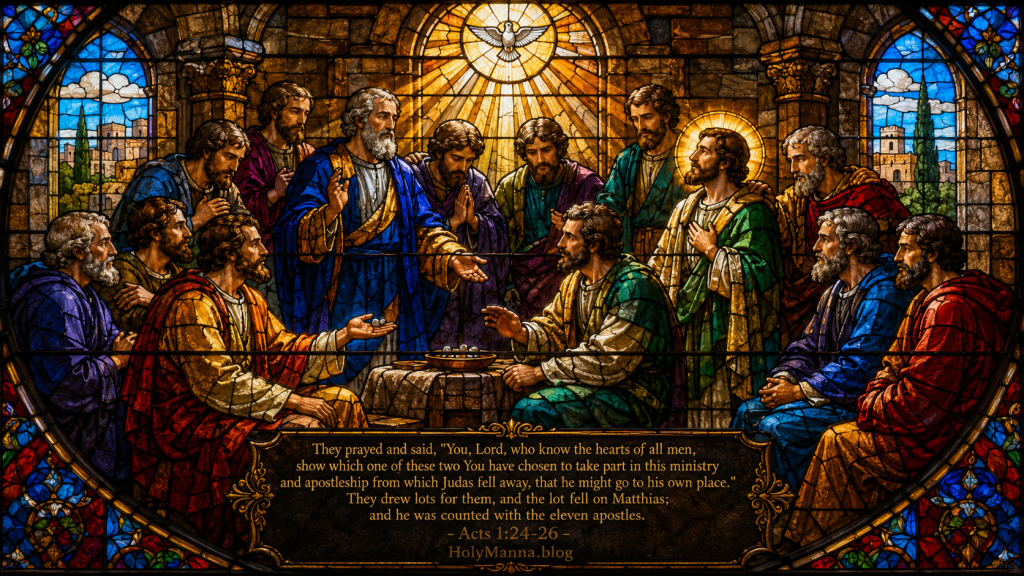
Feast of Saint Matthias, Apostle – Lectionary: 564
The Hidden Witness Chosen by Love
Sometimes the most faithful disciple is the one who has been quietly walking with Jesus the whole time, unseen by the crowd but never unseen by God.
Today’s readings for the Feast of Saint Matthias reveal a beautiful truth at the heart of Catholic faith: Christ chooses His witnesses, forms them in hidden fidelity, and sends them to bear fruit that remains. In Acts 1:15-17, 20-26, the early Church stands in the painful shadow of Judas’s betrayal. The Apostles do not pretend the wound is small, and they do not abandon the mission because one of their own has fallen. Instead, gathered in prayer and guided by Scripture, they seek the Lord’s will. Matthias is chosen, not because he promoted himself, but because he had remained with Jesus from the beginning and was ready to become “a witness to his resurrection” Acts 1:22.
The Responsorial Psalm lifts that moment into praise. The Lord who is “high above all nations” also bends low to raise the humble from the dust Psalm 113:4, 7. That is the quiet beauty of Matthias’s calling. God sees the hidden servant. God remembers the faithful heart. God raises up the one who has remained close when the time comes for mission.
Then, in John 15:9-17, Jesus reveals the source of every true apostolate: love. Before the disciple can preach, lead, suffer, or bear fruit, he must remain in Christ. Jesus says, “It was not you who chose me, but I who chose you” John 15:16. Matthias becomes a living image of that line. His apostleship begins not with ambition, but with election, obedience, and friendship with Christ.
Together, these readings prepare the heart to see Christian mission the Catholic way. The Church is apostolic, rooted in visible continuity with those whom Christ chose and sent. Yet this apostolic mission is never merely institutional or external. It flows from charity, from the love of Christ poured into the soul. As The Catechism of the Catholic Church teaches, the Christian vocation is by its nature a vocation to the apostolate, and that apostolate bears fruit only through vital union with Christ.
Today, Saint Matthias reminds every believer that hidden faithfulness matters. The Lord may spend years forming a soul in ordinary obedience before calling it into visible service. The question is not whether God sees the quiet disciple. He does. The question is whether the disciple will remain close enough to be ready when Christ says, “go and bear fruit that will remain” John 15:16.
First Reading – Acts 1:15-17, 20-26
The Church Learns How to Heal a Wound Without Losing the Mission
The first reading places the Church in one of her earliest and most painful moments. Jesus has risen from the dead. He has ascended into heaven. The Apostles are gathered in Jerusalem, waiting for the promised Holy Spirit. Yet before Pentecost comes, there is a wound that must be faced. Judas, one of the Twelve, has betrayed the Lord, and his place among the Apostles is now empty.
This is not a small administrative detail. In Jewish thought, the number twelve carried deep meaning. Israel had twelve tribes, and Jesus chose twelve Apostles as the foundation of the renewed Israel, the Church. Judas’s betrayal did not destroy Christ’s plan, but it did leave a visible break in the apostolic witness. So Peter stands up, not as a man chasing power, but as the shepherd Christ had appointed to strengthen his brothers.
The theme of today’s readings is already shining here. God chooses His witnesses. He sees the hidden faithful. He restores what sin has wounded. Matthias had followed Jesus quietly from the beginning, and now, at the right time, the Lord raises him up to bear fruit that will remain.
Acts 1:15-17, 20-26 – New American Bible (Revised Edition)
The Choice of Judas’s Successor. 15 During those days Peter stood up in the midst of the brothers (there was a group of about one hundred and twenty persons in the one place). He said, 16 “My brothers, the scripture had to be fulfilled which the holy Spirit spoke beforehand through the mouth of David, concerning Judas, who was the guide for those who arrested Jesus. 17 He was numbered among us and was allotted a share in this ministry.
20 For it is written in the Book of Psalms:
‘Let his encampment become desolate,
and may no one dwell in it.’And:
‘May another take his office.’
21 Therefore, it is necessary that one of the men who accompanied us the whole time the Lord Jesus came and went among us, 22 beginning from the baptism of John until the day on which he was taken up from us, become with us a witness to his resurrection.” 23 So they proposed two, Joseph called Barsabbas, who was also known as Justus, and Matthias. 24 Then they prayed, “You, Lord, who know the hearts of all, show which one of these two you have chosen 25 to take the place in this apostolic ministry from which Judas turned away to go to his own place.” 26 Then they gave lots to them, and the lot fell upon Matthias, and he was counted with the eleven apostles.
Detailed Exegesis
Verse 15 – “During those days Peter stood up in the midst of the brothers; there was a group of about one hundred and twenty persons in the one place.”
Peter stands in the middle of the gathered Church. This matters because Peter is already exercising the leadership Jesus gave him when He said, “You are Peter, and upon this rock I will build my church” Matthew 16:18. He does not act alone or in isolation. He stands among the brothers, in the heart of the praying community.
The mention of about one hundred and twenty persons shows that the Church is already more than the Eleven. There is a visible community gathered in faith, waiting in obedience. This is the Church before Pentecost, small in number but already living as one body. The Lord’s work often begins this way, quietly, with faithful people gathered in prayer before they are sent in power.
Verse 16 – “My brothers, the scripture had to be fulfilled which the holy Spirit spoke beforehand through the mouth of David, concerning Judas, who was the guide for those who arrested Jesus.”
Peter begins with Scripture. He does not begin with panic, resentment, or gossip about Judas. He interprets the crisis through the Word of God. This is deeply Catholic. The Church reads her own life through Scripture, guided by the Holy Spirit and the apostolic faith.
Peter says that the Holy Spirit spoke through David. This shows the Catholic understanding of divine inspiration. The human author truly writes, but God is the primary author of Sacred Scripture. As The Catechism of the Catholic Church teaches, “God is the author of Sacred Scripture because he inspired its human authors; he acts in them and by means of them. He thus gives assurance that their writings teach without error his saving truth.” CCC 136.
Judas is described as “the guide for those who arrested Jesus” Acts 1:16. That is heartbreaking. The one who had walked with Jesus led others to seize Him. His fall reminds every disciple that closeness to holy things must become holiness of heart. A person can be near the altar, near Scripture, near the Church, and still need daily conversion.
Verse 17 – “He was numbered among us and was allotted a share in this ministry.”
This verse is one of the most sobering lines in the reading. Judas was truly numbered among the Apostles. He was not pretending to be chosen. He really had a share in the ministry. His betrayal was not the failure of Christ’s choice, but the misuse of human freedom.
The Church has always taught that grace does not erase freedom. Judas received a calling, but he turned away from it. That is why this passage should make every Catholic humble. Vocation is a gift, but it must be guarded. Friendship with Christ must be nourished. A disciple cannot live on yesterday’s grace while neglecting today’s obedience.
Verse 20 – “For it is written in the Book of Psalms: ‘Let his encampment become desolate, and may no one dwell in it.’ And: ‘May another take his office.’”
Peter quotes the Psalms to show that the wound of betrayal is not outside God’s providence. The first quotation points to the desolation caused by Judas’s sin. The second points to the need for another to take his office.
The word “office” is important. The apostolic ministry is not just a personal friendship circle around Jesus. It is a real office, a mission, a responsibility in the visible Church. This is one reason the Catholic Church sees this passage as deeply connected to apostolic succession. The mission Christ gave the Apostles was meant to continue.
Judas’s failure does not end the apostolic mission. The Church does not say, “The Twelve are broken, so the plan is over.” Instead, the Church prays, reads Scripture, and allows God to restore what sin has wounded.
Verse 21 – “Therefore, it is necessary that one of the men who accompanied us the whole time the Lord Jesus came and went among us.”
Peter now gives the qualifications for Judas’s successor. The new Apostle must have accompanied Jesus throughout His public ministry. This is not about popularity or talent. It is about witness.
The phrase “came and went among us” suggests the ordinary rhythm of life with Jesus. Matthias had seen more than miracles. He had seen the daily life of the Lord. He had watched Jesus teach, pray, walk, eat, suffer opposition, love sinners, correct the proud, and form His disciples.
There is a lesson here for ordinary Catholics. God often prepares a person through years of simple closeness. Matthias was not suddenly invented for the moment. He had been there all along.
Verse 22 – “Beginning from the baptism of John until the day on which he was taken up from us, become with us a witness to his resurrection.”
This verse reveals the heart of apostolic ministry. The Apostle must be a witness to the Resurrection. Christianity is not built on vague spirituality. It is built on the historical reality that Jesus Christ was crucified, died, was buried, and rose from the dead.
Matthias had to be able to testify that the same Jesus who walked through Galilee, preached the Kingdom, and died on Calvary was now risen and glorified. The Resurrection is the center. Without it, there is no Gospel, no Church, no sacraments, no Christian hope.
This is why Catholic faith is always both historical and sacramental. The Church proclaims what happened in history and makes present the fruits of that mystery through her sacramental life.
Verse 23 – “So they proposed two, Joseph called Barsabbas, who was also known as Justus, and Matthias.”
Two men are proposed. Both appear to be worthy. Both had likely followed Jesus faithfully. Yet only one will be chosen for this apostolic office.
This moment is tender because it shows that not every holy person receives the same mission. Joseph called Barsabbas, also known as Justus, is not rejected as unfaithful. He simply is not chosen for this particular office. That is an important lesson in discernment. God’s “no” to one path is not a rejection of the person. It may be His way of assigning a different hidden mission.
Matthias, whose name means “gift of God,” is brought forward. The hidden disciple is about to become part of the foundation of the Church’s apostolic witness.
Verse 24 – “Then they prayed, ‘You, Lord, who know the hearts of all, show which one of these two you have chosen.’”
The Church prays before choosing. This is the soul of Catholic discernment. The Apostles do not simply vote based on charm, resume, or personal preference. They ask the Lord who knows every heart.
This prayer reveals something essential about vocation. A true calling is not self-invented. It is received. The Apostles ask, “show which one of these two you have chosen” Acts 1:24. The choice belongs to God before it becomes visible through the Church.
This also connects beautifully with the Gospel, where Jesus says, “It was not you who chose me, but I who chose you” John 15:16. Matthias is not climbing into ministry. He is being called into it.
Verse 25 – “To take the place in this apostolic ministry from which Judas turned away to go to his own place.”
The phrase “apostolic ministry” shows again that this is not merely a symbolic replacement. Judas had held a real share in the mission. Matthias is chosen to take that place, not to erase the tragedy, but to continue the witness.
The words “from which Judas turned away” are spiritually serious. Judas did not merely stumble in weakness like Peter, who denied Jesus and wept bitterly. Judas turned away and went “to his own place” Acts 1:25. The reading leaves that phrase with a haunting weight.
Catholic tradition does not encourage curiosity about damnation, but it does warn against despair, betrayal, and refusal of mercy. Judas’s story is not given so that Christians can feel superior. It is given so that every disciple stays close to Christ, especially after sin. Peter sinned and returned through repentance. Judas sinned and collapsed into despair. The difference matters.
Verse 26 – “Then they gave lots to them, and the lot fell upon Matthias, and he was counted with the eleven apostles.”
The casting of lots may feel strange to modern readers, but in the biblical world it was sometimes used as a way of entrusting a decision to God’s providence. This happens before Pentecost, before the full outpouring of the Holy Spirit on the Church. The Apostles pray first, then entrust the outcome to the Lord.
Matthias is then “counted with the eleven apostles” Acts 1:26. The Twelve are restored. The Church’s apostolic witness is made whole again. Judas’s betrayal wounded the apostolic body, but it did not defeat Christ’s mission.
This is the quiet triumph of the reading. Sin wounds. God restores. Human betrayal is real. Divine providence is stronger. A hidden disciple becomes a public witness because the Lord knows the heart.
Teachings: Apostolic Succession, Scripture, and the Faithfulness of God
This reading is one of the clearest biblical windows into the apostolic nature of the Church. The Apostles understand their mission as something real, visible, and continuing. Judas’s office does not disappear with his betrayal. Another must take it. This supports the Catholic understanding that Christ did not leave behind a vague movement, but a visible Church with apostolic authority.
The Catechism of the Catholic Church teaches, “The Church is apostolic because she is founded on the apostles, in three ways: she was and remains built on ‘the foundation of the Apostles,’ the witnesses chosen and sent on mission by Christ himself; with the help of the Spirit dwelling in her, the Church keeps and hands on the teaching, the ‘good deposit,’ the salutary words she has heard from the apostles; she continues to be taught, sanctified, and guided by the apostles until Christ’s return, through their successors in pastoral office: the college of bishops, ‘assisted by priests, in union with the successor of Peter, the Church’s supreme pastor.’” CCC 857.
This is exactly what begins to appear in Acts 1. The Church is built on witnesses chosen and sent by Christ. Matthias is added to the Eleven so that the apostolic foundation remains whole. He is not chosen to share an opinion. He is chosen to bear witness to the Resurrection.
The Catechism also explains why this mission had to continue beyond the first generation. It teaches, “In order that the mission entrusted to them might be continued after their death, the apostles consigned, by will and testament, as it were, to their immediate collaborators the duty of completing and consolidating the work they had begun, urging them to tend to the whole flock, in which the Holy Spirit had appointed them to shepherd the Church of God. They accordingly designated such men and then made the ruling that likewise on their death other proven men should take over their ministry.” CCC 860.
Saint John Chrysostom, preaching on this passage, noticed Peter’s humility and order. He observed, “Observe how Peter does everything with the common consent; nothing imperiously.” St. John Chrysostom, Homily 3 on the Acts of the Apostles. That is a powerful image of Catholic leadership. Peter truly leads, but he leads within the gathered Church, under Scripture, through prayer, and in trustful obedience to God.
The reading also teaches the Catholic approach to Scripture. Peter sees the events surrounding Judas through the Psalms. This does not mean he randomly grabs verses to prove a point. Rather, he reads Israel’s Scriptures in the light of Christ and the Paschal Mystery. The Church still does this today. The Old Testament is fulfilled in Christ, and the life of the Church is understood through the Word of God.
This is why The Catechism of the Catholic Church says, “Christians therefore read the Old Testament in the light of Christ crucified and risen.” CCC 129. Peter is doing exactly that. He sees even the painful betrayal of Judas inside the larger mystery of God’s plan, without excusing Judas’s sin.
There is also a sober teaching about vocation. Judas was truly called, but he turned away. Matthias was hidden, but he remained faithful. This reading does not allow cheap confidence or despair. It calls the disciple to humility. It says that being chosen is grace, and remaining faithful is the daily response of love.
Reflection: Remaining Faithful When No One Is Watching
Saint Matthias is a comforting saint for anyone who feels unseen. He had followed Jesus from the baptism of John to the Ascension, yet most readers of the Gospel never noticed his name. He was there, but hidden. He listened, watched, learned, and remained. Then, when the Church needed a witness, God brought him forward.
That is how grace often works. A person may spend years in quiet preparation. A parent may spend years teaching children to pray with no applause. A parish volunteer may serve faithfully while few people notice. A young adult may fight for chastity and holiness in a culture that laughs at sacrifice. A catechist may plant seeds that will not bloom for years. A caregiver may offer hidden acts of love that only God sees.
Matthias teaches that hidden faithfulness is never wasted.
This reading also invites every Catholic to handle wounds in a holy way. The early Church had been wounded by Judas, but the Apostles did not become cynical. They did not abandon structure. They did not stop trusting Jesus. They gathered, prayed, listened to Scripture, and let God restore the mission.
That is a pattern for daily life. When betrayal, disappointment, scandal, or failure wounds the heart, the Catholic response is not to run from the Church or from prayer. The response is to stand with Peter in the Upper Room. Return to Scripture. Pray with the Church. Ask the Lord who knows all hearts to reveal the next faithful step.
A practical way to live this reading is to begin each day with a simple prayer of availability: “Lord, You know my heart. Show me where You are calling me to be faithful today.” Then the day becomes less about chasing recognition and more about readiness. The hidden disciple becomes available to God.
Another way is to examine where vocation has become routine. Judas had a share in the ministry, but his heart turned away. This is a warning to every Christian. Catholic life cannot become external only. Mass, prayer, service, and doctrine must lead to deeper friendship with Christ.
Where is God asking for hidden faithfulness rather than attention?
Is there a wound, betrayal, or disappointment that needs to be brought back into prayer instead of carried alone?
Has Catholic life become merely familiar, or is it still forming the heart in love and obedience?
What would it look like this week to become a clearer witness to the Resurrection in ordinary life?
The first reading ends with Matthias counted among the Apostles. That is not just the closing of an empty seat. It is the sign that Christ continues His work through the Church. Judas’s betrayal did not win. Human weakness did not cancel divine providence. The Lord raised up a hidden witness, and through that witness, the apostolic mission continued.
Responsorial Psalm – Psalm 113:1-8
The God Who Bends Down to Raise the Hidden Servant
The Responsorial Psalm for the Feast of Saint Matthias sounds like a song rising from the Upper Room itself. The Apostles have just faced the wound left by Judas. They have prayed. They have searched the Scriptures. They have asked the Lord, who knows all hearts, to show whom He has chosen. Then Matthias, the hidden disciple who had quietly remained with Jesus, is lifted into the apostolic ministry.
Psalm 113 gives the Church the language for that moment. It praises the Lord who is enthroned above the heavens, yet stoops down to lift the poor from the dust. In Jewish worship, Psalm 113 belongs to the great Hallel psalms, songs of praise traditionally associated with major feasts such as Passover. That matters because the Church hears this psalm in the light of Christ, the true Passover Lamb, whose Resurrection gives birth to the apostolic mission.
Today, the psalm does not simply tell believers to praise God because He is powerful. It reveals the kind of power God has. He is so high that no nation can rival Him, and so tender that no forgotten soul escapes His gaze. That is the story of Matthias. That is also the story of every faithful disciple whom God prepares in hiddenness before raising up for mission.
Psalm 113:1-8 – New American Bible (Revised Edition)
Praise of God’s Care for the Poor
1 Hallelujah!
Praise, you servants of the Lord,
praise the name of the Lord.
2 Blessed be the name of the Lord
both now and forever.
3 From the rising of the sun to its setting
let the name of the Lord be praised.4 High above all nations is the Lord;
above the heavens his glory.
5 Who is like the Lord our God,
enthroned on high,
6 looking down on heaven and earth?
7 He raises the needy from the dust,
lifts the poor from the ash heap,
8 Seats them with princes,
the princes of the people,
Detailed Exegesis
Verse 1 – “Hallelujah! Praise, you servants of the Lord, praise the name of the Lord.”
The psalm begins with “Hallelujah”, a word that means “Praise the Lord.” It is not casual enthusiasm. It is worship. The servants of the Lord are summoned to praise His name, which in biblical thought means praising God Himself, His holiness, His presence, His faithfulness, and His saving power.
This verse fits beautifully with the Feast of Saint Matthias because the true servant does not begin with ambition. He begins with praise. Matthias is not introduced as a man chasing honor. He is a servant who had remained close to Jesus. His apostleship is born from worship, prayer, and readiness before God.
Verse 2 – “Blessed be the name of the Lord both now and forever.”
Praise is not meant to be temporary. The name of the Lord is to be blessed “both now and forever” Psalm 113:2. This verse stretches the heart beyond the anxieties of one moment. Judas’s betrayal was real, but it did not cancel God’s glory. The Church’s wound was real, but it did not silence praise.
Catholic faith teaches that God is worthy of worship in every season. When life is peaceful, His name is blessed. When there is betrayal, His name is blessed. When the future is unclear, His name is blessed. This is not denial. It is trust. The first Christians gathered after the Ascension did not understand every detail of what came next, but they still knew the Lord was faithful.
Verse 3 – “From the rising of the sun to its setting let the name of the Lord be praised.”
This verse widens the scene from Jerusalem to the whole world. The praise of God is not local, tribal, or temporary. From east to west, from morning to evening, from one end of creation to the other, the Lord’s name deserves praise.
For the Feast of Saint Matthias, this points toward apostolic mission. The restored Twelve will not remain locked in the Upper Room forever. After Pentecost, they will be sent to the nations. The witness of the Resurrection is meant to travel “from the rising of the sun to its setting” Psalm 113:3. Matthias is chosen not for comfort, but for mission.
Verse 4 – “High above all nations is the Lord; above the heavens his glory.”
The Lord is not one power among many. He is above every nation, throne, empire, ruler, and human system. This would have mattered deeply to the early Church, which would soon preach Christ in a world dominated by Roman power. The Apostles would need courage because their mission would not be protected by earthly prestige.
This verse reminds believers that the Church’s mission does not depend on worldly approval. The Lord is above the nations. His glory is above the heavens. The apostolic witness is rooted in the authority of the risen Christ, not in social popularity or political strength.
Verse 5 – “Who is like the Lord our God, enthroned on high?”
The psalm asks a question whose answer is obvious: no one is like the Lord. He is enthroned on high, utterly unique in majesty, holiness, and power.
Yet the question also prepares the reader for a surprise. The Lord’s greatness is not shown only by distance and glory. It is shown by His mercy. In the biblical imagination, false gods are often distant, demanding, and indifferent. The God of Israel is exalted beyond all creation, yet lovingly attentive to the lowly.
This is the same God who saw Matthias. Others may have overlooked him, but God did not. The Lord enthroned on high knows every hidden act of fidelity.
Verse 6 – “Looking down on heaven and earth?”
The Lord bends His gaze toward heaven and earth. This does not mean God is far away in a cold or detached sense. It means He is sovereign over all things and lovingly attentive to His creation.
The God who looks down is the God who sees clearly. He sees Judas’s betrayal without confusion. He sees Peter’s leadership without flattery. He sees Joseph called Barsabbas without rejection. He sees Matthias without forgetting. He sees the heart, not merely the public role.
This connects directly with the prayer of the Apostles in Acts 1, when they say, “You, Lord, who know the hearts of all, show which one of these two you have chosen” Acts 1:24. The Lord who looks down on heaven and earth also looks into the human heart.
Verse 7 – “He raises the needy from the dust, lifts the poor from the ash heap.”
This is the turning point of the psalm. The Lord who is high above the nations stoops down to lift the needy and the poor. In the ancient world, the dust and ash heap were places of humiliation, grief, poverty, and social rejection. To be lifted from there meant more than receiving material help. It meant being restored to dignity.
Matthias may not have been materially poor in the scene from Acts 1, but he represents the hidden and humble servant. He is raised from obscurity into apostolic witness. The psalm shows that God’s greatness is revealed in His attention to those who seem small in the eyes of the world.
This verse also points to the heart of Catholic social teaching. God’s love for the poor is not an optional theme. It runs through Scripture, the prophets, the Gospel, the saints, and the mission of the Church.
Verse 8 – “Seats them with princes, the princes of the people.”
The Lord does not merely rescue the lowly. He seats them with princes. This is a dramatic reversal. The one who was in the dust is brought into honor. The one who was overlooked is given a place.
On this feast, Matthias is seated among the Apostles. He is counted with the Eleven. The hidden disciple becomes a prince of the new Israel, not because he seized status, but because God chose him for service. In the Kingdom of God, being raised up is never for vanity. It is always for mission, witness, and love.
Teachings: Praise, Humility, and the God Who Lifts the Lowly
Psalm 113 teaches the Church how to praise God properly. It begins with adoration, expands to universal worship, and then reveals the Lord’s tender care for the lowly. This movement is important. The psalm does not praise God only because He helps people. It praises Him because He is God. Then, having adored His majesty, it marvels at His mercy.
The Catechism of the Catholic Church teaches, “Praise is the form of prayer which recognizes most immediately that God is God. It lauds God for his own sake and gives him glory, quite beyond what he does, but simply because HE IS. It shares in the blessed happiness of the pure of heart who love God in faith before seeing him in glory. By praise, the Spirit is joined to our spirits to bear witness that we are children of God, testifying to the only Son in whom we are adopted and by whom we glorify the Father. Praise embraces the other forms of prayer and carries them toward him who is its source and goal: the ‘one God, the Father, from whom are all things and for whom we exist.’” CCC 2639.
That is exactly what the psalm does. It praises God because He is God. His name is blessed now and forever. His glory is above the heavens. His praise stretches from sunrise to sunset. Then the psalm shows that this glorious God is not indifferent to the poor. He bends down.
The Church also teaches that adoration is the foundation of right worship. The Catechism of the Catholic Church says, “Adoration is the first act of the virtue of religion. To adore God is to acknowledge him as God, as the Creator and Savior, the Lord and Master of everything that exists, as infinite and merciful Love. ‘You shall worship the Lord your God, and him only shall you serve,’ says Jesus, citing Deuteronomy.” CCC 2096.
This matters because Matthias’s calling begins inside a worshiping Church. The Apostles do not treat God as a consultant for their plans. They adore, pray, and receive. Their discernment flows from worship. A Church that praises God rightly can also recognize His will more clearly.
The psalm also speaks to the Catholic duty to love the poor and lowly. The Catechism of the Catholic Church teaches, “God blesses those who come to the aid of the poor and rebukes those who turn away from them: ‘Give to him who begs from you, do not refuse him who would borrow from you’; ‘you received without pay, give without pay.’ It is by what they have done for the poor that Jesus Christ will recognize his chosen ones. When ‘the poor have the good news preached to them,’ it is the sign of Christ’s presence.” CCC 2443.
This teaching does not reduce the psalm to social activism. It deepens it. The Lord who raises the poor from the dust teaches His people to see with His eyes. Catholics praise God not only with words, but with lives that honor the hidden, the weak, the poor, the forgotten, and the spiritually discouraged.
Saint Augustine helps the Church hear the Psalms as the prayer of Christ and His Body. He teaches, “He prays for us as our priest, prays in us as our head, and is prayed to by us as our God. Therefore let us recognize our voices in him and his voice in us.” Saint Augustine, Exposition on Psalm 85.
This means that when the Church prays Psalm 113, she is not merely reading an ancient hymn. She is praying in Christ. The risen Lord, who humbled Himself and was exalted, teaches His Body to praise the Father. In Matthias, the Church sees one more sign of this divine reversal. The humble servant is lifted up, not for self-glory, but to witness to the Resurrection.
Reflection: Learning to Praise While Waiting to Be Raised
Psalm 113 is a beautiful correction for the modern heart. Many people want to be raised up before they learn to praise. They want the mission before the hidden formation. They want the visible fruit before the quiet roots. Matthias shows another way. He remained with Jesus first. The Lord raised him up later.
This psalm invites Catholics to begin with praise. Before checking the phone, before drowning in the news, before measuring the day by productivity, the soul can say, “Blessed be the name of the Lord both now and forever” Psalm 113:2. That small act changes the atmosphere of the heart. It puts God back in the center.
A practical way to live this psalm is to praise God at three simple moments each day: morning, midday, and evening. Morning praise remembers “the rising of the sun” Psalm 113:3. Midday praise keeps work from becoming an idol. Evening praise surrenders the day back to God. This is not complicated, but it is deeply Catholic. The Church has always sanctified time through prayer.
The psalm also asks believers to notice the people God notices. The needy, the poor, the hidden, the embarrassed, the grieving, and the overlooked are not background characters in God’s world. They are seen by the Lord who lifts the poor from the ash heap. A Catholic life shaped by Psalm 113 becomes more attentive, less dismissive, and more willing to serve without applause.
For someone who feels hidden, this psalm brings real comfort. God is not absent from the quiet years. He is not ignoring the faithful disciple who keeps showing up. He sees the sacrifices that never get posted. He hears the prayers whispered in exhaustion. He knows the heart that keeps choosing Him when nobody else notices.
Where is God asking you to praise Him before you see the outcome?
Who around you needs to be lifted from discouragement, loneliness, or shame?
Do you believe that hidden faithfulness is seen by the Lord, even when it is ignored by the world?
What would change if your day began and ended with the words, “Blessed be the name of the Lord”?
The psalm leaves the Church with a steady and joyful truth. The Lord is high above the nations, but He is not too high to stoop down. He raises the needy. He lifts the poor. He seats the hidden servant with princes. On the Feast of Saint Matthias, that truth has a name and a face. Matthias remained faithful in obscurity, and the Lord who sees every heart raised him up to bear witness to the Resurrection.
Holy Gospel – John 15:9-17
Chosen as Friends, Sent to Bear Fruit That Remains
The Holy Gospel brings the whole feast into the Heart of Christ. In the first reading, Matthias is chosen to take his place among the Apostles. In the psalm, God raises the hidden servant and seats him with princes. Now, in John 15:9-17, Jesus reveals the source of every true calling: His own divine love.
These words come from the Last Supper discourse, spoken on the night before Jesus freely goes to His Passion. Judas has already entered the darkness of betrayal. The Cross is near. Yet Jesus does not speak like a defeated man. He speaks as the Son who rests in the Father’s love and pours that same love into His disciples.
This Gospel is not only about affection. It is about communion, obedience, sacrifice, friendship, election, mission, and fruitfulness. Jesus tells His Apostles that they did not choose Him first. He chose them. That line shines beautifully on Saint Matthias. Matthias had quietly followed Jesus from the beginning, but his mission was not self appointed. He was chosen by the Lord who knows all hearts. The hidden disciple becomes an Apostle because Christ’s love always comes before the disciple’s mission.
John 15:9-17 – New American Bible (Revised Edition)
9 As the Father loves me, so I also love you. Remain in my love. 10 If you keep my commandments, you will remain in my love, just as I have kept my Father’s commandments and remain in his love.
11 “I have told you this so that my joy may be in you and your joy may be complete. 12 This is my commandment: love one another as I love you. 13 No one has greater love than this, to lay down one’s life for one’s friends. 14 You are my friends if you do what I command you. 15 I no longer call you slaves, because a slave does not know what his master is doing. I have called you friends, because I have told you everything I have heard from my Father. 16 It was not you who chose me, but I who chose you and appointed you to go and bear fruit that will remain, so that whatever you ask the Father in my name he may give you. 17 This I command you: love one another.
Detailed Exegesis
Verse 9 – “As the Father loves me, so I also love you. Remain in my love.”
Jesus begins with a breathtaking revelation. The love He gives His disciples is not merely human affection. It flows from the eternal love between the Father and the Son. The Christian life begins inside this divine love. A disciple is not first a worker, a speaker, a volunteer, or even a witness. A disciple is first loved by Christ.
The command “Remain in my love” John 15:9 is the key to the whole passage. Remaining means abiding, staying, dwelling, and refusing to wander away. Matthias remained with Jesus from the baptism of John to the Ascension. Judas did not remain. This feast quietly asks every Catholic to examine whether faith is becoming a place of abiding love or merely a set of familiar religious habits.
Verse 10 – “If you keep my commandments, you will remain in my love, just as I have kept my Father’s commandments and remain in his love.”
Jesus joins love and obedience. In the modern world, people often separate them, as if love means doing whatever feels sincere. Jesus says the opposite. To remain in His love means keeping His commandments.
This is not cold legalism. It is the obedience of sons and daughters who trust the Father. Jesus Himself keeps the Father’s commandments and remains in His love. The disciple follows the pattern of the Son. Obedience becomes the shape of love when the heart belongs to God.
For Saint Matthias, apostleship would not be a title of honor first. It would be a life of obedience. He was chosen to serve, witness, suffer, preach, and love according to the command of Christ.
Verse 11 – “I have told you this so that my joy may be in you and your joy may be complete.”
Jesus speaks of joy on the night before the Cross. That alone should make the reader pause. Christian joy is not the same as comfort. It is deeper than mood, success, or ease. It comes from communion with Christ.
Jesus wants His joy to live in His disciples. This joy becomes complete when the disciple remains in His love and walks in His commandments. The world offers distraction and calls it happiness. Christ offers communion and calls it joy.
Matthias would enter apostolic mission after betrayal, uncertainty, and waiting. Yet his calling is still rooted in joy, because the Resurrection has changed everything. The witness of Christ does not deny suffering. He carries Resurrection joy through suffering.
Verse 12 – “This is my commandment: love one another as I love you.”
Here Jesus gives the heart of Christian life. The command is not simply to love others according to personal preference or natural kindness. The standard is Christ Himself. The disciple must love “as I love you” John 15:12.
That changes everything. Christ loves with patience, truth, mercy, purity, sacrifice, and fidelity. He loves sinners without approving sin. He tells the truth without cruelty. He gives Himself without counting the cost.
This is the love that must mark the Church’s apostolic witness. Matthias is chosen into a mission shaped by this command. The Church cannot preach the Resurrection with a loveless heart. The witness must carry the charity of Christ.
Verse 13 – “No one has greater love than this, to lay down one’s life for one’s friends.”
This verse points directly to the Cross. Jesus is not giving a poetic saying. He is describing what He is about to do. He will lay down His life freely for His friends.
The love of Christ is not sentimental. It is cruciform. It takes the shape of self gift. In Catholic faith, this is the pattern of every vocation. Marriage, priesthood, religious life, consecrated life, parenthood, friendship, service, and martyrdom all become holy when they are shaped by self giving love.
For the Apostles, this line would become real. Many would literally lay down their lives for Christ. Matthias, according to ancient tradition, carried the Gospel beyond Jerusalem and gave himself completely to the apostolic mission. Whether in martyrdom, hidden sacrifice, or daily fidelity, the Christian life is measured by love poured out.
Verse 14 – “You are my friends if you do what I command you.”
Jesus calls His disciples friends, but He does not reduce friendship to casual familiarity. Friendship with Christ includes obedience. A person cannot claim intimacy with Jesus while refusing His commands.
This is an important Catholic correction to a shallow spirituality. Jesus is merciful, tender, and close, but He is still Lord. His friendship does not lower the call to holiness. It raises the disciple into a deeper relationship where obedience becomes the language of love.
Matthias becomes an Apostle because he is first a friend of Christ. He has remained close, listened, followed, and received the Lord’s teaching. Apostolic authority must always be rooted in friendship with Jesus.
Verse 15 – “I no longer call you slaves, because a slave does not know what his master is doing. I have called you friends, because I have told you everything I have heard from my Father.”
Jesus reveals the dignity of the disciple. A slave obeys without intimacy. A friend is entrusted with the heart of the master. Jesus has revealed to the Apostles what He has heard from the Father.
This verse is especially important for the apostolic mission. The Apostles do not preach their own spiritual opinions. They hand on what they have received from Christ. This is the beginning of Sacred Tradition, the living transmission of the Gospel in the Church.
Matthias is chosen into that same witness. He is not chosen to create a new message. He is chosen to stand with the Apostles as a witness to the Resurrection and a guardian of what Christ entrusted to His friends.
Verse 16 – “It was not you who chose me, but I who chose you and appointed you to go and bear fruit that will remain, so that whatever you ask the Father in my name he may give you.”
This verse is the bridge between the Gospel and the first reading. Matthias is the living example of Christ’s words. He did not choose himself for apostleship. Christ chose him through the prayer and discernment of the Church.
The phrase “bear fruit that will remain” John 15:16 is also essential. Jesus does not appoint His disciples to be merely active. He appoints them to be fruitful. Activity can be noisy and temporary. Fruit that remains comes from union with Christ.
This fruit includes conversion, holiness, charity, evangelization, sacramental life, perseverance, and souls brought closer to God. Matthias is sent to bear lasting fruit because he has remained in the love of Christ.
Verse 17 – “This I command you: love one another.”
Jesus ends by returning to love. After speaking of election, mission, prayer, obedience, friendship, and fruit, He brings everything back to charity. Love is not one theme among many. It is the command that holds the whole Christian life together.
This verse also keeps apostolic mission from becoming prideful. The Apostle is not sent to dominate, perform, or build a personal platform. He is sent to love with the love of Christ. The Church’s witness is credible when truth and charity remain together.
Saint Matthias teaches this quietly. The hidden disciple becomes an Apostle, but the heart of his mission remains simple: stay in Christ’s love, obey His command, and bear fruit that lasts.
Teachings: Charity, Friendship, and the Apostolic Mission
The Gospel reveals the heart of Catholic moral and spiritual life. Love is not vague emotion. Love is charity, a theological virtue poured into the soul by God. The Catechism of the Catholic Church teaches, “Charity is the theological virtue by which we love God above all things for his own sake, and our neighbor as ourselves for the love of God.” CCC 1822.
This charity is made new by Jesus. He does not merely command love. He becomes the measure of love. The Catechism of the Catholic Church teaches, “Jesus makes charity the new commandment. By loving his own ‘to the end,’ he makes manifest the Father’s love which he receives. By loving one another, the disciples imitate the love of Jesus which they themselves receive. Whence Jesus says: ‘As the Father has loved me, so have I loved you; abide in my love.’ And again: ‘This is my commandment, that you love one another as I have loved you.’” CCC 1823.
This directly explains John 15. The love of the disciple is not invented from below. It is received from above. The Father loves the Son. The Son loves His disciples. The disciples love one another with the love they have received.
The Catechism also shows that love and obedience belong together. It teaches, “Fruit of the Spirit and fullness of the Law, charity keeps the commandments of God and his Christ: ‘Abide in my love. If you keep my commandments, you will abide in my love.’” CCC 1824.
This is why Jesus says, “If you keep my commandments, you will remain in my love” John 15:10. Catholic obedience is not meant to be mechanical or fear driven. It is meant to be the obedience of love.
The Gospel also points directly to the Cross. Jesus says, “No one has greater love than this, to lay down one’s life for one’s friends” John 15:13. The Catechism of the Catholic Church teaches, “By embracing in his human heart the Father’s love for men, Jesus ‘loved them to the end,’ for ‘greater love has no man than this, that a man lay down his life for his friends.’ In suffering and death his humanity became the free and perfect instrument of his divine love which desires the salvation of men. Indeed, out of love for his Father and for men, whom the Father wants to save, Jesus freely accepted his Passion and death: ‘No one takes my life from me, but I lay it down of my own accord.’ Hence the sovereign freedom of God’s Son as he went out to his death.” CCC 609.
This teaching protects the meaning of love from becoming shallow. The love of Christ is free, sacrificial, obedient, and saving. He lays down His life because He loves the Father and loves those whom the Father wants to save.
Saint Augustine, preaching on this Gospel, drew the connection between Christ’s command and the disciple’s self gift. He taught, “The Lord, beloved brethren, has defined that fullness of love which we ought to bear to one another, when He said, ‘Greater love hath no man than this, that a man lay down his life for his friends.’” Saint Augustine, Tractate 84 on the Gospel of John.
That is the Catholic shape of friendship with Christ. It is not merely being comforted by Jesus. It is being transformed by His love until the disciple can love others sacrificially.
Finally, this Gospel speaks to the apostolic mission of the whole Church. Jesus says, “I chose you and appointed you to go and bear fruit that will remain” John 15:16. The Catechism of the Catholic Church teaches, “The whole Church is apostolic, in that she remains, through the successors of St. Peter and the apostles, in communion of faith and life with her origin: and in that she is ‘sent out’ into the whole world. All members of the Church share in this mission, though in various ways. ‘The Christian vocation is, of its nature, a vocation to the apostolate as well.’ Indeed, we call an apostolate ‘every activity of the Mystical Body’ that aims ‘to spread the Kingdom of Christ over all the earth.’” CCC 863.
This is why the Feast of Saint Matthias matters for every Catholic. Matthias is chosen into the apostolic office in a unique way, but every baptized Christian is chosen for mission. Every Catholic life is meant to bear fruit that remains.
Reflection: Friendship With Christ Before Fruitfulness for Christ
The Gospel gives a much needed reminder in an age obsessed with visibility. Before Jesus tells His disciples to go, He tells them to remain. Before He speaks about fruit, He speaks about love. Before He sends them into mission, He calls them friends.
That order matters.
Many people want a mission, a platform, an identity, or a purpose, but Jesus begins deeper. He says, “Remain in my love” John 15:9. The soul that does not remain in Christ eventually runs on ego, anxiety, comparison, or exhaustion. The soul that remains in Christ can bear fruit quietly, steadily, and faithfully.
Saint Matthias is a saint for anyone who feels hidden. He was not chosen because he was famous. He was chosen because he had remained. His life teaches that God forms witnesses in the quiet years. Prayer that nobody sees, obedience that feels ordinary, sacrifices that never receive applause, and fidelity during confusing seasons can become the roots of fruit that remains.
This Gospel can be lived in simple ways. A Catholic can begin by making a daily act of remaining. Spend time with Jesus in prayer before rushing into the demands of the day. Keep His commandments even when the culture calls obedience outdated. Choose sacrificial love in marriage, family, friendship, work, and parish life. Ask whether daily actions are producing noise or lasting fruit. Return to Confession when sin disrupts friendship with Christ. Receive the Eucharist as the source of charity, because the disciple cannot love like Christ without receiving Christ.
The Gospel also challenges the heart to love concretely. Jesus does not say, “Feel warmly toward one another.” He says, “love one another as I love you” John 15:12. That means forgiving when pride wants to punish. It means telling the truth when silence would be easier. It means serving without needing recognition. It means laying down selfishness before laying down one’s life dramatically.
Where is Jesus asking you to remain instead of running?
Is obedience to Christ becoming an act of love, or does it still feel like a burden to resist?
What fruit in your life will still matter in eternity?
Who is Christ asking you to love with patience, truth, and sacrifice this week?
Are you trying to choose your own mission, or are you allowing Christ to choose and appoint you?
The Holy Gospel ends where the Christian life must always return: “love one another” John 15:17. Matthias was chosen to become a witness to the Resurrection, but the heart of that witness was love. The same is true for every Catholic. The Lord chooses, the Lord sends, and the Lord gives the grace to bear fruit that remains. The disciple’s task is to stay close enough to receive the love that makes the mission possible.
When the Hidden Disciple Becomes a Witness
The Feast of Saint Matthias brings the whole Church into a beautiful and sobering story. Judas had been chosen, yet he turned away. Matthias had been hidden, yet he remained. The wound left by betrayal was real, but it was not stronger than the faithfulness of Christ. In Acts 1:15-17, 20-26, the early Church does not panic, scatter, or invent a new mission. Peter stands up among the brothers, Scripture is proclaimed, prayer rises, and the Lord who knows all hearts raises Matthias into the apostolic ministry.
Then Psalm 113 teaches the Church how to see that moment with the eyes of faith. The Lord is “high above all nations” and yet He is close enough to lift “the needy from the dust” Psalm 113:4, 7. Matthias is a living image of that praise. He was not forgotten. He was not wasted in the background. His quiet years with Jesus became the preparation for a mission that would bear fruit beyond anything he could have planned for himself.
The Holy Gospel reveals the source of it all. Jesus says, “It was not you who chose me, but I who chose you” John 15:16. This is the heart of the day. Christian life begins not with self-promotion, but with being loved and chosen by Christ. The disciple remains in His love, keeps His commandments, receives His joy, and learns to love as He loves. Only then can the disciple go and “bear fruit that will remain” John 15:16.
Saint Matthias reminds every Catholic that hidden faithfulness matters. The Lord sees the prayer whispered in the morning, the sacrifice made without applause, the temptation resisted, the forgiveness offered, the Mass attended with a tired heart, and the quiet effort to remain close to Him. Nothing offered to Christ in love is wasted.
The call today is simple but serious. Remain. Remain in prayer when life feels dry. Remain in the Church when wounds and scandals tempt the heart toward cynicism. Remain in the commandments when the world offers easier paths. Remain in charity when love costs more than expected. Remain close to Jesus, because the disciple who remains with Him becomes ready for whatever mission He chooses.
Where is Christ asking you to remain faithful today, even if no one else notices?
What hidden part of your life might God be preparing for future fruit?
Who needs to encounter the love of Christ through your patience, courage, and mercy this week?
Matthias did not choose himself. He stayed near the Lord, and the Lord chose him. That is enough for any disciple to begin again today. Stay close to Jesus. Let Him heal what betrayal has wounded. Let Him raise what feels hidden. Let Him teach the heart to love. Then, when the time comes, be ready to bear fruit that remains.
Engage with Us!
Share your reflections in the comments below. The Feast of Saint Matthias invites every reader to look honestly at hidden faithfulness, apostolic mission, and the love of Christ that makes lasting fruit possible. Sometimes the quietest disciple is the one God has been preparing all along.
- First Reading, Acts 1:15-17, 20-26: Where is God asking you to remain faithful even when your work, prayer, or sacrifice feels unseen? How does Matthias’s quiet preparation help you trust that God sees the hidden parts of your life?
- Responsorial Psalm, Psalm 113:1-8: What does it mean to you that the Lord who is “high above all nations” also lifts “the poor from the ash heap”? Who in your life needs to be reminded that they are seen, loved, and not forgotten by God?
- Holy Gospel, John 15:9-17: Jesus says, “It was not you who chose me, but I who chose you” John 15:16. How does this change the way you understand your vocation, your daily responsibilities, and your call to love others?
May Saint Matthias help every heart trust the Lord’s timing, remain close to Christ in hidden seasons, and answer the call to bear fruit that remains. Let every prayer, every act of service, every word spoken, and every sacrifice offered be done with the love and mercy Jesus taught us.
Sacred Heart of Jesus, we trust in You!
Immaculate Heart of Mary, pray for us!
Saint Michael the Archangel, defend us in battle!
Follow us on YouTube, Instagram and Facebook for more insights and reflections on living a faith-filled life.


Leave a comment