When Heaven Spoke in a Shepherd’s Field
The Feast of Our Lady of Fátima is celebrated on May 13, the day the Blessed Virgin Mary first appeared in 1917 to three shepherd children in Cova da Iria, near Fátima, Portugal. In Catholic tradition, this feast is one of the most beloved Marian celebrations of the modern era because it feels both ancient and urgent. It is ancient because Mary’s message is the same Gospel call heard from the lips of Christ: conversion, prayer, penance, and trust in God. It is urgent because the world of 1917, wounded by war and unbelief, looks uncomfortably familiar to the world today.
At Fátima, Mary did not come to start a new religion, add a new doctrine, or replace the teaching of the Church. She came as a mother. She came to point her children back to Jesus. That distinction matters deeply. The Catholic Church teaches that public Revelation was fulfilled in Christ, and that no private revelation can add anything necessary for salvation. The Catechism of the Catholic Church explains that private revelations do not belong to the deposit of faith, but may help the faithful live the Gospel more fully in a particular moment of history, as taught in CCC 67.
That is exactly what Fátima does. It takes the Catholic faith seriously. It takes sin seriously. It takes the Rosary seriously. It takes the Eucharist seriously. It takes Heaven, hell, repentance, and the salvation of souls seriously. And it does all of this through the tenderness of a mother who wants her children to come home.
A World at War and Three Children Chosen by God
The story of Fátima begins in a poor rural corner of Portugal during the First World War. Europe was bleeding. Nations were collapsing into violence. Families were losing sons. Ideologies hostile to God were rising. Portugal itself had passed through anti-clerical political turmoil, and many Catholics felt the pressure of a culture becoming colder toward the Church.
Into this wounded world, God chose three children.
Lúcia dos Santos was ten years old. Her cousins, Francisco Marto and Jacinta Marto, were nine and seven. They were not powerful. They were not educated in worldly terms. They were shepherd children who prayed, worked, played, and lived close to the rhythms of the land. That is part of the beauty of Fátima. Heaven did not look for the impressive. Heaven chose the little.
This should sound familiar to Catholic ears. In The Gospel of Matthew, Jesus prays, “I thank thee, Father, Lord of heaven and earth, that thou hast hidden these things from the wise and understanding and revealed them to babes” Matthew 11:25. Pope Saint John Paul II used this very passage when he preached at Fátima for the beatification of Francisco and Jacinta in 2000. The message of Fátima was entrusted to children because their hearts were capable of receiving it with humility, sacrifice, and love.
Before Our Lady appeared, the children were prepared by an angel. In 1916, the Angel of Peace, also called the Angel of Portugal, appeared to them and taught them to adore God, pray for sinners, offer sacrifices, and honor Jesus in the Eucharist. This is important because it shows that Fátima is not merely a Marian event. It is Trinitarian. It is Eucharistic. It is penitential. It is centered on God.
The angel taught the children to pray with faith, hope, and love, and to make reparation for those who do not believe, do not adore, do not hope, and do not love. In another apparition, the angel appeared with the Eucharistic Host and chalice, teaching them reverence for the Real Presence of Christ. This fits perfectly with Catholic teaching, because the Eucharist is, as The Catechism teaches, “the source and summit of the Christian life” CCC 1324.
Before Mary spoke of the Rosary, the children were taught adoration. Before they were asked to pray for sinners, they were shown the Eucharistic Heart of Catholic life. Heaven was preparing them to understand that Marian devotion always leads to Jesus.
The Lady More Brilliant Than the Sun
On May 13, 1917, after the children had prayed the Rosary and were tending their sheep, they saw what they first thought was lightning. Then, above a small holm oak tree, they saw a beautiful Lady, brighter than the sun.
When Lúcia asked where she was from, the Lady answered, “I am from Heaven.”
That simple answer contains the whole atmosphere of Fátima. This was not an idea, a political program, or a mere human movement. It was a heavenly visitation. Mary came from Heaven, but she came to speak to earth. She asked the children to return on the thirteenth day of each month for six months. She asked them to offer themselves to God and to bear suffering in reparation for sins and for the conversion of sinners. She also asked them to pray the Rosary every day for peace and for the end of the war.
The request is both simple and demanding. Pray. Offer. Repent. Trust. The modern world often wants complicated solutions without conversion. Fátima does not allow that escape. Mary’s message begins where the Gospel begins, in the conversion of the heart.
In June, Our Lady told Lúcia that Jesus wished to establish devotion to Mary’s Immaculate Heart in the world. Francisco and Jacinta would soon go to Heaven, but Lúcia would remain longer to make Mary known and loved. Our Lady told her that Mary’s Immaculate Heart would be her refuge and the way that would lead her to God.
That phrase should be read carefully. Mary does not lead souls to herself as an end. She leads souls to God. Catholic devotion to Mary is never a detour around Jesus. It is the road of discipleship walked with the Mother who knows Him best.
In July, the children received the famous “secret” of Fátima. This included a vision of hell, a call to devotion to the Immaculate Heart, a warning about war and persecution if humanity did not repent, a request connected to Russia and the First Saturdays, and a prophetic vision later associated with the suffering Church and the violence of the twentieth century.
The vision of hell can sound harsh to modern ears. But a mother warns her children when the danger is real. Mary spoke of hell not because she desired fear, but because she desired salvation. The Church has always taught the reality of hell, not to crush souls with despair, but to awaken them to the seriousness of love, freedom, sin, and grace. As The Catechism teaches, mortal sin separates man from God if it is not repented of, and the chief punishment of hell is eternal separation from God, as taught in CCC 1033.
In August, the children were detained by local authorities and could not go to Cova da Iria on the thirteenth. Our Lady appeared to them later that month at Valinhos. Again she asked for prayer and sacrifice for sinners. In September, she repeated the call to pray the Rosary and promised that in October God would give a sign so that all might believe.
Then came October 13.
The Day the Sun Danced
On October 13, 1917, tens of thousands gathered at Cova da Iria. Some came with faith. Some came with curiosity. Some came to mock. The rain had turned the ground into mud, and the crowd waited under a gray sky.
That day, Our Lady revealed her title. She said, “I am the Lady of the Rosary.” She asked that a chapel be built there in her honor. She again called the faithful to pray the Rosary and amend their lives. She also said that people must stop offending God, who was already too much offended.
Then came the public sign known as the Miracle of the Sun. Many witnesses reported that the clouds parted, the sun appeared to spin or dance in the sky, and the drenched ground and clothing of the people became dry. The event was reported even by secular sources. The miracle was not the heart of the message, but it confirmed that Heaven had truly spoken.
Catholics should be careful here. The miracle matters, but it is not the main point. God does not give signs to satisfy curiosity. He gives signs to invite faith. The Miracle of the Sun points beyond itself to the same message Mary had been giving for months: pray the Rosary, repent, make reparation, and return to God.
The Church investigated the events carefully. On October 13, 1930, the Bishop of Leiria declared the apparitions worthy of belief and permitted public devotion to Our Lady of Fátima. This is the Church’s prudent language. It does not require every Catholic to believe in Fátima as one must believe in the Trinity, the Incarnation, the Real Presence, or the Immaculate Conception. But it does say that the faithful may receive the message with confidence, devotion, and spiritual benefit.
A Mother Who Points to Her Son
The theological heart of Fátima is not fear. It is conversion through the maternal care of Mary.
Mary’s mission is always united to the mission of Jesus Christ. At the Annunciation, Mary gives herself completely to the will of God, saying, “Behold, I am the handmaid of the Lord; let it be to me according to your word” Luke 1:38. At Cana, she points others to obedience, saying, “Do whatever he tells you” John 2:5. At the Cross, she stands beside her Son, and Jesus gives her to the beloved disciple as mother, saying, “Behold, your mother” John 19:27.
Fátima belongs inside this same Marian mission. Mary comes as the Mother who forms disciples. She teaches prayer. She teaches obedience. She teaches sacrifice. She teaches sorrow for sin. She teaches confidence in God’s mercy.
The devotion to the Immaculate Heart of Mary is central to Fátima. This devotion is not sentimental decoration. In Catholic understanding, the heart represents the center of the person, the place of love, will, memory, desire, and surrender. Mary’s Immaculate Heart is the heart perfectly open to God, untouched by sin, totally responsive to grace, and wholly united to the saving mission of Christ.
This connects directly to the dogma of the Immaculate Conception. The Church teaches that Mary, from the first moment of her conception, was preserved from original sin by a singular grace of God in view of the merits of Jesus Christ, as taught in CCC 491. Her Immaculate Heart is not a rival to the Sacred Heart of Jesus. It is the created human heart that most perfectly receives, reflects, and responds to His love.
This also connects to Mary’s role as Mother of the Church. The Catechism teaches that Mary’s motherhood in the order of grace continues, and that by her intercession she continues to bring us the gifts of eternal salvation, as taught in CCC 969. The Church also teaches that devotion to Mary is intrinsic to Christian worship, while remaining essentially different from the adoration given to the Father, Son, and Holy Spirit, as taught in CCC 971.
This is why Fátima is so deeply Catholic. It does not exaggerate Mary by separating her from Jesus. It honors Mary because she belongs completely to Jesus.
The Secret, the Suffering Church, and the Triumph of the Immaculate Heart
Few parts of Fátima have attracted more attention than the “secret.” Sadly, this is also where many people can become distracted. The Church has never treated the secret as a Catholic escape room, a conspiracy code, or an excuse for panic. The Vatican’s theological interpretation, given through Cardinal Joseph Ratzinger before he became Pope Benedict XVI, emphasized that the message of Fátima is not fatalistic. The future is not immovably fixed. Prayer, penance, conversion, and human freedom matter.
The third part of the secret describes a vision of a suffering Church, a bishop dressed in white, martyrs, violence, and the Cross. Pope Saint John Paul II saw a connection between this vision and the assassination attempt made against him on May 13, 1981, the Feast of Our Lady of Fátima. He believed that Mary’s maternal hand had guided the bullet’s path and preserved his life. The bullet later became part of the crown of the statue of Our Lady of Fátima at the Chapel of the Apparitions.
This does not mean Fátima is only about one pope or one century. It means that Fátima speaks to the Church in every age. The Church suffers. Christians are persecuted. Sin wounds history. Ideologies rise against God. But the Cross remains the center, and the victory belongs to Christ.
The famous promise of Fátima is deeply consoling: “In the end, my Immaculate Heart will triumph.”
That triumph is not Mary replacing Christ. It is the victory of grace in a heart perfectly united to Christ. Mary’s triumph is maternal, ecclesial, and Christ-centered. It means that sin does not get the last word. War does not get the last word. Atheism does not get the last word. Despair does not get the last word. Jesus Christ is Lord, and Mary’s Immaculate Heart is a sign of what happens when a human heart belongs entirely to Him.
The Rosary, First Saturdays, and the School of Reparation
The most famous devotion associated with Fátima is the daily Rosary. Our Lady asked for it repeatedly. This makes sense because the Rosary is not merely a string of prayers. It is a meditation on the life of Christ through the heart of Mary. The Catechism calls the Rosary an “epitome of the whole Gospel,” as taught in CCC 971.
At Fátima, the Rosary is connected to peace. That matters. Peace is not only the absence of war. Peace begins when souls are reconciled with God. A family that prays the Rosary is not escaping the world. It is allowing Heaven to enter the home. A parish that prays the Rosary is not retreating from mission. It is learning how to fight with the weapons of grace.
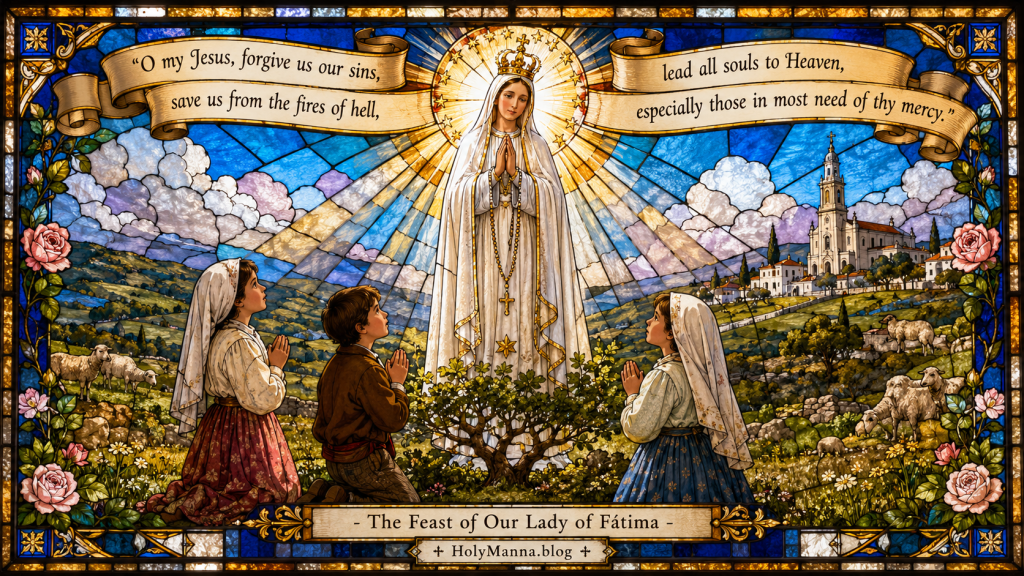
Another devotion associated with Fátima is the prayer often added after each decade of the Rosary: “O my Jesus, forgive us our sins, save us from the fires of hell, lead all souls to Heaven, especially those in most need of thy mercy.” This prayer captures the heart of Fátima in one breath. It is humble, urgent, merciful, and missionary.
The Five First Saturdays devotion is also closely tied to Fátima. In 1925, Our Lady appeared to Sister Lúcia in Pontevedra, Spain, with the Child Jesus, asking for reparation to the Immaculate Heart of Mary. The devotion asks the faithful, on five consecutive first Saturdays, to go to Confession, receive Holy Communion, pray five decades of the Rosary, and spend fifteen minutes meditating on the mysteries of the Rosary, all with the intention of making reparation to Mary’s Immaculate Heart.
This devotion is beautifully Catholic because it is sacramental and contemplative. It does not replace Confession. It sends the soul to Confession. It does not replace the Mass. It draws the soul to Holy Communion. It does not promote vague spirituality. It forms the heart in meditation on the mysteries of Christ.
Reparation is often misunderstood today. It does not mean earning salvation apart from Christ. It means responding to love with love. It means consoling the Hearts of Jesus and Mary by repentance, prayer, sacrifice, and fidelity. It means taking seriously the damage caused by sin and offering oneself, united to Christ, for the salvation of souls. The Catechism teaches that interior repentance is a radical reorientation of life, a return to God with all one’s heart, as taught in CCC 1431. Fátima gives that teaching a mother’s voice.
Pilgrims, Popes, and the Little Chapel Mary Asked For
Our Lady asked that a chapel be built at Cova da Iria. Today, the Chapel of the Apparitions stands at the heart of the Sanctuary of Our Lady of the Rosary of Fátima. It marks the place where Mary appeared over the small holm oak tree. From that humble beginning, Fátima has become one of the great Catholic pilgrimage sites of the world.
Pilgrims come from every continent. Some arrive singing. Some arrive weeping. Some walk long distances. Some come carrying family wounds, illnesses, grief, addictions, doubts, and impossible prayers. They come to a mother’s house. The Rosary is prayed. Candles are lit. Mass is offered. Confessions are heard. The sick are blessed. Souls remember that Heaven is near.
The great pilgrimage days are especially connected to the thirteenth of each month from May to October, recalling the apparitions of 1917. Candlelight processions fill the sanctuary with prayer, and the sight of thousands of pilgrims lifting candles in the night has become one of the most recognizable images of Catholic devotion in the modern world.
The popes have also loved Fátima. Pope Paul VI visited the shrine in 1967 for the fiftieth anniversary of the apparitions, becoming the first pope to go there as a pilgrim. Pope Saint John Paul II had a profound devotion to Our Lady of Fátima, especially after surviving the assassination attempt on her feast day in 1981. He returned to Fátima in thanksgiving and later beatified Francisco and Jacinta there in 2000.
Pope Benedict XVI visited Fátima in 2010 and spoke of Mary as a teacher who helps the faithful see with the eyes of the heart. Pope Francis canonized Francisco and Jacinta at Fátima on May 13, 2017, during the centenary of the apparitions. In his homily, he gave the Church a simple and powerful reminder: “We have a Mother!”
That sentence may be one of the most beautiful summaries of Fátima. Catholics do not walk through history as orphans. The Church has a Mother. The sinner has a Mother. The suffering have a Mother. The confused, exhausted, anxious, distracted, and wounded children of the modern world have a Mother.
A Feast That Shaped Catholic Culture
The Feast of Our Lady of Fátima has shaped Catholic culture across the world. Statues of Our Lady of Fátima are found in parishes, homes, schools, and shrines. The Pilgrim Virgin Statue has traveled across nations, bringing the message of prayer, peace, and conversion to countless communities. Rosary rallies, Marian processions, First Saturday devotions, consecrations to the Immaculate Heart, and parish celebrations all carry the spiritual DNA of Fátima.
In Portugal, Fátima is not only a shrine. It is part of the Catholic soul of the nation. Around the world, Portuguese communities have carried devotion to Our Lady of Fátima into their parish life, family traditions, hymns, festivals, and processions. Many Catholic families know the image well: Mary in white, hands folded in prayer, a Rosary hanging from her hands, her face serene and sorrowful.
Fátima also shaped the Church’s spiritual response to the twentieth century. In an age marked by world wars, atheistic Communism, persecution, moral confusion, and mass violence, Our Lady’s message reminded Catholics that history is not controlled only by armies, governments, ideologies, or economies. Grace is real. Prayer matters. Hidden holiness changes the world.
That message is still needed. The modern Catholic faces a different battlefield in some ways, but the spiritual battle is the same. The family is attacked. The body is confused. Marriage is weakened. Children are catechized by screens. Anxiety is everywhere. Sin is often renamed freedom. Silence is rare. Prayer feels hard. Confession gets postponed. Sunday Mass becomes optional for too many.
Fátima cuts through the noise with motherly clarity. Pray the Rosary. Go to Confession. Receive the Eucharist worthily. Offer sacrifices. Stop offending God. Pray for sinners. Trust the Immaculate Heart. Return to Jesus.
There is nothing trendy about that message. That is why it lasts.
The Motherly Warning That Leads to Hope
The Feast of Our Lady of Fátima is not a feast of panic. It is a feast of hope with a serious face.
Mary does not flatter her children. She tells the truth. Sin destroys. Souls can be lost. War is the fruit of hearts far from God. A world that rejects Heaven does not become more human. It becomes more cruel. But Mary also tells the deeper truth. God is merciful. Prayer is powerful. Sacrifice has meaning. Children can become saints. History can be changed by grace.
Francisco and Jacinta took the message seriously. Francisco became especially devoted to consoling Jesus. Jacinta burned with love for sinners and offered sufferings for their conversion. These were children, but they were spiritually mature because they allowed grace to work. They remind the Church that holiness is not about age, status, or personality. Holiness is about surrender.
Their canonization also matters for the feast. The Church lifted Francisco and Jacinta up as saints, not because they saw Mary, but because they responded with heroic faith, love, prayer, and sacrifice. Seeing a vision does not make a saint. Loving God faithfully does.
That is the invitation of Fátima. Not everyone will see a miracle. Not everyone will go to Portugal. Not everyone will understand every detail of the secret. But every Catholic can pray the Rosary. Every Catholic can go to Confession. Every Catholic can make small sacrifices. Every Catholic can ask Mary for help. Every Catholic can return to Jesus.
Learning to Pray Like Children Again
The Feast of Our Lady of Fátima asks modern Catholics to become spiritually serious without becoming spiritually gloomy. That balance matters. Our Lady’s message is sober, but it is full of maternal hope.
One of the great temptations today is distraction. People can scroll for hours and say there is no time for prayer. They can worry endlessly about the state of the world and never pray a Rosary for peace. They can complain about the culture and avoid Confession. They can talk about spiritual warfare and neglect the Eucharist. Fátima gently but firmly exposes that contradiction.
Mary’s answer is not complicated. Begin again. Pray daily. Repent honestly. Offer suffering instead of wasting it. Go to Mass. Receive Jesus with reverence. Make reparation. Teach children to pray. Place the family under the protection of the Immaculate Heart. Do the small things with love.
There is something deeply comforting about the simplicity of Fátima. Heaven does not ask most Catholics to solve every crisis in the world. Heaven asks for fidelity. A decade of the Rosary prayed in the car with distracted kids still matters. A tired parent offering exhaustion for sinners still matters. A young adult deleting a near occasion of sin still matters. A husband leading prayer badly but sincerely still matters. A confession after years away still matters. A First Saturday Communion offered in reparation still matters.
Fátima teaches that ordinary Catholics are not powerless. The world may laugh at Rosaries, sacrifices, processions, and Marian devotion. But Heaven does not laugh. Heaven uses the humble things.
Mary’s Immaculate Heart will triumph because it belongs entirely to Jesus. That is the goal for every Catholic heart. Not fear. Not obsession. Not spiritual drama. Total belonging to Christ.
Where is Our Lady inviting the heart to conversion today?
Has the Rosary become a living encounter with Christ, or only a religious object nearby?
What suffering, inconvenience, or hidden sacrifice can be offered for sinners and for peace?
Is Confession being delayed when grace is already waiting?
The Feast of Our Lady of Fátima is a mother’s invitation to come back to the essentials. Pray. Repent. Trust. Receive the Eucharist. Love the Church. Stay close to Mary. Belong to Jesus.
Engage with Us!
Share your thoughts and reflections in the comments below. This feast touches so many parts of Catholic life: family prayer, Marian devotion, repentance, Eucharistic love, spiritual warfare, and hope for the world. Your reflection may encourage someone else to pick up the Rosary again, return to Confession, or trust Our Lady more deeply.
- What part of the message of Our Lady of Fátima speaks most directly to your life right now?
- How has the Rosary helped you grow closer to Jesus through Mary?
- Is there a specific intention, person, or wound in the world that you feel called to pray for through the intercession of Our Lady of Fátima?
- What is one small sacrifice you can offer this week for the conversion of sinners and peace in the world?
- How can your family, parish, or prayer group live the message of Fátima more faithfully?
May Our Lady of Fátima help every Catholic heart grow in prayer, repentance, courage, and love for Jesus Christ. May her Immaculate Heart lead the faithful deeper into the Sacred Heart of her Son. And may the Church continue to grow together in faith, hope, and holiness under the guidance of our Blessed Mother.
Our Lady of Fátima, pray for us!
Follow us on YouTube, Instagram and Facebook for more insights and reflections on living a faith-filled life.


Leave a comment