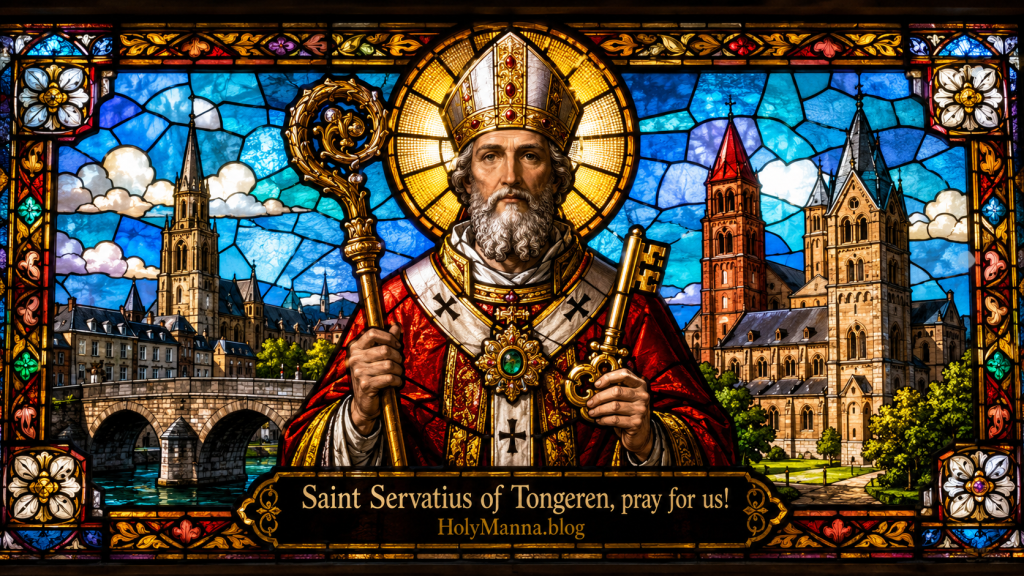
The Bishop with the Key
Saint Servatius of Tongeren, also known as Saint Servaas, stands near the beginning of the Christian story in the Low Countries. He was a fourth-century bishop associated with Tongeren in present-day Belgium and Maastricht in the Netherlands. Catholic tradition honors him as the last bishop of Tongeren and the first bishop of Maastricht, though historians debate exactly when the episcopal seat was formally transferred.
He is remembered above all as a defender of the Catholic faith against Arianism, the ancient heresy that denied the full divinity of Jesus Christ. That might sound like a dusty theological argument from long ago, but it was anything but minor. Arianism struck at the heart of the Gospel. If Jesus is not truly God, then the Creed collapses, the Eucharist loses its meaning, and salvation becomes something far less than the divine rescue mission revealed in Scripture.
Saint Servatius lived during a time when the Church had emerged from persecution, but now faced a different kind of danger. The threat was not only from soldiers, prisons, or executioners. The threat came through false teaching, political pressure, and confusion among Christians themselves. In that world, Servatius stood as a bishop who guarded the truth that the Church still professes every Sunday: “God from God, Light from Light, true God from true God.”
The Catechism of the Catholic Church teaches that “The mystery of the Most Holy Trinity is the central mystery of Christian faith and life” (CCC 234). That is why Saint Servatius matters. He was not merely defending an idea. He was defending the truth of who Jesus Christ is.
From the Mist of History to the Light of Faith
The early life of Saint Servatius is difficult to reconstruct with certainty. Some later medieval legends say that he was born in Armenia and was even a distant relative of Jesus. Other stories say that he served near the Holy Sepulchre in Jerusalem and received a vision telling him to travel to Tongeren. These traditions became beloved in medieval devotion, but they cannot be historically verified with confidence.
That does not mean they should be mocked or dismissed as useless. Catholic storytelling has always understood that legends often express spiritual truths through symbolic language. The story of Servatius coming from the East and being connected to the Holy Land presents him as a man whose life was rooted in the mystery of Christ. Still, a faithful Catholic account should be honest. His Armenian origin and family connection to Jesus belong to later tradition, not to firm historical record.
What can be said more securely is that Servatius became bishop of Tongeren in the fourth century and was involved in the great doctrinal struggle against Arianism. He is often identified with a bishop named Sarbatios, mentioned in connection with the Synod of Sardica in 343. He is also remembered in Catholic tradition as a supporter of Saint Athanasius, the great defender of Nicene orthodoxy.
That connection matters. Saint Athanasius suffered exile and opposition because he refused to compromise the truth that the Son is fully divine. If Servatius welcomed and supported Athanasius, then Servatius belonged to that same brave Catholic line of bishops who refused to bend the Creed to fit political convenience.
He is also remembered as having resisted the Arians at the Council of Rimini in 359. In an age when some bishops gave way under pressure, Servatius is remembered as one who stood firm. He knew that the Church does not exist to soften the truth until the world finds it comfortable. The Church exists to proclaim Jesus Christ, crucified and risen, true God and true man.
The Bishop Who Stood Against the Dragon
In sacred art, Saint Servatius is often shown as a bishop with a crozier, mitre, book, key, and sometimes a dragon beneath his feet. The dragon represents Arianism, the heresy he opposed. That image is powerful because false teaching rarely looks harmless once its spiritual consequences become clear.
Arianism tried to make Christ less than God. It wanted a Jesus who was exalted, holy, and unique, but not truly equal to the Father. Catholic faith says something far greater. Jesus is not merely the highest creature. He is the eternal Son. He is the Word made flesh. He is Emmanuel, God with us.
The Catechism teaches that the Son is “consubstantial with the Father” (CCC 242). That means the Son is of the same divine substance as the Father. The battle against Arianism was therefore a battle over worship, salvation, and truth itself.
Saint Servatius reminds modern Catholics that doctrine is not cold. Doctrine is love protected from distortion. If Jesus is truly God, then His mercy has divine power. If Jesus is truly God, then the Eucharist is not a symbol of distant affection, but the living presence of Christ. If Jesus is truly God, then His commandments are not religious suggestions, but the words of eternal life.
Do Christians today sometimes treat Jesus as inspiring, but not truly Lord?
That question makes Saint Servatius feel very close to our own time.
The Journey to Rome and the Key of Heaven
One of the most famous stories about Saint Servatius comes from later tradition and is especially connected with Saint Gregory of Tours. According to the story, Servatius saw danger approaching his people. Invaders threatened the land, and the bishop did what a true shepherd does. He went to Rome and prayed at the tomb of Saint Peter, begging for mercy.
In the legend, Saint Peter appeared to Servatius and told him that the coming devastation could not be completely avoided. Servatius was told to return home, prepare his affairs, arrange his grave, and ask for a clean burial cloth. This saying is not a verified quotation from Servatius himself. It belongs to the legendary tradition surrounding him.
The story continues that Saint Peter gave Servatius a key, understood in devotion as the key of Heaven’s gate. This key became one of the saint’s most famous symbols. It appears in art, pilgrimage devotion, and the treasury of the Basilica of Saint Servatius in Maastricht.
Historically, the physical key associated with Servatius is a medieval object, and the written story of the key appears much later than the saint’s lifetime. So it should be treated as a legend, not as a verified fourth-century event. Still, the symbolism is deeply Catholic. A key opens what is closed. A key suggests authority, mercy, repentance, and entrance into the Kingdom.
Jesus says to Saint Peter in The Gospel of Matthew, “I will give you the keys of the kingdom of heaven” (Mt 16:19). The legend of Servatius receiving a key from Peter connects the bishop’s ministry to the apostolic faith of the Church. It shows Servatius as a man sent to unlock hope for a frightened people.
Miracles, Legends, and the Bishop’s Compassion
No historically certain miracle from Saint Servatius’ lifetime can be stated with confidence, but later Catholic tradition preserves several stories about him. These stories should be understood as legends unless otherwise noted.
One legend says that while Servatius traveled to Rome, an eagle flew above him and shaded him from the heat of the sun. Another says that he preached in Greek, yet the people understood him by divine assistance. Another says that an angel gave him a mitre and crozier, signs of his episcopal office. Another says that angels covered his body with heavenly cloths after his death. These stories cannot be verified historically, but they show how Catholics remembered him as a bishop protected by God and marked by sacred authority.
There is also a much more fanciful legend that Servatius converted Attila the Hun. This cannot be historically accurate, since Attila ruled decades after the traditional date of Servatius’ death. It is best understood as a later legendary attempt to connect Servatius with the fearsome invaders of Christian memory.
The most important point is not that every story can be proven. The important point is that Catholics remembered Servatius as a shepherd who prayed, taught, warned, defended, and interceded. His holiness was remembered not as private spirituality, but as fatherly care for a people in danger.
A Shepherd Under Pressure
Saint Servatius lived in a hard century. The Church had survived Roman persecution, but now she faced internal conflict. The empire was unstable. Doctrinal confusion spread. Bishops were pressured by rulers, factions, and popular opinion. Servatius also lived near the frontier of a changing world, where invasion and social collapse were real fears.
He was not a martyr in the strict sense. He was not killed for the faith. Yet his life still carried the suffering of witness. To defend Catholic doctrine in a time of confusion takes courage. To remain faithful when compromise would make life easier takes humility. To shepherd frightened people while knowing danger is coming takes a heart deeply rooted in God.
The tradition says that after his journey to Rome, Servatius returned to the region, gathered sacred relics, and eventually came to Maastricht. There he died around the year 384, traditionally on May 13. His grave would become one of the great Catholic pilgrimage places of the Low Countries.
A holy bishop may die quietly, but the seed of his witness does not stay buried.
The Grave That Would Not Hold the Snow
After Saint Servatius’ death, devotion to him grew around his tomb in Maastricht. One of the most famous miracles associated with him appears in the tradition preserved by The Roman Martyrology. In winter, snow covered the surrounding ground, but not the grave of Servatius. His resting place remained clear until the people built a church over it.
It is a beautiful image. The world grows cold, but holiness leaves a warm mark. The snow falls everywhere, but not where the saint rests. The miracle tells the faithful that God had not forgotten His servant, and that the bishop who defended Christ in life continued to draw souls toward Christ after death.
Other miracles were also associated with his tomb. Pilgrims came seeking healing and help. Medieval devotion especially remembered Saint Servatius as an intercessor against sudden fevers in people and animals. In an age when illness could strike quickly and medicine was limited, the faithful turned to him with urgent trust.
His relics became central to Maastricht’s Catholic identity. The most famous reliquary is the Noodkist, often translated as the “Chest of Distress” or “Emergency Chest.” It contains relics of Saint Servatius and Saint Martin of Tongeren. In times of plague, war, and crisis, the reliquary was carried or displayed as the people begged God for mercy through the intercession of the saints.
The Catechism teaches that “The communion of saints is the Church” (CCC 946). This is the Catholic heart behind relics and pilgrimage. Catholics do not worship relics. Worship belongs to God alone. But Catholics honor the saints because God’s grace truly transformed their lives, their bodies, their sufferings, and their witness.
The relics of Servatius remind the faithful that sanctity is not imaginary. Grace enters history. Holiness touches real bones, real cities, real churches, and real generations.
Maastricht, the Noodkist, and a Living Catholic Memory
Saint Servatius is inseparable from Maastricht. His tomb became a place of pilgrimage as early as the centuries after his death. Over time, churches were built over his grave, eventually leading to the great Basilica of Saint Servatius. That basilica remains one of the most important Catholic sites in the Netherlands.
Medieval pilgrims came from many places to honor him. Emperors, bishops, religious, and ordinary faithful visited his shrine. The city’s Catholic memory gathered around his grave like a family gathering around the table of an honored father.
His relic shrine, the Noodkist, became a powerful sign of communal prayer. It was carried during times of distress, including plague and war. In more recent memory, it has also been connected with public prayer during modern crises. This is not superstition when understood properly. It is the Catholic instinct to bring suffering before God with the saints as heavenly friends.
The city also celebrates the Heiligdomsvaart, the great seven-year pilgrimage of relics in Maastricht. This tradition began in the medieval period and continues today. During it, the relics of Saint Servatius and other sacred treasures are honored in procession, prayer, and public devotion. The pilgrimage shows that Saint Servatius is not merely a figure from a dusty past. His memory still shapes Catholic life, culture, art, and worship.
Saint Servatius is also counted among the Ice Saints, those saints whose May feast days became associated in European folk tradition with the final danger of late spring frost. This may seem like a small cultural detail, but it reveals something charming and deeply human about Catholic life. The saints became part of the rhythm of seasons, planting, weather, illness, travel, birth, death, and daily survival.
Faith was not something separate from ordinary life. It touched everything.
The Protector Remembered by the Dominicans
A later Catholic tradition also connects Saint Servatius with the Dominican Order. According to a devotional story, in the year 1330, during political danger involving Emperor Louis of Bavaria, Saint Servatius appeared in a dream to a Dominican friar and warned that the friars gathered for a General Chapter in Cologne were in danger. The friars fled to Maastricht and were received kindly.
This story belongs to later devotional tradition and cannot be treated as part of the saint’s verified fourth-century life. Still, it shows how widely Servatius was remembered as a protector. He was not only patron of one city. He became a heavenly guardian invoked by those who needed warning, shelter, and courage.
That is one of the quiet beauties of Catholic devotion. A saint’s earthly life may be limited to one time and place, but in Christ, his charity can reach far beyond it.
A Saint for Catholics Who Need Courage Today
Saint Servatius is a saint for Catholics living in confused times. He knew what it meant to defend truth when many wanted compromise. He knew what it meant to shepherd people when danger was near. He knew that bishops are not called to be celebrities, managers, or political survivors. They are called to guard the faith once delivered to the saints.
His life asks modern Catholics to take doctrine seriously. Not angrily. Not proudly. Not as a weapon for winning arguments. Doctrine must be loved because Christ must be loved. The truth about Jesus is not optional. If Jesus is God, then everything changes. If Jesus is Lord, then no age, empire, ideology, or fashion gets the final word.
Saint Servatius also teaches the value of intercession. He went to Rome to pray for his people. He placed their fear before God. After death, Catholics continued to bring their fears to his tomb. The pattern is simple and beautiful. A holy shepherd prays for his people in life, and the Church trusts that he continues to pray in Heaven.
Where does fear need to become prayer in your life?
Where is Christ asking you to defend the truth with courage and charity?
What door might God be asking you to open for someone else?
The legend of the key may not be historically certain, but its meaning is worth keeping. A Catholic life should open doors. Doors to mercy. Doors to repentance. Doors to the sacraments. Doors to truth. Doors to Christ.
Engage With Us!
Share your thoughts and reflections in the comments below. Saint Servatius lived in a time of doctrinal confusion, cultural fear, and public crisis, yet he remained faithful to Christ and His Church. His life is a reminder that holiness is not only found in quiet monasteries or dramatic martyrdoms. Sometimes holiness looks like standing firm, praying for others, and refusing to let fear have the final word.
- What part of Saint Servatius’ story speaks most strongly to you: his defense of Christ’s divinity, his prayer for his people, or the miracles associated with his tomb?
- How can you defend the truth of the Catholic faith in your own life without becoming harsh, prideful, or argumentative?
- The key of Saint Servatius became a symbol of opening doors. What door might Jesus be asking you to open for someone else this week?
- Saint Servatius prayed for his people during a time of fear. Who in your life needs your prayers right now?
- How can remembering the communion of saints help you feel less alone in your own struggles?
May the witness of Saint Servatius encourage every Catholic heart to stand firm in the truth, pray boldly for others, and trust that Jesus Christ is truly Lord. Live the faith with courage. Speak the truth with charity. Carry every burden with hope. Above all, do everything with the love and mercy Jesus taught us.
Saint Servatius of Tongeren, pray for us!
Follow us on YouTube, Instagram and Facebook for more insights and reflections on living a faith-filled life.


Leave a comment