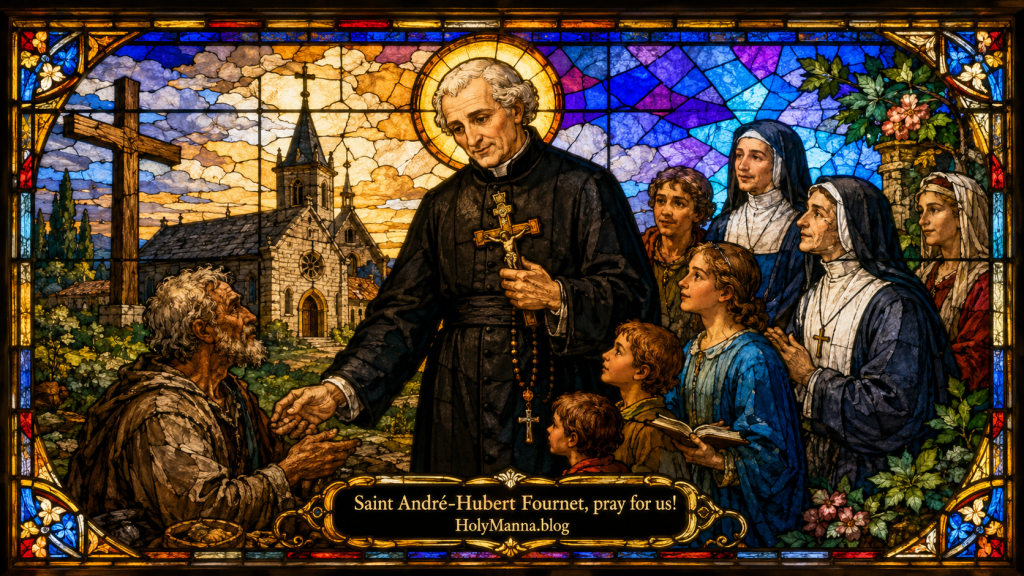
The Priest Who Gave with Both Hands
Saint André-Hubert Fournet was the kind of saint who reminds Catholics that God has a holy sense of humor. As a boy, he once wrote in one of his books that he would “never be a monk or a priest.” Yet the Lord, who sees deeper than youthful confidence and stubbornness, turned that same boy into a priest, a hidden shepherd during the French Revolution, and the co-founder of the Daughters of the Cross.
Born on December 6, 1752, near Saint-Pierre-de-Maillé in the Diocese of Poitiers, France, André-Hubert came from a respected Catholic family. His mother, Florence Chasseloup, was a woman of deep faith who wanted her children to love God, not merely know about Him. His father, Pierre Fournet de Thoiré, also came from a family with strong Catholic roots. Several relatives were priests or religious, so the life of the Church surrounded him from childhood.
Still, young André-Hubert was not exactly the quiet little saint one might imagine. He was lively, playful, and not especially devoted to his studies. He tried law, but that path did not suit him. He even briefly pursued military life, but one of his priestly uncles rebuked him sharply when he appeared in uniform. That moment began to shake him awake.
Eventually, André-Hubert spent time with another uncle, Father Jean Fournet, a priest known for learning, prayer, poverty, and charity. There, the young man saw priesthood not as a career of comfort, but as a life poured out for God and souls. Around the age of twenty-two, he entered seminary. The young man who had insisted he would never be a priest became one anyway, most likely ordained in 1776.
His life is a beautiful reminder that the Lord does not panic over our early resistance. He keeps calling. He keeps inviting. He keeps forming saints out of people who once thought they had other plans.
The Beggar at the Door and the Table Covered with Alms
Father André-Hubert became parish priest of Saint-Pierre-de-Maillé, where he was respected and capable. Yet at first, he still had something of a comfortable clerical life. He enjoyed hosting guests and keeping a generous table. He was not wicked or cold, but the Gospel had not yet taken full possession of his heart.
Then came one of the most famous stories of his life.
One day, while his table was richly prepared, a beggar came asking for alms. Father Fournet said he had no money to give. The poor man looked at the table and replied, “Your table is covered with it!”
Those words pierced him. It was as if Christ Himself had spoken through the poor man at the door. Father Fournet wept and prayed, and from that day forward he changed. He simplified his life, gave more generously, and became deeply attentive to the poor.
This is where Saint André-Hubert becomes so relatable. He was not born already detached from comfort. He had to be converted more deeply. He had to learn that charity is not merely giving from what is left over. It is seeing Christ in the one who interrupts dinner, asks for help, and reveals the truth about the heart.
The Catechism of the Catholic Church teaches that the works of mercy are acts of charity by which Catholics help their neighbors in spiritual and bodily needs. Feeding the hungry, visiting the sick, instructing the ignorant, consoling the afflicted, and caring for the poor are not optional decorations on Christian life. They are part of following Jesus, as taught in CCC 2447.
Saint André-Hubert learned that lesson from a beggar, and he never forgot it.
A Hidden Shepherd During the French Revolution
When the French Revolution erupted, the Church in France entered a terrifying period. Priests were pressured to take the Civil Constitution of the Clergy, an oath that faithful Catholics recognized as a violation of the Church’s communion and authority. Father Fournet refused the oath out of fidelity to the Roman Catholic Church.
Because of that refusal, he became a hunted priest.
He was forced into hiding and eventually fled to Spain in 1792. Yet exile did not extinguish his love for his people. In 1797, while danger still remained, he secretly returned to France. He celebrated Mass in homes, fields, and barns. He heard confessions quietly. He strengthened Catholics who had been deprived of the sacraments. One barn at Les Petits-Marsyllis became especially important in his hidden ministry.
This period reveals the heart of his priesthood. He was not a martyr by blood, but he was a confessor of the faith. He risked his freedom and perhaps his life so ordinary Catholics could receive the Eucharist, confession, and pastoral care.
The Catechism teaches that the priest acts in persona Christi Capitis, in the person of Christ the Head, as described in CCC 1548. Saint André-Hubert lived this truth in a dramatic way. When the public life of the Church was attacked, he became a quiet, hidden sign that Christ the Shepherd had not abandoned His flock.
Several stories from this time became part of Catholic memory. One tradition says he narrowly escaped revolutionary police by pretending to be a dead man. Another pious story says that, while being pursued, he saw a wooden cross, stretched his arms upon it, and waited for death. His pursuers, struck by the sight, fled. This second story should be treated as a hagiographical tradition rather than a verified civil record, but it beautifully expresses how Catholics remembered him: a priest clinging to the Cross when the world turned violent.
The Barn Mass and the Saintly Woman Who Helped Him Rebuild
During his secret ministry, Father Fournet met Saint Jeanne-Élisabeth Bichier des Âges. She was a noblewoman who had suffered during the Revolution and was discerning how to give her life fully to God. Their meeting became one of the most important moments in both of their lives.
Élisabeth initially desired a more withdrawn religious life, but Father Fournet saw the immense suffering around them. France had been spiritually wounded. Children did not know the faith. The sick lacked help and consolation. Families needed catechesis. The poor needed both practical care and the tenderness of Christ.
He urged Élisabeth toward active charity. He told her that there were children who did not know the first principles of religion and poor sick people without help or consolation. In other words, he pointed her toward the suffering Body of Christ.
Together, they founded the Daughters of the Cross, also known as the Sisters of Saint Andrew. Their mission was beautifully simple and deeply Catholic: teach poor children, care for the sick, assist the dying, and bring the love of Christ into wounded communities.
In 1806, the first community began forming at Molante. On February 2, 1807, the first sisters made vows. They committed themselves to poverty, chastity, obedience, instruction of the poor, and care for the sick.
The congregation was not founded for prestige. It was born from the needs of ordinary people. Saint André-Hubert saw that after years of revolution and religious confusion, the Church had to be rebuilt through catechism, mercy, education, and the sacraments.
That is very Catholic. The Church is not renewed only by great speeches or impressive programs. She is renewed when children learn the faith, when the sick are visited, when the poor are loved, when priests remain faithful, and when souls are patiently formed in Christ.
The Good Father of Maillé
After the worst persecution eased, Father Fournet returned openly to his parish. The people called him “the Good Father.” That title says so much. He was not simply an administrator or public religious figure. He was a spiritual father.
He knew his people. He loved them. He visited the sick, preached, gave missions, formed souls, and helped rebuild Catholic life after the Revolution. He also encouraged priestly vocations and helped form many priests for the Diocese of Poitiers.
By 1820, after roughly forty years as parish priest, he resigned his parish so he could dedicate himself more fully to the Daughters of the Cross. He moved to La Puye, where the congregation established its motherhouse in a former religious priory. There, he continued guiding the sisters through letters, retreats, confession, formation, and fatherly counsel.
His spirituality was practical, Eucharistic, Trinitarian, and centered on Christ crucified. He urged the sisters to let Jesus Christ be formed within them. One of his preserved sayings was, “Let your first care be to form Jesus Christ in yourself.”
That is not just advice for religious sisters. It is advice for every Catholic. A person can be busy in ministry, busy in family life, busy in work, and still forget the central question: Is Christ being formed in this soul?
Stories of Grace, Protection, and Miracles
Saint André-Hubert’s life is filled with stories of grace. Some are well-attested, while others belong more to pious tradition and should be presented carefully.
His providential escapes during the Revolution are among the best-known stories associated with him. Catholic accounts speak of him being hunted by revolutionary police and narrowly escaping capture. The story of him posing as a dead man belongs to this period. The story of him stretching himself upon a cross while pursuers fled is a pious tradition and cannot be verified with certainty, but it reflects how deeply Catholics connected him with the mystery of the Cross.
Some hagiographical accounts also associate him with extraordinary events, including a multiplication of food for the sisters and those in their care. This story has been repeated in Catholic devotional material, but the exact details are difficult to verify from accessible official sources. It should therefore be treated as a pious tradition that cannot be fully verified.
What can be said with certainty is that miracles were attributed to his intercession after death and examined in the process leading to his beatification and canonization. Pope Pius XI beatified him on May 16, 1926, and canonized him on June 4, 1933. The Church’s recognition of his sanctity confirms that his life displayed heroic virtue and that God glorified His servant through approved signs.
His holiness also produced a very visible kind of miracle during his lifetime: the spiritual renewal of a wounded region. Children learned the faith. Sisters were formed. The sick were cared for. The poor were served. Priests were encouraged. A religious congregation grew from humble beginnings into a lasting work of mercy.
Sometimes the miracle is not fire from heaven. Sometimes it is a parish priest who gives himself every day until the Church around him begins to breathe again.
The Saint Who Promised to Help from Heaven
Saint André-Hubert died at La Puye on May 13, 1834. Near the end of his life, he told the sisters not to pray that his earthly life would be prolonged. He said, “I will be more useful to you in heaven.”
That line is profoundly Catholic. The saints do not become distant after death. In Christ, they become more alive than ever. The Catechism teaches that the intercession of the saints is their most exalted service to God’s plan, as seen in CCC 956. The saints are not replacements for Christ. They are members of His Body who pray with Him and in Him for the Church on earth.
After his death, devotion to Saint André-Hubert continued especially through the Daughters of the Cross and in the region of Poitou. His relics are venerated at La Puye, where the congregation preserves his memory. His shrine bears the Trinitarian prayer that marked his life: “Glory be to the Father, and to the Son, and to the Holy Spirit.”
His legacy grew through the congregation he helped found. At the time of his death, the Daughters of the Cross had already expanded significantly, with hundreds of sisters serving across many communities. Their work continued through education, care for the sick, and service to the poor. His cultural impact remains especially strong in French Catholic memory, where he is remembered as “le Bon Père,” the Good Father.
He is not one of those saints known for armies, crowns, or dramatic public speeches. He is known for fidelity. He is known for hidden Masses. He is known for loving the poor. He is known for helping a saintly woman found a congregation that served children and the sick. He is known for being a parish priest who took the Gospel seriously.
That is more than enough.
Give With Both Hands
One of the most beautiful final stories from his life happened shortly before his death. He told a sister to go find out what the poor needed. She answered that if the poor needed something, they would come and ask.
Saint André-Hubert corrected her. The surplus belonged to the poor, and it should be brought to them. When asked how much should be given, he answered, “With both hands, my daughter, and without counting.”
That is the whole man in one sentence.
He had learned from the beggar at the table. He had learned from the Cross. He had learned from the Eucharist. He had learned that Christian charity is not stingy. It does not calculate every sacrifice like a business transaction. It gives because Christ gave first.
The Catechism teaches that love for the poor is inspired by the Gospel of the Beatitudes, the poverty of Jesus, and His concern for the poor, as seen in CCC 2444. Saint André-Hubert made that teaching visible. He gave his priesthood, his comfort, his safety, his time, his counsel, and his old age to Christ and His poor.
Holiness Begins at the Door
Saint André-Hubert Fournet’s life asks a simple question: Who is standing at the door, asking for charity, conversion, or courage?
For him, it was a beggar who exposed the comfort of his table. Later, it was persecuted Catholics who needed the sacraments. Then it was children who needed catechism, the sick who needed care, sisters who needed formation, and a wounded Church that needed rebuilding.
His holiness did not come from avoiding inconvenience. It came from answering it with love.
Many Catholics today are not being hunted through fields for refusing revolutionary oaths. Yet there are still pressures to compromise, to stay silent, to make faith private, to ignore the poor, or to let children grow up without knowing the truths of the Church. Saint André-Hubert reminds Catholics that fidelity is often quiet before it becomes heroic.
He also reminds the Church that renewal begins close to home. Teach the faith. Visit the sick. Care for the poor. Go to confession. Receive the Eucharist with reverence. Pray for priests. Encourage vocations. Form Christ within the soul. Give with both hands.
What comfort might Christ be asking His people to surrender so that someone else may be loved?
Where is God asking for courage, not someday, but today?
Who needs to experience the mercy of Jesus through a simple act of generosity?
Saint André-Hubert Fournet shows that a life does not need to begin perfectly in order to end beautifully. The boy who said he would never be a priest became a saintly father. The priest corrected by a beggar became a servant of the poor. The hunted pastor became a hidden light for the Church.
That is what grace does.
Engage With Us!
Share your thoughts and reflections in the comments below. Saint André-Hubert Fournet’s life is full of moments that feel surprisingly close to ordinary Catholic life: reluctance, conversion, sacrifice, service, and the call to love the poor with real generosity.
- What part of Saint André-Hubert Fournet’s story challenged you the most?
- Have you ever had a moment where someone’s simple words exposed something in your heart that needed conversion?
- How can you practice the works of mercy more intentionally this week?
- Where is God asking you to be more courageous in your Catholic faith?
- What would it look like in your life to give “with both hands, and without counting”?
May Saint André-Hubert Fournet pray for all priests, teachers, religious sisters, caregivers, parents, and ordinary Catholics trying to rebuild the faith one act of love at a time. May his example help us live with courage, serve with mercy, and do everything with the love and compassion Jesus taught us.
Saint André-Hubert Fournet, pray for us!
Follow us on YouTube, Instagram and Facebook for more insights and reflections on living a faith-filled life.


Leave a comment