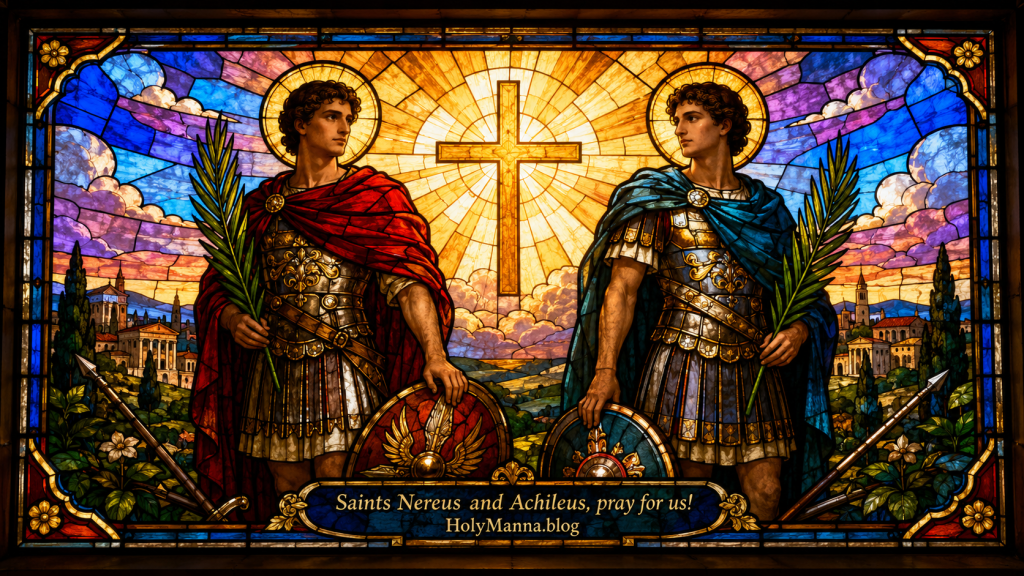
When Soldiers Laid Down Their Weapons for Christ
Saints Nereus and Achilleus come to us from the ancient Christian memory of Rome. Their story is not preserved with all the details modern readers might want. Their birthplaces are unknown. Their families are unknown. Their childhoods are hidden from history. Yet their names endured because the early Church remembered what mattered most: they belonged to Christ, confessed Him publicly, and died as martyrs.
The Catholic Church honors them on May 12. They are especially remembered as Roman soldiers who experienced what Pope Saint Damasus called a “miracle of faith.” They had once served an earthly power, but after their conversion, they threw away their shields, armor, and weapons. They left behind the violent machinery of pagan Rome and chose the Cross of Jesus Christ.
That is why their witness still matters. Nereus and Achilleus remind every Catholic that conversion is not only about feeling sorry for sin. Sometimes conversion means walking away from an entire way of life. Sometimes it means losing security, approval, status, and even life itself because Christ has become the true King of the heart.
The Catechism of the Catholic Church teaches that “Martyrdom is the supreme witness given to the truth of the faith” CCC 2473. Saints Nereus and Achilleus lived that truth with their blood.
From Fearful Obedience to the Freedom of Faith
The oldest and most important testimony about Saints Nereus and Achilleus comes from Pope Saint Damasus I, who reigned in the fourth century and had a deep devotion to the martyrs of Rome. His inscription remembers them as soldiers who had once obeyed cruel commands out of fear. Then grace entered their lives, and everything changed.
Pope Damasus described their conversion with words remembered in Catholic tradition as a “miracle of faith.” He says they abandoned their former violence, threw away their shields, armor, and bloody spears, confessed Christ, and rejoiced in His victory.
That one image tells the story better than a thousand details could. Picture two Roman soldiers, trained to obey, trained to fight, trained to survive in the empire’s world of power and fear. Then suddenly, by the grace of God, they see the truth. They realize they cannot serve Christ and keep serving evil. So they lay down the symbols of their old life.
Their early lives remain unknown, so it would be wrong to invent a childhood or family background for them. What can be said is that their conversion became the defining event of their lives. They are most known for rejecting sinful obedience, confessing Christ, and accepting martyrdom rather than compromise.
Their story speaks clearly to the Catholic conscience. The Catechism teaches that no one may excuse evil by claiming blind obedience to orders. A Christian must obey God before any human authority when those authorities command sin. Nereus and Achilleus became living witnesses to that truth.
The Miracle Hidden in a Changed Heart
No verified miracle stories from their lifetime have been handed down in the way they have for some other saints. There are no reliable accounts of Nereus and Achilleus healing the sick, raising the dead, multiplying food, or escaping prison through angelic intervention.
Yet the ancient Church remembered something just as profound. Their miracle was conversion.
That may sound simple until the heart really sits with it. These were men connected to the Roman military world. They likely had duties, expectations, and pressure placed upon them. They had a place in the empire. They had something to lose. Then Christ became more real to them than fear.
Their witness matters because the Christian life often begins there. A person sees the truth and realizes, “This cannot continue.” A job, a habit, a relationship, a compromise, a hidden sin, a pattern of cowardice, or a comfortable lie must be surrendered. Saints Nereus and Achilleus show that holiness sometimes begins with the sound of armor hitting the ground.
Their lives remind us that the greatest miracle is not always an outward wonder. Sometimes the greatest miracle is a soul that stops obeying fear.
As Jesus says in The Gospel of Matthew, “Whoever endures to the end will be saved” Matthew 10:22. Nereus and Achilleus endured to the end.
The Legend of Saint Domitilla
A later and beloved tradition connects Nereus and Achilleus with Saint Flavia Domitilla, a noble Christian woman associated with the imperial family. According to this story, Nereus and Achilleus were servants or chamberlains in her household. Some versions call them eunuchs. In this legend, they encouraged Domitilla to embrace Christian virginity and remain faithful to Christ despite pressure to marry and participate in pagan life.
The story says that they suffered exile with her, refused to sacrifice to the Roman gods, and were eventually beheaded for their faith. This tradition became popular in Catholic devotion and sacred art, especially because it places the saints within the dramatic world of early Roman converts who risked everything for baptism, chastity, and fidelity to Christ.
This story should be told as legend, not as verified history. The stronger historical tradition from Pope Damasus remembers them as soldiers who abandoned military service after conversion. The Domitilla legend may preserve echoes of early Christian memory, but its details cannot be verified.
Still, legends often reveal what Catholics saw in the saints. In this case, the legend shows Nereus and Achilleus as men who defended purity, encouraged courage, and helped others remain faithful when the world demanded compromise.
Blood Witnesses in the City of Rome
The martyrdom of Nereus and Achilleus is the heart of their memory. Pope Damasus tells us that they confessed Christ and died as martyrs, though he does not give every detail of their execution. Later tradition remembers them as beheaded, and ancient Christian art connected with their basilica also depicts their death by decapitation.
Their martyrdom was not a tragic defeat. In the Catholic view, martyrdom is victory because the martyr belongs completely to Christ. The world can take the body, but it cannot conquer the soul united to Jesus.
The Church’s suggested readings for their memorial beautifully match their witness. In Revelation 7, the saints stand before the throne of God in white robes. In Psalm 124, the faithful proclaim that the Lord has rescued them. In The Gospel of Matthew, Jesus warns His disciples that they will be handed over and hated because of His name, but He also promises that endurance leads to salvation.
That is the world of Nereus and Achilleus. They are men of the white robe. Men rescued by the Lord. Men hated because of the name of Jesus. Men who endured.
Resting Among the Martyrs
After their death, Saints Nereus and Achilleus were buried in the Catacomb of Domitilla on the Via Ardeatina in Rome. This is one of the strongest historical anchors of their story. Their memory was tied to a real place, a real tomb, and real worship by the ancient Roman Church.
A basilica was eventually built over their grave in the catacombs. Centuries later, archaeologists rediscovered important evidence connected to their veneration, including fragments of the inscription of Pope Damasus and artwork showing their martyrdom. A surviving pillar even bears the name Achilleus.
Their relics were later associated with the Roman church of Santi Nereo e Achilleo near the Baths of Caracalla. That church also has a fascinating older name, Titulus Fasciolae. A tradition says this title is connected to Saint Peter, who lost a bandage from his wounded leg while fleeing Rome. This belongs to the larger Quo Vadis tradition, where Peter encounters Christ and returns to Rome to face martyrdom.
That connection is beautiful, even if it is not directly about Nereus and Achilleus. Their church stands in a spiritual landscape of courage. Peter returns to martyrdom. Nereus and Achilleus leave the camp of fear. All of them teach the same lesson: Christ is worth more than survival.
A Legacy Carved in Stone and Written in Blood
The legacy of Saints Nereus and Achilleus is deeply Roman. Their names are remembered in the catacombs, in ancient inscriptions, in the Church’s liturgy, in sacred art, and in the basilica dedicated to them. Their feast is celebrated on May 12 as an Optional Memorial in the Roman calendar.
Their cultural impact is not the kind measured by large national celebrations or popular festivals. It is quieter and older. Their impact lives in the Roman Church’s memory of the martyrs. It lives in pilgrimages to the Catacomb of Domitilla. It lives in the prayers of the faithful who ask for courage when conscience becomes costly.
There are no well-attested posthumous miracle stories widely associated with them. No famous healing shrine or verified apparition tradition has become central to their cult. Instead, their afterlife in the Church is built around veneration, relics, liturgy, and intercession.
The Church’s prayer for their memorial asks God that those who know the courage of these glorious martyrs may experience their loving intercession. That is a very Catholic way to remember them. The saints are not dead heroes admired from a distance. They are living members of the Body of Christ.
The Catechism of the Catholic Church teaches that the saints “do not cease to intercede with the Father for us” CCC 956. Nereus and Achilleus still pray for the Church, especially for those who need courage to choose Christ over fear.
What Saints Nereus and Achilleus Teach the Modern Catholic
Saints Nereus and Achilleus are saints for anyone who feels trapped inside pressure. Pressure from work. Pressure from culture. Pressure from friends. Pressure from family. Pressure from habits. Pressure from a system that says, “Just do what everyone else is doing.”
Their witness says no.
A Christian cannot hand over his conscience to the crowd. A Catholic cannot say, “That is just how business works,” or “That is just how politics works,” or “That is just how my industry works,” when something violates the law of God.
Nereus and Achilleus also teach that conversion is possible, even after a compromised past. Their story does not present them as men who were always innocent. Pope Damasus remembers them as men who once obeyed cruel commands out of fear. Yet grace reached them. Christ claimed them. Their past did not get the final word.
That should give every struggling Catholic hope. The Lord does not only call the already polished and respectable. He calls sinners. He calls cowards. He calls people with baggage. Then He makes them saints.
The practical lesson is clear. Lay down the weapons. Lay down the excuses. Lay down the false loyalties. Lay down whatever keeps the soul serving fear instead of Jesus.
What armor is Christ asking you to drop today?
Where has fear been making decisions that faith should be making?
What would change if Jesus were treated not merely as a belief, but as the true Lord of every choice?
Engage with Us!
Share your thoughts and reflections in the comments below. Saints Nereus and Achilleus may not have left behind long biographies, but their witness still speaks with force. They remind us that courage is not the absence of fear. Courage is obedience to Christ when fear is loud.
- Where do you feel the greatest pressure to compromise your Catholic faith today?
- What “weapons” of fear, pride, anger, ambition, or self-protection might Jesus be asking you to lay down?
- How can the witness of Saints Nereus and Achilleus help you obey God more faithfully in your work, family, or daily responsibilities?
- Have you ever experienced a “miracle of faith,” where God helped you walk away from something that once controlled you?
May Saints Nereus and Achilleus pray for us, especially when faith becomes costly and courage feels difficult. May their witness help us choose Christ above fear, truth above comfort, and holiness above compromise. And may we live each day with the love, mercy, and courage Jesus taught us.
Saints Nereus and Achilleus, pray for us!
Follow us on YouTube, Instagram and Facebook for more insights and reflections on living a faith-filled life.


Leave a comment