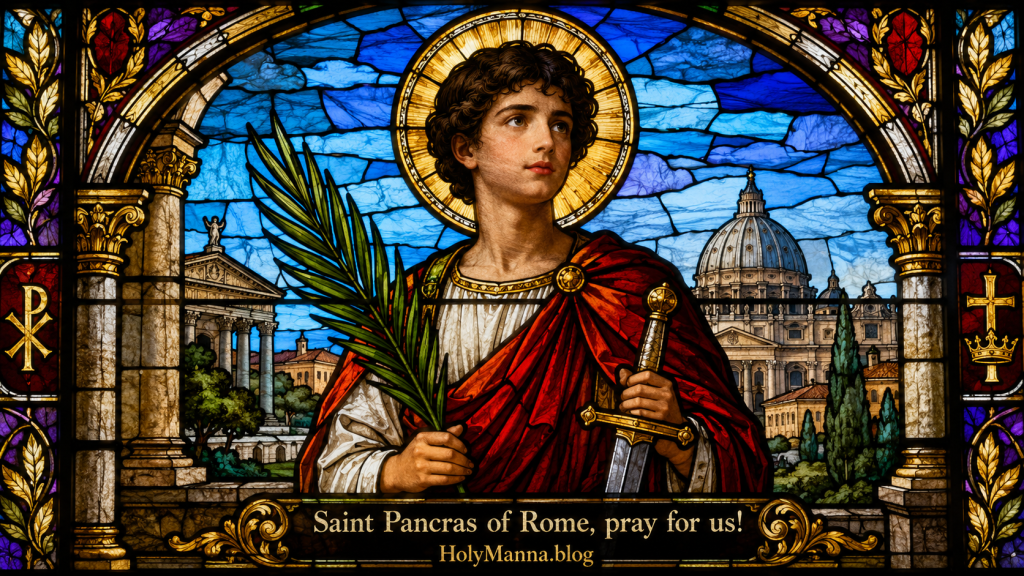
The Boy Who Stood Taller Than an Empire
Saint Pancras of Rome is one of those saints whose story feels almost too simple at first. He was young. He believed in Christ. He refused to worship false gods. He died.
And yet, that simple story has echoed through the Church for more than seventeen centuries.
Saint Pancras, also known as Saint Pancratius, San Pancrazio, or San Pancracio, was an early Christian martyr of Rome. Tradition says he was only about fourteen or fifteen years old when he was beheaded during the persecution of Emperor Diocletian around A.D. 304. The Church honors him on May 12, remembering him as a young witness who chose Christ over fear, social pressure, wealth, and even life itself.
He is especially known as a patron of children, young people, truthfulness, workers, those seeking employment, and those suffering from illness. In some Catholic cultures, especially in Spanish-speaking devotion, San Pancracio is beloved as an intercessor for work, health, and daily provision. Yet at the heart of his legacy is something even deeper. Saint Pancras is remembered as a martyr of truth.
The Catechism of the Catholic Church teaches, “Martyrdom is the supreme witness given to the truth of the faith: it means bearing witness even unto death.” (CCC 2473). Saint Pancras gave that witness while he was still a boy.
A Child of Phrygia Carried to the Heart of Rome
According to Catholic tradition, Pancras was born around A.D. 289 in Synnada, a city in Phrygia, in Asia Minor, which is modern-day Turkey. He came from a wealthy pagan family of Roman background. His life began with sorrow. Tradition says his mother died when he was born, and his father died while Pancras was still young.
After his father’s death, his uncle Dionysius became his guardian. Dionysius brought Pancras to Rome, where they are said to have settled on the Caelian Hill. Rome at that time was not simply the capital of an empire. It was a city full of idols, ambition, politics, danger, and hidden Christian communities trying to live faithfully under suspicion and persecution.
Somewhere in that world, Pancras and his uncle encountered Christians. They received the Gospel, became catechumens, and were baptized. Tradition also says Pancras received the Eucharist, which is a beautiful detail because it reminds Catholics that martyrdom does not come from human toughness alone. It comes from grace.
The boy who would soon stand before imperial power first knelt before Christ.
The Church teaches that Baptism makes us members of Christ’s Body, and the Eucharist strengthens us with Christ Himself. Saint Pancras’ courage was not merely the courage of a brave teenager. It was the courage of a soul claimed by Jesus.
Young in Years, Mature in Faith
Saint Pancras is most known for his youthful martyrdom. He was not a bishop, monk, theologian, or missionary. He did not leave behind sermons, letters, or spiritual writings. His witness was his life, and then his death.
The historical details of his biography are limited, and responsible Catholic tradition recognizes that some later accounts of his life are legendary. What is firmly remembered is that he was an early Roman martyr, that his tomb was venerated on the Via Aurelia, and that his feast was kept in Rome from ancient times.
A famous medieval legend places a bold statement on his lips before the emperor: “Though I am a child in body, my heart is old.” Another version says, “Although my appearance is that of a child, the heart in my chest is that of a mature man.” These words cannot be verified as historically authentic, but they beautifully express the way the Church has remembered him.
Pancras was young, but he was not spiritually childish. He understood something many adults spend a lifetime avoiding. If Christ is Lord, then no emperor, no crowd, no threat, and no offer of comfort can take His place.
That is why Saint Pancras still speaks powerfully today. He reminds young Catholics that holiness is not something reserved for later. It is not something to begin after college, after marriage, after getting the job, after becoming stable, or after life finally slows down. Holiness begins now.
No Known Miracles During Life, Yet a Miraculous Witness
There are no reliable accounts of miracles performed by Saint Pancras during his lifetime. Unlike some saints whose lives include healings, visions, exorcisms, or prophetic signs, Pancras is remembered mainly for his martyrdom.
That absence is worth noticing. Sometimes Catholics imagine holiness must look dramatic. Saint Pancras reminds the Church that the greatest miracle in a person’s life may be fidelity.
A teenage boy refused to betray Christ.
That was his miracle of grace.
He did not need to command nature, heal the sick, or preach before crowds to become a saint. His life became important because he chose truth when lying would have saved him. He chose worship when idolatry would have protected him. He chose Jesus when the empire demanded his soul.
The Catechism of the Catholic Church says that Christians are called to bear witness to the truth in word and deed. Saint Pancras did this in the most radical way. His life shows that holiness is not measured by age, education, reputation, or public influence. It is measured by love and fidelity.
The Emperor’s Threat and the Boy’s Crown
The traditional account places Saint Pancras’ martyrdom during the persecution of Diocletian, one of the fiercest persecutions in the early Church. Christians were pressured to offer sacrifice to the pagan gods. This was not just a private religious act. It was a public sign of loyalty to the empire.
For Christians, however, offering sacrifice to false gods meant denying the one true God.
Tradition says Pancras was arrested and brought before the authorities. Some later stories say Emperor Diocletian himself was impressed by the boy’s courage and tried to persuade him with promises of wealth, honor, and safety if he would simply burn incense to the gods. This scene is part of later hagiographical tradition and cannot be verified in every detail, especially because historians question whether Diocletian himself would have personally judged him in Rome at that time.
Even so, the spiritual meaning of the story is clear. Pancras was offered a bargain. Keep your life, but compromise your worship. Keep your comfort, but deny your Lord. Keep your place in the world, but lose your soul.
Pancras refused.
He was condemned to death and beheaded on the Via Aurelia, traditionally on May 12, around A.D. 304. The ancient memory of the Church places his burial near that road, and his tomb became a place of devotion.
The empire thought it had silenced a boy. Instead, it gave the Church a saint.
Octavilla and the Hidden Reverence of the Church
One of the tenderest traditions surrounding Saint Pancras concerns his burial. After his execution, a Roman matron named Octavilla, sometimes called Ottavilla, is said to have recovered his body and buried him with honor in a new tomb.
This story comes from Catholic tradition and is tied to the ancient cemetery later known as the Cemetery of Octavilla. While the details cannot all be verified with modern precision, the tradition beautifully reflects the early Church’s reverence for the bodies of the martyrs.
The world treated Pancras as a criminal. The Church treated him as a witness.
This is deeply Catholic. The body matters. The body is not a shell to be discarded. Christians honor the bodies of the saints because grace touched those bodies, because those bodies suffered for Christ, and because those bodies await the resurrection.
The tomb of Saint Pancras became a place of prayer. Eventually, a basilica rose in his honor on the Janiculum Hill near the Via Aurelia. Popes cared for and restored the shrine. Pilgrims came to pray near the resting place of the young martyr. His memory became part of Rome’s sacred geography.
The Avenger of Perjury and the Defender of Truth
After his death, Saint Pancras became especially associated with truthfulness. One of the most famous miracle traditions connected to him comes from Saint Gregory of Tours, who referred to Pancras as an avenger of perjury. According to the tradition, people who made false oaths before his relics were visibly punished by God.
This miracle tradition cannot be verified in the same way a modern canonization miracle would be investigated, but it became an important part of Saint Pancras’ devotional legacy. It makes spiritual sense. Pancras died because he refused to lie. He refused to make a false act of worship. He would not let his body say what his soul rejected.
That is why Catholics came to invoke him against perjury, false witnesses, and false testimony.
His witness is especially relevant in an age when truth is often treated as flexible. People are tempted to lie to protect their image, their career, their relationships, or their comfort. Saint Pancras reminds us that truth is not merely a personal preference. Truth belongs to God.
Jesus says in The Gospel of John, “I am the way and the truth and the life.” (John 14:6). Saint Pancras did not die for an idea. He died for a Person.
Healing, Pilgrimage, and the Living Memory of a Martyr
Saint Pancras’ tomb and basilica became associated with pilgrimage, prayer, and healing. Catholic tradition remembers that the area near his basilica and catacombs was once connected with a healing bath believed to have curative powers. Stories of healings and divine help became part of his devotional legacy, though many of these accounts cannot be verified with historical certainty.
Because he lived before the modern canonization process, Saint Pancras was not canonized through the later system of formal miracle investigations. His holiness was recognized through ancient martyr veneration, liturgical memory, relics, and the devotion of the faithful.
His relics and devotion spread beyond Rome. His name became known in Italy, France, Spain, and England. In England, devotion to Saint Pancras became especially important after the mission of Saint Augustine of Canterbury. Tradition says one of the early churches connected with that mission bore the name of Saint Pancras. Over time, his name became attached to places far beyond Rome, including the famous St Pancras area in London.
That is one of the surprising facts about him. A teenage martyr from the early Church still has his name spoken daily by travelers who may not even know they are saying the name of a saint.
San Pancracio and the Catholic Imagination
In Spanish-speaking Catholic devotion, San Pancracio is often loved as a patron of work, health, and practical needs. His image is sometimes found in homes, shops, restaurants, and businesses. In some places, devotees place parsley near his image as a popular custom while asking for employment, prosperity, or help in daily struggles.
This custom should not be understood as magic. Catholics do not worship saints, and no saint replaces God. Popular devotion is healthy only when it leads the heart back to Christ.
Still, there is something very Catholic about asking a young martyr to pray for ordinary needs. The communion of saints is not cold or distant. The saints are alive in Christ. The Catechism of the Catholic Church teaches, “Being more closely united to Christ, those who dwell in heaven fix the whole Church more firmly in holiness.” (CCC 956).
Saint Pancras is not a lucky charm. He is a brother in Christ. He is a young martyr who now intercedes before God, especially for those who are young, pressured, unemployed, sick, falsely accused, or tempted to compromise the truth.
The Lesson of a Fourteen-Year-Old Saint
Saint Pancras’ life teaches something simple and uncomfortable. Faith has to become real before the moment of testing.
When he was asked to sacrifice to false gods, Pancras did not have time to become holy on the spot. His heart had already been formed. Baptism had marked him. The Eucharist had strengthened him. The Christian community had taught him who he belonged to.
That is a lesson for every Catholic home, parish, school, and youth ministry. Young people do not need a watered-down faith. They need the real thing. They need the sacraments, the saints, reverence, truth, beauty, discipline, and the courage to stand apart from the crowd.
Saint Pancras also teaches adults not to underestimate the young. Grace can make a teenager stronger than an emperor. A young person who knows Christ can show a courage that embarrasses the comfortable and awakens the lukewarm.
Where is Christ asking for courage today?
Maybe it is in telling the truth when a lie would be easier. Maybe it is in refusing impurity when everyone else laughs it off. Maybe it is in staying faithful to Sunday Mass when schedules get busy. Maybe it is in refusing to make success, money, politics, popularity, or comfort into an idol.
Saint Pancras reminds us that the First Commandment is not theoretical. God alone is God.
A Young Martyr for a Compromising Age
The ancient world asked Pancras for one little act of compromise. Just offer incense. Just make the gesture. Just do what everyone else is doing. Just keep your faith private and your public life safe.
That temptation has not disappeared.
Modern Catholics are often asked to offer their own little pinches of incense. Laugh at what is impure. Stay silent when truth is mocked. Treat the faith as a hobby. Keep Christ out of public life. Bow to whatever idol the culture currently applauds.
Saint Pancras answers with the courage of a child and the heart of a martyr.
His life does not ask every Catholic to seek martyrdom. It asks every Catholic to be faithful. It asks parents to raise children who know Christ. It asks young people to believe that sainthood is possible now. It asks workers to trust God in practical needs. It asks anyone tempted to lie, flatter, compromise, or hide the faith to remember that truth is worth suffering for.
The world remembers power. The Church remembers witnesses.
And sometimes the witness is a boy on the Via Aurelia, standing before an empire with nothing but Christ, and finding that Christ is enough.
Engage with Us!
Share your thoughts and reflections in the comments below. Saint Pancras was young, but his witness was mature, courageous, and deeply rooted in love for Christ.
- What part of Saint Pancras’ story challenges you the most today?
- Where are you most tempted to compromise your faith in small ways?
- How can young Catholics today be encouraged to pursue holiness with courage and joy?
- Do you struggle more with fear of suffering or fear of standing out for the truth?
- What practical step can you take this week to live more honestly, faithfully, and courageously for Christ?
May Saint Pancras pray for us, especially for the young, the unemployed, the sick, and all who are pressured to compromise the truth. Let us live with courage, speak with honesty, and do everything with the love and mercy Jesus taught us.
Saint Pancras of Rome, pray for us!
Follow us on YouTube, Instagram and Facebook for more insights and reflections on living a faith-filled life.

 Holy Manna!
Leave a comment