Tuesday of the Sixth Week of Easter – Lectionary: 292
When the Prison Becomes a Place of Pentecost
Sometimes grace arrives in the very place where hope seems locked away.
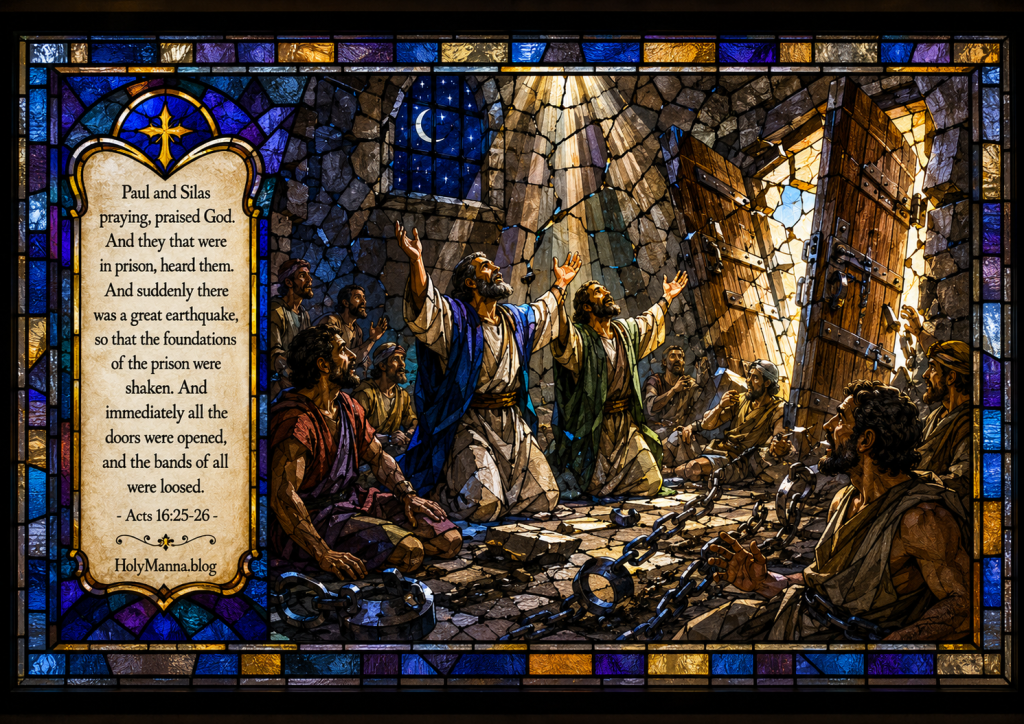
Today’s readings move through prison walls, midnight hymns, trembling fear, grateful praise, and the promise of the Holy Spirit. In Acts 16:22-34, Paul and Silas are beaten, chained, and thrown into the deepest part of the jail, yet their suffering becomes a living sermon. They pray and sing while the other prisoners listen, and when an earthquake opens the doors, they do not run. Instead, Paul saves the jailer from despair with the words, “Do no harm to yourself; we are all here.” Acts 16:28 That mercy opens the way for the jailer’s conversion, the preaching of the Word, and the Baptism of his whole household.
The Responsorial Psalm gives the interior music of this moment: “On the day I cried out, you answered; you strengthened my spirit.” Psalm 138:3 God does not abandon His servants in danger. He strengthens them from within, guards their lives, and completes the work of His hands. This is not shallow optimism. It is the faith of Israel, fulfilled in Christ, that God’s mercy endures even when enemies rage and darkness presses close.
Then, in John 16:5-11, Jesus prepares His disciples for His return to the Father. Grief fills their hearts, but He reveals that His departure will bring a greater gift: the Advocate, the Holy Spirit. The Catechism of the Catholic Church teaches that the Holy Spirit is the Paraclete, meaning the one “called to one’s side.” CCC 692 The same Spirit who strengthens the grieving apostles will later fill Paul and Silas with courage, convict the jailer’s heart, and lead a whole household into the waters of Baptism.
The central theme is this: the Holy Spirit turns suffering into witness, fear into faith, and imprisonment into new life. In the early Church, persecution did not stop the Gospel. It spread it. Roman prisons, public beatings, and social shame became unexpected stages for grace because Christ had already conquered the ruler of this world. The Christian story is never simply about escaping pain. It is about the Spirit of God entering pain and transforming it from the inside.
Where might the Holy Spirit be asking the soul to sing before the doors open?
First Reading – Acts 16:22-34
When midnight prayer turns a prison into a doorway of salvation
The scene in today’s First Reading takes place in Philippi, a Roman colony in Macedonia where Paul and Silas had been preaching the Gospel. Just before this passage, Paul had cast a spirit of divination out of a slave girl, which angered her owners because they had been making money from her condition. Their outrage quickly became public accusation, and the missionaries were dragged before the authorities.
This matters because Philippi was deeply shaped by Roman law, Roman pride, and Roman ideas of public order. Paul and Silas are not treated gently. They are stripped, beaten, and thrown into the deepest part of the prison. Yet the heart of the story is not the cruelty of the mob or the power of the magistrates. The heart of the story is the power of the Holy Spirit, who turns suffering into witness, fear into faith, and a prison cell into the beginning of a household’s salvation.
This reading fits beautifully with today’s theme. In John 16:5-11, Jesus promises the Advocate, the Holy Spirit, who will convict the world and strengthen the Church. In Acts 16, that promise is already alive. Paul and Silas suffer unjustly, but they do not collapse into bitterness. They pray, sing, stay, forgive, preach, and baptize. Their chains become the occasion for another man’s freedom.
Acts 16:22-34 – New American Bible (Revised Edition)
22 The crowd joined in the attack on them, and the magistrates had them stripped and ordered them to be beaten with rods. 23 After inflicting many blows on them, they threw them into prison and instructed the jailer to guard them securely. 24 When he received these instructions, he put them in the innermost cell and secured their feet to a stake.
Deliverance from Prison. 25 About midnight, while Paul and Silas were praying and singing hymns to God as the prisoners listened, 26 there was suddenly such a severe earthquake that the foundations of the jail shook; all the doors flew open, and the chains of all were pulled loose. 27 When the jailer woke up and saw the prison doors wide open, he drew [his] sword and was about to kill himself, thinking that the prisoners had escaped. 28 But Paul shouted out in a loud voice, “Do no harm to yourself; we are all here.” 29 He asked for a light and rushed in and, trembling with fear, he fell down before Paul and Silas. 30 Then he brought them out and said, “Sirs, what must I do to be saved?” 31 And they said, “Believe in the Lord Jesus and you and your household will be saved.” 32 So they spoke the word of the Lord to him and to everyone in his house. 33 He took them in at that hour of the night and bathed their wounds; then he and all his family were baptized at once. 34 He brought them up into his house and provided a meal and with his household rejoiced at having come to faith in God.
Detailed Exegesis
Verse 22 – “The crowd joined in the attack on them, and the magistrates had them stripped and ordered them to be beaten with rods.” Acts 16:22
This verse shows how quickly public emotion can become injustice. Paul and Silas are not given a careful hearing. The crowd joins the attack, and the magistrates respond with punishment. The beating with rods reflects Roman discipline, meant not only to hurt the body but also to shame the person publicly. For Christians, this moment echoes Christ Himself, who was also publicly humiliated and unjustly condemned. The apostles are beginning to share in the sufferings of the Lord they preach.
Verse 23 – “After inflicting many blows on them, they threw them into prison and instructed the jailer to guard them securely.” Acts 16:23
The phrase “many blows” reminds the reader that this was severe physical suffering. Paul and Silas are not merely inconvenienced. They are wounded, exhausted, and treated as dangerous criminals. The jailer is ordered to guard them securely, which means he has a serious responsibility under Roman authority. If prisoners escaped, the jailer could face harsh punishment, even death. This detail prepares us for his later terror when he thinks the prisoners have fled.
Verse 24 – “When he received these instructions, he put them in the innermost cell and secured their feet to a stake.” Acts 16:24
The innermost cell was the most secure and likely the darkest part of the prison. Their feet are fastened to a stake, which would have made movement painful, especially after a beating. Humanly speaking, Paul and Silas are trapped. Spiritually speaking, however, the prison is about to become a sanctuary. The world can restrict the body, but it cannot chain the grace of God.
Verse 25 – “About midnight, while Paul and Silas were praying and singing hymns to God as the prisoners listened.” Acts 16:25
This is one of the most beautiful images in Acts of the Apostles. At midnight, in pain and darkness, Paul and Silas pray and sing. They do not wait until they are comfortable to worship God. They worship Him while still suffering. The other prisoners listen, which means their prayer becomes evangelization. This is the witness of Christian joy. It is not fake cheerfulness. It is confidence that Christ is Lord even when circumstances are brutal.
Verse 26 – “There was suddenly such a severe earthquake that the foundations of the jail shook; all the doors flew open, and the chains of all were pulled loose.” Acts 16:26
The earthquake is a sign of divine intervention. In Scripture, earthquakes often accompany moments when God reveals His power. Here, the foundations shake, doors open, and chains fall away. Yet the miracle is not only physical deliverance. God is preparing a deeper deliverance, the salvation of the jailer and his household. The prison doors open, but the most important opening will happen in the human heart.
Verse 27 – “When the jailer woke up and saw the prison doors wide open, he drew [his] sword and was about to kill himself, thinking that the prisoners had escaped.” Acts 16:27
The jailer assumes the worst. If the prisoners have escaped, he believes his life is over. In a culture of honor, shame, military discipline, and severe Roman punishment, suicide appears to him as the only way out. This is a heartbreaking verse because it shows a man trapped in fear. The doors are open, but he is still imprisoned interiorly by despair.
Verse 28 – “But Paul shouted out in a loud voice, ‘Do no harm to yourself; we are all here.’” Acts 16:28
This is the turning point. Paul could have escaped. He could have seen the earthquake as his chance to flee. Instead, he stays and saves the jailer’s life. This is Christian mercy in action. Paul does not treat the jailer as an enemy, even though the jailer had secured him in the inner prison. Grace has made Paul free enough to love the man connected to his suffering. The sentence “Do no harm to yourself” is also deeply pastoral. The Gospel is life. It interrupts despair. It tells the soul not to surrender to darkness.
Verse 29 – “He asked for a light and rushed in and, trembling with fear, he fell down before Paul and Silas.” Acts 16:29
The jailer asks for light, and the detail is both physical and spiritual. He needs a lamp in the dark prison, but he also needs the light of Christ. He rushes in trembling because he has just encountered something beyond ordinary human behavior. Prisoners whose chains were broken did not run. Beaten men showed mercy. Something divine is present, and the jailer knows it.
Verse 30 – “Then he brought them out and said, ‘Sirs, what must I do to be saved?’” Acts 16:30
This question is the cry of the awakened soul. The jailer has moved from fear of punishment to desire for salvation. He does not ask first how the earthquake happened. He does not ask why they stayed. He asks the most important question a person can ask: “What must I do to be saved?” This is the beginning of conversion. Grace has shaken him awake.
Verse 31 – “And they said, ‘Believe in the Lord Jesus and you and your household will be saved.’” Acts 16:31
Paul and Silas give the central answer of apostolic preaching: salvation is found in Jesus Christ. Faith is not vague spirituality. It is belief in the Lord Jesus, the crucified and risen Son of God. The mention of the household is important because biblical faith often has a family and covenantal shape. Grace enters the home. The Gospel is not meant to remain private. It is meant to sanctify the whole household.
Verse 32 – “So they spoke the word of the Lord to him and to everyone in his house.” Acts 16:32
Faith comes through hearing the Word of God. Paul and Silas do not offer a slogan and leave. They teach. They proclaim Christ to the jailer and his household. This shows the Catholic harmony between faith and instruction. The jailer’s conversion is sincere, but it is also formed by the Word. The Church still follows this pattern by preaching, catechesis, and sacramental preparation.
Verse 33 – “He took them in at that hour of the night and bathed their wounds; then he and all his family were baptized at once.” Acts 16:33
This verse beautifully joins mercy and sacrament. The jailer bathes the wounds of Paul and Silas, and then he and his family are washed in Baptism. Charity flows from faith, and Baptism seals the beginning of new life in Christ. The same man who once guarded their wounded bodies now tends them with compassion. Conversion changes how a person treats others.
Verse 34 – “He brought them up into his house and provided a meal and with his household rejoiced at having come to faith in God.” Acts 16:34
The story ends in the home, around a meal, with joy. This is a complete reversal. The night began with violence, chains, and fear. It ends with hospitality, Baptism, and rejoicing. The jailer’s house becomes a little image of the Church, a place where the Word is received, wounds are cared for, water brings new birth, and believers rejoice together in God.
The Church’s Wisdom: Teachings
This reading is a powerful picture of Christian witness under pressure. Paul and Silas do not merely preach Christ when it is safe. They reveal Christ when they are bleeding. This is why the saints often saw suffering as a place where the Gospel becomes visible. Saint John Chrysostom, reflecting on this passage, admired the way Paul and Silas prayed at midnight and how their mercy toward the jailer became more convincing than their escape would have been. Their freedom was not proven by leaving the prison. Their freedom was proven by love.
The Catechism of the Catholic Church teaches that the Holy Spirit is the one Jesus promised as Advocate. This helps explain the supernatural courage in Paul and Silas. The Church teaches, “When he proclaims and promises the coming of the Holy Spirit, Jesus calls him the ‘Paraclete,’ literally, ‘he who is called to one’s side,’ advocatus. ‘Paraclete’ is commonly translated by ‘consoler,’ and Jesus is the first consoler. The Lord also called the Holy Spirit ‘the Spirit of truth.’” CCC 692
That is exactly what the Holy Spirit does in this passage. He stands beside Paul and Silas in the prison. He consoles them without removing their wounds immediately. He gives them truth, courage, and charity. The Advocate turns them into advocates for the jailer’s life.
This passage also reveals the beauty of Baptism. The jailer asks about salvation, hears the Word of the Lord, believes in Jesus, and is baptized with his household. The Catechism teaches, “The different effects of Baptism are signified by the perceptible elements of the sacramental rite. Immersion in water symbolizes not only death and purification, but also regeneration and renewal. Thus the two principal effects are purification from sins and new birth in the Holy Spirit.” CCC 1262
The jailer’s night becomes a baptismal night. He is moved from fear to faith, from despair to life, from being a prison guard to becoming a brother in Christ. His household also receives the gift of Baptism, which fits the apostolic pattern of grace entering entire homes. The Catechism explains, “The practice of infant Baptism is an immemorial tradition of the Church. There is explicit testimony to this practice from the second century on, and it is quite possible that, from the beginning of the apostolic preaching, when whole ‘households’ received baptism, infants may also have been baptized.” CCC 1252
The reading also reveals that faith must become charity. The jailer does not simply say he believes. He washes wounds. He opens his home. He provides food. He rejoices with his household. This reflects the Catholic truth that saving faith is living faith, formed by love. As The Letter of James says, “So also faith of itself, if it does not have works, is dead.” James 2:17
Historically, this passage also shows the astonishing courage of the early Church in the Roman world. Christians did not conquer the empire by political force. They conquered hearts through worship, truth, mercy, martyrdom, Baptism, and joy. The prison in Philippi becomes a small preview of how the Gospel would spread across the world. The world could beat the apostles, but it could not silence the Word of God.
The Midnight Invitation: Reflection
This reading speaks directly to ordinary Christian life because every person eventually finds himself in some kind of midnight. Sometimes the prison is grief. Sometimes it is anxiety. Sometimes it is a wound from the past, a family struggle, financial pressure, temptation, or loneliness. Paul and Silas show that the first Christian response is not panic. It is prayer.
Their hymn in the prison is not denial. Their backs are still wounded. Their feet are still fastened. Their future is still uncertain. Yet they choose to place God at the center of the darkness. That is a practical lesson for daily life. When the heart feels trapped, begin with prayer before reaction. Speak to God before speaking from fear. Let worship become the first act of resistance against despair.
This reading also invites Christians to notice who may be listening. The prisoners listened as Paul and Silas sang. People notice how Catholics suffer, forgive, speak, work, and respond under pressure. A faithful response during hardship may become the very witness someone else needs in order to believe.
The mercy of Paul is another daily challenge. When the doors open, he does not run. He sees a desperate man and saves him. That is mature Christian freedom. Real freedom is not simply doing whatever benefits oneself. Real freedom is being able to love when selfishness would be easier. In a culture that often encourages resentment, Paul shows a better way. He protects the life of the man who had guarded him.
This reading also asks families to take conversion seriously. The jailer brings the Word into his home, and his household is baptized. Catholic homes are meant to become places where Christ is welcomed, Scripture is heard, wounds are tended, meals are shared, and joy is restored. The domestic church begins when faith stops being only a Sunday habit and becomes the atmosphere of the home.
Where is the Lord asking you to pray before the doors open?
Who might be listening to your witness while you are still carrying your wounds?
Is there someone in your life who needs mercy more than punishment?
How can your home become more like the jailer’s house, a place of faith, healing, hospitality, and joy?
The good news of this reading is that Christ does not wait for perfect circumstances to save. He works at midnight. He works in prison cells. He works through wounded disciples. He works through trembling questions. He works through Baptism, mercy, and the quiet courage of those who keep singing when the world expects them to give up.
Responsorial Psalm – Psalm 138:1-3, 7-8
The grateful heart that keeps singing in the middle of danger
The Responsorial Psalm gives the heart a language for everything happening in today’s readings. In the First Reading, Paul and Silas pray and sing hymns at midnight while their feet are fastened in prison. In the Gospel, Jesus promises the Advocate, the Holy Spirit, who will come to strengthen His disciples after grief has filled their hearts. Between those two moments, Psalm 138 rises like the prayer of a soul that has been rescued before and trusts that God will be faithful again.
Traditionally attributed to David, this psalm is a hymn of thanksgiving. It is not the prayer of someone living in easy comfort. It is the prayer of someone who has cried out, walked through danger, faced enemies, and still discovered that the Lord answers, strengthens, protects, and saves. That makes it a perfect response to Acts 16. Paul and Silas do not wait for the earthquake before praising God. Their praise is already their freedom.
This psalm also carries a deeply liturgical feel. The psalmist bows toward the holy temple, sings before the heavenly court, and gives thanks with his whole heart. For Catholics, this points naturally toward the worship of the Church, where earthly prayer joins the praise of the angels and saints. The Christian does not praise God because life is painless. The Christian praises God because His mercy endures forever, even in the middle of danger.
Psalm 138:1-3, 7-8 – New American Bible (Revised Edition)
Hymn of a Grateful Heart
1 Of David.
I thank you, Lord, with all my heart;
in the presence of the angels to you I sing.
2 I bow low toward your holy temple;
I praise your name for your mercy and faithfulness.
For you have exalted over all
your name and your promise.
3 On the day I cried out, you answered;
you strengthened my spirit.7 Though I walk in the midst of dangers,
you guard my life when my enemies rage.
You stretch out your hand;
your right hand saves me.
8 The Lord is with me to the end.
Lord, your mercy endures forever.
Never forsake the work of your hands!
Detailed Exegesis
Verse 1 – “I thank you, Lord, with all my heart; in the presence of the angels to you I sing.” Psalm 138:1
The psalm begins with wholehearted gratitude. The phrase “with all my heart” matters because biblical worship is never meant to be merely external. God wants the whole person: mind, will, memory, body, and desire. The psalmist sings “in the presence of the angels,” reminding the faithful that worship is bigger than what the eye can see. Every act of true prayer participates in a heavenly reality. At Mass, the Church still enters this mystery when she joins the angels in the Sanctus, singing “Holy, holy, holy Lord God of hosts.” The soul that praises God is never alone.
Verse 2 – “I bow low toward your holy temple; I praise your name for your mercy and faithfulness. For you have exalted over all your name and your promise.” Psalm 138:2
The psalmist bows toward the holy temple because the temple was the sacred place of God’s presence among His people. For Israel, the temple was not just a building. It was the place of sacrifice, prayer, covenant memory, and divine worship. The psalmist praises God for two great covenant words: mercy and faithfulness. God does not merely feel compassion. He keeps His promises. In today’s First Reading, Paul and Silas are living proof that God’s name and promise are trustworthy. Even when human authorities act unjustly, the Lord remains faithful.
Verse 3 – “On the day I cried out, you answered; you strengthened my spirit.” Psalm 138:3
This verse is the heartbeat of the psalm. The Lord answers the cry of His servant, but notice how He answers. The psalm does not first say, “You removed every danger.” It says, “You strengthened my spirit.” This is one of the great truths of Catholic spirituality. God may deliver His people from suffering, but He also strengthens them within suffering. Paul and Silas are not spared the rods or the prison, but they are strengthened to pray, sing, stay, forgive, and evangelize. The Lord’s grace does not always begin by changing the circumstance. Often, it begins by strengthening the soul.
Verse 7 – “Though I walk in the midst of dangers, you guard my life when my enemies rage. You stretch out your hand; your right hand saves me.” Psalm 138:7
The psalmist does not pretend danger is imaginary. He says plainly that he walks “in the midst of dangers.” This is mature faith. It does not deny hardship, enemies, fear, or pain. It confesses that God guards life even there. The image of God stretching out His hand and saving by His right hand recalls the mighty deeds of the Lord throughout salvation history, especially the Exodus. God’s right hand symbolizes power, victory, and protection. In today’s readings, that saving hand is seen in the prison earthquake, but even more deeply in the mercy that prevents the jailer’s death and leads his household to Baptism.
Verse 8 – “The Lord is with me to the end. Lord, your mercy endures forever. Never forsake the work of your hands!” Psalm 138:8
This final verse is both confidence and petition. The psalmist trusts that the Lord is faithful “to the end,” yet he still prays, “Never forsake the work of your hands!” That is a beautiful image of the human person. Every soul is the work of God’s hands. The Lord creates, sustains, redeems, and sanctifies. This verse fits perfectly with the Gospel promise of the Advocate. Jesus does not leave His disciples orphaned. The Holy Spirit comes to remain with the Church, to guard her, strengthen her, and bring God’s work to completion.
The Church’s Wisdom: Teachings
The psalm teaches the Catholic heart how to pray with gratitude in every season. Thanksgiving is not reserved for comfortable days. It belongs even to midnight, even to danger, even to the places where the soul is still waiting for deliverance. This is why Paul and Silas can sing in prison. They are not ignoring pain. They are worshiping the God whose mercy is greater than pain.
The Catechism of the Catholic Church teaches that Christian prayer is not merely human effort. It is a living relationship with God, made possible by grace. The Church teaches, “Christian prayer is a covenant relationship between God and man in Christ. It is the action of God and of man, springing forth from both the Holy Spirit and ourselves, wholly directed to the Father, in union with the human will of the Son of God made man.” CCC 2564
That teaching helps explain this psalm. The psalmist cries out, sings, bows, and gives thanks, but God is also acting. God answers. God strengthens. God guards. God saves. Prayer is never a lonely monologue. It is covenant communion with the living God.
The Catechism also connects thanksgiving with the entire life of the Church. It teaches, “Thanksgiving characterizes the prayer of the Church which, in celebrating the Eucharist, reveals and becomes more fully what she is. Indeed, in the work of salvation, Christ sets creation free from sin and death to consecrate it anew and make it return to the Father, for his glory. The thanksgiving of the members of the Body participates in that of their Head.” CCC 2637
This is especially important because the word Eucharist itself means thanksgiving. Every Mass is the Church’s great prayer of gratitude to the Father through the Son in the Holy Spirit. When the psalmist says, “I thank you, Lord, with all my heart,” the Catholic soul can hear an echo of the Eucharistic life. The Church gathers not because everything is easy, but because Christ has died, Christ is risen, and Christ will come again.
The psalm also reveals God’s providence. The Lord does not create and then abandon. He remains faithful to the work of His hands. The Catechism teaches, “With creation, God does not abandon his creatures to themselves. He not only gives them being and existence, but also, and at every moment, upholds and sustains them in being, enables them to act and brings them to their final end.” CCC 301
That is the God praised in Psalm 138. He is not distant from the prisoner, the frightened jailer, the grieving disciple, or the person quietly carrying a burden no one else sees. He upholds. He sustains. He strengthens the spirit. He brings His work to completion.
Saint Augustine often understood the Psalms as the prayer of Christ and His Body, the Church. This helps Catholics read Psalm 138 not only as David’s prayer, but also as the prayer of the whole Church in Christ. When one member cries out, the Body prays. When one member gives thanks, the Body rejoices. When one member walks in danger, Christ remains near.
The Prayer That Strengthens the Soul: Reflection
This psalm is a school of gratitude for real life. It does not ask the faithful to pretend everything is fine. It teaches the faithful to thank God while still walking through danger. That is the kind of gratitude that matures a soul. It is easy to thank God when doors are open, bills are paid, relationships are peaceful, and prayers are answered quickly. It is much harder, and much holier, to say with trust, “On the day I cried out, you answered; you strengthened my spirit.” Psalm 138:3
This reading invites a simple but powerful daily practice. Begin prayer by remembering God’s past faithfulness. Before asking for help, recall where He has already answered, protected, forgiven, provided, or strengthened. Gratitude gives the soul courage because it reminds the heart that God has been faithful before and will be faithful again.
The psalm also invites Catholics to worship with the whole heart. It is possible to show up to prayer while the heart is scattered across worries, plans, resentments, and distractions. The psalmist teaches a better way. Bring the whole heart to God, even if that heart is tired. Bring the fear. Bring the gratitude. Bring the wounds. Bring the questions. The Lord can strengthen what is honestly surrendered.
This psalm also speaks to anyone who feels unfinished. The prayer “Never forsake the work of your hands” is deeply consoling. God is still at work. The soul is not a failed project. The family is not beyond grace. The hidden struggle is not outside His mercy. The same Lord who strengthened Paul and Silas in prison can strengthen ordinary Catholics in offices, kitchens, hospital rooms, classrooms, cars, confession lines, and quiet bedrooms where tears have become prayer.
Where has God already answered a cry from your heart?
What danger are you walking through right now, and how might God be strengthening your spirit within it?
Do you praise God only after the earthquake, or are you learning to sing at midnight?
What would change this week if gratitude became the first movement of your prayer instead of the last?
The promise of Psalm 138 is not that the faithful will never walk through danger. The promise is better and deeper. The Lord walks with His people to the end. His mercy endures forever. He does not forsake the work of His hands.
Holy Gospel – John 16:5-11
The Advocate comes when grief feels like the end of the story
The Holy Gospel takes us into the Upper Room, into the solemn tenderness of Jesus’ Farewell Discourse. The Passion is near. Judas has already set betrayal in motion. The disciples can sense that something terrible is coming, but they do not yet understand that the Cross will become the throne of victory and that the Resurrection will open the way for the gift of the Holy Spirit.
Jesus speaks to men whose hearts are heavy. They have followed Him, eaten with Him, watched Him heal, listened to His words, and left their former lives behind. Now He tells them He is going to the Father. To them, it sounds like abandonment. To Jesus, it is the beginning of a greater intimacy.
This Gospel explains the hidden power behind today’s First Reading. Paul and Silas can sing in prison because the Advocate has come. They can show mercy to the jailer because the Spirit has made them free. They can preach salvation and baptize a whole household because Jesus has gone to the Father and poured out the Holy Spirit upon His Church. The central theme remains clear: the Holy Spirit turns grief into courage, exposes the false judgment of the world, and leads souls into the saving truth of Jesus Christ.
John 16:5-11 – New American Bible (Revised Edition)
5 But now I am going to the one who sent me, and not one of you asks me, ‘Where are you going?’ 6 But because I told you this, grief has filled your hearts. 7 But I tell you the truth, it is better for you that I go. For if I do not go, the Advocate will not come to you. But if I go, I will send him to you. 8 And when he comes he will convict the world in regard to sin and righteousness and condemnation: 9 sin, because they do not believe in me; 10 righteousness, because I am going to the Father and you will no longer see me; 11 condemnation, because the ruler of this world has been condemned.
Detailed Exegesis
Verse 5 – “But now I am going to the one who sent me, and not one of you asks me, ‘Where are you going?’” John 16:5
Jesus begins by pointing to His return to the Father. He is not wandering into tragedy. He is going to the One who sent Him. His mission comes from the Father and returns to the Father. The disciples, however, are overwhelmed by sorrow and confusion. Earlier, Peter had asked where Jesus was going, but here Jesus reveals something deeper. They are not asking with trust, wonder, or spiritual understanding. Their grief has turned them inward. They are focused on what His departure will cost them, not yet on what His glorification will accomplish for the world.
Verse 6 – “But because I told you this, grief has filled your hearts.” John 16:6
Jesus does not shame the disciples for their sorrow. He names it. Their hearts are full of grief because they love Him, but their love is not yet purified by Easter faith. This is a deeply human moment. The disciples are not cold religious professionals. They are wounded friends who cannot imagine life without the visible presence of their Master. In the Catholic life, grief is not treated as a lack of faith. It becomes a place where faith must grow deeper. Jesus enters their grief and begins teaching them that His apparent absence will become a new mode of presence through the Holy Spirit.
Verse 7 – “But I tell you the truth, it is better for you that I go. For if I do not go, the Advocate will not come to you. But if I go, I will send him to you.” John 16:7
This verse is one of the great mysteries of the Gospel. Jesus says it is better that He go. The disciples could hardly have believed this in the moment. How could it be better for Jesus to leave their sight? Yet His departure is not abandonment. Through His Passion, Resurrection, and Ascension, Jesus opens the way for the sending of the Holy Spirit. The Advocate will not merely stand beside them externally. He will dwell within the Church and within the souls of the baptized. The same Christ who walked beside them in Galilee will now be present sacramentally, spiritually, and ecclesially through the Holy Spirit.
Verse 8 – “And when he comes he will convict the world in regard to sin and righteousness and condemnation.” John 16:8
The word “convict” has a courtroom sense. The Holy Spirit reveals the truth and exposes falsehood. In The Gospel of John, the “world” often refers not to creation itself, which God made good, but to fallen humanity organized in resistance to God. The Holy Spirit comes as divine witness. He shows that the world misjudged Jesus, misunderstood sin, rejected true righteousness, and followed a ruler already defeated. This work of conviction is not merely accusation. It is also mercy, because sin must be exposed before it can be healed.
Verse 9 – “Sin, because they do not believe in me.” John 16:9
Jesus identifies the deepest sin as unbelief in Him. This does not mean other sins are unimportant. It means that refusal of Christ is the root tragedy because He is the Savior sent by the Father. To reject Him is to reject the light, mercy, truth, and life God offers. In today’s First Reading, the jailer moves in the opposite direction. He asks, “What must I do to be saved?” Acts 16:30 Paul and Silas answer by pointing him to faith in the Lord Jesus. The Spirit convicts the world of unbelief so that hearts may be moved toward faith.
Verse 10 – “Righteousness, because I am going to the Father and you will no longer see me.” John 16:10
The world will condemn Jesus as a criminal, but the Father will reveal Him as righteous by raising Him from the dead and receiving Him in glory. His return to the Father is the divine vindication of His mission. The disciples will no longer see Him in the same earthly way, but His Ascension is not defeat. It is enthronement. The Holy Spirit teaches the Church to see rightly. What looked like shame was glory. What looked like failure was victory. What looked like absence becomes a deeper presence through grace.
Verse 11 – “Condemnation, because the ruler of this world has been condemned.” John 16:11
The ruler of this world is Satan, the evil one who deceives, accuses, enslaves, and opposes the Kingdom of God. Jesus announces that this ruler has already been condemned. The Cross is not Satan’s triumph. It is his defeat. This is why Paul and Silas can remain free while chained. This is why the jailer can be rescued from despair. This is why the Church can keep preaching under persecution. Evil still rages, but its sentence has been pronounced. Christ has conquered.
The Church’s Wisdom: Teachings
This Gospel is one of the clearest passages on the mission of the Holy Spirit. Jesus calls Him the Advocate, the divine Paraclete, the One sent to stand beside the Church and bear witness to Christ. The Catechism of the Catholic Church teaches, “When he proclaims and promises the coming of the Holy Spirit, Jesus calls him the ‘Paraclete,’ literally, ‘he who is called to one’s side,’ advocatus. ‘Paraclete’ is commonly translated by ‘consoler,’ and Jesus is the first consoler. The Lord also called the Holy Spirit ‘the Spirit of truth.’” CCC 692
This is the Spirit at work in the disciples’ grief. He does not erase the Cross from Christian life. He teaches the Church how to understand it. He consoles, strengthens, defends, convicts, and leads believers into the truth of Christ.
The Catechism also places this promise within the saving work of Jesus’ Passion, Resurrection, and glorification. It teaches, “Only when the hour has arrived for his glorification does Jesus promise the coming of the Holy Spirit, since his Death and Resurrection will fulfill the promise made to the fathers. The Spirit of truth, the other Paraclete, will be given by the Father in answer to Jesus’ prayer; he will be sent by the Father in Jesus’ name; and Jesus will send him from the Father’s side, since he comes from the Father. The Holy Spirit will come and we shall know him; he will be with us forever; he will remain with us. The Spirit will teach us everything, remind us of all that Christ said to us and bear witness to him. He will lead us into all truth and will glorify Christ. He will prove the world wrong about sin, righteousness, and judgment.” CCC 729
That final line directly echoes today’s Gospel. The Holy Spirit proves the world wrong. The world thought Jesus was defeated. The Spirit reveals Him as Lord. The world thought the Cross was shame. The Spirit reveals it as saving love. The world thought persecution could silence the Church. The Spirit makes martyrs, missionaries, saints, and confessors.
The Gospel also teaches Catholics how to understand sin. Sin is not merely rule-breaking. It is a refusal of God’s love and truth. The Catechism teaches, “Sin is an offense against reason, truth, and right conscience; it is failure in genuine love for God and neighbor caused by a perverse attachment to certain goods. It wounds the nature of man and injures human solidarity. It has been defined as ‘an utterance, a deed, or a desire contrary to the eternal law.’” CCC 1849
This is why the Spirit convicts. He exposes sin not to crush the soul, but to bring it to conversion. The jailer in Acts 16 is a living example. Fear brings him to the edge of death, but grace brings him to the question of salvation. The Spirit moves him from darkness to faith, from despair to Baptism, from self-destruction to joy.
The Lord’s words about the ruler of this world also belong to the heart of Catholic faith. The Catechism teaches, “The victory over the ‘prince of this world’ was won once for all at the Hour when Jesus freely gave himself up to death to give us his life.” CCC 2853
This matters for ordinary believers. Satan is real, temptation is real, and spiritual battle is real, but Christ’s victory is more real. The Christian does not fight for victory as if the outcome were uncertain. The Christian fights from the victory of Christ, strengthened by the Holy Spirit, nourished by the Sacraments, and guarded by the Church.
Saint Augustine, reflecting on the Holy Spirit’s work in this passage, saw that the Spirit convicts the world through the witness of the Church. The disciples were once afraid, but after receiving the Holy Spirit, they preached Christ boldly. This is exactly what unfolds in Acts of the Apostles. The same apostles who scattered in fear become witnesses who rejoice to suffer for the name of Jesus. The Advocate turns frightened disciples into courageous saints.
The Spirit Who Teaches the Heart to Stand: Reflection
This Gospel speaks to anyone who has ever felt confused by God’s timing. The disciples hear Jesus say that He is going away, and grief fills their hearts. They cannot yet see Pentecost. They cannot yet see the courage that will come. They cannot yet see prison hymns, missionary journeys, household baptisms, martyrs, monasteries, cathedrals, confessionals, and ordinary Catholic homes where the Holy Spirit will keep forming saints.
That is often how grace works. God may be doing something larger than the soul can understand in the moment. What feels like loss may become deeper communion. What feels like silence may become an invitation to listen differently. What feels like absence may become the place where the Holy Spirit teaches trust.
This Gospel invites Catholics to ask for the Advocate daily. Before reacting out of grief, ask the Holy Spirit for wisdom. Before speaking in anger, ask the Holy Spirit for restraint. Before making a major decision, ask the Holy Spirit for counsel. Before giving in to discouragement, ask the Holy Spirit to reveal the truth of Christ’s victory.
The Spirit also convicts, and that is a mercy. A faithful Catholic should not be afraid of conviction. The Holy Spirit may reveal unbelief, hidden pride, resentment, impurity, lukewarmness, cowardice, or attachment to comfort. That conviction is not condemnation for the repentant soul. It is the beginning of healing. The same Spirit who exposes the wound also brings the medicine of grace through Confession, prayer, Scripture, the Eucharist, and works of charity.
This Gospel also challenges believers to see the world rightly. The world often calls evil good and good evil. It praises power, comfort, self-invention, and public approval. The Holy Spirit teaches the Church to judge according to Christ. True righteousness is not found in applause. It is found in union with the Son who goes to the Father through the Cross.
Where has grief filled your heart so much that it has become hard to ask Jesus where He is leading you?
Do you invite the Holy Spirit into your decisions, temptations, conversations, and wounds, or do you usually try to handle them alone?
What sin might the Advocate be lovingly exposing so that Christ can heal it?
Where do you need to remember that the ruler of this world has already been condemned?
The promise of this Gospel is not that disciples will never feel sorrow. The promise is that sorrow will not have the final word. Jesus goes to the Father. The Advocate comes to the Church. Sin is exposed. Righteousness is revealed. The evil one is judged. And the faithful are strengthened to sing, witness, forgive, and rejoice, even when the night feels long.
The Door Is Open, and the Spirit Is Calling
Today’s readings begin in a prison and end with a promise. Paul and Silas are beaten, chained, and locked away, yet midnight finds them praying and singing hymns to God. The jailer sees open doors and thinks only of death, but Paul cries out with mercy: “Do no harm to yourself; we are all here.” Acts 16:28 That single act of Christian love becomes the doorway to faith, Baptism, hospitality, and joy.
The Psalm gives words to the miracle happening beneath the surface: “On the day I cried out, you answered; you strengthened my spirit.” Psalm 138:3 God does not always begin by removing the danger. Sometimes He begins by strengthening the heart inside the danger. He guards His people, stretches out His saving hand, and refuses to forsake the work of His hands.
Then Jesus reveals the source of this courage in the Gospel. He tells His grieving disciples that His return to the Father will bring the Advocate, the Holy Spirit. The Catechism of the Catholic Church teaches that the Holy Spirit is the Paraclete, the one “called to one’s side.” CCC 692 He is the divine Consoler who strengthens the Church, convicts the world, exposes sin, reveals the righteousness of Christ, and reminds the faithful that the ruler of this world has already been condemned.
Together, these readings tell one beautiful story: the Holy Spirit turns locked places into places of grace. He turns suffering into witness, fear into conversion, prayer into strength, and homes into little churches filled with faith. The prison in Philippi did not have the final word. The crowd did not have the final word. The chains did not have the final word. Christ did.
The invitation today is simple and serious. Pray before the doors open. Sing before the answer comes. Choose mercy when resentment would be easier. Bring faith into the home. Let the Holy Spirit convict what needs healing, strengthen what feels weak, and lead the soul deeper into Jesus Christ.
Where is God asking you to trust Him before the earthquake comes?
Who needs to encounter Christ through your patience, mercy, or quiet courage today?
What part of your heart needs the Advocate to enter, strengthen, and set free?
The Lord is still with His people to the end. His mercy still endures forever. He has not abandoned the work of His hands. So today, let the heart open the door, welcome the Holy Spirit, and rejoice again in the saving love of God.
Engage with Us!
Share your reflections in the comments below. Today’s readings are rich with hope, courage, conversion, and the quiet power of the Holy Spirit working in places that look hopeless.
- First Reading, Acts 16:22-34: Where is God asking you to pray and remain faithful before the prison doors open? How might your patience, mercy, or courage become a witness to someone who is quietly watching your life?
- Responsorial Psalm, Psalm 138:1-3, 7-8: When has the Lord strengthened your spirit in the middle of danger, uncertainty, or suffering? How can gratitude become a more regular part of your prayer life this week?
- Holy Gospel, John 16:5-11: Where do you need the Advocate, the Holy Spirit, to convict, console, and guide your heart today? What fear, sin, or sorrow needs to be brought honestly before Christ?
May these readings inspire a deeper trust in the Lord, especially when life feels dark, uncertain, or locked shut. Live today with faith, speak with mercy, pray with courage, and do everything with the love and compassion Jesus taught His disciples.
Sacred Heart of Jesus, we trust in You!
Immaculate Heart of Mary, pray for us!
Saint Michael the Archangel, defend us in battle!
Follow us on YouTube, Instagram and Facebook for more insights and reflections on living a faith-filled life.


Leave a comment