The Bishop Who Taught a Frightened City to Pray
Saint Mamertus of Vienne was a fifth-century bishop in Gaul, in what is now France, and he is remembered as one of those quiet but powerful saints whose influence still echoes through Catholic tradition. He was not a martyr, a king, or a famous desert monk. He was a shepherd of souls in a city shaken by fear.
His world was unstable. The Roman Empire in the West was collapsing. Cities were vulnerable. The people of Gaul knew war, famine, fires, earthquakes, crop failures, and uncertainty. Into that anxious world, Saint Mamertus gave the Church a deeply Catholic response: prayer, fasting, processions, litanies, and trust in God.
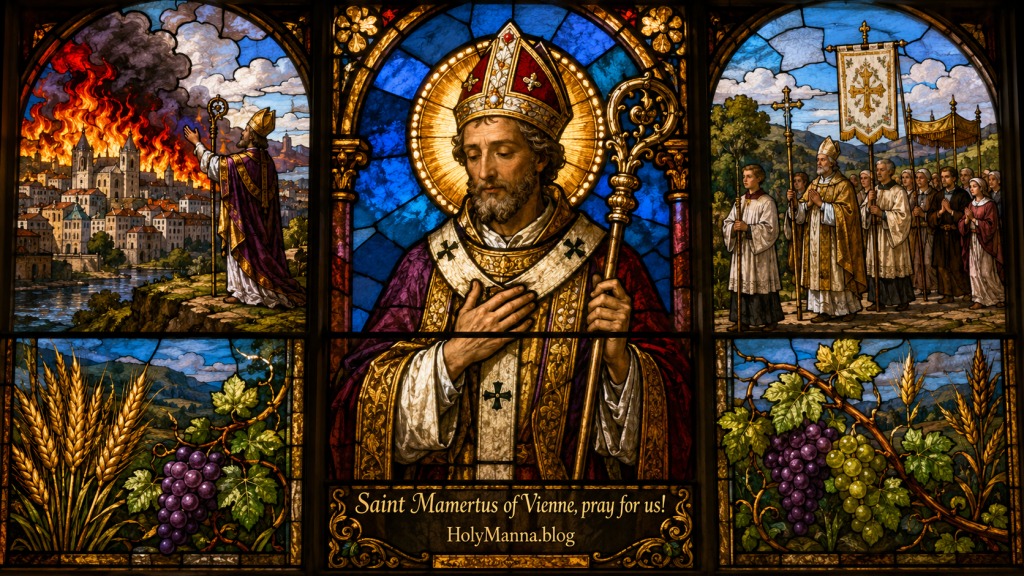
He is most known for instituting the Minor Rogation Days, the three days of penitential prayer before the Ascension of the Lord. These days were marked by public processions, the Litany of the Saints, fasting, and prayers asking God for mercy, protection from calamities, and blessings upon the harvest.
Saint Mamertus reminds the Church that when the world trembles, Catholics do not simply panic. They pray. They repent. They process together. They ask God for mercy.
A Son of Christian Gaul
Very little is known with certainty about the early life of Saint Mamertus. He was likely born into a learned Gallo-Roman family, probably somewhere in the region of Lyons or Vienne. His family appears to have been educated and socially respected, which helps explain the learning and culture seen in both Mamertus and his younger brother, Claudianus Mamertus.
Claudianus became a priest, theologian, and writer, and Catholic tradition remembers him as a man of impressive learning. Saint Mamertus eventually called his brother out of the cloister and ordained him a priest of Vienne, where Claudianus helped him in the service of the Church.
Some Catholic sources also suggest that Mamertus may have been married before becoming bishop. That detail can surprise modern readers, but in the early centuries of the Church, the discipline surrounding clerical celibacy developed over time and was lived in ways that differed from later centuries. What matters most is that Mamertus gave his life fully to Christ and His Church.
By around A.D. 461 or 462, Mamertus had become Bishop of Vienne. This was not an easy assignment. Vienne was an ancient and important city, but it was also part of a world in transition. The old Roman order was weakening, Christian communities were facing instability, and bishops often had to serve not only as spiritual fathers, but also as defenders, organizers, teachers, and sources of hope for frightened people.
Saint Mamertus became known as a learned bishop, a defender of Catholic life, a pastor of courage, and a man who believed deeply that public suffering should lead Christians back to God.
A Bishop Corrected, and a Saint Who Obeyed
One of the most human details in the life of Saint Mamertus is that he was corrected by the pope.
Around A.D. 463, Mamertus consecrated a bishop for the Diocese of Die. The problem was that this action interfered with the ecclesiastical rights of Arles, which had authority in that region. The matter was brought to Pope Saint Hilary, who judged against Mamertus and warned him seriously about his actions.
This could be an uncomfortable detail if holiness were misunderstood as never needing correction. But Catholic sanctity is not the same thing as flawless administration. Saints are not holy because they never make mistakes. They are holy because they surrender to grace, seek Christ, and remain faithful within the Church.
Mamertus appears to have submitted to the pope’s correction, and no lasting rebellion is recorded. That detail matters. He was a strong bishop, but he was not his own pope. His life reminds Catholics that zeal must be joined to obedience.
The Catechism of the Catholic Church teaches that bishops exercise their ministry in communion with the pope, the successor of Saint Peter. The Church is not a loose collection of private spiritual projects. She is the visible Body of Christ, ordered by Christ Himself. Mamertus’s story quietly teaches that even holy leadership must remain humble.
The City of Fear and the Birth of the Rogation Days
Saint Mamertus is most famous for the Minor Rogation Days. The word “Rogation” comes from the Latin word rogare, meaning “to ask.” The Rogation Days were days when the Church publicly asked God for mercy, protection, and blessing.
Catholic tradition says that Vienne was struck by terrifying calamities during Mamertus’s time as bishop. Older accounts speak of earthquakes, fires, crop failures, famine, and even wild animals entering the city. Some of these details come from later hagiographical tradition and cannot all be verified with certainty, but they show how the Christian memory of Mamertus understood his mission. He was the bishop who stood in the middle of a frightened people and led them back to God.
The strongest miracle tradition connected to Mamertus involves fire. Saint Sidonius Apollinaris, a near-contemporary bishop and writer, praised Mamertus for his role in turning back a destructive fire that threatened Vienne. Sidonius wrote that “the mere interposition of your body beat off the fire.” This is not a quote from Mamertus himself, but it is one of the most famous early testimonies about him.
Later tradition tells another story of a fire breaking out on Easter night. According to that account, Mamertus prostrated himself in prayer before the altar, and through his intercession the flames were extinguished. This story is part of the saint’s hagiographical tradition, but it cannot be verified with the same certainty as the testimony of Sidonius.
After these calamities, Mamertus called his people to three days of fasting, prayer, litanies, and processions before the Ascension. These became known as the Minor Rogation Days. They were not acts of superstition. They were acts of Catholic penance and dependence on God.
The Catechism of the Catholic Church says, “The interior penance of the Christian can be expressed in many and various ways. Scripture and the Fathers insist above all on three forms, fasting, prayer, and almsgiving.” CCC 1434
That is the heart of Saint Mamertus’s legacy. He did not tell his people to pretend nothing was wrong. He did not tell them to despair. He told them to repent, pray, fast, and walk together as the People of God.
A Shepherd Among Relics, Martyrs, and the Communion of Saints
Saint Mamertus also strengthened devotion to the martyrs. During his episcopate, the relics of Saint Ferreolus were discovered and solemnly translated to a church in Vienne. Saint Sidonius Apollinaris also connects Mamertus with the translation of the body of Saint Ferreolus and the head of Saint Julian of Brioude.
To modern ears, this may sound unusual, but to Catholics it makes perfect sense. The saints are not dead heroes from a closed past. They are alive in Christ. The Church on earth is united with the Church in heaven.
The Catechism of the Catholic Church teaches, “Being more closely united to Christ, those who dwell in heaven fix the whole Church more firmly in holiness.” CCC 956
Mamertus’s devotion to the martyrs was a pastoral act. He was teaching his people that they were not alone. Their city might tremble. Their crops might fail. Their buildings might burn. Their political world might collapse. But they belonged to a Church that stretched from earth to heaven.
The relics of the martyrs were not museum pieces. They were reminders of victory. The martyrs had already passed through suffering into glory. By honoring them, Mamertus reminded his people that Christian hope is stronger than disaster.
Miracles, Stories, and the Faith of a Frightened People
The miracle most closely associated with Saint Mamertus is the turning back of fire. The early testimony of Sidonius makes this tradition especially important. A bishop standing between his city and destruction is a powerful image. It is easy to imagine the people of Vienne watching their shepherd pray as flames threatened their homes, their church, and their lives.
Later stories added more dramatic details. Some traditions say the city was troubled by repeated earthquakes. Others say wild beasts appeared in public places, terrifying the people. Still others say that after Mamertus instituted the Rogation processions, the calamities ceased. These stories belong to the larger hagiographical memory of the saint and cannot all be verified historically.
But even when a story cannot be verified in every detail, it can still preserve something true about how Catholics remembered a saint. In Mamertus’s case, the memory is clear. He was remembered as a bishop whose prayer mattered, whose courage steadied the people, and whose leadership turned fear into penance.
There are no securely verified famous quotations from Saint Mamertus himself. Some older sources mention sermons attributed to him, including one connected to the Rogations and another connected to the repentance of Nineveh, but these attributions are not certain enough to quote as his own words.
Still, the life of Mamertus speaks with clarity. His great sermon was the procession. His great teaching was the Rogation. His great message was that Christian people must ask God for mercy with humble and converted hearts.
Trials Without Martyrdom
Saint Mamertus was not martyred, but his life was not easy. He served during one of the most unsettled periods in Western history. The Roman world was breaking apart. Civil stability was fragile. The Church had to preserve faith, worship, and moral order while society around her shifted dramatically.
His hardships came through pastoral responsibility. He had to shepherd frightened people, respond to disasters, preserve Church order, promote devotion, correct spiritual indifference, and endure ecclesiastical conflict. His correction by Pope Saint Hilary must have been humbling. Yet that humility became part of his witness.
He also attended or was connected with Church efforts to address theological confusion in Gaul, including controversies around predestination. His ministry was not just emotional comfort. He was a bishop concerned with doctrine, discipline, worship, and the salvation of souls.
In this way, Mamertus offers a different kind of heroic witness. Some saints die in one moment of martyrdom. Others die slowly through years of responsibility, obedience, and sacrifice. Mamertus belonged to the second kind.
He carried the burden of being a father when his people were afraid.
A Legacy That Walked Through the Fields
After Mamertus died, likely around A.D. 475 or 477, his memory endured through the Church’s liturgical life. His feast day is May 11, and he is remembered in Catholic tradition as Bishop of Vienne and founder of the Minor Rogations.
The Rogation Days spread beyond Vienne. Saint Sidonius Apollinaris adopted them in Auvergne, and the Fifth Council of Orléans in 511 helped establish them more broadly in Gaul. Over time, they entered the wider Western Catholic tradition.
For centuries, Catholics observed the three days before Ascension with processions, chanting of the Litany of the Saints, prayers over fields, and petitions for protection from calamity. The priest and people would walk through villages, roads, farms, and countryside, asking God to bless the land and the labor of human hands.
This is a beautiful Catholic instinct. The Church does not separate heaven from earth. She blesses fields. She prays for rain. She asks protection from storms. She honors work. She recognizes that every harvest is a gift.
The Catechism of the Catholic Church teaches that popular piety can include “veneration of relics, visits to sanctuaries, pilgrimages, processions, the stations of the cross, religious dances, the rosary, medals, etc.” CCC 1674
The Rogation procession belongs to that Catholic world. It is public faith in motion. It is the Church walking through creation and asking the Creator for mercy.
Relics, Memory, and the Ice Saints
The relic tradition of Saint Mamertus is somewhat complicated. Some sources associate his burial with Vienne, while others connect later relic traditions with Orléans. Catholic devotional sources also say that relics attributed to him were destroyed by Huguenots during the religious violence of the sixteenth century. Because the details differ across traditions, it is safest to say that devotion to him continued even though the history of his relics became complex over time.
Saint Mamertus also became linked to European farming folklore as one of the “Ice Saints.” In parts of Europe, the feast days of Saint Mamertus on May 11, Saint Pancras on May 12, and Saint Servatius on May 13 were associated with the last dangerous cold snap before safer spring planting. Some regions added Saint Boniface of Tarsus or Saint Sophia to the group.
This connection does not mean Mamertus himself was personally connected with frost or cold weather. It is a cultural association that grew because his feast day fell during a sensitive moment in the agricultural calendar. Still, it fits his legacy in a charming way. The bishop who taught Christians to pray over calamities became, in popular memory, a saint remembered by farmers watching the skies.
That is not a bad legacy for a Catholic bishop. The Church remembers him in her prayers. Farmers remembered him in their fields. Families remembered him when the weather threatened their food.
The Saint Who Teaches Us What to Do With Fear
Saint Mamertus is a saint for anxious times. He lived in a world where public life felt unstable and ordinary people had good reason to be afraid. That sounds familiar. Modern Catholics may not live in fifth-century Gaul, but anxiety is not hard to find. Families worry about money, children, culture, sickness, disasters, loneliness, war, and the future of the Church.
Mamertus does not offer a shallow answer. He does not say fear is fake. He teaches what to do with fear.
Bring fear to prayer. Bring uncertainty to penance. Bring the needs of the body, the land, the home, and the city before God. Do not suffer alone. Walk with the Church. Invoke the saints. Fast. Pray. Ask mercy. Trust Christ.
His life also teaches that Catholic prayer is not meant to stay hidden inside private feelings. Sometimes faith must become public. Sometimes the Church must walk through the streets and fields. Sometimes frightened people need to see their bishop, their priests, their families, and their neighbors praying together.
What fear needs to be brought before God instead of carried alone?
Where is Christ inviting the heart to move from anxiety into repentance and trust?
What would it look like to make prayer, fasting, and humble petition part of daily life again?
Saint Mamertus reminds Catholics that the answer to crisis is not despair. The answer is conversion. The answer is worship. The answer is the mercy of God.
Engage With Us!
Share your thoughts and reflections in the comments below. Saint Mamertus lived in a frightened age, yet he responded with prayer, fasting, processions, and trust in God. His witness invites every Catholic to ask how faith should shape the way suffering and uncertainty are faced today.
- When life feels unstable, is the first response usually prayer, panic, distraction, or control?
- What does Saint Mamertus teach about bringing public problems, like disaster, fear, and uncertainty, before God as a community?
- How can fasting, prayer, and repentance become more than ideas and actually become part of daily Catholic life?
- Why do you think the Church has always turned to processions, litanies, relics, and the saints during times of crisis?
- What is one fear that needs to be surrendered to Christ with greater trust this week?
May the example of Saint Mamertus help every heart respond to fear with faith, to uncertainty with prayer, and to hardship with perseverance. Live with courage, stay close to the Church, and do everything with the love and mercy Jesus taught us.
Saint Mamertus of Vienne, pray for us!
Follow us on YouTube, Instagram and Facebook for more insights and reflections on living a faith-filled life.


Leave a comment