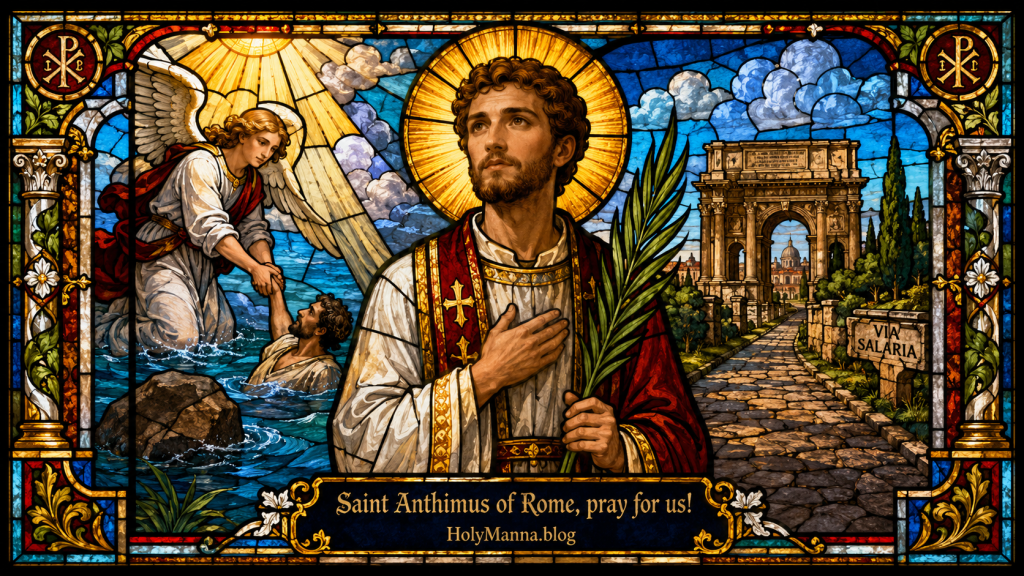
The Priest Who Would Not Bow to the Empire
Saint Anthimus of Rome is one of those early martyrs whose name comes down through the Church like a small flame guarded through centuries of darkness. The official memory of him is brief, but powerful. The Roman Martyrology honors him on May 11 as a martyr near the twenty second milestone of the Via Salaria, an ancient road outside Rome.
In Christian tradition, Saint Anthimus is remembered as a priest, evangelizer, miracle worker, and martyr during the persecution of Diocletian. His life is wrapped in early Christian legend, and the Church’s historical sources treat some details with caution. Still, the heart of his witness is clear. He was a priest who preached Christ, brought pagans to the faith, refused to sacrifice to false gods, and gave his life rather than deny the Lord.
The Catechism of the Catholic Church teaches, “Martyrdom is the supreme witness given to the truth of the faith.” CCC 2473. That is the key to understanding Saint Anthimus. His greatness is not found in political power, fame, or worldly success. His greatness is found in fidelity. He belonged to Jesus Christ, and when the empire demanded worship, he chose the Cross.
A Priest from the Shadows of Persecution
The early life of Saint Anthimus is difficult to reconstruct with certainty. Some Catholic traditions say he was born in Bithynia, possibly in Nicomedia, and later came to Rome as a priest. This detail is repeated in Catholic hagiographical sources, but it should be held with humility because some scholars have wondered whether parts of his story became confused with another Saint Anthimus, the bishop martyr of Nicomedia.
What can be said with more confidence is that Anthimus was venerated as a Roman martyr connected with the Via Salaria. He lived in a time when being openly Christian could cost everything. During the reign of Diocletian, Christians faced imprisonment, confiscation of property, torture, forced sacrifice, and death. In that atmosphere, the priesthood was not a comfortable religious career. It was a life lived under the shadow of the sword.
Tradition remembers Anthimus as a priest who preached the Gospel in Rome and helped bring souls into the Church. He was especially known for conversions. That matters because evangelization in his time was not a soft invitation to join a respectable community. To become Christian could mean being cut off from family, society, and imperial favor. Yet Anthimus preached anyway.
The Christian life is never meant to be hidden out of fear. Prudence has its place, of course, but cowardice does not. Saint Anthimus reminds the Church that faith is not merely an opinion held privately. Faith is a life surrendered publicly to Christ.
The Noble Household That Found Christ
One of the most famous stories connected with Saint Anthimus involves a Roman official named Faltonius Pinianus and his wife, Anicia Lucina. According to the ancient tradition, Pinianus became gravely ill, and no physician could heal him. Lucina, who is remembered as a Christian noblewoman, secretly asked imprisoned Christians to pray for her husband.
Among those Christians was Anthimus. The tradition says Anthimus promised that Pinianus would be healed if he embraced the Christian faith. Pinianus was healed, converted, and then received instruction in the mysteries of the faith along with his household.
This story comes from later hagiographical sources, so every detail cannot be historically verified. Still, it beautifully expresses a deeply Catholic truth. Grace does not merely heal the body. Grace calls the whole person to conversion. Pinianus was not healed so he could return to ordinary life untouched. He was healed so he could belong to Christ.
The tradition goes even further. After his conversion, Pinianus is said to have freed many Christians from prisons, mines, and places of forced labor. He gave them assistance and helped them return home. Whether every detail can be proven or not, the spiritual message is clear. Real conversion produces mercy.
The Catechism teaches that faith must be lived through charity, because “faith without works is dead.” CCC 1815, James 2:26. Pinianus’s conversion, guided by the witness of Anthimus, becomes a picture of what happens when the Gospel moves from the lips into the hands. The healed man becomes a merciful man.
The Pagan Priest, the Idol, and the Power of Christ
Another dramatic story from the tradition says that Anthimus was hidden on one of Pinianus’s estates near the Via Salaria. There he encountered a priest of the pagan god Silvanus.
According to the legend, this pagan priest was afflicted in a terrible way. Some versions say he had become violent and possessed during sacrifice. Anthimus prayed over him, invoked the name of Jesus Christ, fasted, and brought him healing. The man then converted to Christianity, and so did members of his family. Afterward, the idol or sacred image of Silvanus was destroyed.
This story cannot be verified in every historical detail, but it is one of the most memorable legends associated with Saint Anthimus. It captures the early Christian conviction that Christ is not one god among many. He is Lord.
The destruction of the idol enraged the local pagans, and Anthimus was denounced to the authorities. That part of the story feels very believable in the world of early Christian persecution. The Roman Empire could often tolerate private religious customs, but it could not tolerate Christians refusing sacrifice and rejecting the gods that were tied to civic loyalty.
Anthimus’s crime was not violence. His crime was fidelity. He healed, preached, and converted. But conversion threatened the old order. When false gods lose worshipers, the servants of those false gods often become angry.
The Stone, the River, and the Angel
The most famous miracle associated with Saint Anthimus is his miraculous escape from drowning. After being denounced, he was condemned to death. The tradition says he was thrown into the Tiber River with a stone tied around his neck.
That should have been the end of the story.
Instead, according to the legend, an angel rescued him from the river and restored him safely to his oratory, the place where he prayed. Because of this story, Saint Anthimus is sometimes depicted in sacred art as a man being pulled from the water by an angel.
This miracle cannot be verified by modern historical standards, but it has been preserved in Catholic tradition for centuries. It is also spiritually rich. The image of a priest cast into the water with a stone around his neck naturally calls to mind death, judgment, and the apparent victory of evil. But the angelic rescue proclaims that God is never trapped by human cruelty.
The persecutors could bind Anthimus. They could throw him into the river. They could try to erase him. But they could not command heaven.
That is not a promise that every martyr will be spared physical death. Anthimus himself was eventually killed. Rather, it is a reminder that God’s providence rules even when evil seems to have the upper hand. For the Christian, no act of fidelity is wasted, and no suffering offered to Christ disappears into nothing.
A Martyr on the Via Salaria
After the miracle of the Tiber, Saint Anthimus was eventually recaptured. Tradition says he was tortured and ordered to sacrifice to the pagan gods. He refused. He was then beheaded near the Via Salaria, outside Rome, around the beginning of the fourth century.
His martyrdom matters because it shows the final shape of Christian witness. Anthimus did not merely preach courage. He lived it. He did not simply ask others to convert. He remained converted when conversion became costly.
The Catechism says of the martyr, “He bears witness to Christ who died and rose, to whom he is united by charity.” CCC 2473. Saint Anthimus was united to Christ not only in words, but in blood. Like the Lord he served at the altar, he offered himself in faithfulness.
The tradition says he was buried in the oratory where he had been accustomed to pray. That detail is beautiful. The place where he had lifted his heart to God became the place where Christians remembered his sacrifice. Prayer formed him for martyrdom, and martyrdom turned his place of prayer into a place of veneration.
Companions in the Same Storm
Saint Anthimus is often remembered with several other Christians named in the later Acta Sancti Anthimi. These include Maximus, Bassus, Fabius, Sisinnius, Diocletianus, Florentius, Pinianus, and Lucina.
The tradition says some of these companions were also martyred after refusing to sacrifice to idols. Sisinnius, Diocletianus, and Florentius are associated with Osimo in Picenum, where they were said to have lived before being stoned. Maximus, Bassus, and Fabius were connected with martyrdom along or near the Via Salaria.
Catholic scholars caution that these stories may have originally belonged to separate local martyr traditions that were later woven together. That does not make them meaningless. It simply means they should be told with honesty. The Church remembers real witnesses, while also recognizing that early hagiography often arranged memories in a way meant to teach, inspire, and strengthen the faithful.
The common thread is unmistakable. These were Christians remembered for refusing idolatry, accepting suffering, and choosing Christ above life itself.
Relics, Churches, and a Memory That Would Not Die
After his death, devotion to Saint Anthimus grew around the places connected with his martyrdom and burial. His cult was especially associated with the area near Cures Sabini, along the Via Salaria. By the early sixth century, there is evidence that his memory had become important enough that the bishop of Cures identified himself in connection with the church of Saint Anthimus.
His relic tradition is complex. Some traditions connect relics of Anthimus and his companions with Osimo, where devotion to related martyrs became strong. Other Italian traditions connect the name Sant’Antimo with important churches and sacred sites, including the famous Abbey of Sant’Antimo near Montalcino in Tuscany. That abbey has its own rich medieval history and a legendary connection to Charlemagne, though the exact relationship between the abbey and Saint Anthimus of Rome is not completely simple.
In the town of Sant’Antimo near Naples, the saint became a powerful patronal figure. Local tradition says the town’s devotion began when a duke of Naples named Antimo had a dream in which the martyr asked for a chapel to be built in his honor. The settlement that grew around that devotion eventually bore the saint’s name.
That story is a local legend and cannot be fully verified, but it shows how deeply Saint Anthimus entered the Catholic imagination of the people. He was not remembered only as a name in an ancient book. He became a patron, protector, and spiritual father for communities.
The Flight of the Angels and the Living Culture of Devotion
One of the most striking cultural traditions connected with Saint Anthimus is found in Sant’Antimo near Naples. The town honors him with patronal celebrations, processions, and dramatic devotional customs.
Among the most famous is the “Flight of the Angels,” connected with a dramatic presentation of the saint’s life and martyrdom. In this tradition, young girls dressed as angels move along a wire in a symbolic scene associated with the recovery of the saint’s severed head. The event is both cultural and devotional, drawing pilgrims and locals into the memory of the martyr.
There is also a local story from 1862 that during the “Flight of the Angels,” the ropes holding two girls gave way, yet the girls remained suspended and were saved. The faithful attributed this rescue to Saint Anthimus’s intercession. This story is part of local devotional tradition and cannot be historically verified in every detail.
Still, these celebrations reveal something beautiful about Catholic life. The saints are not treated as museum pieces. They become part of a people’s memory, their art, their songs, their processions, their fears, and their gratitude. Through the communion of saints, the Church on earth remains united to those who have gone before in Christ.
The Catechism teaches, “Being more closely united to Christ, those who dwell in heaven fix the whole Church more firmly in holiness.” CCC 956. That is why Catholics honor martyrs like Anthimus. The saints do not replace Jesus. They point to Him.
The Saint Who Still Challenges Comfortable Faith
Saint Anthimus of Rome challenges a comfortable Christianity. He lived in a world where faith could not be reduced to vague spirituality or cultural identity. To say, “Jesus is Lord,” meant something. It meant refusing idols. It meant risking status. It meant accepting suffering. It meant being ready to die.
Modern life has different pressures, but the temptation is familiar. The world still asks Christians to make peace with idols. Not carved statues, perhaps, but idols of comfort, pleasure, approval, career, politics, resentment, and self-worship. Saint Anthimus speaks into that struggle with the quiet authority of a martyr.
His life teaches that evangelization begins with fidelity. He preached, but he also prayed. He converted others, but only because he had first given himself to Christ. He faced death, but not as a man chasing suffering. He faced death as a priest who knew that Jesus had already conquered it.
What false gods quietly ask for loyalty today? What fear keeps the heart from speaking the truth with charity? What would it look like to live the faith with the courage of Saint Anthimus?
The path of Saint Anthimus is not only for martyrs in ancient Rome. It is for every Catholic trying to be faithful in ordinary life. Pray when it is easier to scroll. Tell the truth when silence would be more convenient. Show mercy when resentment feels justified. Refuse sin when everyone else calls it normal. Keep worshiping Christ when the world tells the soul to bow somewhere else.
Engage With Us!
Share your thoughts and reflections in the comments below. Saint Anthimus may not be one of the most famous saints in the Church calendar, but his witness is powerful for anyone trying to live with courage, purity of faith, and trust in Christ.
- What part of Saint Anthimus’s story challenged you the most?
- Are there any “idols” in modern life that quietly compete with loyalty to Christ?
- How can Saint Anthimus’s courage help Catholics speak the truth with charity today?
- Where is God asking you to be more faithful, even if it costs comfort or approval?
- How can devotion to the martyrs deepen your love for the Eucharist, the Church, and the Cross?
May Saint Anthimus pray for every soul seeking courage in a world full of compromise. May his witness inspire Catholics to live the faith openly, love generously, reject every false idol, and do everything with the love and mercy Jesus taught us.
Saint Anthimus of Rome, pray for us!
Follow us on YouTube, Instagram and Facebook for more insights and reflections on living a faith-filled life.


Leave a comment