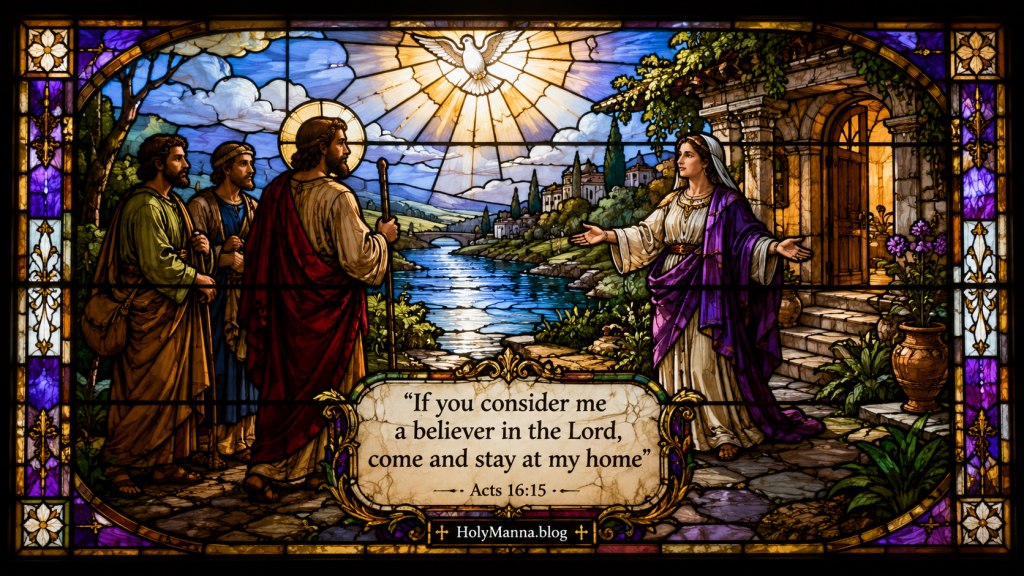
Monday of the Sixth Week of Easter – Lectionary: 291
When the Heart Opens, the Church Begins to Sing
Sometimes the Gospel does not arrive with noise, but with a quiet conversation beside a river and a heart made ready by God.
Today’s readings for Monday of the Sixth Week of Easter are held together by one beautiful theme: the Holy Spirit opens the heart so the Church can receive Christ, praise God, and bear witness with courage. In Acts 16:11-15, Saint Paul enters Philippi, a Roman colony in Macedonia, and the mission of the Church quietly crosses into Europe. There is no grand synagogue scene, only a group gathered for prayer near the water and a woman named Lydia listening with humility. Scripture tells us that “the Lord opened her heart” Acts 16:14, and from that hidden grace comes baptism, hospitality, and the beginnings of a Christian household.
The Psalm then shows what an opened heart becomes. Psalm 149 calls God’s faithful ones to sing a new song, rejoice in their Maker, and praise Him with joy because “the Lord takes delight in his people” Psalm 149:4. This praise is not naïve happiness. It is Easter confidence, the kind of joy that knows Christ is risen and that God is still at work even when the world feels uncertain.
In the Gospel, Jesus prepares His disciples for the cost of that witness. In John 15:26-16:4, He promises the Advocate, the Spirit of truth, who will testify to Him and strengthen the apostles when persecution comes. The same Spirit who opens Lydia’s heart will also steady the Church when believers are rejected, misunderstood, or hated for the name of Christ.
These readings invite the soul to see Christian life as a movement of grace: God opens the heart, fills it with praise, and sends it into the world as a witness. The Church does not begin with power, popularity, or perfect circumstances. She begins wherever the Holy Spirit finds someone willing to listen.
Where is the Lord asking the heart to open today, so that Christ may be received more deeply and witnessed more courageously?
First Reading – Acts 16:11-15
The Riverbank Where Europe Began to Listen
The first reading brings the Church to a quiet but monumental moment in salvation history. Saint Paul and his companions cross from Asia Minor into Macedonia, and the Gospel begins to take root in Europe. Yet the scene is surprisingly simple. There is no temple platform, no public debate, and no crowd pressing in to hear a famous preacher. There is only a river outside the city gate, a place of prayer, a small group of women, and one woman named Lydia whose heart is opened by the Lord.
Philippi was a Roman colony, shaped by Roman law, military pride, commerce, and imperial culture. Lydia, a dealer in purple cloth from Thyatira, likely moved in a world of trade and social influence. Purple cloth was associated with wealth and status, so she was not a hidden or insignificant person. Yet Scripture remembers her first as “a worshiper of God” Acts 16:14. She is spiritually attentive before she is sacramentally baptized. She is already seeking, already listening, already close to the threshold of the Church.
This reading fits beautifully into today’s theme: the Holy Spirit opens the heart so the Church can receive Christ, praise God, and bear witness. Lydia does not convert herself by intelligence or success. Paul does not convert her by eloquence alone. The Lord opens her heart, she listens, she is baptized, and then her home becomes a place of Christian hospitality. Grace enters quietly, and the mission of the Church expands.
Acts 16:11-15 – New American Bible (Revised Edition)
Into Europe. 11 We set sail from Troas, making a straight run for Samothrace, and on the next day to Neapolis, 12 and from there to Philippi, a leading city in that district of Macedonia and a Roman colony. We spent some time in that city. 13 On the sabbath we went outside the city gate along the river where we thought there would be a place of prayer. We sat and spoke with the women who had gathered there. 14 One of them, a woman named Lydia, a dealer in purple cloth, from the city of Thyatira, a worshiper of God, listened, and the Lord opened her heart to pay attention to what Paul was saying. 15 After she and her household had been baptized, she offered us an invitation, “If you consider me a believer in the Lord, come and stay at my home,” and she prevailed on us.
Detailed Exegesis
Verse 11 – “We set sail from Troas, making a straight run for Samothrace, and on the next day to Neapolis,”
Paul’s journey begins with movement. Troas was located in Asia Minor, and from there Paul and his companions sail toward Macedonia. This is not just travel information. In Acts, missionary movement is guided by the Holy Spirit. The Gospel is not trapped in one region, culture, or people. It is being carried outward, according to Christ’s command to make disciples of all nations.
The mention of Samothrace and Neapolis gives the scene a real historical weight. The Christian faith enters actual cities, ports, roads, homes, and households. Catholicism is never a vague spiritual idea floating above history. God works inside history, through human journeys, conversations, and decisions.
Verse 12 – “and from there to Philippi, a leading city in that district of Macedonia and a Roman colony. We spent some time in that city.”
Philippi was an important city in Macedonia and a Roman colony. This means it carried Roman identity, Roman privilege, and Roman customs. The Gospel is entering a place proud of its citizenship and public order. That matters because Christianity will soon teach believers that their deepest citizenship is in heaven, even while they remain faithful and responsible within earthly society.
Paul and his companions spend time there. This small phrase reminds the reader that evangelization often requires patience. The Gospel usually grows through presence before proclamation bears visible fruit. The missionary does not merely pass through people’s lives. He stays long enough to listen, observe, pray, and speak at the right time.
Verse 13 – “On the sabbath we went outside the city gate along the river where we thought there would be a place of prayer. We sat and spoke with the women who had gathered there.”
Paul goes first to a place of prayer on the sabbath. This reflects his Jewish roots and the early Church’s continuity with Israel. Christianity is not a rejection of God’s covenantal work with Israel. It is the fulfillment of God’s promises in Christ.
The group gathers outside the city gate along the river, likely because there may not have been enough Jewish men in Philippi to establish a synagogue. In Jewish practice, a synagogue community traditionally required a sufficient number of Jewish men, and where there was no synagogue, believers might gather in a quieter place for prayer. Water nearby also made sense for ritual washing.
Paul sits and speaks with the women. This detail is tender and powerful. In the ancient world, women were often publicly overlooked, but the Gospel does not overlook them. The mission into Europe begins not with the powerful men of Philippi, but with praying women at the river. God delights in choosing humble beginnings that later reshape the world.
Verse 14 – “One of them, a woman named Lydia, a dealer in purple cloth, from the city of Thyatira, a worshiper of God, listened, and the Lord opened her heart to pay attention to what Paul was saying.”
Lydia is introduced with dignity. She has a name, a profession, a city of origin, and a religious disposition. As a dealer in purple cloth, she was likely a capable and respected businesswoman. Yet her greatest description is that she is a worshiper of God.
Then comes the heart of the passage: “the Lord opened her heart” Acts 16:14. This is the mystery of grace. Paul speaks, Lydia listens, but God opens. The Catholic Church teaches that faith is both a gift of God and a human response. Lydia’s conversion is not forced. Her freedom is not erased. Her heart is awakened.
Saint John Chrysostom comments on this moment by saying, “The opening, then, was God’s work, the attending was hers.” This captures the Catholic balance beautifully. Grace comes first, but the soul must cooperate. Lydia listens with a heart made receptive by God.
Verse 15 – “After she and her household had been baptized, she offered us an invitation, ‘If you consider me a believer in the Lord, come and stay at my home,’ and she prevailed on us.”
Lydia’s faith becomes sacramental through Baptism. Her household is baptized with her, showing how grace often moves through family, community, and domestic life. In the early Church, households were not merely private spaces. They often became places of prayer, instruction, hospitality, and worship.
Her invitation is also a sign of conversion. She does not simply receive a religious idea. She receives the Church. She welcomes the messengers of Christ into her home. Her house becomes a place where the Gospel can rest, grow, and be shared.
The phrase “she prevailed on us” Acts 16:15 shows her holy determination. Lydia is not passive. Grace has opened her heart, and now charity opens her door.
Teachings: The Opened Heart, Baptism, and the Mission of the Laity
This reading teaches that conversion begins with grace. The Lord opens Lydia’s heart before Lydia opens her home. This order matters. Catholic spirituality always begins with God’s initiative. The soul does not climb to heaven by sheer effort. God comes first, calling, stirring, inviting, and strengthening.
The Catechism of the Catholic Church teaches, “Our justification comes from the grace of God. Grace is favor, the free and undeserved help that God gives us to respond to his call to become children of God, adoptive sons, partakers of the divine nature and of eternal life.” CCC 1996
This is exactly what happens to Lydia. She receives a grace she did not earn, and that grace enables her response. She listens. She believes. She is baptized. She serves.
The Catechism also teaches, “Grace is a participation in the life of God. It introduces us into the intimacy of Trinitarian life: by Baptism the Christian participates in the grace of Christ, the Head of his Body.” CCC 1997
Lydia’s Baptism is not a symbolic membership card. It is the beginning of life in Christ. Through Baptism, she is joined to the Church, brought into the life of the Trinity, and made part of Christ’s Body. Her household’s Baptism also reminds Catholic readers that faith is never meant to remain isolated. Grace naturally seeks communion.
The Catechism teaches, “Holy Baptism is the basis of the whole Christian life, the gateway to life in the Spirit, and the door which gives access to the other sacraments.” CCC 1213
That line shines over Lydia’s story. The riverbank leads to Baptism. Baptism leads to hospitality. Hospitality leads to mission. Her life begins to show the pattern of Christian discipleship: receive grace, enter the Church, and make room for Christ in ordinary life.
Saint John Chrysostom’s teaching on this passage is especially helpful because he notices both divine grace and human humility. He says, “Observe how women were the first to receive the word. The opening, then, was God’s work, the attending was hers.” His point is not merely historical. It is spiritual. God opens, but the soul must attend. The heart must pay attention when grace visits.
Lydia also becomes a beautiful example of the lay apostolate. She is not ordained, and she does not hold an apostolic office. Yet her home becomes a place of welcome for the Church’s mission. The Catechism teaches, “Since, like all the faithful, lay Christians are entrusted by God with the apostolate by virtue of their Baptism and Confirmation, they have the right and duty, individually or grouped in associations, to work so that the divine message of salvation may be known and accepted by all men throughout the earth.” CCC 900
Lydia lives that truth before it is ever written in a catechism. Her business, her resources, her household, and her hospitality become instruments of the Gospel. She reminds the Church that lay holiness is not second-class holiness. A Christian home can become a mission station. A dining table can serve the Kingdom. A person with ordinary responsibilities can help the Word of God take root in a whole city.
Reflection: Let the Lord Open the Door from the Inside
Lydia’s story is gentle, but it is not small. The Gospel enters Europe through a woman who listens. That should encourage every Catholic who wonders whether ordinary faithfulness matters. God does not need a perfect stage to begin something holy. He needs an open heart.
There is a lesson here for daily life. Before speaking about Christ, the soul must first listen to Christ. Before inviting others into the faith, the home must first make room for grace. Before trying to control outcomes, the Christian must trust that God is the one who opens hearts.
A practical response to this reading could begin with a simple prayer each morning: “Lord, open my heart to pay attention to what You are saying today.” That prayer can change the whole day. It can make Scripture less routine. It can make Mass more attentive. It can make conversations more charitable. It can make the home more welcoming.
Lydia also challenges Catholic families and households. Her faith does not remain private. It becomes visible through hospitality. A Catholic home does not need to be fancy to be holy. It needs prayer, welcome, truth, forgiveness, and room for the people God sends.
The modern world often treats faith as a private preference, something to keep tucked away so nobody feels uncomfortable. Lydia shows another way. She does not force herself on anyone, but she does let grace rearrange her life. Her heart opens, and then her home opens.
Where is the Lord trying to open the heart today?
Is there a place in daily life where grace is being resisted because comfort feels safer than conversion?
Does the home, schedule, and speech of the Christian make room for Christ and His Church?
Who might be waiting beside the river, quietly ready for someone to speak the truth with humility and love?
The story of Lydia reminds the Church that the Holy Spirit often begins with what looks small. A prayer gathering. A conversation. A woman listening. A household baptized. A door opened. From there, the Gospel moves outward, because when God opens a heart, He is often preparing to open a whole world.
Responsorial Psalm – Psalm 149:1-6, 9
The New Song of a People Who Know They Are Loved
After Lydia’s heart is opened in the first reading, the Responsorial Psalm shows what an opened heart does next. It sings. Psalm 149 belongs near the end of the Psalter, where the prayers of Israel rise into a final chorus of praise. These closing psalms are full of alleluia, worship, music, joy, and confidence in the Lord who reigns over His people.
This is important because today’s readings are not naïve about hardship. In the Gospel, Jesus will warn His disciples that persecution is coming. Yet before that warning, the Church places praise on the lips of the faithful. The Christian does not praise because life is comfortable. The Christian praises because God is faithful. The Lord opens the heart, gathers His people, delights in the humble, and gives them the courage to stand firm.
The Psalm’s language of song, dance, victory, and even the two-edged sword can sound intense to modern ears. Read through the light of Christ and the teaching of the Church, this is not a call to worldly violence. It is a call to worship, spiritual courage, and faithful witness. The baptized fight with praise in their mouths, truth in their hearts, and holiness in their lives.
Psalm 149:1-6, 9 – New American Bible (Revised Edition)
Praise God with Song and Sword
1 Hallelujah!
Sing to the Lord a new song,
his praise in the assembly of the faithful.
2 Let Israel be glad in its maker,
the people of Zion rejoice in their king.
3 Let them praise his name in dance,
make music with tambourine and lyre.
4 For the Lord takes delight in his people,
honors the poor with victory.
5 Let the faithful rejoice in their glory,
cry out for joy on their couches,
6 With the praise of God in their mouths,
and a two-edged sword in their hands,9 To execute the judgments decreed for them—
such is the glory of all God’s faithful.
Hallelujah!
Detailed Exegesis
Verse 1 – “Hallelujah! Sing to the Lord a new song, his praise in the assembly of the faithful.”
The Psalm begins with “Hallelujah”, a Hebrew expression meaning praise the Lord. It is not a casual religious greeting. It is a summons. God’s people are being called out of forgetfulness and into worship.
The “new song” is the song of a people who have seen God act. In Catholic worship, this finds its deepest fulfillment in Christ’s Resurrection. Every Easter season is a new song because the risen Lord has conquered sin and death. The praise is also sung “in the assembly of the faithful”, which reminds the reader that worship is not only private. God forms a people. The Church gathers, sings, listens, offers, and receives.
Verse 2 – “Let Israel be glad in its maker, the people of Zion rejoice in their king.”
Israel is called to rejoice in the Lord as Maker and King. This verse holds creation and covenant together. God made His people, but He also rules them with love. Zion represents Jerusalem, the place associated with God’s presence, worship, and kingship.
For Catholics, this joy reaches its fullness in Christ the King. The Church rejoices because Jesus is not merely a teacher or moral example. He is Lord. He is the King whose throne is the Cross and whose victory is revealed in the Resurrection. The people of God do not belong to chance, politics, fear, or fashion. They belong to their Maker and King.
Verse 3 – “Let them praise his name in dance, make music with tambourine and lyre.”
This verse shows praise becoming embodied. Israel praises with song, movement, and instruments. Worship is not reduced to ideas in the mind. The whole person is invited into praise.
Catholic worship is deeply incarnational. The body matters. Kneeling, standing, singing, processing, making the Sign of the Cross, receiving the Eucharist, and bowing before the Lord all remind the faithful that grace touches the whole person. God made the body, Christ took on a body, and the body is called to glorify God.
Verse 4 – “For the Lord takes delight in his people, honors the poor with victory.”
This is the tender center of the Psalm. The Lord does not merely tolerate His people. He delights in them. That truth can be hard to receive, especially for Catholics who carry shame, discouragement, or the quiet fear that God is always disappointed.
The Psalm also says He “honors the poor with victory” Psalm 149:4. The poor are not simply those without money, although that meaning is included. In the biblical sense, the poor are the lowly, the humble, the dependent, the ones who know they need God. This connects beautifully to Lydia. She may have been financially comfortable as a dealer in purple cloth, but spiritually she is poor enough to listen. Her heart is open, and the Lord honors her with grace.
Verse 5 – “Let the faithful rejoice in their glory, cry out for joy on their couches,”
This verse brings praise from the assembly into the home. The faithful rejoice not only in public worship, but even “on their couches” Psalm 149:5. The home becomes a place of praise.
That fits perfectly with Lydia’s story. After Baptism, her home becomes a place of Christian welcome. The Psalm reminds Catholics that faith should not stay locked inside Sunday Mass, even though the Mass is the source and summit of the Christian life. The song of God’s people should echo through kitchens, bedrooms, car rides, family dinners, bedtime prayers, and quiet moments of gratitude.
Verse 6 – “With the praise of God in their mouths, and a two-edged sword in their hands,”
This verse holds together worship and battle. The faithful have praise in their mouths and a sword in their hands. In its original setting, this language reflected Israel’s confidence that God would defend His people and judge evil. Yet Catholics read the Old Testament through Christ, who fulfills the Scriptures and reveals the deepest meaning of God’s victory.
For the Christian, the two-edged sword is not a weapon of hatred. It is the Word of God, the truth of Christ, and the spiritual courage to resist sin. The battle is real, but it is first fought in the heart. Pride, lust, greed, despair, resentment, cowardice, and lukewarmness are enemies no army can defeat. Only grace can.
Verse 9 – “To execute the judgments decreed for them, such is the glory of all God’s faithful. Hallelujah!”
This verse speaks of judgment and glory. It can sound severe, but in the full light of Scripture, God’s judgment is not random cruelty. It is the setting right of all things. Evil does not get the final word. The proud do not rule forever. The humble are not forgotten.
For the faithful, this is glory: to stand with God, to praise Him, to reject evil, and to participate in His victory. The Psalm ends as it began, with “Hallelujah”. Praise is the first word and the last word. That is the shape of the Christian life.
Teachings: Praise, Spiritual Battle, and the Victory of the Humble
The Responsorial Psalm teaches that praise is not decorative. Praise is a weapon of hope. It reorders the heart around God instead of fear. It teaches the faithful to remember who God is, who they are, and where history is going.
The Catechism of the Catholic Church teaches, “Praise is the form of prayer which recognizes most immediately that God is God. It lauds God for his own sake and gives him glory, quite beyond what he does, but simply because HE IS.” CCC 2639
That quote explains the heart of Psalm 149. The faithful praise God not only because He gives victory, but because He is God. He is worthy before the problem is solved. He is worthy before the persecution ends. He is worthy before the heart feels brave.
The Catechism also teaches, “The Eucharist contains and expresses all forms of prayer: it is ‘the pure offering’ of the whole Body of Christ to the glory of God’s name and, according to the traditions of East and West, it is the ‘sacrifice of praise.’” CCC 2643
This matters for Catholics because the Psalm’s call to praise finds its highest expression in the Mass. The Church does not merely sing about God from a distance. At the Eucharist, the Church is drawn into Christ’s perfect offering to the Father. The praise of Israel becomes the praise of the Body of Christ.
Saint Augustine famously taught, “He who sings, prays twice.” While this phrase is commonly associated with Augustine’s teaching on sacred song, the deeper Augustinian point is that true singing must come from a heart shaped by love. Sacred music is not performance for attention. It is prayer lifted by affection for God.
The Psalm’s battle language also belongs within Catholic teaching on spiritual combat. The Catechism teaches, “The whole of man’s history has been the story of dour combat with the powers of evil, stretching, so our Lord tells us, from the very dawn of history until the last day.” CCC 409
That is the Catholic way to understand the sword imagery in today’s Psalm. The Christian life is not sentimental. There is a battle. But the battlefield is not first out there in the world. It begins in the soul. The faithful fight by clinging to Christ, confessing sin, receiving the sacraments, speaking truth with charity, and refusing to let darkness steal their praise.
Saint Paul’s mission to Philippi, Lydia’s conversion, and the Psalm’s new song all belong together. When the Lord opens a heart, that heart does not remain silent. It begins to praise. When that praise is real, it becomes courage. When that courage is purified by grace, it becomes witness.
Reflection: Learning to Praise Before the Battle Is Over
There is something deeply practical about Psalm 149. It teaches Catholics not to wait until life feels perfect before praising God. That is a trap. If praise depends on ideal circumstances, then praise will always be postponed.
The faithful are invited to sing a new song now. Not when the bills are paid. Not when the family conflict disappears. Not when the diagnosis changes. Not when the culture becomes friendly to Christianity. Not when the soul finally feels strong. Now.
This does not mean pretending pain is not real. Catholic praise is honest. It can rise from tears, hospital rooms, confession lines, anxious mornings, and tired kitchens. Easter praise does not deny the Cross. It stands on the other side of the empty tomb and says that Christ is still Lord.
A simple way to live this Psalm is to begin the day with praise before checking the phone. The first words of the morning can become an offering: “Lord, You are good, and this day belongs to You.” Another way is to bring sacred music back into the home and car, not as background noise, but as a way of training the heart to remember God. Families can also recover the practice of praying together at night, turning even the couch into a place where the faithful rejoice in the Lord.
The Psalm also invites Catholics to examine what is in their mouths. Is it praise, complaint, gossip, sarcasm, fear, or gratitude? The same mouth that receives the Eucharist is called to bless the Lord. That does not mean every conversation becomes awkwardly religious. It means speech should carry the scent of faith.
What would change if praise became the first response instead of the last resort?
Does the home sound more like anxiety or more like trust in God?
Where is the Lord inviting the soul to fight spiritually with prayer, truth, confession, and perseverance?
Is there a place where the heart has forgotten that the Lord truly delights in His people?
The Psalm gives the Church a holy rhythm for the Easter season. Sing, rejoice, praise, and stand firm. The same Lord who opened Lydia’s heart also teaches His people to sing in the middle of the mission. The world may be loud with fear, but the Church has been given a better song.
Holy Gospel – John 15:26-16:4
The Advocate Who Teaches the Church How to Stand
The Holy Gospel brings the reader into the Upper Room, where Jesus speaks to His apostles on the night before His Passion. The air is heavy with love, sorrow, confusion, and coming trial. Judas has gone into the darkness. Peter will soon deny the Lord. The disciples do not yet understand the Cross, the Resurrection, or the mission that will carry them to the ends of the earth.
Yet Jesus does not leave them with fear as the final word. He promises the Advocate, the Holy Spirit, the Spirit of truth. The same Spirit who opens Lydia’s heart in Acts 16:14 will strengthen the apostles to testify when the world rejects them. The same Spirit who fills the faithful with praise in Psalm 149 will give the Church courage when praise becomes costly.
This Gospel fits today’s theme with beautiful force. God opens the heart, fills it with truth, and sends it to bear witness. The Christian life is not built on personality, comfort, or popularity. It is built on the Holy Spirit, who testifies to Christ and forms the Church into a living witness.
John 15:26-16:4 – New American Bible (Revised Edition)
26 “When the Advocate comes whom I will send you from the Father, the Spirit of truth that proceeds from the Father, he will testify to me. 27 And you also testify, because you have been with me from the beginning.
16:1 “I have told you this so that you may not fall away. 2 They will expel you from the synagogues; in fact, the hour is coming when everyone who kills you will think he is offering worship to God. 3 They will do this because they have not known either the Father or me. 4 I have told you this so that when their hour comes you may remember that I told you.
Jesus’ Departure; Coming of the Advocate. “I did not tell you this from the beginning, because I was with you.
Detailed Exegesis
Verse 26 – “When the Advocate comes whom I will send you from the Father, the Spirit of truth that proceeds from the Father, he will testify to me.”
Jesus calls the Holy Spirit the Advocate. The word carries the sense of one who comes alongside, defends, strengthens, consoles, and speaks on behalf of another. The disciples will soon feel abandoned as Jesus is arrested, crucified, and buried. Yet He promises that they will not be left alone. The Advocate will come.
Jesus also calls Him the “Spirit of truth” John 15:26. This matters because Christian witness is not rooted in opinion, vibes, or personal branding. The Holy Spirit testifies to Christ because Christ is the Truth. The Spirit does not draw attention away from Jesus. He reveals Jesus, confirms Jesus, and leads the Church deeper into the mystery of Jesus.
The verse also gives the Church a profound glimpse into the life of the Most Holy Trinity. The Spirit is sent by the Son from the Father, and He proceeds from the Father. Catholic teaching holds firmly that the Holy Spirit is not a force or symbol. He is the Third Person of the Trinity, fully God, eternally united with the Father and the Son.
Verse 27 – “And you also testify, because you have been with me from the beginning.”
The Spirit testifies, and the apostles testify. This is the pattern of Catholic mission. The Church does not witness apart from the Holy Spirit, and the Holy Spirit ordinarily works through the Church’s witness.
The apostles are uniquely qualified because they have been with Jesus from the beginning of His public ministry. They heard His words, saw His miracles, ate with Him, watched Him forgive sinners, and would soon see Him risen from the dead. Their testimony becomes the foundation of apostolic faith.
This is why the Church is apostolic. Catholic faith is not a later invention or private interpretation. It is rooted in the witness of those who were with Christ and were empowered by the Holy Spirit to proclaim Him. Every Catholic today receives the faith through that apostolic stream.
Verse 1 – “I have told you this so that you may not fall away.”
Jesus speaks honestly because He loves them. He does not hide the difficulty of discipleship. He warns them so that suffering will not scandalize them when it comes.
The phrase “fall away” points to the danger of losing faith when expectations are shattered. Many people can follow Jesus when faith feels inspiring, accepted, or socially comfortable. The test comes when discipleship costs something. Jesus prepares His apostles so they will remember that persecution is not proof that God has failed. It is something He already warned them about.
This is still merciful today. Christ does not promise a life without pressure. He promises grace, truth, and the Holy Spirit.
Verse 2 – “They will expel you from the synagogues; in fact, the hour is coming when everyone who kills you will think he is offering worship to God.”
For the first Christians, expulsion from the synagogue was not a small inconvenience. It meant religious rejection, social loss, family strain, and public shame. Many of the earliest Christians were Jews who believed Jesus was the promised Messiah. To be cast out was deeply painful.
Jesus then gives an even more sobering warning. Some will kill His disciples while thinking they are serving God. This reveals how dangerous zeal becomes when it is separated from truth. A person can be religiously intense and still oppose God if he does not know the Father and the Son.
This verse also speaks to the mystery of martyrdom. The Church has always honored the martyrs because they bear witness to Christ with their lives. Their blood does not mean the Gospel has failed. It shows that love can remain faithful even when hatred seems powerful.
Verse 3 – “They will do this because they have not known either the Father or me.”
Jesus goes to the root of the problem. Persecution is not merely political, emotional, or cultural. At its deepest level, it comes from not knowing God. To reject the Son is to misunderstand the Father. To hate Christ’s witnesses is to stand against the truth they bear.
This does not give Christians permission to hate persecutors. It gives Christians clarity. The world’s rejection should not make the disciple bitter. It should make the disciple more faithful, more prayerful, and more dependent on the Holy Spirit.
The Catholic response to opposition is not revenge. It is witness. It is truth spoken with charity. It is courage without cruelty. It is firmness without losing the heart of Christ.
Verse 4 – “I have told you this so that when their hour comes you may remember that I told you.”
Jesus gives His disciples memory as a shield. When persecution comes, they are to remember His words. Memory is a major part of Catholic faith. The Church remembers what Christ said and did. The Church remembers His Passion, Death, Resurrection, and Ascension. The Church remembers through Scripture, Tradition, liturgy, doctrine, and the saints.
This verse also shows the tenderness of Jesus. He knows the apostles will suffer confusion, fear, and sorrow. So He plants His words in them ahead of time, like a lamp they can carry into the dark.
Verse 4 continued – “I did not tell you this from the beginning, because I was with you.”
Jesus had protected and guided them during His earthly ministry. While He was physically with them, He carried much of the burden. Now He prepares them for the new stage of salvation history. He will go to the Father, and the Holy Spirit will come upon the Church.
This does not mean Jesus abandons them. It means His presence will be given in a new way. Through the Holy Spirit, through the sacraments, through the apostolic Church, and above all in the Eucharist, Christ remains with His people.
Teachings: The Holy Spirit, Apostolic Witness, and the Courage of the Martyrs
This Gospel is one of the Church’s great passages on the Holy Spirit. Jesus reveals that Christian witness does not begin with human strength. It begins with the Advocate. The apostles will testify because the Spirit testifies first.
The Catechism of the Catholic Church teaches, “The Holy Spirit is at work with the Father and the Son from the beginning to the completion of the plan for our salvation. But in these ‘end times,’ ushered in by the Son’s redeeming Incarnation, the Spirit is revealed and given, recognized and welcomed as a person.” CCC 686
This helps explain why Jesus speaks this way in the Upper Room. The disciples have known Jesus in the flesh, but now they must learn how the Holy Spirit will guide, strengthen, and sanctify the Church after the Resurrection and Ascension.
The Catechism also teaches, “The One whom the Father has sent into our hearts, the Spirit of his Son, is truly God. Consubstantial with the Father and the Son, the Spirit is inseparable from them, in both the inner life of the Trinity and his gift of love for the world.” CCC 689
That quote matters because many modern people reduce the Holy Spirit to a feeling of inspiration or religious energy. Catholic faith is far richer and more demanding. The Spirit is truly God. He is the divine Advocate who gives life to the Church.
The title Advocate is also explained in the Catechism: “Jesus calls the Holy Spirit ‘Paraclete,’ literally, ‘he who is called to one’s side,’ advocatus. ‘Paraclete’ is commonly translated by ‘consoler,’ and Jesus is the first consoler. The Lord also called the Holy Spirit ‘the Spirit of truth.’” CCC 692
This gives warmth to the Gospel. The Holy Spirit is not distant. He is called to the side of the Church. He consoles, strengthens, defends, and guides the faithful in truth.
Saint Augustine preached on this Gospel with special attention to the courage the Spirit gives. He wrote, “The Holy Spirit, then, would bear witness of Christ; and the apostles also would bear witness, because they had been with Him from the beginning.” Saint Augustine, Tractates on the Gospel of John, Tractate 92
Augustine understood that the apostles were not heroic by natural temperament. Peter denied Christ before Pentecost, but after receiving the Holy Spirit, he preached boldly. The difference was grace. The Spirit transformed fear into witness.
The Catechism teaches the same truth about Christian witness: “The duty of Christians to take part in the life of the Church impels them to act as witnesses of the Gospel and of the obligations that flow from it. This witness is a transmission of the faith in words and deeds.” CCC 2472
This is exactly what Jesus prepares His disciples to do. Their testimony will not be only speeches. It will be lives, sufferings, patience, forgiveness, martyrdom, and love.
The Church’s history is full of this Gospel lived to the end. Saint Stephen testified before his death and forgave his killers. Saint Peter and Saint Paul bore witness in Rome. Saint Ignatius of Antioch walked toward martyrdom with Eucharistic faith. Saint Thomas More stood firm before political pressure. Saint Maximilian Kolbe offered his life in Auschwitz as a priest of Christ. Their stories are not exceptions to Christianity. They are luminous examples of what the Advocate can do in ordinary human weakness.
The Catechism teaches, “Martyrdom is the supreme witness given to the truth of the faith: it means bearing witness even unto death.” CCC 2473
Jesus’ warning in today’s Gospel is fulfilled across the centuries, but so is His promise. The persecuted Church is never abandoned. The Advocate stands with her.
Reflection: Courage Begins by Staying Close to the Advocate
This Gospel speaks directly to Catholics trying to live faithfully in a confused age. Most believers today may not face martyrdom, but many know the smaller costs of witness. A Catholic may be mocked for defending life, chastity, marriage, forgiveness, Sunday Mass, confession, or belief in the Real Presence. A young adult may feel pressure to hide faith in the workplace or online. A parent may feel alone trying to raise children in truth. A parish volunteer may feel worn down. A convert may feel misunderstood by family.
Jesus does not shame the disciple for feeling the weight of that. He simply says, in effect, that He already told His Church this would happen. Then He gives the Advocate.
The practical response is not to become louder, angrier, or more combative. The response is to become more rooted in the Holy Spirit. A Catholic can begin by praying each morning, “Come, Holy Spirit, teach the heart to testify to Jesus today.” That prayer is simple enough for a busy morning and deep enough for a lifetime.
The Gospel also invites Catholics to recover the habit of remembering. When trials come, remember what Jesus said. When faith feels costly, remember that the Cross came before the Resurrection. When rejection stings, remember that the Advocate has not left the Church. When fear rises, remember that witness is not powered by personality but by grace.
There are simple ways to live this Gospel. Spend time with Scripture before reacting to the world. Ask the Holy Spirit for prudence before difficult conversations. Go to confession when fear, pride, or resentment takes over. Receive the Eucharist as strength for witness. Learn the faith well enough to speak it calmly. Practice charity toward those who misunderstand Catholic teaching. Tell the truth without trying to crush the person in front of you.
Where is fear keeping the soul silent when love is asking for witness?
Is the Holy Spirit being treated as a living Advocate or merely as an idea learned long ago?
When Catholic faith becomes unpopular, does the heart remember the words of Jesus or panic as if He never warned His Church?
What would change today if the first response to pressure was not anger, but the prayer, “Come, Holy Spirit”?
Jesus does not promise that witness will be easy. He promises that the Church will not witness alone. The Spirit of truth still testifies to Christ. The Advocate still strengthens weak disciples. The same Lord who opened Lydia’s heart now sends His Church into the world with courage, praise, and truth.
When the Opened Heart Becomes a Witness
Today’s readings begin quietly beside a river and end with the courage of the Church standing before a hostile world. Lydia listens, the Lord opens her heart, and her home becomes a place where the Gospel can dwell. The Psalm takes that opened heart and teaches it to sing, reminding the faithful that “the Lord takes delight in his people” Psalm 149:4. Then Jesus promises the Advocate, the Spirit of truth, who will testify to Him and strengthen His disciples when witness becomes costly.
This is the movement of grace in the Christian life. God opens the heart. God fills it with praise. God sends it out in courage. The Church does not grow because believers are clever, impressive, or perfectly fearless. The Church grows because the Holy Spirit still works through ordinary people who listen, receive, worship, and make room for Christ.
Lydia shows the beauty of a receptive soul. She reminds every Catholic that holiness often begins with attention. The Psalm shows the strength of a praising soul. It reminds the faithful that worship is not reserved for easy days, but becomes most powerful when life is uncertain. The Gospel shows the courage of a Spirit-filled soul. Jesus does not pretend that discipleship will always be welcomed, but He promises that His people will never testify alone.
The invitation today is simple, but it reaches deep: let the Holy Spirit open the heart again. Let Him open the places that have become distracted, tired, guarded, or afraid. Let Him teach the home to become more hospitable, the mouth to become more grateful, and the life to become more faithful. A Catholic home, a daily prayer routine, a conversation at work, a quiet act of mercy, or a courageous word spoken with charity can become the riverbank where someone else first hears Christ.
Where is the Lord asking the heart to listen more carefully today?
What would change if praise became the first response to stress, rather than the last resort after worry has taken over?
Who needs to encounter Christ through a life that is truthful, steady, generous, and unashamed of the Gospel?
The same Spirit who opened Lydia’s heart still opens hearts now. The same Lord who delighted in His people still delights in the humble who seek Him. The same Advocate promised by Jesus still strengthens the Church. So today, the faithful can pray with confidence: “Come, Holy Spirit. Open the heart, place praise on the lips, and make the life a witness to Christ.”
Engage with Us!
Share your reflections in the comments below. Today’s readings invite a beautiful conversation about open hearts, joyful praise, and courageous witness. The Holy Spirit is still working in ordinary places, through ordinary people, and in quiet moments that can change the course of a life.
- First Reading, Acts 16:11-15: Like Lydia, where might the Lord be opening the heart to listen more deeply to His Word? How can the home become a place of greater hospitality, prayer, and Christian witness?
- Responsorial Psalm, Psalm 149:1-6, 9: What “new song” is God asking the soul to sing in this Easter season? How can praise become a daily response, especially when life feels stressful or uncertain?
- Holy Gospel, John 15:26-16:4: Where is the Holy Spirit inviting greater courage in bearing witness to Christ? When faith becomes uncomfortable or unpopular, how can the heart remain rooted in truth, charity, and peace?
May this day become a small but real beginning again. Let the heart stay open to grace, the lips remain ready for praise, and the life become a quiet witness to Christ. Walk in faith, love generously, forgive quickly, and do everything with the love and mercy Jesus taught His Church.
Sacred Heart of Jesus, we trust in You!
Immaculate Heart of Mary, pray for us!
Saint Michael the Archangel, defend us in battle!
Follow us on YouTube, Instagram and Facebook for more insights and reflections on living a faith-filled life.


Leave a comment